
- Buy Crypto
- Markets
- Futures
- Spot
- Copy Trade
 WE-Launch
What Is Piggycell (PIGGY)? Exploring the DePIN Powerhouse Linking South Korea's Charging Empire to Blockchain

Imagine turning a simple phone charge into a rewarding adventure that blends everyday convenience with cutting-edge blockchain tech. That's the essence of Piggycell (PIGGY), a trailblazing DePIN project that fuses South Korea's dominant shared power bank system with the BNB Chain. This guide dives into its innovative Charge-to-Earn framework, the intricacies of PIGGY tokenomics, its practical applications in the real world, and the exciting prospects for its price trajectory ahead.
As of October 30, 2025, just days after its token generation event on October 28, Piggycell continues to spark buzz across crypto communities, with recent launches on platforms like Binance Alpha and KuCoin fueling discussions about its potential to redefine energy assets. Drawing from verified on-chain data and market insights, this project stands out by tokenizing verifiable activities like device rentals and charging sessions, building a robust Real-World Asset ecosystem right on the BNB Chain.
Before embracing Web3, Piggycell had already carved out a commanding presence in South Korea, boasting a 95% market share, more than 4 million active users, and over 14,000 charging stations nationwide. This solid foundation sets it apart from many speculative crypto ventures, delivering actual income streams and a loyal user community to drive its blockchain integration forward.
How Piggycell Operates: Unpacking the Mechanics
At its heart, Piggycell thrives on a sophisticated incentive structure that transforms routine behaviors into blockchain-verified value, much like how a beehive turns individual efforts into collective honey.
The bedrock combines DePIN with Real-World Assets, where every charging station and power bank becomes a tokenized NFT on the blockchain. This setup ensures a clear record of ownership and how revenues are shared. Data shows that as much as 70% of rental earnings gets funneled directly to NFT holders through automated smart contracts, promoting fairness and efficiency.
Layered on top is the incentive system with various X-to-Earn approaches. In Charge-to-Earn, people gain PIGGY tokens just by borrowing and returning power banks, with each transaction authenticated and logged on opBNB for utmost clarity. Then there's Dominate-to-Earn, where individuals can buy or rent NFTs tied to particular stations or areas, entitling them to a portion of the profits from those physical assets. Adding a fun twist, Challenge-to-Earn incorporates game-like rewards for activities such as sharing with friends or engaging within the app, boosting overall participation and growth.
Technologically, it leans on the BNB Chain and its efficient Layer-2 opBNB for speedy, low-cost transactions essential for managing countless small-scale interactions from its vast user pool. Partnerships extend to chains like Internet Computer for specialized features, enhancing its versatility.
Why Dive into Piggycell: Key Benefits Unveiled
Whether you're a seasoned crypto enthusiast or a newcomer from traditional apps, Piggycell presents irresistible perks that bridge gaps between worlds, akin to how a universal adapter makes any outlet accessible.
It opens doors to genuine real-world returns, letting investors tap into the profits of a thriving physical operation via NFTs, democratizing access to assets in a way that's refreshingly inclusive. Rewards are handled transparently through smart contracts, all traceable on the blockchain, cutting out any murky financial practices. Bolstered by prestigious venture capital from firms like Animoca Brands and DWF Labs, it gains trustworthiness and the muscle needed for worldwide rollout. For everyday folks, the app-centric Charge-to-Earn eases entry into crypto without overwhelming hurdles, making blockchain feel as straightforward as plugging in your device.
Recent metrics underscore this appeal: post-launch, the network has surged to over 187,000 users and 3.2 million transactions in a short span, reflecting explosive adoption. Discussions on platforms like X highlight its real infrastructure—15,000+ locations generating 180 million Piggy Watts and 51 billion on-chain charge seconds—as a standout in the DePIN space, where many projects linger in testing phases.

Essential Details on the PIGGY Token
The PIGGY token anchors this ecosystem, with a total supply capped at 100 million. Its contract address is
0x8410fea2Dd13c1798977Ff4D55A9e1835f54f216.
As of October 30, 2025, the market capitalization hovers around $11.8 million, showcasing its early-stage vitality amid broader market dynamics.
Assessing Piggycell’s Investment Outlook
Piggycell's strength lies in its rock-solid base and vast growth horizon, setting it apart like a well-rooted tree in a field of saplings.
Unlike fledgling tokens, it builds on a revenue-generating leader in South Korea, pulling in approximately $7.5 million yearly, which provides a stable value anchor uncommon in crypto and mitigates risks relative to idea-only counterparts. With its 4 million-plus established users, the focus shifts to seamlessly transitioning them into token participants, a strategy already yielding fruit with 166,898% user growth recently. The global shared power bank rental sector, valued at about $2.5 billion in 2025, is forecasted to climb to $4.2 billion by 2033 at a 15.6% CAGR, offering Piggycell immense room for international expansion and skyrocketing potential.
For traders eyeing opportunities, platforms like WEEX exchange stand out with their robust spot trading features, user-friendly interfaces, and commitment to security, making it an ideal spot to engage with emerging tokens like PIGGY/USDT while aligning seamlessly with innovative projects that emphasize real utility and brand credibility.
Technical Breakdown of Piggycell
Intense market activity marks Piggycell, with 24-hour trading volumes reaching $67 million, far exceeding its $11.8 million market cap and yielding a turnover ratio of about 5.7, signaling high liquidity yet a speculative edge over steady holding. Amid this, Bitcoin's dominance at around 59% and a Fear & Greed Index of 34 reflect ongoing caution in the crypto landscape, meaning PIGGY navigates a competitive, risk-wary environment.
Evaluating Risks in Piggycell
Speculation heavily influences current pricing, and any sentiment shift could trigger abrupt drops. Scaling from Korean dominance to global markets poses real hurdles in operations and rivalry. Tied to crypto's overall vibe, a Bitcoin slump might drag down altcoins like PIGGY.
FAQ
- What exactly is Charge-to-Earn in Piggycell?
Charge-to-Earn lets users accumulate PIGGY tokens through everyday power bank rentals, with each verified session on the blockchain turning routine charging into rewarding, transparent income.
- How can I start earning with Piggycell?
Download the app, rent a power bank from one of the 14,000+ stations, and watch rewards flow via smart contracts—it's as simple as charging your phone while building crypto holdings.
- Is investing in PIGGY tokens a safe bet?
While backed by real revenue and strong metrics like 4 million users, it carries crypto risks like market volatility; always research and consider diversification for balanced exposure.
You may also like

Which Crypto Will Go 1000x in 2026?
Examining historical 1000x gainers reveals patterns centered on timing, narrative, and network effects rather than predictable fundamentals. Such extraordinary returns typically emerge from assets that started with low valuations, aligned with powerful cultural or technological shifts, and captured momentum at the right phase of a broader market cycle.
Bitcoin (BTC): Initially valued at pennies, Bitcoin introduced decentralized digital scarcity and established a new asset class. Its growth beyond 1000x was fueled by growing institutional trust, global adoption, and its evolution into a macroeconomic reserve asset over multiple cycles.Ethereum (ETH): Launched as a smart contract platform, Ethereum unlocked decentralized applications, DeFi, and NFTs. Early participants realized exponential gains as its ecosystem became the foundation for Web3 innovation.Dogecoin (DOGE): Originally created as a humorous experiment, Dogecoin leveraged community-driven virality and celebrity endorsement to achieve parabolic returns, demonstrating the power of meme culture in financial markets.Shiba Inu (SHIB): Starting with a micro-cap valuation, SHIB capitalized on meme coin mania and retail frenzy, delivering gains measured in tens of thousands of percent through exchange listings and expanding ecosystem narratives.Pepe (PEPE): A 2023 entrant with no functional utility, PEPE illustrated how internet-native memes can rapidly translate into speculative financial assets, briefly generating multi-billion-dollar valuations purely through social momentum.These cases underscore that 1000x outcomes are less about guarantees and more about early exposure, compelling storytelling, and favorable market psychology.
Top Cryptos With 1000x Potential in 2026Identifying tokens with 1000x potential requires a focus on the high-risk, high-reward segment of the market. The following assets represent speculative narratives that could attract extreme capital flows during aggressive bull phases. All projections are illustrative and assume optimal market conditions.
Bitcoin Hyper (HYPER): Positions as a Bitcoin Layer-2 solution aiming to extend functionality beyond store of value. Benefits from strong Bitcoin-centric narratives during BTC-led market cycles.Dogecoin (DOGE): As one of the most recognized cryptocurrencies globally, DOGE retains potential for resurgence driven by community loyalty, social media trends, and celebrity influence.Pepe (PEPE): A pure meme asset relying entirely on cultural virality and speculative momentum, historically capable of rapid multi-billion dollar valuation spikes.Shiba Inu (SHIB): Evolved from a meme token into an ecosystem with its own Layer-2 network, combining community scale with ongoing development to sustain speculative interest.These tokens are characterized by high volatility, narrative dependency, and sensitivity to broader market sentiment. Position sizing and exit planning are critical when engaging with such assets.
High-Growth Cryptos That Could Still Deliver Significant ReturnsNot all opportunities require extreme risk. Many investors achieve substantial returns through established projects with clearer fundamentals, growing adoption, and ecosystem maturity. While unlikely to deliver 1000x from current valuations, these assets can still produce strong performance in favorable market conditions.
Maverick Protocol (MAV): A decentralized exchange emphasizing capital efficiency for liquidity providers. Positioned to benefit from renewed DeFi activity and trading volume expansion in bull markets.Sui (SUI): A high-throughput Layer-1 blockchain focused on consumer applications like gaming and payments. Gains traction through developer adoption and scalability narratives.Aptos (APT): A scalable Layer-1 with institutional backing, increasingly associated with real-world asset tokenization and enterprise use cases.These projects represent a more balanced risk-return profile, appealing to investors seeking exposure to crypto growth with relatively stronger fundamental grounding.
Can These Cryptos Make You a Millionaire?The possibility exists, but it is contingent on specific and often unforgiving conditions. True millionaire-making outcomes typically require:
Exceptionally early entry before broad recognitionFavorable macro and market cycle timingDisciplined position management and profit-takingMost successful crypto wealth stories involve a portfolio approach, where one or two high-conviction winners offset other positions. Equally important is the discipline to secure gains—many paper millionaires fail to realize profits by holding through volatile downturns.
While the assets discussed could theoretically generate life-changing returns, achieving such results depends far more on strategy, risk management, and emotional control than on merely selecting the "right" token.
Conclusion: Which Crypto Will Give 1000x in 2026?There is no definitive answer, as 1000x returns are inherently unpredictable and historically rare. They tend to emerge from narratives that resonate deeply during specific market phases, often beginning as overlooked or dismissed ideas.
Investors should balance ambition with pragmatism: high-risk meme and narrative-driven tokens offer theoretical upside but come with extreme volatility and failure rates. More established projects provide growth potential with comparatively lower risk.
Ultimately, the search for exponential returns is less about prediction and more about preparation—staying informed, managing exposure, maintaining discipline, and recognizing that in crypto, timing and psychology often outweigh fundamentals in the short to medium term.
Further ReadingWhat Is Dogecoin and How Does It Work?What Is Ethereum and How Does It Work?What Is Shiba Inu and How Does It Work?Disclaimer: The opinions expressed in this article are for informational purposes only. This article does not constitute an endorsement of any of the products and services discussed or investment, financial, or trading advice. Qualified professionals should be consulted prior to making financial decisions.
What Is Audiera (BEAT)? Audiera (BEAT) Price Prediction 2025–2030
Audiera (BEAT) is a blockchain-native entertainment token powering the Audiera ecosystem—an interactive platform based on the iconic “Audition” dance game IP. Developed on BNB Chain, this token connects users with a music-centric metaverse where digital creativity meets Web3 infrastructure. Users can produce songs, interact with AI idols, and participate in dance gaming via a smart fitness mat, all while earning and trading in BEAT tokens.
The core product includes a mobile dance game, creator tools via the Creative Studio, NFT minting systems, and mini-dApps that bridge AI and physical gaming. BEAT isn’t just a gaming token—it’s a gateway into the future of interactive music-based entertainment, rewarding creators and players alike in a decentralized digital economy.
How Audiera (BEAT) Works?Audiera combines rhythm-based gameplay, artificial intelligence integration, and blockchain infrastructure to deliver a multi-layered interactive experience. At its core, the platform functions as a modern dance and rhythm game where players synchronize inputs with music tracks, competing in solo challenges, social rooms, and live events. Performance is measured by timing, accuracy, and consistency, with scoring tied directly to player skill.
Beyond traditional gameplay, Audiera incorporates several innovative layers:
AI-Powered Content Creation: Users can generate original music and choreography using integrated AI tools, enabling player-created content to be incorporated into gameplay or shared across the community.Virtual AI Companions: AI-driven characters serve as interactive guides, content generators, and social facilitators within the ecosystem.Multi-Platform Accessibility: The experience spans a full mobile game, lightweight social applications, and physical-compatible interfaces such as smart dance mats.Blockchain-Enabled Economy: While blockchain technology operates largely in the background, it enables verifiable ownership of in-game assets, transparent reward distribution, and attribution for user-generated content.This architecture allows Audiera to function not merely as a game but as a participatory ecosystem where gameplay, creativity, and community interaction continuously reinforce one another.
Audiera (BEAT) TokenomicsBEAT serves as the primary utility and incentive token within the Audiera ecosystem, facilitating gameplay rewards, content monetization, governance participation, and platform transactions. Deployed on BNB Smart Chain, BEAT benefits from fast finality and low fees, making it suitable for frequent microtransactions typical in gaming environments.
The token operates under a fixed maximum supply of 1 billion BEAT, with a significant portion allocated to long-term community incentives, ecosystem development, and content creator funds. Team and early contributor allocations are subject to extended vesting schedules to align long-term interests and mitigate sell pressure.
To support sustainable token economics, Audiera incorporates deflationary mechanisms such as periodic token buybacks and burns, funded through platform revenue streams including marketplace fees and premium subscriptions. This model aims to balance reward emissions with controlled supply reduction, fostering an economy driven by genuine engagement rather than pure speculation.
Audiera (BEAT) Price Prediction for 2025–2030At the time of analysis, BEAT is trading around $4.40, following a notable appreciation driven by early platform adoption, exchange listings, and growing interest in AI-integrated GameFi projects. Future price trajectories will largely depend on Audiera's ability to execute its roadmap, expand its user base, and maintain token utility within a competitive and evolving market.
The following scenarios outline potential price ranges under varying conditions of adoption and market sentiment:
Audiera (BEAT) Price Prediction 2025Assuming steady platform updates and sustained user engagement, BEAT could consolidate within a $5.00–$7.00 range, supported by controlled token circulation and incremental ecosystem growth.Audiera (BEAT) Price Prediction 2026With expanded creator participation and deeper platform integrations, BEAT may see gradual appreciation toward $7.00–$10.00, particularly if broader GameFi sentiment remains favorable.Audiera (BEAT) Price Prediction 2027–2028Should Audiera establish itself as a recognizable name in rhythm-based blockchain gaming, BEAT could trend toward $10.00–$18.00, driven by scaling user activity, enhanced token utility, and systematic supply management.Audiera (BEAT) Price Prediction 2029–2030In a long-term bullish scenario—where Audiera achieves sustained cultural relevance and ecosystem maturity—BEAT could approach $18.00–$25.00 or beyond, contingent on execution, market cycles, and the continued convergence of gaming, AI, and decentralized technologies.These predictions are speculative and intended to illustrate potential pathways rather than serve as financial guidance. Actual performance will be influenced by product execution, competitive dynamics, regulatory developments, and overall crypto market conditions.
ConclusionAudiera (BEAT) exemplifies the ongoing evolution of GameFi from simplistic "play-to-earn" models toward more immersive, creator-centric, and socially interactive ecosystems. By fusing rhythm gameplay with AI-generated content and blockchain-based ownership, the platform transforms a familiar entertainment genre into a participatory digital economy where users can play, create, and govern.
From a market perspective, Audiera represents a case study in sustainable incentive design, balancing token emissions with deflationary mechanisms and long-term vesting schedules. While its future trajectory will hinge on execution and adoption, the project offers a compelling vision of how gaming, artificial intelligence, and decentralized systems can converge to create new forms of community-driven entertainment. For observers and participants alike, Audiera stands as a noteworthy experiment in the next chapter of blockchain-enabled interactive media.
Ready to trade Audiera (BEAT)?Join WEEX now—enjoy zero trading fees, smooth execution, and instant access. Sign up today and start trading in minutes.
Further ReadingWhat Is Animecoin (ANIME)? A New Meme Coin With 100% PotentialIs This AI Token Worth It? Acet (ACT) Price AnalysisWhat Is Magma Finance (MAGMA) and How Does It Work?Disclaimer: The opinions expressed in this article are for informational purposes only. This article does not constitute an endorsement of any of the products and services discussed or investment, financial, or trading advice. Qualified professionals should be consulted prior to making financial decisions.

What is RSI Divergence and How It Works?
RSI divergence occurs when an asset's price moves in one direction while its Relative Strength Index (RSI) moves in the opposite direction. This discrepancy between price action and underlying momentum often indicates potential trend weakening or a forthcoming reversal.
Traders use RSI divergence as an early signal that a prevailing trend may be losing strength, which can help identify potential market tops or bottoms. The concept is applicable across various timeframes and can assist in decisions to enter, exit, or adjust positions.
What is the RSI and How Is It Calculated?The Relative Strength Index (RSI) is a momentum oscillator that quantifies the magnitude and speed of price changes over a defined period—typically 14 periods. The index oscillates between 0 and 100.
In essence, RSI compares the average gains and losses over the selected period. A higher RSI (closer to 100) indicates stronger buying momentum, while a lower RSI (closer to 0) reflects stronger selling pressure. Levels above 70 are generally considered overbought, and levels below 30 are viewed as oversold—conditions that may precede price reversals.
Most modern trading platforms calculate RSI automatically, allowing traders to focus on interpretation rather than computation. Due to its clarity and adaptability, RSI is widely used across equities, forex, and cryptocurrency markets.
How to Define RSI Divergence?Divergence is identified when the price forms a new high or low that is not confirmed by a corresponding new extreme in the RSI.
Bullish Divergence: Price records a lower low, while RSI forms a higher low.Bearish Divergence: Price makes a higher high, while RSI makes a lower high.These patterns suggest underlying momentum is weakening, even if price action appears strong. Divergences do not guarantee reversals but increase the probability of a shift when observed within a broader technical context. Traders often use historical backtesting to assess the reliability of divergence signals in different market environments.
Types of RSI DivergenceRegular Bullish Divergence Occurs during a downtrend: price makes lower lows, but RSI forms higher lows. This signals decreasing selling pressure and may precede a bounce or trend reversal upward.Regular Bearish Divergence Appears in an uptrend: price reaches higher highs, while RSI makes lower highs. This indicates fading bullish momentum and can be used to prepare for short entries or exit long positions.Hidden Bullish Divergence Observed in an uptrend: price forms a higher low, but RSI prints a lower low. This suggests the underlying uptrend remains intact and a pullback may be ending.Hidden Bearish Divergence Seen in a downtrend: price makes a lower high, while RSI creates a higher high. This reinforces the ongoing downtrend and can be used to add or maintain short positions during retracements.Recognizing these variations helps traders align decisions with the prevailing market structure.
How to Spot RSI Divergence?Apply a 14-period RSI to your price chart.Identify significant highs and lows in both price and RSI.Draw trendlines connecting these extremes in each window.Look for opposing slopes between the price and RSI trendlines—this confirms divergence.Use breaks of key support/resistance or trendline violations as additional confirmation before acting on the signal.When Does RSI Divergence Work Best?RSI divergence tends to be more reliable on higher timeframes—such as daily or weekly charts—and after a sustained directional move. It is less effective during parabolic or extremely strong trends, where momentum and price may remain disconnected for extended periods.
Context is critical. Combining divergence with other confirming factors—such as key support/resistance levels, volume patterns, or candlestick formations—increases the robustness of the signal.
Common RSI Divergence PitfallsDivergence signals possible weakening, not certain reversal. Strong trends may consolidate before resuming.Signals can be invalidated if price continues to make new extremes despite RSI divergence.Lower timeframe divergences carry less weight and often indicate only short-term corrections within a larger trend.Overreliance on divergence without confluence from other indicators increases risk.General RSI Trading GuidelinesUse RSI alongside other technical tools to build a multi-factor view of market conditions.Analyze multiple timeframes to gauge the strength and scope of a potential reversal.Always define invalidation levels and employ stop-loss orders to manage risk.Trade in probabilities, not certainties—no signal guarantees success.Exercise patience: wait for confluence rather than entering solely on divergence.Consider intermarket dynamics, especially in crypto—Bitcoin’s trend often influences altcoin behavior.Base divergence analysis on closing prices rather than intra-candle wicks for clearer signals.Trading Strategies Using RSI Divergence
Reversal Strategy (Regular Divergence)Entry: After confirmation, such as RSI crossing a key level or price breaking a trendline.Stop-loss: Placed beyond the recent swing high/low.Take-profit: Set near previous support or resistance.Trend Continuation Strategy (Hidden Divergence)Entry: On a pullback within a prevailing trend, supported by hidden divergence.Confirmation: RSI crossing back above/below 50, or price resuming its trend direction.Real-World Example: Bitcoin in Late 2022
In November 2022, Bitcoin established a significant market bottom near $15,500. Analysis of the weekly chart revealed a clear bullish divergence: price made a lower low while RSI formed a higher low. This was accompanied by a volume spike at the lows—a common capitulation signal—before the market reversed into a new uptrend.
ConclusionRSI divergence is a valuable technical tool for identifying potential trend reversals and continuations. Regular divergences often flag trend changes, while hidden divergences support staying with the existing trend. By integrating these patterns into a structured trading plan—supported by risk management and additional technical confirmation—traders can enhance decision timing and trade with greater discipline. Remember, divergence alone does not assure success, but it provides probabilistic signals that can improve overall trading effectiveness when used thoughtfully.
Further ReadingWhen the Market is Down, What Should We Do?What Are Crypto Signals and How to Use them?Crypto Trading vs.Traditional Investment, What's the Difference?Disclaimer: The opinions expressed in this article are for informational purposes only. This article does not constitute an endorsement of any of the products and services discussed or investment, financial, or trading advice. Qualified professionals should be consulted prior to making financial decisions.

What is OASIS Coin? OASIS Price Analysis
OASIS is a gaming-centric cryptocurrency designed to serve as the foundational token for an evolving decentralized metaverse ecosystem. Centered on digital identity, virtual worlds, and interconnected experiences, the project describes itself as a “Galaxy of Gaming”—positioned not merely as an in-game currency but as an economic layer for a broader, persistent virtual universe.
Rather than launching a single standalone game, OASIS aims to establish a shared infrastructure where users can navigate across multiple gaming environments, own digital assets, and participate in community-driven virtual economies. This places it within the growing intersection of gaming, decentralized finance, and the metaverse, tapping into long-term narratives around digital ownership and immersive online interaction.
OASIS Token DetailsOASIS operates on the BNB Smart Chain (BSC), utilizing its low transaction fees and high throughput to support seamless gaming and trading activity. Key token specifications include:
Blockchain: BNB Smart ChainToken Standard: BEP-20Token Symbol: OASISTotal & Max Supply: 100,000,000 OASISCirculating Supply: 100,000,000 OASISContract Address: 0x1a4d41219c547f3a0ee36cf3d9e68f80699cf283With the entire supply already in circulation, the token carries no inflationary pressure from future token issuance, placing emphasis on organic demand and ecosystem adoption.
OASIS Use Case and Ecosystem VisionThe project envisions OASIS as a multi-purpose asset within a growing virtual universe, including:
Serving as a primary medium of exchange across interconnected gaming worldsEnabling digital identity and avatar customizationFacilitating cross-platform asset portability and utilitySupporting community-driven virtual economies and governanceWhile the full ecosystem is still in development, the vision aligns with a broader trend toward interoperable, player-owned gaming environments where tokens enable both utility and user participation.
OASIS TokenomicsOASIS employs a straightforward tokenomic structure centered on scarcity and demand-driven valuation:
Fixed maximum supply of 100 million tokensNo inflationary minting or programmed token burnsValue reliant on ecosystem growth, user adoption, and market sentimentDesigned to benefit from network effects as the metaverse expandsThis model can encourage price appreciation during phases of high demand but may also increase volatility in the absence of sustained usage or during broader market downturns.
OASIS Price AnalysisRecently, OASIS achieved a new all-time high, reflecting increased trading interest and positive momentum:
All-time high: ~$0.6773All-time low: ~$0.519624-hour range: $0.6547 – $0.677324-hour change: +3.35%The token has demonstrated a generally upward trajectory since early December, although daily moves remain subject to volatility.
OASIS Technical Price AnalysisFrom a chart perspective, OASIS is currently trading near the upper bounds of its recent range:
Price is testing the upper Bollinger Band around $0.68The middle Bollinger Band near $0.669 acts as dynamic near-term supportRSI readings near 74 suggest overbought conditionsMACD remains in positive territory but shows early signs of momentum decelerationThis technical profile indicates a bullish structure that may be vulnerable to a short-term correction or consolidation if buying pressure subsides.
Key Support and Resistance LevelsBased on recent price action, notable levels include:
Immediate resistance: ~$0.68Psychological resistance: $0.70Near-term support: ~$0.669 (middle Bollinger Band)Secondary support: ~$0.660A sustained hold above the middle Bollinger Band would support continued upward momentum, while a break below could signal a period of retracement or sideways movement.
Is OASIS safe to invest in?Yes, OASIS should be considered a high-risk investment for several reasons:
Execution of its metaverse vision remains unproven and reliant on future developmentThe gaming ecosystem is still conceptual in many respectsThe token recently entered overbought technical territorySentiment in the gaming/metaverse niche can shift rapidly based on broader market conditionsWhile the project’s narrative is compelling, its long-term value will depend on tangible adoption, engaging user experiences, and sustained community growth.
ConclusionOASIS represents an ambitious attempt to build a token-driven metaverse gaming ecosystem on the BNB Smart Chain. Its fixed supply, gaming-focused narrative, and recent technical strength have fueled a notable price advance to new all-time highs.
However, overbought signals and the project’s early-stage status warrant caution. For momentum traders, OASIS offers volatility and short-term opportunity; for long-term holders, its ultimate success will hinge on whether the envisioned “Galaxy of Gaming” materializes into an active, engaged, and economically vibrant virtual universe. As with many gaming and metaverse tokens, prudent risk management and realistic timeframe expectations are advised.
Ready to trade cryptocurrencies?Join WEEX now—enjoy zero trading fees, smooth execution, and instant access. Sign up today and start trading in minutes.
Further ReadingWhat Is APRO (AT) and How Does It Work?What Is Quant (QNT)?What Is Momentum (MMT)?Disclaimer: The opinions expressed in this article are for informational purposes only. This article does not constitute an endorsement of any of the products and services discussed or investment, financial, or trading advice. Qualified professionals should be consulted prior to making financial decisions.
The Fed Cuts Rates Again: How This Macro Impact Crypto In 2026?
When the Federal Reserve lowers interest rates, several systemic shifts typically unfold: borrowing costs decrease, financial system liquidity expands, the U.S. dollar often softens, and investor capital tends to migrate toward higher-growth, higher-risk assets. Cryptocurrency markets frequently respond more swiftly to accommodative monetary policy than traditional equities do, positioning digital assets as early beneficiaries of a dovish pivot. While short-term volatility persists, the directional shift in Fed policy establishes an important macro backdrop for longer-term positioning in Bitcoin, Ethereum, and select altcoins.
The Fed Is Adding LiquidityThe Fed’s accompanying announcement to purchase $40 billion in Treasury bills over the next 30 days represents a deliberate injection of liquidity into the financial system. Such operations increase the supply of available capital, which historically flows into risk-on markets—including cryptocurrencies. This liquidity supports not only core assets like Bitcoin and Ethereum but also extends to large-cap altcoins and high-activity thematic sectors such as AI-driven tokens, layer‑2 scaling solutions, and real-world asset (RWA) protocols.
Why Crypto Has Not Surged Immediately?Despite the policy shift, cryptocurrency markets have not exhibited an immediate, broad-based rally. Several factors contribute to this delayed reaction:
Recent Market Stress: Significant liquidations and selloffs in prior sessions have left traders in a cautious, wait-and-see posture.Desire for Confirmation: Participants often await subsequent Fed communications, updated economic projections, and tangible evidence of sustained liquidity before committing capital decisively.Residual Macro Uncertainty: Commentary regarding labor market revisions and persistent inflation concerns continues to influence near-term sentiment.While the initial price response may be muted, a sustained shift toward easier monetary policy typically lays the groundwork for stronger performance in subsequent crypto market phases.
How This Macro Impact Crypto In 2026?Should the Fed maintain or extend its current dovish trajectory, several developments could unfold in cryptocurrency markets through 2026:
Gradual but steady capital inflows into Bitcoin and EthereumAccelerated recovery and rotation within altcoin sectorsRenewed interest in thematic narratives such as AI, layer‑2 scaling, and tokenized real-world assetsEnhanced trading opportunities amid structurally higher volatility environmentsMacro policy conditions often exert greater influence on crypto market cycles than individual news events, and a sustained move toward lower rates historically supports extended upward trends over time.
What Traders Should Consider?A practical monitoring framework in the current environment includes:
Bitcoin Dominance: BTC frequently leads during macro-driven inflection points.U.S. Dollar Index (DXY): A weakening dollar generally correlates with strength in Bitcoin and Ethereum.Sector Rotation: Tokens tied to AI, RWAs, and layer‑2 infrastructure often exhibit early momentum when liquidity conditions improve.Fed Communication: Forward guidance regarding the pace and extent of future rate cuts can trigger immediate market responses.ConclusionThe Federal Reserve’s latest 25‑basis‑point rate cut—the third of the year—coupled with its announced Treasury bill purchases, marks a clear transition toward more accommodative monetary policy. While cryptocurrency prices may not react instantaneously, these developments contribute to a macro foundation that has historically supported renewed market expansion. Traders who contextualize price action within this shifting liquidity and rate environment may be better positioned to navigate the evolving landscape through 2026.
Further ReadingGlobal Crypto Regulation 2025: Everything You Must KnowWhat Crypto Traders Do in a Bearish Market 2025?If You Invested $1,000 in Bitcoin 10 years ago, Here’s How Much You’d Have NowDisclaimer: The opinions expressed in this article are for informational purposes only. This article does not constitute an endorsement of any of the products and services discussed or investment, financial, or trading advice. Qualified professionals should be consulted prior to making financial decisions.

What is AgentLISA (LISA) and How Does It Work?
AgentLISA (LISA) represents a pioneering advancement in blockchain security as the world's first Agentic Security Operating System. Designed to address the growing complexities and risks associated with smart contract development, the platform employs a sophisticated multi-agent AI architecture that moves beyond conventional static analysis and signature-based detection.
Traditional auditing tools often focus on known vulnerability patterns or syntax-level issues, leaving critical business logic flaws undetected. In contrast, AgentLISA dynamically simulates contract interactions and real-world deployment scenarios, enabling it to uncover hidden risks that commonly evade manual reviews and standard scanning tools. By integrating security directly into the development lifecycle, it empowers teams to deploy more resilient smart contracts in minutes rather than weeks.
How AgentLISA (LISA) Works?At the operational core of AgentLISA is a coordinated network of specialized AI agents, each assigned to evaluate distinct aspects of a smart contract’s design and behavior. This collaborative framework allows for comprehensive examination across multiple layers, including:
Execution path analysis and state transition validationCross-protocol interaction modelingEdge case and failure-mode simulationRather than simply flagging code anomalies, the system emulates how contracts perform under realistic—and adversarial—conditions. Built upon peer-reviewed cryptographic and AI research, AgentLISA merges academic rigor with practical usability, offering developers a security tool that is both intellectually grounded and operationally effective.
Key Features of AgentLISA (LISA)High-Speed Smart Contract Auditing AgentLISA dramatically reduces audit timelines, completing in-depth logical reviews up to 99% faster than traditional manual processes. What once required weeks of expert analysis can now be accomplished within minutes.Multi-Chain & Multi-Language Support The platform is compatible with over 14 major blockchain ecosystems, including Ethereum, Polygon, BNB Chain, Base, Arbitrum, and Solana, supporting both Solidity and Rust-based smart contracts.Seamless Developer Integration Designed for workflow efficiency, AgentLISA integrates directly into widely used development environments such as VSCode, Cursor, GitHub, and CI/CD pipelines, allowing security validation without disrupting existing processes.Unified Reporting Interface Despite its multi-chain capability, AgentLISA delivers consolidated, intelligible security reports that clearly outline vulnerabilities, risk levels, and remediation guidance, enabling teams to prioritize and resolve issues efficiently.AgentLISA (LISA) TokenmicsThe LISA token is anticipated to function as a core utility and governance asset within the AgentLISA ecosystem. Key token metrics include:
Expected Launch: December 2025Total & Max Supply: 1,000,000,000 LISAInitial Circulating Supply: Approximately 216,220,000 LISASpecific utility mechanisms—such as access to premium audit features, staking for enhanced services, or participation in protocol governance—are expected to be detailed closer to the official launch.
ConclusionAgentLISA (LISA) stands at the intersection of artificial intelligence and blockchain security, offering a dynamic, AI-driven solution to one of Web3’s most persistent challenges: securing smart contracts against both known and unforeseen vulnerabilities. With its emphasis on logic-level analysis, rapid auditing, and developer-centric design, the platform is positioned to become a foundational security layer for the next generation of decentralized applications.
As blockchain ecosystems continue to scale and interact, tools like AgentLISA will play an increasingly vital role in ensuring the integrity, safety, and reliability of on-chain systems—enabling builders to innovate with greater confidence and reduced operational risk.
Further ReadingWhat Is APRO (AT) and How Does It Work?What Is Quant (QNT)?What Is Momentum (MMT)?Disclaimer: The opinions expressed in this article are for informational purposes only. This article does not constitute an endorsement of any of the products and services discussed or investment, financial, or trading advice. Qualified professionals should be consulted prior to making financial decisions.
FAQQ1: What is AgentLISA (LISA) used for?A: AgentLISA (LISA) is an AI-powered security operating system specialized in conducting deep, logic-level smart contract audits. It is engineered to identify complex vulnerabilities often overlooked by conventional auditing tools and static analyzers.
Q2: Is AgentLISA faster than manual audits?A: Yes. The platform is designed to reduce audit time by up to 99% compared to traditional manual security reviews, delivering comprehensive assessments in minutes rather than weeks, while also lowering associated costs.
Q3: Which blockchains does AgentLISA support?A: AgentLISA is compatible with more than 14 major blockchain networks, including Ethereum, Solana, Polygon, BNB Chain, Arbitrum, and Base, supporting both Solidity and Rust-based smart contracts.
Q4: Is AgentLISA suitable for small Web3 teams?A: Absolutely. With its emphasis on integration into common development workflows and scalable pricing, AgentLISA aims to make enterprise-grade smart contract security accessible and practical for teams of all sizes, from independent developers to growing startups.

Global Crypto Regulation 2025: Everything You Must Know
Cryptocurrency has evolved into a significant global asset class, with its total market capitalization surpassing $3 trillion in recent years. As adoption continues to expand, governments worldwide are grappling with the complex task of regulating a technology that is at once innovative, decentralized, and highly volatile. The result is a diverse and often fragmented landscape of Global Crypto Regulation—spanning from outright prohibition to proactive legal frameworks designed to foster innovation.
In 2025, this landscape can generally be categorized into four distinct approaches adopted by different jurisdictions, each reflecting varying levels of acceptance, control, and strategic intent.
Red Light CountriesThese nations maintain stringent prohibitions or severe restrictions on cryptocurrency activities, often citing concerns related to financial stability, capital controls, or national security within their Global Crypto Regulation framework.
China: While continuing to promote its central bank digital currency (the digital yuan) and supporting blockchain infrastructure, China upholds a comprehensive ban on cryptocurrency trading and mining. Enforcement measures include monitoring, fines, and in some cases, criminal penalties.Algeria: The possession, trading, or promotion of cryptocurrencies is criminalized, with violations carrying the risk of significant fines and imprisonment.Despite these prohibitions, peer-to-peer and underground trading often persist, driven by public demand and the borderless nature of digital assets, challenging the enforcement of strict Global Crypto Regulation.
Yellow Light CountriesJurisdictions in this category permit cryptocurrency under a regulated framework, emphasizing legal clarity, consumer protection, and anti-money laundering (AML) compliance as part of their approach to Global Crypto Regulation.
European Union: The Markets in Crypto-Assets (MiCA) regulation establishes comprehensive licensing requirements for exchanges, stablecoin issuers, and other crypto service providers, representing a major milestone in Global Crypto Regulation. The Digital Operational Resilience Act (DORA) further strengthens cybersecurity and operational standards.Japan: Recognized as an early adopter of crypto regulation, Japan requires exchanges to register with the Financial Services Agency (FSA), implement strict KYC/AML procedures, and adhere to custody and reporting rules.These regulatory environments seek to balance innovation with oversight, providing a structured pathway for legitimate crypto businesses to operate within the evolving Global Crypto Regulation landscape.
Green Light CountriesThese nations actively encourage cryptocurrency adoption and aim to position themselves as hubs for digital asset innovation and investment, often through progressive Global Crypto Regulation.
United Arab Emirates: Through regulatory bodies such as the Virtual Assets Regulatory Authority (VARA) in Dubai and the Financial Services Regulatory Authority (FSRA) in Abu Dhabi, the UAE has created clear, progressive frameworks that attract global crypto enterprises and set benchmarks in Global Crypto Regulation.El Salvador: While maintaining Bitcoin as legal tender, the country has faced implementation challenges and has adjusted certain policies in response to practical and economic considerations, offering a unique case study in Global Crypto Regulation.Such jurisdictions often leverage crypto-friendly policies to stimulate technological development, foreign investment, and financial inclusion.
Roadwork or Under ConstructionA number of countries are still in the process of developing comprehensive crypto regulations, resulting in a state of legal ambiguity or selective enforcement that complicates Global Crypto Regulation coherence.
India: While applying certain AML measures and tax reporting requirements, India has yet to enact a holistic crypto law, leaving businesses and users in a gray area within the broader context of Global Crypto Regulation.Nigeria: The country has taken steps to recognize cryptocurrencies as securities, but regulatory consistency and enforcement remain uneven.In these markets, uncertainty can both hinder institutional participation and create opportunities for adaptive local ecosystems, highlighting the uneven pace of Global Crypto Regulation development.
Major Crypto Laws and Compliance Trends in 2025United States
The GENIUS Act focuses on stablecoin regulation, mandating full reserve backing, regular audits, and consumer protections, reflecting a significant development in Global Crypto Regulation.The CLARITY Act seeks to distinguish between digital commodities and securities, while the Anti-CBDC Surveillance State Act aims to restrict the deployment of a U.S. central bank digital currency without explicit congressional approval.European Union
MiCA provides a unified regulatory framework for crypto-assets across the EU, covering licensing, transparency, and governance, representing a cornerstone of European Global Crypto Regulation.DORA imposes stringent operational resilience and cybersecurity requirements on financial entities, including crypto service providers.Asia
Hong Kong’s Stablecoins Ordinance introduces a licensing regime for issuers, requiring full asset backing and regular reporting, contributing to the maturation of Global Crypto Regulation in the region.Singapore’s FIMA Act expands the Monetary Authority of Singapore’s oversight to include crypto derivatives and enhances its inspection powers.Middle East
UAE’s VARA regulates a wide range of virtual asset activities, including issuance, exchange services, and custody, serving as a model for progressive Global Crypto Regulation.Abu Dhabi’s FSRA enforces licensing, minimum capital requirements, and restrictions on privacy-focused tokens and algorithmic stablecoins.These legislative developments reflect a global trend toward greater transparency, risk mitigation, and institutionalization of the crypto sector within the broader context of Global Crypto Regulation.
How Global Crypto Regulation 2025 Will Impact?For InvestorsClear regulatory frameworks in Global Crypto Regulation help reduce fraud, provide tax guidance, and enhance market integrity, though compliance requirements may also increase operational complexity.
For BusinessesAdherence to Global Crypto Regulation can serve as a competitive differentiator, enabling access to broader markets and fostering trust among users and partners.
For Global MarketsHarmonized rules—or at least mutually recognized standards—in Global Crypto Regulation facilitate cross-border services, liquidity flows, and international cooperation in supervision and enforcement.
Trends to WatchIncreased focus on stablecoin reserve transparency and issuer accountability within Global Crypto Regulation frameworks.Growth of multi-jurisdictional licensing models for global crypto platforms in response to evolving Global Crypto Regulation.Emerging markets exploring adaptive regulatory sandboxes to attract fintech innovation while shaping their own approaches to Global Crypto Regulation.ConclusionThe landscape of Global Crypto Regulation in 2025 is characterized by significant diversity, reflecting differing national priorities, risk appetites, and economic strategies. From restrictive bans to innovation-friendly frameworks, each approach shapes how digital assets are accessed, used, and integrated into the broader financial system.
As Global Crypto Regulation continues to mature, participants across the ecosystem—from individual users to institutional players—will benefit from staying informed, engaging compliantly, and adapting to an environment where legal clarity is increasingly synonymous with sustainable growth.
Ready to be part of this evolving crypto revolution? Join WEEX today — where innovation meets compliance and opportunity awaits. Sign up now and start trading securely in a globally connected marketplace!
Further ReadingHow to Trade Bitcoin Futures on WEEX?What Is Bitcoin and How Does It Work?If You Invested $1,000 in Bitcoin 10 years ago, Here’s How Much You’d Have NowBitcoin at $126,000: What's Next?Disclaimer: The opinions expressed in this article are for informational purposes only. This article does not constitute an endorsement of any of the products and services discussed or investment, financial, or trading advice. Qualified professionals should be consulted prior to making financial decisions.
CYS Airdrop on WEEX Exchange: Join the 60,000 USDT New User Rewards Event
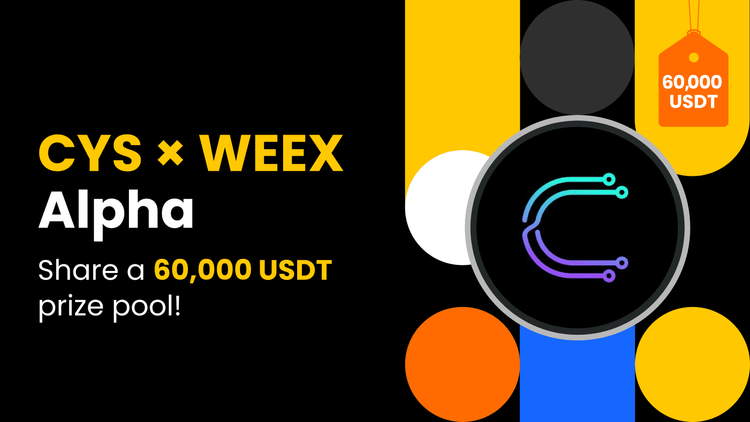
The CYS airdrop on WEEX Exchange is now live with a massive 60,000 USDT prize pool, giving new users a chance to earn 30–2,410 USDT in rewards through deposits, spot trading, futures trading, and referrals. During the event period, users can join multiple campaigns including the CYS new user bonus, the Futures King Tournament, the CYS spot trading challenge, and the daily spin lottery. With prizes distributed across spot traders, futures volume leaders, and active referrers, the WEEX CYS airdrop offers one of the most rewarding onboarding experiences of 2025. Start trading CYS on WEEX Exchange today and secure your share of the 60,000 USDT giveaway before the event ends.
CYS × WEEX Airdrop Event Overview (60,000 USDT Rewards)Event period:
2025/12/11 18:00 – 2025/12/18 18:00 (UTC+8)
Total rewards: 60,000 USDT
Eligibility: All new users registered during event period
Note: KYC is not required to join the airdrop.
New users who make a net deposit ≥ 100 USDT (on-chain, P2P, or OTC) and complete their first CYS spot trade can earn:
10–100 USDT+10 USDT Futures BonusTotal up to 110 USDT per userFirst-come, first-served from a 25,000 USDT pool???? No minimum volume is required for the first CYS spot trade.
Event 2: Futures King Tournament — Share 25,000 USDTTrade any futures pair and reach ≥500 USDT volume to enter the rankings.
Top traders will share 25,000 USDT in USDT + futures bonuses.
???? 1st place: 1,200 USDT + 300 USDT futures bonus + 1 CYSIC miner
???? 2nd place: 800 USDT + 200 USDT futures bonus + 1 CYSIC miner
???? 3rd place: 650 USDT + 150 USDT futures bonus + 1 CYSIC miner
???? Additional note:
One winner among ranks 4–10 will be randomly selected for an extra CYSIC miner.
Trade CYS spot and rank by trading volume to earn rewards.
Top 3 users receive both USDT rewards and CYSIC miners.
Ranks 4–500 also share the remaining USDT pool proportionally.
???? One additional CYSIC miner will be randomly awarded to a trader from rank 4–10.
Event 4: Daily Spin Lottery — Up to 7 SpinsTrade CYS ≥ 50 USDT daily to earn 1 spin per day (max 7).
Prizes include:
Event 4 rewards are separate from the main pool.
Event 5: Referral Rewards — Up to 1,000 USDT Per PersonInvite new users to join WEEX. Each invitee who completes Event 1 + Event 2 counts as a valid referral.
ReferralsReward per Invite1–510 USDT6–2015 USDT20+20 USDTReferral pool is independent of the main 60,000 USDT event pool.
???? Insert Image Here (Middle of Article)ALT text: CYS Airdrop on WEEX Exchange: 60,000 USDT Rewards
Caption: The CYS × WEEX airdrop offers new users up to 2,410 USDT in cumulative rewards.
With up to 2,410 USDT possible through combined tasks, this is one of the most generous onboarding campaigns in 2025.
2. Multiple ways to participateDeposit, spot trade, futures trade, daily spins, and referrals — users of all levels can earn rewards.
3. Exclusive CYSIC miner prizesRare hardware rewards are given to top traders and lucky winners.
4. Fast payouts & no KYC requiredMaking rewards accessible to global users.
Conclusion & CTA (Keyword ≥1 time)The CYS airdrop on WEEX Exchange delivers one of the most rewarding multi-event campaigns of the year, giving new traders a chance to earn substantial USDT bonuses through deposits, CYS trading, futures volume, and referrals. With a total of 60,000 USDT up for grabs, now is the best time to start your crypto journey with WEEX.
???? Sign up on WEEX Exchange today and claim your share of the CYS airdrop rewards!
???? Follow WEEX on X, Telegram, and YouTube for the latest event updates.

What Is Lucidum (LUCIC)?
Lucidum Coin (LUCIC), operating on Binance Smart Chain, introduces a transparent contract model designed to build investor trust through clear milestones and financial disclosures, trading at around $0.296 with a $48.5 million market cap.
The project emphasizes accountability with 4.5% transaction taxes funding liquidity dividends, marketing, and burns, while its roadmap ties development to BNB market cap achievements.
As a one-year-old token listed on CoinGecko, LUCIC combines meme appeal with structured growth plans amid recent 49% daily surges on PancakeSwap.
Key TakeawaysTransparent contract model discloses progress and finances, verified by independent third parties.Tokenomics include a fixed 210 million total supply, with taxes allocated to LP rewards, marketing, and deflationary burns.Roadmap development is tied to BNB market cap thresholds, targeting milestones from audits to exchange listings.Strong security profile with clean audits, no detected honeypot risks, and growing liquidity and holder base.What Is Lucidum (LUCIC)?Lucidum Coin positions itself as a project built around transparency and verifiable progress. Its core model centers on a publicly visible contract framework, ensuring that all financial flows and development milestones are disclosed in real time. This stands in contrast to many speculative token launches, where details remain opaque and inaccessible to average investors.
By linking tangible growth objectives to specific, measurable milestones, Lucidum aims to foster realistic expectations and build sustainable trust. The project has seen steady adoption, now supported by over 12,800 token holders—a testament to the appeal of its structured, community-verifiable approach within the highly competitive BNB Chain ecosystem.
Lucidum (LUCIC) TokenomicsLUCIC operates with a fixed total supply of 210 million tokens. A 4.5% transaction fee is applied to every buy and sell, distributed as follows:
1.5% to liquidity provider dividends, incentivizing long-term staking and pool stability.2% to marketing and ecosystem growth initiatives.1% to permanent token burns, creating consistent deflationary pressure over time.This tax structure is designed to align incentives across stakeholders, supporting liquidity while gradually reducing circulating supply. The contract has undergone multiple independent security audits and is publicly accessible, with no major vulnerabilities detected. The current fully diluted valuation stands at approximately $61.5 million.
Lucidum (LUCIC) RoadmapLucidum’s development is structured around progressive BNB market capitalization targets, ensuring that funding and visibility grow in tandem with genuine community interest and adoption. Key phases include:
100 BNB: Completion of third-party security audits.300 BNB: Integration with external wallets and exchange APIs.500 BNB: Expansion of marketing partnerships and mainstream visibility campaigns.5,000 BNB: Launch of dividend-earning NFTs for liquidity providers.10,000 BNB: Application for listing on tier-one centralized exchanges.This gated approach aims to create a self-sustaining growth loop, where each milestone is funded and validated by market-driven momentum rather than speculative hype.
Lucidum (LUCIC) Trading, Security, and CommunityThe primary trading pair for LUCIC is LUCIC/WBNB on PancakeSwap V2, supported by over $6.3 million in pooled liquidity. This ensures low slippage and stable trade execution for investors.
Security reviews from platforms such as Cyberscope, Honeypot.is, and QuillCheck have confirmed the contract’s safety, with no evidence of malicious code or honeypot mechanisms. Community interaction is centered on the project’s official website, Twitter, and Telegram channels, where updates are regularly shared alongside educational content.
Leveraging the speed and affordability of Binance Smart Chain, Lucidum aims to remain accessible to a broad base of retail users while pursuing structured growth through its transparent and milestone-driven model.
Further ReadingWhat Is APRO (AT) and How Does It Work?What Is Quant (QNT)?What Is Momentum (MMT)?Disclaimer: The opinions expressed in this article are for informational purposes only. This article does not constitute an endorsement of any of the products and services discussed or investment, financial, or trading advice. Qualified professionals should be consulted prior to making financial decisions.
FAQQ1: What is Lucidum Coin (LUCIC)?
A: Lucidum Coin (LUCIC) is a Binance Smart Chain-based cryptocurrency that operates under a transparent contractual framework. The project features a total supply of 210 million tokens and implements a 4.5% transaction fee, which supports liquidity provider dividends, marketing activities, and deflationary token burning to promote accountability and sustainable growth.
Q2: What are LUCIC tokenomics?
A: LUCIC applies a 4.5% tax on every transaction, distributed as follows: 1.5% is allocated to liquidity provider dividends, 2% is used for marketing, and 1% is permanently burned. The token is actively traded on PancakeSwap V2 with a liquidity pool of approximately $6.3 million and is currently held by over 12,800 wallet addresses.
Q3: How does LUCIC roadmap work?
A: The project’s roadmap is structured around achieving specific Binance Coin (BNB) market capitalization milestones. For instance, an external audit is completed upon reaching 100 BNB market cap, wallet integrations occur at 300 BNB, influencer partnerships are initiated at 500 BNB, and major exchange listings — including Binance — are targeted at 10,000 BNB market cap.
Q4: Is LUCIC safe to trade? A: LUCIC has received a GT Score of 80/100, reflecting strong on-chain metrics. Security scans from platforms such as De.Fi and GoPlus have detected no honeypot or rug-pull risks. The contract code is open-source, has passed a third-party audit, and currently has zero reported security incidents from the community.

What is 黄果之年 (YEAROFYELLOWFRUIT)? The New Trending Chinese Meme Coin
The USDT">黄果之年 (YEAROFYELLOWFRUIT), which loosely translates to "Year of the Yellow Fruit," draws its identity from culturally resonant themes often celebrated in Asian communities, particularly around harvests and symbolic abundance. Within the vibrant and often whimsical meme coin ecosystem, its name and branding serve as strong anchors for viral storytelling, allowing it to spread quickly across Chinese-speaking crypto circles.
This cultural-meme fusion taps into three key drivers behind viral token movements: a memorable visual and linguistic identity, a narrative that travels organically within community channels, and a high-engagement trading environment powered by social momentum. 黄果之年 successfully embodies these traits, positioning itself as a distinct contender in the crowded BNB Chain meme space.
Current Price of 黄果之年 (YEAROFYELLOWFRUIT)The initial price trajectory of 黄果之年 (YEAROFYELLOWFRUIT) followed a pattern familiar to many rapidly emerging meme tokens. After a brief post-launch dip, the price entered a prolonged consolidation phase, lasting roughly two days. This period of accumulation was followed by an explosive breakout, pushing the token to a peak near $0.00110. A sharp correction subsequently brought prices back into a more stable range between $0.00025 and $0.00030.
Key dynamics observed in this phase include:
A concentrated wave of early buying that fueled the initial surge.A steep but measured sell-off, reflecting profit-taking after rapid gains.Subsequent stabilization, indicating renewed interest rather than a loss of momentum.This price behavior mirrors the lifecycle of many successful meme tokens, where volatility paves the way for renewed accumulation and potential secondary rallies.
Can 黄果之年 (YEAROFYELLOWFRUIT) Sustain Growth?黄果之年 (YEAROFYELLOWFRUIT) currently maintains approximately $78,000 in liquidity, evenly distributed between the native token and WBNB. This provides sufficient market depth for moderate-sized trades without excessive slippage. The token’s fully diluted valuation (FDV) stands around $256,000, which places it in a micro-cap category with significant room for upward movement if momentum continues.
Given the historical performance of BNB Chain meme tokens, which frequently reach valuations in the tens of millions, a 10x to 100x increase in FDV is mathematically plausible under sustained speculative interest and growing community engagement.
How 黄果之年 (YEAROFYELLOWFRUIT) Surges?The on-chain activity surrounding 黄果之年 underscores its early traction:
Over 31,000 total transactions.Trading volume exceeding $4.9 million.More than 5,000 liquidity providers.Nearly balanced buy and sell volumes ($2.4M buys vs. $2.5M sells), suggesting organic market activity rather than manipulative trading.Such widespread participation across thousands of unique buyers and sellers indicates genuine community interest and decentralized ownership—a positive sign for tokens in this category.
What Is Driving the 黄果之年 (YEAROFYELLOWFRUIT)'s Hype?Several factors contribute to the rapid ascent of 黄果之年 (YEAROFYELLOWFRUIT):
Cultural Resonance: Its name and theme align with linguistic and symbolic humor popular in Asian digital communities.Platform Dynamics: The BNB Chain remains a preferred network for meme coin trading due to its low fees and high transaction throughput.Community Virality: Meme tokens thrive on social sharing, and 黄果之年 (YEAROFYELLOWFRUIT) has benefited from rapid dissemination across platforms like Telegram and Twitter.Chart Visibility: Strong early volume propelled it onto trending lists, attracting further speculative attention.Can 黄果之年 (YEAROFYELLOWFRUIT) Reach 100x?To achieve exponential growth, several conditions should be met:
Sustained Trading Volume: Daily volume consistently above $1 million would help maintain price momentum and visibility.Community Cohesion: An active, creative, and engaged social community is essential for narrative longevity.Increased Liquidity: Growth beyond $100,000–$200,000 in liquidity would enhance stability and attract larger participants.Broader Exposure: Listings on additional DEX aggregators and tracking platforms could introduce the token to wider audiences.Should I Buy 黄果之年 (YEAROFYELLOWFRUIT) Now?As with all speculative meme assets, 黄果之年 (YEAROFYELLOWFRUIT) carries high risk. Its price has already undergone significant volatility, and future performance will heavily depend on social momentum and market sentiment.
Entering during a consolidation phase—such as the current $0.00025–$0.00030 range—may offer a more measured opportunity than chasing all-time highs. However, investors should only allocate capital they are prepared to lose, and recognize that the token currently operates on narrative appeal rather than technical utility or a defined roadmap.
Conclusion黄果之年 (YEAROFYELLOWFRUIT) has rapidly emerged as one of the most actively traded and culturally distinctive meme tokens on the BNB Chain. With strong volume, broad holder distribution, and compelling cultural branding, it possesses the key ingredients for short-term viral success.
Whether it evolves into a sustained movement will depend on its ability to maintain community energy, grow liquidity, and capture ongoing attention in a fast-moving market. While the potential for significant returns exists due to its low valuation, participants should approach with disciplined risk management and a clear understanding of meme coin dynamics.
Ready to join the trend? Sign up now and start trading 黄果之年 (YEAROFYELLOWFRUIT) on WEEX today!
Further ReadingWhat is the D ($D) and It's Safe to Invest in D ($D)?What Is Quant (QNT)?What Is Momentum (MMT)?Disclaimer: The opinions expressed in this article are for informational purposes only. This article does not constitute an endorsement of any of the products and services discussed or investment, financial, or trading advice. Qualified professionals should be consulted prior to making financial decisions.

ASTER Airdrop on WEEX Exchange: Claim Your Share of 50,000 USDT in the New User Welcome Reward
The ASTER Airdrop on WEEX Exchange is offering a 50,000 USDT new user welcome reward from December 9 to December 16, 2025. Newcomers can unlock rewards through a simple three-step journey: complete a 100 USDT net deposit, trade eligible ASTER tokens, and achieve futures trading volume tiers. Additional rewards such as proportional futures prizes and referral bonuses make this ASTER Airdrop one of the most valuable newcomer events on WEEX. With limited quotas and first-come, first-served distribution, users joining the WEEX Exchange now can maximize their rewards before the ASTER Airdrop ends.
What Is the ASTER Airdrop on WEEX Exchange?The ASTER Airdrop is a limited-time 50,000 USDT new user welcome reward designed to support first-time users joining the WEEX Exchange. Running from December 9, 2025, 15:00 (UTC+8) to December 16, 2025, 15:00 (UTC+8), the event highlights WEEX’s commitment to creating a secure, rewarding environment for new traders.
ASTER is a next-generation decentralized exchange offering both perpetual and spot trading with MEV-free execution in Simple Mode and advanced tools—such as stock perpetuals, Hidden Orders, and grid trading—in Pro Mode. Its ecosystem spans BNB Chain, Ethereum, Solana, and Arbitrum, making it a strong candidate for future growth.
Event 1: First Deposit & First Spot Trade – Earn 10 USDTReward: 10 USDT(限前 1,000 名)
To begin the ASTER Airdrop journey, new users must:
Once completed, users instantly qualify for the 10 USDT new user reward.
This task acts as the foundation for all subsequent ASTER Airdrop rewards on the WEEX Exchange.
???? Quota is limited to the first 1,000 participants—so speed matters.
Event 2: Futures Trading Tasks – Earn Up to 30 USDTAchieving valid futures trading volume unlocks tiered base rewards plus USDT bonus rewards:
Futures VolumeBase RewardBonus RewardTotal≥ 500 USDT5 USDT+5 USDT bonus10 USDT≥ 5,000 USDT10 USDT+5 USDT bonus15 USDT≥ 10,000 USDT20 USDT+10 USDT bonus30 USDTRewards are limited to the first 1,000 participants.
Only USDT-M futures pairs qualify; Coin-M pairs and 0% maker fee trades are excluded.
Event 2 must be completed after Event 1 to unlock eligibility.
Event 3: Share the 20,000 USDT Futures Prize PoolFor users aiming higher, achieving ≥ 20,000 USDT futures trading volume grants access to the 20,000 USDT proportional prize pool.
Your reward =
(Your futures volume ÷ Total eligible volume) × 20,000 USDT
This mechanism encourages active participation and rewards users based on actual contribution—mirroring real trading strategies on the WEEX Exchange.
Event 4: Earn Up to 1,000 USDT With ReferralsBoth new and existing users can participate in the ASTER Airdrop referral task.
You will receive 10 USDT for every valid referral, where a valid referral =
✔ The invitee completes Event 1
✔ The invitee completes Event 2
Rewards scale up to 1,000 USDT per user.
This makes referrals one of the strongest earning opportunities during the new user welcome reward campaign.
Reward Eligibility & Key RulesTo maximize rewards in the ASTER Airdrop on WEEX Exchange, keep these rules in mind:
Must register during the event and complete KYCEvent 1 → Event 2 must be completed in orderSpot volume = buys + sellsFutures volume = opening + closingOnly USDT-M futures pairs countMarket makers and institutional accounts are excludedRewards are distributed within 7 working days after event endsWEEX will disqualify users who engage in bulk registrations, fraud, or manipulationAll participants accept the final interpretation rights held by WEEX ExchangeWhy the ASTER Airdrop Is a Top Opportunity for New UsersThe 50,000 USDT ASTER Airdrop blends newcomer-friendly tasks with high-value rewards, allowing traders to grow their portfolio while learning the WEEX ecosystem. With tiered perks, proportional prize pools, and referral bonuses, the event gives every new user a meaningful chance to earn.
As the event ends on December 16, 2025, the countdown is ticking.
Now is the ideal time to join WEEX, complete your tasks, and claim your share of this new user welcome reward.
Don’t miss the final days of the ASTER Airdrop—register on the WEEX Exchange, complete the tasks, and unlock your share of the 50,000 USDT reward pool.
Start your journey now and maximize your earnings before the event ends.

What is the D ($D) and It's Safe to Invest in D ($D)?
The rapid expansion of decentralized finance (DeFi) has fueled the emergence of countless new cryptocurrency initiatives, each striving to define its unique position in the market.
Within this dynamic landscape, community-led and meme-inspired tokens frequently capture the spotlight. One such digital asset drawing growing interest is the D ($D) Token.
For those active within the BNB Smart Chain ecosystem, gaining clarity on its core identity, technical framework, and market behavior is fundamental to informed participation.
What is the D ($D) ?So, what exactly is the $D token? In essence, D ($D) is a decentralized digital asset built on the Binance Smart Chain (BSC), explicitly designed as a community-centric token that resonates with crypto-native culture and communication styles.
The project's identity leans heavily into themes of persistence and optimistic market sentiment, often expressed through familiar colloquialisms like "Diamond hands" and "Doge vibes." This positioning signals a deliberate appeal to the engaged, often speculative, segment of the crypto community.
This approach indicates a project whose growth may depend more on viral engagement and collective momentum than on conventional, utility-driven models.
To fully understand the asset, one must examine its technical groundwork. The D ($D) token operates within the efficient, low-cost framework of the BNB Chain, benefiting from its proven infrastructure and wide adoption.
The core of the $D token lies in its transparent structure and community-led narrative. Rather than offering multifaceted utility, its immediate value is closely tied to perceived scarcity, market demand, and its standing within the broader meme token category.
This straightforward design allows the community's story to become the primary engine for adoption and trading activity.
D ($D) Tokenomics and DistributionAn examination of the D ($D) tokenomics reveals a deliberate choice for a fixed maximum supply—a model commonly adopted by assets seeking to emphasize long-term scarcity.
Understanding $D's token distribution starts with its key supply metrics:
Max. Supply: 69,000,000,000 DTotal Supply: 69,000,000,000 DSelf-Reported Circulating Supply: 69,000,000,000 DThe alignment of maximum, total, and circulating supply—with the circulating supply reported as 100% of the total—offers significant insight. This model indicates that all tokens were accessible from the launch, removing potential future sell pressure from planned token releases.
Such a distribution framework is particularly relevant for community-focused tokens, as it establishes transparent and predictable conditions by making all tokens available for public trading from inception.
It should be noted that, as of current reporting, these figures—including the associated market capitalization (approximately $1.36 million based on recent data)—are classified as self-reported by the project. Investors are encouraged to exercise due diligence when evaluating data that has not been independently verified by third-party platforms.
It's Safe to Invest in D ($D)?The D ($D) Token, like many cryptocurrencies—and particularly those within the meme token category—is a highly volatile and speculative asset. Its price action is often driven by community sentiment, social media trends, and shifting market narratives, rather than by measurable utility or fundamental value. As a result, it carries significant investment risk and is not generally regarded as a "safe" or stable holding.
Investors should approach $D with caution and clear risk awareness. The token’s fully distributed supply and community-led nature can lead to sharp price swings. It is essential to perform thorough due diligence, understand your personal risk tolerance, and never allocate funds you cannot afford to lose. In volatile crypto markets, self-education and careful analysis remain your most reliable safeguards.
ConclusionIn summary, the D ($D) Token represents a distinctive participant within the meme coin sector, utilizing the speed and affordability of the BNB Chain. Characterized by strong community messaging and a fully distributed supply model, it presents a value proposition driven largely by sentiment and engagement.
As is prudent with any high-volatility digital asset, prospective participants should perform comprehensive independent research and carefully evaluate their risk tolerance before engaging with the market.
Further ReadingWhat Is APRO (AT) and How Does It Work?What Is Quant (QNT)?What Is Momentum (MMT)?Disclaimer: The opinions expressed in this article are for informational purposes only. This article does not constitute an endorsement of any of the products and services discussed or investment, financial, or trading advice. Qualified professionals should be consulted prior to making financial decisions.
FAQQ1: What is the D ($D) Token used for?
A: The D ($D) Token functions primarily as a community-centric digital asset, commonly recognized within the meme coin segment on the BNB Smart Chain. Its core use case revolves around fostering social engagement, speculative trading, and participation in community-driven initiatives, rather than being anchored in structured utility or protocol governance.
Q2: What is the total supply of the D ($D) Token?
A: The D ($D) Token maintains a fixed maximum supply of 69 billion units, equating to 69,000,000,000 D tokens. According to the project’s own disclosure, the entire supply is currently in circulation, indicating a fully distributed model with no scheduled token releases or inflationary mechanisms in the future.
Q3: Which blockchain does the D ($D) Token operate on?
A: The D ($D) Token is deployed and operates exclusively on the BNB Smart Chain (BSC), leveraging the network's high throughput and low transaction costs to support efficient trading and community interactions.
What is WEEX OTC and How to Buy BTC with EUR on WEEX OTC?
WEEX has officially launched our WEEX OTC Quick Buy feature to help make fiat deposits more convenient and accessible. Enjoy more payment options with a secure, seamless.
WEEX OTC platform now supports 200+ trading pairs and multiple mainstream payment methods.
You can use Fiat to purchase cryptocurrencies anytime, anywhere on the WEEX OTC platform, and enjoy Quick Buy in just three steps.
How to Buy BTC with EUR on WEEXWeb Version:Step 1: On the WEEX OTC platform, after selecting [EUR] fiat currency and [BTC] crypto, you can input the EUR payment amount, then this will estimate the amount of BTC you will receive.
Step 2: Choose the the payment method which you want to use, then click the [Confirm].
Step 3: After choosing the payment method, click the [Buy BTC] and place the buy BTC with EUR order.
Step 4: After confirming the order, we will redirect to the payment channel to complete the transaction.You will receive the BTC in 5 min after your order payment is completed.
APP Version:Step 1: On the WEEX APP,click the [Deposit] and select the [Buy crypto], you will enter the OTC platform.
Step 2: Selecting [EUR] fiat currency and [BTC] crypto, you can input the EUR payment amount, then this will estimate the amount of BTC you will receive.
Step 3: Choose the the payment method which you want to use, then click the [Confirm].
Step 4: After choosing the payment method, click the [Buy BTC] and place the buy BTC with EUR order.
Step 5: After confirming the order, we will redirect to the payment channel to complete the transaction. You will receive the BTC in 5 min after your order payment is completed.
Follow WEEX on social media:
Instagram: @WEEX_ExchangeX: @WEEX_OfficialTiktok: @weex_globalYoutube: @WEEX_GlobalTelegram: WeexGlobal GroupWhat is WEEX OTC and How to Buy ETH with AUD on WEEX OTC?
WEEX has officially launched our WEEX OTC Quick Buy feature to help make fiat deposits more convenient and accessible. Enjoy more payment options with a secure, seamless.
WEEX OTC platform now supports 200+ trading pairs and multiple mainstream payment methods.
You can use Fiat to purchase cryptocurrencies anytime, anywhere on the WEEX OTC platform, and enjoy Quick Buy in just three steps.
How to Buy ETH with AUD on WEEX OTC?Web Version:Step 1: On the WEEX OTC platform, you can select the fiat currency [AUD] and crypto [ETH] , you can input the [AUD] payment amount, then this will estimate the amount of ETH you will receive.
Step 2: Choose the the payment method which you want to use, then click the [Confirm].
Step 3: After choosing the payment method, click the [Buy ETH] and place the buy ETH with AUD order.
Step 4: After confirming the order, we will redirect to the payment channel to complete the transaction.You will receive the ETH in 5 min after your order payment is completed.
APP Version:Step 1: On the WEEX APP,click the [Deposit] and select the [Buy crypto], you will enter the OTC platform.
Step 2: Selecting fiat [AUD] and crypto [ETH], you can input the [AUD] payment amount, then this will estimate the amount of ETH you will receive.
Step 3: Choose the the payment method which you want to use, then click the [Confirm].
Step 4: After choosing the payment method, click the [Buy ETH] and place the buy ETH with AUD order.
Step 5: After confirming the order, we will redirect to the payment channel to complete the transaction. You will receive the ETH in 5 min after your order payment is completed.
Follow WEEX on social media:
Instagram: @WEEX_ExchangeX: @WEEX_OfficialTiktok: @weex_globalYoutube: @WEEX_GlobalTelegram: WeexGlobal Group
BOB Airdrop 50,000 USDT – New User Welcome Reward | Deposit, Trade & Earn
Event Period:
2025/12/04 18:00:00 – 2025/12/11 18:00:00 (UTC+8)
BOB is creating a next-generation Bitcoin DeFi Gateway, combining Bitcoin’s security with Ethereum’s flexibility. As a leading hub for Bitcoin liquidity and decentralized applications, BOB allows users and institutions to unlock real utility within the Bitcoin ecosystem.
To celebrate, WEEX is launching a 50,000 USDT BOB Airdrop exclusively for new users. Complete simple tasks to earn spot and futures rewards, plus access a shared prize pool.
Event 1: First Deposit & Spot Trade (Get 10 USDT)Make a net deposit ≥ 100 USDTHold the deposit until the event endsComplete your first spot trade in eligible tokensReward: 10 USDTLimited to 1,000 participants (first-come, first-served)This task is designed to help new users start trading on WEEX while earning stable rewards.
Event 2: Futures Trading Volume Task (Earn up to 20 USDT + Bonus)Reach the designated futures trading volume in any contract to claim:
Base RewardRequired Trading Volume5 USDT500 USDT10 USDT5,000 USDT20 USDT10,000 USDTAdditionally, users completing Event 1 can claim an extra 5 – 10 USDT futures bonus.
Rewards are limited to 1,000 participants.
This pool encourages deeper engagement for users exploring futures trading on WEEX.
Reward EligibilityTo claim all rewards:
Complete Event 1 → Event 2 in sequenceUsers who do not follow the order will not be eligible for reward distribution.Why Join the BOB Airdrop?50,000 USDT total rewardsEasy onboarding tasksExtra futures bonusesShared prize pool for active tradersLimited-quota, high-value new user eventThis is one of the highest-value BOB ecosystem onboarding events, ideal for users starting their Bitcoin DeFi journey on WEEX.
Step-by-Step: Buy Bitcoin(BTC) via RUB on WEEX P2P
Want to buy Bitcoin (BTC) via RUB quickly and securely? Many traders struggle with slow transactions, high fees, and untrustworthy sellers. WEEX P2P solves these problems by offering a fast, secure, and user-friendly platform where you can complete your crypto purchase in just a few clicks. Whether you’re a beginner or an experienced trader, WEEX P2P makes buying bitcoin easy and worry-free, keeping you updated with the latest market trends and giving you full control over your trades.
What is WEEX P2P?WEEX P2P is a peer‑to‑peer trading platform that connects buyers and sellers directly — letting you pay RUB and receive Bitcoin (or other supported cryptocurrencies) without complicated steps. This model gives you greater flexibility and control over your trades, compared to traditional centralized exchanges. On WEEX, you only trade with other verified users and use escrow protection to ensure fairness. The platform supports a variety of local payment methods and other fiat currencies.
Why WEEX P2P is the Best Choice in 2025?WEEX P2P provides several advantages that make it the top platform to buy USDC. Buyers enjoy zero transaction fees, while professional merchants ensure fast confirmations and smooth trade execution at all hours. WEEX’s official escrow service protects every transaction end-to-end, removing all counterparty risk.
0% fee for buyers (save 2-8% vs competitors)Average trade completion: under 3 minutesOfficial escrow protection – 100% safeSupports from 500 [Currency] up to millionsMore [Payment Method] ads than any other platformStep-by-Step: Buy Bitcoin (BTC) via RUB in MinutesGrabbing Bitcoin (BTC) on WEEX feels like a seamless UPI top-up—no jargon, no waits. Here's your quick path, straight from the app:
Sign Up & Verify: Download WEEX (iOS/Android/web), enter your phone/email, set a password—done in 20 seconds. Snap your Aadhaar/PAN for KYC (under 60 seconds approval, unlocking full limits).Select an offer: Go to the “Buy” tab on the P2P page. Choose Bitcoin (BTC) as the crypto you want, and RUB as your payment currency. From the list of sellers, select one whose terms (price, payment method, limits, completion rate) suit your needs.Input the amount: Input how much RUB you want to spend, confirm the seller, and complete payment using the chosen method.Receive Bitcoin (BTC): Once the seller confirms receipt of payment, the escrowed Bitcoin (BTC) will be released to your Funding Account.Also, you can check out this video to know more about WEEX P2P.
Notice: Always Stay SecureWhile WEEX P2P offers convenience, it’s important to remain cautious and follow best practices:
Complete KYC verification and link payment methods that match your verified identity — this helps reduce risk.Double‑check seller’s reputation, limits, and payment instructions before confirming a trade.Understand that payment‑provider fees may still apply — while WEEX charges no P2P fees, third‑party payment services might.Note: Simpler, smaller trades are safer, especially when you’re just starting out.
Final ThoughtsIf you're in Russia and want a reliable method to buy Bitcoin (BTC) via RUB—whether for trading, investing, or entering decentralized finance—WEEX P2P stands out as a clear choice. With local payment support, secure transaction escrow, no platform charges, and a smooth user experience, it offers a trustworthy entry point into the crypto ecosystem.
Within minutes, you can seamlessly transition from RUB in your bank account to Bitcoin (BTC) in your crypto wallet. This opens direct access to global crypto opportunities—streamlined, secure, and designed for ease of use.
FAQQ1: What is P2P Trading on WEEX?
A: WEEX P2P is a safe, easy-to-use peer-to-peer trading platform that allows users to buy and sell cryptocurrencies directly with each other at mutually agreed prices. Please note that WEEX does not provide buy or sell quotes on the P2P page.
Q2: Is KYC Verification Required for P2P trading?
A: Yes, you must complete identity verification (KYC) to use P2P trading.
Q3: What's the Minimum Amount for Each P2P Order?
A: The minimum and maximum order amounts depend on the limits set by each advertiser for their offer.
Q4: Are there Transaction Fees on P2P trading?
A: WEEX charges no transaction fees for P2P trading. However, please note that traders may need to pay transaction fees to payment providers based on their selected payment method.
Follow WEEX on social media:Instagram: @WEEX_ExchangeX: @WEEX_OfficialTiktok: @weex_globalYoutube: @WEEX_GlobalTelegram: WeexGlobal GroupWEEX P2P Guide: Buy Ethereum(ETH) via WEEX P2P
Want to buy Ethereum(ETH) quickly and securely? Many traders struggle with slow transactions, high fees, and untrustworthy sellers. WEEX P2P solves these problems by offering a fast, secure, and user-friendly platform where you can complete your crypto purchase in just a few clicks. Whether you’re a beginner or an experienced trader, WEEX P2P makes buying bitcoin easy and worry-free.
What is WEEX P2P?WEEX P2P is a peer‑to‑peer trading platform that connects buyers and sellers directly — letting you pay USDT and receive Bitcoin (or other supported cryptocurrencies) without complicated steps. This model gives you greater flexibility and control over your trades, compared to traditional centralized exchanges. On WEEX, you only trade with other verified users and use escrow protection to ensure fairness. The platform supports a variety of local payment methods and other fiat currencies.
Why WEEX P2P is the Best Choice in 2025?WEEX P2P provides several advantages that make it the top platform to buy USDC. Buyers enjoy zero transaction fees, while professional merchants ensure fast confirmations and smooth trade execution at all hours. WEEX’s official escrow service protects every transaction end-to-end, removing all counterparty risk.
0% fee for buyers (save 2-8% vs competitors)Average trade completion: under 3 minutesOfficial escrow protection – 100% safeSupports from 500 [Currency] up to millionsMore [Payment Method] ads than any other platformStep-by-Step: Ethereum(ETH) via WEEX P2P in MinutesGrabbing Ethereum(ETH) on WEEX feels like a seamless UPI top-up—no jargon, no waits. Here's your quick path, straight from the app:
Sign Up & Verify: Download WEEX (iOS/Android/web), enter your phone/email, set a password—done in 20 seconds. Snap your Aadhaar/PAN for KYC (under 60 seconds approval, unlocking full limits).Select an offer: Select an offer with your preferred price and payment method. After you enter the amount you want to buy and place your order, WEEX P2P will hold the crypto in escrowPay the seller: Send money to the seller via the suggested payment methods. Complete the fiat transaction and use the "Transfer Complete" button to notify the seller on WEEX P2P. WEEX will not charge any fees.Receive Ethereum(ETH): Once the seller confirms receipt of payment, the escrowed Ethereum(ETH) will be released to your Funding Account.Also, you can check out this video to know more about WEEX P2P.
Notice when Using WEEX P2PWhen you use WEEX P2P to buy crypto with fiat currency, keep the following important tips and precautions in mind to ensure a safe and smooth transaction:
Always complete identity verification (KYC) before trading on P2P. Only verified accounts can access full P2P features and benefit from higher transaction limits.Choose sellers with high completion rate and good trading history. Check seller’s rating, past trades and feedback to reduce the risk of failed orders or disputes.Confirm all payment details with the seller before transferring funds — including exact amount, payment method, and any required reference or note. Mistakes or delays in payment information may cause trade failure.After you make the fiat payment, keep your payment receipt or proof. This is essential if the seller needs verification, or in case of disputes.Do not mark the order as “paid” until you have actually completed the transfer. Marking as “paid” prematurely may result in loss if payment fails.Wait for the seller to confirm receipt of funds before expecting release of crypto. Crypto is only released to your account after seller confirmation — do not rely on payment alone.Double-check that the correct cryptocurrency and amount appear in your wallet after release. If anything looks wrong, contact support immediately.For large orders or first-time trading, consider starting with a small test order to check process reliability before committing larger amounts.Following these tips will help you minimize risk and make your P2P purchase with UAH more secure and predictable.
FAQQ1: What is P2P Trading on WEEX?
A: WEEX P2P is a safe, easy-to-use peer-to-peer trading platform that allows users to buy and sell cryptocurrencies directly with each other at mutually agreed prices. Please note that WEEX does not provide buy or sell quotes on the P2P page.
Q2: Is KYC Verification Required for P2P trading?
A: Yes, you must complete identity verification (KYC) to use P2P trading.
Q3: What's the Minimum Amount for Each P2P Order?
A: The minimum and maximum order amounts depend on the limits set by each advertiser for their offer.
Q4: Are there Transaction Fees on P2P trading?
A: WEEX charges no transaction fees for P2P trading. However, please note that traders may need to pay transaction fees to payment providers based on their selected payment method.
Follow WEEX on social media:Instagram: @WEEX_ExchangeX: @WEEX_OfficialTiktok: @weex_globalYoutube: @WEEX_GlobalTelegram: WeexGlobal GroupWEEX P2P Guide: Buy Crypto via RUB
Want to buy crypto via RUB quickly and securely? Many traders struggle with slow transactions, high fees, and untrustworthy sellers. WEEX P2P solves these problems by offering a fast, secure, and user-friendly platform where you can complete your crypto purchase in just a few clicks. Whether you’re a beginner or an experienced trader, WEEX P2P makes buying bitcoin easy and worry-free, keeping you updated with the latest market trends and giving you full control over your trades.
What is WEEX P2P?WEEX P2P is a peer‑to‑peer trading platform that connects buyers and sellers directly — letting you pay USDT and receive Bitcoin (or other supported cryptocurrencies) without complicated steps. This model gives you greater flexibility and control over your trades, compared to traditional centralized exchanges. On WEEX, you only trade with other verified users and use escrow protection to ensure fairness. The platform supports a variety of local payment methods and other fiat currencies.
Why WEEX P2P is the Best Choice in 2025?WEEX P2P provides several advantages that make it the top platform to buy USDC. Buyers enjoy zero transaction fees, while professional merchants ensure fast confirmations and smooth trade execution at all hours. WEEX’s official escrow service protects every transaction end-to-end, removing all counterparty risk.
0% fee for buyers (save 2-8% vs competitors)Average trade completion: under 3 minutesOfficial escrow protection – 100% safeSupports from 500 [Currency] up to millionsMore [Payment Method] ads than any other platformStep-by-Step: Buy Crypto via RUB in MinutesGrabbing crypto on WEEX feels like a seamless UPI top-up—no jargon, no waits. Here's your quick path, straight from the app:
Sign Up & Verify: Download WEEX (iOS/Android/web), enter your phone/email, set a password—done in 20 seconds. Snap your Aadhaar/PAN for KYC (under 60 seconds approval, unlocking full limits).Select an offer: Go to the “Buy” tab on the P2P page. Choose USDT as the crypto you want, and RUB as your payment currency. From the list of sellers, select one whose terms (price, payment method, limits, completion rate) suit your needs.Input the amount: Input how much RUB you want to spend, confirm the seller, and complete payment using the chosen method.Receive crypto: Once the seller confirms receipt of payment, the escrowed cryptos will be released to your Funding Account.Also, you can check out this video to know more about WEEX P2P.
Notice: Always Stay SecureWhile WEEX P2P offers convenience, it’s important to remain cautious and follow best practices:
Complete KYC verification and link payment methods that match your verified identity — this helps reduce risk.Double‑check seller’s reputation, limits, and payment instructions before confirming a trade.Understand that payment‑provider fees may still apply — while WEEX charges no P2P fees, third‑party payment services might.Note: Simpler, smaller trades are safer, especially when you’re just starting out.
Final ThoughtsIf you're in Russia and want a reliable method to buy crypto via RUB—whether for trading, investing, or entering decentralized finance—WEEX P2P stands out as a clear choice. With local payment support, secure transaction escrow, no platform charges, and a smooth user experience, it offers a trustworthy entry point into the crypto ecosystem.
Within minutes, you can seamlessly transition from RUB in your bank account to crypto in your crypto wallet. This opens direct access to global crypto opportunities—streamlined, secure, and designed for ease of use.
FAQQ1: What is P2P Trading on WEEX?
A: WEEX P2P is a safe, easy-to-use peer-to-peer trading platform that allows users to buy and sell cryptocurrencies directly with each other at mutually agreed prices. Please note that WEEX does not provide buy or sell quotes on the P2P page.
Q2: Is KYC Verification Required for P2P trading?
A: Yes, you must complete identity verification (KYC) to use P2P trading.
Q3: What's the Minimum Amount for Each P2P Order?
A: The minimum and maximum order amounts depend on the limits set by each advertiser for their offer.
Q4: Are there Transaction Fees on P2P trading?
A: WEEX charges no transaction fees for P2P trading. However, please note that traders may need to pay transaction fees to payment providers based on their selected payment method.
Follow WEEX on social media:Instagram: @WEEX_ExchangeX: @WEEX_OfficialTiktok: @weex_globalYoutube: @WEEX_GlobalTelegram: WeexGlobal GroupWhich Crypto Will Go 1000x in 2026?
Examining historical 1000x gainers reveals patterns centered on timing, narrative, and network effects rather than predictable fundamentals. Such extraordinary returns typically emerge from assets that started with low valuations, aligned with powerful cultural or technological shifts, and captured momentum at the right phase of a broader market cycle.
Bitcoin (BTC): Initially valued at pennies, Bitcoin introduced decentralized digital scarcity and established a new asset class. Its growth beyond 1000x was fueled by growing institutional trust, global adoption, and its evolution into a macroeconomic reserve asset over multiple cycles.Ethereum (ETH): Launched as a smart contract platform, Ethereum unlocked decentralized applications, DeFi, and NFTs. Early participants realized exponential gains as its ecosystem became the foundation for Web3 innovation.Dogecoin (DOGE): Originally created as a humorous experiment, Dogecoin leveraged community-driven virality and celebrity endorsement to achieve parabolic returns, demonstrating the power of meme culture in financial markets.Shiba Inu (SHIB): Starting with a micro-cap valuation, SHIB capitalized on meme coin mania and retail frenzy, delivering gains measured in tens of thousands of percent through exchange listings and expanding ecosystem narratives.Pepe (PEPE): A 2023 entrant with no functional utility, PEPE illustrated how internet-native memes can rapidly translate into speculative financial assets, briefly generating multi-billion-dollar valuations purely through social momentum.These cases underscore that 1000x outcomes are less about guarantees and more about early exposure, compelling storytelling, and favorable market psychology.
Top Cryptos With 1000x Potential in 2026Identifying tokens with 1000x potential requires a focus on the high-risk, high-reward segment of the market. The following assets represent speculative narratives that could attract extreme capital flows during aggressive bull phases. All projections are illustrative and assume optimal market conditions.
Bitcoin Hyper (HYPER): Positions as a Bitcoin Layer-2 solution aiming to extend functionality beyond store of value. Benefits from strong Bitcoin-centric narratives during BTC-led market cycles.Dogecoin (DOGE): As one of the most recognized cryptocurrencies globally, DOGE retains potential for resurgence driven by community loyalty, social media trends, and celebrity influence.Pepe (PEPE): A pure meme asset relying entirely on cultural virality and speculative momentum, historically capable of rapid multi-billion dollar valuation spikes.Shiba Inu (SHIB): Evolved from a meme token into an ecosystem with its own Layer-2 network, combining community scale with ongoing development to sustain speculative interest.These tokens are characterized by high volatility, narrative dependency, and sensitivity to broader market sentiment. Position sizing and exit planning are critical when engaging with such assets.
High-Growth Cryptos That Could Still Deliver Significant ReturnsNot all opportunities require extreme risk. Many investors achieve substantial returns through established projects with clearer fundamentals, growing adoption, and ecosystem maturity. While unlikely to deliver 1000x from current valuations, these assets can still produce strong performance in favorable market conditions.
Maverick Protocol (MAV): A decentralized exchange emphasizing capital efficiency for liquidity providers. Positioned to benefit from renewed DeFi activity and trading volume expansion in bull markets.Sui (SUI): A high-throughput Layer-1 blockchain focused on consumer applications like gaming and payments. Gains traction through developer adoption and scalability narratives.Aptos (APT): A scalable Layer-1 with institutional backing, increasingly associated with real-world asset tokenization and enterprise use cases.These projects represent a more balanced risk-return profile, appealing to investors seeking exposure to crypto growth with relatively stronger fundamental grounding.
Can These Cryptos Make You a Millionaire?The possibility exists, but it is contingent on specific and often unforgiving conditions. True millionaire-making outcomes typically require:
Exceptionally early entry before broad recognitionFavorable macro and market cycle timingDisciplined position management and profit-takingMost successful crypto wealth stories involve a portfolio approach, where one or two high-conviction winners offset other positions. Equally important is the discipline to secure gains—many paper millionaires fail to realize profits by holding through volatile downturns.
While the assets discussed could theoretically generate life-changing returns, achieving such results depends far more on strategy, risk management, and emotional control than on merely selecting the "right" token.
Conclusion: Which Crypto Will Give 1000x in 2026?There is no definitive answer, as 1000x returns are inherently unpredictable and historically rare. They tend to emerge from narratives that resonate deeply during specific market phases, often beginning as overlooked or dismissed ideas.
Investors should balance ambition with pragmatism: high-risk meme and narrative-driven tokens offer theoretical upside but come with extreme volatility and failure rates. More established projects provide growth potential with comparatively lower risk.
Ultimately, the search for exponential returns is less about prediction and more about preparation—staying informed, managing exposure, maintaining discipline, and recognizing that in crypto, timing and psychology often outweigh fundamentals in the short to medium term.
Further ReadingWhat Is Dogecoin and How Does It Work?What Is Ethereum and How Does It Work?What Is Shiba Inu and How Does It Work?Disclaimer: The opinions expressed in this article are for informational purposes only. This article does not constitute an endorsement of any of the products and services discussed or investment, financial, or trading advice. Qualified professionals should be consulted prior to making financial decisions.
What Is Audiera (BEAT)? Audiera (BEAT) Price Prediction 2025–2030
Audiera (BEAT) is a blockchain-native entertainment token powering the Audiera ecosystem—an interactive platform based on the iconic “Audition” dance game IP. Developed on BNB Chain, this token connects users with a music-centric metaverse where digital creativity meets Web3 infrastructure. Users can produce songs, interact with AI idols, and participate in dance gaming via a smart fitness mat, all while earning and trading in BEAT tokens.
The core product includes a mobile dance game, creator tools via the Creative Studio, NFT minting systems, and mini-dApps that bridge AI and physical gaming. BEAT isn’t just a gaming token—it’s a gateway into the future of interactive music-based entertainment, rewarding creators and players alike in a decentralized digital economy.
How Audiera (BEAT) Works?Audiera combines rhythm-based gameplay, artificial intelligence integration, and blockchain infrastructure to deliver a multi-layered interactive experience. At its core, the platform functions as a modern dance and rhythm game where players synchronize inputs with music tracks, competing in solo challenges, social rooms, and live events. Performance is measured by timing, accuracy, and consistency, with scoring tied directly to player skill.
Beyond traditional gameplay, Audiera incorporates several innovative layers:
AI-Powered Content Creation: Users can generate original music and choreography using integrated AI tools, enabling player-created content to be incorporated into gameplay or shared across the community.Virtual AI Companions: AI-driven characters serve as interactive guides, content generators, and social facilitators within the ecosystem.Multi-Platform Accessibility: The experience spans a full mobile game, lightweight social applications, and physical-compatible interfaces such as smart dance mats.Blockchain-Enabled Economy: While blockchain technology operates largely in the background, it enables verifiable ownership of in-game assets, transparent reward distribution, and attribution for user-generated content.This architecture allows Audiera to function not merely as a game but as a participatory ecosystem where gameplay, creativity, and community interaction continuously reinforce one another.
Audiera (BEAT) TokenomicsBEAT serves as the primary utility and incentive token within the Audiera ecosystem, facilitating gameplay rewards, content monetization, governance participation, and platform transactions. Deployed on BNB Smart Chain, BEAT benefits from fast finality and low fees, making it suitable for frequent microtransactions typical in gaming environments.
The token operates under a fixed maximum supply of 1 billion BEAT, with a significant portion allocated to long-term community incentives, ecosystem development, and content creator funds. Team and early contributor allocations are subject to extended vesting schedules to align long-term interests and mitigate sell pressure.
To support sustainable token economics, Audiera incorporates deflationary mechanisms such as periodic token buybacks and burns, funded through platform revenue streams including marketplace fees and premium subscriptions. This model aims to balance reward emissions with controlled supply reduction, fostering an economy driven by genuine engagement rather than pure speculation.
Audiera (BEAT) Price Prediction for 2025–2030At the time of analysis, BEAT is trading around $4.40, following a notable appreciation driven by early platform adoption, exchange listings, and growing interest in AI-integrated GameFi projects. Future price trajectories will largely depend on Audiera's ability to execute its roadmap, expand its user base, and maintain token utility within a competitive and evolving market.
The following scenarios outline potential price ranges under varying conditions of adoption and market sentiment:
Audiera (BEAT) Price Prediction 2025Assuming steady platform updates and sustained user engagement, BEAT could consolidate within a $5.00–$7.00 range, supported by controlled token circulation and incremental ecosystem growth.Audiera (BEAT) Price Prediction 2026With expanded creator participation and deeper platform integrations, BEAT may see gradual appreciation toward $7.00–$10.00, particularly if broader GameFi sentiment remains favorable.Audiera (BEAT) Price Prediction 2027–2028Should Audiera establish itself as a recognizable name in rhythm-based blockchain gaming, BEAT could trend toward $10.00–$18.00, driven by scaling user activity, enhanced token utility, and systematic supply management.Audiera (BEAT) Price Prediction 2029–2030In a long-term bullish scenario—where Audiera achieves sustained cultural relevance and ecosystem maturity—BEAT could approach $18.00–$25.00 or beyond, contingent on execution, market cycles, and the continued convergence of gaming, AI, and decentralized technologies.These predictions are speculative and intended to illustrate potential pathways rather than serve as financial guidance. Actual performance will be influenced by product execution, competitive dynamics, regulatory developments, and overall crypto market conditions.
ConclusionAudiera (BEAT) exemplifies the ongoing evolution of GameFi from simplistic "play-to-earn" models toward more immersive, creator-centric, and socially interactive ecosystems. By fusing rhythm gameplay with AI-generated content and blockchain-based ownership, the platform transforms a familiar entertainment genre into a participatory digital economy where users can play, create, and govern.
From a market perspective, Audiera represents a case study in sustainable incentive design, balancing token emissions with deflationary mechanisms and long-term vesting schedules. While its future trajectory will hinge on execution and adoption, the project offers a compelling vision of how gaming, artificial intelligence, and decentralized systems can converge to create new forms of community-driven entertainment. For observers and participants alike, Audiera stands as a noteworthy experiment in the next chapter of blockchain-enabled interactive media.
Ready to trade Audiera (BEAT)?Join WEEX now—enjoy zero trading fees, smooth execution, and instant access. Sign up today and start trading in minutes.
Further ReadingWhat Is Animecoin (ANIME)? A New Meme Coin With 100% PotentialIs This AI Token Worth It? Acet (ACT) Price AnalysisWhat Is Magma Finance (MAGMA) and How Does It Work?Disclaimer: The opinions expressed in this article are for informational purposes only. This article does not constitute an endorsement of any of the products and services discussed or investment, financial, or trading advice. Qualified professionals should be consulted prior to making financial decisions.
What is RSI Divergence and How It Works?
RSI divergence occurs when an asset's price moves in one direction while its Relative Strength Index (RSI) moves in the opposite direction. This discrepancy between price action and underlying momentum often indicates potential trend weakening or a forthcoming reversal.
Traders use RSI divergence as an early signal that a prevailing trend may be losing strength, which can help identify potential market tops or bottoms. The concept is applicable across various timeframes and can assist in decisions to enter, exit, or adjust positions.
What is the RSI and How Is It Calculated?The Relative Strength Index (RSI) is a momentum oscillator that quantifies the magnitude and speed of price changes over a defined period—typically 14 periods. The index oscillates between 0 and 100.
In essence, RSI compares the average gains and losses over the selected period. A higher RSI (closer to 100) indicates stronger buying momentum, while a lower RSI (closer to 0) reflects stronger selling pressure. Levels above 70 are generally considered overbought, and levels below 30 are viewed as oversold—conditions that may precede price reversals.
Most modern trading platforms calculate RSI automatically, allowing traders to focus on interpretation rather than computation. Due to its clarity and adaptability, RSI is widely used across equities, forex, and cryptocurrency markets.
How to Define RSI Divergence?Divergence is identified when the price forms a new high or low that is not confirmed by a corresponding new extreme in the RSI.
Bullish Divergence: Price records a lower low, while RSI forms a higher low.Bearish Divergence: Price makes a higher high, while RSI makes a lower high.These patterns suggest underlying momentum is weakening, even if price action appears strong. Divergences do not guarantee reversals but increase the probability of a shift when observed within a broader technical context. Traders often use historical backtesting to assess the reliability of divergence signals in different market environments.
Types of RSI DivergenceRegular Bullish Divergence Occurs during a downtrend: price makes lower lows, but RSI forms higher lows. This signals decreasing selling pressure and may precede a bounce or trend reversal upward.Regular Bearish Divergence Appears in an uptrend: price reaches higher highs, while RSI makes lower highs. This indicates fading bullish momentum and can be used to prepare for short entries or exit long positions.Hidden Bullish Divergence Observed in an uptrend: price forms a higher low, but RSI prints a lower low. This suggests the underlying uptrend remains intact and a pullback may be ending.Hidden Bearish Divergence Seen in a downtrend: price makes a lower high, while RSI creates a higher high. This reinforces the ongoing downtrend and can be used to add or maintain short positions during retracements.Recognizing these variations helps traders align decisions with the prevailing market structure.
How to Spot RSI Divergence?Apply a 14-period RSI to your price chart.Identify significant highs and lows in both price and RSI.Draw trendlines connecting these extremes in each window.Look for opposing slopes between the price and RSI trendlines—this confirms divergence.Use breaks of key support/resistance or trendline violations as additional confirmation before acting on the signal.When Does RSI Divergence Work Best?RSI divergence tends to be more reliable on higher timeframes—such as daily or weekly charts—and after a sustained directional move. It is less effective during parabolic or extremely strong trends, where momentum and price may remain disconnected for extended periods.
Context is critical. Combining divergence with other confirming factors—such as key support/resistance levels, volume patterns, or candlestick formations—increases the robustness of the signal.
Common RSI Divergence PitfallsDivergence signals possible weakening, not certain reversal. Strong trends may consolidate before resuming.Signals can be invalidated if price continues to make new extremes despite RSI divergence.Lower timeframe divergences carry less weight and often indicate only short-term corrections within a larger trend.Overreliance on divergence without confluence from other indicators increases risk.General RSI Trading GuidelinesUse RSI alongside other technical tools to build a multi-factor view of market conditions.Analyze multiple timeframes to gauge the strength and scope of a potential reversal.Always define invalidation levels and employ stop-loss orders to manage risk.Trade in probabilities, not certainties—no signal guarantees success.Exercise patience: wait for confluence rather than entering solely on divergence.Consider intermarket dynamics, especially in crypto—Bitcoin’s trend often influences altcoin behavior.Base divergence analysis on closing prices rather than intra-candle wicks for clearer signals.Trading Strategies Using RSI Divergence
Reversal Strategy (Regular Divergence)Entry: After confirmation, such as RSI crossing a key level or price breaking a trendline.Stop-loss: Placed beyond the recent swing high/low.Take-profit: Set near previous support or resistance.Trend Continuation Strategy (Hidden Divergence)Entry: On a pullback within a prevailing trend, supported by hidden divergence.Confirmation: RSI crossing back above/below 50, or price resuming its trend direction.Real-World Example: Bitcoin in Late 2022
In November 2022, Bitcoin established a significant market bottom near $15,500. Analysis of the weekly chart revealed a clear bullish divergence: price made a lower low while RSI formed a higher low. This was accompanied by a volume spike at the lows—a common capitulation signal—before the market reversed into a new uptrend.
ConclusionRSI divergence is a valuable technical tool for identifying potential trend reversals and continuations. Regular divergences often flag trend changes, while hidden divergences support staying with the existing trend. By integrating these patterns into a structured trading plan—supported by risk management and additional technical confirmation—traders can enhance decision timing and trade with greater discipline. Remember, divergence alone does not assure success, but it provides probabilistic signals that can improve overall trading effectiveness when used thoughtfully.
Further ReadingWhen the Market is Down, What Should We Do?What Are Crypto Signals and How to Use them?Crypto Trading vs.Traditional Investment, What's the Difference?Disclaimer: The opinions expressed in this article are for informational purposes only. This article does not constitute an endorsement of any of the products and services discussed or investment, financial, or trading advice. Qualified professionals should be consulted prior to making financial decisions.
What is OASIS Coin? OASIS Price Analysis
OASIS is a gaming-centric cryptocurrency designed to serve as the foundational token for an evolving decentralized metaverse ecosystem. Centered on digital identity, virtual worlds, and interconnected experiences, the project describes itself as a “Galaxy of Gaming”—positioned not merely as an in-game currency but as an economic layer for a broader, persistent virtual universe.
Rather than launching a single standalone game, OASIS aims to establish a shared infrastructure where users can navigate across multiple gaming environments, own digital assets, and participate in community-driven virtual economies. This places it within the growing intersection of gaming, decentralized finance, and the metaverse, tapping into long-term narratives around digital ownership and immersive online interaction.
OASIS Token DetailsOASIS operates on the BNB Smart Chain (BSC), utilizing its low transaction fees and high throughput to support seamless gaming and trading activity. Key token specifications include:
Blockchain: BNB Smart ChainToken Standard: BEP-20Token Symbol: OASISTotal & Max Supply: 100,000,000 OASISCirculating Supply: 100,000,000 OASISContract Address: 0x1a4d41219c547f3a0ee36cf3d9e68f80699cf283With the entire supply already in circulation, the token carries no inflationary pressure from future token issuance, placing emphasis on organic demand and ecosystem adoption.
OASIS Use Case and Ecosystem VisionThe project envisions OASIS as a multi-purpose asset within a growing virtual universe, including:
Serving as a primary medium of exchange across interconnected gaming worldsEnabling digital identity and avatar customizationFacilitating cross-platform asset portability and utilitySupporting community-driven virtual economies and governanceWhile the full ecosystem is still in development, the vision aligns with a broader trend toward interoperable, player-owned gaming environments where tokens enable both utility and user participation.
OASIS TokenomicsOASIS employs a straightforward tokenomic structure centered on scarcity and demand-driven valuation:
Fixed maximum supply of 100 million tokensNo inflationary minting or programmed token burnsValue reliant on ecosystem growth, user adoption, and market sentimentDesigned to benefit from network effects as the metaverse expandsThis model can encourage price appreciation during phases of high demand but may also increase volatility in the absence of sustained usage or during broader market downturns.
OASIS Price AnalysisRecently, OASIS achieved a new all-time high, reflecting increased trading interest and positive momentum:
All-time high: ~$0.6773All-time low: ~$0.519624-hour range: $0.6547 – $0.677324-hour change: +3.35%The token has demonstrated a generally upward trajectory since early December, although daily moves remain subject to volatility.
OASIS Technical Price AnalysisFrom a chart perspective, OASIS is currently trading near the upper bounds of its recent range:
Price is testing the upper Bollinger Band around $0.68The middle Bollinger Band near $0.669 acts as dynamic near-term supportRSI readings near 74 suggest overbought conditionsMACD remains in positive territory but shows early signs of momentum decelerationThis technical profile indicates a bullish structure that may be vulnerable to a short-term correction or consolidation if buying pressure subsides.
Key Support and Resistance LevelsBased on recent price action, notable levels include:
Immediate resistance: ~$0.68Psychological resistance: $0.70Near-term support: ~$0.669 (middle Bollinger Band)Secondary support: ~$0.660A sustained hold above the middle Bollinger Band would support continued upward momentum, while a break below could signal a period of retracement or sideways movement.
Is OASIS safe to invest in?Yes, OASIS should be considered a high-risk investment for several reasons:
Execution of its metaverse vision remains unproven and reliant on future developmentThe gaming ecosystem is still conceptual in many respectsThe token recently entered overbought technical territorySentiment in the gaming/metaverse niche can shift rapidly based on broader market conditionsWhile the project’s narrative is compelling, its long-term value will depend on tangible adoption, engaging user experiences, and sustained community growth.
ConclusionOASIS represents an ambitious attempt to build a token-driven metaverse gaming ecosystem on the BNB Smart Chain. Its fixed supply, gaming-focused narrative, and recent technical strength have fueled a notable price advance to new all-time highs.
However, overbought signals and the project’s early-stage status warrant caution. For momentum traders, OASIS offers volatility and short-term opportunity; for long-term holders, its ultimate success will hinge on whether the envisioned “Galaxy of Gaming” materializes into an active, engaged, and economically vibrant virtual universe. As with many gaming and metaverse tokens, prudent risk management and realistic timeframe expectations are advised.
Ready to trade cryptocurrencies?Join WEEX now—enjoy zero trading fees, smooth execution, and instant access. Sign up today and start trading in minutes.
Further ReadingWhat Is APRO (AT) and How Does It Work?What Is Quant (QNT)?What Is Momentum (MMT)?Disclaimer: The opinions expressed in this article are for informational purposes only. This article does not constitute an endorsement of any of the products and services discussed or investment, financial, or trading advice. Qualified professionals should be consulted prior to making financial decisions.
The Fed Cuts Rates Again: How This Macro Impact Crypto In 2026?
When the Federal Reserve lowers interest rates, several systemic shifts typically unfold: borrowing costs decrease, financial system liquidity expands, the U.S. dollar often softens, and investor capital tends to migrate toward higher-growth, higher-risk assets. Cryptocurrency markets frequently respond more swiftly to accommodative monetary policy than traditional equities do, positioning digital assets as early beneficiaries of a dovish pivot. While short-term volatility persists, the directional shift in Fed policy establishes an important macro backdrop for longer-term positioning in Bitcoin, Ethereum, and select altcoins.
The Fed Is Adding LiquidityThe Fed’s accompanying announcement to purchase $40 billion in Treasury bills over the next 30 days represents a deliberate injection of liquidity into the financial system. Such operations increase the supply of available capital, which historically flows into risk-on markets—including cryptocurrencies. This liquidity supports not only core assets like Bitcoin and Ethereum but also extends to large-cap altcoins and high-activity thematic sectors such as AI-driven tokens, layer‑2 scaling solutions, and real-world asset (RWA) protocols.
Why Crypto Has Not Surged Immediately?Despite the policy shift, cryptocurrency markets have not exhibited an immediate, broad-based rally. Several factors contribute to this delayed reaction:
Recent Market Stress: Significant liquidations and selloffs in prior sessions have left traders in a cautious, wait-and-see posture.Desire for Confirmation: Participants often await subsequent Fed communications, updated economic projections, and tangible evidence of sustained liquidity before committing capital decisively.Residual Macro Uncertainty: Commentary regarding labor market revisions and persistent inflation concerns continues to influence near-term sentiment.While the initial price response may be muted, a sustained shift toward easier monetary policy typically lays the groundwork for stronger performance in subsequent crypto market phases.
How This Macro Impact Crypto In 2026?Should the Fed maintain or extend its current dovish trajectory, several developments could unfold in cryptocurrency markets through 2026:
Gradual but steady capital inflows into Bitcoin and EthereumAccelerated recovery and rotation within altcoin sectorsRenewed interest in thematic narratives such as AI, layer‑2 scaling, and tokenized real-world assetsEnhanced trading opportunities amid structurally higher volatility environmentsMacro policy conditions often exert greater influence on crypto market cycles than individual news events, and a sustained move toward lower rates historically supports extended upward trends over time.
What Traders Should Consider?A practical monitoring framework in the current environment includes:
Bitcoin Dominance: BTC frequently leads during macro-driven inflection points.U.S. Dollar Index (DXY): A weakening dollar generally correlates with strength in Bitcoin and Ethereum.Sector Rotation: Tokens tied to AI, RWAs, and layer‑2 infrastructure often exhibit early momentum when liquidity conditions improve.Fed Communication: Forward guidance regarding the pace and extent of future rate cuts can trigger immediate market responses.ConclusionThe Federal Reserve’s latest 25‑basis‑point rate cut—the third of the year—coupled with its announced Treasury bill purchases, marks a clear transition toward more accommodative monetary policy. While cryptocurrency prices may not react instantaneously, these developments contribute to a macro foundation that has historically supported renewed market expansion. Traders who contextualize price action within this shifting liquidity and rate environment may be better positioned to navigate the evolving landscape through 2026.
Further ReadingGlobal Crypto Regulation 2025: Everything You Must KnowWhat Crypto Traders Do in a Bearish Market 2025?If You Invested $1,000 in Bitcoin 10 years ago, Here’s How Much You’d Have NowDisclaimer: The opinions expressed in this article are for informational purposes only. This article does not constitute an endorsement of any of the products and services discussed or investment, financial, or trading advice. Qualified professionals should be consulted prior to making financial decisions.
What is AgentLISA (LISA) and How Does It Work?
AgentLISA (LISA) represents a pioneering advancement in blockchain security as the world's first Agentic Security Operating System. Designed to address the growing complexities and risks associated with smart contract development, the platform employs a sophisticated multi-agent AI architecture that moves beyond conventional static analysis and signature-based detection.
Traditional auditing tools often focus on known vulnerability patterns or syntax-level issues, leaving critical business logic flaws undetected. In contrast, AgentLISA dynamically simulates contract interactions and real-world deployment scenarios, enabling it to uncover hidden risks that commonly evade manual reviews and standard scanning tools. By integrating security directly into the development lifecycle, it empowers teams to deploy more resilient smart contracts in minutes rather than weeks.
How AgentLISA (LISA) Works?At the operational core of AgentLISA is a coordinated network of specialized AI agents, each assigned to evaluate distinct aspects of a smart contract’s design and behavior. This collaborative framework allows for comprehensive examination across multiple layers, including:
Execution path analysis and state transition validationCross-protocol interaction modelingEdge case and failure-mode simulationRather than simply flagging code anomalies, the system emulates how contracts perform under realistic—and adversarial—conditions. Built upon peer-reviewed cryptographic and AI research, AgentLISA merges academic rigor with practical usability, offering developers a security tool that is both intellectually grounded and operationally effective.
Key Features of AgentLISA (LISA)High-Speed Smart Contract Auditing AgentLISA dramatically reduces audit timelines, completing in-depth logical reviews up to 99% faster than traditional manual processes. What once required weeks of expert analysis can now be accomplished within minutes.Multi-Chain & Multi-Language Support The platform is compatible with over 14 major blockchain ecosystems, including Ethereum, Polygon, BNB Chain, Base, Arbitrum, and Solana, supporting both Solidity and Rust-based smart contracts.Seamless Developer Integration Designed for workflow efficiency, AgentLISA integrates directly into widely used development environments such as VSCode, Cursor, GitHub, and CI/CD pipelines, allowing security validation without disrupting existing processes.Unified Reporting Interface Despite its multi-chain capability, AgentLISA delivers consolidated, intelligible security reports that clearly outline vulnerabilities, risk levels, and remediation guidance, enabling teams to prioritize and resolve issues efficiently.AgentLISA (LISA) TokenmicsThe LISA token is anticipated to function as a core utility and governance asset within the AgentLISA ecosystem. Key token metrics include:
Expected Launch: December 2025Total & Max Supply: 1,000,000,000 LISAInitial Circulating Supply: Approximately 216,220,000 LISASpecific utility mechanisms—such as access to premium audit features, staking for enhanced services, or participation in protocol governance—are expected to be detailed closer to the official launch.
ConclusionAgentLISA (LISA) stands at the intersection of artificial intelligence and blockchain security, offering a dynamic, AI-driven solution to one of Web3’s most persistent challenges: securing smart contracts against both known and unforeseen vulnerabilities. With its emphasis on logic-level analysis, rapid auditing, and developer-centric design, the platform is positioned to become a foundational security layer for the next generation of decentralized applications.
As blockchain ecosystems continue to scale and interact, tools like AgentLISA will play an increasingly vital role in ensuring the integrity, safety, and reliability of on-chain systems—enabling builders to innovate with greater confidence and reduced operational risk.
Further ReadingWhat Is APRO (AT) and How Does It Work?What Is Quant (QNT)?What Is Momentum (MMT)?Disclaimer: The opinions expressed in this article are for informational purposes only. This article does not constitute an endorsement of any of the products and services discussed or investment, financial, or trading advice. Qualified professionals should be consulted prior to making financial decisions.
FAQQ1: What is AgentLISA (LISA) used for?A: AgentLISA (LISA) is an AI-powered security operating system specialized in conducting deep, logic-level smart contract audits. It is engineered to identify complex vulnerabilities often overlooked by conventional auditing tools and static analyzers.
Q2: Is AgentLISA faster than manual audits?A: Yes. The platform is designed to reduce audit time by up to 99% compared to traditional manual security reviews, delivering comprehensive assessments in minutes rather than weeks, while also lowering associated costs.
Q3: Which blockchains does AgentLISA support?A: AgentLISA is compatible with more than 14 major blockchain networks, including Ethereum, Solana, Polygon, BNB Chain, Arbitrum, and Base, supporting both Solidity and Rust-based smart contracts.
Q4: Is AgentLISA suitable for small Web3 teams?A: Absolutely. With its emphasis on integration into common development workflows and scalable pricing, AgentLISA aims to make enterprise-grade smart contract security accessible and practical for teams of all sizes, from independent developers to growing startups.
Popular coins


Customer Support:@weikecs
Business Cooperation:@weikecs
Quant Trading & MM:bd@weex.com
VIP Services:support@weex.com
 App
App