
- Buy Crypto
- Markets
- Futures
- Spot
- Copy Trade
 WE-Launch
10 Days, $2 Billion Trading Volume, Another Smash Hit for Hyperliquid

The unreachable wealth gap and the weakening of class mobility have led people to no longer believe in linear wealth accumulation.
Modern market participants, especially those dreaming of crossing class barriers as retail traders, are fervently pursuing high-leverage exposure. However, traditional financial instruments appear arrogant and inefficient when faced with this primal desire.
In the United States, futures dominate the commodity and index trading markets, but single-stock futures have always been absent. Behind this is the stubbornness of two institutions regarding regulatory authority.
In 1975, the CFTC was established, sparking a fierce conflict with the SEC over the jurisdiction of financial derivatives. Neither side backed down. In 1981, the chairmen of the two institutions signed the famous "Shad-Johnson Agreement," directly prohibiting single-stock futures in the United States. It was a ban for two decades. It wasn't until the Commodity Futures Modernization Act of 2000 that it was "legalized." Unfortunately, constrained by a strict dual regulatory framework, this market never truly developed.
So, when retail traders wanted to have leveraged exposure to individual stocks, they ultimately had to turn to the options market, also under SEC supervision.
Traders desiring simple leverage had to search for liquidity among thousands of options contracts scattered across different strike prices and expiration dates. Worse still, they had to endure those mysterious Greek letters.
The "great invention" of the crypto market, perpetual contracts, provided an elegant solution. It eliminates the hidden trading costs and operational risks associated with traditional futures' "rollover." More importantly, it pools all the liquidity that was originally spread across thousands of contracts onto a single order book, providing the purest and most efficient form of leverage.
Arthur Hayes first introduced perpetual contracts to the cryptocurrency market in 2016

This validated financial instrument in the crypto market is now attempting to conquer the world's largest speculative market—the U.S. stock market.
However, stock assets have distinct physical attributes. They are limited by fixed trading hours and have corporate governance actions such as dividends.
This is fundamentally different from native crypto assets like Bitcoin, which trade around the clock and lack cash flows, making it a challenging task to fit the vast and mature U.S. stock market into perpetual contracts.
trade.xyz is the first HIP-3 trading platform deployed by the Unit team on Hyperliquid, and is currently the largest on-chain stock perpetual contract trading venue.
This article will take trade.xyz as an example to dissect the design game behind this financial experiment.
Design Challenge 1: Pricing During Market Closure
The lifeline of a perpetual contract relies on the oracle's price feed, yet the spot trading of US stocks is limited by trading hours.
trade.xyz employs different strategies for various asset types:
For index contracts like XYZ100 (tracking the Nasdaq), trade.xyz uses the CME NQ futures price (trading 23 hours a day) with a cost-of-carry model to reverse-engineer the spot price.
For stock contracts, it utilizes stock quotes from Pyth, covering regular market hours, after-hours, and overnight sessions (Monday to Friday 9:30 AM - 8:00 PM ET).
When external inputs are unavailable (futures have a 1-hour daily market closure window, individual stocks have 48-hour weekend market closure), the oracle triggers an internal pricing mechanism: adjusting the slippage spread through a continuous-time Exponential Moving Average (EMA) with a time constant of 8 hours. The slippage spread is based on the order book depth to reflect market supply and demand pressure.
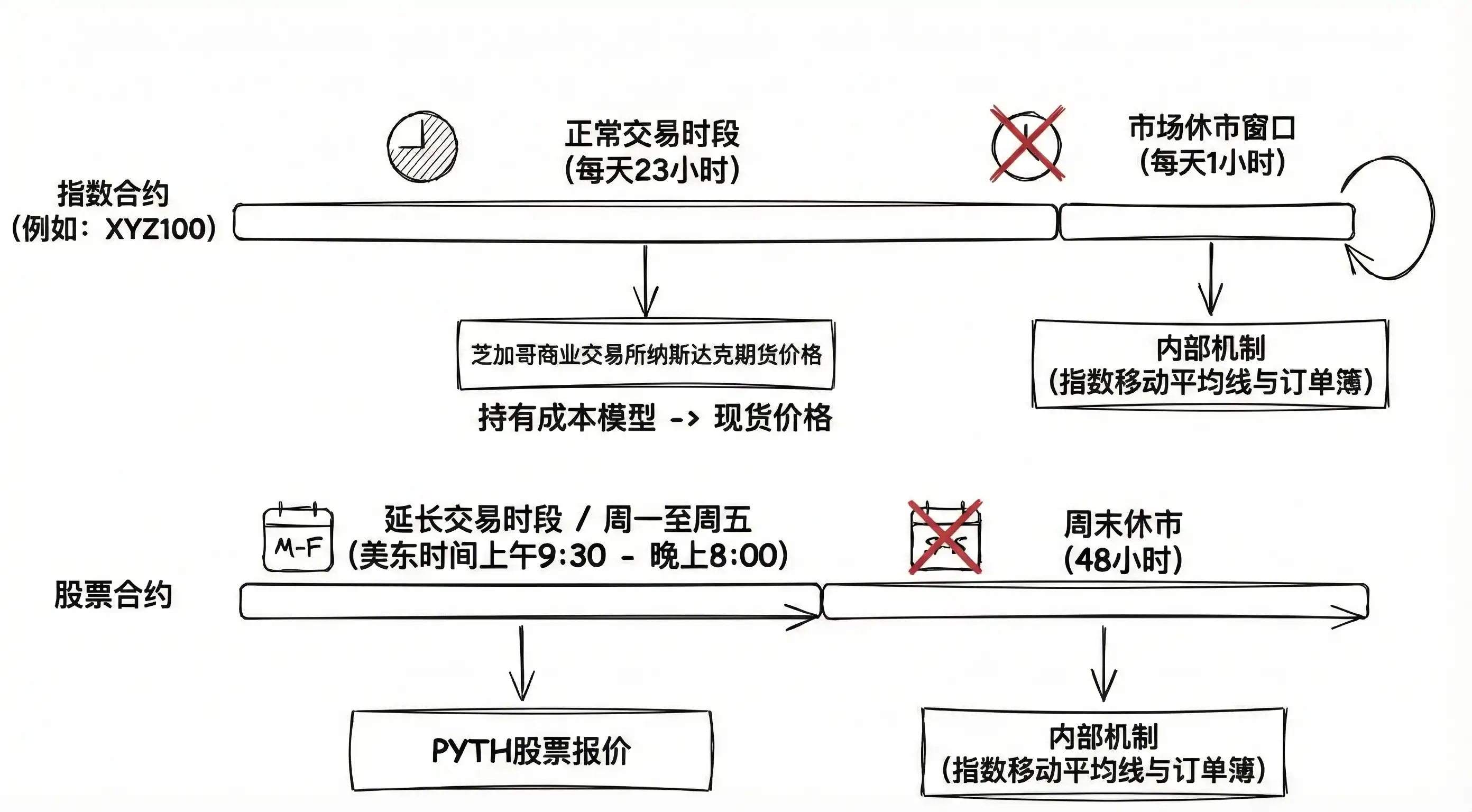
This design enables the oracle to self-adjust based on the on-chain order book when external data is lacking, maintaining responsiveness to market supply and demand. Once external data is restored, the oracle immediately reverts to external pricing.
Design Challenge 2: Dividends Are Not a Free Lunch for Shorts
Unlike Bitcoin, which does not generate cash flow, US stocks have regular dividend payments. In traditional markets, the ex-dividend date usually leads to an automatic stock price drop. In perpetual contracts, this seems to provide a perfect arbitrage opportunity for shorts: by shorting before the ex-dividend date, one can profit from the price decrease.
However, this clearly violates the "no-arbitrage principle." To address this issue, trade.xyz internalizes dividends into the funding rate. We can use reverse inductive reasoning to deduce this process:
Assuming the oracle price is $100, and in the future moment T, it drops to $98 due to a $2 dividend distribution. Every hour before T, the mark price must exhibit a smooth discounted curve.
At moment T-1, to prevent arbitrage, the funding rate paid by shorts must precisely equal the profit they receive as the price drops from the mark price to $98. According to the funding rate formula:
Funding Rate = ( Mark Price - Oracle Price ) / Oracle Price + Truncation Function (...)
By solving the no-arbitrage condition, we can deduce that the fair Mark price at time T-1 should be around $98.975. Continuing to T-2 and T-3, we find that the Mark price will preemptively form a discount curve.
Image Source: https://oldcoinbad.com/p/non-arbitrage-conditions-for-perpetual
In simple terms, while the short position seems to profit from the price drop spread, it actually pays out the full amount through the funding rate; whereas the long position, although enduring a nominal price drop, earns an income equivalent to holding the spot through the funding rate, a sort of "dividend."
Design Challenge Three: Who Bears the Cost of "Volatility Arbitrage"?
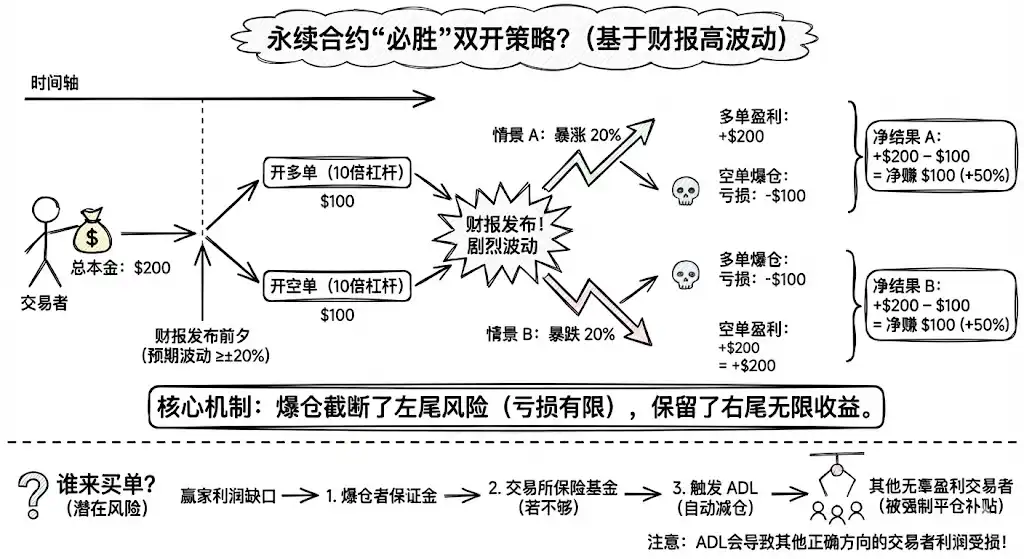
Perpetual contracts give linear assets a non-linear option-like property: the liquidation mechanism truncates left-tail risk (at most losing the entire principal), while retaining the infinite upside of the right tail.
An earnings report is a typical "known unknown" event: the timing is known, the direction is unknown, but the magnitude of volatility is often significant (e.g., ±20%).
This has led to a sure-win "doubling" strategy in perpetual contracts with 10x leverage.
Let's look at a specific example: suppose a trader has $200 in capital, and the implied volatility on earnings report day is 20%. Before the report is released, the trader opens a 10x long position with $100 margin and a 10x short position with $100 margin.
Scenario A (20% surge): Short position liquidates, losing $100; long position gains $200. Net profit is $100.
Scenario B (20% plunge): Long position liquidates, losing $100; short position gains $200. Net profit is $100.
Regardless of the price movement, the trader seems to achieve a 50% return. This is because the liquidation mechanism cuts off losses in the wrong direction while not affecting gains in the correct direction.
So who foots the bill?
In cases where the main net short is liquidated, a portion of the long's profits are covered by the short's margin, while the remaining profit gap is first filled by the exchange's insurance fund. After the insurance fund is depleted, the platform will initiate the Auto-Deleveraging mechanism (ADL), forcibly closing profitable trades and using their paper profits to subsidize the doubling arbitragers. This process causes the non-volatility arbitrage traders who bet correctly on the direction to lose a portion of their profits.
You cannot balance the system's fairness and stability while allowing users to freely choose high leverage.
Current solutions, such as dynamic deleveraging before financial reports or increasing margin requirements, seem to be imperfect.
Design Challenge Four: Market Manipulation
"The measuring cup cannot hold the giant whale, a single turn creates a stormy sea."
In addition to the challenges of mechanism design, the early market's fragile liquidity is also a major risk.
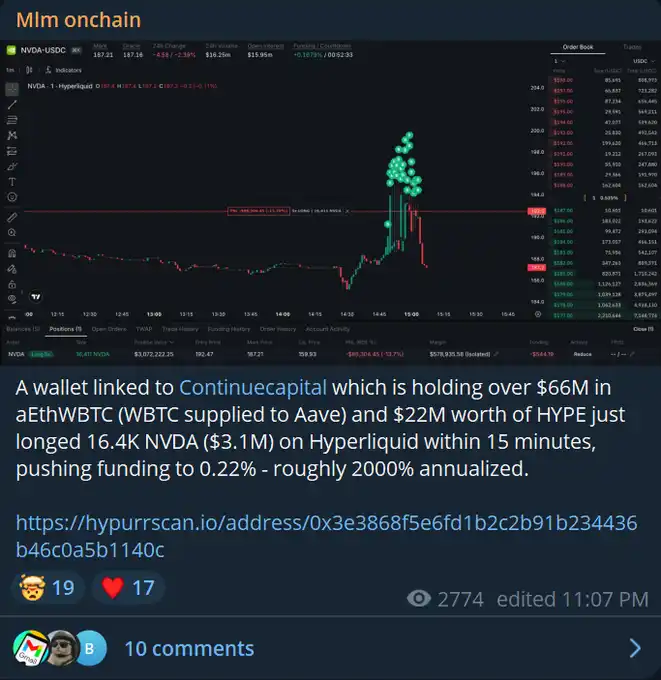
Recently, Continue Capital established a $3.1M long position in NVDA on trade.xyz, directly pushing the short-term annualized funding rate to an astonishing 2000%. KOL trader @CL207 complained, "This guy forced me to liquidate my position because at an hourly interest rate of 0.2%, I'll probably have to pay $200,000 by Wednesday, which will bankrupt me."
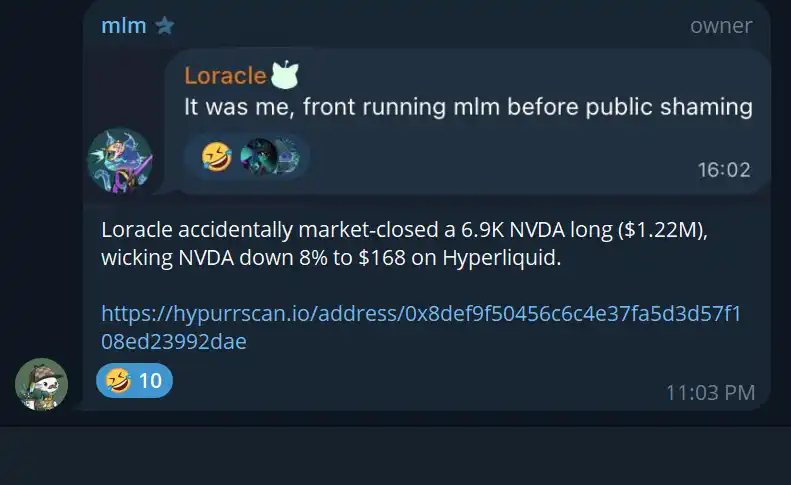
Another whale, Loracle, unexpectedly market liquidated a 1.2M NVDA long position, causing an instantaneous 8% price drop. If trade.xyz offers options with leverage greater than 13x in the future, this sudden liquidity drain will lead to numerous traders being liquidated.
Normally, a whale's "market manipulation" behavior would result in a hefty funding cost penalty, but during off-market hours, oracle prices lose their anchor to spot prices, weakening this "penalty."
To address this, Trade.xyz's oracle price algorithm during off-market hours maintains stickiness to the closing price and sets price limits based on the final opening price to prevent extreme fluctuations during off-market hours.
However, ultimately, before solving the liquidity issue, any "stopgap measure" is just "a Band-Aid on a wooden leg." You cannot prevent well-capitalized players from manipulating a fragile order book while keeping the market open.
Conclusion
Perpetual contracts are poised to be another crypto application with massive potential after stablecoins.
The PMF of US stock perpetual contracts has been preliminarily validated. Data shows that trade.xyz's cumulative trading volume has exceeded $2 billion, with a record-breaking $200 million in daily trading volume during NVDA's earnings release.
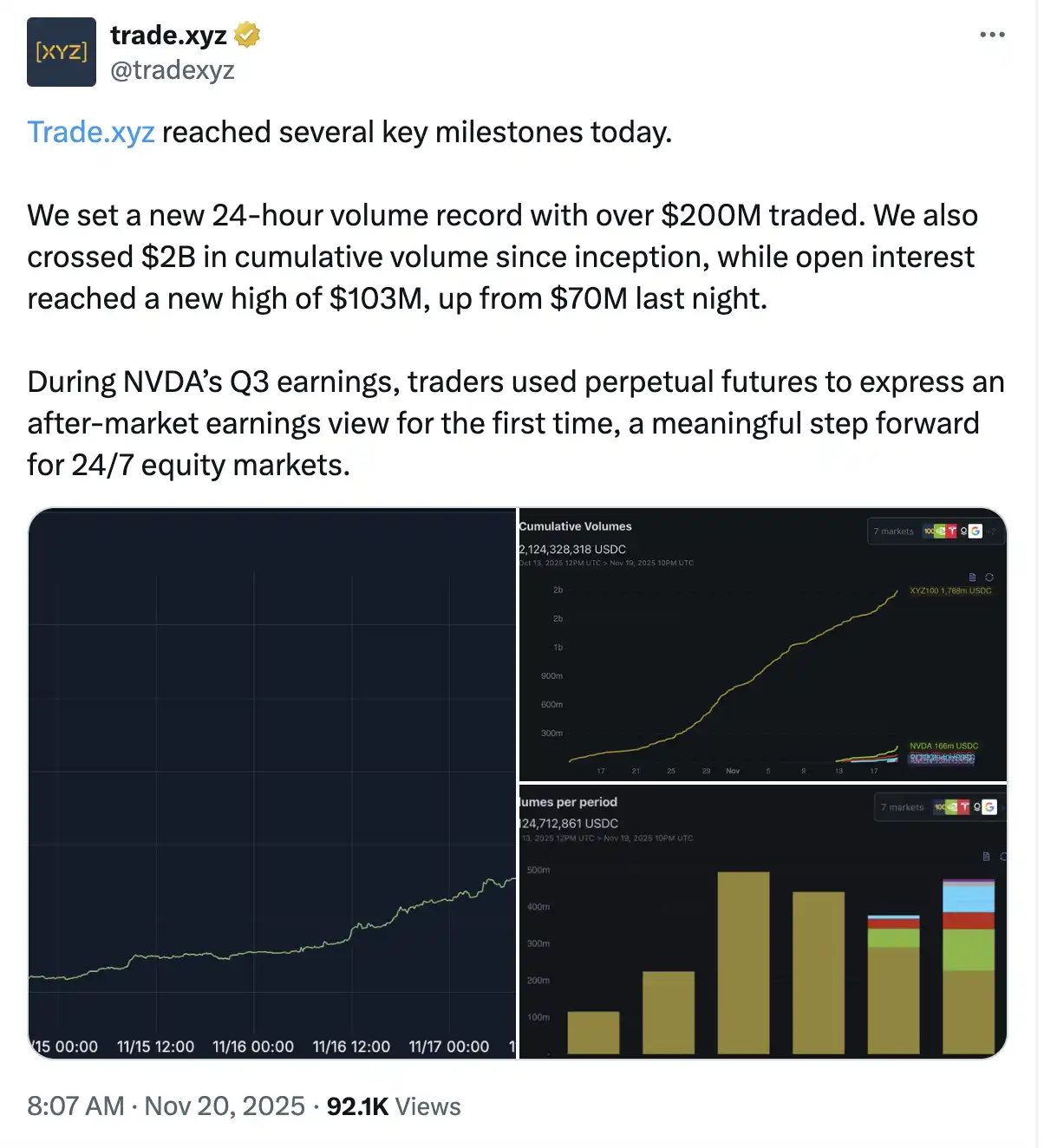
The history of the traditional financial markets tells us that the trading volume of derivatives often far exceeds that of the spot market. CME Gold futures trade 27 million ounces daily, more than 30 times the daily average of 800,000 ounces for the SPDR Gold ETF. The notional trading volume of interest rate derivatives reaches the level of several trillion dollars in the OTC market.
Compared to the spot market, the derivatives market does not involve physical delivery, provides higher capital efficiency, and has a leverage-driven, more efficient price discovery mechanism.
Perpetual contracts take these advantages to the extreme. They offer continuous exposure, extremely low costs, and maximum efficiency.
While Bitcoin struggles in a bear market, the U.S. stock market continues to thrive, highlighting more and more the potential of stock perpetual contracts.
Despite facing significant technical and game-theoretical challenges, perpetual contracts are starting to "swallow" the stock market in an irreversible manner.
References:
https://oldcoinbad.com/p/non-arbitrage-conditions-for-perpetual
https://docs.trade.xyz/xyz-perps-specification/equity-perpetuals/single-name-equities
https://docs.trade.xyz/xyz-perps-specification/equity-perpetuals/xyz100-and-index-perpetuals
You may also like

Hyperliquid Whales Shift Strategies: BTC Longs Decline, ETH Shorts Dominate
Key Takeaways A significant reduction in Bitcoin long positions has been observed on Hyperliquid, with large holders decreasing…

Crypto Christmas Heist: Over $6 Million Lost, Trust Wallet Chrome Extension Wallet Hacked Analysis

Trust Wallet Browser Extension Security Incident Leads to Losses
Key Takeaways Trust Wallet identified a significant security breach in its browser extension version 2.68. Approximately over $6…
Bitcoin Surges Toward $90,000 as $27 Billion Crypto Options Expire
Key Takeaways Bitcoin’s price is nearing the $90,000 mark amid increased market activity following the holiday lull. The…

Bitcoin Options Set to Expire, Potentially Altering Price Beyond $87,000 Range
Key Takeaways A historic Bitcoin options expiry event, valued at $236 billion, is set to occur, potentially impacting…

Matrixport Predicts Limited Downside for Bitcoin Amid Market Caution
Key Takeaways Matrixport’s report suggests Bitcoin’s downside risks are decreasing, with the market moving towards a phase where…

Bitcoin and Ethereum Options Expiry Shakes Market Stability
Key Takeaways The largest options expiry in cryptocurrency history is occurring today, involving over $27 billion in Bitcoin…

Trust Wallet Hack Results in $3.5 Million Loss for Major Wallet Holder
Key Takeaways A significant Trust Wallet hack led to the theft of $3.5 million from an inactive wallet.…

Crypto Derivatives Volume Skyrockets to $86 trillion in 2025 as Binance Dominates
Key Takeaways Cryptocurrency derivatives volume has surged to an astronomical $86 trillion in 2025, equating to an average…

Social Engineering in the Crypto Universe: Safeguarding Your Assets in 2025
Key Takeaways Social engineering, a psychological manipulation tactic, has been the leading cause of crypto asset theft in…

Kraken IPO to Rekindle Crypto’s ‘Mid-Stage’ Cycle: A Comprehensive Analysis
Key Takeaways: Kraken’s anticipated IPO in 2026 could significantly attract fresh capital from traditional financial investors, marking a…
Fed Q1 2026 Outlook: Potential Impact on Bitcoin and Crypto Markets
Key Takeaways: Federal Reserve’s policies could exert significant pressure on cryptocurrencies if rate cuts halt in early 2026.…

Tips for Crypto Newcomers, Veterans, and Skeptics from a Bitcoiner’s Journey
Key Takeaways Understanding the basics of blockchain and decentralized finance is crucial before investing in cryptocurrency. Newcomers should…
Quantum Computing in 2026: No Crypto Doomsday, Time to Prepare
Key Takeaways: Quantum computing still poses a theoretical risk to cryptocurrency security, but immediate threats are minimal due…

Trust Wallet to Reimburse $7 Million Lost in Christmas Hack: An Inside Job?
Key Takeaways Trust Wallet’s browser extension was compromised, leading to a $7 million loss on Christmas Day. The…
El Salvador’s Bitcoin Aspirations Brought Closer to Earth in 2025
Key Takeaways: Early Ambitions vs. Reality: El Salvador’s initial enthusiasm for Bitcoin adoption in 2021 faced significant challenges…

Ethereum Price: New Highs in 2026 Unlikely According to Crypto Analyst Ben Cowen
Key Takeaways Analyst Ben Cowen suggests Ethereum may not reach new highs in 2026 due to prevailing market…
Blockchains Quietly Brace for Quantum Threat Amid Bitcoin Debate
Key Takeaways Cryptocurrency networks, especially altcoins, are enhancing security to prepare for potential quantum computing threats. Bitcoin faces…
Hyperliquid Whales Shift Strategies: BTC Longs Decline, ETH Shorts Dominate
Key Takeaways A significant reduction in Bitcoin long positions has been observed on Hyperliquid, with large holders decreasing…
Crypto Christmas Heist: Over $6 Million Lost, Trust Wallet Chrome Extension Wallet Hacked Analysis
Trust Wallet Browser Extension Security Incident Leads to Losses
Key Takeaways Trust Wallet identified a significant security breach in its browser extension version 2.68. Approximately over $6…
Bitcoin Surges Toward $90,000 as $27 Billion Crypto Options Expire
Key Takeaways Bitcoin’s price is nearing the $90,000 mark amid increased market activity following the holiday lull. The…
Bitcoin Options Set to Expire, Potentially Altering Price Beyond $87,000 Range
Key Takeaways A historic Bitcoin options expiry event, valued at $236 billion, is set to occur, potentially impacting…
Matrixport Predicts Limited Downside for Bitcoin Amid Market Caution
Key Takeaways Matrixport’s report suggests Bitcoin’s downside risks are decreasing, with the market moving towards a phase where…
Popular coins
Latest Crypto News


Customer Support:@weikecs
Business Cooperation:@weikecs
Quant Trading & MM:bd@weex.com
VIP Services:support@weex.com
 App
App