
- Buy Crypto
- Markets
- Futures
- Spot
- Copy Trade
 WE-Launch
Multicoin: What Other Entrepreneurial Opportunities Exist in the Prediction Market?

Original Article Title: Building The Attention Economy
Original Article Author: Eli Qian, Multicoin Capital
Translation: Peggy, BlockBeats
Editor's Note: In the era of information explosion, attention itself is becoming a measurable and tradable asset. This article explores how "attention assets" are being financialized through prediction markets and oracle mechanisms, and proposes a methodology for building an "Attention Perpetual Contract." As the value of memes gradually emerges in traditional assets such as stocks, we may be on the threshold of the attention economy becoming a mainstream asset class.
The following is the original content:
The Financial Potential of Attention Assets
Although it may be overly simplistic, assets are generally divided into two categories:
1. Cash Flow Assets — Mainly including stocks and bonds. These assets generate cash flow, and investors use this as a basis for valuation.
2. Supply-Demand Assets — Mainly applicable to commodities and forex. Their prices fluctuate based on supply and demand.
Recently, the crypto space has spawned a new type of asset — one based on attention as its fundamental value. Today, "attention assets" are mainly User-Generated Assets (UGAs), such as NFTs, creator tokens, and meme coins. These assets act as the "Schelling points" of cultural attention, and their prices reflect the ebbs and flows of attention.
From a cultural perspective, meme coins are interesting, but from a financial perspective, they still have many shortcomings. An efficient attention asset should allow market participants to directly gain financial exposure to the attention of something. In this way, participants will be incentivized to trade assets they believe are mispriced in terms of attention, and the market will be able to form a price reflective of attention prediction through collective behavior.
We believe that, if structured appropriately, attention assets have the potential to become a true asset class. To advance this idea, this article introduces the concept of "Attention Oracles," a novel oracle structure that can support "Attention Perpetual Contracts" — a new financial instrument that allows traders to go long or short on cultural attention.
In essence, Attention Oracles leverage binary prediction markets around a specific topic, utilizing their price, liquidity, and time dimension to build a weighted aggregate index designed to capture attention changes. To ensure its effective operation, the underlying markets must be carefully selected to represent relevant attention inputs in the real world. Using prediction markets as inputs for attention oracles also introduces an "embedded manipulation cost" that theoretically can reduce malicious manipulation, as adversarial traders must bear capital risk to influence the index.
errorHowever, this design still has room for improvement. The goal of the attention oracle is to take attention-related data as input, apply some function to this data, and output a value for traders to long or short.
One issue with using social media as input is that social media is easily manipulated. This reflects a variant of Goodhart's Law: in adversarial markets, traders will attempt to manipulate input data to influence prices. Kaito has had to redesign their leaderboard and anti-spam mechanisms to address this issue.
Furthermore, social media does not perfectly capture attention. Take Shohei Ohtani, for example; he has a global fanbase, uses various social media apps, some of which might not be indexed by Kaito. If he were to win another World Series, his star power would grow, but not necessarily in a linear fashion in terms of fan count or social media mentions.
Attention Oracle: A Market-Based Approach
Returning to our previous example of LeBron James, suppose you want to trade LeBron's attention. To build an attention oracle for him, the first step would be to collect (or create if they don't exist) multiple binary prediction markets about LeBron, such as:
"Will LeBron James have over X million followers by the end of this month?" "Will LeBron James win a championship in 2026?" "Will LeBron James get the MVP in 2026?"
A comprehensive LeBron attention oracle would use more underlying markets, but for the sake of the example, let's stick to these three. The index price would be calculated by a weighted aggregation of each market's price, liquidity, resolution time, and importance.
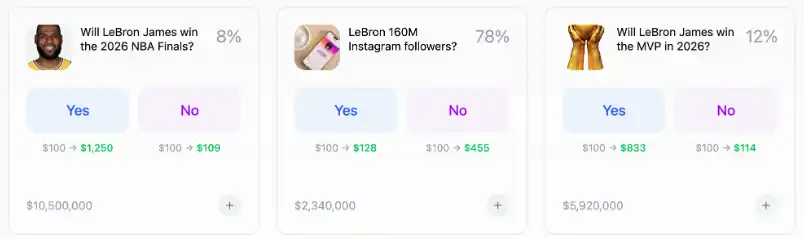
For each market, we have a price, liquidity, resolution time, and an importance score. For illustrative purposes, we'll use a very simplistic weighting formula. Each market's score ranges from 1 to 10 and is combined with liquidity and time factors:
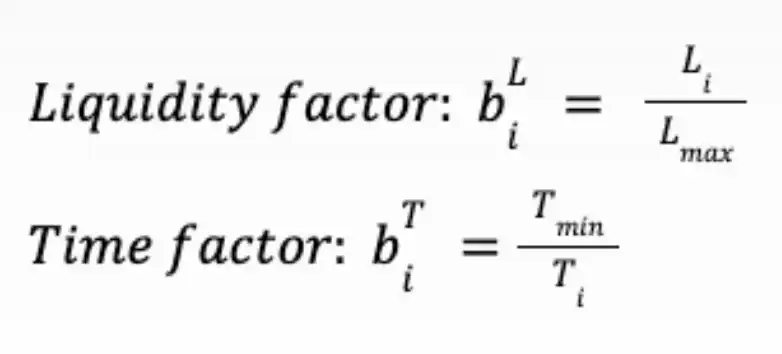
Let's say we decide to set the scores for the three markets at 8, 2, and 10; then the weight for each market would be:
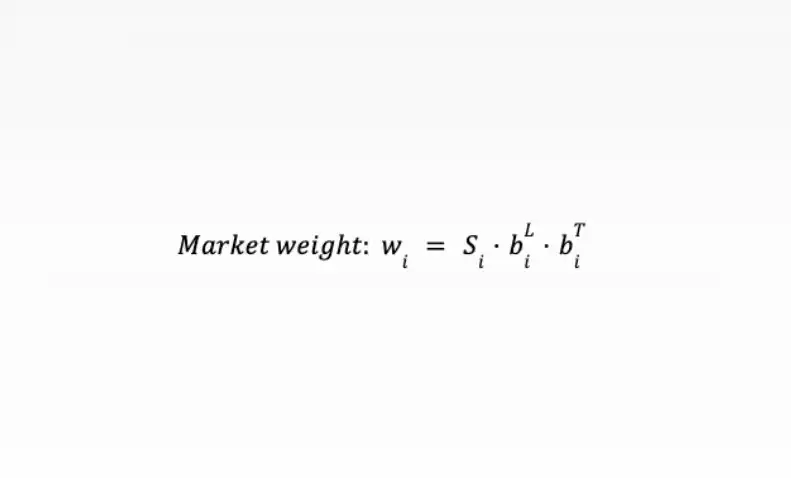
The final attention score will be:

If we assume that the resolution times for these three markets are 180 days, 20 days, and 180 days respectively, and the importance scores are 8, 2, and 10 respectively, then combining the above factors will result in:
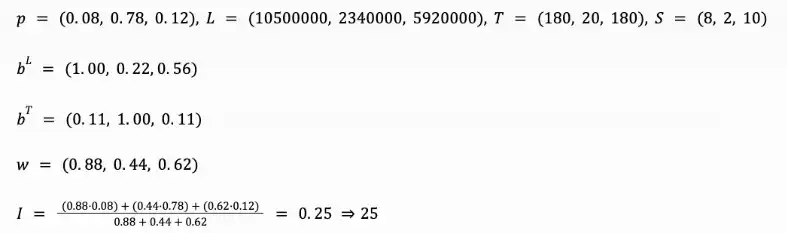
Of course, there are more sophisticated methods that can be used to calculate the attention index, such as using open interest instead of trading volume, considering relevant events, adjusting market depth, nonlinear relationships between variables, and more. We have also created an interactive website for readers to create their own indices based on real-time Kalshi markets.
The primary advantage of this oracle design based on prediction markets is that manipulative behavior comes with a real cost. If a trader wants to manipulate the LeBron attention upwards by longing it, they would need to buy long positions on the underlying binary prediction market. Assuming there is sufficient liquidity in the underlying market, this means they would need to buy at a price the market deems overvalued.
We believe that as these markets evolve, another significant advantage is that binary prediction markets provide a spot market for liquidity providers to hedge. If a liquidity provider is short on the attention index, they can hedge their risk exposure by longing the underlying prediction market positions that make up that index.
Adjacent has already used real-time, liquid markets on Kalshi to create indices tracking political trends such as the battle for control between the Democratic and Republican parties, and the New York City mayoral election. We believe a similar approach can be used to track attention on any topic. As prediction markets evolve, the range of topics available to construct attention indices will continue to expand.
Design Space of Attention Oracles
The oracle structure we propose is not without trade-offs. When considering attention oracles more broadly, we believe the following aspects are key considerations:
1. How relevant is the input data?
2. How feasible is it to obtain this input data?
3. How susceptible is the input data to manipulation or gamification?
4. What functions have we applied to the input to calculate the attention score?
The most obvious trade-off of the oracle we propose is the difficulty in obtaining input data. If you wanted to build an attention oracle about LeBron James, you would first need to create multiple well-liquidated prediction markets on topics related to LeBron. Additionally, these markets would need to maintain liquidity over time and be promptly replaced with new liquid markets as the original markets resolve or become irrelevant. Therefore, we believe this design is best suited for a few high-profile topics that already have mature prediction markets (such as Donald Trump or Taylor Swift).
Another trade-off is that attention may increase regardless of the event's outcome. For example, even if LeBron doesn't win another championship, people's attention on him may still rise as they begin to question his performance. There may be widespread discussions about whether he is truly aging, experiencing a decline in form, etc. Similarly, real-world attention often gravitates towards unexpected events, while prediction markets measure the expected outcome of an event. If the market expects LeBron to win MVP but he doesn't, attention may rise while the index drops. Fans and commentators may discuss how he was "robbed" of the MVP or whether the selection process was unfair.
The optimal oracle design may ultimately involve a combination of prediction markets, social media data, and other sources. Google Trends recently opened an alpha project, allowing developers to access search trend data via an API. The internet search volume for a topic is evidently highly correlated with its attention, and since Google Trends filters out repeated searches, it may be less easily manipulated than social media data. Another source could be using Large Language Models (LLMs) to analyze more manipulable inputs and attempt to filter out spam. For instance, an LLM could score attention based on mainstream news headlines or popular posts on X (formerly Twitter).
We believe that mature exchanges like Kalshi and Polymarket are best positioned to offer Attention Perpetual Contracts, as they already have many liquid foundational markets and users willing to trade on new markets. However, we do not believe that the opportunity for attention assets is limited to these large platforms.
One configuration could be: vaults trading prediction markets and targeting a topic for long/short positions. For example, a vault bullish on Taylor Swift could purchase "yes" contracts on events like whether she will have a Top 10 single, perform at the Super Bowl, etc. Vault managers decide which markets are related to attention increase.
Another example is using Hyperliquid's builder-deployed perpetual contracts. HIP-3 provides flexibility, allowing market deployers to customize an oracle — an HIP-3 market could use a combination of Kalshi/Polymarket prices, social media metrics, Google Trends, news headlines, etc.
Attention as an Asset Class
Ironically, the first mature application of the attention economy may emerge in the stock market. Stock prices are composed of two parts: DCF Value (intrinsic value) and Memetic Value.
In history, most stocks did not have significant meme value. But in recent years, thanks to platforms like WallStreetBets and Robinhood, meme value has become more and more prevalent, especially with 24x5 retail trading.
The goal of stock research analysts is to determine the stock's price. While there are established methods to calculate the DCF component, how should the meme value component be modeled? As more and more asset trading is influenced by meme value, developing methods to model meme value will become necessary. Mature investors are already using metrics such as follower count, likes, views, etc., to gauge market sentiment. Predictive markets and other oracle structures can be useful tools for measuring stock attention, thus constructing better trading models.
However, the opportunity of attention assets extends far beyond stock pricing. We believe that predicting attention itself is an economically valuable activity. Attention is a leading indicator of consumer preferences and spending. Companies allocate R&D, hiring, and marketing budgets based on attention flows. The key is to find new heuristic approaches to model these flows.
If you are building attention assets or related infrastructure, feel free to contact us.
You may also like

World Cup of 'Oracles': How to Interpret Next Year's Prediction Market Growth Prospects?

Former SEC Counsel Explains What It Takes to Make RWAs Compliant
Key Takeaways The SEC’s shifting approach is aiding the growth of Real-World Assets (RWAs), but jurisdictional and yield…

Extended Crypto ETF Outflows Indicate Institutional Pullback: Glassnode
Key Takeaways: Recent outflows from Bitcoin and Ether ETFs suggest a withdrawal of institutional interest. Institutional disengagement has…

December 24th Market Key Intelligence, How Much Did You Miss?

Kalshi First Research Report: When Predicting CPI, Crowd Wisdom Beats Wall Street Analysts

Are Those High-Raised 2021 Projects Still Alive?

Aave Community Governance Drama Escalates, What's the Overseas Crypto Community Talking About Today?

Where Did $362 Million Go? Hyperliquid Counters FUD in Decentralization Showdown

2025 Whale Saga: Mansion Kidnapping, Supply Chain Poisoning, and Billions Liquidated

Absorb Polymarket Old Guard, Coinbase Plunges Into Prediction Market Abyss
Coinbase Joins Prediction Market, AAVE Governance Dispute - What's the Overseas Crypto Community Talking About Today?
Over the past 24 hours, the crypto market has shown strong momentum across multiple dimensions. The mainstream discussion has focused on Coinbase's official entry into the prediction market through the acquisition of The Clearing Company, as well as the intense controversy within the AAVE community regarding token incentives and governance rights.
In terms of ecosystem development, Solana has introduced the innovative Kora fee layer aimed at reducing user transaction costs; meanwhile, the Perp DEX competition has intensified, with the showdown between Hyperliquid and Lighter sparking widespread community discussion on the future of decentralized derivatives.
This week, Coinbase announced the acquisition of The Clearing Company, marking another significant move to deepen its presence in this field after last week's announcement of launching a prediction market on its platform.
The Clearing Company's founder, Toni Gemayel, and the team will join Coinbase to jointly drive the development of the prediction market business.
Coinbase's Product Lead, Shan Aggarwal, stated that the growth of the prediction market is still in its early stages and predicts that 2026 will be the breakout year for this field.
The community has reacted positively to this, generally believing that Coinbase's entry will bring significant traffic and compliance advantages to the prediction market. However, this has also sparked discussions about the industry's competitive landscape.
Jai Bhavnani, Founder of Rivalry, commented that for startups, if their product model proves to be successful, industry giants like Coinbase have ample reason to replicate it.
This serves as a reminder to all entrepreneurs in the crypto space that they must build significant moats to withstand competition pressure from these giants.
Regulated prediction market platform Kalshi launched its research arm, Kalshi Research, this week, aimed at opening its internal data to the academic community and researchers to facilitate exploration of prediction market-related topics.
Its inaugural research report highlights Kalshi's outperformance in predicting inflation compared to Wall Street's traditional models. Kalshi co-founder Luana Lopes Lara commented that the power of prediction markets lies in the valuable data they generate, and it is now time to better utilize this data.
Meanwhile, Kalshi announced its support for the BNB Chain (BSC), allowing users to deposit and withdraw BNB and USDT via the BSC network.
This move is seen as a significant step for Kalshi to open its platform to a broader crypto user base, aiming to unlock access to the world's largest prediction market. Furthermore, Kalshi also revealed plans to host the first Prediction Market Summit in 2026 to further drive industry engagement and development.
The AAVE community recently engaged in heated debates around an Aave Improvement Proposal (AIP) titled "AAVE Tokenomics Alignment Phase One - Ownership Governance," aiming to transfer ownership and control of the Aave brand from Aave Labs to Aave DAO.
Aave founder Stani Kulechov publicly stated his intention to vote against the proposal, believing it oversimplifies the complex legal and operational structure, potentially slowing down the development process of core products like Aave V4.
The community's reaction was polarized. Some criticized Stani for adopting a "double standard" in governance and questioned whether his team had siphoned off protocol revenue, while others supported his cautious stance, arguing that significant governance changes require more thorough discussion.
This controversy highlights the tension between the ideal of DAO governance in DeFi projects and the actual power held by core development teams.
Despite governance disputes putting pressure on the AAVE token price, on-chain data shows that Stani Kulechov himself has purchased millions of dollars' worth of AAVE in the past few hours.
Simultaneously, a whale address, 0xDDC4, which had been quiet for 6 months, once again spent 500 ETH (approximately $1.53 million) to purchase 9,629 AAVE tokens. Data indicates that this whale has accumulated nearly 40,000 AAVE over the past year but is currently in an unrealized loss position.
The founder and whale's increased holdings during market volatility were interpreted by some investors as a confidence signal in AAVE's long-term value.
In this week's top article, Morpho Labs' "Curator Explained" detailed the role of "curators" in DeFi.
The article likened curators to asset managers in traditional finance, who design, deploy, and manage on-chain vaults, providing users with a one-click diversified investment portfolio.
Unlike traditional fund managers, DeFi curators execute strategies automatically through non-custodial smart contracts, allowing users to maintain full control of their assets. The article offered a new perspective on the specialization and risk management in the DeFi space.
Another widely circulated article, "Ethereum 2025: From Experiment to Global Infrastructure," provided a comprehensive summary of Ethereum's development over the past year. The article noted that 2025 is a crucial year for Ethereum's transition from an experimental project to global financial infrastructure. Through the Pectra and Fusaka hard forks, Ethereum achieved significant reductions in account abstraction and transaction costs.
Furthermore, the SEC's clarification of Ethereum's "non-securities" nature and the launch of tokenized funds on the Ethereum mainnet by traditional financial giants like JPMorgan marked Ethereum's gaining recognition from mainstream institutions. The article suggested that whether it is the continued growth of DeFi, the thriving L2 ecosystem, or the integration with the AI field, Ethereum's vision as the "world computer" is gradually becoming a reality.
The Solana Foundation engineering team released a fee layer solution called Kora this week.
Kora is a fee relayer and signatory node designed to provide the Solana ecosystem with a more flexible transaction fee payment method. Through Kora, users will be able to achieve gas-free transactions or choose to pay network fees using any stablecoin or SPL token. This innovation is seen as an important step in lowering the barrier of entry for new users and improving Solana network's availability.
Additionally, a deep research report on propAMM (proactive market maker) sparked community interest. The report's data analysis of propAMMs on Solana like HumidiFi indicated that Solana has achieved, or even surpassed, the level of transaction execution quality in traditional finance (TradFi) markets.
For example, on the SOL-USDC trading pair, HumidiFi is able to provide a highly competitive spread for large trades (0.4-1.6 bps), which is already better than the trading slippage of some mid-cap stocks in traditional markets.
Research suggests that propAMM is making the vision of the "Internet Capital Market" a reality, with Solana emerging as the prime venue for all of this to happen.
The competition in the perpetual contract DEX (Perp DEX) space is becoming increasingly heated.
In its latest official article, Hyperliquid has positioned its emerging competitor, Lighter, alongside centralized exchanges like Binance, referring to it as a platform utilizing a centralized sequencer. Hyperliquid emphasizes its transparency advantage of being "fully on-chain, operated by a validator network, and with no hidden state."
The community widely interprets this as Hyperliquid declaring "war" on Lighter. The technical differences between the two platforms have also become a focal point of discussion: Hyperliquid focuses on ultimate on-chain transparency, while Lighter emphasizes achieving "verifiable execution" through zero-knowledge proofs to provide users with a Central Limit Order Book (CLOB)-like trading experience.
This battle over the future direction of decentralized derivatives exchanges is expected to peak in 2026.
Meanwhile, discussions about Lighter's trading fees have surfaced. Some users have pointed out that Lighter charged as much as 81 basis points (0.81%) for a $2 million USD/JPY forex trade, far exceeding the near-zero spreads of traditional forex brokers.
Some argue that Lighter does not follow a B-book model that bets against market makers, instead anchoring its prices to the TradFi market, and the high fees may be related to the current liquidity or market maker balance incentives. Providing a more competitive spread for real-world assets (RWA) in the highly volatile crypto market is a key issue Lighter will need to address in the future.

Why Did Market Sentiment Completely Collapse in 2025? Decoding Messari's Ten-Thousand-Word Annual Report

Fintechs’ Prediction Market Add-ons and the Risk of User Churn: Insights from Inversion CEO
Key Takeaways Fintech platforms like Robinhood are increasingly adding prediction markets, which may result in higher user churn…

Former SEC Counsel Explains What It Takes to Achieve Compliance in RWA Tokenization
Key Takeaways Shifts in the SEC’s regulatory approach to cryptocurrency are aiding the growth of compliance in Real-World…

Understand Tokenization, Differentiating Between the DTCC Model and the Direct Ownership Model

Open Source Achilles' Heel: Nofx and Its 9,000-Star Drama, Forking Fiasco, and Open Source Controversy
Upcoming Lighter TGE: What Is a Reasonable Valuation? As a finance and blockchain translation expert, you are familiar with the field's slang and terminology.

Security Tokenization and Prediction Markets: 7 Major Crypto Boons to Watch in 2026
World Cup of 'Oracles': How to Interpret Next Year's Prediction Market Growth Prospects?
Former SEC Counsel Explains What It Takes to Make RWAs Compliant
Key Takeaways The SEC’s shifting approach is aiding the growth of Real-World Assets (RWAs), but jurisdictional and yield…
Extended Crypto ETF Outflows Indicate Institutional Pullback: Glassnode
Key Takeaways: Recent outflows from Bitcoin and Ether ETFs suggest a withdrawal of institutional interest. Institutional disengagement has…
December 24th Market Key Intelligence, How Much Did You Miss?
Kalshi First Research Report: When Predicting CPI, Crowd Wisdom Beats Wall Street Analysts
Are Those High-Raised 2021 Projects Still Alive?
Popular coins
Latest Crypto News


Customer Support:@weikecs
Business Cooperation:@weikecs
Quant Trading & MM:bd@weex.com
VIP Services:support@weex.com
 App
App