
- Buy Crypto
- Markets
- Futures
- Spot
- Copy Trade
 WE-Launch
What is CZ's latest investment Funes about?

Original Article Title: "What Is Our Startup Funes Doing and How Did We Raise Funds?"
Original Article Author: Hanyang MASTERPA
Editor's Note: On November 6, YZi Labs announced its investment in Funes, an AI-driven online museum dedicated to collecting, preserving, and curating 3D models of all human-made structures. The author of this article, Hanyang MASTERPA, is a co-founder of Funes, and in this article, he shares why he started Funes and his fundraising experience. The following is the original content of the article:
Early in the morning, I saw the news that a nuclear power plant cooling tower in Tennessee had been demolished. The cover looked familiar to me, so I clicked on it and realized it was from last year. It was a rainy morning when Reiqing and I drove over an hour from Nashville to get there. There was nothing on the road except deer and wild chickens until we parked our car at the entrance and were suddenly surrounded by a group of burly men—because there was a private prison next to the nuclear power plant, and the main entrance faced the power plant. We were targeted by these big guys as soon as we arrived, adding a touch of color to their boring morning.
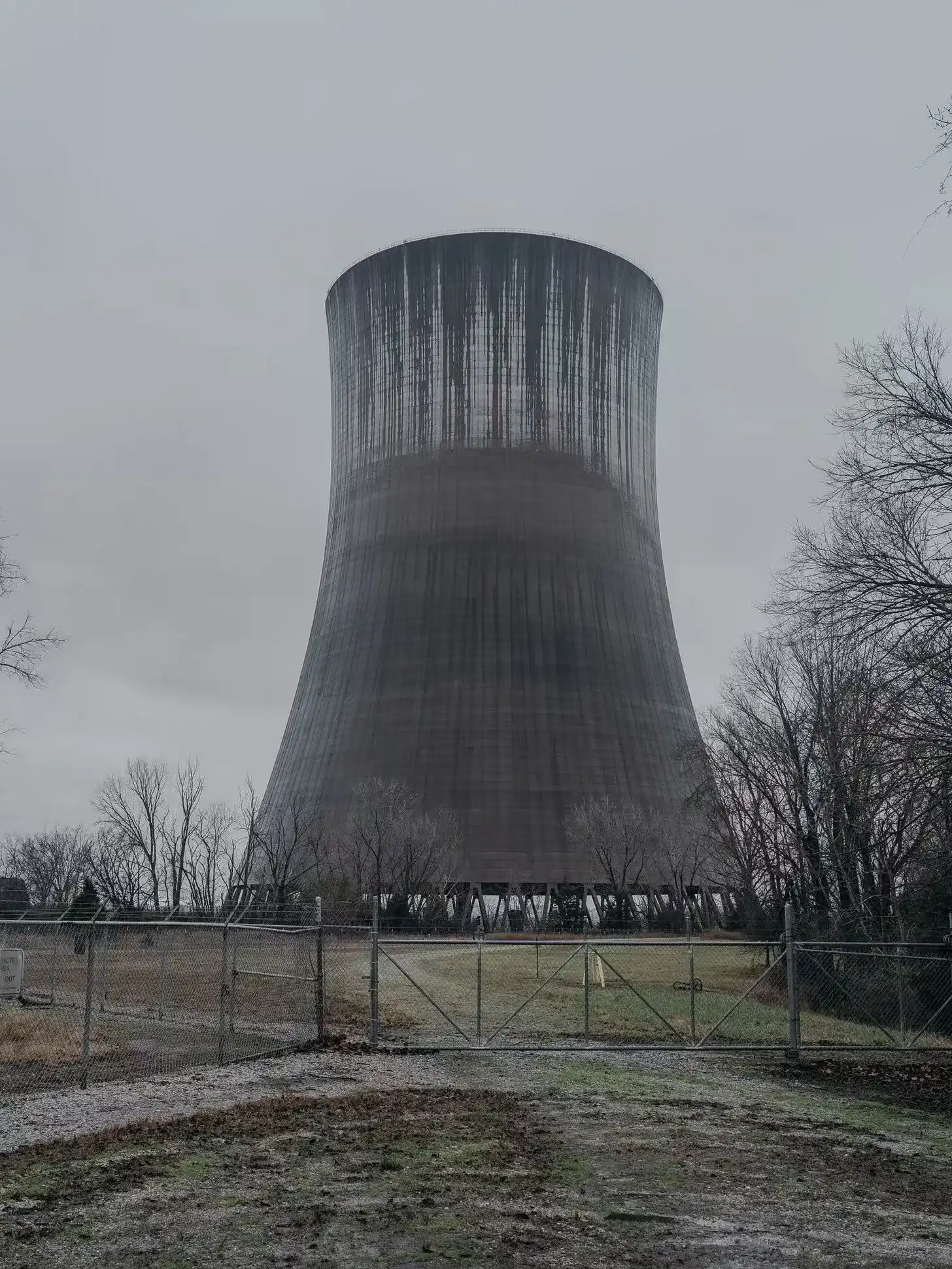
The cooling tower that has now disappeared forever
Like many stereotypical North American stories, the big guys were relieved to see two Asians. After advising us not to fly a drone to take photos, they were attracted by the next alarm and moved on. So this abandoned nuclear power plant and cooling tower are among the few buildings we only took photos of without modeling. But it would have been impractical to model the site, as it was just too large for a small remote-controlled aircraft to cover.
But there will never be a model of it again. Its immense, almost sublime magnitude did not prevent it from inevitably collapsing, just like the small bungalow next to my house. The inmates in the prison and the security guards must have had a good show.
Humans cannot achieve eternity, but we always want to defy time. This is the reason for Funes' existence, and why we have devoted our energy to Funes.
0. What Is Funes?
It seems like I have never introduced Funes in such a formal and serious manner to everyone. So, before delving into the story of our fundraising, let me first explain what Funes is.
In 2012, extremists took over Timbuktu, damaging historical sites. In 2014, Shangri-La was hit by a major fire. In the same year, the ancient city of Aleppo became a battlefield in the Syrian war, suffering severe damage. Not far away, the ruins of Palmyra were leveled by the Islamic State in 2015. In 2019, the Notre-Dame Cathedral in Paris was ravaged by a massive fire. In recent years, international turmoil and climate disasters have increasingly exacerbated, making world cultural heritage more vulnerable and endangered. Every corner of the world, every day, could be the last day. Our material world urgently needs to be preserved and documented through digitization.
However, even so, a country's landmark buildings, a house passed down through generations in a hometown, a skyscraper you pass by every day... These physical entities of architecture are themselves carriers of information and knowledge. But our understanding of them is probably far less than you imagine. From large-scale architecture, monuments, ruins to artifacts, toys, crafts... These creations are traces and testimonies of human presence on Earth, yet they have hardly ever been digitized on a large scale, for purposes such as collection, protection, and display, and uploaded to the Internet for people to browse and use.
This is why we founded Funes.
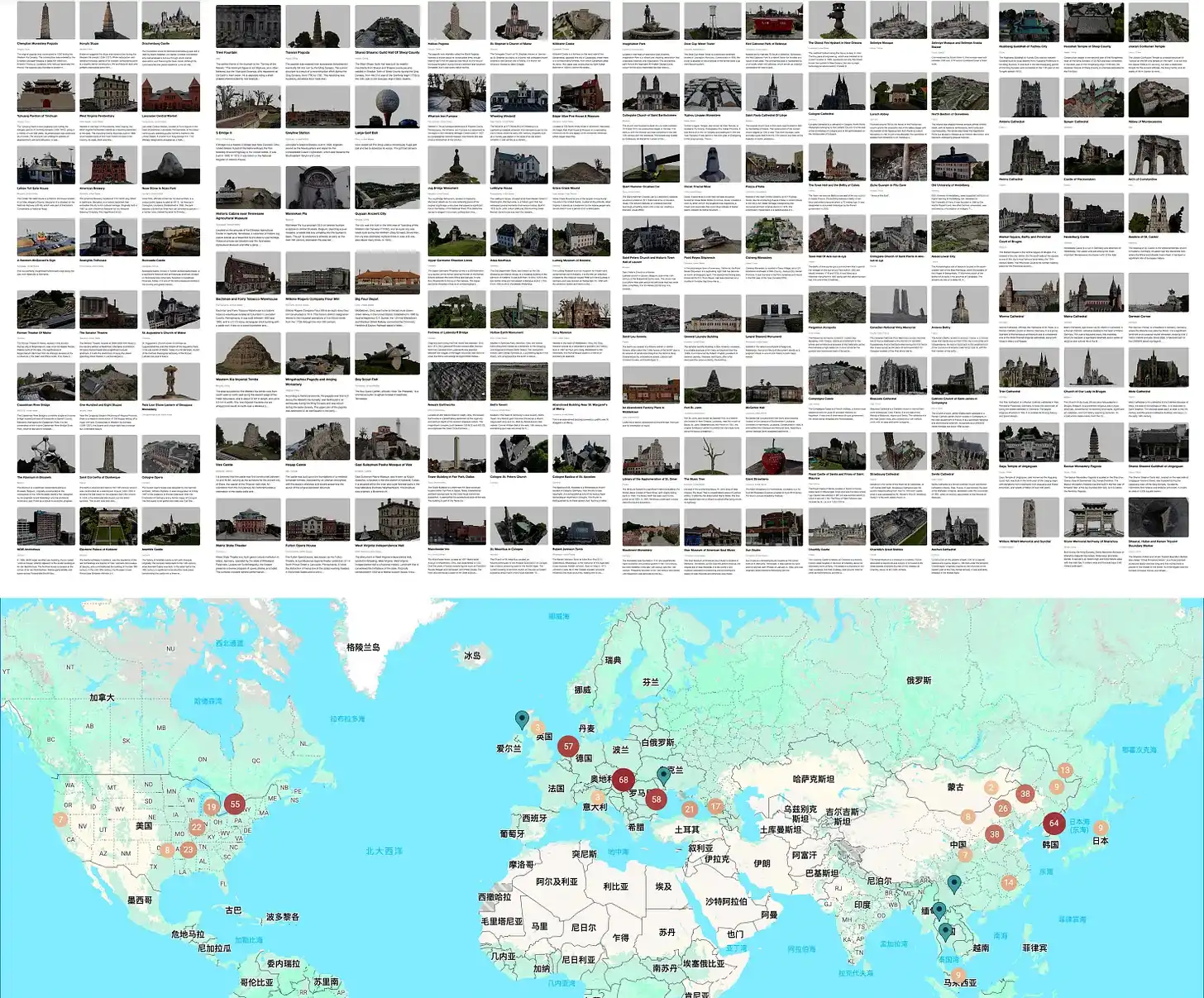
Some models and model-based maps that Funes has already launched
Funes is like a GitHub for the physical world. Together with users worldwide, we model and store all of humanity's buildings and structures. Funes' database now includes models of over 1,000 human-made structures and buildings (not all are online yet). These models span across continents, with a time span of over 4,000 years, and the number is rapidly growing.
We dare not guarantee, but at least within the known range, Funes is the world's largest open database of architectural 3D data.
Currently, Funes adds an average of 5 to 10 models per day, some directly collected by our team, while others are contributed from around the globe—from Singapore to Moldova. These models collectively form an unprecedented digital resource, providing rich research material for computer vision and graphics researchers, as well as serving as a new research direction previously unattainable in heritage preservation, architectural history, archaeology, and other related fields.
When there are enough models, many unimaginable things naturally emerge. For example, cross-regional and cross-cultural real-world visual comparisons. With these models, historians can trace the spread of cultural ideas, studying how different cultures respond to natural conditions and social challenges through the built environment. A researcher of ancient trade can now simultaneously "stand in front of" a pass in northwest China and an inn site in Anatolia, meticulously comparing stone carving techniques and architectural structures. Scholars can also use our large map feature to "connect the dots, connect the lines into shapes," gaining insights into cross-regional, cross-era development trends.
Each 3D model in Funes comes with coordinates and a modern address, associated with 3D terrain data. Therefore, the database has also become a powerful tool for Geographic Information System (GIS) analysis and spatial humanities research, assisting urban planning researchers in analyzing settlement patterns and architectural distribution in different landscapes. Especially for large site models, archaeologists can use this to correlate site locations with geographic features, ancient transportation routes, and early urban planning, examine the impact of climate and terrain on architectural development, and even map out the cross-regional spread of architectural styles. These high-precision geographic spatial data can also be used for heritage tourism planning and development.
For professional users, Funes has specially introduced a series of research-friendly features:
“Wireframe Mode” allows engineers to penetrate surface materials and view the structural details of the model's triangular mesh, while heritage conservationists can use it to analyze the internal construction of buildings in depth.
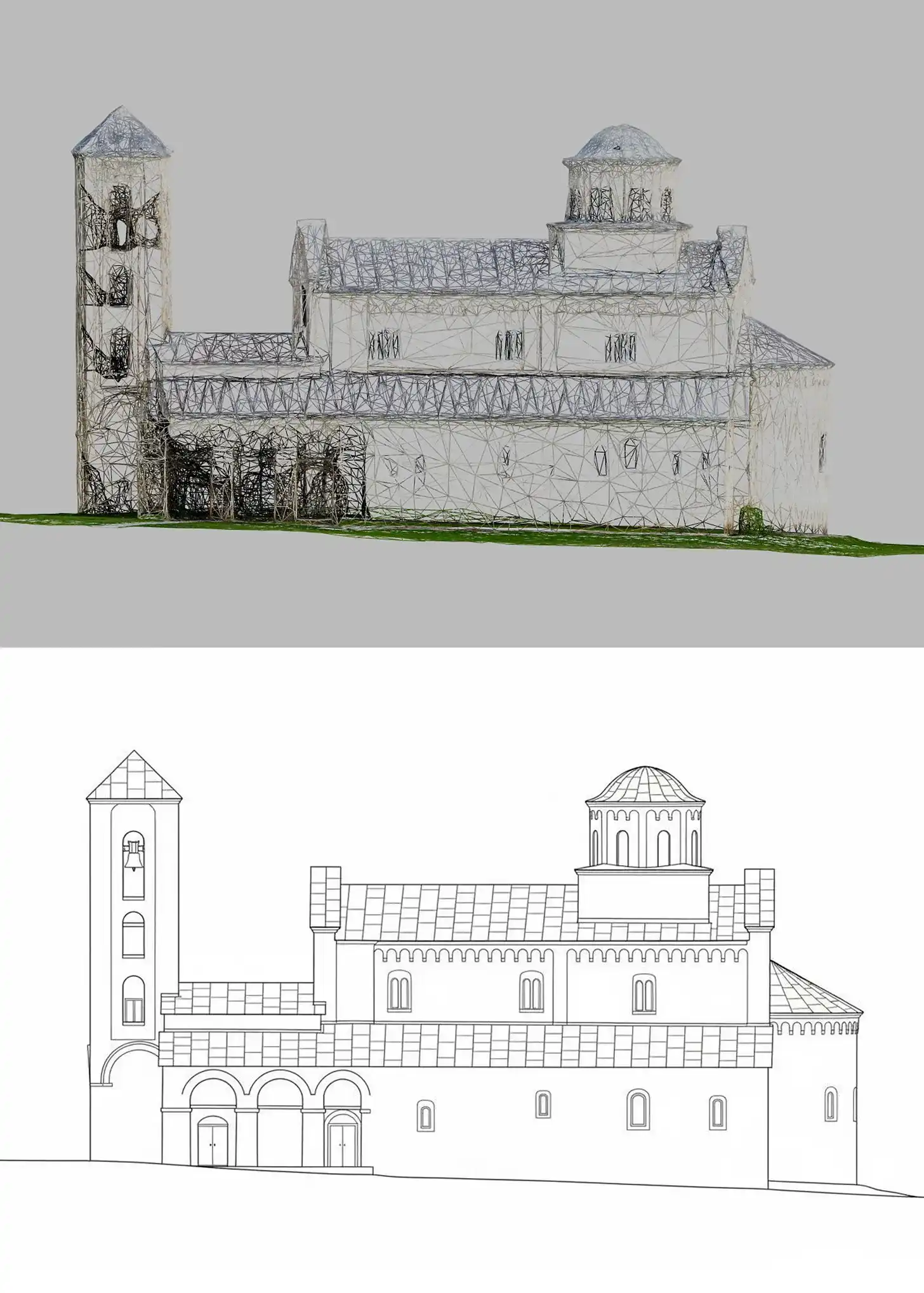
Wireframe and Survey Line-Drawing Mode, Sopoćani Monastery
Unlike general online model repositories, Funes also provides a professional “Orthographic View” function. "Orthographic" comes from descriptive geometry, and this mode eliminates the perspective effect of "closer objects appear larger and distant ones smaller" through professional measurement rendering. For example, a tall tower or large cathedral often looks smaller at the top in regular photos, and “Orthographic View” completely avoids this kind of distortion, allowing for a more accurate comparison of the scale of large buildings—whether it's Cologne Cathedral or a Tang Dynasty pagoda, all can be presented with the precision of a Liang Sicheng-style drawing, completely eliminating perspective distortion and lens aberration, greatly helping archaeologists understand architectural proportions.
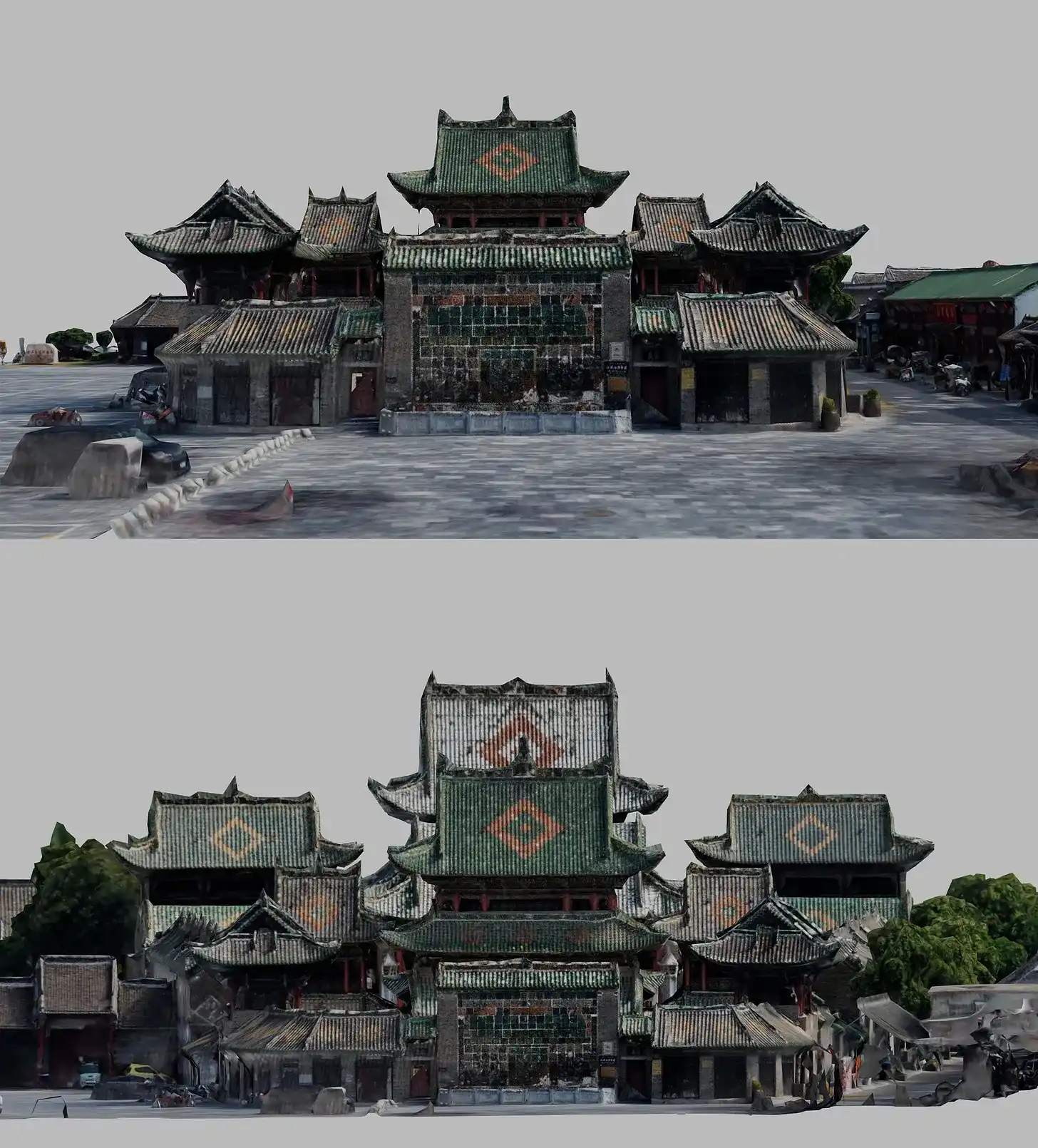
The difference between standard view and orthographic view in the same perspective, Henan Sheqi Shanxi Guild Hall
Building on the “Orthographic View,” Funes has achieved the world's first “Survey Line-Drawing Mode” by leveraging extensive drawing training and optimizing the 3D structure of models, which can automatically generate archaeologically accurate architectural drawings, including plans, elevations, sections, orthographic projections, axonometrics, and orthophotos. The quality meets the standards of the Historic American Buildings Survey (HABS) and fulfills the needs of academic publishing and comparative research. This mode also adopts the UNESCO's standard heritage survey archive format, effectively supporting international cultural heritage protection and “World Heritage” cooperation.
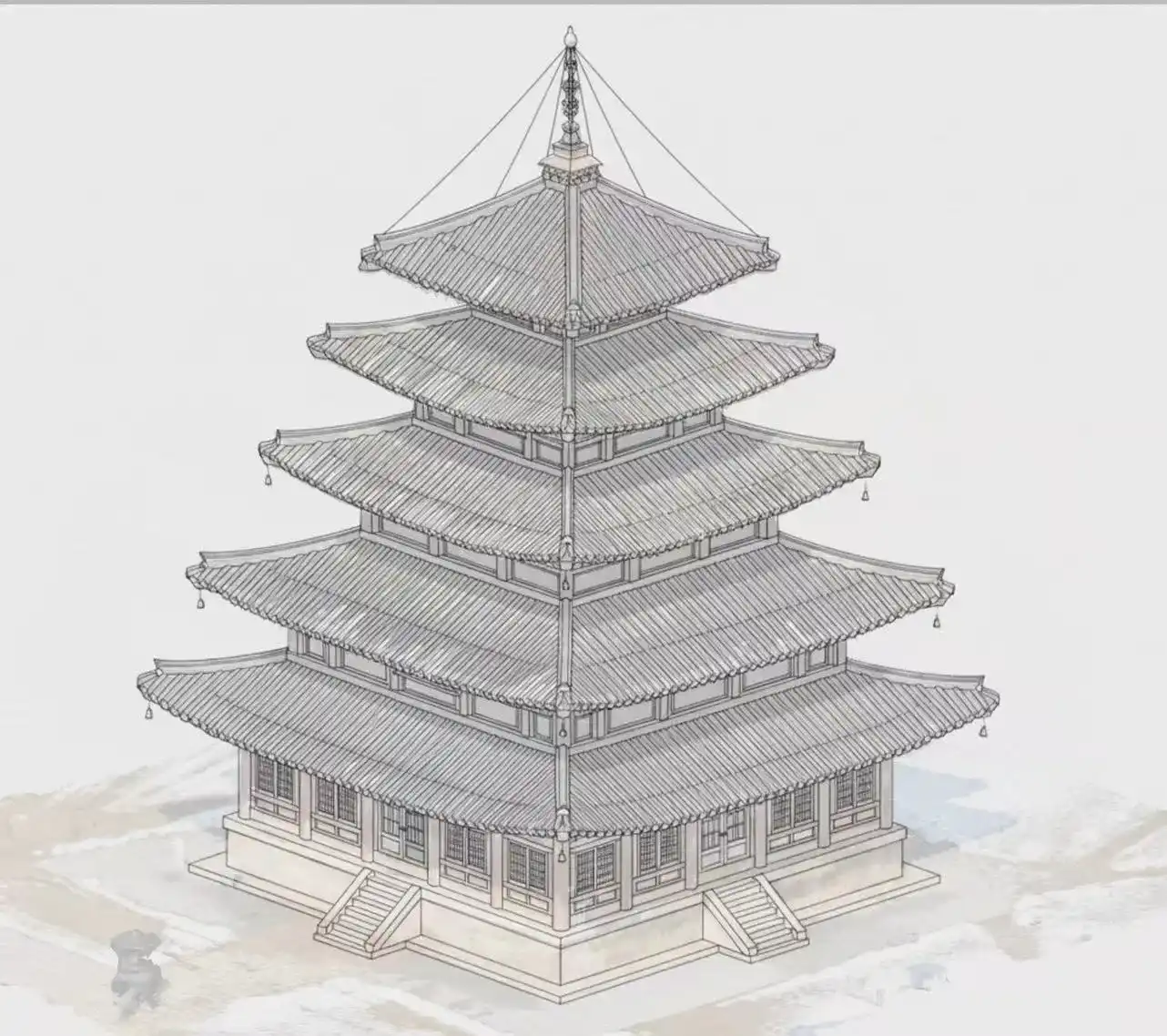
Overlay of the survey map and model of the Eight-sided Hall in Seokgatap Pagoda at the Law AD 54. This hall is the 55th national treasure of Korea.
Thanks to optimized photogrammetric algorithms, Funes' model allows measurement and calculation of scale structures and geometric relationships at every point. Mathematical structures and modular designs found in Bauhaus, Metabolist, and Brutalist architecture can be accurately extracted using measurement tools, assisting researchers in exploring the spatial philosophy within them, such as the eave curve of East Asian traditional architecture or the complex curve structure of Greek temple column proportions. These measurements can also be carried out in three-dimensional space with extremely high precision.
These specialized models provide researchers with tools that were previously only obtainable through expensive on-site surveys.
Next, Funes will soon support 360-degree panoramic views, covering not only the external appearance of buildings but also allowing an in-depth exploration of their interiors, providing a complete spatial experience. Researchers can "enter" a 13th-century Gothic church, gaze up at its towering vaults, and observe the play of light from stained glass windows on stone pillars. They can also step into an ancient Chinese courtyard, experiencing the changing views created by courtyards, corridors, and artificial hills. A complete record of the internal panoramic view can help restoration engineers determine the position of each beam and the spatial relationship of each mural, almost like a digital "Noah's Ark" of cultural heritage.
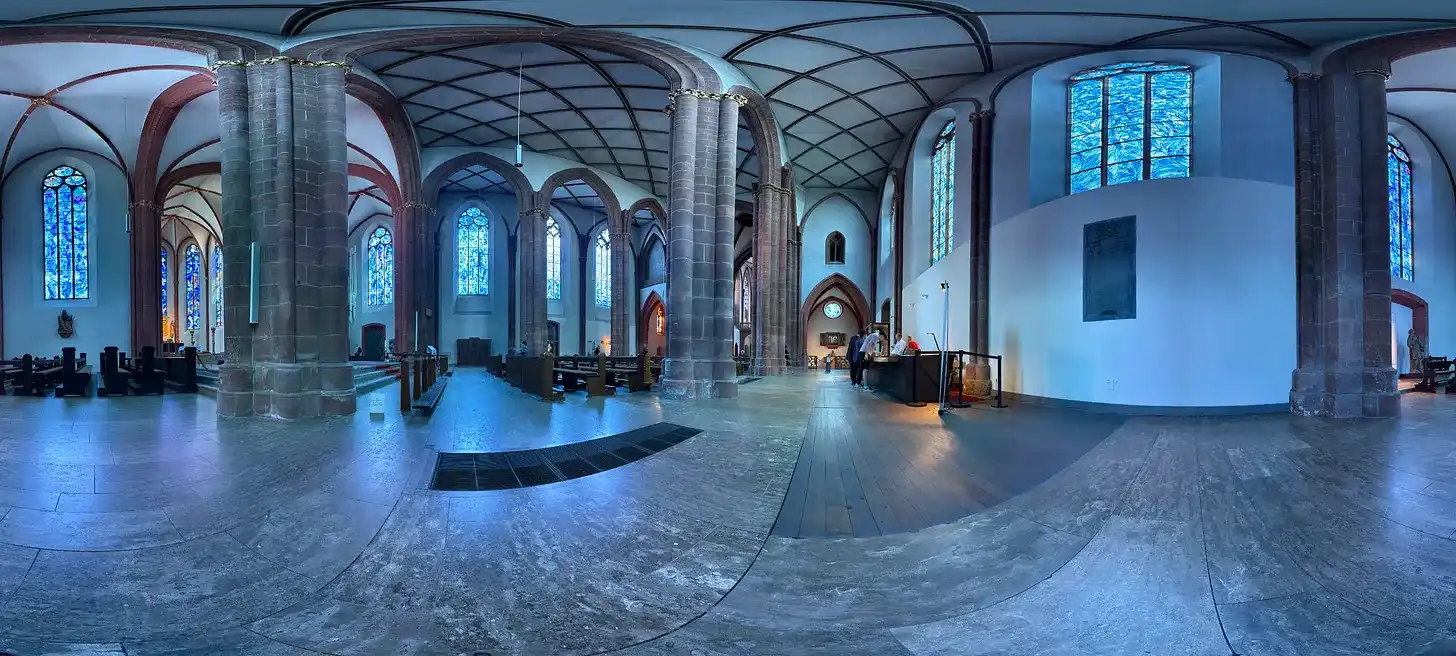
The panoramic photo is from St. Stephan's Church of Mainz, where the entire church's blue stained glass was created by Chagall.
An introductory document for each building model is also crucial. Currently, we are using our in-house AI pipeline to enable machines to understand expert descriptions, academic materials, and the visual features of 3D models simultaneously, thereby generating accurate and understandable encyclopedic introductions. We are gradually introducing real-time AI narration and interactive browsing features. This experimental educational tool allows users to freely navigate, rotate, and zoom in on buildings, while AI provides instant narration of the structural and historical background of the details seen, achieving a deep integration of visual and textual information. Demos are already available online, offering a preview of the effects on the Selimiye Mosque page.
Funes hopes that even if the physical structure of a building is damaged, the civilization's spatial memory can still be preserved intact.
Architecture is the tangible crystallization of different human civilizations, eras, and intellects, and it should be shared by all of humanity rather than meet an inevitable fate in a lonely corner. Many times, buildings are seen as worthless or as hindrances to urban development and are casually demolished. Decades later, someone realizes the incredible importance of these buildings, but can only understand them through archives or photos, by which time it is too late to reverse the damage. The ability of modern humans to appreciate everything around them is questionable; all the spaces around us contain unimaginable significance, as long as we can truly delve into studying and paying attention to the messages they convey.
By lowering the modeling threshold and opening up more data, Funes is driving the true democratization of cultural heritage: a child from an inland mountainous area can now closely examine the details of world-famous architecture, just like a university student on the East Coast of the United States. The openness of model access is not at odds with the diversity of model collection: whether it's a high-precision scan by an archaeological team or photos taken by local residents with their smartphones, each contribution is included in the archive. This means that cultural heritage recording is no longer the privilege of a few experts, but has become a collective endeavor for all of humanity.
The value of a specific place is inherently immeasurable. Its importance can never be solely measured from a societal perspective. The place of our first date, the grassy field where we walked our pet, the room that was once our home but exists no more, the restaurant where we hold fond memories of absent loved ones, the office where we began our career, and the classroom where we last sat—all these places may not pique the interest of historians, but they hold immense value for all of us because they define our human existence through experiences, feelings, and memories. Therefore, protecting these seemingly insignificant spaces is equally crucial.
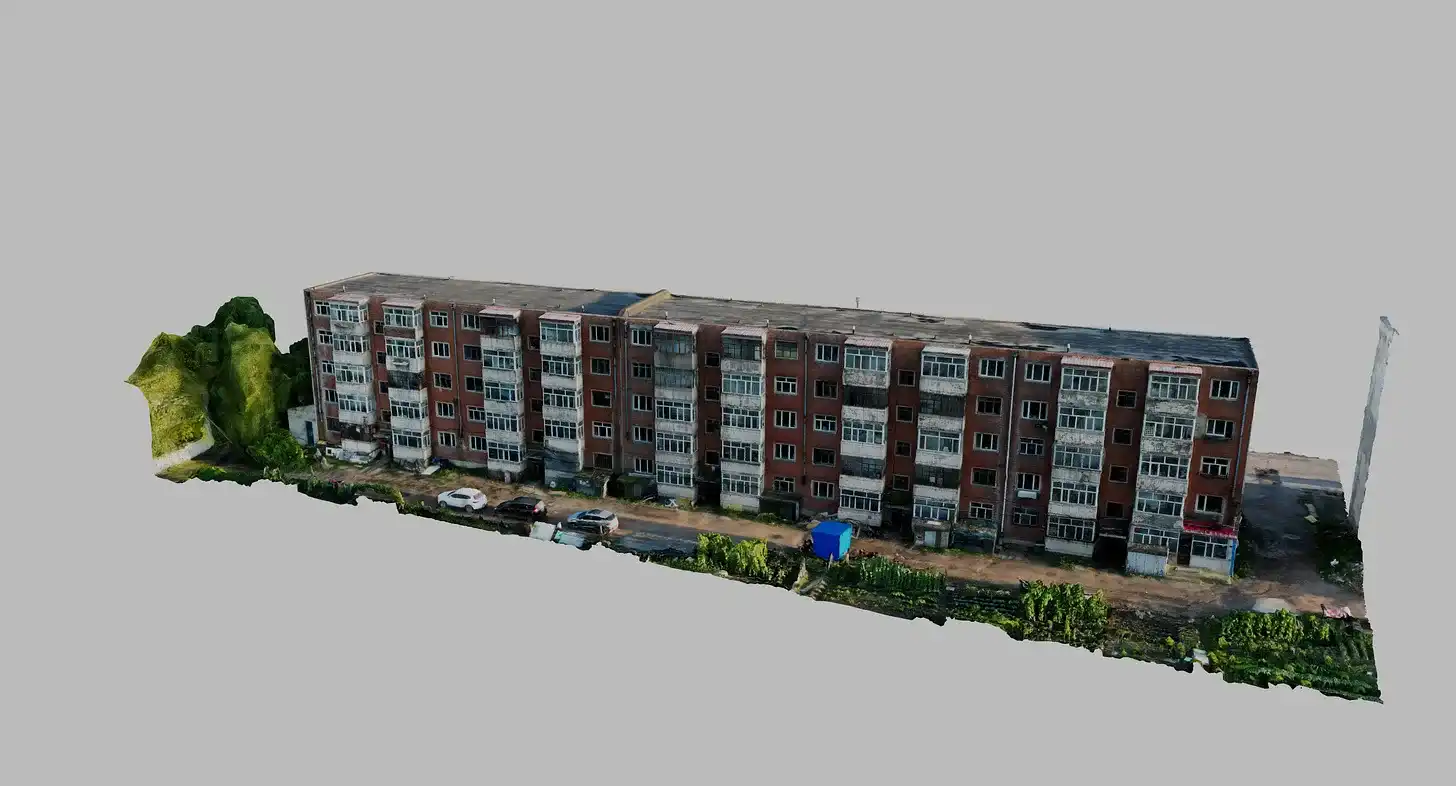
The tube-shaped buildings of Qitaihe are my childhood memories and those of countless others.
Funes's ultimate goal is to connect the online domain with the physical world, not only these carefully researched, planned, and commemorative "important spaces," but our spaces, every fleeting moment in our ordinary yet intimate lives.
1. About Funes's Funding
After starting Funes, three questions were almost always asked whenever I met someone:
1. How to model?
2. How to make money?
3. Who invested in us?
These three questions have a strict sequential relationship. I will write a separate article about the second question next time; this time, I mainly discuss the third one: who were our investors in this round? How did the discussion go? Because fundraising itself is a long, tense, and stomach-churning job for founders, not very interesting to write about. So, for readability, I will focus on a few key excerpts.
I feel that in the current market environment, there mainly exist two types of early-stage projects: those where founders haven't started, but investors are already locked in, or those that can't secure funding. Like a few years ago, companies that worked hard for 4-6 months to raise funds successfully, are few and far between, statistically outliers. Last June when we were preparing for fundraising, we had this mental expectation: if we could get the money by December, that would be great. So it's best for everyone to spend as little money as possible, focus on modeling more, gathering data, and achieving results.
Some people think that fundraising is a moment, where someone wants to invest in you, you take the money, and it's done. But in reality, fundraising is a process, starting from initial contact, moving to formal meetings, discussing terms, making the payment... It takes time. So this means that the founder can't just say, "I'll hunker down and work hard for a few months to present some really good numbers to people." It's not like that at all. Because fundraising is a process, the founder must keep pushing the company forward throughout this process to reassure investors that they are not mistaken.
My life essentially became two parts: going out to model and then engage with users, and going out to meet with investors. These two things cannot be done together because places where investors are often have flight restrictions.
After deciding to start Funes, I went to Xiamen to meet with Teacher Liu Feng, and his only advice to me at that time was: meet more people as soon as possible because the market could turn bad at any time. He discouraged me from preparing first before meeting with investors, and instead urged me to start conversations early and understand what investors are thinking sooner rather than later. At that time, I was traveling between Shanghai and Hong Kong, and HG's KK and Walter had a vast network of contacts, helping me get introduced to the first group of investors to talk to, and also helping me analyze how to pitch. And that's how the fundraising process kicked off.
I have to say, Teacher Liu's prediction was very accurate. Before I knew it, it was already September, and I had accumulated nearly four months of rejections from investors. That wasn't a big deal because rejection fundamentally stems from another person having a different perspective on your company, and sometimes this can be helpful for founders. On a side note, it's a pity that most investors fail to ask questions that can truly impress a founder. Occasionally, when I encounter such a question, I am extremely grateful. The first significant moment in this fundraising round that greatly helped me was in Silicon Valley. Due to the pandemic, I hadn't been to Silicon Valley in three years. Super Brother helped me get introduced to a group of friends in Silicon Valley. After rejecting me, one American investor spent an hour analyzing the current challenges and difficulties of fundraising in Silicon Valley. If it weren't for him, I would have wasted a lot of time.
1.
By September, due to having a lot of engagements, I had come to Singapore. It was just too hot, feeling like I was experiencing an endless summer. One afternoon, I was modeling at the CHIJMES Hall. Since MegaETH's event was held there, Shuyao asked me if I could showcase Funes at the event, so I decided to model the venue. Just as I finished, Siyuan from ABCDE messaged me, asking if I wanted to meet their founder, Du Jun.
My intuition told me that ABCDE was unlikely to invest in Funes, and the distance was too far to walk in the scorching heat. I was wearing my summer modeling outfit: quick-dry shirt and shorts, drenched in sweat, not a great sight to meet someone. I was about to politely decline. However, Siyuan gave me an irresistible reason: he said that from ABCDE's office rooftop, you could see the roof of CHIJMES Hall. This was an offer I couldn't refuse because the area restricted drone flights, and I couldn't capture the rooftop.
When I arrived, he took me directly to meet Mr. Du. When Mr. Du heard me say that we were like the Wikipedia of the 3D world, he told me that he had loved Wikipedia when he was young. Each entry would link to another, and he would imagine himself traveling to different places. He could spend half a day just reading. However, at that time, there was less Chinese content than there is now, so he had to translate some parts himself, and he would only half understand what he read. He then said that Funes's philosophy was very much like Wikipedia, and he fully understood why we wanted to do this.
Then he said, "Let's not talk about investment yet" (my heart skipped a beat), and he personally donated ten thousand US dollars to us (I was surprised).
We then talked a lot about his involvement in the development of Discuz! back in the day. I will probably record a podcast episode with him in the future, so I won't go into detail here. Finally, he said that Funes was also worth investing in, but the investment process would be quite lengthy. So, let's focus on the donation first before discussing the investment. We can achieve more with a bit of money. As we were leaving, he told me that he genuinely liked Wikipedia, but when I meet most other investors, it would be better to use a different comparison for Funes. Everyone says they like Wikipedia, but no investor wants to invest in Wikipedia.
When I heard this, I thought that his offer to donate first before investing was just a polite gesture, but I was still very grateful for the ten thousand US dollars—after all, this was the first funding Funes had received. The next day, we started advancing the investment process, and everything went very smoothly. However, now the ABCDE brand has ceased operations and has been rebranded. Funes may be the last project ABCDE invested in.
As we were leaving, Siyuan kept his word and took me to see the window where you could see the Hall of Praise—it was indeed visible, but too small to capture in a photo.
I want to give a special thanks to Shuyao, who helped us a lot. Thank you very much! MegaETH is also a great project, and I like everyone there (I even thought about poaching some of them). When we were first fundraising, Siyuan introduced us to MegaETH, and later on, we met many friends here, which was a huge help to us. I feel that in entrepreneurship, finding a group of partners who can help each other is very important—it is often overlooked that not only is funding important, but also who is with you during the funding process is equally important.
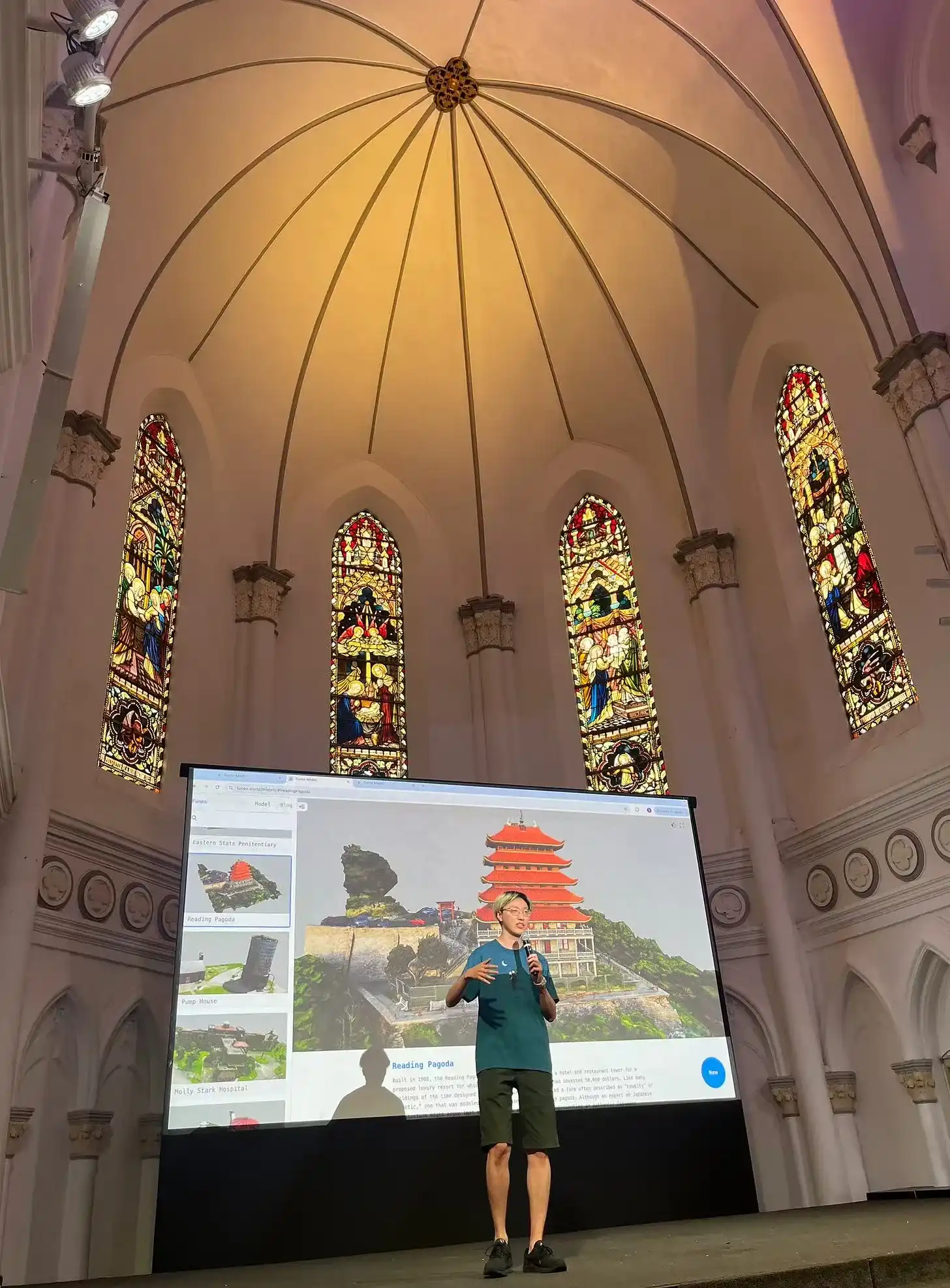
Attended the MegaETH event, back when I still had golden hair (actually silver fading).
Two.
The day after meeting with Mr. Du, Dragonfly's GM messaged me: Could I stay an extra day in Singapore to meet with Bo Ge (Mr. Feng Bo)? They would reimburse the cost of changing my flight. At that time, I was chatting with Mable, and she said, "If you can meet Bo Ge, you should go quickly." Moreover, the rescheduled flight was cheaper than the original one, and Ctrip even refunded me over a hundred yuan.
I first met Bo at his house, and as soon as I walked in, I was immediately drawn to a piece of artwork by Ernst Haas.
Since many of the subscribers to this newsletter may not be familiar with what I have done, let me explain. If we only consider my day-to-day work, one could say I am a photographer. Ernst Haas, on the other hand, was a pioneer in color photography, and the photo at Bo's house was one that I had seen in my class materials. I had originally thought it was a small piece, but it turned out the original was quite large.
So, unlike a typical fundraising meeting, my first question when meeting Bo was: "That piece is by Ernst Haas, right?" Bo probably didn't expect someone to ask that, so we ended up talking about photography. Thus, our conversation that day was a mix of Funes, large format cameras, Polymarket, Mamiya 7, Protra 400, interests in the future, the meaning of life, and a series of completely unrelated topics. Despite my years of fundraising experience, I had never had such a wide-ranging conversation.
GM has been in charge of the Funes project all along and has been very dedicated. However, we faced a significant challenge with Dragonfly: we were asking for too little money. Let me explain: for large funds, investing in small projects does not necessarily reduce the amount of effort required. There is still post-investment management to consider. So, one usually needs to calculate how much we can handle with this fund and these team members? This leads to a minimum investment amount.
For founders, taking more money is not always a good thing. More money either means giving up more equity or a higher valuation. Frankly, I believe that valuations of non-public companies are like paper tigers, often inflated to satisfy the founder's vanity. Becoming a founder of a company valued at one billion dollars holds no appeal for me. We can only raise funds at a reasonable price without giving up too much equity.
However, Bo didn't put me in a difficult position. He offered me a solution: whatever was left in this round, he personally would invest in.
So, I ended up having the first and last investors in this round. Bo quickly arranged for me to meet Mable, his wife, who is also a podcast host. It was on her show where Huan and I first publicly introduced Funes.
Three.
York from Generative Ventures and I had always wanted to meet in person to chat, but it never happened—we were preoccupied with fundraising 80% of the time. Even though we were both working remotely, when it comes to investments, we still hope for a face-to-face meeting. Later, York suggested, "Why don't you meet with my partner Will first?" However, similarly, the two of us could hardly find a time to meet. Finally, he came to Beijing, I went to Shanghai, and we met at a KFC at Hongqiao Airport. I brought a 3D-printed plastic model of the Liaozhong Beijing Daming Tower and used it to explain. He could sense that the tower was meant to be my gift—except it wasn't because we didn't have time to print more, so I had to show this to everyone. Nevertheless, the investment deal was sealed at that KFC.
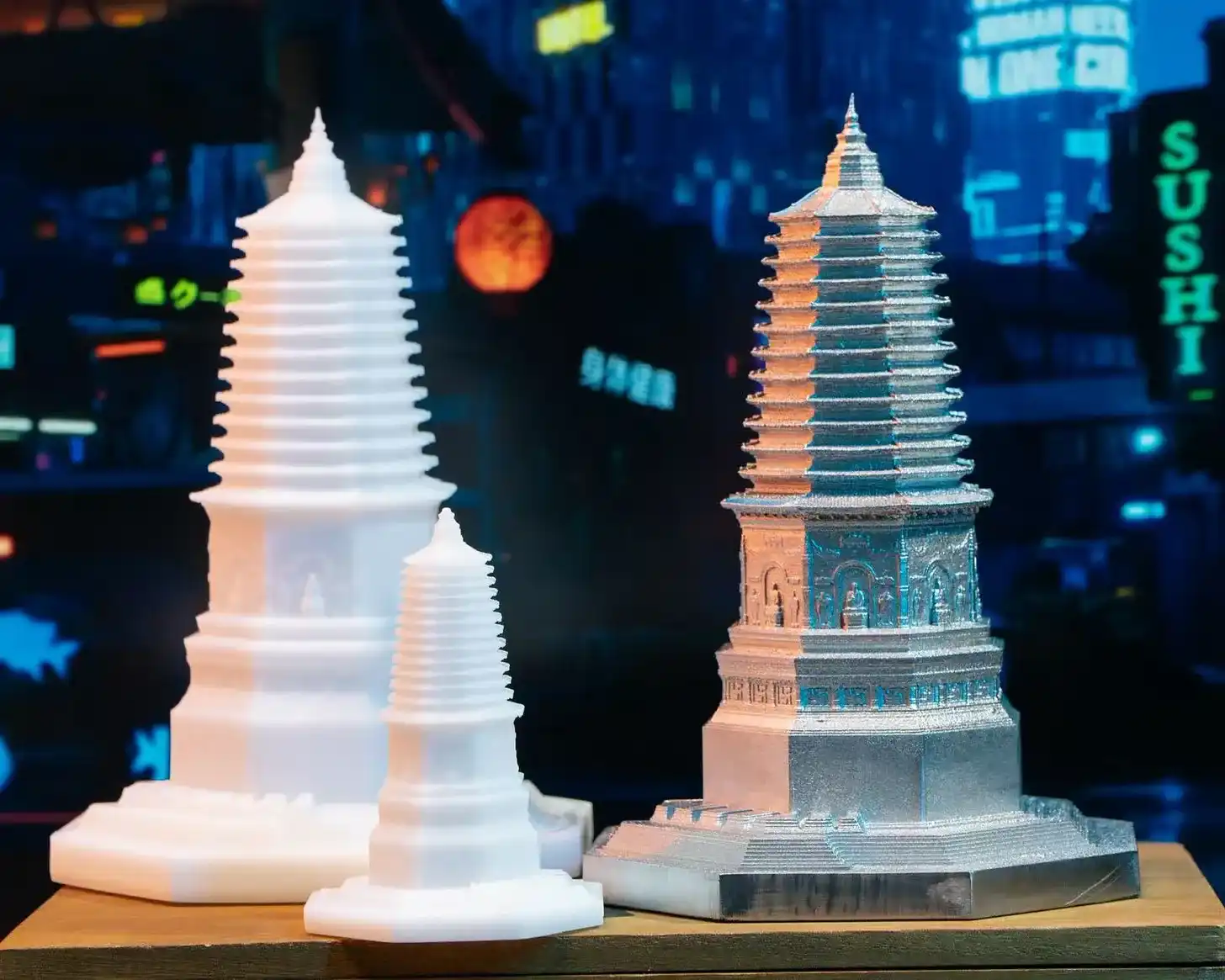
At that time, I was holding the large white stupa in the picture, but now all three in the picture have been given to friends; the two on the left are plastic 3D prints, and the one on the right is a stainless steel 3D print + polished
Later, he also introduced me to Anna, the founder of BAI. Before meeting her, I asked Xiaowan, the founder of WanDian, if she knew Anna. She said Anna is a very easygoing and talkative person, and indeed she was when we met. I just wanted to say that if any of my friends see this, could you come or recommend your portfolio company to join our "Mayfly World" for a chat!
Then he mentioned the plastic stupa incident. When I came out of the airport, I went straight to HashKey's office. I met Jeffrey from HashKey at Li Yang's dinner in Chiang Mai. I didn't know Jeffrey was an investor, but after returning to China, he invited me for a chat. We didn't talk much about projects, but we chatted a lot about the Liao Tower. So when I came to Shanghai this time, I brought this plastic version of the Liao Tower with me. Therefore, the deal with HashKey was conducted during the discussion about the Liao Tower.
Of course, the fastest round this time is thanks to a dinner at our investor Michael Jin's house and Owen's finalizing of a financing deal. Well, financing indeed may require dining a few more times. Our cooperation with D11 was also discussed at a restaurant in Dubai that seemed to specialize in tourist meals.
Here, I also want to thank a friend, Jarseed—whether in Beijing or online, he helped me and several partners understand a lot about the industry.
Four.
No more casual talk; there are some investors not mentioned here, and for that, I apologize. I believe many friends reading this article should have seen the news of YZi investing in us. So let's talk about that.
I actually talked to YZi very early on. Shortly after the first meeting with Mr. Du, I met Dana from YZi Labs. At that time, they hadn't changed their name yet; they were still called Binance Lab. However, I wasn't too optimistic before the meeting because Funes didn't seem like a project that Labs would invest in. But after chatting with Dana for over two hours, I felt there was still a chance. Dana's curiosity about Funes was more focused on us as partners. We talked a lot about the stories that happened during modeling. Of course, we also talked about why I wanted to write for Binance at the time.
In fact, if you've read up to this point, you may realize that your investor is unlikely to engage with you only about the project the first time they meet you. It's possible that the person investing in you will be interested in you holistically, and details about the project itself will gradually be discussed throughout the lengthy fundraising process. So, based on Dana's questions, I feel like progress should be possible.
However, two things happened afterwards: Binance Lab was renamed to YZi, and Siyuan left ABCDE to join YZi. Therefore, internal adjustments take time, and I was hesitant to push forward—Siyuan led the investment in us at ABCDE and has a vested interest. In fact, throughout the entire fundraising process that followed, except for friendly meetings, Siyuan avoided the whole process.
On the other hand, Dana took the initiative to reach out later and set up a meeting in Hong Kong. It just so happened that the three of us, Keda, Zhongqing, were all coming to Hong Kong, so we brought along the brochure we had just completed. The brochure contained photos taken during our Funes journey. So, the three of us, along with Dana, Ella, Siyuan, and Nicola, sat on either side of the largest table in the coffee shop, starting the conversation from this brochure.

In the distance of the picture is the great Ming Pagoda of Liaozhongjing, the first model Funes put online
As a founder, I thoroughly enjoy engaging with outstanding investors. Because a good investor is never in a rush to prove they are right. When you meet enough investors, you will realize that many of them are just looking to prove their intelligence in front of you. So, discussions with good investors about fundraising are not about questions and answers but about exchanges. Founders also throw questions at investors. Our main question was simply this:
What should Funes look like in YZi's eyes?
Many investors have said that since Funes is based on photo-based modeling, is there a possibility for it to become the 3D version of Instagram? Here lies a significant logical gap: should a startup become a specific likeness in the founder's mind, or should it swiftly become "any big company"? Many founders deceive themselves at this point; they might say our company will become XXX—where XXX can be any major company. For example, if Funes claims it can become this generation's Instagram. When I say this, do I mean that the Instagram model is something Funes can learn from, or is it just because Instagram is a successful large company with which we can align, thus using this comparison? This balance is within the founder's own mind, but for us, Funes has a specific image in our minds, and becoming "any big company" is not the goal.
Most importantly for us, Dana identified that it is crucial for a founder to calmly reject what they are not when discussing the vision with investors. Dana casually mentioned an example at that time: Github is like that, where the Founder is creating what he envisions the world should be, rather than focusing on market share. The founders of Github believed that the organization and flow of the code world should be a specific way, and they aimed to achieve that, instead of shaping themselves to beat competitors and achieve a monopoly. Both founders and investors need to have their limits.
During this conversation, Dana paused for a moment and said, Funes is very much like the Github of the Physical World. Upon hearing this, I realized that this was the best analogy for Funes that I had ever heard—of course, we did not set out to become the Github of anything, but it is indeed a very good and easy-to-understand analogy. I have been using this in most situations now, but I must say that I did not come up with this (I wish I did, hahaha).
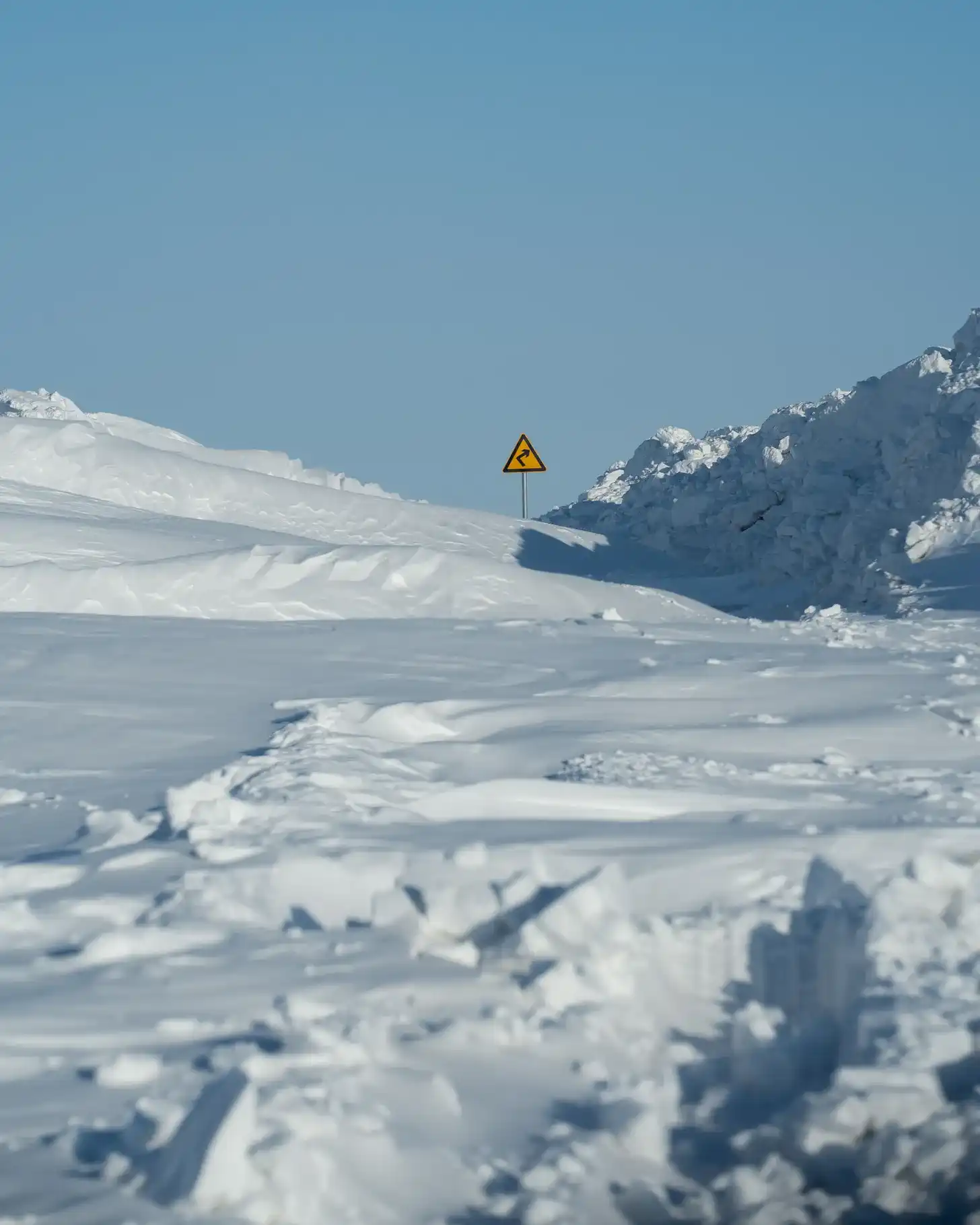
The first photo in the art book; this art book was only released in physical form and was never fully online
Later on, Ella messaged me, saying that when she left Hong Kong, she had a lot of things to take with her, but she brought our art book home. This made me very happy because these images represent the journey we have taken.
Next, I had a chat with CZ. I had a video call with him and Keda from the hotel in Huludao. I was particularly worried about the internet connection in that place and did several rounds of testing back and forth. I joked that this might be the most important video call in this local hotel since it was built.
During the formal conversation, CZ mentioned that he had known me for a few years, understood that I was more idealistic, and was serious about what I was doing, not someone looking to make a quick buck (thanks for the recognition). So, he also wanted to see the other members of our team. Therefore, the conversation was mainly between Keda and him. They discussed the projects Keda had worked on, what architectural archaeology is, and which countries' historical buildings need more protection... If you don't know Keda, then I highly recommend listening to this episode to experience his charm. I have always felt that a hundred years from now, if history remembers me, it will be because I once drove Keda. Going off track, CZ and Keda also had a great conversation. Then, the two of us went to meet Sister No. 1 again. Before meeting her, I realized my mistake as a founder: Sister No. 1 was one of the first people to pay attention to Funes, probably in the top ten. Even many people in our company have not paid attention to their own accounts, but Sister No. 1 did. Unfortunately, at the meeting, I forgot to ask her how she first discovered Funes. I will have to ask next time we meet.
Just a side note: Founders enjoy interacting with other founders, which means that during fundraising, if the other party's leader has their own entrepreneurial experience, we actually have better conversations. There are many entrepreneurial contexts that don't need to be explicitly mentioned.
Five.
Reading this might feel contradictory to what was written at the beginning, wasn't it said that fundraising is quite difficult? It seems like a casual conversation now, right? Yes, because it wouldn't be meaningful if I didn't write it like this. If I strictly followed the process in writing, it would be a very long and boring account.
This article is different from what I usually write, so I'm not sure who will read up to this point. Nevertheless, reaching this point is fate, and maybe the reader is a founder like me. So, setting aside these dramatic details, I want to talk about what else we have done. The moments I've written about here only represent 1% of our fundraising process. The rest is made up of dull, tedious, and boring work. But founders thrive on doing these things. We don't live off that 1% highlight moment; the remaining 99% is the essence of our existence.
What we did ourselves in this round of fundraising also played a significant role.
1. Funes' MVP evolved from a conceptual webpage into reality. We built a whole set of cloud-based modeling and front-end rendering processes from scratch. And due to the unique attributes of the buildings, we created a custom data management system. Every step of this progression is visible to investors. We can assure that every time an investor sees us next, the product has advanced.
2. We really took a lot of models. The entire team was basically non-stop, going to all the places we could to model. Ultimately, the Funes project is a physical endeavor. Why would someone be under the sun, sweating, capturing an unnoticed building? Actually, when investors invest in us, they are understanding this process.
3. We have users. Every week, we host modeling sharing sessions, and each session is larger and more attended than the previous one. Moreover, many people actually go out and model their own buildings after attending the sharing session. At the end of the day, a project doesn't thrive on fundraising but on users. I am very, very grateful to these friends participating in Funes.
4. We were lucky. Many key moments in this process weren't solely due to my efforts but also involved luck. How do we view effort and luck? A few of us partners really like a phrase:
A warrior, before his duel, also prays to God, asking for courage and determination, but he never prays for victory itself.
Aside from funding, there are some additional costs: First, I estimate that I will not be writing any new articles in the Binance series in the near future. This series is for media contributions and presents a conflict of interest. However, if possible, I would like to interview CZ or another key figure using my own account, Fuyou Tiandi. Also, some time ago, I conducted an interview with Xiaofeng, the CEO of HashKey. Unfortunately, this interview could not be published for various reasons. Now, due to our partnership, it is not suitable for media publication. Nonetheless, it was a very insightful interview, and I will explore the possibility of publishing it in my own newsletter.
The story does not end here, as Funes' latest round of funding received help from many friends. I am unable to list them all again, but I am extremely grateful to each and every one of them.
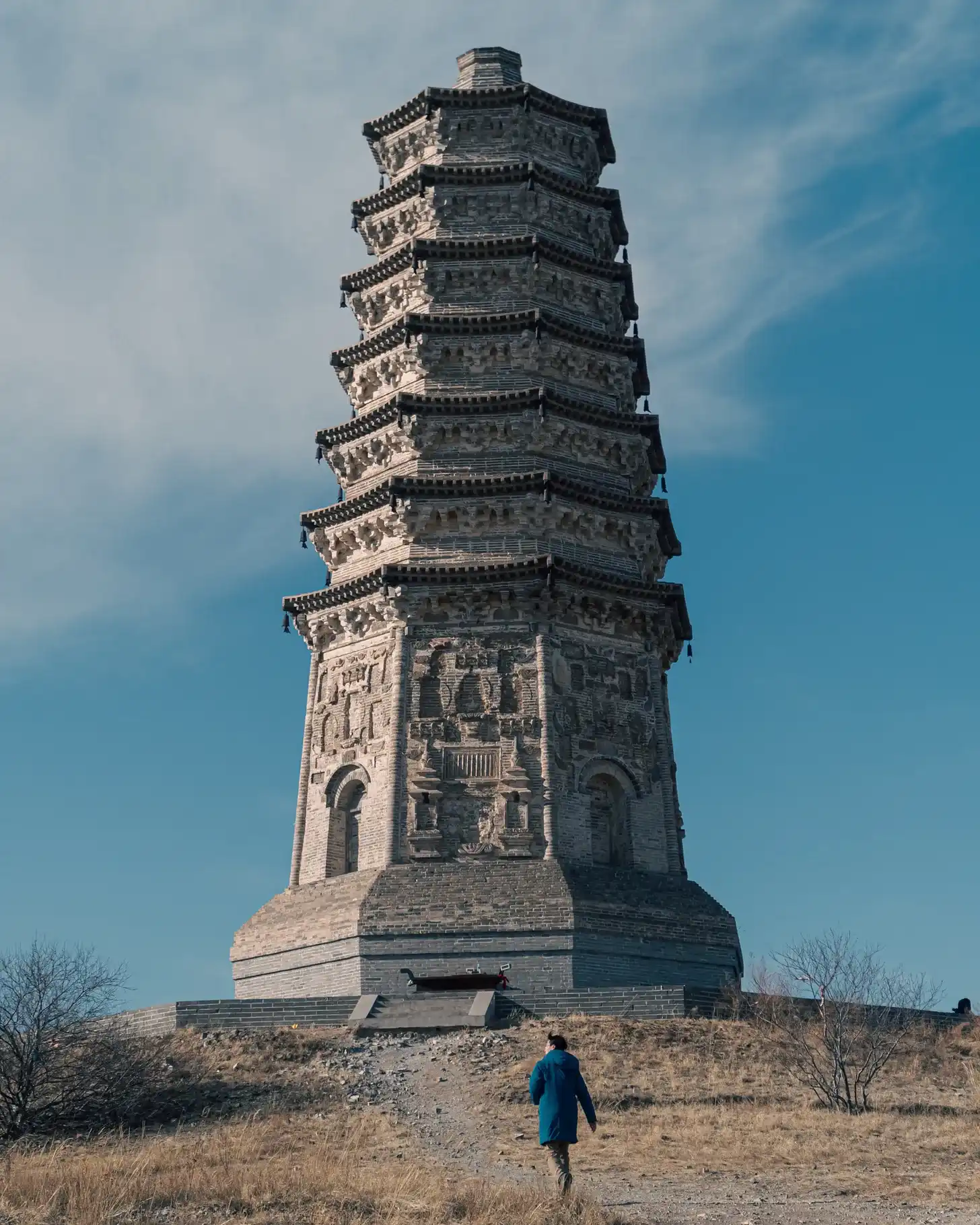
Han and Yang journey to the Southern Pagoda of Liaoyang
Lastly, Why "Funes"?
Modeling the whole world, why such an obsession with this endeavor?
Because we are likely the last generation to fully live in the physical world. With technological advancements, the cyber world will inevitably become increasingly important in human life, surpassing the physical world in significance. The most grandiose and magnificent human constructions in the physical world are now history, and our generation is likely the last to dedicate time, money, ambition, and life entirely to building the physical world. For the next generation, the cyber world is the ideal to strive for.
Therefore, it is time to leave a legacy for this material and spatial world. What we are doing is creating a death mask for this inevitably rigid and decaying world. Before transforming into the peaks, triangles, UVs, projections, pipelines, and parameters of the cyber world, we leave behind a final semblance.
For ten thousand years, humanity has endeavored to transform the Earth's surface using soil, wood, stone, brick, glass curtain walls, and reinforced concrete, all but a dream. Now, the awakening from the dream has arrived, and we are jotting down notes on the dreamworld, capturing a sidelong glance at past illusions.
So you could also consider this project as the ultimate museum, one that can never be completed. Ultimately, all matter that has ever existed in the world, all museums that have housed this matter, and all museums that have collected those museums will become part of the collection and subset of this final museum.
This is why the project is named Funes. It is derived from Borges' short story "Funes the Memorious," which is a story that encompasses all stories, just as our plan is to collect all museums in the museum.
During the process of constructing this endless, eternal, and possibly futile museum, everything will be nurtured.
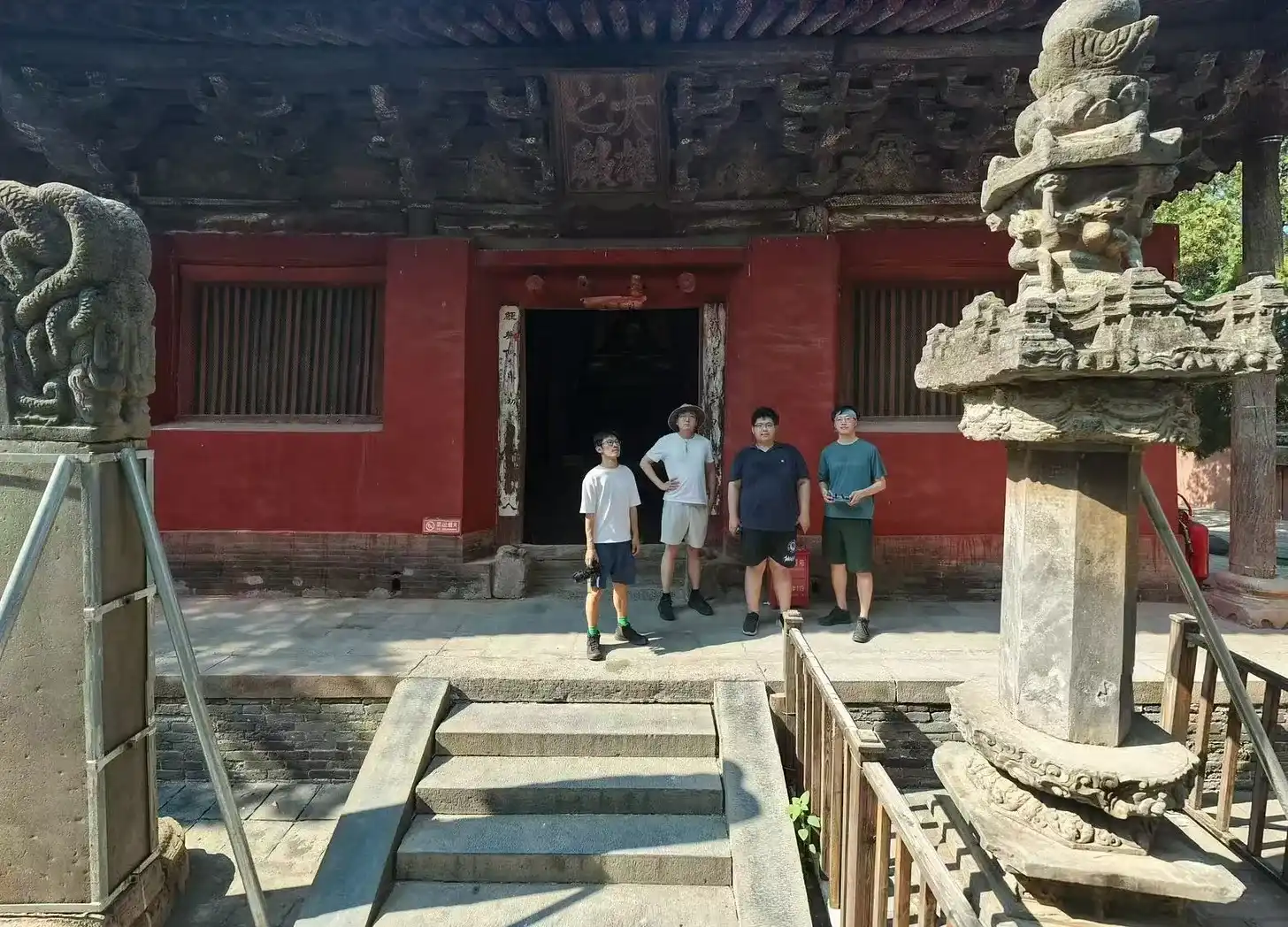
Photo of Funes' first-party modeling team at the Holy Mercy Temple in Henan, on a day close to forty degrees
Appendix: Recently, we have released the download of the standard precision model. If you wish to use our model for any form of re-creation, just double-click the mouse, and we hope you can also share it with us.
Since you've come this far, I feel you must also be quite interested in Funes. We hope to collaborate with independent developers to try out some applications and new gameplay for the model together. We can open up a lot of data (including but not limited to models and photos).
If you are interested in us, please contact me at hy@funes.world. Or if you feel that you are a good fit for the Funes team, self-recommendations are also very welcome!
You may also like

HashKey Secures $250M for New Crypto Fund Amid Strong Institutional Interest
Key Takeaways HashKey Capital successfully secured $250 million for the initial close of its fourth crypto fund, showcasing…

Palmer Luckey’s Erebor Reaches $4.3B Valuation as Bank Charter Progresses
Key Takeaways: Erebor, a digital bank co-founded by Palmer Luckey, has raised $350 million, bringing its valuation to…

Kalshi First Research Report: When Predicting CPI, Crowd Wisdom Beats Wall Street Analysts

The Trillion-Dollar Stablecoin Battle: Binance Decides to Step in Again
Are Those High-Raised 2021 Projects Still Alive?

High Fees, Can't Beat the Market Even After Paying 10x More, What Exactly Are Top Hedge Funds Selling?

2025 Token Postmortem: 84% Peak at Launch, High-Cap Project Turns into a "Rug Pull" Epicenter?
Polymarket Announces In-House L2, Is Polygon's Ace Up?

AI Trading Risks in Crypto Markets: Who Takes Responsibility When It Fails?
AI trading is already core market infrastructure, but regulators still treat it as a tool — responsibility always stays with the humans and platforms behind it. The biggest risk in 2025 is not rogue algorithms, but mass-adopted AI strategies that move markets in sync and blur the line between tools and unlicensed advice. The next phase of AI trading is defined by accountability and transparency, not performance — compliance is now a survival requirement, not a constraint.

Twitter 上的「虚假流量」是指通过操纵关注者数量、喜欢和转发等指标来人为增加一条推文的影响力和可信度。下面是一些常见的制造虚假流量的方法: 1. <b>购买关注者:</b> 一些用户会通过购买关注者来迅速增加他们的关注者数量,从而让他们的账号看起来更受欢迎。 2. <b>使用机器人账号:</b> 制造虚假流量的另一种常见方法是使用机器人账号自动执行喜欢、转发和评论等互动操作,从而提高一条推文的互动量。 3. <b>推文交换:</b> 一些用户之间会进行推文交换,即互相喜欢、转发对方的推文...
Facing Losses: A Trader’s Journey to Redemption
Key Takeaways Emotional reactions to trading losses, such as increasing risks or exiting the market entirely, often reflect…

Beacon Guiding Directions, Torches Contending Sovereignty: A Covert AI Allocation War
Key Takeaways The AI that rules today’s landscape exists in two forms—a centralized “lighthouse” model by major tech…
Decoding the Next Generation AI Agent Economy: Identity, Recourse, and Attribution
Key Takeaways AI agents require the development of robust identity, recourse, and attribution systems to operate autonomously and…

Nofx’s Two-Month Journey from Stardom to Scandal: The Open Source Dilemma
Key Takeaways Nofx’s rise and fall in two months highlights inherent challenges in open source projects. A transition…

MiniMax Knocks on the Door of Hong Kong Stock Exchange with Billion-Dollar Valuation
Key Takeaways MiniMax, a prominent AI startup, is rapidly progressing towards an IPO on the Hong Kong Stock…

Coinbase to Acquire The Clearing Company in Prediction Markets Push
Key Takeaways Coinbase is set to acquire The Clearing Company, a prediction markets startup, to expand its product…

Understand Tokenization, Differentiating Between the DTCC Model and the Direct Ownership Model
When AI Starts Spending Money: Who Will Underwrite Agent Transactions?
HashKey Secures $250M for New Crypto Fund Amid Strong Institutional Interest
Key Takeaways HashKey Capital successfully secured $250 million for the initial close of its fourth crypto fund, showcasing…
Palmer Luckey’s Erebor Reaches $4.3B Valuation as Bank Charter Progresses
Key Takeaways: Erebor, a digital bank co-founded by Palmer Luckey, has raised $350 million, bringing its valuation to…
Kalshi First Research Report: When Predicting CPI, Crowd Wisdom Beats Wall Street Analysts
The Trillion-Dollar Stablecoin Battle: Binance Decides to Step in Again
Are Those High-Raised 2021 Projects Still Alive?
High Fees, Can't Beat the Market Even After Paying 10x More, What Exactly Are Top Hedge Funds Selling?
Popular coins
Latest Crypto News


Customer Support:@weikecs
Business Cooperation:@weikecs
Quant Trading & MM:bd@weex.com
VIP Services:support@weex.com
 App
App