
- Buy Crypto
- Markets
- Futures
- Spot
- Copy Trade
 Earn
Earn- More
Esteemed data website DappRadar has announced its shutdown, marking another bittersweet moment in time.

Original Article Title: "DappRadar, Another Tear of the Era"
Original Article Author: Eric, Foresight News
On the evening of November 17, 2025, DappRadar, which has been with the industry for nearly 8 years, announced that it would gradually shut down its service and no longer continue to track blockchain and DApp data.
It is said that "a grain of sand of the era falling on an individual is a mountain," which is a perfect description of DappRadar. Born perhaps in the most turbulent era of the "blockchain is dead" narrative, it accompanied Web3 from its stumbling infancy to its spoon dance year, but ultimately could not withstand the pains of regime change. The exit of products like this, imprinted with the mark of the era, reminds me of what the Nokia CEO said at the end of the announcement of its acquisition by Microsoft 11 years ago:
"We didn't do anything wrong, but somehow, we lost."
Those Years When We Used Data Websites Together
Many newcomers to the Web3 industry may not be aware that DappRadar was once a very important and authoritative source of data. In addition to references from sources such as CoinDesk and Chinese Web3 media, including mainstream Western media such as Bloomberg, Forbes, and the BBC have also cited DappRadar data many times.
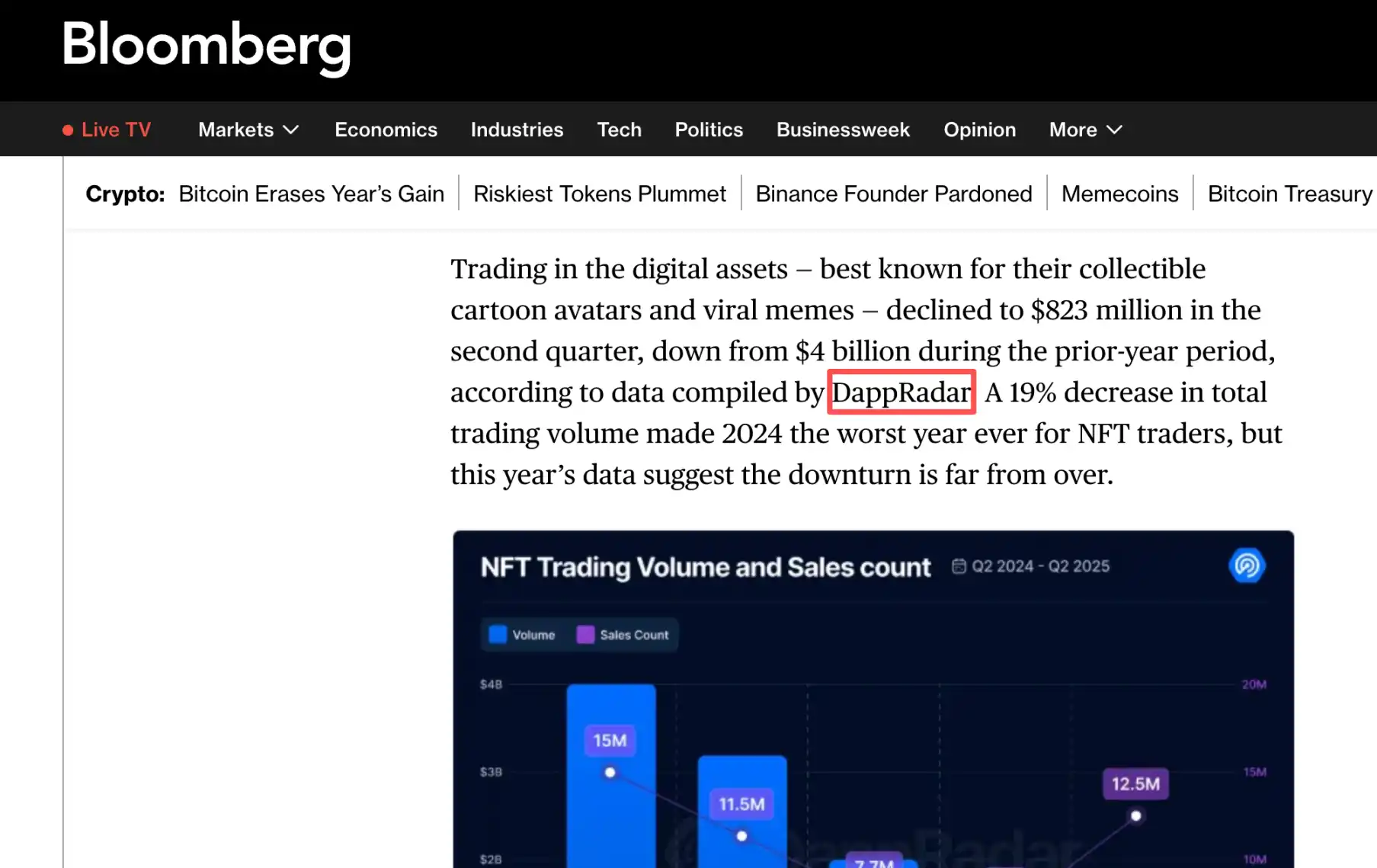
The reason it is called authoritative is that before the rise of professional data websites (such as Nansen, Arkham, DefiLlama, etc.) and professional Web3 marketing tools (such as Cyber, Kaito, etc.), DappRadar was almost the gateway website that all DApps had to be listed on in the early days. The completeness of the projects made its data incomparable in terms of completeness and credibility, almost becoming the only and best way at that time to quickly understand the basic information of new projects.
DappRadar's co-founder, Skirmantas Januskas, is from Lithuania. Unlike many industry giants who hold multiple positions, he has been solely focused on DappRadar from February 2018 to the present. Prior to that, he briefly worked as a software developer at NFQ. Another co-founder, Dunica Dragos, previously worked in operations at the American gaming giant EA in his early years and, like Skirmantas, has been single-mindedly focused on DappRadar since its founding.
DappRadar has received two rounds of investment. In September 2019, DappRadar secured a $2.23 million investment in a seed round from Naspers, Blockchain Ventures, and Angel Invest Berlin. Naspers is the South African multinational media group that famously acquired a 46.5% stake in Tencent for $32 million in 2001 from Li Ka-shing, IDG, and others. Subsequently, in May 2021, DappRadar received a $4.94 million investment in a Series A round from Blockchain.com Ventures, Prosus Ventures, and NordicNinja VC.
The author found a record of an interview with Skirmantas Januskas after completing the fundraising in 2019, at a time when Web3 was at its darkest moment. Despite this, Skirmantas was full of confidence in the industry, believing that as long as the issues of user experience and finding user needs were addressed, "centralized applications would become a thing of the past."
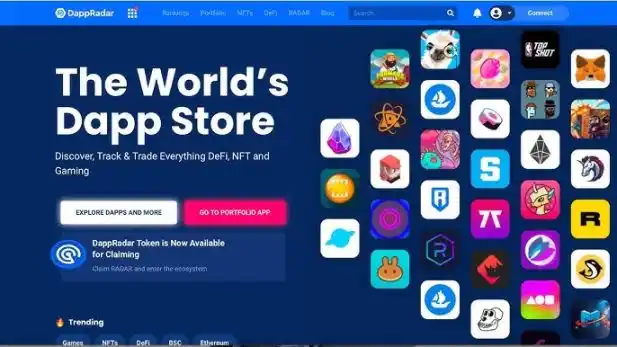
In 2019, this passionate and impulsive visionary expressed his views on DeFi, gaming, and other tracks, all of which eventually saw explosive growth in 2021. While most of the DeFi data pie was snatched by DefiLlama, DappRadar excelled in comprehensive data and deep exploration of emerging concepts such as NFTs, GameFi, and the metaverse, allowing it to have a user base in the millions at its peak. Even for small projects that some Twitter accounts can't find, you can see the DAU fluctuating between 0 and 3 on DappRadar.
Professionalism Became the Original Sin
If one must summarize the biggest reason for DappRadar's failure, it can only be attributed to being overly crypto-native and neglecting the importance of commercialization.
Today, when you open DappRadar's homepage, you will notice that besides the categories they have consistently showcased from the beginning such as gaming, DeFi, NFTs, gambling, and the newly added AI, RWA, and social, you won't see trending topics like memes. So why call Skirmantas an impulsive visionary when even in a track like NFT, they continue to persist in releasing a detailed quarterly report and tracking every nook and cranny airdrop but have almost completely missed out on all the hot trends.
DappRadar has been arguably the only platform in the past two years that has covered all Web3 long-tail sectors and projects, but the issue is that it seems to only focus on the tail.
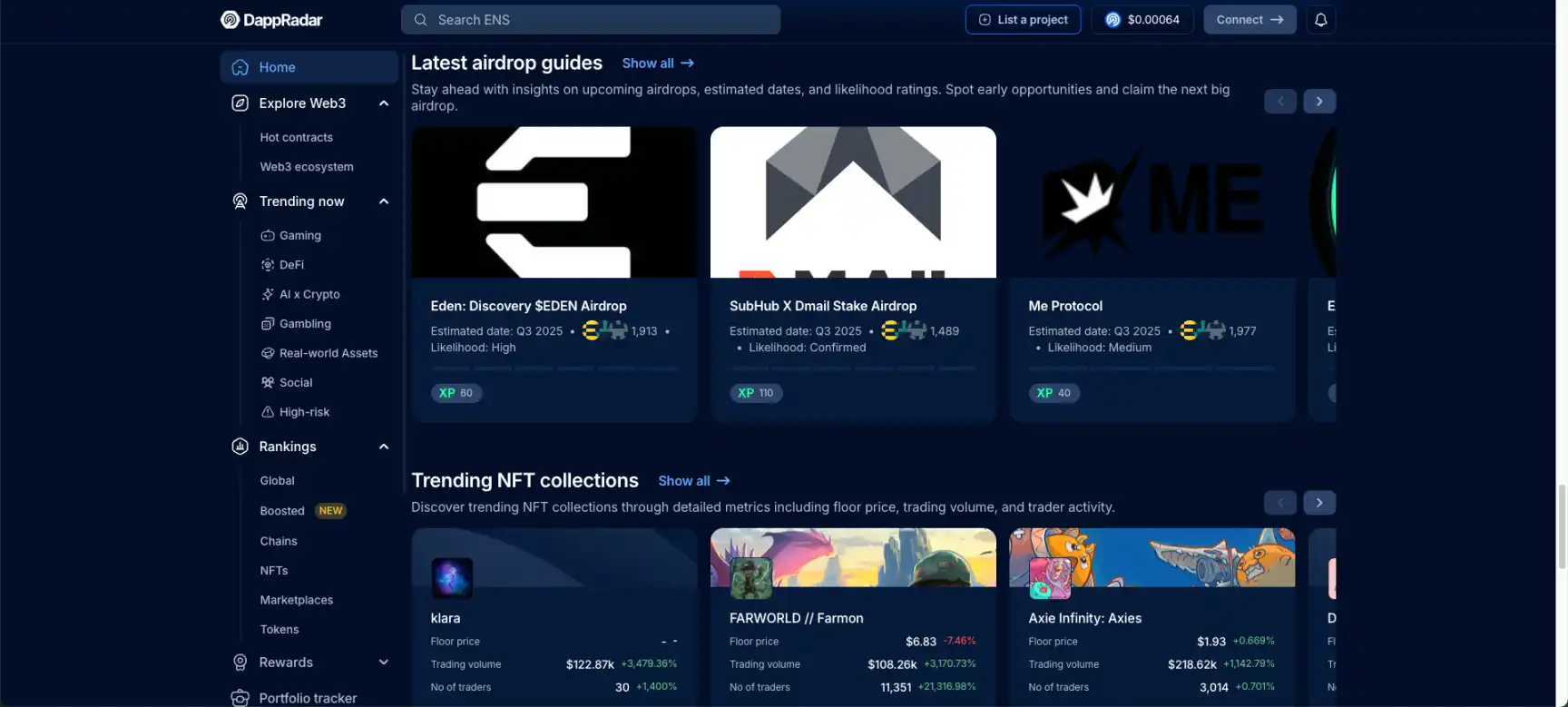
This kind of nitpicking expertise can indeed provide high-quality material for Bloomberg and Forbes, but it lacks any commercial value. The RADAR token launched after the 2021 funding round seems to have not seen a better use case other than subscribing to Pro services, staking, and voting, and it has also blocked the most premium subscription revenue source.
What was initially built on a comprehensive image has gradually turned into a shackle. Its DeFi professionalism is no match for DefiLlama, its token information seems inferior to CMC, its research depth does not reach the level of Bankless, and the only thing it excels at, the NFT sector, has become stagnant. However, I believe that DappRadar itself has long been aware of these issues, so it has also accelerated its commercialization, including providing high-quality data through an API and offering advertising space.
After the 2021 funding round, DappRadar has also been supported for 4 years. Apart from the funding itself, it has certainly generated some revenue through traffic monetization, but obviously, this revenue falls short compared to the cost needed to provide massive data for exponential growth. Moreover, since 2023, although the market has been bullish, there are not many projects with truly sufficient budgets. The limited budget has been mostly spent on KOLs, exchanges, and some emerging platforms, leaving DappRadar, which has been left high and dry, increasingly strapped for cash.
As mentioned earlier, its coverage is too long-tail, and tail-end projects may have no way of knowing what kind of user profile would refer to DappRadar's information under what circumstances. In the wilderness era, DappRadar provided a channel to understand new projects, but after the dust settled, the channel to understand the few "premium projects" has become more widespread, and the relics of the past are no longer the only best choice.
Compared to the concise website of two to three years ago, today's DappRadar is all-encompassing but seems cluttered, which is the result of excessive effort in commercialization, and it is the epitome of the "exhaust all possibilities" in the farewell letter. For DappRadar, without ongoing funding or excessive funding to spend, it needs to show on its website the balance between content curation and ad display. DappRadar's excessive insistence on professionalism or "orthodoxy," and its later realization of the mistake of content and ad stacking, have laid bare its operational shortcomings.
In addition to its own shortcomings, the Web3 data and information platform itself is a challenging business. Today, multi-chain data explosion, rising costs of indexing and servers, and a market demand for high-quality data coupled with a lack of matching payment capability make it difficult. Without other sources of revenue, relying solely on advertising and API sales will inevitably face competition. Platforms with low monetization capabilities, in order to survive, increase ad density and compromise user experience, leading to a seemingly inevitable decline.
The seven-year trajectory of DappRadar encapsulates the common commercialization challenges of such projects: high value, low payment, cost rigidity, and rapid narrative iteration. Its shutdown leaves a clear lesson for newcomers: if a business model cannot be closed-loop from day one, even the most authoritative data cannot prevent "death by hemorrhage."
You may also like

North Korean Hackers Enjoy 'Fat Years': Stole Record Amount in 2025, With Money Laundering Cycle of About 45 Days

Why Is On-Chain Fixed-Rate Lending Hard to Come By? "Basis Swap" Trading Is the Way Out

ZCash Team Split, Bank of America Upgrades Coinbase Rating, What's the Overseas Crypto Community Talking About Today?

Key Market Info Discrepancy on January 9th - A Must-Read! | Alpha Morning Report

Aster Coin: A Deep Dive into Its Price, Potential, and Why It’s Catching Eyes in 2026
Have you ever stumbled upon a crypto project that seems poised for growth amid market volatility, only to…

Left Hand BTC, Right Hand AI Computing Power: The Gold and Oil of the Data Intelligence Era

Farewell to "Air" Investments: Use These 6 Key Metrics to Identify a Winning Project

The old altcoin script is outdated, take you to decipher the new market structure

$250 Billion, 6723 Rounds of Funding: Where Did Crypto VCs Invest in 2025?

Coin Ownership or Equity Ownership? The Real Question Is Being Asked Wrong

Ranger Fund Takes a New Approach to Public Offering: Can a Grassroots Team Earn Market Trust?

Visa Crypto Lead: Eight Key Evolutions of Crypto and AI by 2026

CoinDesk 20 Performance Update: Uniswap (UNI) Dips 1.5% as Index Experiences Downturn
Key Takeaways Uniswap (UNI) experienced a notable drop of 1.5% as the CoinDesk 20 Index saw a decline.…

Crypto Markets Today: Bitcoin Slides as Asia-Led Sell-Off Hits Altcoins
Key Takeaways: Bitcoin could not surpass the $94,500 mark and fell to roughly $91,530, contributing to a wider…

Start-of-the-Year Crypto Rally Stalls: What’s Next?
Key Takeaways The initial crypto market boost at the start of 2026 has lost momentum, primarily due to…

Karatage Welcomes Shane O’Callaghan as Senior Partner in Strategic Move
Key Takeaways Karatage, a London-based hedge fund, appoints Shane O’Callaghan as a senior partner to enhance its institutional…

JPMorgan Targets Canton Network for Next Phase of JPM Coin
Key Takeaways JPMorgan’s Kinexys unit is set to advance the use of JPM Coin by integrating it with…

2025 Crypto Bear Market: A Crucial Year for Institutional Repricing
Key Takeaways The 2025 crypto bear market witnessed significant corrections in the DeFi and smart contract sectors, setting…
North Korean Hackers Enjoy 'Fat Years': Stole Record Amount in 2025, With Money Laundering Cycle of About 45 Days
Why Is On-Chain Fixed-Rate Lending Hard to Come By? "Basis Swap" Trading Is the Way Out
ZCash Team Split, Bank of America Upgrades Coinbase Rating, What's the Overseas Crypto Community Talking About Today?
Key Market Info Discrepancy on January 9th - A Must-Read! | Alpha Morning Report
Aster Coin: A Deep Dive into Its Price, Potential, and Why It’s Catching Eyes in 2026
Have you ever stumbled upon a crypto project that seems poised for growth amid market volatility, only to…


 App
App