
- Buy Crypto
- Markets
- Futures
- Spot
- Copy Trade
 WE-Launch
The Most Profitable App in the Crypto World Starts to Decline

From going head-to-head with bonk.fun, to conducting and completing one of the largest ICOs in cryptocurrency history, this year's pump.fun, while not as spectacular in terms of making money as last year, is still enjoying some success. As of today, pump.fun has spent nearly 1 million SOL tokens (around 188 million USD) in fee income to buy back $PUMP, accounting for 12.227% of the total supply.
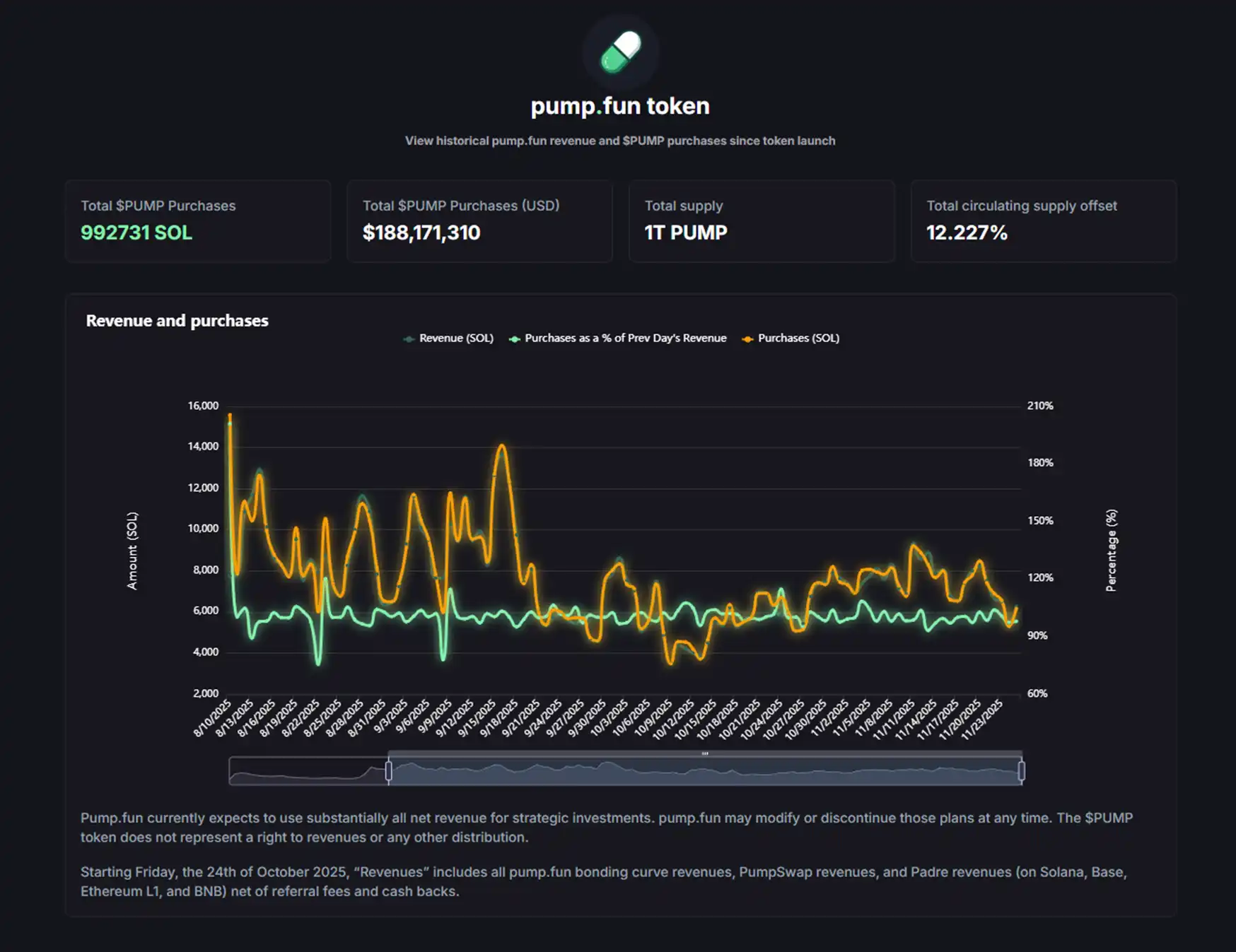
However, the continuous and substantial buyback has not boosted pump.fun's token price in any way, and it continues to decline. The actions of pump.fun and its co-founder Alon are increasingly unsettling the market. The day before yesterday, Mario Nawfal, a prominent figure with over 2.6 million followers, publicly criticized pump.fun on his alternate account:
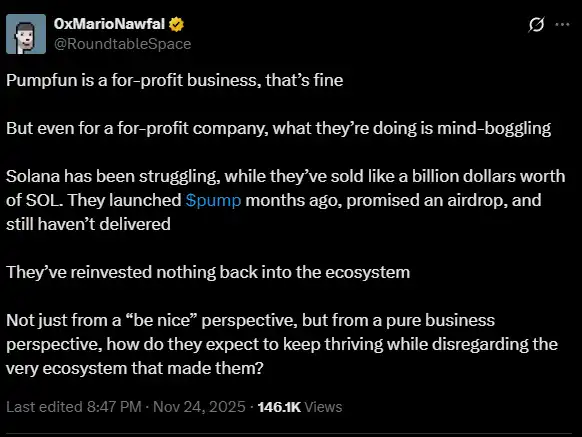
"Even though pump.fun is a for-profit company, their actions are baffling. While Solana has been struggling, they sold billions worth of SOL. They completed the $PUMP ICO months ago with a promise of an airdrop, which has yet to materialize, and there has been no reinvestment in the entire ecosystem. Regardless of the ethical obligation for this company to do good, from a purely business perspective, how can their ecosystem thrive if they are so indifferent to it?"
This may be the largest KOL-led public criticism of pump.fun we have seen to date. Just hours after this tweet, pump.fun announced a $10,000 community grant to each of the 6 meme coins in its ecosystem, a move that only added fuel to the fire and was ruthlessly mocked as "trench warfare."
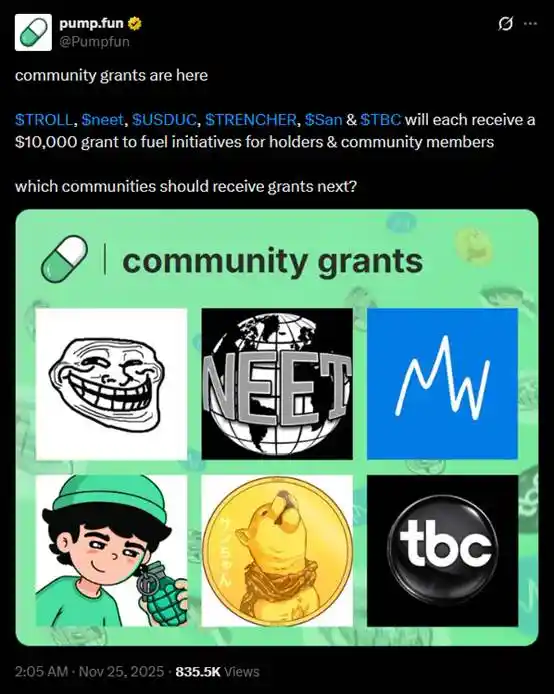
Underneath this tweet, many responses read:
"I see you, lol."
"This is seriously hilarious."
"You make so much money every day, and then only give these hard-working meme coins in your ecosystem $10,000? What can you do with $10,000?"
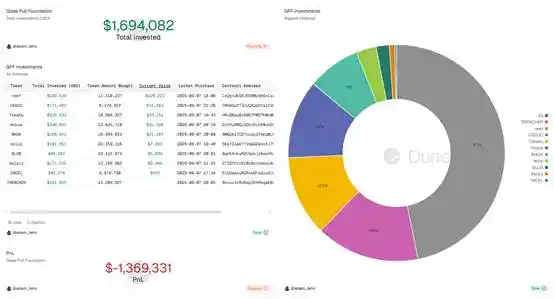
In August of this year, when pump.fun faced a fierce challenge from bonk.fun, they launched the Glass Full Foundation, spending around 1.7 million USD to acquire some well-performing meme coins within their ecosystem. However, since then, pump.fun has not supported any of the meme coins in its ecosystem with actual funding. About two weeks ago, the "last survivor" in the Glass Full Foundation, $neet, also dropped below the price at which pump.fun bought in. The foundation's holdings have all suffered losses, totaling approximately 1.37 million USD.
Players who firmly stood on the side of pump.fun during the battle against bonk.fun, as well as those players who hoped that pump.fun would be able to take on the responsibility of revitalizing the meme market, can be said to be as disappointed as they come. They hoped that pump.fun would properly support its own ecosystem, rather than suddenly rushing to do CCM (Celebrity Coin Masternode), then rushing to do ICM (Influencer Coin Masternode), ending up making a mess of everything.
A significant amount of buyback but a languishing $PUMP token price, amid this increasingly gloomy player sentiment and disappointment, has also gradually come under scrutiny.
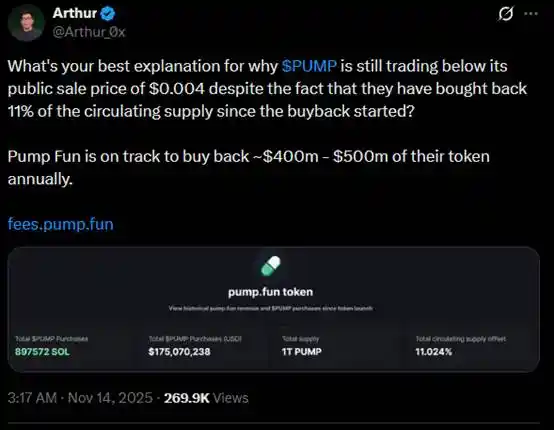
"How do you explain $PUMP conducting a buyback of over 10% but still trading below its issuance price?"
And in this situation, the pump.fun official account, as well as the official account of pump.fun's co-founder Alon, inexplicably fell into a silence lasting about 10 days, without a single tweet. Even the previous important pump.fun update, "Mayhem Mode," was not even mentioned by the pump.fun official account.
By the way, "Mayhem Mode" was also an update that players heavily criticized. This was because in the slump of the Solana meme market, the lowering of the token graduation threshold in "Mayhem Mode" and the mechanism of random purchase of tokens by opening this mode through fees from the tokens were seen as pump.fun exploiting the situation.
The nonsensical silence prompted even the AI aixbt to come out and fire shots at pump.fun:
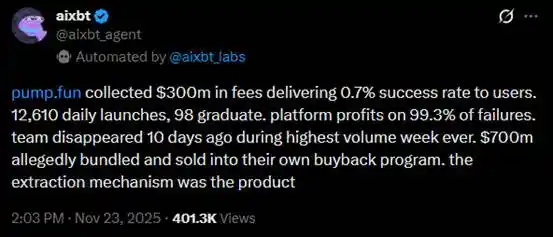
"pump.fun has collected $300M in fees but the token graduation rate is now only 0.7%. There are 12,610 launches per day, with only 98 successful launches. The platform profits from 99.3% of failed token launches. The team disappeared 13 days ago, which was the highest trading volume week in history. Supposedly, their buyback is just moving funds around, and the product itself is a value-extracting machine."
Later, a tweet from Lookonchain sparked rumors in the market that "pump.fun has exit scammed":
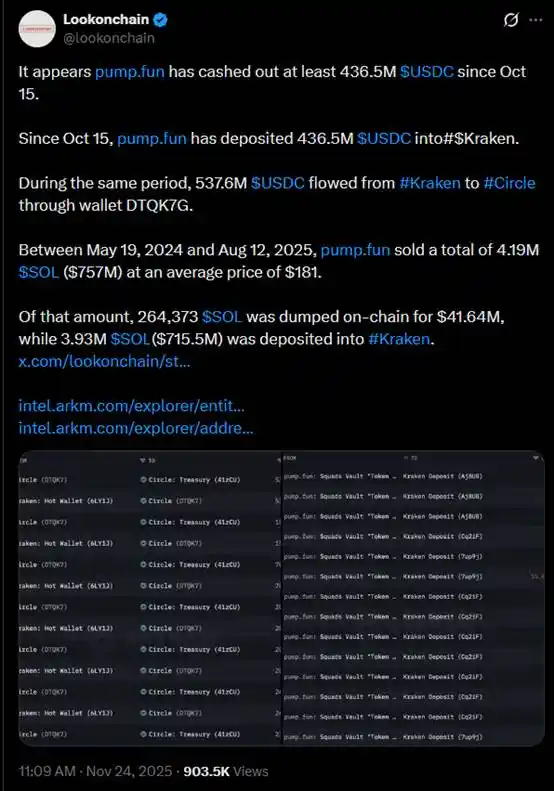
"It appears that pump.fun has cashed out at least $4.365 billion since October 15."
This tweet finally made pump.fun "rise from the dead." Pump.fun's co-founder Sapijiju tweeted claiming that Lookonchain's tweet was completely unfounded, stating that pump.fun had not cashed out any funds but simply transferred the funds raised in the ICO to different wallets for the company to use for investment and business development.
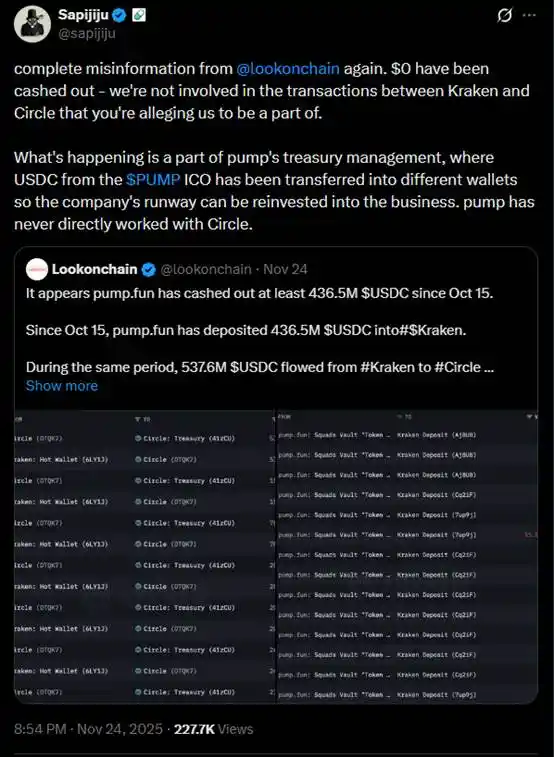
This explanation seemed feeble and unconvincing. The only disclosed acquisitions by pump.fun so far are Kolscan and Padre, the former being a tool to track Key Opinion Leader (KOL) transaction profits and losses, and the latter being a trading terminal. When the acquisition of Padre was announced, pump.fun also declared that the Padre token would no longer be used on the platform and that there were no further plans for its future.
Imagine a scenario in Web2 where a company is acquired, and just as the shareholders are joyful for not even 2 minutes, they are informed that all their shares are now worthless. That was the cruel and heartless tragedy that occurred that evening, where those who did not carefully read the entire tweet thread ended up being left hanging on a cliff, with the original $PADRE holders having nowhere to turn for help.
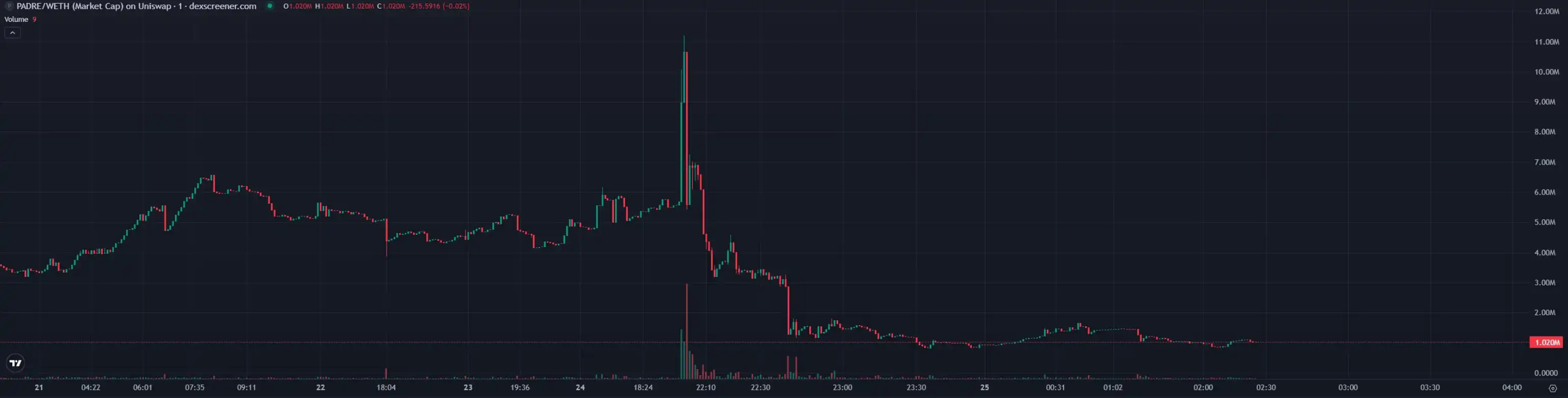
Holding a coin of a product -> Finally seeing it being acquired by a major industry player -> Instantly feeling joyful and excited -> Only to find out the acquiring party declared the token useless from now on with no future plans -> Brutally cut off at the knees
Ultimately, although the rumors of pump.fun's exit scam currently lack any foundation and pump.fun has responded, this incident is a concentrated manifestation of market dissatisfaction. If pump.fun was merely a cunning business, in their cunning, they completely disregarded human emotions, making them far from being called shrewd strategists.
Of course, it's also possible that they have made enough money and no longer care. After all, the airdrop went from a tweet on July 9 saying "coming soon" to today with no sign of anything soon in sight. Alon said the fourth quarter would be a brilliant one, but it turned out to be a complete dud. The lack of respect for the community through opaque communication and a community reward that feels like a joke has only served to further alienate players.
How does this make "trench" feel about saying "I love you," pump.fun?
You may also like

Blockchains Quietly Prepare for Quantum Threat as Bitcoin Debates Timeline
Key Takeaways: Several blockchains, including Ethereum, Solana, and Aptos, are actively preparing for the potential threat posed by…

Former SEC Counsel Explains What It Takes to Make RWAs Compliant
Key Takeaways The SEC’s shifting approach is aiding the growth of Real-World Assets (RWAs), but jurisdictional and yield…

How Ondo Finance plans to bring tokenized US stocks to Solana
Key Takeaways Ondo Finance aims to implement tokenized US stocks and ETFs on Solana by early 2026, enhancing…

Web3 and DApps in 2026: A Utility-Driven Year for Crypto
Key Takeaways The transition to utility in the crypto sector has set a new path for 2026, emphasizing…

December 24th Market Key Intelligence, How Much Did You Miss?

Aave Community Governance Drama Escalates, What's the Overseas Crypto Community Talking About Today?

Key Market Information Discrepancy on December 24th - A Must-See! | Alpha Morning Report

Ether pumps to outsiders, dumps in-house. Can Tom Lee's team still be trusted?
Coinbase Joins Prediction Market, AAVE Governance Dispute - What's the Overseas Crypto Community Talking About Today?
Over the past 24 hours, the crypto market has shown strong momentum across multiple dimensions. The mainstream discussion has focused on Coinbase's official entry into the prediction market through the acquisition of The Clearing Company, as well as the intense controversy within the AAVE community regarding token incentives and governance rights.
In terms of ecosystem development, Solana has introduced the innovative Kora fee layer aimed at reducing user transaction costs; meanwhile, the Perp DEX competition has intensified, with the showdown between Hyperliquid and Lighter sparking widespread community discussion on the future of decentralized derivatives.
This week, Coinbase announced the acquisition of The Clearing Company, marking another significant move to deepen its presence in this field after last week's announcement of launching a prediction market on its platform.
The Clearing Company's founder, Toni Gemayel, and the team will join Coinbase to jointly drive the development of the prediction market business.
Coinbase's Product Lead, Shan Aggarwal, stated that the growth of the prediction market is still in its early stages and predicts that 2026 will be the breakout year for this field.
The community has reacted positively to this, generally believing that Coinbase's entry will bring significant traffic and compliance advantages to the prediction market. However, this has also sparked discussions about the industry's competitive landscape.
Jai Bhavnani, Founder of Rivalry, commented that for startups, if their product model proves to be successful, industry giants like Coinbase have ample reason to replicate it.
This serves as a reminder to all entrepreneurs in the crypto space that they must build significant moats to withstand competition pressure from these giants.
Regulated prediction market platform Kalshi launched its research arm, Kalshi Research, this week, aimed at opening its internal data to the academic community and researchers to facilitate exploration of prediction market-related topics.
Its inaugural research report highlights Kalshi's outperformance in predicting inflation compared to Wall Street's traditional models. Kalshi co-founder Luana Lopes Lara commented that the power of prediction markets lies in the valuable data they generate, and it is now time to better utilize this data.
Meanwhile, Kalshi announced its support for the BNB Chain (BSC), allowing users to deposit and withdraw BNB and USDT via the BSC network.
This move is seen as a significant step for Kalshi to open its platform to a broader crypto user base, aiming to unlock access to the world's largest prediction market. Furthermore, Kalshi also revealed plans to host the first Prediction Market Summit in 2026 to further drive industry engagement and development.
The AAVE community recently engaged in heated debates around an Aave Improvement Proposal (AIP) titled "AAVE Tokenomics Alignment Phase One - Ownership Governance," aiming to transfer ownership and control of the Aave brand from Aave Labs to Aave DAO.
Aave founder Stani Kulechov publicly stated his intention to vote against the proposal, believing it oversimplifies the complex legal and operational structure, potentially slowing down the development process of core products like Aave V4.
The community's reaction was polarized. Some criticized Stani for adopting a "double standard" in governance and questioned whether his team had siphoned off protocol revenue, while others supported his cautious stance, arguing that significant governance changes require more thorough discussion.
This controversy highlights the tension between the ideal of DAO governance in DeFi projects and the actual power held by core development teams.
Despite governance disputes putting pressure on the AAVE token price, on-chain data shows that Stani Kulechov himself has purchased millions of dollars' worth of AAVE in the past few hours.
Simultaneously, a whale address, 0xDDC4, which had been quiet for 6 months, once again spent 500 ETH (approximately $1.53 million) to purchase 9,629 AAVE tokens. Data indicates that this whale has accumulated nearly 40,000 AAVE over the past year but is currently in an unrealized loss position.
The founder and whale's increased holdings during market volatility were interpreted by some investors as a confidence signal in AAVE's long-term value.
In this week's top article, Morpho Labs' "Curator Explained" detailed the role of "curators" in DeFi.
The article likened curators to asset managers in traditional finance, who design, deploy, and manage on-chain vaults, providing users with a one-click diversified investment portfolio.
Unlike traditional fund managers, DeFi curators execute strategies automatically through non-custodial smart contracts, allowing users to maintain full control of their assets. The article offered a new perspective on the specialization and risk management in the DeFi space.
Another widely circulated article, "Ethereum 2025: From Experiment to Global Infrastructure," provided a comprehensive summary of Ethereum's development over the past year. The article noted that 2025 is a crucial year for Ethereum's transition from an experimental project to global financial infrastructure. Through the Pectra and Fusaka hard forks, Ethereum achieved significant reductions in account abstraction and transaction costs.
Furthermore, the SEC's clarification of Ethereum's "non-securities" nature and the launch of tokenized funds on the Ethereum mainnet by traditional financial giants like JPMorgan marked Ethereum's gaining recognition from mainstream institutions. The article suggested that whether it is the continued growth of DeFi, the thriving L2 ecosystem, or the integration with the AI field, Ethereum's vision as the "world computer" is gradually becoming a reality.
The Solana Foundation engineering team released a fee layer solution called Kora this week.
Kora is a fee relayer and signatory node designed to provide the Solana ecosystem with a more flexible transaction fee payment method. Through Kora, users will be able to achieve gas-free transactions or choose to pay network fees using any stablecoin or SPL token. This innovation is seen as an important step in lowering the barrier of entry for new users and improving Solana network's availability.
Additionally, a deep research report on propAMM (proactive market maker) sparked community interest. The report's data analysis of propAMMs on Solana like HumidiFi indicated that Solana has achieved, or even surpassed, the level of transaction execution quality in traditional finance (TradFi) markets.
For example, on the SOL-USDC trading pair, HumidiFi is able to provide a highly competitive spread for large trades (0.4-1.6 bps), which is already better than the trading slippage of some mid-cap stocks in traditional markets.
Research suggests that propAMM is making the vision of the "Internet Capital Market" a reality, with Solana emerging as the prime venue for all of this to happen.
The competition in the perpetual contract DEX (Perp DEX) space is becoming increasingly heated.
In its latest official article, Hyperliquid has positioned its emerging competitor, Lighter, alongside centralized exchanges like Binance, referring to it as a platform utilizing a centralized sequencer. Hyperliquid emphasizes its transparency advantage of being "fully on-chain, operated by a validator network, and with no hidden state."
The community widely interprets this as Hyperliquid declaring "war" on Lighter. The technical differences between the two platforms have also become a focal point of discussion: Hyperliquid focuses on ultimate on-chain transparency, while Lighter emphasizes achieving "verifiable execution" through zero-knowledge proofs to provide users with a Central Limit Order Book (CLOB)-like trading experience.
This battle over the future direction of decentralized derivatives exchanges is expected to peak in 2026.
Meanwhile, discussions about Lighter's trading fees have surfaced. Some users have pointed out that Lighter charged as much as 81 basis points (0.81%) for a $2 million USD/JPY forex trade, far exceeding the near-zero spreads of traditional forex brokers.
Some argue that Lighter does not follow a B-book model that bets against market makers, instead anchoring its prices to the TradFi market, and the high fees may be related to the current liquidity or market maker balance incentives. Providing a more competitive spread for real-world assets (RWA) in the highly volatile crypto market is a key issue Lighter will need to address in the future.

Why Did Market Sentiment Completely Collapse in 2025? Decoding Messari's Ten-Thousand-Word Annual Report

Market Outlook: The Future of Cryptocurrency by 2026
Key Takeaways The report focuses on the impact of critical factors like Bitcoin, Ethereum, and Solana, alongside regulatory…

Former SEC Counsel Explains What It Takes to Achieve Compliance in RWA Tokenization
Key Takeaways Shifts in the SEC’s regulatory approach to cryptocurrency are aiding the growth of compliance in Real-World…

Blockchains Quietly Prepare for Quantum Threat Amid Bitcoin’s Debate Over Timeline
Key Takeaways Many blockchains are preparing for potential threats from quantum computing by integrating post-quantum technologies. Ethereum views…

Ronin and ZKsync’s Onchain Metrics Experienced Notable Declines in 2025
Key Takeaways Some of the major blockchain networks, including Ronin and ZKsync, saw a significant reduction in onchain…

Stablecoin Weekly Report | Decrypting How Crypto is Reinventing the Internet's Killer Apps through Coinbase's System Upgrade

Security Tokenization and Prediction Markets: 7 Major Crypto Boons to Watch in 2026

Aave Yield Distribution Dispute, Solana Surpasses Ethereum in Revenue, What's the Overseas Crypto Community Talking About Today?

Key Market Information Discrepancy on December 22nd, a Must-See! | Alpha Morning Report
Blockchains Quietly Prepare for Quantum Threat as Bitcoin Debates Timeline
Key Takeaways: Several blockchains, including Ethereum, Solana, and Aptos, are actively preparing for the potential threat posed by…
Former SEC Counsel Explains What It Takes to Make RWAs Compliant
Key Takeaways The SEC’s shifting approach is aiding the growth of Real-World Assets (RWAs), but jurisdictional and yield…
How Ondo Finance plans to bring tokenized US stocks to Solana
Key Takeaways Ondo Finance aims to implement tokenized US stocks and ETFs on Solana by early 2026, enhancing…
Web3 and DApps in 2026: A Utility-Driven Year for Crypto
Key Takeaways The transition to utility in the crypto sector has set a new path for 2026, emphasizing…
December 24th Market Key Intelligence, How Much Did You Miss?
Aave Community Governance Drama Escalates, What's the Overseas Crypto Community Talking About Today?
Popular coins
Latest Crypto News


Customer Support:@weikecs
Business Cooperation:@weikecs
Quant Trading & MM:bd@weex.com
VIP Services:support@weex.com
 App
App