
- Buy Crypto
- Markets
- Futures
- Spot
- Copy Trade
 WE-Launch
Interpreting the ZAMA Dutch Auction: How to Seize the Final Interaction Opportunity?

Original Title: "Zama Public Sale Too Complicated? Understand Dutch Auction Playthrough in One Article"
Original Author: Asher, Odaily Planet Daily
On December 1st, Zama, a fully homomorphic encryption network with a total funding of $130 million, announced in a post on the X platform that it would conduct a sealed-bid Dutch auction to sell 10% of the total ZAMA token supply. The auction will use fully homomorphic encryption (FHE) to maintain bid confidentiality. In addition, the Zama mainnet is expected to launch by the end of the year.
Zama can be said to be one of the most highly anticipated projects in recent TGEs, and below Odaily Planet Daily will guide everyone through an analysis of the Zama project, sealed-bid Dutch auctions, and the final interactive opportunity before the token launch.
Project Overview
Zama is a company dedicated to fully homomorphic encryption (FHE) technology, which is considered one of the most hardcore innovations in the field of privacy computing. Simply put, it allows for computations on encrypted data without the need for decryption. Zama's mission is to build efficient and user-friendly FHE tools to drive widespread adoption of this technology in Web3 and other domains. Zama's core team was co-founded by Rand Hindi and Pascal Paillier:
· Rand Hindi started programming at the age of 10, created a popular social networking site in France at the age of 14, holds a Ph.D. in Computer Science and Bioinformatics from University College London, and previously founded and sold the AI voice platform Snips;
· Pascal Paillier is a top expert in the field of fully homomorphic encryption with 25 years of research experience, holding 25 patents, publishing dozens of papers, receiving the Best Paper Award at Asiacrypt, and being a core member of the IACR.
Currently, Zama has completed two funding rounds, with a total amount of $130 million. In March 2024, Zama announced the completion of a $73 million Series A funding round, co-led by Multicoin Capital and Protocol Labs; in June 2025, Zama announced the completion of a $57 million Series B funding round, led by Blockchange Ventures and Pantera Capital.
Sealed Bid Dutch Auction Token Sale Will Commence on January 12
Token Sale Details
Auction Method: Sealed Bid Dutch Auction;
Auction Timeline: To be held from January 12 to 15, with distribution starting on January 20;
Sale Allocation: 10% of the total token supply, where 8% is sold through the auction and 2% is sold at a fixed price post-auction (up to $10,000 per person);
Lock-up Status: Zama tokens purchased in the auction will be fully unlocked;
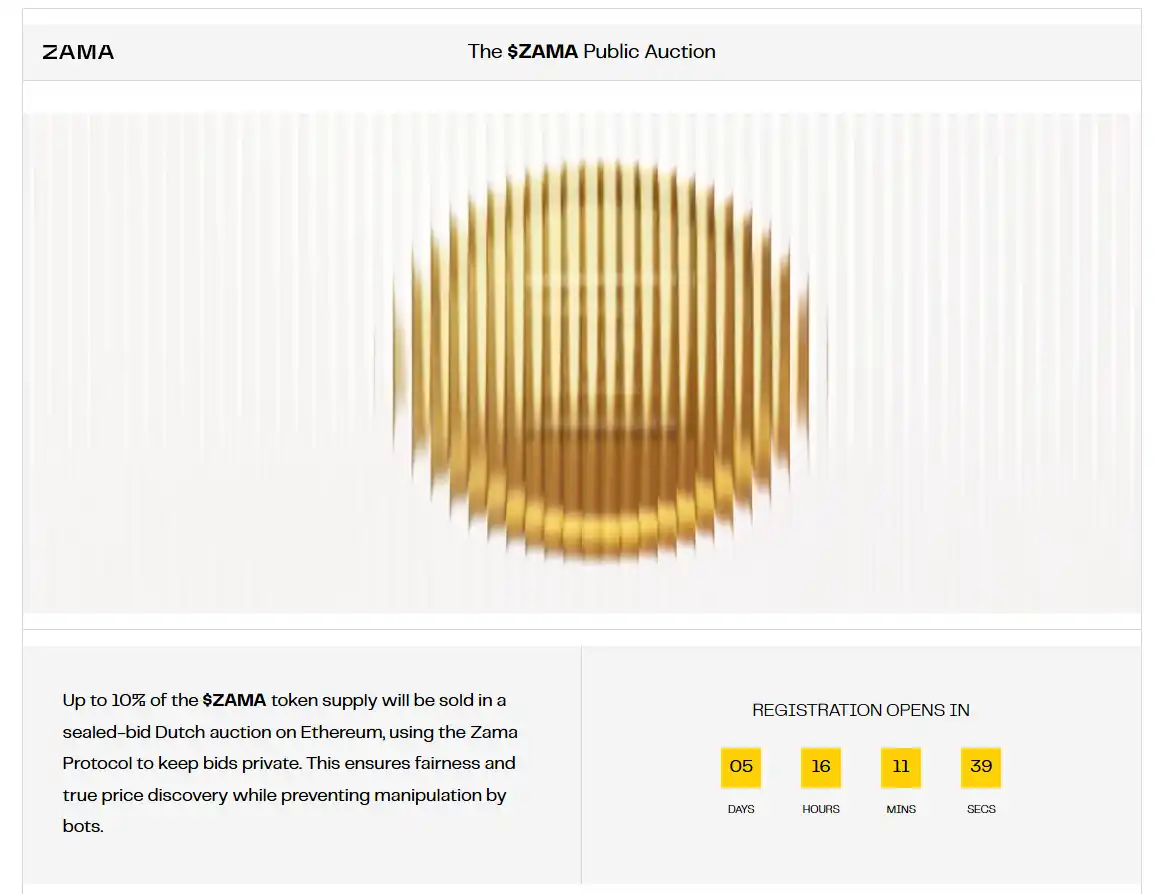
Zama Token Sale Will Commence on January 12
What Is a Sealed Bid Dutch Auction?
Zama will conduct a sealed bid Dutch auction on Ethereum to sell 10% of the total ZAMA token supply, with auction using Fully Homomorphic Encryption (FHE) to maintain bid confidentiality, highlighted by fair distribution, no frontrunning, no bots, and no Gas wars. Specifically, the sealed bid Dutch auction consists of 4 phases:
· Phase 1: Shield stablecoins, prepare funds and convert personal Ethereum network balances of USDC, USDT, DAI, and other stablecoins to ERC-7984 confidential assets (the official asset conversion website will be provided at the start of the sale), where balances and transfer amounts of these tokens will be encrypted.
· Phase 2: Place your bids, the bidding phase, running from January 12 to January 15, where users can submit any amount of bids, with bids being public and quantities kept confidential, with a floor price of $0.005 (equivalent to a $55 million FDV). Unlike traditional Dutch auctions where the price decreases over time, the sealed bid Dutch auction allows users to bid at any price throughout the bidding period.
· Phase 3: Clearing price and allocation, the settlement phase running from January 16 to January 19, where through the FHE smart contract calculation, demand is cumulatively added up from high to low bids to determine the clearing price. As a result, users will fall into three categories: 1. Bidding above the clearing price will receive their full allocation, and any excess payment will be refunded; 2. Bidding equal to the clearing price: If the quantity exceeds the remaining supply at that price, they will receive a proportional token share, with the excess refunded; 3. Bidding below the clearing price will not receive tokens and will receive a full refund.
· Phase 4: Claim your tokens, which is the token claiming phase starting from January 20th, to receive ZAMA tokens (fully unlocked) and refunds.
For easier understanding, Odaily Planet Daily provides an example for everyone. Assume that 1000 ZAMA tokens were sold through a sealed-bid Dutch auction, and three people participated in the bidding, namely Alice, Bob, and Charlie.
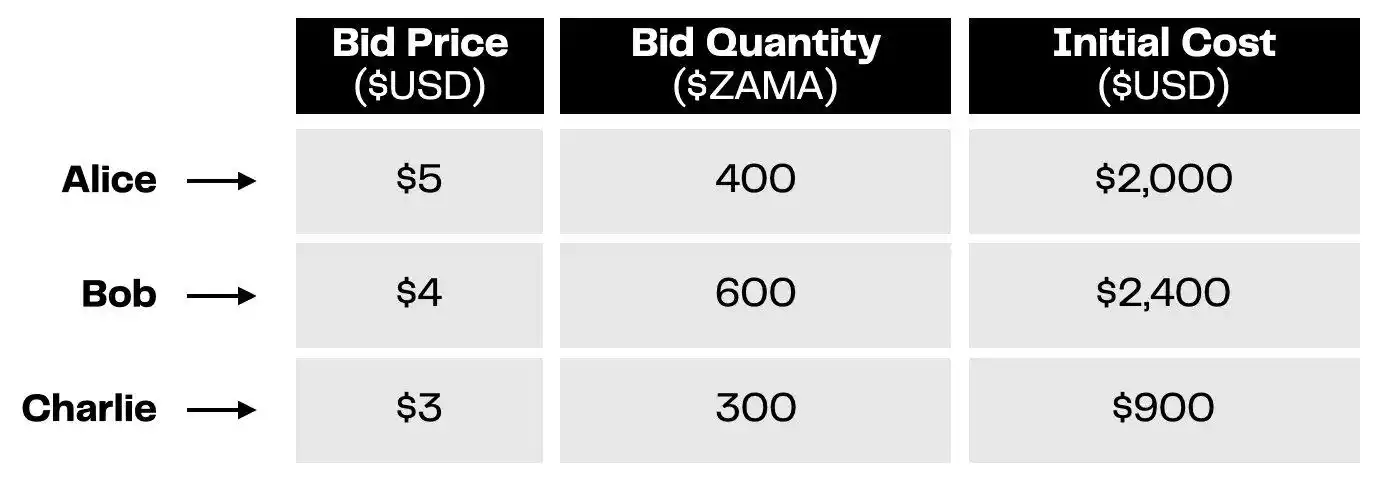
Firstly, during the bidding phase, the bidding situation of the three individuals is as follows:
· Alice bid for 400 tokens at $5 per token, ultimately paying $2000;
· Bob bid for 600 tokens at $4 per token, ultimately paying $2400;
· Charlie bid for 300 tokens at $3 per token, ultimately paying $900.
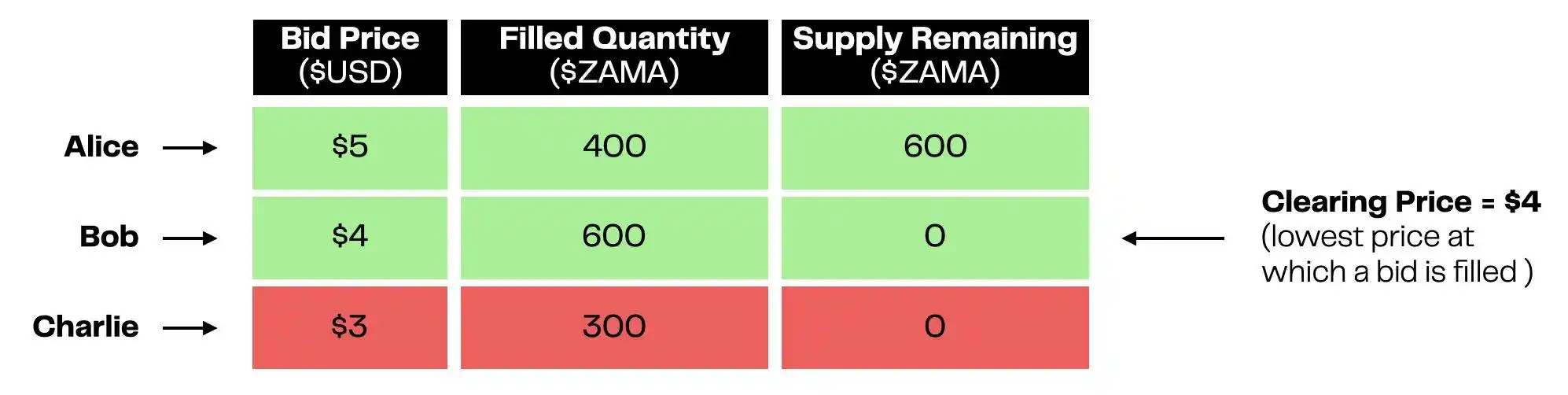
Secondly, after the bidding period ends, the auction smart contract will allocate tokens to each participant in descending order of their bids:
· Alice bid the highest, receiving 400 tokens, with 600 tokens remaining to be allocated;
· Bob was the second highest bidder, receiving 600 tokens. The remaining tokens to be allocated are 0. Therefore, the final clearing price is Bob's bid, which is $4 per token;
· Charlie's bid was below the final clearing price, so he did not receive any allocation.
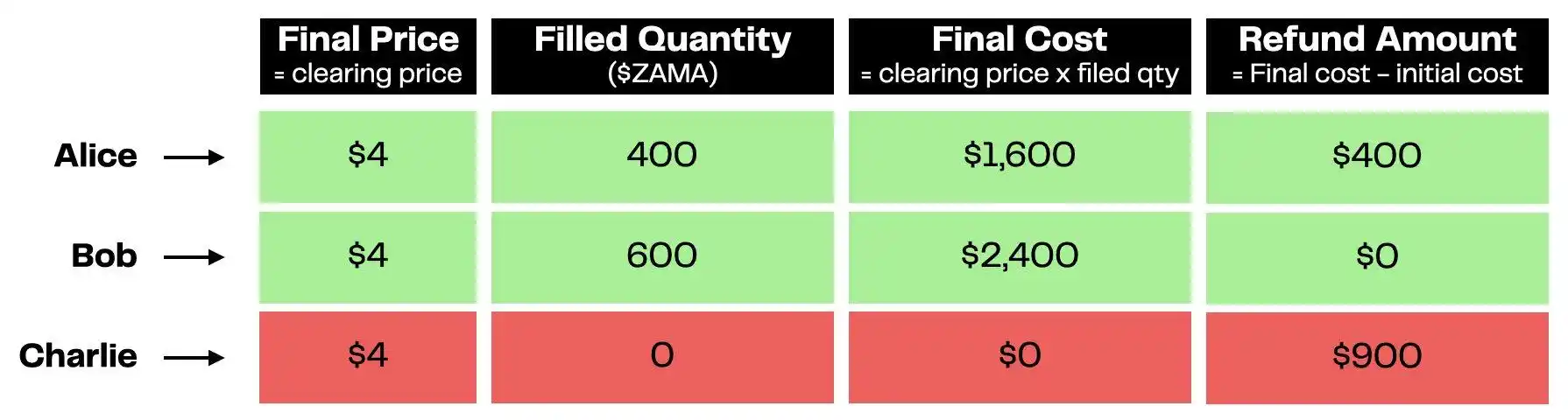
Lastly, during the claiming and refund phase, the specifics are as follows:
· Alice received 400 ZAMA tokens and a $400 refund;
· Bob received 600 ZAMA tokens with no refund;
· Charlie did not receive any ZAMA tokens but received a full refund of $900.
Final Interaction Opportunity Before TGE
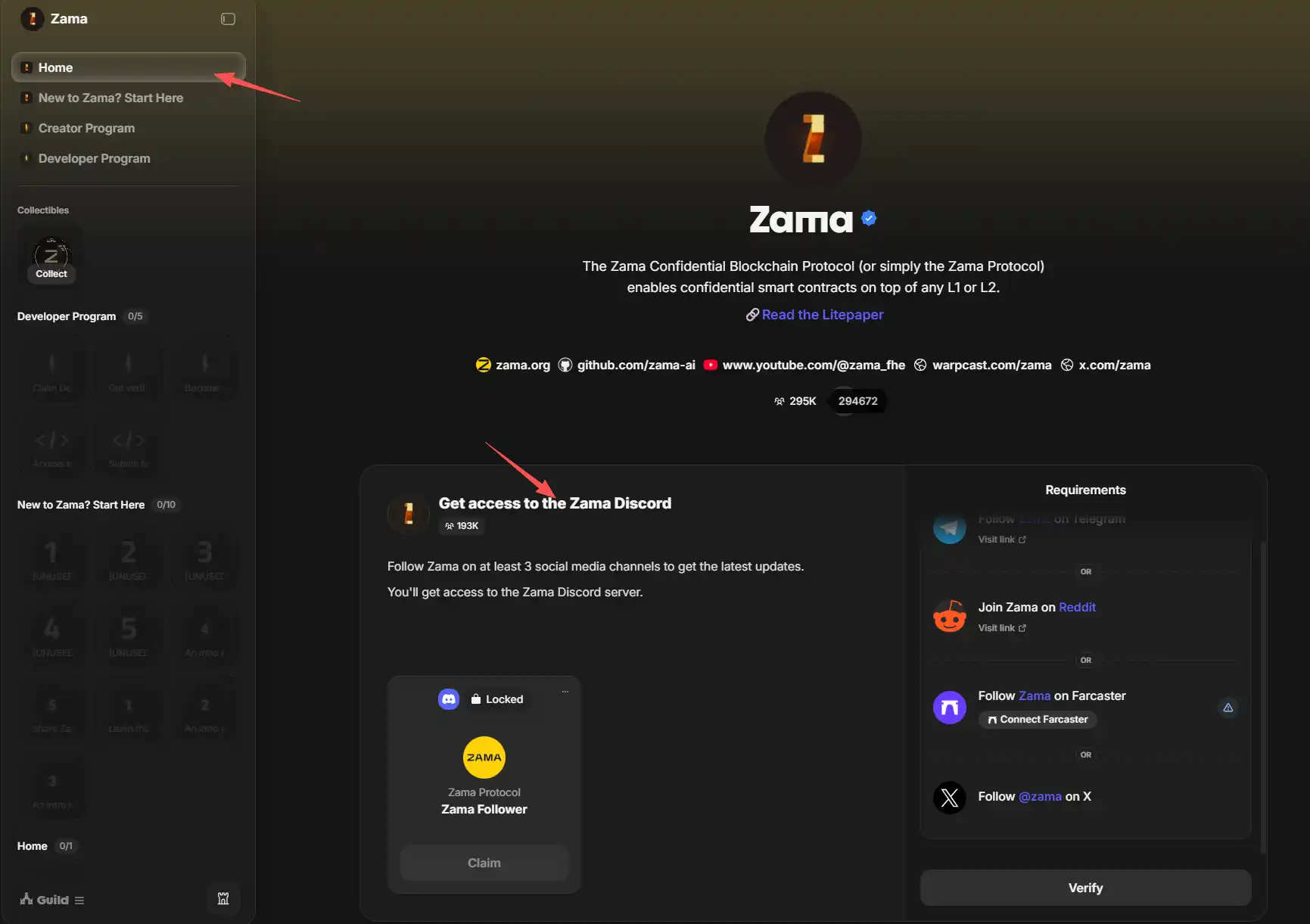
Currently, Zama can still participate in Guild Missions, which include:
Core Missions: Get access to the Zama Discord, enter three out of four official communities to complete, and join the official Discord channel to get an identity role.
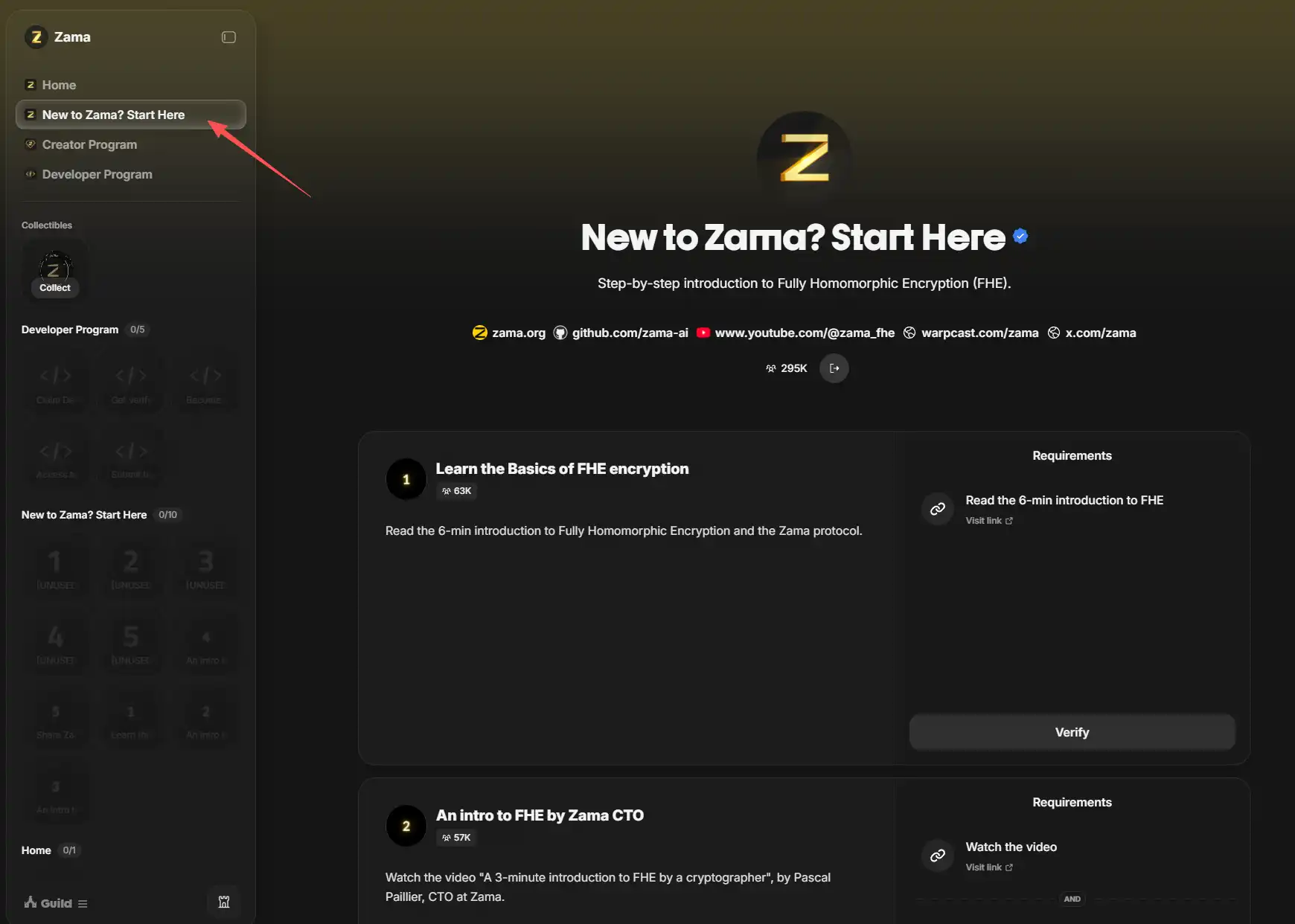
New to Zama? Missions: Specifically includes five sub-missions, which can be easily completed based on the mission prompts.
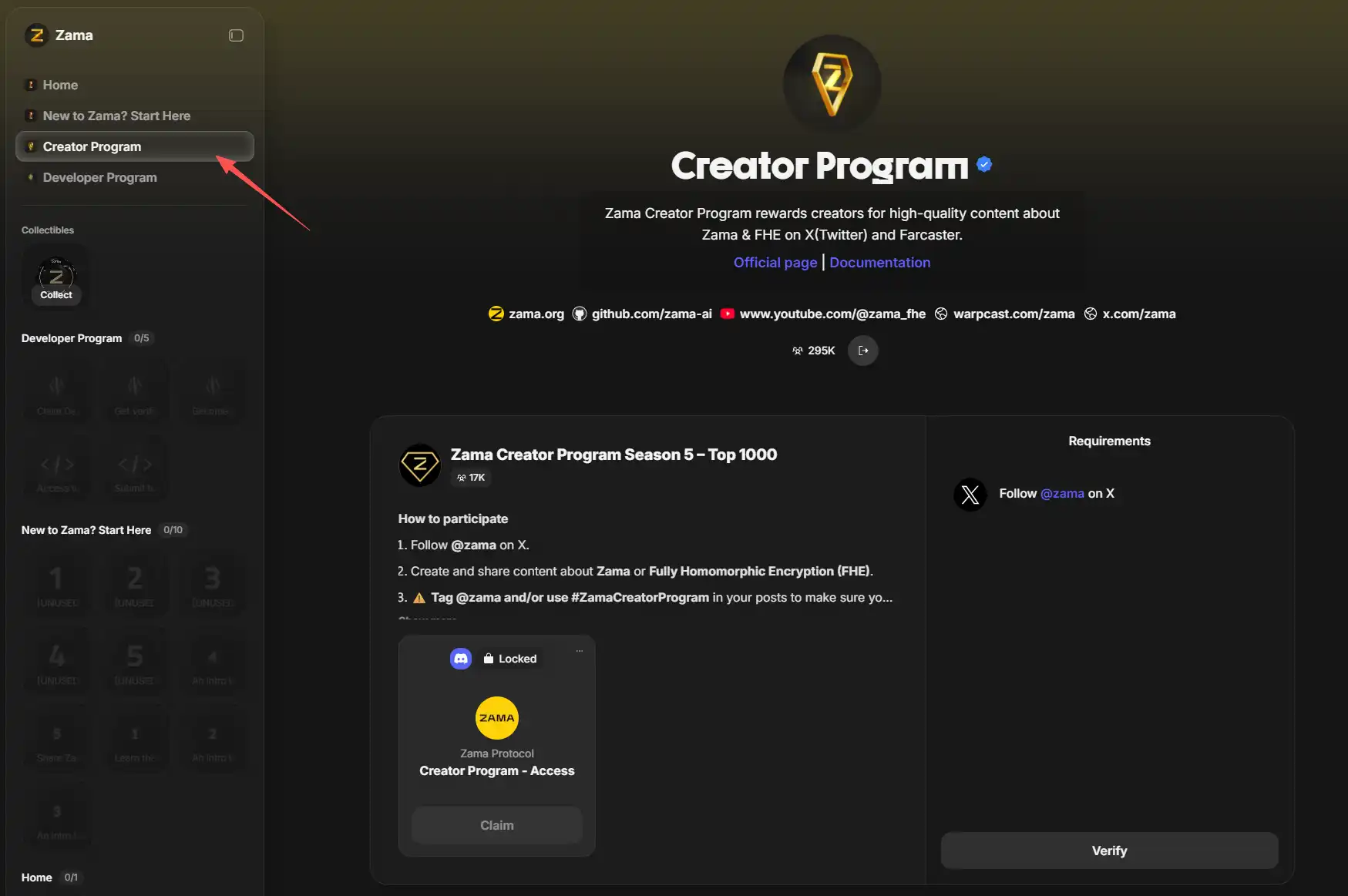
Creator Program Missions: Includes two sub-missions, where sub-mission one has a funding requirement, and sub-mission two is for the creator program.
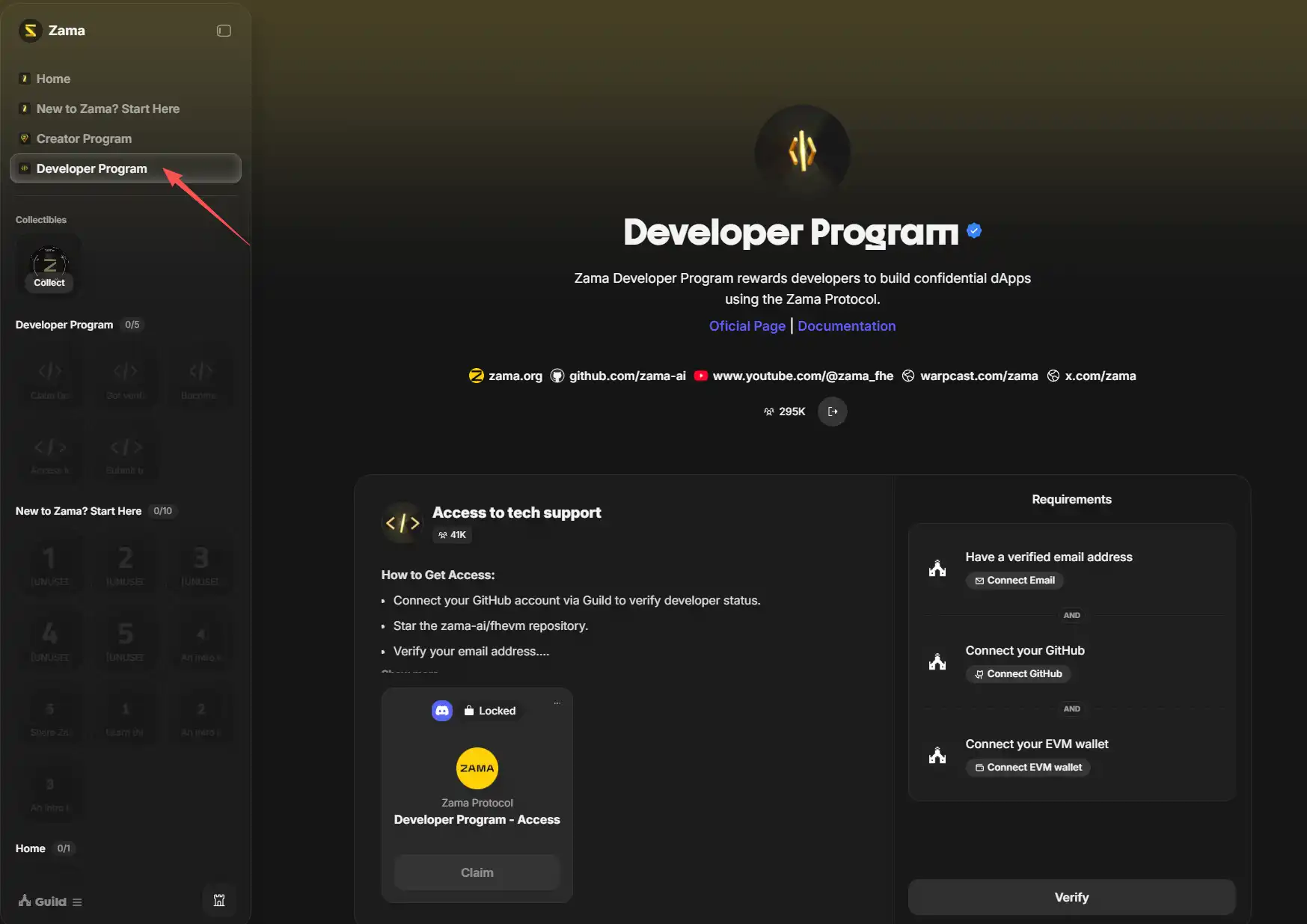
Developer Program Missions: The missions have high requirements, so they should be carried out based on individual circumstances.
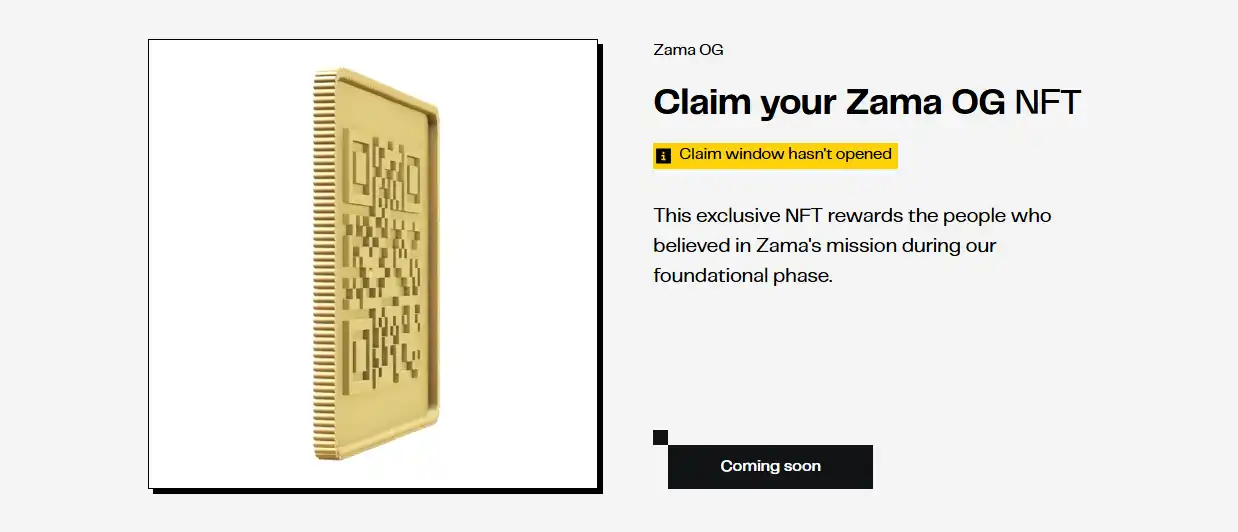
In addition, the OG NFT minting page is about to open, so early participants should check if they qualify when it opens.
You may also like

Blockchains Quietly Prepare for Quantum Threat as Bitcoin Debates Timeline
Key Takeaways: Several blockchains, including Ethereum, Solana, and Aptos, are actively preparing for the potential threat posed by…

Former SEC Counsel Explains What It Takes to Make RWAs Compliant
Key Takeaways The SEC’s shifting approach is aiding the growth of Real-World Assets (RWAs), but jurisdictional and yield…

Trend Research Quietly Becomes One of Ethereum’s Largest Whales with Major ETH Acquisition
Key Takeaways Trend Research has acquired 46,379 ETH, boosting their total holdings to about 580,000 ETH. The company,…

Web3 and DApps in 2026: A Utility-Driven Year for Crypto
Key Takeaways The transition to utility in the crypto sector has set a new path for 2026, emphasizing…

Base's 2025 Report Card: Revenue Grows 30X, Solidifies L2 Leadership

Kalshi First Research Report: When Predicting CPI, Crowd Wisdom Beats Wall Street Analysts

Venture Capital Post-Mortem 2025: Hashrate is King, Narrative is Dead

The Trillion-Dollar Stablecoin Battle: Binance Decides to Step in Again

Are Those High-Raised 2021 Projects Still Alive?

Aave Community Governance Drama Escalates, What's the Overseas Crypto Community Talking About Today?

Where Did $362 Million Go? Hyperliquid Counters FUD in Decentralization Showdown
Key Market Information Discrepancy on December 24th - A Must-See! | Alpha Morning Report

2025 Token Postmortem: 84% Peak at Launch, High-Cap Project Turns into a "Rug Pull" Epicenter?

CFTC Welcomes New Chairman, Which Way Will Crypto Regulation Go?
Polymarket Announces In-House L2, Is Polygon's Ace Up?

IOSG: From Compute to Intelligence, a Reinforcement Learning-Driven Decentralized AI Investment Map

AI Trading Risks in Crypto Markets: Who Takes Responsibility When It Fails?
AI trading is already core market infrastructure, but regulators still treat it as a tool — responsibility always stays with the humans and platforms behind it. The biggest risk in 2025 is not rogue algorithms, but mass-adopted AI strategies that move markets in sync and blur the line between tools and unlicensed advice. The next phase of AI trading is defined by accountability and transparency, not performance — compliance is now a survival requirement, not a constraint.

Ether pumps to outsiders, dumps in-house. Can Tom Lee's team still be trusted?
Blockchains Quietly Prepare for Quantum Threat as Bitcoin Debates Timeline
Key Takeaways: Several blockchains, including Ethereum, Solana, and Aptos, are actively preparing for the potential threat posed by…
Former SEC Counsel Explains What It Takes to Make RWAs Compliant
Key Takeaways The SEC’s shifting approach is aiding the growth of Real-World Assets (RWAs), but jurisdictional and yield…
Trend Research Quietly Becomes One of Ethereum’s Largest Whales with Major ETH Acquisition
Key Takeaways Trend Research has acquired 46,379 ETH, boosting their total holdings to about 580,000 ETH. The company,…
Web3 and DApps in 2026: A Utility-Driven Year for Crypto
Key Takeaways The transition to utility in the crypto sector has set a new path for 2026, emphasizing…
Base's 2025 Report Card: Revenue Grows 30X, Solidifies L2 Leadership
Kalshi First Research Report: When Predicting CPI, Crowd Wisdom Beats Wall Street Analysts
Popular coins
Latest Crypto News


Customer Support:@weikecs
Business Cooperation:@weikecs
Quant Trading & MM:bd@weex.com
VIP Services:support@weex.com
 App
App