
- Buy Crypto
- Markets
- Futures
- Spot
- Copy Trade
 Earn
Earn- More
Next year's biggest IPO, how will SpaceX, valued at $1.5 trillion, participate?

On-chain stock trading has rapidly evolved in the US market. Apart from stocks that are already listed and can be directly traded on the secondary market, many high-quality companies now receive significant funding through private placements without the need for an IPO, such as OpenAI and SpaceX.
For these private placement equity holdings, retail investors often find it difficult to participate. Investment opportunities usually only arise after an IPO, with a few institutional investors monopolizing pre-IPO investment opportunities. Although in the traditional finance field, platforms like Ustockplus under Korea's Dunamu, as well as Forge and EquityZen in the US, allow retail investors to purchase private placement equity within existing regulatory frameworks, these traditional financial platforms operate on a peer-to-peer matching basis. If no one is willing to sell, buyers still have limited access, leading to poor liquidity due to unpredictable transaction volumes.
So, would the situation improve with pre-IPO private equity + blockchain? Currently, there are three platforms on-chain—Ventuals, PreStocks, and Jarsy—that provide pre-IPO private equity trading. Let's take a look at their respective characteristics.
Ventuals
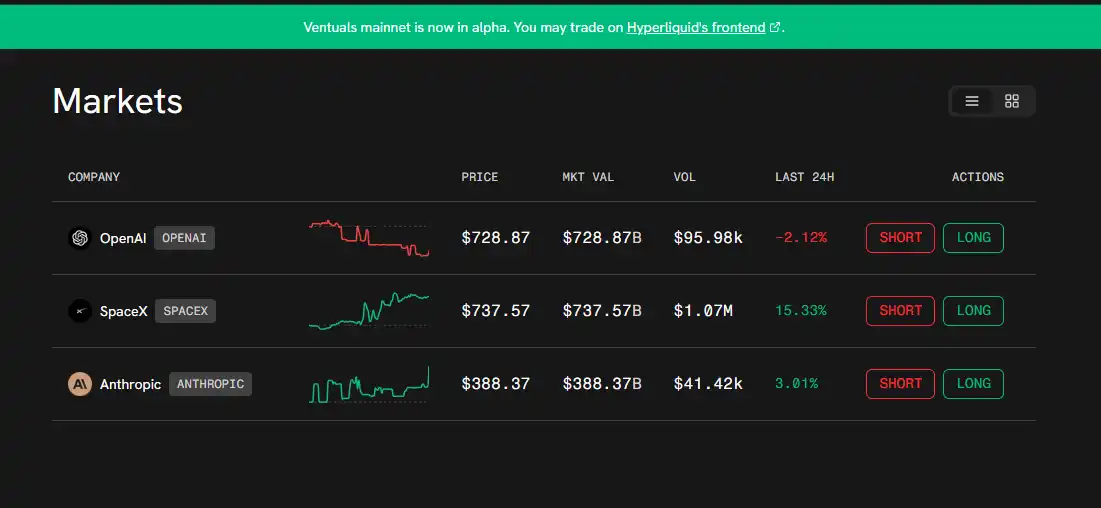
Ventuals is an IPO pre-equity perpetual contract platform built on HIP-3. On Ventuals, traders do not trade based on stock prices but on their expectations of the company's total valuation fluctuations. Holding a position on a pre-IPO company on Ventuals does not imply actual ownership of the company—only speculation on its valuation changes.
As it is not tied to actual equity, Ventuals is essentially a platform for speculating on company valuations. The advantage of this model is that Ventuals can quickly list a large number of pre-IPO company targets and respond to market trends. Moreover, having no underlying assets to a certain extent can help avoid traditional regulations.
However, Ventuals' drawback is that price manipulation is easily facilitated due to reliance on oracle feeds. Private company valuation data is inherently opaque, with low update frequencies. Additionally, Ventuals recently reduced the weight of external oracle feeds to 0.25 and increased the marking price weight to 0.75, raising concerns among some players about potential market manipulation.

PreStocks
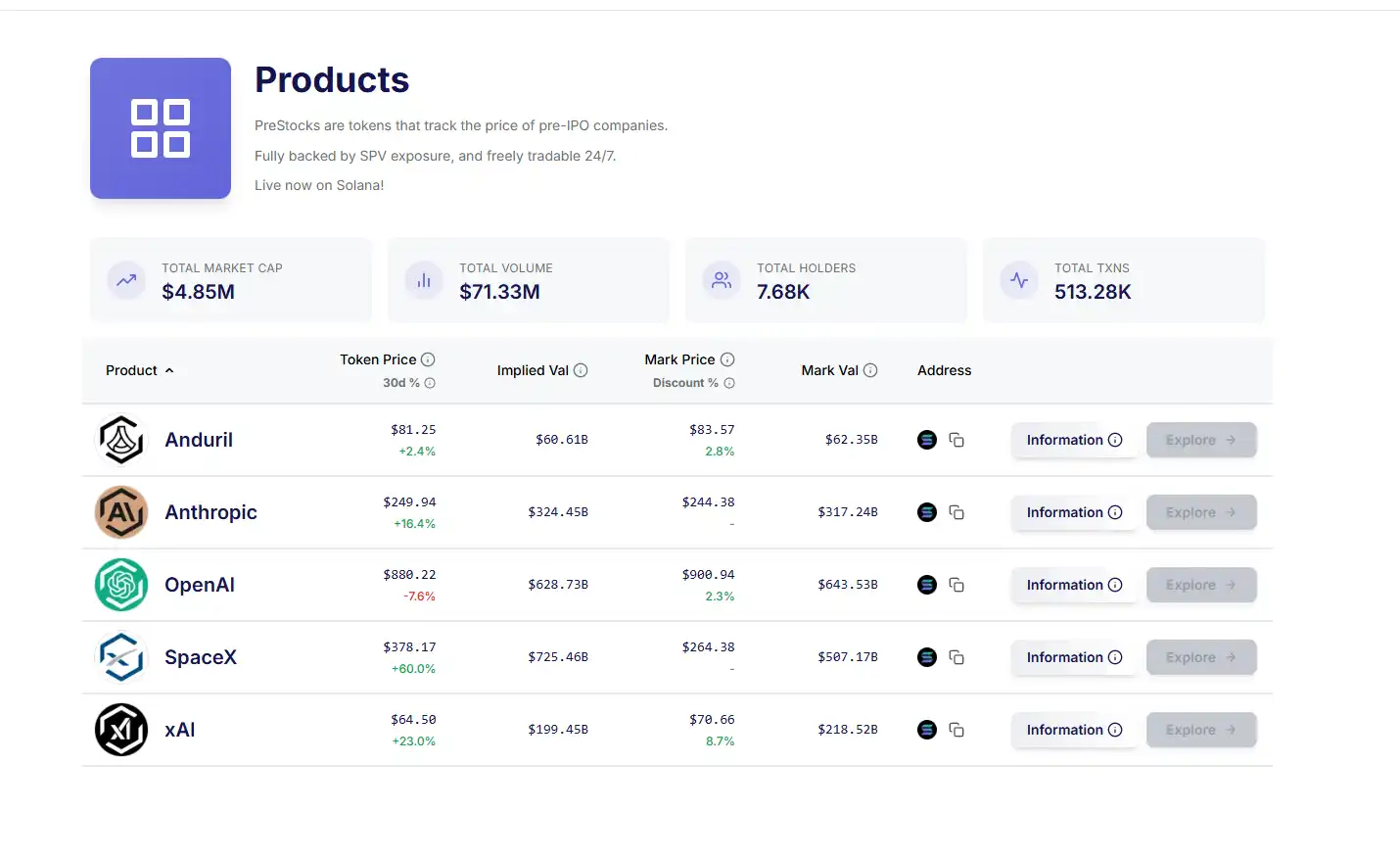
PreStocks is built on the Solana network. Unlike Ventuals, PreStocks truly tokenizes pre-IPO equity held directly or indirectly by entities investing in the underlying company. The team mentioned on their website that they will regularly release third-party verification reports to ensure that the token supply corresponds to the actual equity held and will also publish them upon active requests that can cover audit fees.
Due to the involvement of actual equity, users from countries such as China, the United States, Canada, etc., cannot practically use the platform's minting and redemption services. While it is still possible to buy and sell these equity tokens on-chain without KYC, if one wants to buy and wait for listing before redeeming these tokens for USDC, KYC is required. Additionally, despite having actual equity backing, holding equity tokens does not imply ownership, voting rights, dividend rights, or similar privileges.
PreStocks' main advantage lies in its good integration with the DeFi ecosystem, allowing direct trading in wallets such as Jupiter, OKX, and participation in low-cost lending or leverage trading within some dApps in the Solana ecosystem.
Jarsy
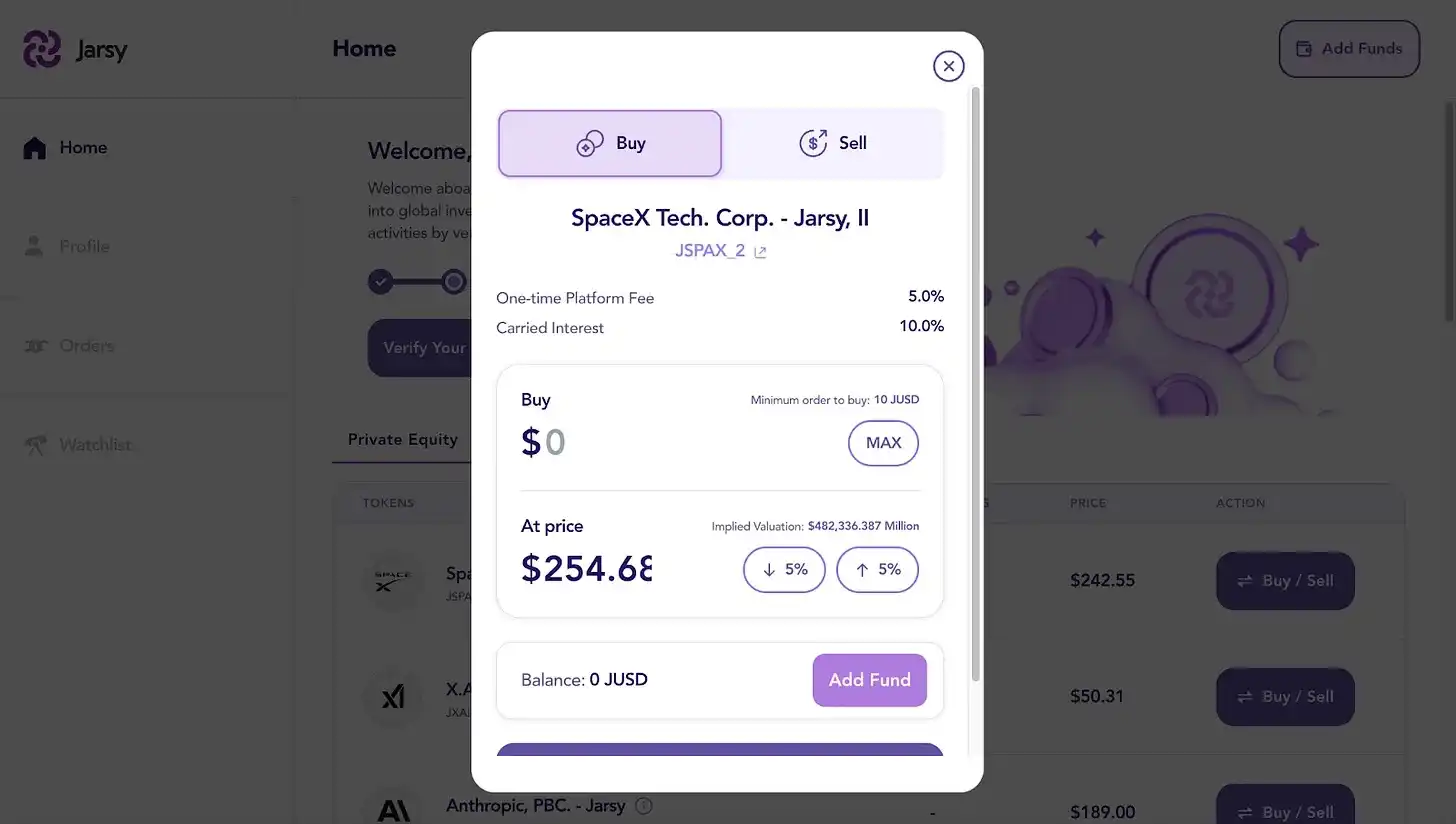
Similar to PreStocks, Jarsy also has actual equity support. However, compared to PreStocks, Jarsy is more like a blockchain-technology-based pre-IPO equity investment platform rather than a trading platform. This is because equity tokens on Jarsy are non-transferable and cannot be used in DeFi; they have their own built-in trading system and trading can only occur on the platform.
Nevertheless, Jarsy currently provides better transparency and disclosure compared to PreStocks.
Jarsy and PreStocks share some similarities and differences. Firstly, the minimum investment amounts for both platforms are very low, with Jarsy at $10 and PreStocks having none, which is beneficial for users worldwide as it lowers the barrier to entry for pre-IPO equity investments. However, a downside is that the amount of equity they can hold is relatively low; for example, xAI's equity token TVL on Jarsy is only about $1.1 million, whereas SpaceX's is approximately $1.7 million. The limited scale of actual pre-IPO equity holdings can directly lead to liquidity issues, where even seemingly small orders can cause significant price fluctuations.
Conclusion
Looking at the three companies above, liquidity remains a challenging issue for pre-IPO equity tokenization, making it difficult for large on-chain funds to enter this space.
However, the benefits are also obvious. Retail investors previously had almost no way to invest in companies like SpaceX and OpenAI before their IPOs. Now, through blockchain technology, a door that has always been closed is opened.
In fact, Echo, the on-chain funding platform created by Cobie and acquired by Coinbase for $375 million, is doing something similar. They have previously conducted a $10 million 1X Technologies Series C round of financing in a private group, although they did not tokenize equity.
It's all still early days.
You may also like

Twitter Hashtag Price Check, Will Trading Go Further?

Telegram 2025 Financial Report Puzzle: Revenue Soars by 65%, Yet Plagued by $200 Million Loss Due to TON?

North Korean Hackers Enjoy 'Fat Years': Stole Record Amount in 2025, With Money Laundering Cycle of About 45 Days

Crypto and AI: the hidden digital gray market of Xianyu
Crypto and AI: You Can Buy Anything on Xianyu.

Why Is On-Chain Fixed-Rate Lending Hard to Come By? "Basis Swap" Trading Is the Way Out

What’s Driving Crypto Markets in Early 2026: Market Swings, AI Trading, and ETF Flows?
Imagine checking Bitcoin and Ethereum prices in a day — one minute up 5%, the next down 4%. Sharp moves, quick reversals, and sensitivity to macro signals marked the first week of 2026. After an early-year rally, both assets pulled back as markets recalibrated expectations around U.S. monetary policy and institutional flows. For traders — including those relying on AI or automated systems — this period offered a vivid reminder: abundant signals do not guarantee clarity. Staying disciplined in execution is often the real challenge.

America's First State-Backed Stablecoin FRNT: Can It Save Wyoming Amid Energy Slump?

ZCash Team Split, Bank of America Upgrades Coinbase Rating, What's the Overseas Crypto Community Talking About Today?

Key Market Info Discrepancy on January 9th - A Must-Read! | Alpha Morning Report

Aster Coin: A Deep Dive into Its Price, Potential, and Why It’s Catching Eyes in 2026
Have you ever stumbled upon a crypto project that seems poised for growth amid market volatility, only to…

Left Hand BTC, Right Hand AI Computing Power: The Gold and Oil of the Data Intelligence Era

Wyoming’s FRNT Stablecoin Launches — First State-Backed Stablecoin Hits Market
Key Takeaways Wyoming leads innovation in the U.S. by launching the first state-backed stablecoin, FRNT, representing a pivotal…

Solana Price Prediction: Morgan Stanley Just Filed for a SOL ETF – Is This the Beginning of Wall Street’s Next Crypto Obsession?
Key Takeaways Morgan Stanley’s filing for a SOL-based ETF signifies growing institutional interest in cryptocurrencies beyond Bitcoin, boosting…

Key Market Insights for January 8th, how much did you miss out on?
All these uncommon things in the crypto world are listed on Idle Fish

Farewell to "Air" Investments: Use These 6 Key Metrics to Identify a Winning Project
USD 1 Billion Surge in Market Cap: Behind the Scenes with Trump Family Bet and CEX Shilling

Predicting Contrarian Buy Pressure in the Market: Who is Taking the Other Side of Your Trade?
Twitter Hashtag Price Check, Will Trading Go Further?
Telegram 2025 Financial Report Puzzle: Revenue Soars by 65%, Yet Plagued by $200 Million Loss Due to TON?
North Korean Hackers Enjoy 'Fat Years': Stole Record Amount in 2025, With Money Laundering Cycle of About 45 Days
Crypto and AI: the hidden digital gray market of Xianyu
Crypto and AI: You Can Buy Anything on Xianyu.
Why Is On-Chain Fixed-Rate Lending Hard to Come By? "Basis Swap" Trading Is the Way Out
What’s Driving Crypto Markets in Early 2026: Market Swings, AI Trading, and ETF Flows?
Imagine checking Bitcoin and Ethereum prices in a day — one minute up 5%, the next down 4%. Sharp moves, quick reversals, and sensitivity to macro signals marked the first week of 2026. After an early-year rally, both assets pulled back as markets recalibrated expectations around U.S. monetary policy and institutional flows. For traders — including those relying on AI or automated systems — this period offered a vivid reminder: abundant signals do not guarantee clarity. Staying disciplined in execution is often the real challenge.


 App
App