
- Buy Crypto
- Markets
- Futures
- Spot
- Copy Trade
 WE-Launch
Breaking Frontiers: Web3 Lawyer Decodes Latest Developments in Stock Tokenization

Original Article Title: "Insider Look | Web3 Lawyer Interprets the Latest Changes in US Stock Tokenization!"
Original Article Authors: Fangxin Guo, Jun Sha, Crypto Law Firm
On December 15, 2025, Nasdaq officially submitted Form 19b-4 to the SEC in the United States, applying to extend the trading hours of US stocks and exchange-traded platform products to 23/5 (trading 23 hours a day, 5 days a week).
However, Nasdaq's proposed trading hours extension is not merely an extension but a change to two formal trading sessions:
Day Trading Session (4:00-20:00 ET) and Night Trading Session (21:00-04:00 ET the next day). Trading will be paused between 20:00-21:00, and all unfilled orders will be uniformly canceled during the pause.
Many readers were excited when they saw the news, thinking, is the US preparing for 24/7 US stock tokenization trading? However, upon careful review of the document, Crypto Law Firm would like to tell everyone, don't rush to conclusions just yet, because Nasdaq stated in the document that many traditional securities trading rules and complex orders are not suitable for the night trading session, and some functionalities will also be restricted.
We have always been closely following US stock tokenization, considering it one of the most important targets for real-world asset tokenization, especially with various official actions from the US SEC (Securities and Exchange Commission) being frequent in recent times.
This application has sparked renewed anticipation for US stock tokenization because the US aims to bring the securities trading hours closer to the 24/7 digital asset market. However, upon closer inspection:
Nasdaq's document doesn't mention anything about tokenization at all, focusing solely on institutional reform for traditional securities.
If you would like a deeper understanding of Nasdaq's actions, Crypto Law Firm can write another article specifically for that. But today, we still want to discuss concrete news related to US stock tokenization—
SEC Officially "Allows" US Securities Depository Central Hub Giants to Experiment with Offering Tokenization Services.
On December 11, 2025, SEC's Division of Trading and Markets staff issued a "No-Action Letter (NAL)" to DTCC, which was subsequently made public on the SEC's website. The letter explicitly states that subject to specific conditions, the SEC will not take enforcement action against DTC for engaging in tokenization services related to its custody of securities.
So, what does this letter actually say? And how far has the latest development in US stock tokenization progressed? Let's start with the main character of the letter:
Who Are DTCC and DTC?
DTCC, short for Depository Trust & Clearing Corporation, is a US group of companies that includes various entities responsible for custody, stock clearing, and bond clearing.
DTC, short for Depository Trust Company, is a subsidiary of DTCC and the largest securities depository in the US. It is responsible for central custody of securities such as stocks and bonds, as well as handling settlements and transfers. Currently, DTC oversees custody and recordkeeping of securities assets exceeding $100 trillion, making DTC the ledger keeper of the entire US stock market.
What's the Relationship Between DTC and US Stock Tokenization?
In early September 2025, the news broke that Nasdaq had filed an application with the SEC to issue stocks in tokenized form. In that application, DTC was already mentioned.
Nasdaq stated that the only difference between tokenized stocks and traditional stocks lies in the clearing and settlement of orders by DTC.
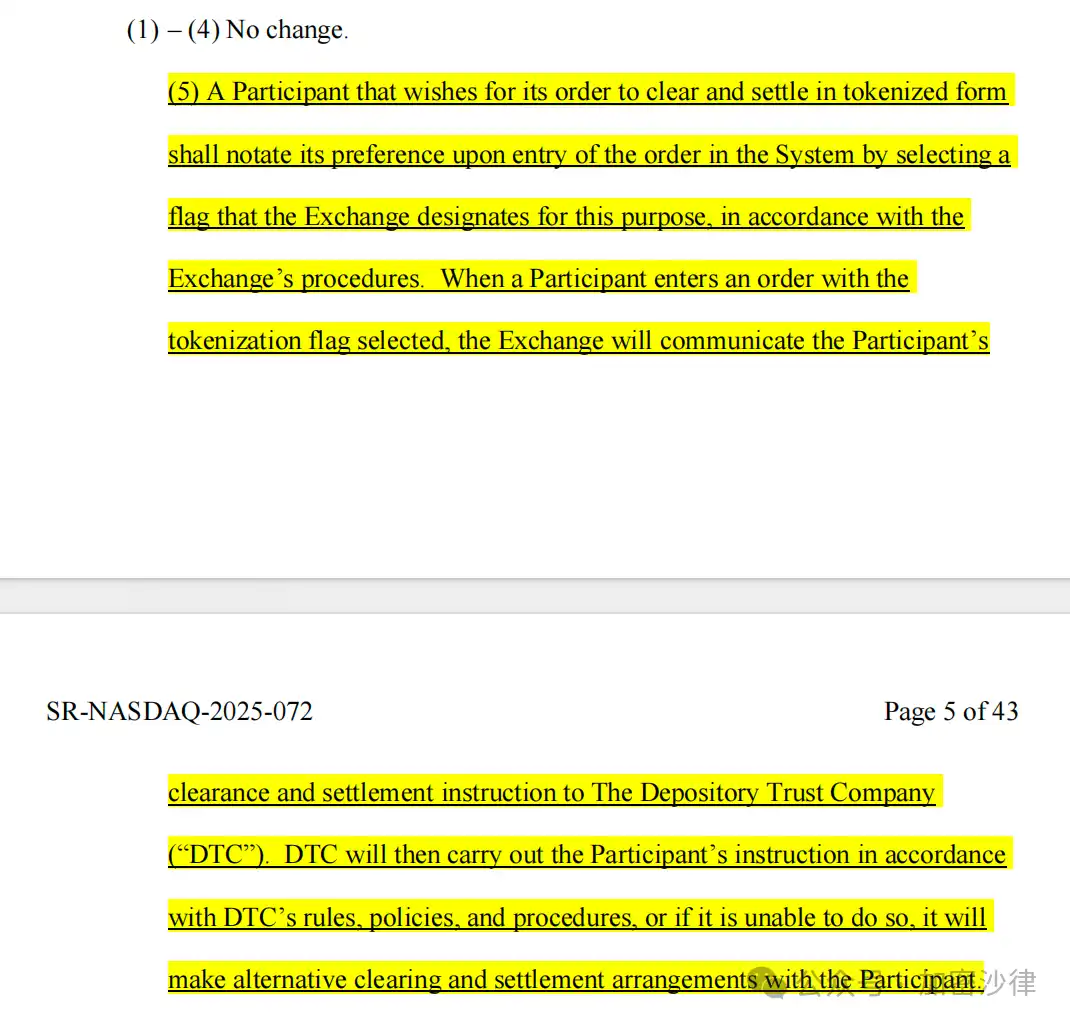
(The above image is from Nasdaq's application proposal)
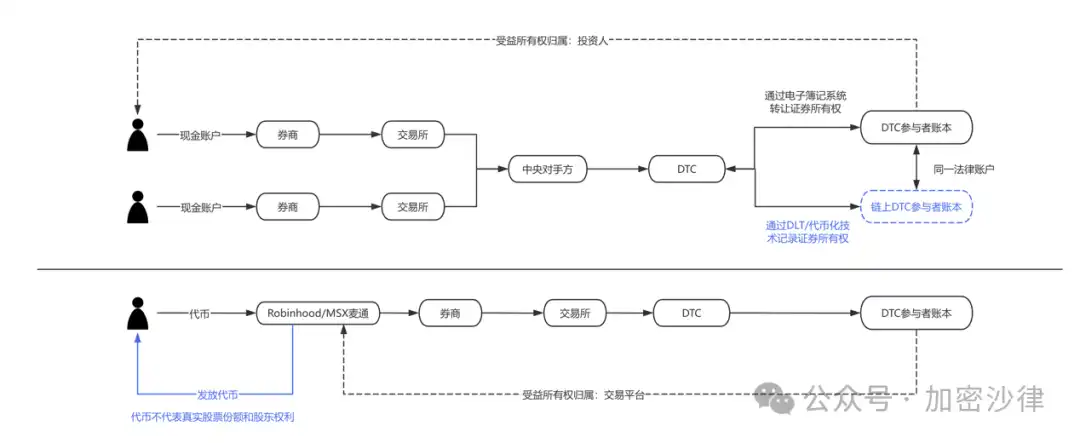
To make this matter easier to understand, we have created a flowchart. The blue section represents the part that Nasdaq proposed to change in its September submission this year. It is evident that DTC is the key institution for implementing and executing US stock tokenization.
What Does the Newly Released "Do Not Take Action" Letter Say?
Many people directly equate this document with the SEC's approval for DTC to use blockchain for US stock recordkeeping, but that is not entirely accurate. To correctly understand this matter, one must be aware of a provision in the US Securities Exchange Act of 1934:
Section 19(b) of the Securities Exchange Act mandates that any self-regulatory organization (including clearing agencies) must submit rule change proposals to the SEC and obtain approval when amending rules or making significant business arrangements.
Both Nasdaq proposals are based on this regulation.
However, the rule filing process is usually lengthy, potentially delaying for several months, with the longest extension being 240 days. If every change requires a new application and approval, the time and cost would be prohibitive. Therefore, to ensure the smooth progress of their security tokenization pilot activity, DTC applied for an exemption to waive its full compliance obligation with the Rule 19b filing process during the pilot period, which the SEC approved.
This means that the SEC has only temporarily exempted DTC from some of its procedural filing obligations, rather than substantively permitting the application of tokenization technology in the securities market.
So, what will be the future development of tokenized US stocks? We need to understand the following two questions:
01. What pilot activities can DTC conduct without the need for filing?
Currently, the equity custody and record-keeping of US stocks operate as follows: assuming a broker has an account at DTC, DTC uses a centralized system to record every buy and sell transaction of shares. Now, DTC proposes, what if we could offer brokers an option to re-record these shareholdings on the blockchain in the form of tokens?
In practice, participants would first register a qualified, DTC-approved Registered Wallet. When a participant sends a tokenization instruction to DTC, DTC will perform three actions:
a) Move these shares from the original account to a central pool;
b) Mint tokens on the blockchain;
c) Send the tokens to the participant's wallet, representing their ownership of these securities.
Afterward, these tokens can be directly transferred between these brokers without the need for every transfer to go through DTC's centralized ledger. However, all token transfers will be monitored and recorded in real-time by DTC through an off-chain system called LedgerScan, and LedgerScan's records will constitute the official register of DTC. If a participant wishes to exit the tokenized state, they can instruct DTC to "detokenize," where DTC will destroy the tokens and transfer the securities ownership back to the traditional account.
The NAL also details technical and risk control restrictions, including: tokens can only be transferred between wallets approved by DTC, so DTC even has the authority to forcibly transfer or destroy tokens in wallets in specific cases, strict segregation between the token system and DTC's core clearing system, and so on.
02. What is the Significance of This Letter?
From a legal perspective, concerning crypto law, it is essential to emphasize that a No-Action Letter (NAL) does not equate to legal authorization or rule modification. It does not have universally binding legal effect but rather represents the enforcement posture of SEC staff under established facts and assumed conditions.
The U.S. securities law system does not have a single "prohibition on using blockchain for accounting" provision. Regulation is more concerned with whether existing market structures, custodial responsibilities, risk management, and disclosure obligations are still met after the adoption of new technology.
Furthermore, in the U.S. securities regulatory system, letters such as NAL have long been seen as significant indicators of regulatory stance, especially when the recipient is a systemically important financial institution like DTC. The symbolic significance of such letters is actually greater than the specific business itself.
In terms of disclosure content, the premise of the SEC's waiver in this case is very clear: DTC is not directly issuing or trading securities on-chain. Instead, it is tokenizing existing securities ownership within its custodial system.
This tokenization is actually a form of "ownership mapping" or "ledger representation" used to enhance back-office efficiency rather than alter the legal attributes or ownership structure of the securities. The related services operate on a permissioned blockchain in a controlled environment, with strict restrictions on participants, use cases, and technical architecture.
Crypto law believes that this regulatory posture is very reasonable. The most common financial crimes associated with on-chain assets are money laundering and illegal fundraising. Tokenization technology is new, but it should not be an accomplice to crime. Regulation needs to acknowledge the potential of blockchain in the securities infrastructure while adhering to the boundaries of existing securities laws and custodial systems.
The Latest Development Progress in Tokenizing U.S. Stocks
The discussion around tokenizing U.S. stocks has begun to shift from "compliance feasibility" to "implementation strategies." Breaking down the current market practices reveals at least two parallel but logically distinct paths are emerging:
· Represented by DTCC and DTC, the officially-driven tokenization path aims to enhance settlement, reconciliation, and asset transfer efficiency, primarily targeting institutional and wholesale market participants. In this model, tokenization is almost "invisible," and for retail investors, stocks remain stocks, with only backend systems undergoing technological upgrades.
· On the contrary, the frontend role that brokerages and trading platforms might play is considered. For example, Robinhood and MSX Mercurity have been continuously exploring products in cryptocurrency assets, fractional stock trading, and extended trading hours. If tokenizing U.S. stocks matures gradually in terms of compliance, such platforms naturally have the advantage of becoming user gateways. For them, tokenization does not mean reshaping business models but is more likely an extension of the existing investment experience, such as closer-to-real-time settlement, more flexible asset splitting, and the integration of cross-market product forms. Of course, the premise for all this is the gradual clarification of the regulatory framework. Such explorations typically operate on the edge of regulatory boundaries, where risks and innovation coexist. Their value lies not in short-term scale but in validating the shape of the next-generation securities market. From a practical perspective, they more resemble samples for institutional evolution rather than direct replacements for the existing U.S. stock market.
In order to help everyone understand more intuitively, you can refer to the following comparison chart:
Crypto Salad Perspective
From a more macro perspective, the tokenization of US stocks is not truly about turning stocks into "coins," but rather about how to improve asset liquidity, reduce operational costs, and reserve interfaces for future cross-market collaboration while maintaining legal certainty and system security. In this process, compliance, technology, and market structure will engage in a long-term parallel game, and the evolutionary path will inevitably be gradual rather than radical.
It can be expected that the tokenization of US stocks will not fundamentally alter the operation of Wall Street in the short term, but it is already a significant project in the agenda of the US financial infrastructure. The interaction between the SEC and DTCC is more like an institutional-level "experiment," setting preliminary boundaries for subsequent broader exploration. For market participants, this may not be the endpoint but a true starting point worth continuous observation.
This article is a contribution and does not represent the views of BlockBeats.
You may also like

Trump’s World Liberty Financial Token Ends 2025 Significantly Down
Key Takeaways World Liberty Financial, led by the Trump family, witnessed its token value drop by over 40%…

Former SEC Counsel Explains What It Takes to Make RWAs Compliant
Key Takeaways The SEC’s shifting approach is aiding the growth of Real-World Assets (RWAs), but jurisdictional and yield…

HashKey Secures $250M for New Crypto Fund Amid Strong Institutional Interest
Key Takeaways HashKey Capital successfully secured $250 million for the initial close of its fourth crypto fund, showcasing…

Crypto Market Slump Unveils Disparity Between VC Valuations and Market Caps
Key Takeaways Recent market downturns highlight discrepancies between venture capital (VC) valuations of crypto projects and their current…

Philippines Cracks Down on Unlicensed Crypto Exchanges: Coinbase and Gemini Blocked
Key Takeaways The Philippine government is increasing regulatory oversight on cryptocurrency exchanges, requiring local licenses for operations. Internet…

Amplify ETFs for Stablecoins and Tokenization Begin Trading
Key Takeaways Amplify’s newly launched ETFs focus on tracking companies contributing to the development of stablecoins and tokenization…

JPMorgan Explores Cryptocurrency Trading for Institutional Clients
Key Takeaways JPMorgan Chase is considering introducing cryptocurrency trading services to its institutional clientele, marking a notable shift…

Palmer Luckey’s Erebor Reaches $4.3B Valuation as Bank Charter Progresses
Key Takeaways: Erebor, a digital bank co-founded by Palmer Luckey, has raised $350 million, bringing its valuation to…
Trump Family-Linked USD1 Stablecoin Gains $150M as Binance Unveils Yield Program
Key Takeaways The USD1 stablecoin, associated with the Trump family, increased its market capitalization by $150 million following…
Hong Kong Moves Forward with Licensing Regimes for Virtual Asset Dealers and Custodians
Key Takeaways Hong Kong’s FSTB and SFC are implementing new licensing requirements for virtual asset dealers and custodians…

Kalshi First Research Report: When Predicting CPI, Crowd Wisdom Beats Wall Street Analysts

Venture Capital Post-Mortem 2025: Hashrate is King, Narrative is Dead
High Fees, Can't Beat the Market Even After Paying 10x More, What Exactly Are Top Hedge Funds Selling?
Key Market Information Discrepancy on December 24th - A Must-See! | Alpha Morning Report

Absorb Polymarket Old Guard, Coinbase Plunges Into Prediction Market Abyss

AI Trading Risks in Crypto Markets: Who Takes Responsibility When It Fails?
AI trading is already core market infrastructure, but regulators still treat it as a tool — responsibility always stays with the humans and platforms behind it. The biggest risk in 2025 is not rogue algorithms, but mass-adopted AI strategies that move markets in sync and blur the line between tools and unlicensed advice. The next phase of AI trading is defined by accountability and transparency, not performance — compliance is now a survival requirement, not a constraint.
Why Did Market Sentiment Completely Collapse in 2025? Decoding Messari's Ten-Thousand-Word Annual Report

Twitter 上的「虚假流量」是指通过操纵关注者数量、喜欢和转发等指标来人为增加一条推文的影响力和可信度。下面是一些常见的制造虚假流量的方法: 1. <b>购买关注者:</b> 一些用户会通过购买关注者来迅速增加他们的关注者数量,从而让他们的账号看起来更受欢迎。 2. <b>使用机器人账号:</b> 制造虚假流量的另一种常见方法是使用机器人账号自动执行喜欢、转发和评论等互动操作,从而提高一条推文的互动量。 3. <b>推文交换:</b> 一些用户之间会进行推文交换,即互相喜欢、转发对方的推文...
Trump’s World Liberty Financial Token Ends 2025 Significantly Down
Key Takeaways World Liberty Financial, led by the Trump family, witnessed its token value drop by over 40%…
Former SEC Counsel Explains What It Takes to Make RWAs Compliant
Key Takeaways The SEC’s shifting approach is aiding the growth of Real-World Assets (RWAs), but jurisdictional and yield…
HashKey Secures $250M for New Crypto Fund Amid Strong Institutional Interest
Key Takeaways HashKey Capital successfully secured $250 million for the initial close of its fourth crypto fund, showcasing…
Crypto Market Slump Unveils Disparity Between VC Valuations and Market Caps
Key Takeaways Recent market downturns highlight discrepancies between venture capital (VC) valuations of crypto projects and their current…
Philippines Cracks Down on Unlicensed Crypto Exchanges: Coinbase and Gemini Blocked
Key Takeaways The Philippine government is increasing regulatory oversight on cryptocurrency exchanges, requiring local licenses for operations. Internet…
Amplify ETFs for Stablecoins and Tokenization Begin Trading
Key Takeaways Amplify’s newly launched ETFs focus on tracking companies contributing to the development of stablecoins and tokenization…
Popular coins
Latest Crypto News


Customer Support:@weikecs
Business Cooperation:@weikecs
Quant Trading & MM:bd@weex.com
VIP Services:support@weex.com
 App
App