
- Buy Crypto
- Markets
- Futures
- Spot
- Copy Trade
 Earn
Earn- More
2025 Crypto Card Annual Report: 40,000 Monthly Active Users, Average Spending of Less Than $100

Original Title: The State of Crypto Cards and What Comes Next
Original Author: @ahboyash, Crypto Researcher
Original Translation: Deep Tide TechFlow
Introduction
2025 was a milestone year for the development of crypto cards, as they transitioned from a niche entry tool to an increasingly widely used payment instrument. Whether for deposits or spending, crypto cards demonstrated strong growth momentum in this year, driven by improved user experience, broader blockchain support, and a gradual increase in user acceptance of stablecoin-denominated spending.
This report provides an ecosystem-level overview of crypto card activity over the past two years (December 2023 to October 2025), with a focus on analyzing the observable on-chain behavior of leading crypto card providers.
Executive Summary
· From Experimentation to Real-World Application: In 2025, crypto cards transitioned from the experimentation phase to real-world application, with both deposits and spending showing sustained exponential growth trends.
· Deposit-Led Spending: Stablecoins took the lead in deposit behavior, occupying nearly all collateral asset shares, further reinforcing a low-volatility spending pattern akin to debit cards.
· Leading Usage by @Rain Card: The @Rain series of crypto cards led in usage, but most users still primarily engaged in small-value spending, indicating their main use for daily spending wallet top-ups.
· Future Growth Potential: The growth trend is expected to continue in 2026, with profitability, exchange economics, and credit-related factors set to further develop, focusing not only on the singular goal of user acquisition.
Methodology and Scope
This report analyzes crypto card activity through verifiable on-chain data, with a focus on observable economic behaviors rather than self-reported metrics.
· Card Coverage:
· Type 1 Cards: On-chain verifiable deposits and spending (e.g., Rain series cards, Gnosis Pay cards, MetaMask cards)
· Type 2 Card: Supports on-chain verifiable deposits only (e.g., WireX Card, RedotPay Card, Holyheld Card)
· Type 3 Card: Card issued by centralized exchanges (CEX) (e.g., Binance Card, Bybit Card, Nexo Card) → Not included in the analysis due to limited data availability
· Analysis Method:
· Deposit Analysis: Includes Type 1 and Type 2 Cards to capture a broader range of liquidity inflows.
· Spending Analysis: Limited to Type 1 Cards only, as their transaction behavior is directly observable on-chain.
For wallets with native cards that do not follow traditional deposit flows, their spending activity is considered as a deposit in the analysis to maintain consistency. Non-stablecoin balances are normalized using the average price from the past 12 months to represent all transaction volumes in equivalent USD.
Deposits: How Liquidity Enters the System
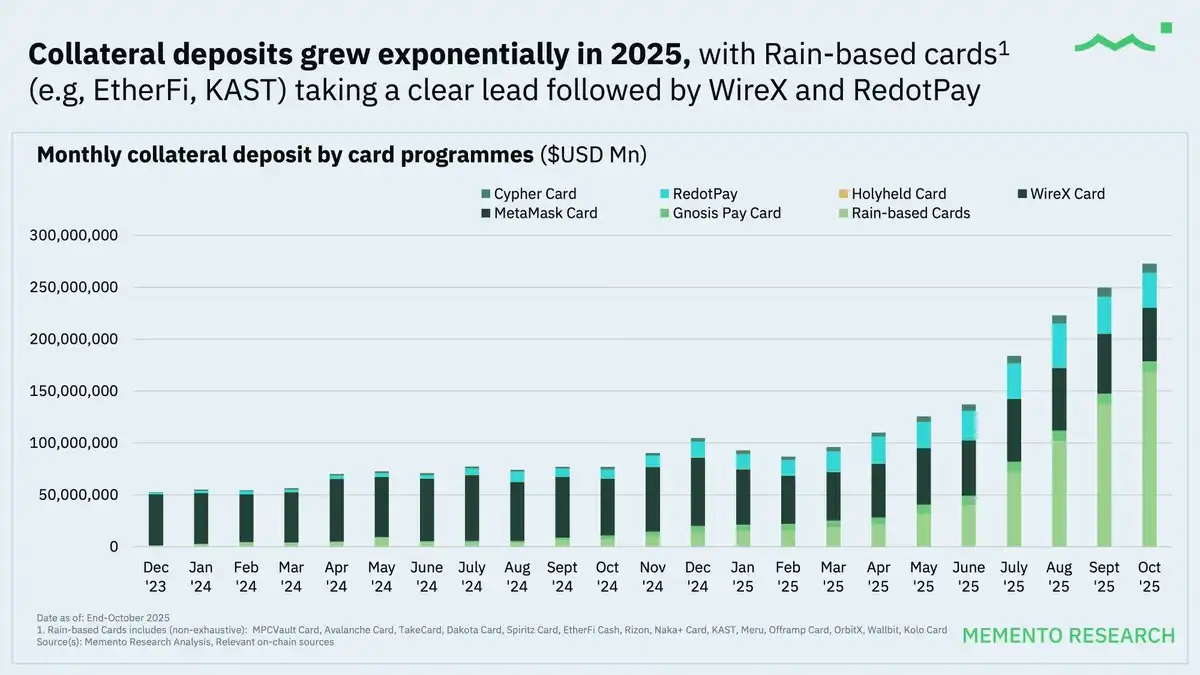
Deposits Lead Expansion with the Fastest Growth Rate
Between 2024, the monthly collateral deposit volume of crypto cards experienced exponential growth and further accelerated in 2025.
Cards projects based on the Rain series of crypto cards consistently maintained a leading position in deposit volume, as they serve as core infrastructure for various popular crypto card projects, including @ether_fi Cash, @KASTxyz, @OfframpXYZ, and Avalanche (@avax) cards.
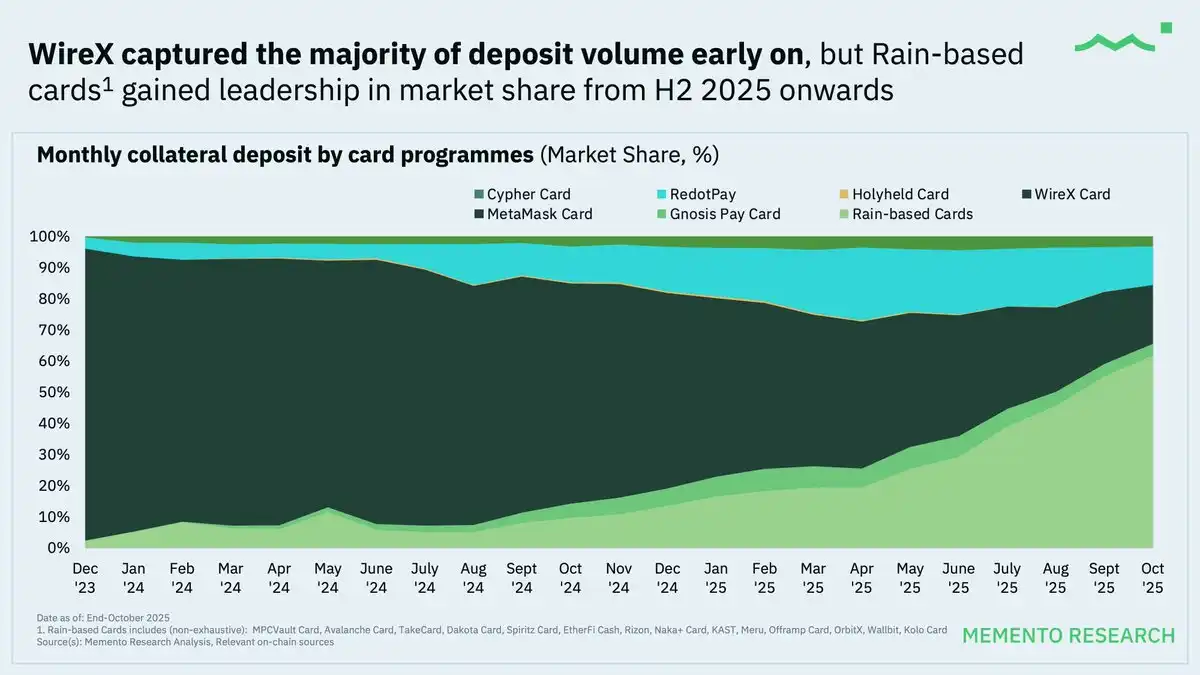
Market Share: Initially Concentrated, Then Distributed
Throughout most of 2024, @wirexapp held the major share of the deposit volume, but starting in the second half of 2025, the Rain series of crypto cards took the lead in market share.
Key Insight: Since the second half of 2025, a new wave of crypto card projects has been launched, with Rain being chosen as the core infrastructure partner. This trend has driven increased deposit inflows and accelerated the onboarding of new users.
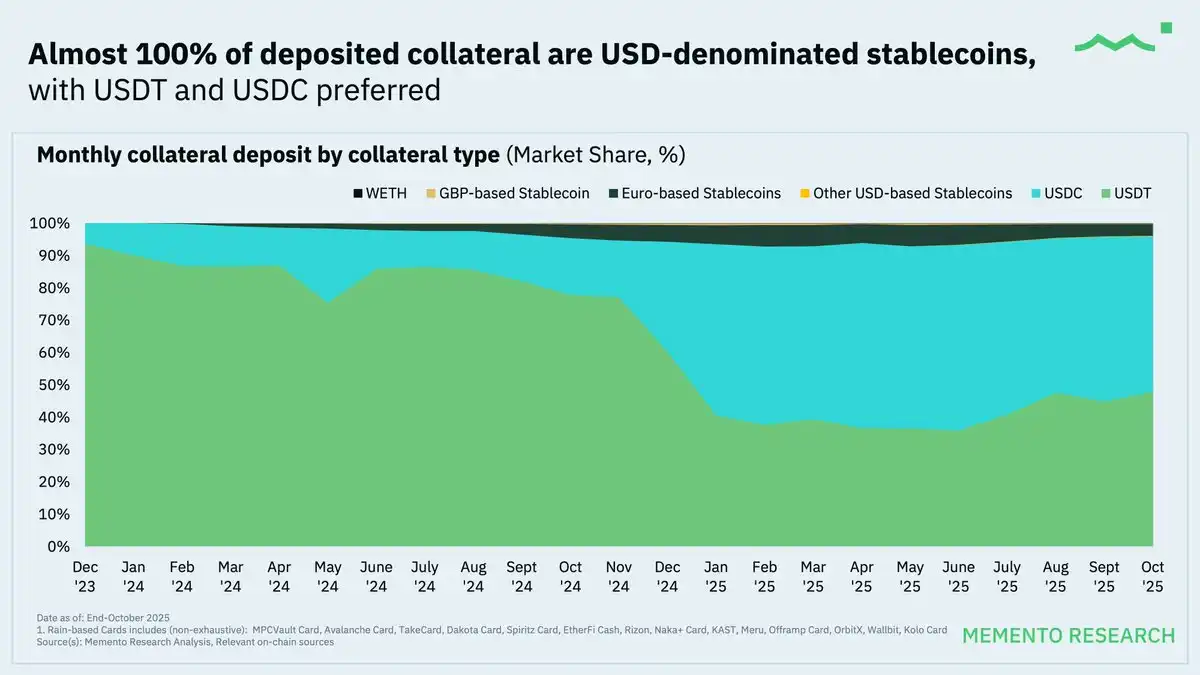
Stablecoins Almost Completely Dominate
Across the dataset, nearly 100% of deposit-backed assets are composed of USD-denominated stablecoins, with USDT and USDC as the primary leaders.
This phenomenon further demonstrates that current crypto cards are closer to international payment accounts rather than speculative spending tools, even for non-U.S. users.
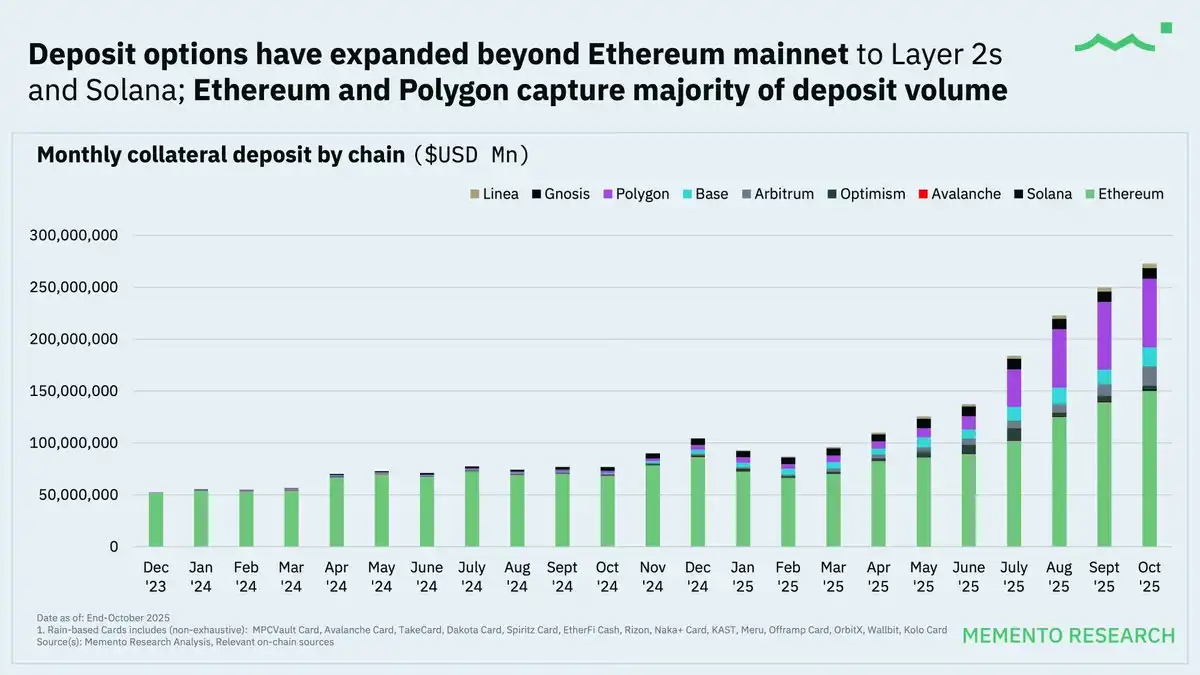
@ethereum and @0xPolygon are the dominant chains for deposits, with multi-chain usage gradually increasing.
While Ethereum (@ethereum) and Polygon (@0xPolygon) remain the primary deposit networks, other layer-one chains (such as @base, @arbitrum, @Optimism, and @solana) are also steadily gaining market share.
The rise of multi-chain trends reflects the following factors:
· Lower transaction costs: Lowering the threshold for users to recharge more frequently.
· Card service provider-optimized routing: No longer forcing users onto a single chain, multi-chain deposits have gradually become a "basic feature."
Consumer Behavior: The Actual Usage of Crypto Cards
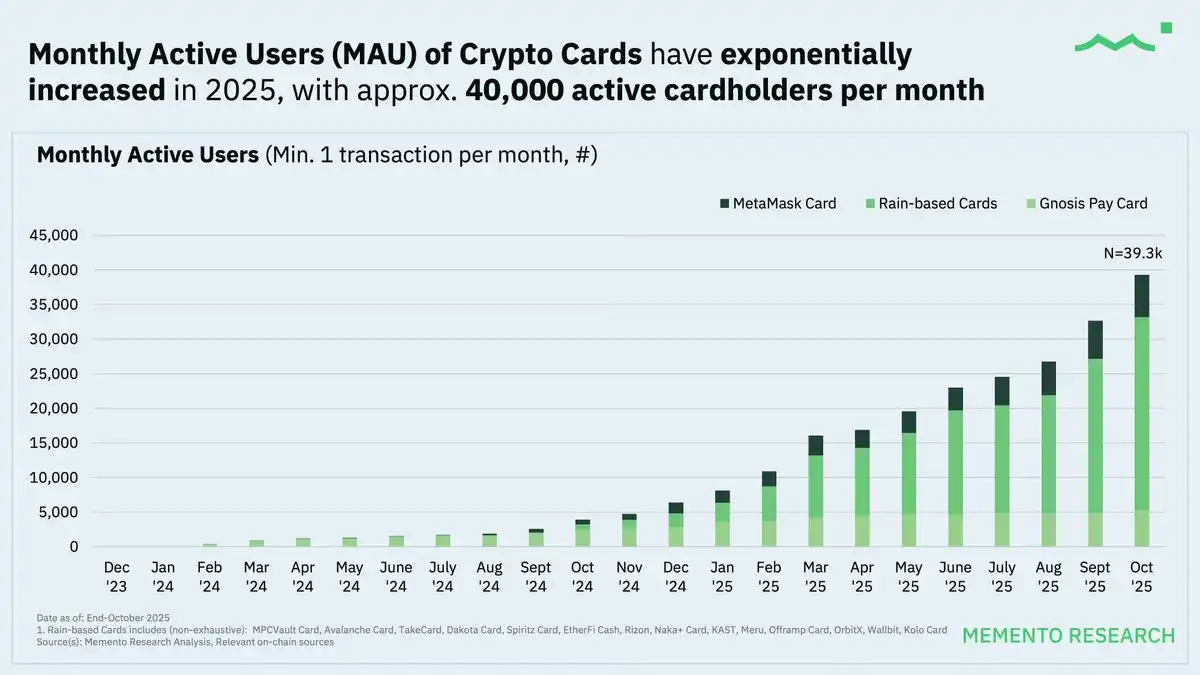
Monthly Active Users (MAU) Continues Rapid Growth in 2025
As of October 2025, monthly active card users (MAU) have reached approximately 40,000, indicating an increasing user acceptance of crypto cards as a reusable payment tool rather than just a one-time experimental tool.
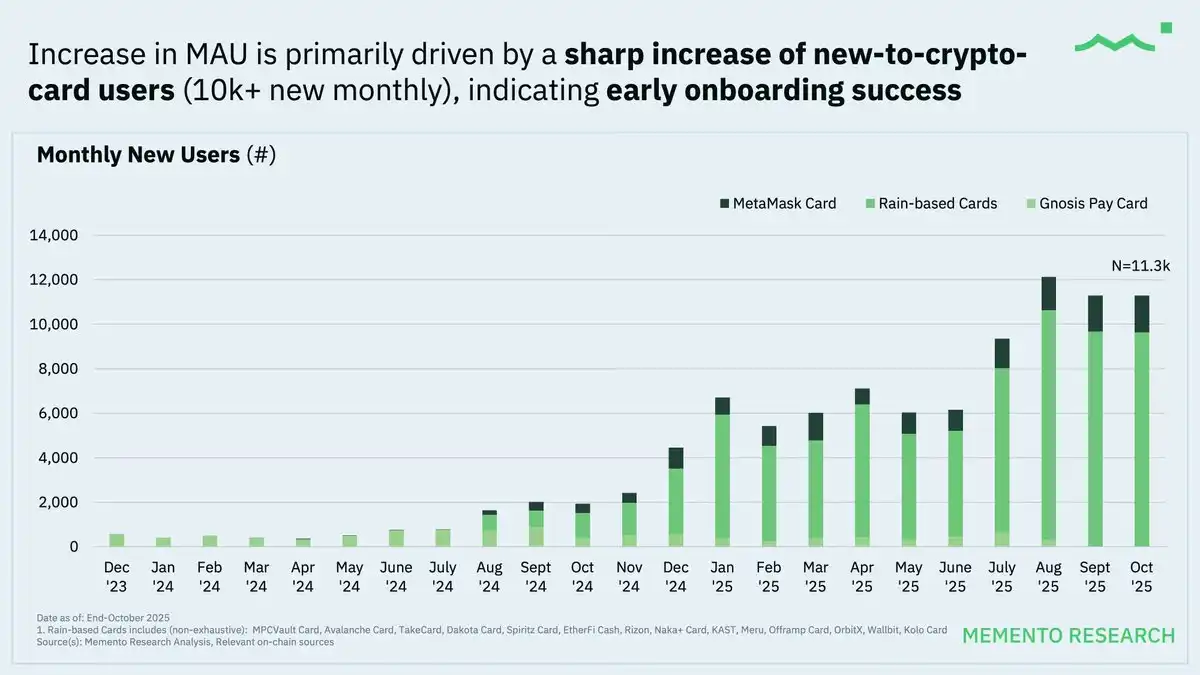
The crypto card industry is still in its early "user adoption-driven" growth stage, indicating that the industry's adoption curve is still in its infancy, with distribution and accessibility continuously expanding.
The Rain series of cards, due to their role as shared infrastructure for multiple crypto card projects (card-as-a-service), occupy the major share of transaction volume. The data of these Rain series cards is better suited for trend-level interpretation.
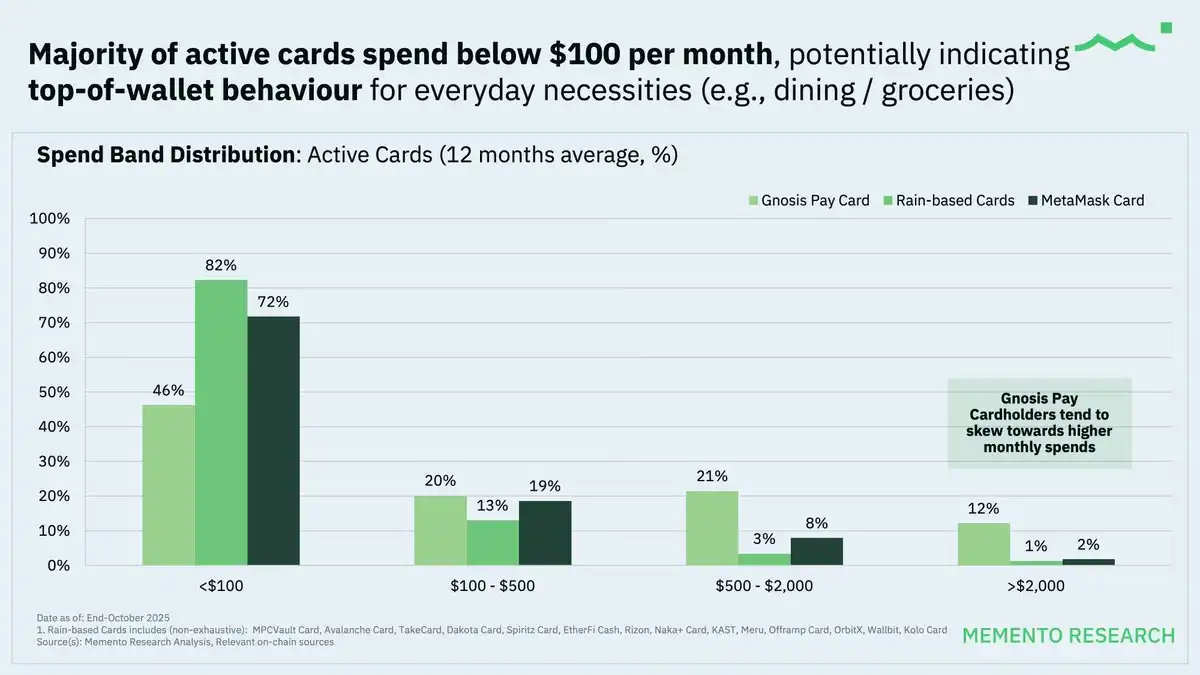
The overall spending amount remains at a relatively low level, which may indicate that crypto cards are primarily used for daily expenses.
The pattern of low-value card usage may also suggest that users treat crypto cards as a fiat withdrawal tool, thereby bypassing the manual stablecoin-to-fiat conversion step directly.
It is worth noting that @gnosispay cardholders have a higher monthly spending amount, indicating that their users are more inclined to use it as their primary payment card for more consistent usage.
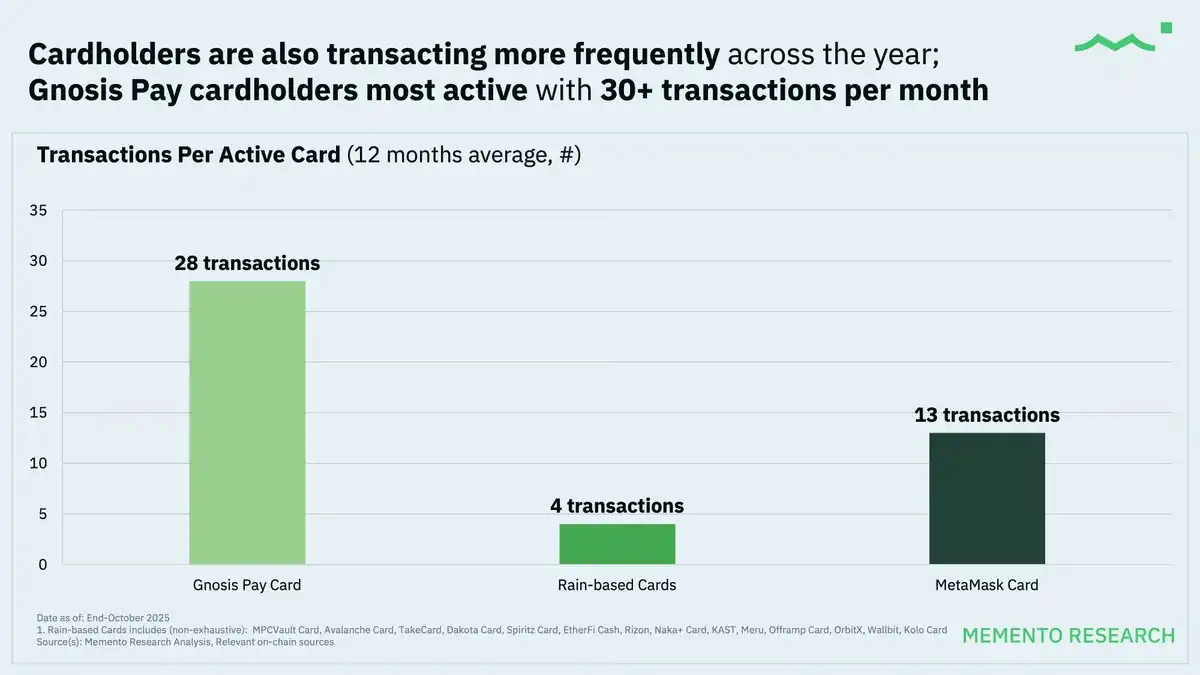
Over time, the transaction frequency of active cardholders has increased year by year; similar to spending patterns, @Gnosis Pay cardholders have the highest level of activity, with an average of over 30 transactions per month, fully reflecting the behavioral characteristics of daily payments.
Key Insights
· Increased User Activity: More and more people are truly starting to use crypto cards, not just registering, with 2025 seeing a steady rise in consumption and activity levels.
· Emphasis on Everyday Small Transactions: Users rely more on stablecoins for small, regular transactions rather than large or speculative trades.
· Core Role of Infrastructure Providers: The shared "card as a service" model has driven transaction volume concentration and determined the ecosystem's expansion path.
Outlook for 2026: From Experimentation to Sustainable Expansion
The data from 2025 indicates that crypto cards have transitioned from the experimental phase to the early application stage. While deposits, spending, and active usage have seen significant growth, user behavior remains cautious, similar to a stablecoin-centered prepaid card model rather than a complete replacement for traditional credit cards.
Currently, crypto cards mainly serve as a bridge between on-chain liquidity and real-world payments, rather than a complete replacement for traditional credit cards.
Looking ahead to 2026, growth is expected to be more driven by economic sustainability and product design, rather than solely relying on the momentum of user adoption. As the scale of usage expands, card service providers need to find a balance between expansion, cross-border and domestic flow economics, routing efficiency, and increasingly complex operational management.
Key Issues to Note:
1. Privacy Concerns Persist: Transaction records are public on-chain, and spending behavior may be exposed. Once addresses are clustered or linked to deposit addresses on centralized exchanges, ownership attribution can become easy based on on-chain behavioral traces (such as time, amount, etc.).
2. Double-Edged Sword of Public Data: While public data is easy to analyze, it can also be exploited by competitors. Competitors can monitor traffic, mimic incentive measures, and even target high-value users through predatory discount attacks.
3. Non-Vertical Integration Risk: Most cryptocurrency card projects rely on issuers, payment processors, and a few "card-as-a-service" providers. This model may lead to single points of failure or be subject to restrictions due to upstream compliance events or policy changes, triggering sudden limitations or shutdowns.
4. High-Risk Merchant Categories: High-risk merchant categories such as gaming, online casinos, adult entertainment, etc., often face higher fraud and dispute/chargeback rates, which may lead card networks and issuers to implement stricter controls. Furthermore, these categories may face more stringent anti-money laundering (AML) scrutiny in different jurisdictions.
5. Homogenization Issue: The core functionalities offered by most cryptocurrency cards in the current market are similar, with limited differentiation apart from selected cardholder rewards such as cashback or points. The continued reliance on a prepaid structure and a few card-as-a-service providers (such as Rain) may pose long-term challenges for cryptocurrency card issuers seeking to compete with global incumbent banks.
Key Future Trends to Watch:
· Transition from a prepaid model to credit card-like designs, similar to the @Coinbase One AMEX card.
· Stablecoins continuing to dominate as the primary unit of account.
· Intensified focus on profitability and unit economics as competition grows.
Cryptocurrency cards are gradually becoming a foundational tool for embedded payments within wallets and apps. Market demand has been established for 2025, with 2026 determining which models can achieve sustainable scalability.
You may also like

Wyoming’s FRNT Stablecoin Launches — First State-Backed Stablecoin Hits Market
Key Takeaways Wyoming leads innovation in the U.S. by launching the first state-backed stablecoin, FRNT, representing a pivotal…

Binance Launches Regulated Gold and Silver Perpetual Futures Settled in USDT
Key Takeaways: Binance has introduced its first regulated perpetual futures contracts, which are tied to traditional assets like…

Vietnam Sets Mid-January Timeline for Pilot Crypto Exchange Approvals
Key Takeaways Vietnam aims to regulate its growing cryptocurrency market by licensing pilot digital asset exchanges under a…

Why Ethereum Can’t Compete on Speed Alone
Key Takeaways Vitalik Buterin emphasizes the importance of bandwidth scaling over latency reduction for Ethereum’s future. Ethereum’s design…

Bitmine Perseveres with Ethereum Staking, Adds Over $344 Million More in ETH
Key Takeaways Bitmine has significantly increased its Ethereum holdings by adding nearly 100,000 ETH valued at $344.4 million.…

Key Market Insights for January 8th, how much did you miss out on?

USD 1 Billion Surge in Market Cap: Behind the Scenes with Trump Family Bet and CEX Shilling

The old altcoin script is outdated, take you to decipher the new market structure

$250 Billion, 6723 Rounds of Funding: Where Did Crypto VCs Invest in 2025?
Wyoming Stablecoin FRNT Goes Live on Solana, Polycule Bot Hacked, What's the Overseas Crypto Community Talking About Today?

Visa Crypto Lead: Eight Key Evolutions of Crypto and AI by 2026

Rumble Launches Crypto Wallet in Collaboration with Tether, Boosting Share Value
Key Takeaways: Rumble’s latest innovation integrates cryptocurrency tipping for content creators directly within its platform. Built in partnership…

Former Brazil Central Bank Official Introduces Real-Pegged Stablecoin Offering Yield Sharing
Key Takeaways BRD, a newly unveiled stablecoin by Tony Volpon, a former director of the Central Bank of…

Ripple reaffirms its decision to remain private, supported by a robust balance sheet
Key Takeaways Ripple has decided against pursuing an IPO, thanks to ample internal resources and a strong balance…
Start-of-the-Year Crypto Rally Stalls: What’s Next?
Key Takeaways The initial crypto market boost at the start of 2026 has lost momentum, primarily due to…

Nike Sells its NFT and Virtual Sneakers Amid Waning Interest in Digital Art
Key Takeaways Nike has discreetly sold its NFT and virtual sneakers subsidiary, RTFKT, as interest in digital collectibles…
Barclays Invests in Stablecoin Settlement Firm as Tokenized Infrastructure Expands
Key Takeaways Barclays has invested in Ubyx, a U.S.-based startup focused on developing clearing systems for tokenized forms…

Karatage Welcomes Shane O’Callaghan as Senior Partner in Strategic Move
Key Takeaways Karatage, a London-based hedge fund, appoints Shane O’Callaghan as a senior partner to enhance its institutional…
Wyoming’s FRNT Stablecoin Launches — First State-Backed Stablecoin Hits Market
Key Takeaways Wyoming leads innovation in the U.S. by launching the first state-backed stablecoin, FRNT, representing a pivotal…
Binance Launches Regulated Gold and Silver Perpetual Futures Settled in USDT
Key Takeaways: Binance has introduced its first regulated perpetual futures contracts, which are tied to traditional assets like…
Vietnam Sets Mid-January Timeline for Pilot Crypto Exchange Approvals
Key Takeaways Vietnam aims to regulate its growing cryptocurrency market by licensing pilot digital asset exchanges under a…
Why Ethereum Can’t Compete on Speed Alone
Key Takeaways Vitalik Buterin emphasizes the importance of bandwidth scaling over latency reduction for Ethereum’s future. Ethereum’s design…
Bitmine Perseveres with Ethereum Staking, Adds Over $344 Million More in ETH
Key Takeaways Bitmine has significantly increased its Ethereum holdings by adding nearly 100,000 ETH valued at $344.4 million.…


 App
App