
- Buy Crypto
- Markets
- Futures
- Spot
- Copy Trade
 Earn
Earn- More
Glassnode New Year Report: $95K Call Option Premium, Bulls Shift to Aggressive Offense

Original Title: Clearing the Decks
Original Authors: Chris Beamish, CryptoVizArt, Antoine Colpaert, Glassnode
Original Translation: AididiaoJP, Foresight News
Bitcoin has entered 2026 with a clearer market structure after a significant year-end consolidation. The current profit-taking pressure has eased, market risk appetite is gradually recovering, but to establish a sustained uptrend, it is crucial to hold key levels and reclaim important price benchmarks.
Summary
- After experiencing a deep retracement and months of consolidation, Bitcoin has officially entered 2026. On-chain data shows that the pressure from profit-taking has significantly alleviated, and the market structure is showing initial signs of stabilization along the lower range.
- Despite the reduced selling pressure, there is still a significant amount of trapped liquidity above the price, mainly concentrated in the upper half of the current range. This will continue to suppress upward price movement, highlighting the importance of breaking key resistance levels to recover the uptrend.
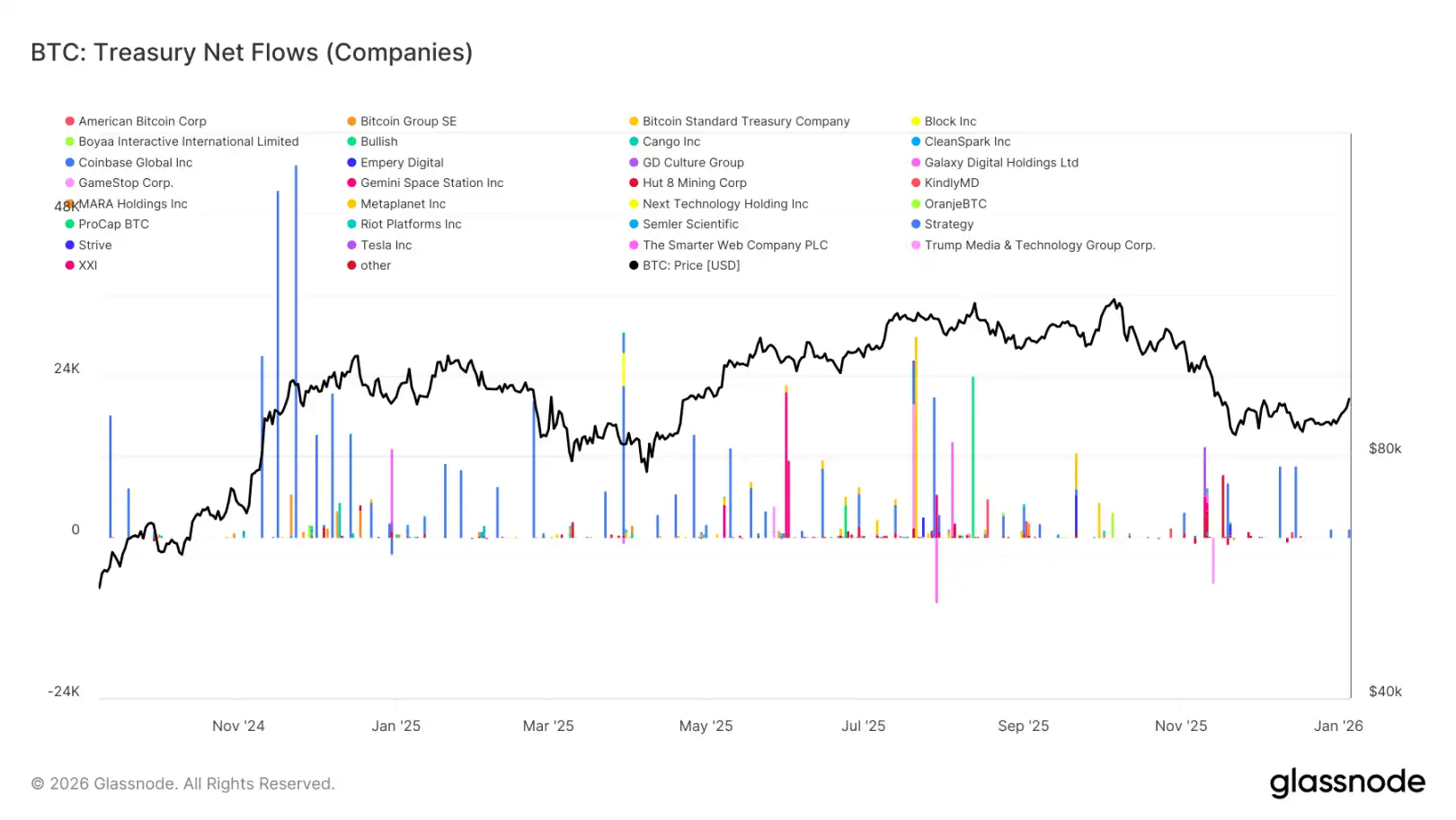
- The demand for Bitcoin from corporate treasuries continues to provide underlying support for the price, but this demand exhibits a pulsed nature, lacking continuity and structure.
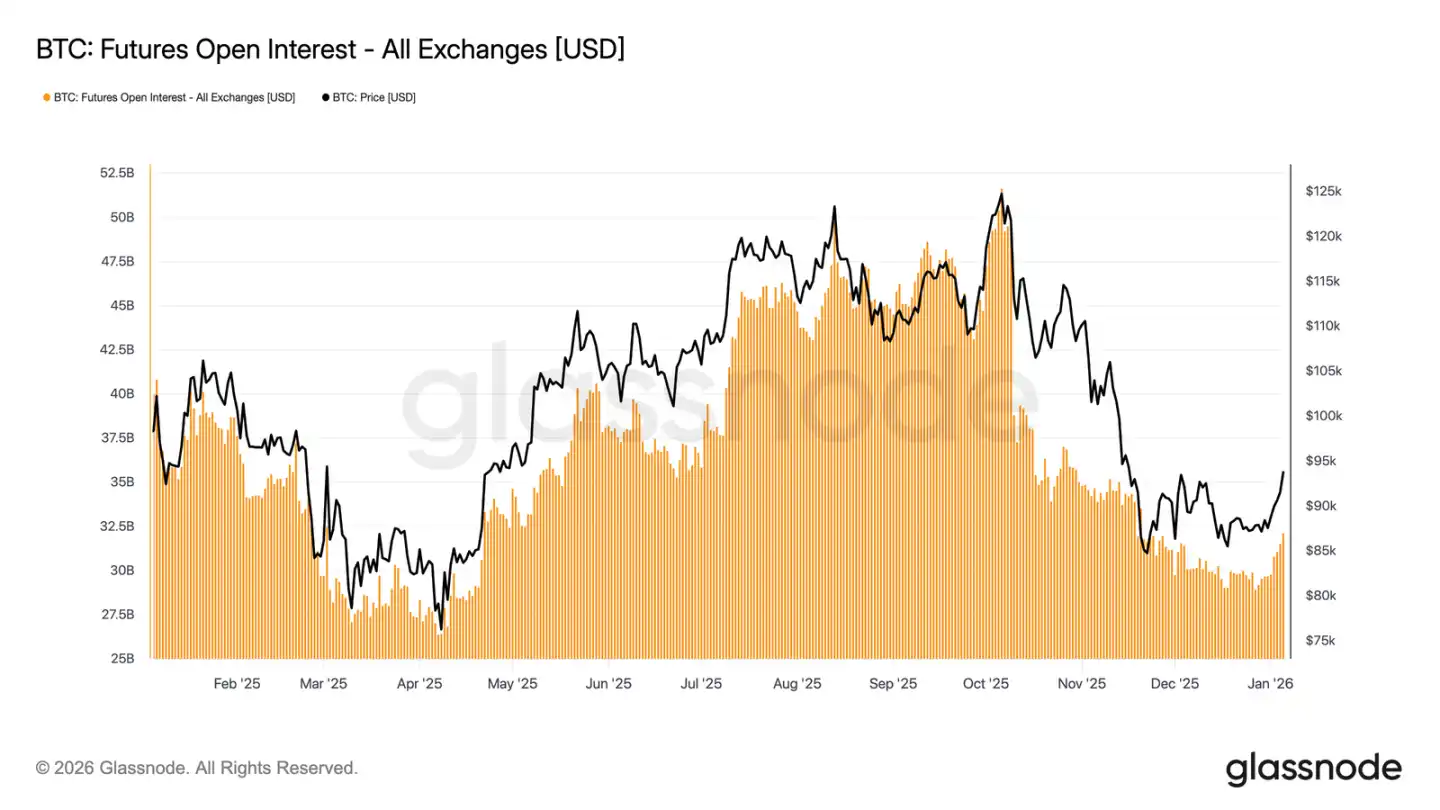
- Following a net outflow at the end of 2025, U.S. physically settled Bitcoin ETF funds have recently shown net inflow signs. Meanwhile, open interest in the futures market has stopped declining and is starting to rise, indicating that institutional investors are re-engaging with the market, and derivative activity is rebuilding.
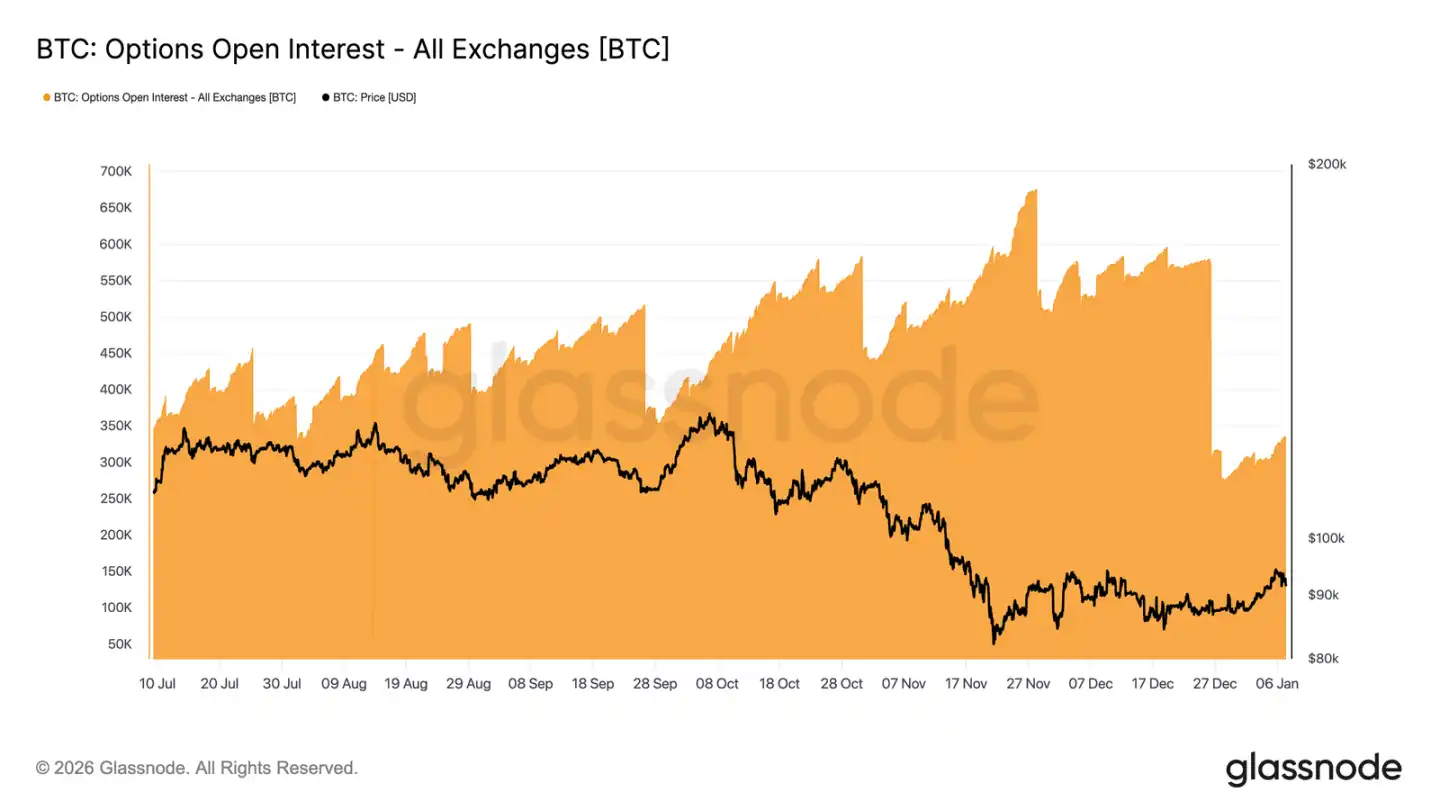
- A record amount of options positions expired at the year-end, with over 45% of open interest being settled, eliminating structural hedging constraints in the market, allowing true risk appetite to more clearly reflect in prices.
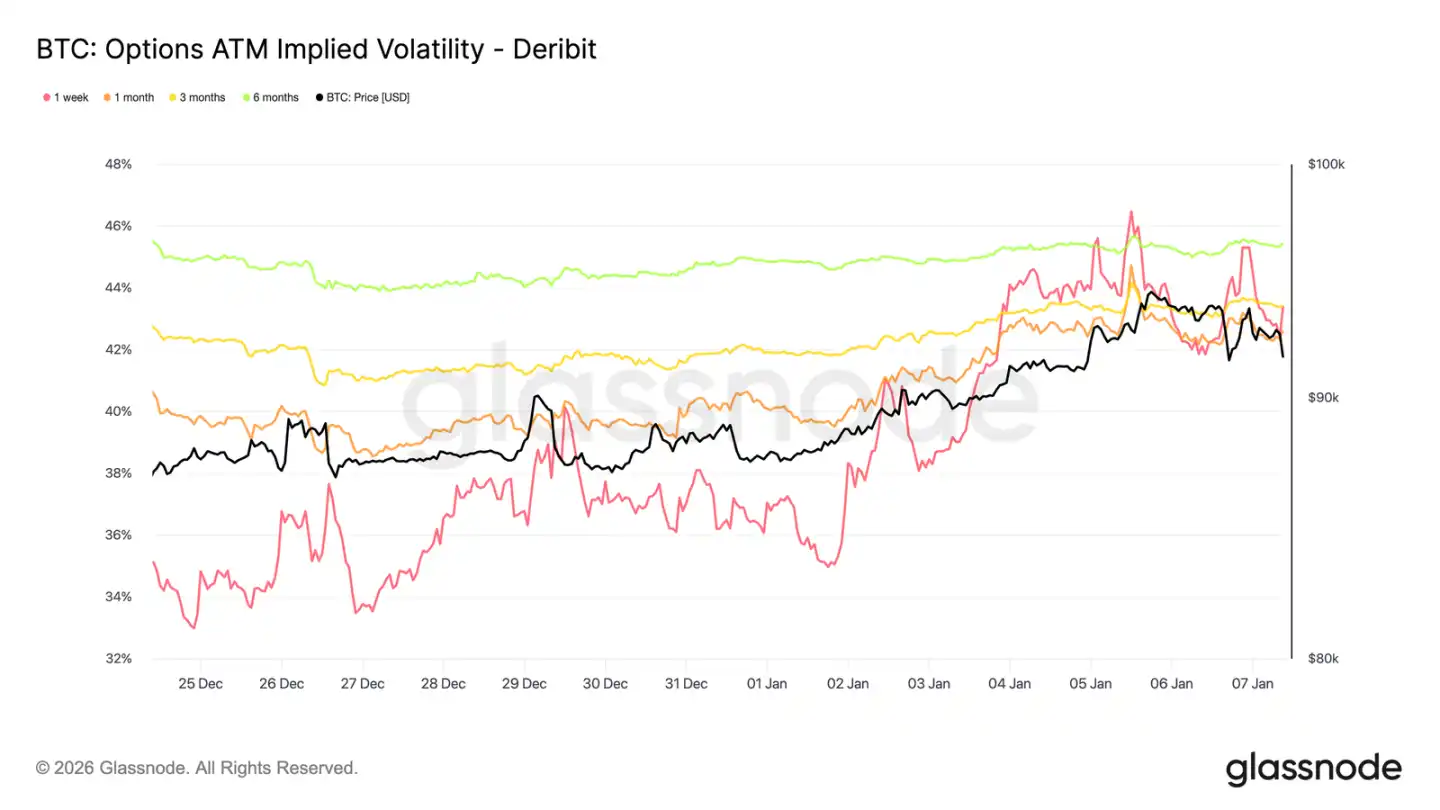
- Implied volatility has likely hit a phase bottom, with buyer demand at the start of the year gently boosting the volatility curve, but still in a relatively low position within the past three months' range.
- As put option premiums narrow and call option trading dominance increases, the market skew continues to normalize. Since the new year, option trading has significantly tilted towards the call side, indicating that investors are transitioning from defensive hedging to actively positioning for upside opportunities.
- Between the $95,000 and $104,000 range, market maker positions have shifted to net short, implying that when the price rises into this range, their hedging behavior will passively fuel the uptrend. Additionally, the performance of call option premiums around the $95,000 strike price shows that long position holders prefer holding rather than rushing to take profits.
Overall, the market is gradually transitioning from a defensive deleveraging phase to a selective risk-on stance, entering 2026 with a clearer structure and increased resilience.
On-chain Insight
Profit Taking Pressure Significantly Eased
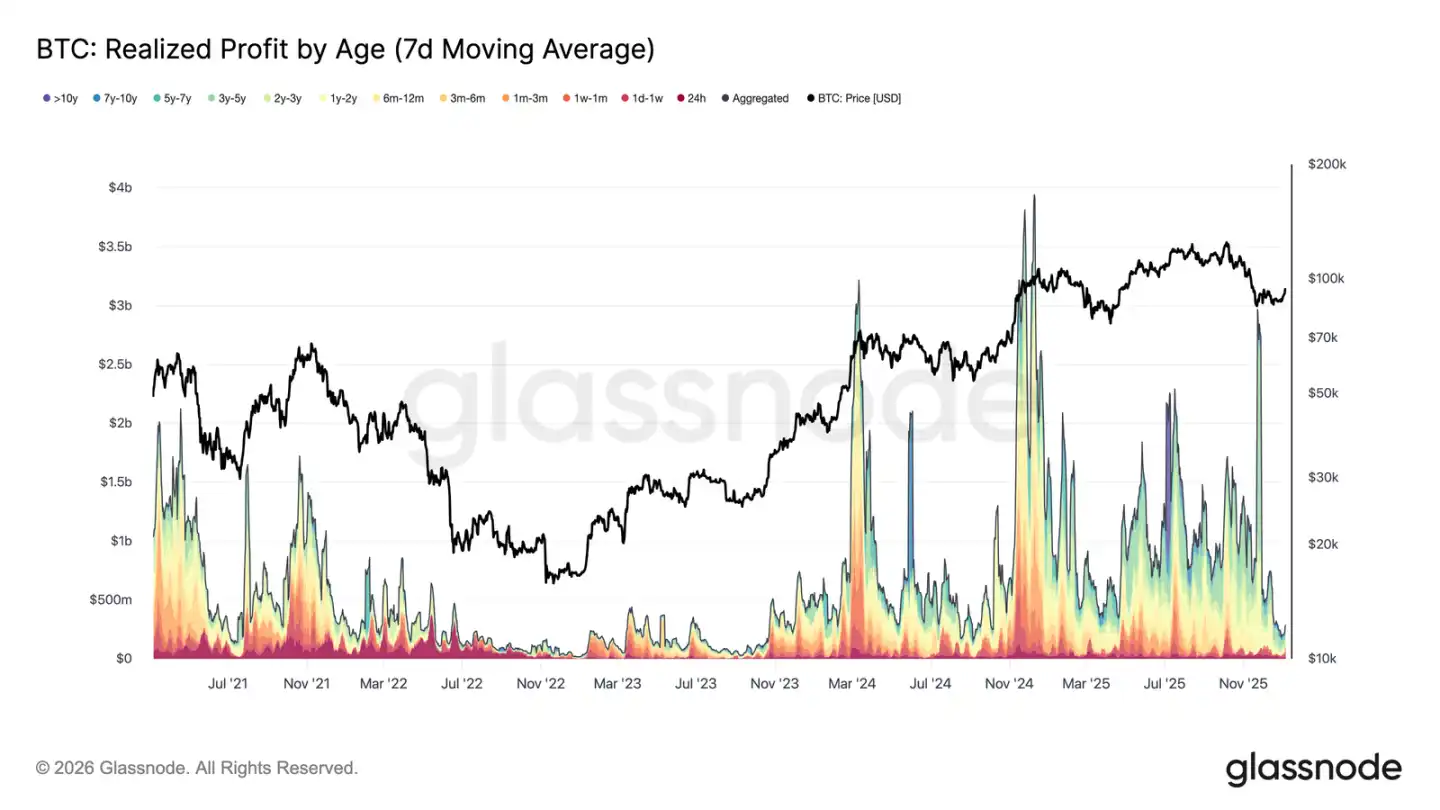
In the first week of 2026, Bitcoin broke out of a weeks-long consolidation range around $87,000, rising by about 8.5% to reach a high of $94,400. This increase was supported by a significant reduction in overall market profit-taking pressure. By late December 2025, the 7-day average realized profit had dropped from a high of over $1 billion on most days in the fourth quarter to a substantial $183.8 million.
The decline in realized profit, particularly the weakening sell-off from long-term holders, indicates that the major selling pressure suppressing price gains has been temporarily released. With selling pressure easing, the market has stabilized and regained confidence, leading to a new round of upward movement. Therefore, the early-year breakout marks the market's successful absorption of profit-taking pressure, opening up room for price appreciation.
Facing Overhead Supply Zone Resistance
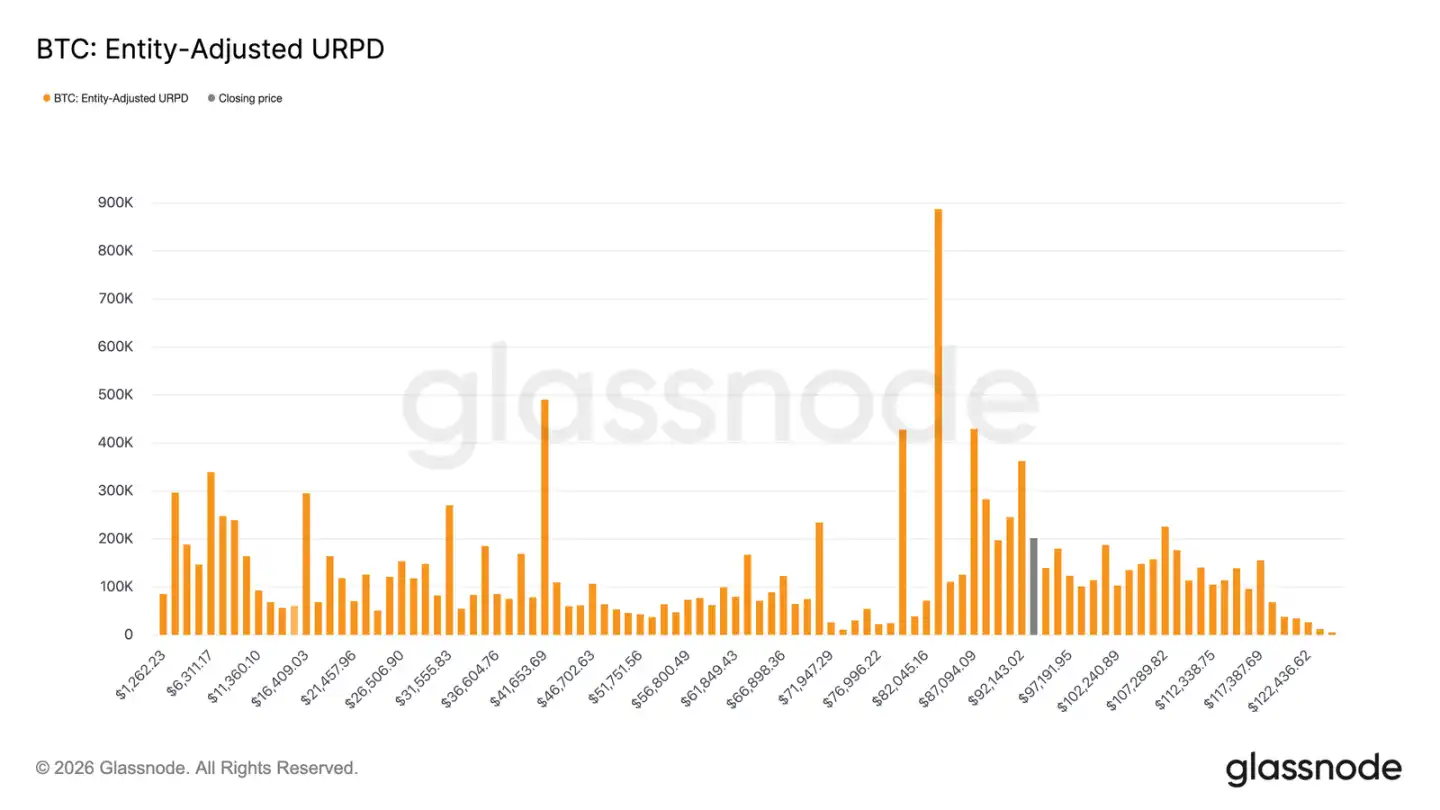
With profit-taking pressure easing, the price has been able to move higher, but the current rebound is now entering a supply zone composed of different cost bases. The market has now entered a range predominantly controlled by "recent top buyers," whose cost bases are densely distributed between $92,100 and $117,400. These investors accumulated heavily near previous highs and have been holding through the price retracement from the all-time high to around $80,000 until the current rebound phase.
Therefore, as the price rises back into their cost zone, these investors have the opportunity to break even or take slight profits, naturally creating upward resistance. For the market to truly restart the bull run, it needs time and resilience to absorb this overhead supply and facilitate a decisive breakthrough above this area.
Key Recovery Level
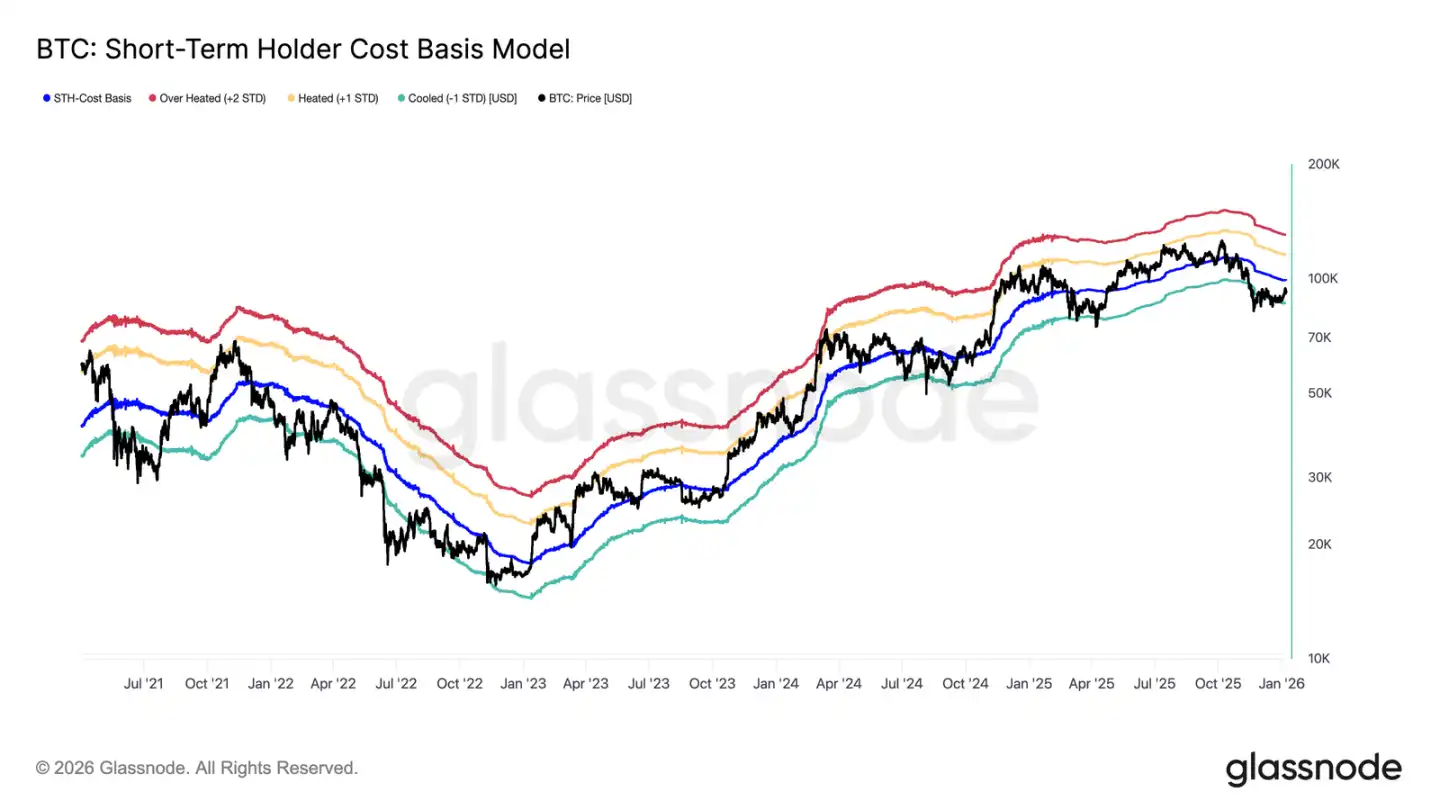
While facing overhead supply zone pressure, determining whether the recent rebound can genuinely reverse the previous downtrend and enter a phase driven by sustained demand requires a reliable price analysis framework. The Short-Term Holder Cost Basis model is particularly crucial during this transitional period.
It is worth noting that the market's weak balance in December last year coincided with the lower band of this model, reflecting fragile market sentiment and insufficient buyer confidence at the time. The subsequent rebound brought the price back towards the model's average, specifically the $99,100 level where the Short-Term Holder Cost Basis lies.
Therefore, the first key confirmation signal of market recovery will be the price's ability to sustainably hold above short-term holder cost basis, representing a resurgence in confidence from new market participants and a potential shift in trend towards bullish.
The Crossroads of Profit and Loss
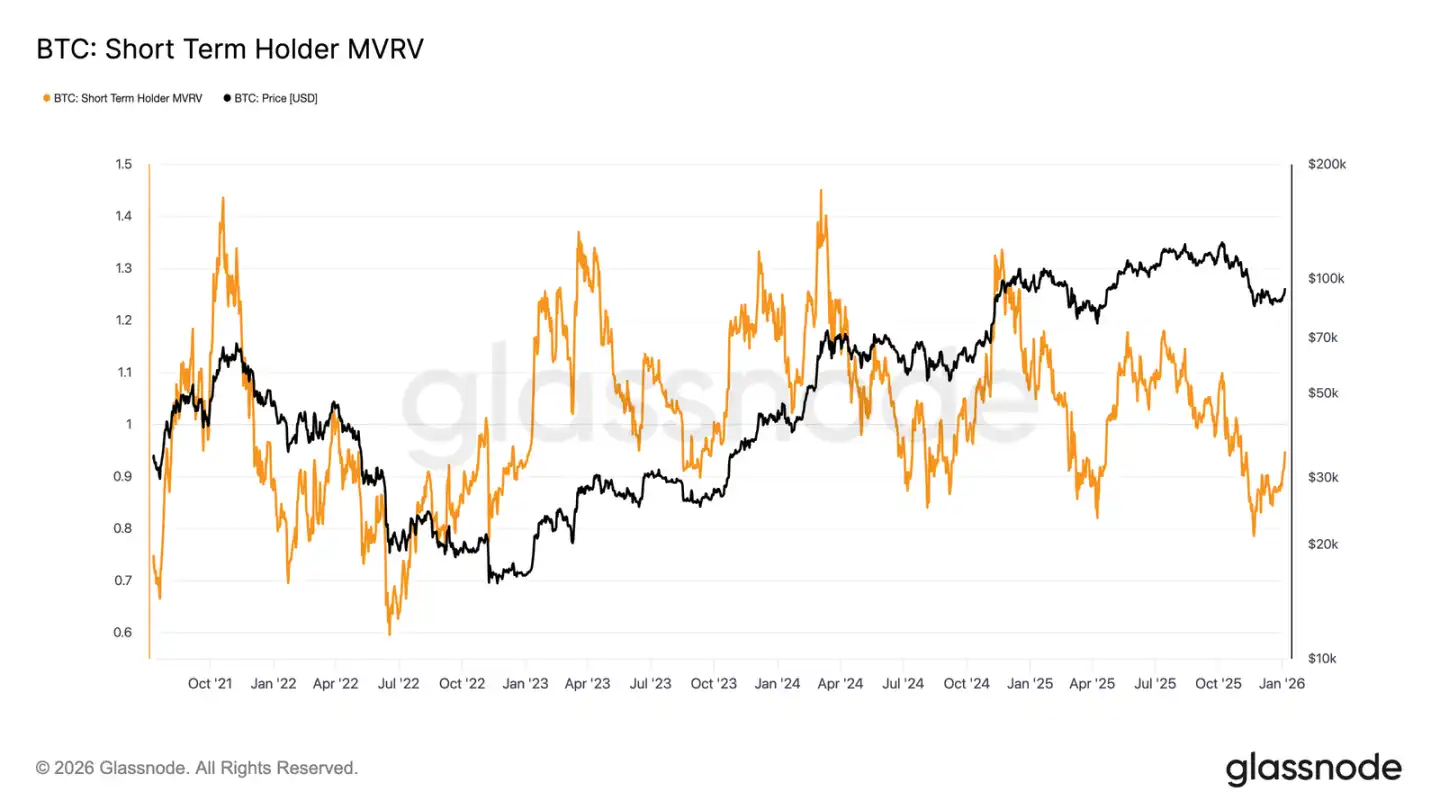
As the market's focus shifts to whether it can effectively reclaim the short-term holder cost basis, the current market structure bears similarities to the failed rebound of Q1 2022. If the price continues to fail to recover above this level, it may trigger a deeper downside risk. If confidence remains subdued, demand will further shrink.
This dynamic is also clearly reflected in the Short-Term Holder MVRV Ratio. This metric compares the spot price to the average cost of recent buyers, reflecting their unrealized gains or losses. Historically, when this ratio stays consistently below 1 (meaning the price is below the average cost), the market is often bear-dominated. Currently, the ratio has bounced back from a low of 0.79 to 0.95, indicating that recent buyers are still about 5% in unrealized losses on average. If the market cannot quickly return to a profitable state (MVRV > 1), it will continue to face downward pressure, making this metric a key observation point for the coming weeks.
On-Chain Insights
Decline in Digital Asset Treasury Demand
Corporate treasuries continue to provide significant marginal demand support for Bitcoin, but their buying behavior remains intermittent and event-driven. Treasury entities have seen net inflows of thousands of bitcoins in single weeks multiple times, but these purchases have not led to a sustained, stable accumulation pattern.
Large-scale inflows often occur during price pullbacks or consolidation phases, indicating that corporate buying behavior is still price-driven, characterized by opportunistic allocations rather than long-term structural accumulation. Although institutional participation has expanded, overall inflows exhibit a "pulsating" nature, interspersed with longer periods of silence.
In the absence of sustained treasury buying support, corporate demand serves more as a price "stabilizer" rather than a driver of trending price appreciation. The market direction will increasingly depend on changes in derivative positions and short-term liquidity conditions.
ETF Funds See Return to Net Inflows
Recent movements in U.S. Bitcoin spot ETF flows have shown early signs of institutional funds re-entering the market. After experiencing continuous outflows and subdued trading activity towards the end of 2025, fund flows have recently shifted decisively towards net inflows, coinciding with a stabilization rebound in the sub-$80,000 price range.
Although the current net inflow level has not yet returned to the mid-term peak seen in the cycle, fund flows have experienced a deterministic inflection point. The increase in net inflow days indicates that ETF investors are transitioning back from net sellers to marginal buyers.
This shift signifies that institutional spot demand is once again becoming a positive supporting force in the market, rather than a liquidity pressure source, providing structural buying support for the early-year market stabilization.

Resurgence in Futures Market Participation
After undergoing a sharp deleveraging following the price drop at the end of 2025, the total open interest in the futures market has recently started to rise. The size of open interest, after retracing from a cycle high of over $50 billion, is now stabilizing and gradually increasing, indicating that derivative traders are re-establishing risk positions.
This position rebuilding, synchronized with a stabilization phase in the price range of $80,000 to $90,000, shows that traders are gradually increasing their risk exposure rather than rushing to chase higher prices. The current pace of re-leveraging is relatively moderate, with open interest still far below the previous cycle high, reducing the risk of large-scale liquidation in the short term.
The moderate increase in open interest marks an improvement in local risk appetite, with derivative buyers gradually returning, helping the price embark on a new round of pricing in the early stage of liquidity normalization.
Options Market Positioning Undergoes "Great Reshuffling"
At the end of 2025, the Bitcoin options market witnessed the largest-ever position reset. The number of open interest contracts plummeted from 579,258 contracts on December 25 to 316,472 contracts after the December 26 expiry, a decrease of over 45%.
A significant amount of open interest was concentrated at certain key strike prices, indirectly impacting short-term price movements through market maker hedging operations. By the end of last year, this concentration of positions reached a peak, leading to "price stickiness" in the market, limiting volatility.
Now, this pattern has been disrupted. With the clearing of concentrated year-end positions, the market has freed itself from the structural constraints of the hedging mechanism.
The post-expiry market environment provides a clearer window to observe true sentiment, as new positions reflect investors' current risk appetite, rather than the influence of legacy positions, making options trading in the early weeks of the year more directly reflective of market expectations for future trends.
Implied Volatility Bottomed Out
Following a significant reset of option positioning, implied volatility hit a short-term low during the Christmas period. With thin trading activity during the holiday season, one-week implied volatility dropped to the lowest level since late September of last year.
Subsequently, buying interest started to return, with investors gradually establishing long volatility positions around the New Year (especially in the call direction), causing a mild uptick across the volatility curve.
Despite the rebound, implied volatility remains in a compressed state. Implied volatilities across various tenors from one week to six months are concentrated between 42.6% and 45.4%, with a relatively flat curve shape.
Volatility continues to sit at the low end of a range seen in the past three months, with the recent rise more reflective of increased market participation rather than a broad repricing of risk.
Market Moving Towards Equilibrium
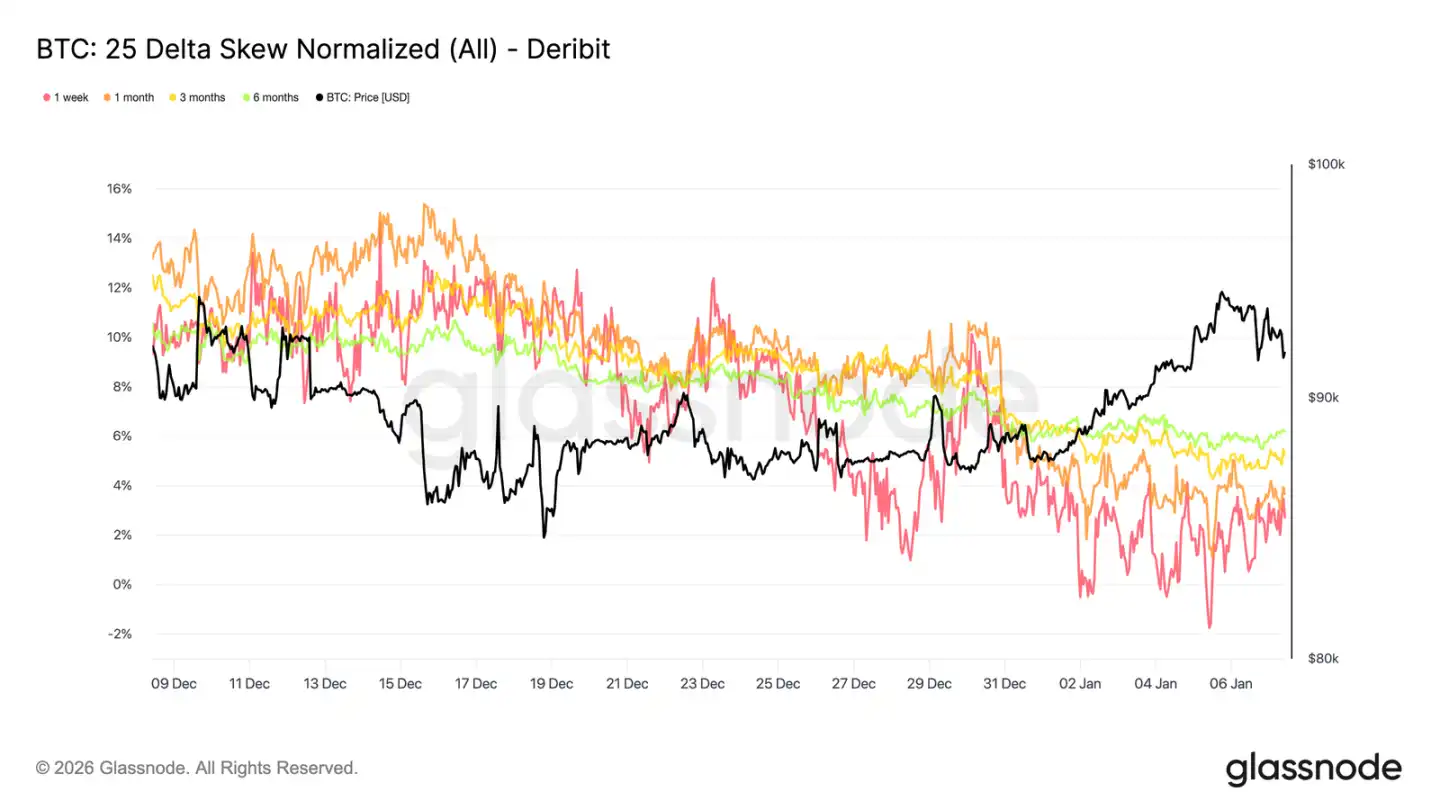
As implied volatility stabilizes, the skew provides a clearer view of traders' directional preferences. Over the past month, the premium of put options relative to call options has consistently narrowed, and the 25-Delta skew curve is gradually reverting towards the zero axis.
This reflects a gradual shift in the market towards a call bias. Investor demand is transitioning from pure downside hedging to increasing exposure to upside opportunities, aligning with their post-year-end repositioning behavior.
Simultaneously, defensive positions have decreased. Some downside protection positions have been unwound, reducing the premium paid for "black swan" insurance.
Overall, the skew indicates that market risk expression is becoming more balanced, with investors' expectations of price appreciation or volatility expansion heating up.
New Year Option Trading Prefers Calls
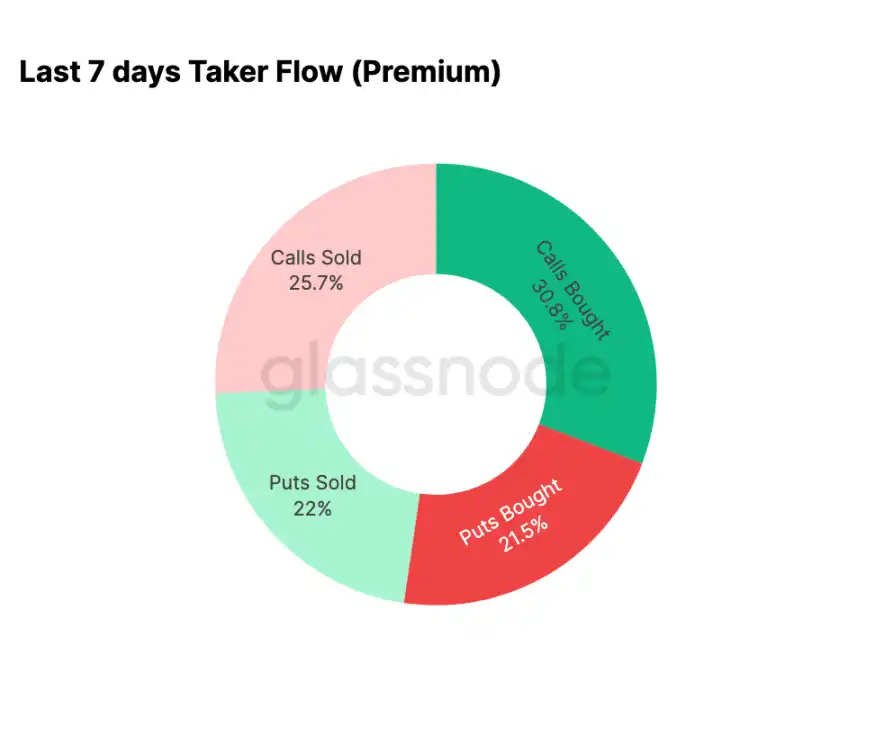
Fund flow data confirm the trend reflected in the skew. Since the beginning of the year, option market activity has shifted from systematic selling of call options (betting on volatility decrease) to actively buying call options (betting on upside or increased volatility).
Over the past seven days, buy trades of call options accounted for 30.8% of total option activity. The increase in call demand has also attracted participation from volatility sellers, who are selling call options (25.7% of total activity) to earn higher premium income.
Trades in the put direction represent 43.5% of total volume, which is relatively moderate given the recent price increase. This aligns with the trend towards equilibrium in skew, reflecting a reduced market demand for immediate downside protection.
Liquidity Providers Turn Net Short in Key Range
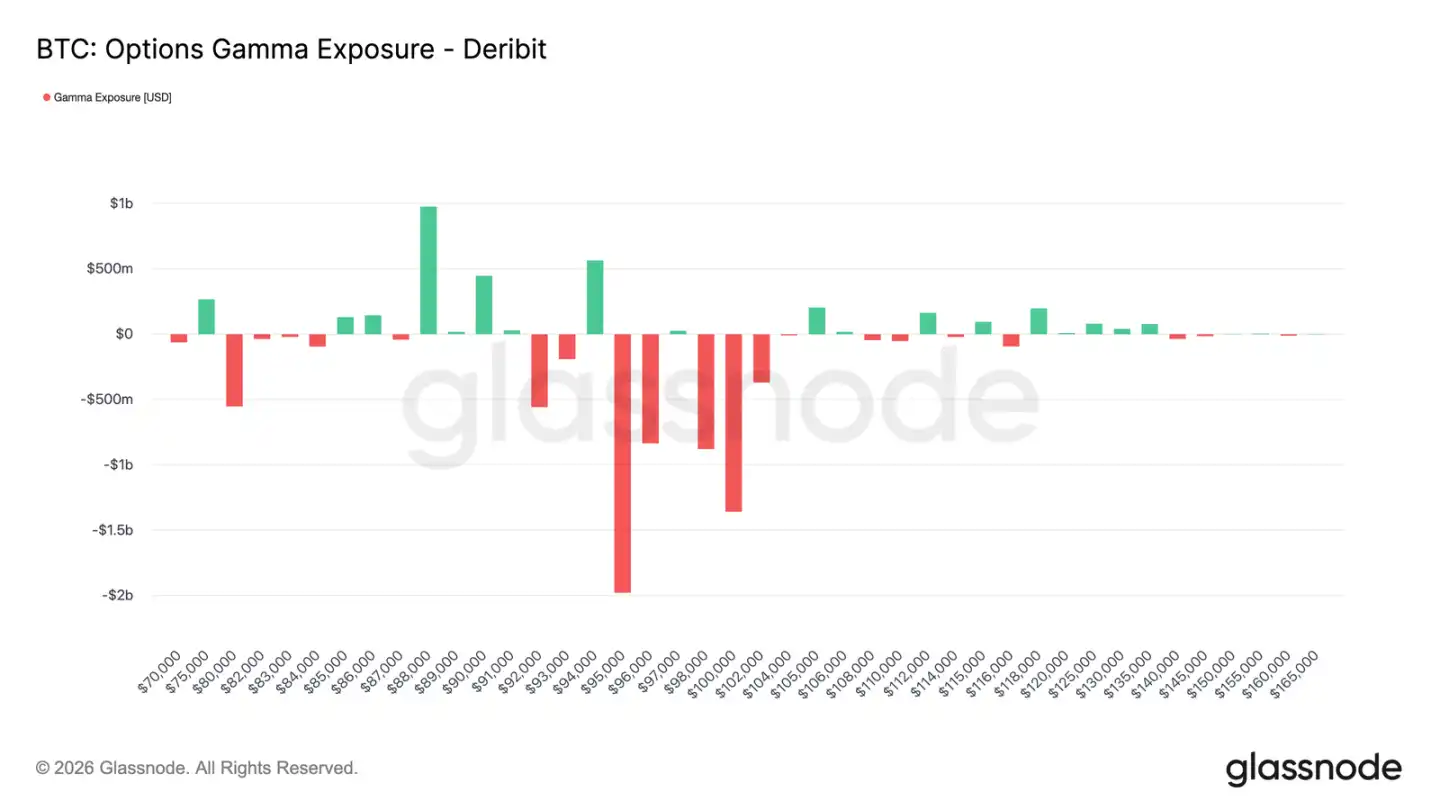
As bullish options trading activity has picked up since the new year, liquidity provider positions have adjusted accordingly. Currently, in the $95,000 to $104,000 range, liquidity providers hold a net short position overall.
Within this range, as prices increase, liquidity providers need to buy spot or perpetual contracts to hedge their risk, creating a feedback loop that bolsters the market during rallies, a stark contrast to the conducive environment that suppressed volatility at the end of last year.
In the first quarter expiry contracts, traders concentrating their bullish options buying between $95,000 and $100,000 further confirm the shift in market risk expression. The current liquidity provider position structure implies that their hedging behavior in this range no longer suppresses price fluctuation and may even amplify upward momentum.
$95,000 Call Option Premium Shows Patience
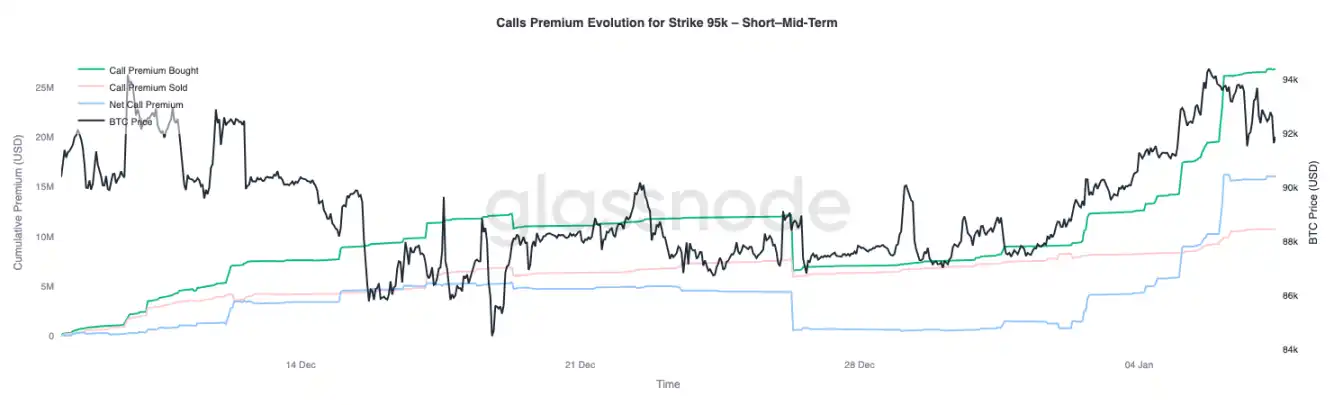
The performance of the call option premium at a $95,000 strike price can serve as an effective indicator of market sentiment changes. On January 1st, when the spot price was still around $87,000, buying of call option premiums at this strike price began to accelerate and continued to increase as the price surged to a recent high of $94,400.
Subsequently, while the premium buying slowed, there was no significant retreat. More importantly, this process was not accompanied by a substantial increase in call option premium selling.
This indicates limited profit-taking behavior. Since the recent high, the volume of call option selling has only modestly risen, indicating that the majority of call position holders choose to continue holding rather than rushing to lock in profits.
Overall, regarding the option premium behavior around the $95,000 strike price, it reflects the patience and holding confidence of bullish participants.
Summary
As Bitcoin entered the new year, it has significantly cleared historical positions in the spot, futures, and options markets. The deleveraging at the end of 2025 and the year-end options expiry event effectively removed the structural constraints the market faced previously, leaving behind a cleaner, more clearly signalled environment.
Currently, early signs of market re-engagement are emerging: ETF inflows stabilizing and rising, futures market activity rebuilding, options market clearly shifting to a bullish layout - skew returning to normal, volatility bottoming out, liquidity providers turning negative in a key upper range.
These dynamics collectively suggest that the market is gradually shifting from a mode dominated by defensive selling towards a phase of selectively increasing risk exposure and rebuilding engagement. Despite structural buying pressure still needing to firm up, the release of historical positioning pressures and the re-accumulation of bullish sentiment indicate that Bitcoin has started 2026 at a more nimble pace, with internal market improvements providing more possibilities for a subsequent expansionary market.
You may also like

What’s Driving Crypto Markets in Early 2026: Market Swings, AI Trading, and ETF Flows?
Imagine checking Bitcoin and Ethereum prices in a day — one minute up 5%, the next down 4%. Sharp moves, quick reversals, and sensitivity to macro signals marked the first week of 2026. After an early-year rally, both assets pulled back as markets recalibrated expectations around U.S. monetary policy and institutional flows. For traders — including those relying on AI or automated systems — this period offered a vivid reminder: abundant signals do not guarantee clarity. Staying disciplined in execution is often the real challenge.

Aster Coin: A Deep Dive into Its Price, Potential, and Why It’s Catching Eyes in 2026
Have you ever stumbled upon a crypto project that seems poised for growth amid market volatility, only to…

Left Hand BTC, Right Hand AI Computing Power: The Gold and Oil of the Data Intelligence Era

Solana Price Prediction: Morgan Stanley Just Filed for a SOL ETF – Is This the Beginning of Wall Street’s Next Crypto Obsession?
Key Takeaways Morgan Stanley’s filing for a SOL-based ETF signifies growing institutional interest in cryptocurrencies beyond Bitcoin, boosting…

Binance Launches Regulated Gold and Silver Perpetual Futures Settled in USDT
Key Takeaways: Binance has introduced its first regulated perpetual futures contracts, which are tied to traditional assets like…

Ondo Finance Price Prediction – ONDO Anticipated to Decrease to $0.331411 by Jan 12, 2026
Key Takeaways The prediction for Ondo Finance (ONDO) indicates a significant price decline to $0.331411, translating to a…
Capital Inflows into Bitcoin: An Examination of Current Trends and Future Implications
Key Takeaways Institutional long-term holding strategies have reshaped Bitcoin’s traditional market cycles. Capital inflows into Bitcoin have dried…

From Manus' Shihong onwards, those Coinsquare interns
All these uncommon things in the crypto world are listed on Idle Fish

The old altcoin script is outdated, take you to decipher the new market structure

Key Market Information Discrepancy on January 8th - A Must-See! | Alpha Morning Report

Rumble Launches Crypto Wallet in Collaboration with Tether, Boosting Share Value
Key Takeaways: Rumble’s latest innovation integrates cryptocurrency tipping for content creators directly within its platform. Built in partnership…

Babylon Labs Secures $15 Million from a16z Crypto to Enhance Bitcoin Collateral Framework
Key Takeaways Babylon Labs has successfully raised $15 million from a16z crypto to further develop and expand its…

Crypto Markets Today: Bitcoin Slides as Asia-Led Sell-Off Hits Altcoins
Key Takeaways: Bitcoin could not surpass the $94,500 mark and fell to roughly $91,530, contributing to a wider…
Start-of-the-Year Crypto Rally Stalls: What’s Next?
Key Takeaways The initial crypto market boost at the start of 2026 has lost momentum, primarily due to…

Strategy’s STRC Preferred Stock Rebounds to $100: Potential Catalyst for Bitcoin Purchases
Key Takeaways STRC, the perpetual preferred equity of Strategy, returns to $100, the first time since November. This…

Karatage Welcomes Shane O’Callaghan as Senior Partner in Strategic Move
Key Takeaways Karatage, a London-based hedge fund, appoints Shane O’Callaghan as a senior partner to enhance its institutional…

Lloyds Bank Achieves a Milestone: UK’s First Gilt Purchase via Tokenized Deposits
Key Takeaways Lloyds Bank executed the first-ever UK government gilt purchase through tokenized deposits, highlighting a transformative use…
What’s Driving Crypto Markets in Early 2026: Market Swings, AI Trading, and ETF Flows?
Imagine checking Bitcoin and Ethereum prices in a day — one minute up 5%, the next down 4%. Sharp moves, quick reversals, and sensitivity to macro signals marked the first week of 2026. After an early-year rally, both assets pulled back as markets recalibrated expectations around U.S. monetary policy and institutional flows. For traders — including those relying on AI or automated systems — this period offered a vivid reminder: abundant signals do not guarantee clarity. Staying disciplined in execution is often the real challenge.
Aster Coin: A Deep Dive into Its Price, Potential, and Why It’s Catching Eyes in 2026
Have you ever stumbled upon a crypto project that seems poised for growth amid market volatility, only to…
Left Hand BTC, Right Hand AI Computing Power: The Gold and Oil of the Data Intelligence Era
Solana Price Prediction: Morgan Stanley Just Filed for a SOL ETF – Is This the Beginning of Wall Street’s Next Crypto Obsession?
Key Takeaways Morgan Stanley’s filing for a SOL-based ETF signifies growing institutional interest in cryptocurrencies beyond Bitcoin, boosting…
Binance Launches Regulated Gold and Silver Perpetual Futures Settled in USDT
Key Takeaways: Binance has introduced its first regulated perpetual futures contracts, which are tied to traditional assets like…
Ondo Finance Price Prediction – ONDO Anticipated to Decrease to $0.331411 by Jan 12, 2026
Key Takeaways The prediction for Ondo Finance (ONDO) indicates a significant price decline to $0.331411, translating to a…


 App
App