
- Buy Crypto
- Markets
- Futures
- Spot
- Copy Trade
 Earn
Earn- More
Why Is On-Chain Fixed-Rate Lending Hard to Come By? "Basis Swap" Trading Is the Way Out

Original Article Title: Why fixed-rate lending never took off on-chain
Original Article Author: @nicoypei, Crypto Content Creator
Original Article Translation: AididiaoJ, Foresight News
The demand for fixed-rate lending mainly comes from institutional borrowers and carry trade users. While the scale of on-chain credit will expand in the future, at the current stage, most on-chain participants highly value the flexibility of being able to withdraw funds at any time. Therefore, instead of having lenders accept "term lock-in," a better approach would be to build an interest rate swap layer on top of existing money markets (such as Aave) to meet the demand for fixed-rate lending.
Insight from Traditional Finance: The Fixed-Rate Market, Originating from Borrower Demand
In the private debt market, the reason fixed-rate is mainstream lies in the borrower's need for certainty, not because lenders like it.
· Borrower's Perspective (corporates, private equity funds, real estate developers, etc.): Their primary concern is predictable cash flow. A fixed rate can mitigate the risk of benchmark rate increases, simplify budgeting, and reduce refinancing risks. This is particularly crucial for highly leveraged or long-term projects, where interest rate fluctuations could directly threaten their viability.
· Lender's Perspective: They usually prefer floating rates. Loan pricing is typically "benchmark rate + credit risk premium." A floating structure can protect profit margins when rates rise, reduce "duration risk," and capture additional returns when benchmark rates increase. Lenders only offer fixed rates when they can hedge interest rate risk or charge a sufficient premium.
Therefore, fixed-rate products are a response to borrower demand, rather than the market's default form. An important insight for DeFi is that without clear and persistent borrower demand for "rate certainty," fixed-rate lending is unlikely to gain liquidity, scale, or sustainable development.
Who Are the Borrowers on Aave / Morpho & Euler? Why Are They Borrowing?
A common misconception is: "Traders borrow from the money market for leverage or to short."
In reality, directional leverage trades are mostly done through perpetual contracts as they are more capital efficient. Money markets require overcollateralization and are not suitable for speculative leverage.
Yet, Aave alone has around $8 billion in stablecoin borrowings. Who are these borrowers?
It can be broadly categorized into two groups:
1. Long-Term Holder / Whale / Treasury: They collateralize their held crypto assets (e.g., ETH), borrow stablecoins to gain liquidity, while avoiding asset liquidation (thus retaining upside potential and avoiding taxable events).
2. Yield Farmer: They borrow to recursively leverage interest-bearing assets (such as liquidity provider tokens LST/LRT, e.g., stETH; or interest-bearing stablecoins, such as sUSDe). The goal is to achieve a higher net yield rather than speculate on price movements.
So, Is There Actually On-Chain Demand for Fixed Rates?
Yes. The demand mainly comes from two types of users: institutional-grade crypto asset collateralized loans and yield strategies.
1. Institutional-Grade Crypto Collateralized Loans Require Fixed Rates
Take Maple Finance as an example, it provides overcollateralized loans, lending stablecoins to institutions, with collateral mainly in BTC, ETH, and other blue-chip crypto assets. Borrowers include high-net-worth individuals, family offices, hedge funds, etc., seeking fixed-rate funds with predictable costs.
· Rate Comparison: The cost of borrowing USDC on Aave is approximately 3.5% annualized, while on Maple, the fixed-rate loan liquidation yield for similar collateral is between 5.3% and 8%. This means that transitioning from a variable rate to a fixed rate, borrowers need to pay an additional premium of around 180-450 basis points.
· Market Size: Just Maple's Syrup pool manages around $2.67 billion, comparable to Aave's outstanding loans of about $3.75 billion on the Ethereum mainnet.
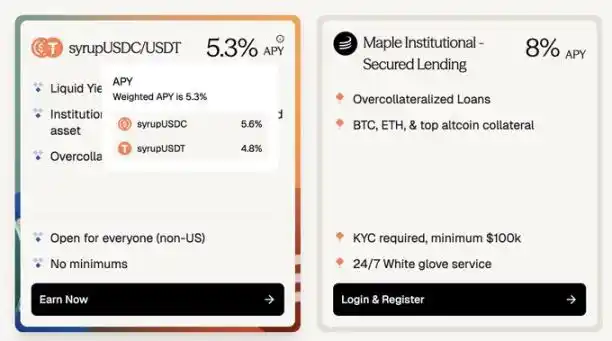
(Paying around a 180-400 basis point premium for fixed-rate crypto loans on Maple compared to Aave's ~3.5%.)
It should be noted that some borrowers choose Maple to mitigate (early DeFi) smart contract risk. However, as protocols like Aave demonstrate security, transparency, and liquidation mechanisms, this risk perception is diminishing. If a reliable on-chain fixed-rate option emerges, the off-chain fixed-rate loan premium is likely to compress.
2. Yield Strategies Require Fixed Rates
Despite generating billions of dollars in capital requirements, the carry trade strategy is often unprofitable due to sharp fluctuations in borrowing rates.
A stablecoin carry trade borrower remarked: "As a carry trader / borrower, the borrowing rate is unpredictable, and rate fluctuations often suddenly erase several months of accumulated gains, resulting in position losses."
Historical data also shows that borrowing rates on Aave and Morpho are extremely volatile, with annualized volatility exceeding 20%.
For carry traders, they earn a fixed income (e.g., through Pendle's PT), but using floating-rate borrowing to maintain the carry introduces "interest rate risk." Once borrowing rates skyrocket, it can potentially wipe out all profits. If both borrowing rates and investment returns are fixed, then the funding risk is eliminated. The strategy becomes easier to assess, positions can be held securely, and capital can be deployed more efficiently.
With on-chain infrastructure (such as Pendle's PT) having undergone more than five years of security testing, the demand for on-chain fixed-rate loans is rapidly increasing.
If there is demand, why hasn't the market grown? Look at the supply-side issues.
Flexibility: The "Invaluable Asset" for On-chain Participants
Flexibility here refers to the ability to adjust or exit positions at any time, without a lock-up period—lenders can withdraw at any time, while borrowers can repay or redeem collateral at any time without penalties.
In contrast, holders of Pendle PT sacrifice some flexibility. Even in the largest pools of funds, Pendle's mechanism cannot allow positions exceeding approximately $1 million to exit instantly without experiencing significant slippage.
So, how much compensation do on-chain lenders receive for giving up flexibility? Taking Pendle PT as an example, compensation is usually as high as over 10% annually, and during yield farming frenzies (such as usdai on Arbitrum), it can even exceed 30%.
Evidently, true borrowers (non-speculators) cannot afford a 10% fixed-rate cost. This high rate is essentially a "premium" paid for relinquishing flexibility and is unsustainable without speculation on yield farming tokens.
While PTs pose higher risks compared to foundational lending protocols like Aave (increasing risks to the protocol itself and underlying assets), the core conclusion remains the same: any fixed-rate market that requires borrowers to give up flexibility cannot scale if borrowers cannot afford the exorbitant rates.
Term Finance and TermMax are examples: Few lenders are willing to sacrifice flexibility for a tiny amount of interest, and borrowers would never pay 10% to lock in a rate when the Aave rate is 4%.
Solution: Don't Directly Match Fixed-Rate Borrowers with Fixed-Rate Lenders
Fixed-rate borrowers should be matched with rate traders. Specifically:
Step 1: Preserve Lender Experience
The vast majority of on-chain capital trusts only Aave, Morpho, Euler’s security and prefers the simple passive experience of "money lego" in Aave. They are not the "sophisticated yield farmer" who evaluates every new protocol for a 50-100 basis point premium.
Therefore, for the fixed-rate market to scale, the lender experience must mirror what it’s like to use Aave today:
· Deposit anytime
· Withdraw anytime
· Little to no additional trust assumptions
· No lockup period
In an ideal world, the fixed-rate protocols would sit directly on top of these trusted money markets of Aave, leveraging their security and liquidity.
Step 2: Trade the "Spread," Not the "Principal"
For borrowers looking to borrow at a fixed rate, they do not need another full locked-term loan. What they truly need is capital willing to take on the risk between the "agreed fixed rate" and the "Aave floating rate," while the rest of the principal can still be borrowed from Aave and elsewhere.
In other words, traders are trading the expected difference between fixed and floating rates, not the entire loan principal.
A layer of interest rate swaps can achieve this:
· Hedgers can swap fixed payments for fully matched floating payments from Aave.
· Macro traders can express views on interest rate moves with extremely high capital efficiency.
Capital Efficiency Example: Traders only need to post a small amount of margin to take on interest rate exposure, far less than the loan's nominal principal. For example, to short a $10 million, 1-month Aave borrowing rate, assuming a fixed rate of 4% annually, traders might need only about $33,300 in margin—implying a 300x capital efficiency.
Considering that the Aave interest rate often fluctuates between 3.5% and 6.5%, this implied leverage allows traders to treat the rate itself as a highly volatile "token" to trade (rising from $3.5 to $6.5), with fluctuations far exceeding mainstream cryptocurrencies, closely tied to overall market liquidity and price, while avoiding the risk of liquidation associated with explicit leverage (e.g., 40x on BTC).
Go long on interest rates to earn the "peak," go short on interest rates to earn the "trough."
Long-Term Outlook: Fixed Rates Are Key to On-Chain Credit Expansion
I anticipate that as on-chain credit grows, so too will the demand for fixed-rate loans. Borrowers will increasingly require predictable financing costs to support larger-scale, longer-term positions, and productive capital allocation.
· Institutional Credit Expansion: Projects like Cap Protocol are driving on-chain institutional credit. They help over-collateralized protocols insure institutional-grade credit stablecoin loans. Currently, rates are determined by utilization curves applicable to short-term liquidity, but institutional borrowers value rate certainty. In the future, a dedicated interest rate swap layer will be crucial for supporting "term pricing" and risk transfer.
· On-Chain Consumer Credit: Projects like 3Jane focus on on-chain consumer credit. This space is almost entirely made up of fixed-rate loans because consumers need certainty.
In the future, borrowers may enter different segmented rate markets based on credit ratings or collateral asset type. Unlike traditional finance, the on-chain rate market may enable borrower pools to directly face market-driven rates rather than being locked in by a single lender's set rate.
You may also like

ZCash Team Split, Bank of America Upgrades Coinbase Rating, What's the Overseas Crypto Community Talking About Today?

Key Market Info Discrepancy on January 9th - A Must-Read! | Alpha Morning Report

Aster Coin: A Deep Dive into Its Price, Potential, and Why It’s Catching Eyes in 2026
Have you ever stumbled upon a crypto project that seems poised for growth amid market volatility, only to…

Left Hand BTC, Right Hand AI Computing Power: The Gold and Oil of the Data Intelligence Era

Key Market Insights for January 8th, how much did you miss out on?

Farewell to "Air" Investments: Use These 6 Key Metrics to Identify a Winning Project

USD 1 Billion Surge in Market Cap: Behind the Scenes with Trump Family Bet and CEX Shilling

The old altcoin script is outdated, take you to decipher the new market structure

Coin Ownership or Equity Ownership? The Real Question Is Being Asked Wrong

Ranger Fund Takes a New Approach to Public Offering: Can a Grassroots Team Earn Market Trust?

CoinDesk 20 Performance Update: Uniswap (UNI) Dips 1.5% as Index Experiences Downturn
Key Takeaways Uniswap (UNI) experienced a notable drop of 1.5% as the CoinDesk 20 Index saw a decline.…

Crypto Markets Today: Bitcoin Slides as Asia-Led Sell-Off Hits Altcoins
Key Takeaways: Bitcoin could not surpass the $94,500 mark and fell to roughly $91,530, contributing to a wider…

Start-of-the-Year Crypto Rally Stalls: What’s Next?
Key Takeaways The initial crypto market boost at the start of 2026 has lost momentum, primarily due to…

Karatage Welcomes Shane O’Callaghan as Senior Partner in Strategic Move
Key Takeaways Karatage, a London-based hedge fund, appoints Shane O’Callaghan as a senior partner to enhance its institutional…
JPMorgan Targets Canton Network for Next Phase of JPM Coin
Key Takeaways JPMorgan’s Kinexys unit is set to advance the use of JPM Coin by integrating it with…

2025 Crypto Bear Market: A Crucial Year for Institutional Repricing
Key Takeaways The 2025 crypto bear market witnessed significant corrections in the DeFi and smart contract sectors, setting…

Trend Research: 2026 Beyond Paradigm, WLFI Initiates Financial Ecosystem New Era
2025 Crypto Card Annual Report: 40,000 Monthly Active Users, Average Spending of Less Than $100
ZCash Team Split, Bank of America Upgrades Coinbase Rating, What's the Overseas Crypto Community Talking About Today?
Key Market Info Discrepancy on January 9th - A Must-Read! | Alpha Morning Report
Aster Coin: A Deep Dive into Its Price, Potential, and Why It’s Catching Eyes in 2026
Have you ever stumbled upon a crypto project that seems poised for growth amid market volatility, only to…


 App
App