
- Buy Crypto
- Markets
- Futures
- Spot
- Copy Trade
 Earn
Earn- More
Why is the Hong Kong RWA Market Attracting Global Capital in Droves?

Original Title: "Hong Kong RWA Regulatory Practice and Representative Project | Viewing RWA from Traditional Finance Series Article Three – by W Labs Brian"
Original Source: Melon Lab Wlabs
This article will elaborate on the Hong Kong RWA regulatory practice and representative project
In early August 2025, Hong Kong's RWA and stablecoin tracks were at their hottest point in nearly five years. At that moment, the entire city was filled with a passion not seen since 2017-2018: top executives from traditional financial institutions, AI entrepreneurs, and even industry capital leaders flocked to Hong Kong in search of a Web3 integration path, with discussions of tokenized national debt, cash management tools, and stablecoin legislation filling banquet halls and hotel lobbies. A Wall Street banker who had just relocated from New York to Hong Kong at the time candidly stated: in terms of crypto topic density and participation breadth, Hong Kong has replaced New York as the world's hottest blockchain city.
However, just over two months later, the market temperature plummeted sharply. Mainland China's regulators signaled a notable tightening of policies regarding mainland financial institutions and assets' RWA-ization in Hong Kong, leading to the postponement or shelving of several mainland tangible asset tokenization projects that were already in progress. The trading volume on some mainland-backed RWA platforms plummeted by 70%-90%. The once-"world's number one" Hong Kong RWA frenzy seemed to transition from midsummer to deep autumn in an instant, raising temporary doubts in the market about Hong Kong's status as an international Web3 hub. On November 28, 2025, the People's Bank of China took the lead, convening a "coordination mechanism meeting to crack down on virtual currency trading speculation." For the first time, the meeting included stablecoins in the scope of virtual currency regulation, clarifying that virtual currency-related businesses are considered illegal financial activities, emphasizing that they do not have legal tender status and cannot be used as a medium of exchange.
While the mainland's tightening regulations did have some impact on mainland clients in the short term and restricted mainland capital outflow, some mainland institutions suspended their Hong Kong RWA business. However, Hong Kong has a special "one country, two systems" framework and an independent regulatory system, theoretically not subject to mainland policies. This is not a fundamental shift in Hong Kong's RWA policy but another manifestation of the "high-level cooling—structural repositioning" cycle that has repeatedly occurred in this track over the past two years. Looking back at the evolution path in 2023-2025, three stages can be clearly outlined:
2023 - 2024 H1: Regulatory Opening and Sandbox Trial Period
HKMA launched Project Ensemble, the SFC consecutively approved multiple tokenized currency market ETFs and bond funds, and local licensed platforms such as HashKey, OSL obtained virtual asset VA licenses for expansion, officially establishing Hong Kong as a "regulated RWA experimental field."
2024 H2 - July 2025: Explosive Growth Phase of Internal and External Resonance
The U.S. "GENIUS Stablecoin Act" is passed, the Fed begins an interest rate cut cycle, the Trump administration clarifies its pro-crypto stance, and the release of a consultation paper on local stablecoin legislation in Hong Kong triggers accelerated global funds and project inflow. The Boson - HashKey Tokenized Currency Market ETF, XSGD, and multiple tokenized private credit funds see their AUM surge from tens of millions to billions of dollars in a matter of months, making Hong Kong briefly the fastest-growing market in global RWA.
August 2025 to Present: Limited Participation and Risk Isolation Phase
Mainland regulation takes a more cautious stance on cross-border asset tokenization, explicitly limiting deep involvement of mainland institutions and individuals in the Hong Kong RWA ecosystem, effectively cutting off the main source of incremental funds and assets. Local and international capital in Hong Kong continue to be allowed full participation, but the growth momentum shifts from "mainland asset securitization" to "local + global compliant fund allocation to U.S.-led on-chain assets."
The underlying logic of this cyclical cooldown is the dynamic balance between the decision-makers' "participation in the new global digital economic order" and "prevention of systemic financial risk." Hong Kong's role is redefined as: leveraging local resources to fully connect with the U.S.-led blockchain economic network while building firewalls to prevent risk transmission to the mainland.
This signifies that the Hong Kong RWA market is not declining but entering a more distinct, sustainable third phase: transitioning from the previous "unchecked growth" to a new landscape of "compliance-led, DeFi entry, and global fund integration with U.S.-linked on-chain assets." Pure on-chain, high-transparency, low-risk cash management RWA (money market funds, bond tokens) will continue to grow rapidly, while the path to physical asset securitization heavily reliant on mainland assets and funds will be significantly compressed.
For practitioners, the short-term pains resulting from policy reversals are inevitable, but there remains ample regulatory space. Particularly, the brief tolerance window of U.S. regulation towards DeFi, coupled with the rare overlay advantage of on-chain services that licensed platforms in Hong Kong can lawfully offer, provides a valuable strategic runway for further deepening on-chain liquidity, structured products, and cross-chain asset allocation within a regulated framework.
The story of the Hong Kong RWA is far from over; it is merely transitioning from the clamor of emotional fervor to a more composed, professional deepening phase. This article will further elaborate on the Hong Kong RWA market and related representative projects.
Hong Kong RWA Market Landscape
As the global forefront of blockchain and traditional finance integration, Hong Kong's Real World Assets (RWA) market has established itself in 2025 as Asia's most regulatory mature ecosystem hub. The market, driven by the Hong Kong Monetary Authority (HKMA) and the Securities and Futures Commission (SFC), focuses on tokenized currency market tools, government bonds, green bonds, and emerging real-world assets (such as EV charging station revenue and international shipping rents) through Project Ensemble sandbox initiatives and the "Digital Assets Policy 2.0" framework. The overall landscape exhibits a characteristic of "Institutional Leadership, Compliance First, DeFi Gradual Entry": shifting from experimental issuance in 2024 to scaled infrastructure development in 2025, emphasizing cross-chain settlement, stablecoin integration, and global liquidity bridging. The Hong Kong RWA ecosystem has transitioned from a "Funding Window" to an "Innovation Platform," deeply integrating with U.S.-led layer-one networks, while fortifying risk walls to prevent cross-border contagion.
Participant Types: Institutional Capital Dominance, Coexistence of Tech Corporations and Startups
The Hong Kong RWA market participants are highly stratified, led by institutional capital, supplemented by local tech corporations and emerging Web3 startups, forming a closed-loop ecosystem. The following table outlines the primary types (based on 2025 active entities):
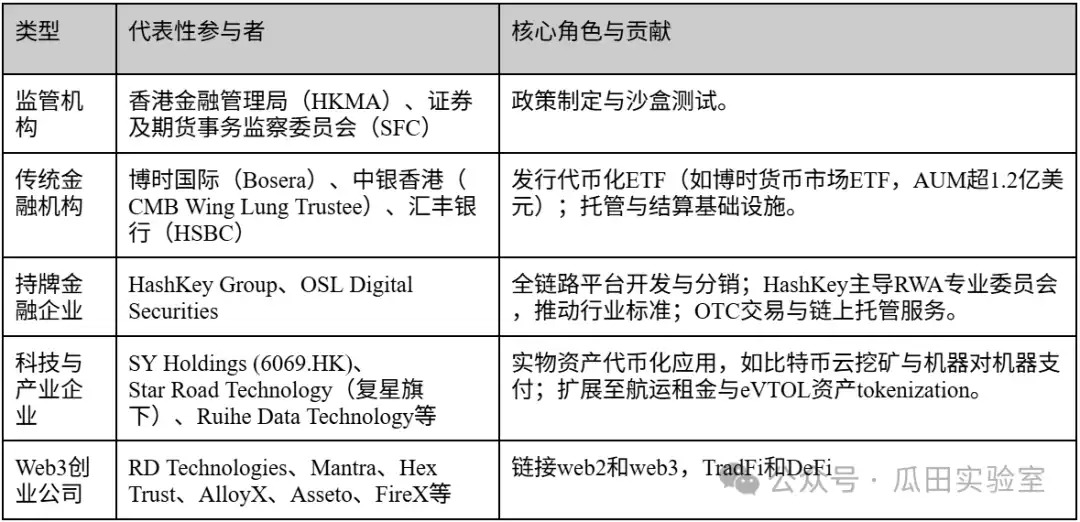
It can be seen that institutional players still dominate the Hong Kong market, accounting for approximately 70%, leading high-threshold product issuance; corporations and startups fill the technology and application gaps, benefiting from the SFC's VA license expansion.
Overall Scale and Growth Trend
In 2025, the Hong Kong RWA market's scale is embedded within the global $26.59B - $35.8B on-chain TVL framework, with AUM jumping from tens of millions of dollars at the beginning of the year to the billion-dollar level. Growth momentum stems from policy overlay effects—the 2025 Policy Address calls for RWA infrastructure investments, the Stablecoin Act is set to take effect in 2026, expecting a 90% reduction in cross-border payment costs, and settlement finality within 10 seconds. With an annual growth rate exceeding 200%, TVL expanding 58x in 3 years, but high compliance costs (over $820,000 for a single product issuance) limit retail penetration, with over 80% institutional inflow.
Future Development Potential Assessment
Hong Kong's RWA potential is vast, with the market expected to reach the trillion-dollar level from 2025 to 2030, ranking among the global top three (behind only the United States and Singapore). Its strengths lie in the regulatory sandbox's iteration speed and international alignment: the SFC is set to open up global order book sharing to enhance liquidity; the Ensemble project will build a tokenized deposit settlement system, extending to emerging trade chains like Brazil/Thailand. DeFi tolerance windows and AI+Blockchain integration (such as shipping rent tokenization, unlocking a $200 billion market) will drive diversified scenarios, with over 50 new projects expected in the startup ecosystem. Challenges include cost barriers and mainland capital isolation, but this actually strengthens Hong Kong's position as a "Global Neutral Hub": attracting European and American institutions to allocate to U.S. bonds / MMF, while local companies focus on Asian real-world assets. Overall, Hong Kong RWA is transitioning from "Hype-Driven" to "Sustainable Growth," with the key lying in policy continuity and mature infrastructure.
Hong Kong RWA-Related Platforms
HashKey Group - The "Full-Stack" Cornerstone of Compliance Ecosystem
Amid Hong Kong's grand narrative to become a global Web3 hub, the HashKey Group is undoubtedly the most iconic "flagship" entity to date. As Asia's leading end-to-end digital asset financial service group, HashKey is not only a pioneer in Hong Kong's compliant trading market but also a builder of key infrastructure for RWA (Real World Asset) asset issuance and trading. Its strategic layout spans from underlying blockchain technology to upper-layer asset management and trading, forming a complete compliance loop.
Founded in 2018 and headquartered in Hong Kong, HashKey Group has a deep connection with Wanxiang Blockchain Labs. Since the beginning of the Securities and Futures Commission of Hong Kong's (SFC) virtual asset trading platform licensing regime, HashKey has established a regulatory-embracing path.
In August 2023, HashKey Exchange became one of the first exchanges in Hong Kong to obtain both Type 1 (Securities Trading) and Type 7 (Providing Automated Trading Services) license upgrades, allowing it to serve retail investors. This milestone not only cemented its legal monopoly advantage in the Hong Kong market (one of the duopoly) but also provided an effective channel for the secondary market circulation of future compliant RWA products (such as STOs, security token offerings).
On December 1, 2025, HashKey Group underwent a hearing at the Hong Kong Stock Exchange and is set to be listed on the Main Board of Hong Kong, poised to become the "first licensed virtual asset stock in Hong Kong." There have been many analyses of HashKey's prospectus and listing prospects by industry experts. I believe that HashKey's listing is a landmark event that will help Hong Kong compete globally (especially compared to Singapore and the United States) for pricing power and discourse power in the Web3 field, solidifying Hong Kong's position as a "compliant digital asset hub."
HashKey's architecture is not a single exchange model but rather has built an ecosystem that serves the full lifecycle of RWA:
HashKey Exchange (Trading Layer): Hong Kong's largest licensed virtual asset exchange, providing fiat (HKD/USD) on/off ramps. For RWA, this is the future liquidity destination post-asset tokenization.
HashKey Tokenisation (Issuance Layer): This is the core engine of its RWA business. This division focuses on assisting institutions in tokenizing real-world assets (such as bonds, real estate, art, etc.), providing a one-stop STO solution from consultation, technical implementation to legal compliance.
HashKey Capital (Asset Management Layer): A globally leading blockchain investment institution with assets under management (AUM) exceeding $1 billion. Its role in the RWA field is more focused on fund support and product development (such as ETFs).
HashKey Cloud (Infrastructure Layer): Provides node validation and blockchain underlying technical support to ensure the security and stability of on-chain assets.
In the Hong Kong RWA market, HashKey's core competitiveness lies in two dimensions: "Compliance" and "Ecosystem Interoperability":
1. Regulatory Moat: The essence of RWA is to map regulated offline assets onto the chain. HashKey holds full compliance licenses, allowing it to legally deal with "security" nature tokens (Security Tokens), a threshold that most unlicensed DeFi platforms cannot overcome.
2. "Consolidated Financial Statement" Level Ecosystem Capability: Ability to connect the asset side (Tokenization), fund side (Capital), and exchange side (Exchange). For example, a real estate project can be tokenized and packaged by HashKey Tokenisation, early subscribed by HashKey Capital, and finally traded on HashKey Exchange.
3. Institutional-Grade Connectors: HashKey has established fiat settlement partnerships with traditional financial institutions such as ZA Bank and Bank of Communications (Hong Kong), solving the most critical "deposit/withdrawal" and fiat settlement issues in RWA.
HashKey's practice in the RWA field mainly focuses on the "On-Chain of Traditional Financial Assets" and "Compliant Issuance" directions. Here is a summary of its typical cases:

HashKey Group is not just an exchange; it is the operating system of the Hong Kong RWA market. By holding rare compliance licenses and building full-stack technical infrastructure, HashKey is transforming "asset tokenization" from concept to executable financial business. For any institution looking to issue or invest in RWA in Hong Kong, HashKey is an indispensable partner.
OSL Exchange - The "Digital Arms Dealer" and Infrastructure Expert of Traditional Finance
In the Hong Kong RWA landscape, if HashKey is the vanguard, building a complete ecosystem, then OSL Group (formerly BC Technology Group, 863.HK) is the behind-the-scenes player, providing technology to traditional financial institutions as the "arms dealer."
As the only digital asset-focused publicly listed company in Hong Kong, OSL has the transparency and audit standards of a public company. This has made OSL the preferred "safe passage" for those risk-averse traditional banks and sovereign funds looking to enter the RWA market.
Unlike HashKey's active expansion into retail users and public chain ecosystem building, OSL's strategic focus is heavily on the institutional business. Its architecture is not designed to "build an exchange" but to "help banks build their products":
A Unique "Public Company" Moat:
At the core of RWA is compliance through Traditional Finance (TradFi) scrutiny. For large banks, the compliance cost of partnering with a public company is much lower than that of a private enterprise. OSL's financial statements undergo audits by the Big Four, and this "institutionalized trust" is its biggest asset in the B2B market.
Technology Provider (SaaS Model):
OSL is not fixated on having all assets traded on the OSL platform but is willing to provide technology (OSL Tokenworks) to help banks build their tokenization platform. This is a "sell the shovels" strategy—anyone who issues RWA using OSL's underlying technology or liquidity pool allows OSL to profit.
Monopoly in the Custody Space:
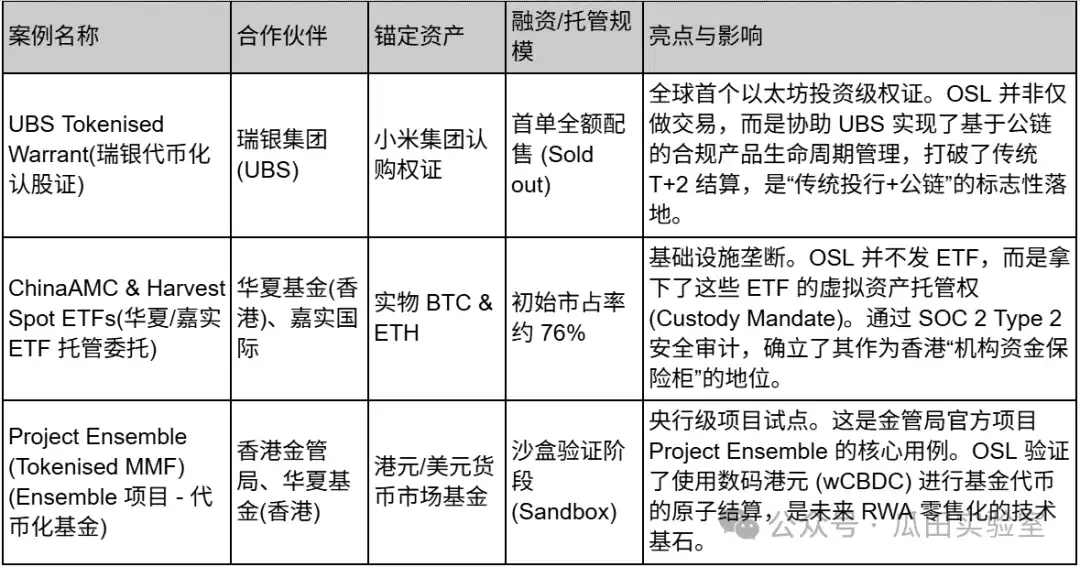
In the first batch of Bitcoin/Ethereum spot ETF issuances in Hong Kong, Harvest and ChinaAMC both chose OSL as the virtual asset custodian. This means that OSL controls the security of over half of the underlying assets in the Hong Kong ETF market. For RWA, "whoever controls custody holds the key to the assets."
In the RWA industry chain, OSL defines itself as a precise conduit connecting traditional assets with the Web3 world:
RWA Structurer & Distributor:
Utilizing its licensed brokerage status, OSL excels in handling complex financial product structuring. It is not just about simple "asset on-chain" but focuses on the tokenization of investment-grade products such as banknotes, structured products, and more.
Transnational Compliance Liquidity Network:
OSL has deep partnerships with Zodia Markets under Standard Chartered Bank and a Japanese financial giant. In terms of RWA liquidity, OSL operates through an "institution-to-institution" dark pool and over-the-counter (OTC) route, rather than a retail order book model.
OSL's use cases are not limited to Hong Kong but have a strong international showcase effect, with partners being top TradFi giants. Due to its B2B nature, the funding scale is usually not disclosed:
To better understand the difference between the two, a comparative table of HashKey vs. OSL has been prepared:
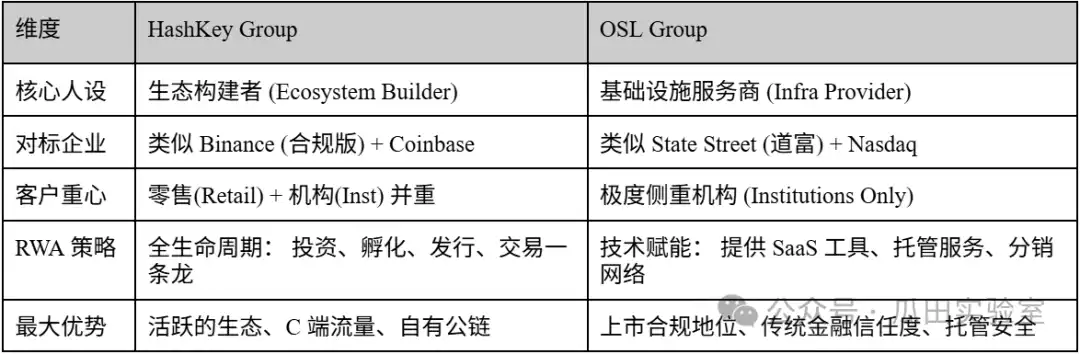
If HashKey is building a bustling "Web3 Business Metropolis" in Hong Kong, then OSL is like the chief engineer responsible for the city's underground infrastructure, vault security, and power delivery. In the RWA market, OSL does not aim for the largest "issuance" volume but strives to be the safest "warehouse" for all RWA assets and the most compliant "corridor."
Ant Digital - The "Trusted Bridge" for On-chain Physical Assets
In the Hong Kong RWA landscape, Ant Digital (and its Web3 brand ZAN) represents a disruptive move from an Internet giant. Unlike financial institutions focusing on "licensing" and "transactions," Ant Digital's core competency lies in addressing the most foundational pain point of RWA: how to prove that on-chain Tokens truly correspond to off-chain physical assets?
Ant Digital's strategic path is very clear: leveraging the high-performance technology of AntChain cultivated for many years domestically, combined with Trusted IoT, in this international gateway of Hong Kong, to provide "asset digitization" technical standards and validation services for global RWA projects.
Ant Group's presence in the Hong Kong RWA market is not as an "exchange," but as a Web3 technology service provider. Its business logic can be summarized as "Two Ends, One Cloud":
Asset Side: By implanting IoT modules (Trusted Modules) into physical equipment such as solar panels, charging stations, and construction machinery, real-time data is collected and sent directly to the blockchain. This transforms RWA from being "issuer credit-based" (trust the issuer) to "asset credit-based" (trust the real-time cash flow generated by the equipment).
Capital Side: Through the ZAN brand, it provides institutional investors with KYC/KYT (Know Your Customer/Transaction), smart contract auditing, and node services to ensure the compliance of fund inflows and outflows.
Privacy Protection: It is one of the very few vendors in the Hong Kong Monetary Authority's Project Ensemble (Sandbox) that can provide Zero-Knowledge Proof (ZKP) technology, solving the dilemma faced by banks when settling assets on public blockchains—needing to verify transactions while keeping business secrets confidential.
When dealing with "tokenized assets" (such as bonds and funds) at HashKey and OSL, Ant Group excels at handling "non-standard physical assets":
Trusted Origins: Traditional RWAs rely on auditors to physically inspect warehouses, but Ant Group, through chip implantation, enables real-time on-chain data of new energy vehicles, batteries, and even biological assets (such as livestock) (electricity generation, mileage).
High Concurrency Processing: Inheriting Alipay's "Double 11" level of technology genes, Ant Group's blockchain can support the concurrent on-chain data of billions of assets, a feat that most public blockchains find challenging to achieve.
Internationalization of the ZAN Brand: From 2024 to 2025, ZAN rapidly rose in Hong Kong, becoming a key middleware platform connecting Web2 developers and the Web3 world, particularly establishing a presence in the Regulatory Technology (RegTech) field.
Ant Group's use cases mainly focus on "Real Economy On-Chain" and "Interbank Settlement Architecture."
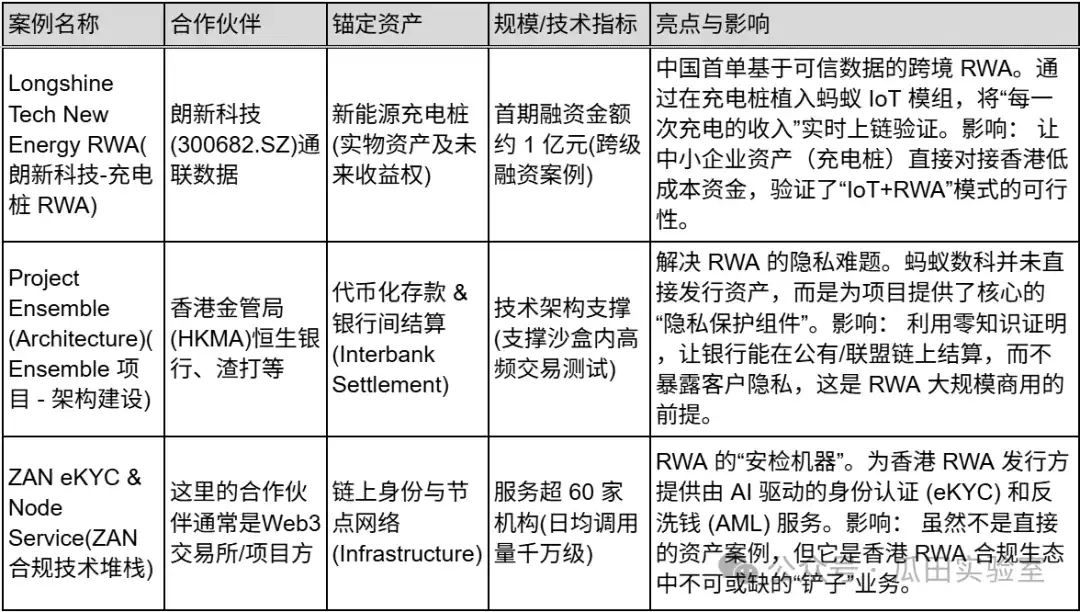
If HashKey is the "Taobao," building a platform for everyone to trade RWA commodities, and OSL is the "Fort Knox," providing the most secure warehouse to help institutions safeguard RWA assets, then Ant Group is the "Smart Factory + Quality Inspector." They delve into the production process (charging stations, batteries), affixing each asset with a "qualified tag" (IoT verification), and providing the technology for these assets to circulate smoothly. In the Hong Kong RWA market, Ant Group is data-centric, aiming to be the "Customs" and "Interpreter" guiding physical world assets into the Web3 world.
Conflux Network—The "Compliance Public Chain" Connecting Mainland China and Hong Kong
In the Hong Kong RWA market, the majority of platforms (such as HashKey, OSL) mainly address the issue of "how local assets in Hong Kong can be traded," while Conflux addresses the questions of "how mainland assets can exit compliantly" and "what currency to settle in."
As the "sole compliant public chain in China," Conflux leverages its background in the Shanghai Tree-Graph Blockchain Research Institute and deep integration with "national team" resources such as China Telecom and the Belt and Road Initiative. By 2025 in the Hong Kong market, Conflux is no longer just a technical public chain but has evolved into the core issuance layer for the Offshore Chinese Yuan/Hong Kong Dollar Stablecoin.
Conflux's RWA strategy is drastically different from others, avoiding the crowded asset management track and focusing on the infrastructure at the most foundational level:
The Lifeblood of RWA (Stablecoin): Conflux incubated and supported AnchorX (major investor Hongyuan Investment), dedicated to issuing a compliant Hong Kong Dollar Stablecoin (AxHKD). In RWA transactions, asset onboarding is the first step, but "what to buy with" is the second step. Conflux aims to make AxHKD the settlement currency for the Hong Kong RWA market, comparable to USDT/USDC.
Physical Entry Point (BSIM Card): The BSIM card launched in partnership with China Telecom embeds blockchain private keys directly into the mobile SIM card. For RWA, this means that future asset ownership (e.g., buying tokenized real estate on your phone) can be linked to the telecom operator's real-name identity, addressing the most challenging aspect of RWA, "Decentralized Identity (DID)."
Mainland-Hong Kong Connector: Leveraging its R&D center in Shanghai (Tree-Graph), Conflux can meet the outward expansion needs of mainland enterprises, allowing mainland physical assets (such as photovoltaics, supply chains) to compliantly map to Hong Kong's Conflux public chain for financing through technical means.
In the RWA track, Conflux's moat lies in its geopolitical advantage:
"Desensitized" Interoperability: Conflux has achieved a unique technical architecture that complies with mainland regulation (non-coin blockchain technology application) while enabling tokenized transactions in Hong Kong through cross-chain bridges. This makes it the most "politically correct" choice for mainland state-owned enterprises and central enterprises attempting RWA internationalization.
Payment and Settlement Closed Loop: Through the AnchorX project, Conflux is actually participating in the Hong Kong Monetary Authority's "sandbox supervision." Once the Hong Kong dollar stablecoin is launched, Conflux will transform from a simple "road" to a financial network with the pricing power of "tolls."
High-Performance Throughput: RWAs (especially high-frequency bills or retailized assets) require extremely high TPS (transactions per second). Conflux's Tree-Graph structure claims to achieve 3000-6000 TPS, which is more advantageous in handling high-concurrency transactions in traditional finance compared to the Ethereum mainnet.
Conflux's use case focuses on "monetary infrastructure" and "national-level cooperation."
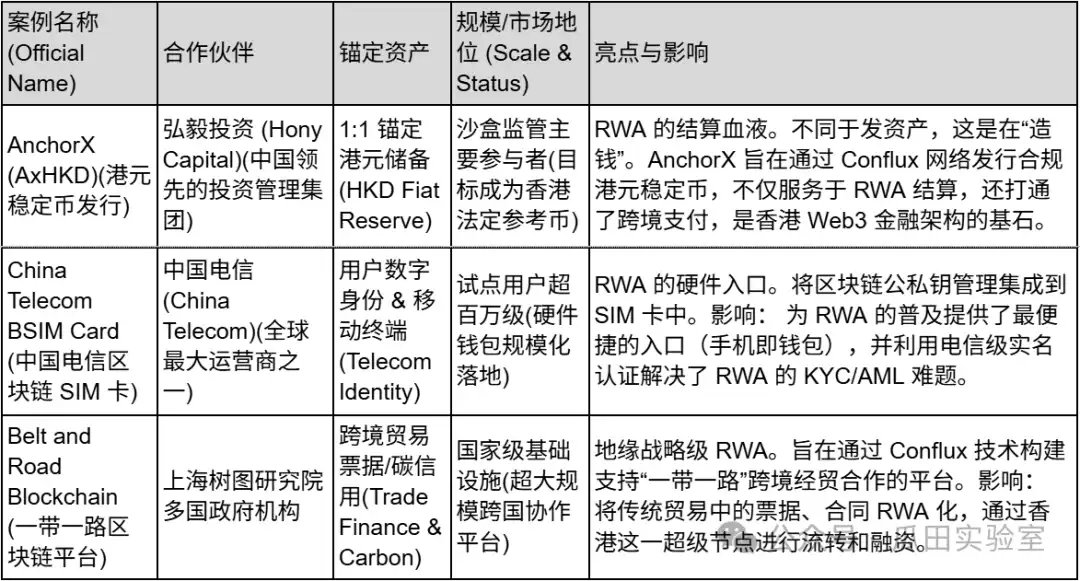
The Conflux Network is the only "public-chain-level" player in the Hong Kong RWA market. It does not earn money directly through transaction fees but seeks to become the "Digital Silk Road" connecting Chinese manufacturing with global funds through setting underlying standards (stablecoin standards, SIM card standards).
Star Road Technology — Customized First-Class Cabin for "Old Money" to Web3
Amidst the clamor in the Hong Kong RWA market, Star Road Technology (part of the overseas promotion brand Finloop) is not the loudest "disruptor," but it is likely the most stable "successor."
Instead of viewing Star Road as an independent Web3 startup, it is better seen as a large comprehensive private enterprise—an "official landing craft" sent to the world of digital assets by Fosun International. Independently incubated by Fosun Wealth, the birth of Star Road itself carries a clear corporate will: it is not committed to building a new financial order from scratch but to smoothly and compliantly "ferry" the massive stock assets and high-net-worth clients of traditional finance into the world of blockchain.
At a strategic level, Star Road has proposed a unique "Web5" concept. Different from the purely decentralized Web3 idealism, Star Road's Web5 strategy is more like a practical compromise—it seeks to integrate the mature user experience and traffic entry points of the Web2 era (Fosun Wealth's client base) with the value-interconnected technology of the Web3 era.
In this narrative, Star Road has built its core infrastructure — the FinRWA Platform (FRP). This is an enterprise-grade RWA issuance engine, but it is not designed to serve anonymous on-chain geeks, but to serve institutions and high-net-worth individuals within the Fosun ecosystem. It is like a sophisticated converter, with one end connected to Fosun's years of deep cultivation in real estate, consumer goods, culture, and tourism, among other tangible asset industries, and the other end connected to a compliant digital asset distribution network. For Star Road, RWA is not the end goal but a means to activate the group's existing asset liquidity.
Unlike other platforms eager to explore high-risk, high-return DeFi plays, Star Road has chosen the most robust entry path: Money Market Fund Tokenization.
Through deep alliances with Huaxia Fund (Hong Kong) and its parent company Fosun Wealth, Star Road's inaugural flagship product focuses on tokenized currency market funds denominated in Hong Kong dollars, US dollars, and Chinese yuan. This choice demonstrates great strategic foresight — money market funds are the most familiar and lowest barrier to entry type of investment for traditional investors. Star Road leverages its technology to tokenize these funds, effectively providing the safest entry ticket for "old money" investors who are cautious about crypto.
More importantly, Star Road has opened up the RWA channel for the Chinese yuan (RMB). Against the backdrop of Hong Kong as an offshore RMB center, this capability allows Star Road to accurately capture mainland-backed capital that holds a large amount of offshore RMB and is seeking compliant outbound appreciation.
Star Road's business landscape is not like an exchange but more like a “Boutique Digital Investment Bank.” Its case study showcases a complete closed-loop from “underlying technology” to “asset issuance” to “ecosystem capital”:
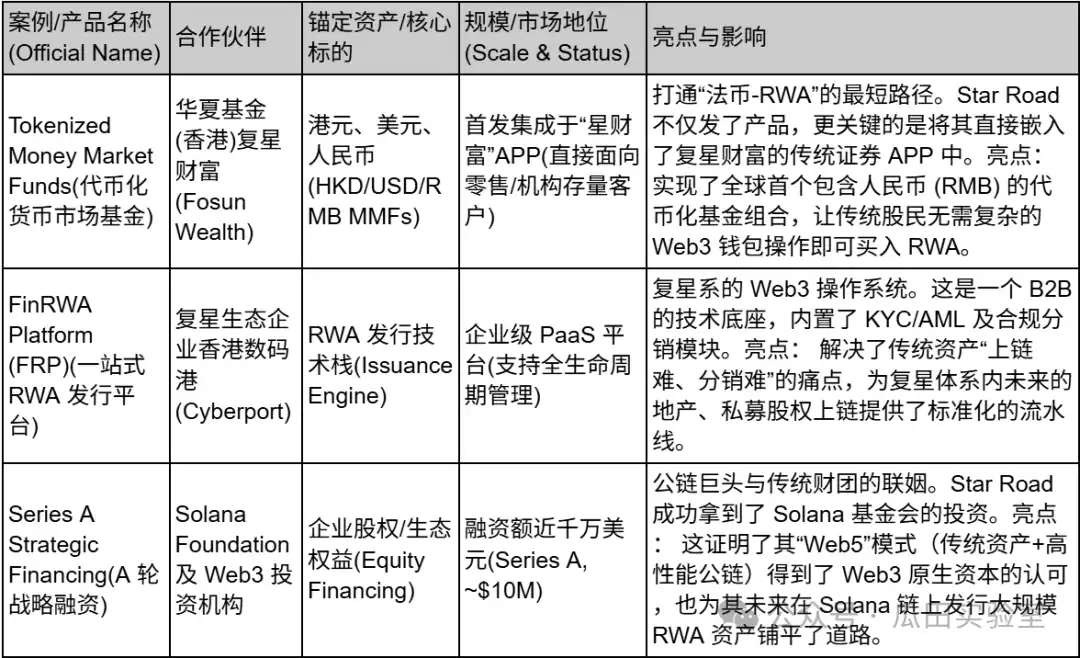
Star Road Technology epitomizes the traditional financial elite's understanding and transformation of Web3: not pursuing radical decentralization but striving for ultimate compliance, security, and user experience. For institutions and high-net-worth individuals who want to allocate digital assets while retaining the experience of traditional financial services, Star Road is the most seamless and convenient entry point.
MANTRA — Connecting the Middle East and Asia through an RWA “Compliance Expressway”
In the era of RWA's Warring States, MANTRA represents the rise of the “Infrastructure School.” It is not satisfied with issuing just one type of asset but seeks to define the underlying standards for RWA assets to operate on-chain.
The predecessor of MANTRA was MANTRA DAO, and after years of transformation, it has evolved into a public chain focused on regulatory-compliant Real World Assets (RWA). Its strategic focus is quite unique—avoiding the intense competition in the U.S. market, not fully relying on Hong Kong, but rather heavily positioning in the United Arab Emirates (UAE), leveraging Dubai's very friendly Virtual Asset Regulatory Framework (VARA) to build a corridor connecting Middle Eastern capital with Asian liquidity.
At a strategic level, MANTRA has addressed a core pain point: the contradiction between the public chain's "permissionless" nature and finance's "strong regulation."
Native Compliance Layer: The MANTRA Chain has built-in identity authentication (DID), KYC/AML modules, and a compliance whitelist mechanism at the protocol level. This means that developers do not need to write complex compliance code themselves; they can directly call MANTRA's modules to issue regulatory-compliant real estate tokens or bonds.
Connecting "Oil Capital" in the Middle East: MANTRA secured a lead investment from a top Middle Eastern venture capital firm, Shorooq Partners, and established a deep partnership with Dubai real estate giant MAG. This not only brought in funding but, more importantly, connected the vast real estate and sovereign wealth resources in the Middle East, a unique advantage that other platforms mainly reliant on USD or HKD assets do not have.
Mainnet Incentives and Tokenomics: Through its native token $OM's buyback and staking mechanism, MANTRA has built a tight economic loop. It uses token incentives to attract institutional validators and asset issuers, attempting to leverage a Web3 incentive model to bring traditional finance assets onto the blockchain.
On the asset side, MANTRA has chosen one of the heaviest but most attractive tracks: Real Estate. Unlike sovereign bond RWAs (which is also a strength of platforms like Star Road), real estate RWAs require dealing with complex offline ownership and legal structures. MANTRA is directly collaborating with Dubai developer MAG, planning to tokenize a $500 million luxury real estate portfolio. This approach is highly ambitious—if Dubai's luxury homes can be transformed into tradable tokens on the blockchain, MANTRA will have demonstrated its ability to deal with "non-standard, large-scale, tangible assets," a much deeper moat than simple sovereign bond tokenization.
Furthermore, MANTRA has announced a large-scale $OM token buyback plan in 2025 (committing to at least $25 million), a "stock buyback" behavior similar to that of a publicly traded company, greatly bolstering institutional investors' confidence in its tokenomics.
The MANTRA business landscape presents a distinct combination of "Middle Eastern Assets + Asian Technology + Global Compliance":
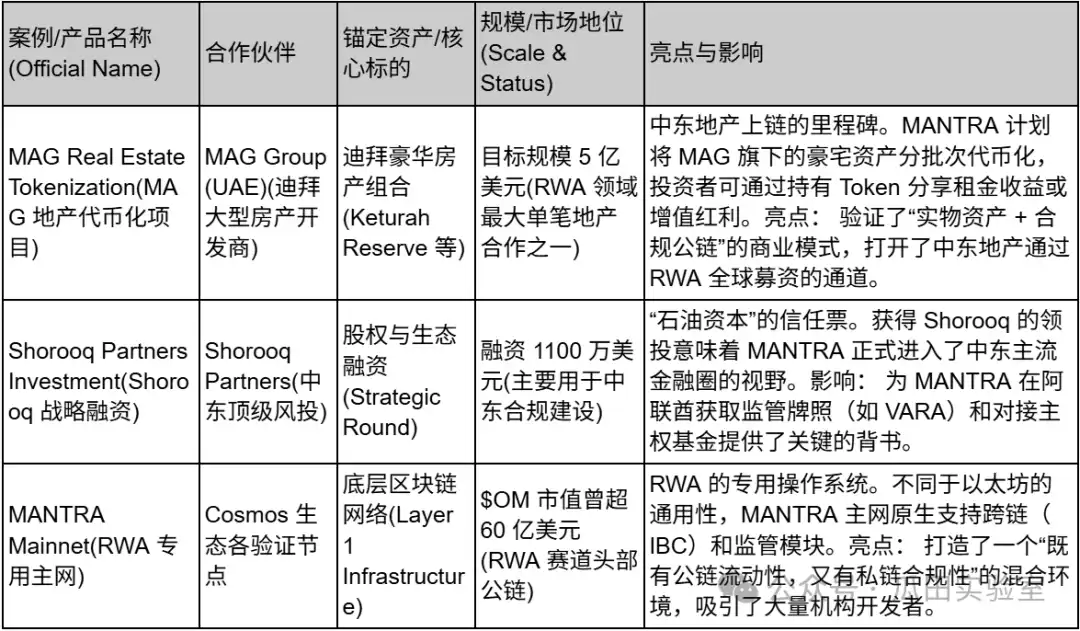
Although MANTRA started in Hong Kong, it has shifted its focus to the Middle East to align with its RWA compliance strategy. MANTRA represents another possibility in the RWA market: not just moving assets onto the chain, but creating a chain specifically for the assets. For investors bullish on the rise of Middle Eastern capital and the prospect of real estate tokenization, MANTRA is currently the most representative infrastructure target.
AlloyX—Bridging DeFi Liquidity with Real-World Assets as a "Hybrid Aggregator"
In the grand narrative of Hong Kong's RWAs, if HashKey and OSL have built a "heavy asset" infrastructure akin to NASDAQ or a bank vault, then AlloyX represents another agile force in the RWA market—a "DeFi-native aggregator".
As a Web3 fintech company originating from San Francisco, USA, later acquired by the Hong Kong-listed brokerage firm Solowin Holdings (NASDAQ: SWIN), AlloyX plays a unique "CeDeFi (Centralized and Decentralized Finance hybrid) connector" role in Hong Kong's RWA landscape. It does not directly hold heavy real-world assets but, through smart contract technology, "packages" credit assets dispersed across different chains and protocols into highly liquid financial products, directly delivered to investors in the crypto world.
AlloyX's business logic is fundamentally different from traditional exchanges. It is essentially an RWA asset aggregation protocol.
In the early RWA market, assets were fragmented: investors looking to buy US Treasury bonds may have to go to one platform, while those seeking to invest in private credit have to go to another platform, with very high barriers to entry. AlloyX's emergence addresses this pain point. It has built a modular "Vault" system that can access assets from multiple upstream credit protocols such as Centrifuge, Goldfinch, Credix, among others. By standardizing them into unified tokenized products, AlloyX allows users to easily allocate stablecoins like USDC to real-world credit assets as if depositing them in Yu'E Bao (a money market fund).
By officially joining Solowin Holdings in 2025, AlloyX has completed its magnificent transformation from a "pure DeFi protocol" to a "compliant FinTech flagship." The current AlloyX now resembles a tentacle of Solowin, a traditional brokerage firm reaching into the Web3 world. Leveraging the compliance license advantage in Hong Kong, traditional assets such as securities and funds are now distributed globally in tokenized form through AlloyX's technical channel, achieving true "Asset Ownership in the Traditional World, Liquidity Unleashed in the Blockchain World."
In the competitive Hong Kong market, AlloyX's moat mainly lies in its unique shareholder background and technical architecture.
First and foremost, the endorsement and resource injection of a publicly listed company are its greatest differentiating advantage. As a wholly-owned subsidiary of the Nasdaq-listed company Solowin, AlloyX has stepped out of the compliance dilemma faced by ordinary DeFi projects. It can directly utilize the Hong Kong Securities and Futures Commission (SFC) Type 1, 4, and 9 licenses held by its parent company to legally design and distribute tokenized products involving securities. This "front-end DeFi experience + back-end licensed brokerage risk control" model perfectly aligns with the CeDeFi regulatory direction promoted in Hong Kong.
Secondly, AlloyX possesses a strong capability in "Asset Composability." Unlike a single-asset issuer, AlloyX excels in algorithmically blending different risk-level RWAs (such as low-risk U.S. Treasuries and high-risk trade finance) to construct chain-based products resembling structured notes. This capability allows institutional investors to customize RWA investment portfolios on-chain based on their risk preferences, greatly enriching the profit strategies in the RWA market.
AlloyX's business practices mainly focus on two dimensions: "Asset Aggregation" and "Compliant Issuance." Below are its most representative business cases:
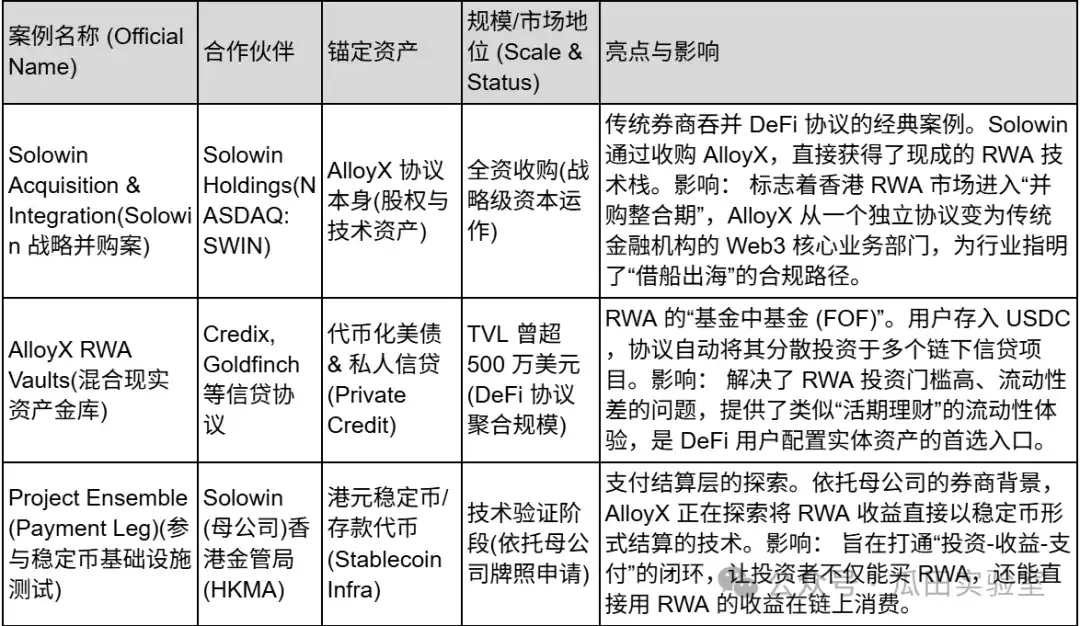
Looking back at AlloyX's development path, we can clearly see that it does not pursue platform traffic on a large scale but rather focuses on refined operations on the asset side. Through Solowin's acquisition, AlloyX has essentially become the "technology engine" for traditional financial institutions to undergo RWA digitization transformation. For the market, AlloyX has proven that RWAs are not solely the game of giants; technology-driven protocols can also find a core ecosystem position within the compliant high walls through deep integration with licensed institutions.
Asseto - RWA Asset Origination Factory Designed for Institutions
In the Hong Kong RWA industry chain, Asseto plays a key role as the Asset Originator. It is positioned at the top of the industry chain, directly connected to the real economy.
As the flagship RWA infrastructure project strategically invested by HashKey Group, Asseto has a strong "blue-blooded" lineage. It does not directly interact with retail investors but focuses on solving the most challenging "first mile" issue in RWA: How to "tokenize" a building or a fund into a compliant Token from legal structure, technical standards, and compliance processes?
Asseto's business model is very vertical and high barrier to entry, mainly serving Traditional Finance (TradFi) giants with assets in the tens of billions:
RWA Asset Issuance Gateway: Asseto provides a standardized technology stack that allows institutions to "one-click" bring assets such as money market products, real estate, private loans, etc., onto the chain. It not only provides smart contracts but more importantly offers "Legal Wrapper" services to ensure the on-chain Token has a valid claim to the underlying assets under Hong Kong law.
HashKey Ecosystem's "Asset Conveyor Belt": As a HashKey invested enterprise, Asseto is a key source of potential RWA assets for HashKey Exchange. Asseto is responsible for organizing assets off-chain (cleaning, due diligence, tokenization), and then distributing them to secondary market investors through HashKey's compliant channels.
Stablecoin Sandbox's "Use Case Partner": Asseto works closely with several institutions applying for a Hong Kong stablecoin license, aiming to have RWA assets as reserve assets for stablecoins, exploring the high-end play of "issuing stablecoins using tokenized government bonds/cash."
Asseto's core advantage in the Hong Kong market lies in the top-notch resources brought by its shareholder structure:
HashKey's technical and channel support: HashKey not only provides funding but also has opened up HashKey Chain (L2 public chain) to Asseto as the preferred issuance platform. This means that assets issued by Asseto inherently have access to Hong Kong's largest compliant liquidity bridge.
Asset Injection by DL Holdings: Hong Kong mainboard-listed company DL Holdings (1709.HK) has not only invested in Asseto but also signed a strategic agreement to tokenize its managed family office assets (such as commercial real estate, fund shares) through Asseto. This solves the most troubling "asset shortage" issue of RWA projects—Asseto started with high-quality assets from a listed company.
Asseto's cases are highly "institutionalized," mainly revolving around real estate and cash management:
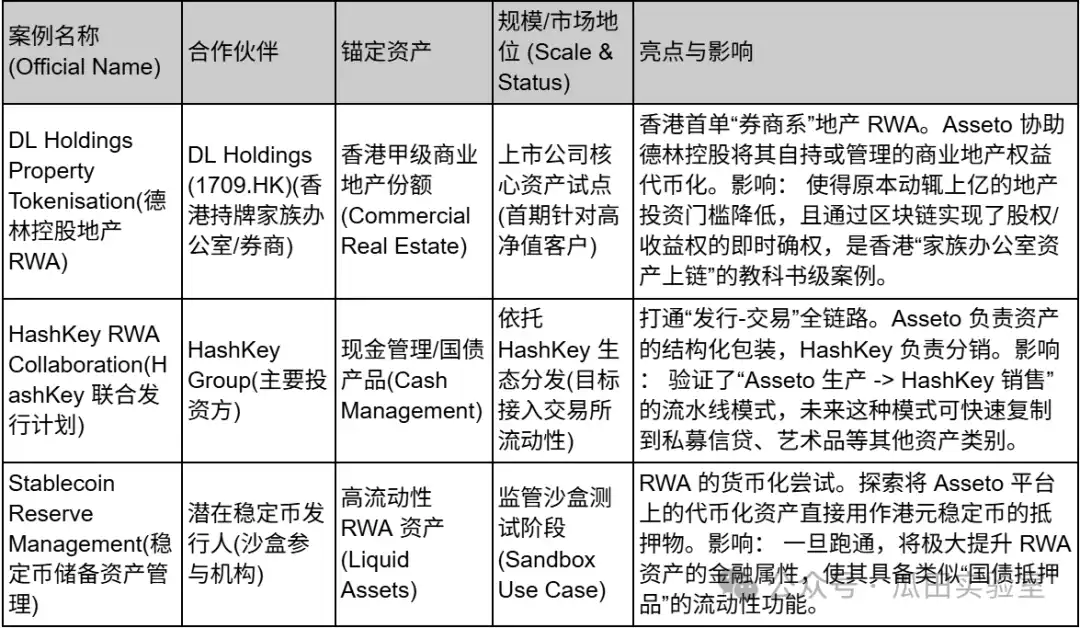
Asseto is the "asset alchemist" of the Hong Kong RWA market. It does not directly face retail investors but hides behind the scenes, using sophisticated legal and technical molds to melt down the massive and cumbersome assets of traditional financial institutions into coins suitable for circulation in the Web3 world.
FireX—An "Industrial-Grade" RWA Platform Unlocking Compute Power Liquidity
In the Hong Kong RWA market, the vast majority of platforms deal with "paper assets" (such as bonds, equities), while FireX focuses on "productive assets."
FireX is an institutional-grade RWA trading platform, with its core narrative being "financializing Bitcoin's primary output capacity (compute power)." By partnering with top-tier infrastructure providers such as Bitmain, FireX encapsulates data centers and mining entity entities distributed globally (in the US, Canada, Kazakhstan, etc.) into on-chain tradable RWA tokens. For investors, purchasing FireX's RWA products essentially means buying the "future cash flow rights" of a running supercomputer.
FireX's business logic is highly vertical, addressing the mismatch between traditional mining's "poor liquidity" and Web3 capital's "lack of stable physical revenue":
Hashrate as an Asset: FireX transforms the originally physical-world "S21e Hyd miner" and its generated hashrate (288 TH/s) into an on-chain asset. This means that users can hold hashrate and receive Bitcoin mining rewards without the need to build or maintain their mining setups.
Global Energy Arbitrage Network: FireX is not just a trading platform but is backed by a vast physical infrastructure network. It owns or has partnered with over 30 data centers in locations such as Texas, USA, Quebec, Canada, and Ethiopia. It is effectively conducting global energy arbitrage—seeking the cheapest electricity, converting it to Bitcoin, and distributing returns through RWA.
Multi-Asset Allocation Gateway: In addition to its core Bitcoin hash power, FireX's vision also includes global high-quality stocks (such as NVDA, MSFT), Pre-IPO equity, and RWA of AI hash power assets. It aims to build a comprehensive asset allocation basket that spans the "digital world and the physical world."
Unlike pure software protocols, FireX's moat is built on heavy "hardware" and "ecosystem relationships":
Verifiable Entity Scale: FireX has currently deployed over 5,000 supercomputing servers, manages hash power exceeding 1,000 PH/s, on-chain asset value exceeding 20 million dollars. This "visible and tangible" entity scale provides the most foundational credit endorsement for RWA—customer property rights, and real asset operation.
Top-tier Ecosystem Network: According to disclosures, FireX's partner network covers mining giant BITMAIN, mining pool Antpool, as well as Binance, Coinbase, Tether, and other leading institutions. This resource integration capability spanning the entire "mining machine production-mining-exchange-stablecoin" industry chain ensures the stability of its asset supply and the advantage of low cost (such as zero rack fees, zero service fees).
High-Yield Expectation Product Design: During the Bitcoin bull market cycle, FireX's hash power RWA exhibits extremely high yield elasticity. According to calculations for its S21e Hyd product, under the optimistic assumption of a Bitcoin price reaching $150,000, the ROI (Return on Investment) may even approach 100%. This is more attractive than traditional government bond RWAs.
FireX's business is extremely focused on "hash power securitization" and "global asset allocation":
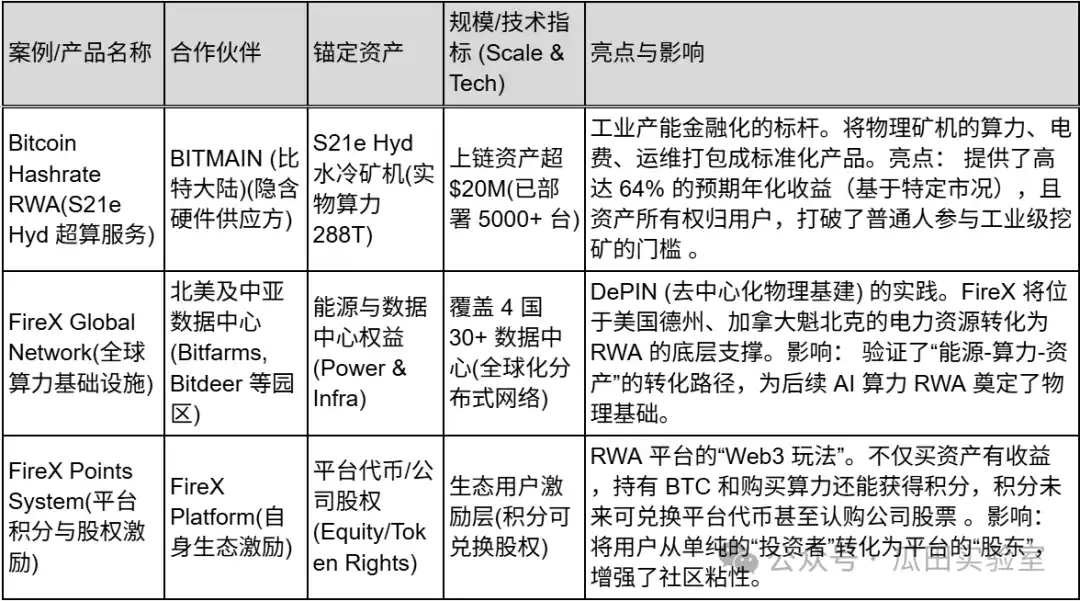
FireX is the "hardcore industrialist" in the RWA track. It breaks away from the simple "old wine in a new bottle" model of traditional financial assets (such as government bonds) and instead by "securitizing packaging" native digital assets like Bitcoin hash power, it provides a foundational revenue layer supported by the real roar of machines and power consumption for the Web3 world.
Dualistic Narrative: Depth Benchmarking of the Hong Kong and US RWA Markets
If 2024 was the concept validation year for RWA, then 2025 will be the year when the global RWA market structure bifurcates. In the global RWA landscape, the United States and Hong Kong represent two distinctly different yet mirror-image evolutionary paths.
The United States relies on its native DeFi innovation and the dominance of the US Dollar to become the "super factory" of RWA assets; while Hong Kong, leveraging its unique institutional advantage and geopolitical position, has become the "super boutique" and "distribution hub" of RWA assets.
1. Regulatory Philosophy: "Enforcement-led Tolerance" vs. "Admission-led Sandbox"
United States: Bottom-up Jungle Rule
The RWA market in the United States has grown wildly in the regulatory gray area. Although the regulatory environment softened after the Trump administration took office in 2025, the core logic remains a game of "Regulation by Enforcement" and "DeFi First."
Characteristics: U.S. projects (such as Ondo, Centrifuge) mostly start in the form of DAOs or decentralized protocols, first pursuing scale and technological innovation, and then using complex legal structures (such as SPV offshore isolation) to bypass SEC's securities classification.
Advantages: Extremely fast innovation, able to achieve asset composition through smart contracts without the need for licensing approval, easy to create phenomena-level products with strong economies of scale like BlackRock BUIDL.
Disadvantages: High legal gray areas; once it involves cross-border distribution or non-accredited investors (Retail), it faces extremely high compliance risks.
Hong Kong: Top-down Design
Hong Kong is taking a completely opposite path – "Licensing-driven Regime." From HashKey obtaining exchange licenses to Star Road relying on Fosun Wealth's 1, 4, 9 numbers, every step of Hong Kong's RWA is within the sight of the SFC and HKMA.
Characteristics: "No license, no RWA." All projects (such as OSL, HashKey) must operate in the Project Ensemble sandbox or the existing securities framework. Regulators are not only referees but also "product managers" (such as guiding the design of tokenized deposits).
Advantages: Extremely high certainty. Once a product is approved (such as Huaxia Fund's tokenized product), it can legally connect to the banking system and retail funds, with the endorsement of traditional financial institutions.
Downsides: The high barrier to entry and compliance cost (over $800,000 per project) have stifled grassroots innovation, resulting in market participants mostly being "big players" or "consortiums".
2. Market Structure: "Pure DeFi" vs. "Traditional Consortium"
United States: Home of DeFi Native Capital
The RWA market structure in the United States is "DeFi Backward Compatible TradFi". The main sources of funding come from on-chain whales in USDC/USDT, DAO treasuries, and crypto hedge funds. Project teams are usually led by tech geeks who disdain cumbersome offline processes, aiming to tokenize everything (including government bonds) into ERC-20 tokens and then collateralize them on Uniswap or Aave.
Typical Profile: Protocols like MakerDAO or Compound, which purchase US Treasuries through the RWA module to provide yield support for stablecoins.
Hong Kong: Digital Transformation of Traditional Consortium
The RWA market structure in Hong Kong is "TradFi Upward Adapting Web3". The main sources of funding come from family offices, HNWIs, and corporate treasuries seeking financial diversification. Project teams often have deep industry backgrounds (such as mining hash power resources behind FireX, Fosun Industrial Capital behind Star Road, real estate funds behind Asseto).
Typical Profile: The "Web5" strategy proposed by Star Road Technology is the most typical—using Web3 technology to serve Web2's existing customers. The RWA in Hong Kong is not about creating new assets but making "old money" feel trendy and secure.
3. Asset and Project Spectrum: "Standardized Treasury Bonds" vs. "Non-Standard Structured Assets"
United States: Unilateral Hegemony of Treasuries
Around 80% of the TVL in the US RWA market is concentrated in "tokenized US Treasuries". This is the most standard, liquid, and easily accepted collateral by DeFi protocols. Most US RWA projects focus on fee rates and T+0 settlement.
Hong Kong: Sandbox of Diversified Assets
Constrained by market size, Hong Kong could not compete with the United States in the pure US Treasury bond arena, so it has moved towards "differentiation" and "concretization."
Concretization and Industrial RWA: FireX packages Bitcoin hashrate and energy into RWA, a unique "hardcore industrial" innovation in Hong Kong that leverages Asia's advantage in the global mining supply chain.
Real Estate and Alternative Assets: Mantra (although based in Dubai but deeply rooted in Asia) and Asseto focus on structured real estate, private credit, and other non-standard assets. Hong Kong excels in dealing with complex offline asset ownership (such as the assets handled by Star Road).
Infrastructure Development: OSL and HashKey are not only dealing with assets but also providing a full set of infrastructure for "exchange + custody + SaaS," reflecting Hong Kong's DNA as a service provider in the financial center.
Recommendations for Mainland Assets and Enterprises Issuing RWA in Hong Kong
Given the recent layers of regulatory tightening, the window for issuing RWA through the "Mainland assets/team + Hong Kong entity" model is essentially closed for enterprises with Mainland backgrounds (shareholders, teams, operating entities). This is not just a matter of increased compliance difficulty but a shift from a "gray area" to a "high-risk criminal involvement" nature.
On November 28, 2025, during a meeting of the People's Bank of China and 13 other departments, it was made clear that stablecoins are considered virtual currency, lack legal tender status, and related activities are illegal financial activities. This essentially severs the most core "payment settlement" leg of RWA. RWA returns are usually settled in stablecoins (USDT/USDC), which have now been classified as illegal. On December 5, 2025, in a risk warning from seven major industry associations, it was explicitly stated that RWA issuance is essentially equivalent to issuing tokens for the first time, categorizing RWA investment as illegal and part of illegal public financing.
In this policy environment, Mainland enterprises issuing RWA in Hong Kong face three dimensions of obstruction:
A. Jurisdictional "Long Arm" Extension of Law (Pervasive Regulation)
The past operating model involved setting up an SPV (special purpose vehicle) in Hong Kong, with the Mainland parent company only providing technical support or advisory services. This kind of "isolation wall" has now become ineffective.
Territorial Jurisdiction: Even if the issuing entity is based in Hong Kong, if the ultimate beneficiary owner, executives, or technical team are located in the mainland, under the new regulations, they are considered to be "aiding illicit financial activities."
Accessory Liability: The policy in December particularly emphasized a full industry chain crackdown. Mainland entities (and individuals) providing technical development, marketing, user acquisition, payment settlement, or even liquidity services for overseas RWA projects may violate the crime of illegal business operation or the crime of aiding activities related to an information network (aiding cybercrime).
B. Asset-Side "Cut-Off"
What the Hong Kong RWA market desires most are high-quality mainland physical assets (such as solar power station revenue rights, commercial real estate rental).
Asset Outflow Restrictions: Since RWA has been categorized as illicit financial activity, packaging domestic assets for outbound financing through RWA is suspected of illegal forex trading and capital flight.
Challenge of Asset Ownership Confirmation: Domestic law does not recognize on-chain tokens as proof of ownership of domestic assets. If a project defaults, overseas investors holding tokens suing mainland courts for asset enforcement will not be supported (due to violations of public order and mandatory provisions).
C. Fund-Side "Blockade"
Funds Repatriation Obstructed: Even if you raise USDT/USDC in Hong Kong, these funds cannot flow back to mainland entities through regular banking channels for real economic development (as banks will refuse funds related to "virtual currency businesses").
Marketing Red Line for Mainland Investors: Prohibition on marketing to Chinese citizens. If your RWA product offering memorandum (PPM) has a Chinese version, or if your roadshows involve mainland IPs, you will directly trigger regulatory red lines.
According to market feedback, since November 28, the Hong Kong RWA market has experienced a strong reaction. Around 90% of mainland-related RWA consulting projects have been suspended or canceled, and Hong Kong-listed companies related to RWA concepts (especially those with mainland parent companies, such as Meitu, SinoMedia, Boyaa Interactive, etc.) have seen a significant drop in stock prices.
Therefore, purely mainland-based companies (Team in China, Assets in China) that still wish to participate in RWA token issuance face extremely high risks. Not only can they not comply with regulations, but they also face criminal liability. It is advisable to abandon the RWA tokenization narrative, return to traditional ABS (Asset-Backed Securities), or issue traditional bonds in Hong Kong.
If it is a fully offshore enterprise (Global Team, Global Assets), theoretically it is still feasible but requires segmentation, including physical and legal segmentation, for example:
Personnel Segmentation: The core team and key holders cannot be on the mainland.
Asset Segmentation: The underlying assets must be overseas assets (such as US Treasury bonds, overseas real estate) and cannot be domestic assets.
Market Segmentation: Strict KYC, blocking mainland IP addresses through technical means, and refraining from any promotion on the Simplified Chinese internet.
Conclusion and Outlook: Hong Kong's Path from "Frenzy" to "Origins"
Looking back at 2025, Hong Kong's RWA market underwent an almost brutal stress test. From the high expectations at the launch of Project Ensemble early in the year, to the frenzy of funds pouring in mid-year, and to the freeze and restructuring triggered by tightened mainland regulations at the year's end, although painful, this process completed a deep reshaping of the market.
After the storm, the speculative swimmers left, leaving behind the seven pillars we deeply analyzed in the article:
HashKey and OSL held the bottom line of compliant trading and custody, becoming the "utilities" of Hong Kong's Web3;
Star Road and Asseto demonstrated the feasibility of traditional financial institutions using RWA to unlock existing assets;
FireX showcased Hong Kong's unique ability to connect physical industries (computing power/energy) with digital finance;
Mantra and AlloyX provided the market with essential underlying blockchain infrastructure and DeFi liquidity aggregation.
In the outlook for 2026, the Hong Kong RWA market will show the following three major trends:
1. Shift from "Internal Circulation" to "External Circulation": With the tightening of mainland funding channels, Hong Kong will completely bid farewell to the gray fantasy of "assisting mainland capital in going offshore." Future increments will mainly come from "global assets, Hong Kong distribution." That is, using Hong Kong's compliant channels to package and sell US Treasury bonds, Dubai real estate (as in the Mantra case study), or global computing power (as in the FireX case study) to institutional investors in Southeast Asia, the Middle East, and Japan and South Korea. Hong Kong will become a true "offshore financial router."
2. The Blurring of the Line between RWA and DeFi (CeDeFi): Simply "on-chain assets" are no longer profitable. The next stage of competition lies in "composability." We will see more aggregators like AlloyX taking Star Road's tokenized funds as collateral to mint stablecoins or leverage on-chain. Compliant CeFi assets will become the highest-quality foundational "Lego bricks" for DeFi protocols.
3. Stablecoins as the Final Battlefield for RWAs: All RWA transactions and settlements ultimately lead to currency. With the enforcement of stablecoin regulations in Hong Kong, "interest-bearing stablecoins" (stablecoins backed by RWA assets) will become the largest single RWA product. Whoever can dominate the issuance scenario of RWAs (such as FireX's mining revenue settlement, Asseto's real estate rental distribution) will wield the minting power of an HKD/USD stablecoin.
The Hong Kong RWA story is far from over; it has just passed the prologue of "grassroots entrepreneurship" and entered the main body of "institutional competition." In this new stage, compliance is no longer a burden but the greatest asset; technology is no longer a gimmick but the vehicle of trust. Hong Kong, the city that always evolves in crises, is redefining itself as the financial hub of the digital age.
You may also like

Ether Sentiment at Pre-Run Levels, Hints at Possible Price Surge
Key Takeaways Ethereum’s current sentiment mirrors previous levels before its significant price runs. Analysts suggest Ethereum might not…

Ethereum Treasury Firm BitMine Achieves Remarkable 1 Million Staked ETH Milestone
Key Takeaways BitMine Immersion Technologies, a leading Ethereum treasury company, has accomplished the significant feat of staking over…

Nvidia’s Vera Rubin Keeps Crypto Networks Like Render In Demand
Key Takeaways Nvidia’s Vera Rubin architecture significantly cuts AI model costs, challenging decentralized GPU networks. Efficiency gains from…

Bitcoin Bear Market Still in Play as Power Law Approaches Critical $65K ‘Do-or-Die’ Price
Key Takeaways: Bitcoin remains entrenched in its four-year price cycle, with critical implications on market dynamics. The $65,000…

Bitfinex Whales Dump BTC Longs as a $135K Bitcoin Price Target Reemerges
Key Takeaways: Bitfinex’s influential investors, often termed as ‘whales’, are reducing their long positions on Bitcoin, triggering historical…

Betterment Warns Users Against Unauthorized Crypto Promotion
Key Takeaways Betterment has advised its users to ignore a fraudulent crypto promotion promising to triple Bitcoin and…

SEC Delays Crypto ETFs: A Deep Dive into PENGU, T. Rowe, and Grayscale Options
Key Takeaways The SEC has extended its decision deadline on two groundbreaking crypto ETFs. Canary’s PENGU ETF represents…
Most US debanking cases stem from government pressure, says report
Key Takeaways A report from the Cato Institute indicates that most debanking incidents in the US originate from…

Elon Musk to Deep Dive into Bitcoin by 2026, Predicts Samson Mow
Key Takeaways Industry insider Samson Mow forecasts Tesla’s Elon Musk will significantly increase his Bitcoin investments by 2026.…

UK Lawmakers Urge Ban on Political Donations in Crypto
Key Takeaways: A group of senior UK lawmakers is pushing for a legislative ban on political donations in…

zkSync Price Forecast – ZK Value Anticipated to Decline to $0.026629 by January 15, 2026
Key Takeaways zkSync’s current price is $0.034635, with an anticipated drop to $0.026629 by mid-January 2026. The crypto…
Pepe Coin Price Prediction – PEPE Value Estimated to Decline to $ 0.000005 By Jan 15, 2026
Key Takeaways The forecast for Pepe Coin predicts a significant drop in its value by January 15, 2026,…

Polygon Ecosystem Token Price Prediction – POL Price Anticipated to Fall to $ 0.132816 By Jan 16, 2026
Key Takeaways The Polygon Ecosystem Token is predicted to experience a significant price decrease to $ 0.132816 by January…

South Korea to Lift Longstanding Ban on Corporate Crypto Investments
Key Takeaways South Korea is lifting a nine-year ban on corporate cryptocurrency investments, allowing firms to invest up…

Crypto YouTube Audience Plummets to 5-Year Lows Amid Retail Exodus
Key Takeaways: The decline in viewership of crypto content across platforms like YouTube and X indicates bear market…

Coinbase May Withdraw Support for CLARITY Act Amid Stablecoin Rewards Ban Debate
Key Takeaways Potential Withdrawal: Coinbase is considering withdrawing support for the CLARITY Act if it restricts stablecoin rewards.…

Ethereum Needs Superior Decentralized Stablecoins: Vitalik Buterin
Key Takeaways: Vitalik Buterin emphasizes the need for decentralized stablecoins that are not overly reliant on any single…

SEC now fully Republican, set for pro-crypto rulemaking in 2026
Key Takeaways The SEC is now completely under Republican control following the departure of Caroline Crenshaw, indicating a…
Ether Sentiment at Pre-Run Levels, Hints at Possible Price Surge
Key Takeaways Ethereum’s current sentiment mirrors previous levels before its significant price runs. Analysts suggest Ethereum might not…
Ethereum Treasury Firm BitMine Achieves Remarkable 1 Million Staked ETH Milestone
Key Takeaways BitMine Immersion Technologies, a leading Ethereum treasury company, has accomplished the significant feat of staking over…
Nvidia’s Vera Rubin Keeps Crypto Networks Like Render In Demand
Key Takeaways Nvidia’s Vera Rubin architecture significantly cuts AI model costs, challenging decentralized GPU networks. Efficiency gains from…
Bitcoin Bear Market Still in Play as Power Law Approaches Critical $65K ‘Do-or-Die’ Price
Key Takeaways: Bitcoin remains entrenched in its four-year price cycle, with critical implications on market dynamics. The $65,000…
Bitfinex Whales Dump BTC Longs as a $135K Bitcoin Price Target Reemerges
Key Takeaways: Bitfinex’s influential investors, often termed as ‘whales’, are reducing their long positions on Bitcoin, triggering historical…
Betterment Warns Users Against Unauthorized Crypto Promotion
Key Takeaways Betterment has advised its users to ignore a fraudulent crypto promotion promising to triple Bitcoin and…


 App
App