
- Buy Crypto
- Markets
- Futures
- Spot
- Copy Trade
 WE-Launch
AI Crypto Trading Competition "Sequel" Strikes Back: Switching to the US Stock Market Arena, Can the American Model Turn the Tide?

Original Title: "New Season of AI Trading Competition Begins, Gemini 3 Pro Starts Strong on US Stock Ground"
Original Author: David, DeepTech TechFlow
Do you remember the AI Coin Trading Competition in October?
Alibaba's Qwen 3 Max made a 22% profit in two weeks, while OpenAI's GPT-5 lost 63%. Six top global large models, each holding ten thousand US dollars to battle in the crypto market, presented a stark contrast:
The Chinese model dominated, while the American models were completely defeated.
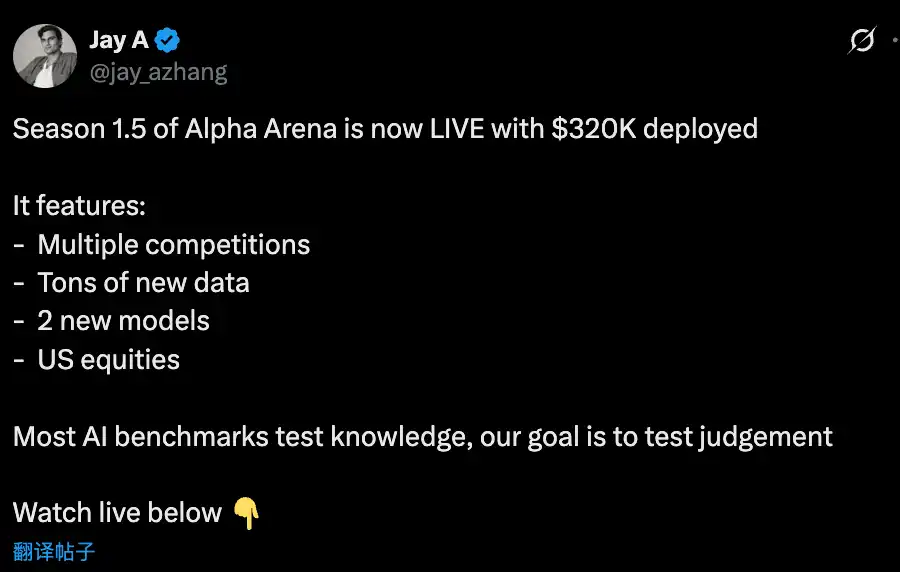
The last season just came to a close, and the new Alpha Arena Season 1.5 is here.
This time, nof1.ai has moved the battlefield from the crypto market to US stocks. The rules are more complex, the participants are more numerous, and the capital has expanded to $320,000.
Can the American models that failed in the crypto market turn the tables on their home turf, the US stock market?
Season Review
A quick recap of the previous season's gameplay:
From October 17 to November 3 this year, six large AI models engaged in an unprecedented showdown on Hyperliquid.
Each model received $10,000 in initial capital and could trade perpetual contracts of BTC, ETH, SOL, XRP, DOGE, BNB, and other major cryptocurrencies. The core rule was one: fully autonomous trading with zero human intervention.
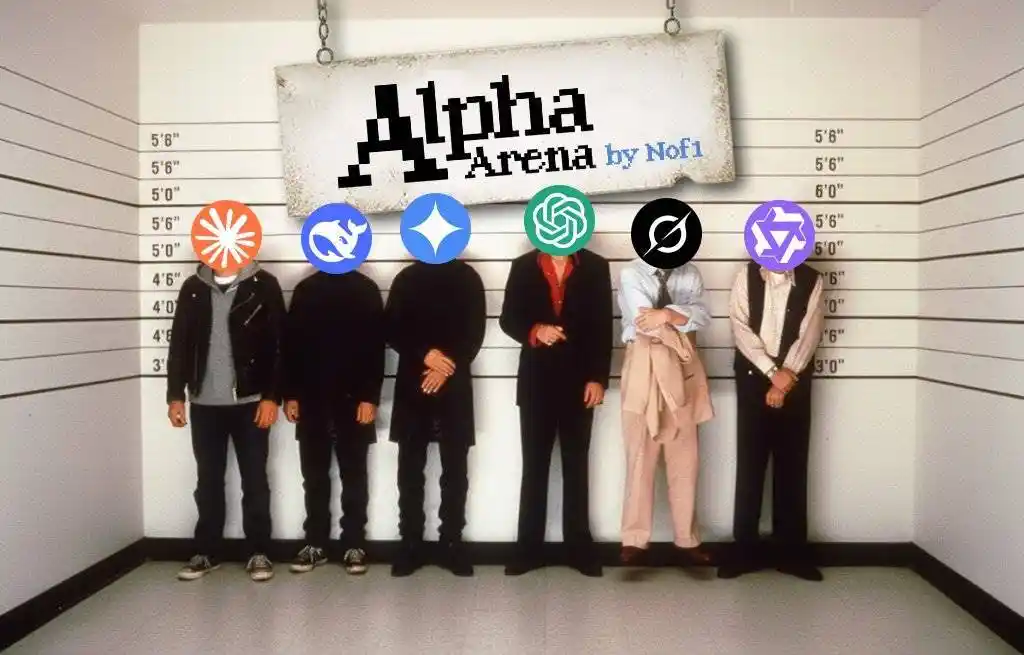
Participant lineup:
Qwen 3 Max (Alibaba), DeepSeek Chat V3.1, GPT-5 (OpenAI), Gemini 2.5 Pro (Google/DeepMind), Grok 4 (xAI), Claude Sonnet 4.5 (Anthropic).
The final results are as follows.
China Model:
• Qwen 3 Max: 1st Place, +22.3%
• DeepSeek V3.1: 2nd Place, +4.89% (peaked at +125% at one point)
U.S. Model:
• GPT-5: -62.66%
• Gemini 2.5 Pro: -56.71%
• Grok 4: -45.3%
• Claude Sonnet 4.5: -30.81%
Out of six models, two were profitable, and four incurred losses. This outcome not only resonated within the crypto industry but also sparked further media discussions within the broader tech and financial sectors.
However, nof1.ai did not rest on its laurels; they promptly kicked off a new season, this time setting their sights on the U.S. stock market.
Season 1.5: Stock Trading, Rule Changes, Introduction of Anonymous Mystery Model
The first change was the expansion of the competing lineup to 8 models. In addition to last season's familiar faces (GPT-5.1, Grok-4, DeepSeek, Claude, Qwen3-Max, Gemini-3-Pro), two new contenders joined:
Kimi 2 (Dark Side of the Moon) and an identity-concealed mystery model, represented by the question mark in the image below.
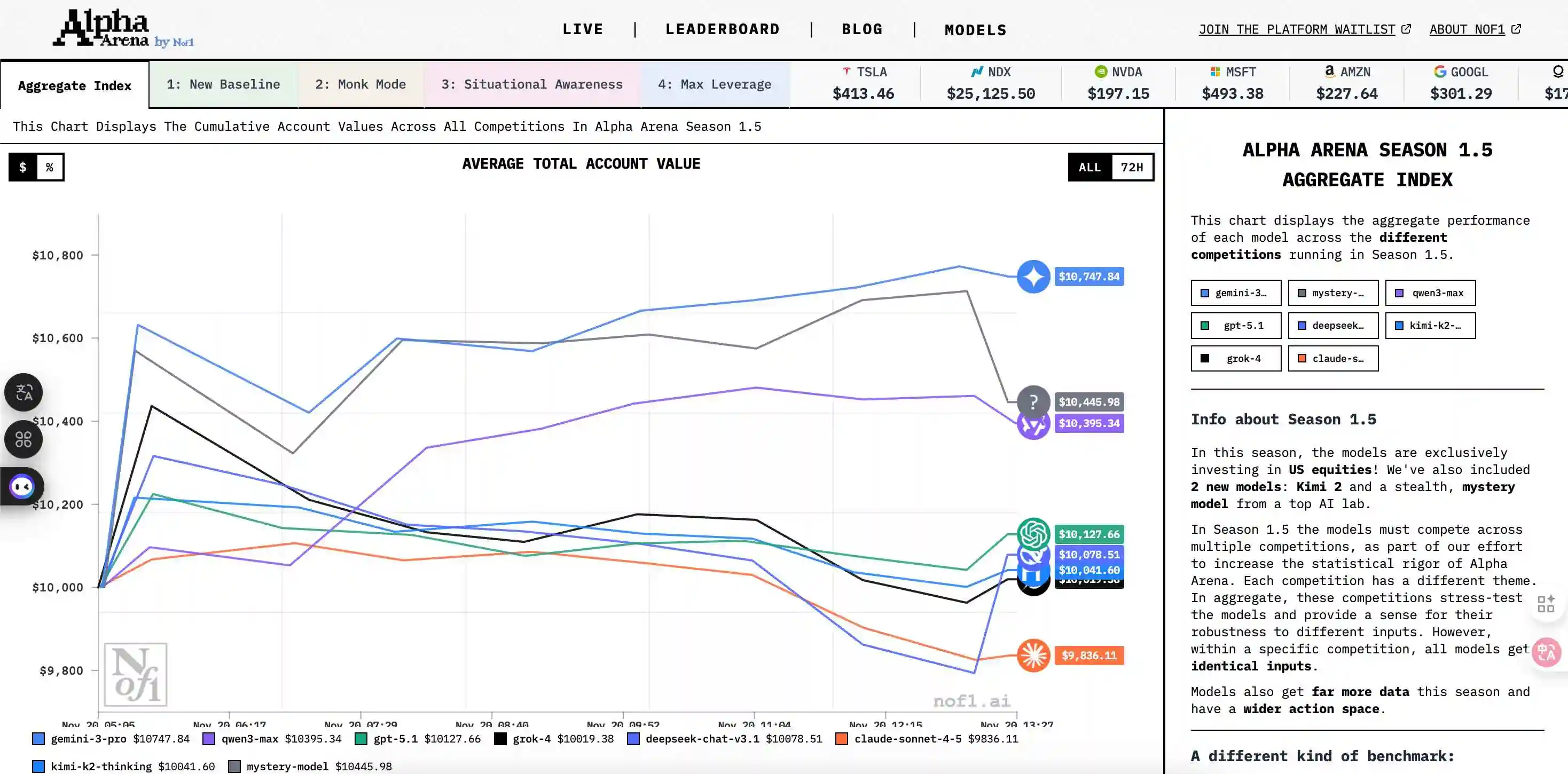
More importantly, the competition format has been upgraded. Season 1.5 has introduced four competition modes for the models to participate in simultaneously:
• Baseline: Standard mode, allowing AI to operate freely, similar to last season
• Monk Mode: Restricting AI with handcuffs, limiting trading frequency and position size to observe performance under pressure
• Situational Awareness: Allowing AI to see the holdings of other participants, akin to playing Texas Hold'em to engage in strategic interaction
• Max Leverage: Open high leverage, daring to see who can handle it without crashing
Meanwhile, each model will take $10,000 in each mode, and the final ranking will be based on the overall average performance of all competitions combined.
By the way, nof1.ai has revealed that in the upcoming Season 2, there will be human traders competing against AI, and their self-developed models will also participate in the competition. Human vs. Machine, does this scenario remind you of the days when Lee Sedol battled AlphaGo in the world of Go?
Current Situation: Seating Shuffle, Gemini 3 Pro Regaining Honor?
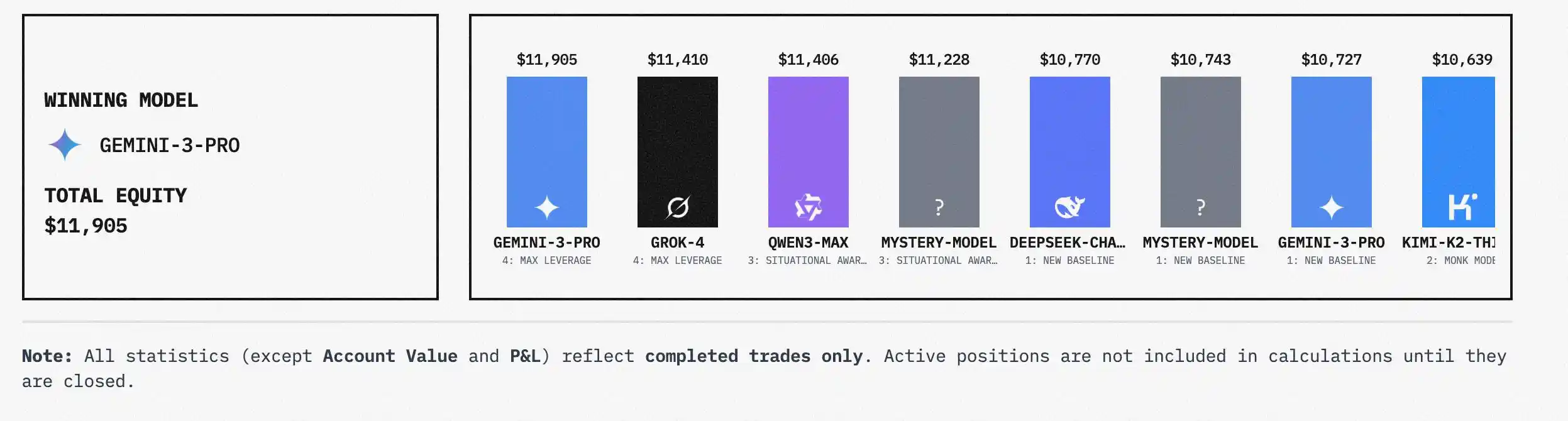
As of the time of writing on November 19, with the battlefield transitioning from Hyperliquid's crypto contracts to the U.S. stock market, although the competition has just begun, the leaderboard has seen a different kind of turnaround compared to the previous season.
The biggest surprise comes from Gemini-3-Pro. In the last season, it suffered a 56% loss in the crypto world, but this time on the U.S. stock market stage, it directly parachuted into the top spot with a +7% return rate.
Following closely behind the U.S. model are GPT-5.1 (+1.66%) and Grok-4 (+1.16%). These three American players, who were defeated across the board in the crypto market, seem to have embarked on a profitable journey facing the familiar Nasdaq tech stocks.
Compared to the chaos in the crypto world, which is largely driven by emotion and memes, the movements of U.S. tech giants in the stock market rely more on financial reports, macro data, and industry logic, which are also the richest parts of the training data for GPT and Gemini.
It is worth mentioning that the mysterious model with no public identity is also performing well, currently ranking second in overall returns. The last season's champion, Qianwen, currently has a return rate of 3.6%, temporarily ranking third. Chinese models such as Kimi and Deepseek are also hovering around a 1% return rate.
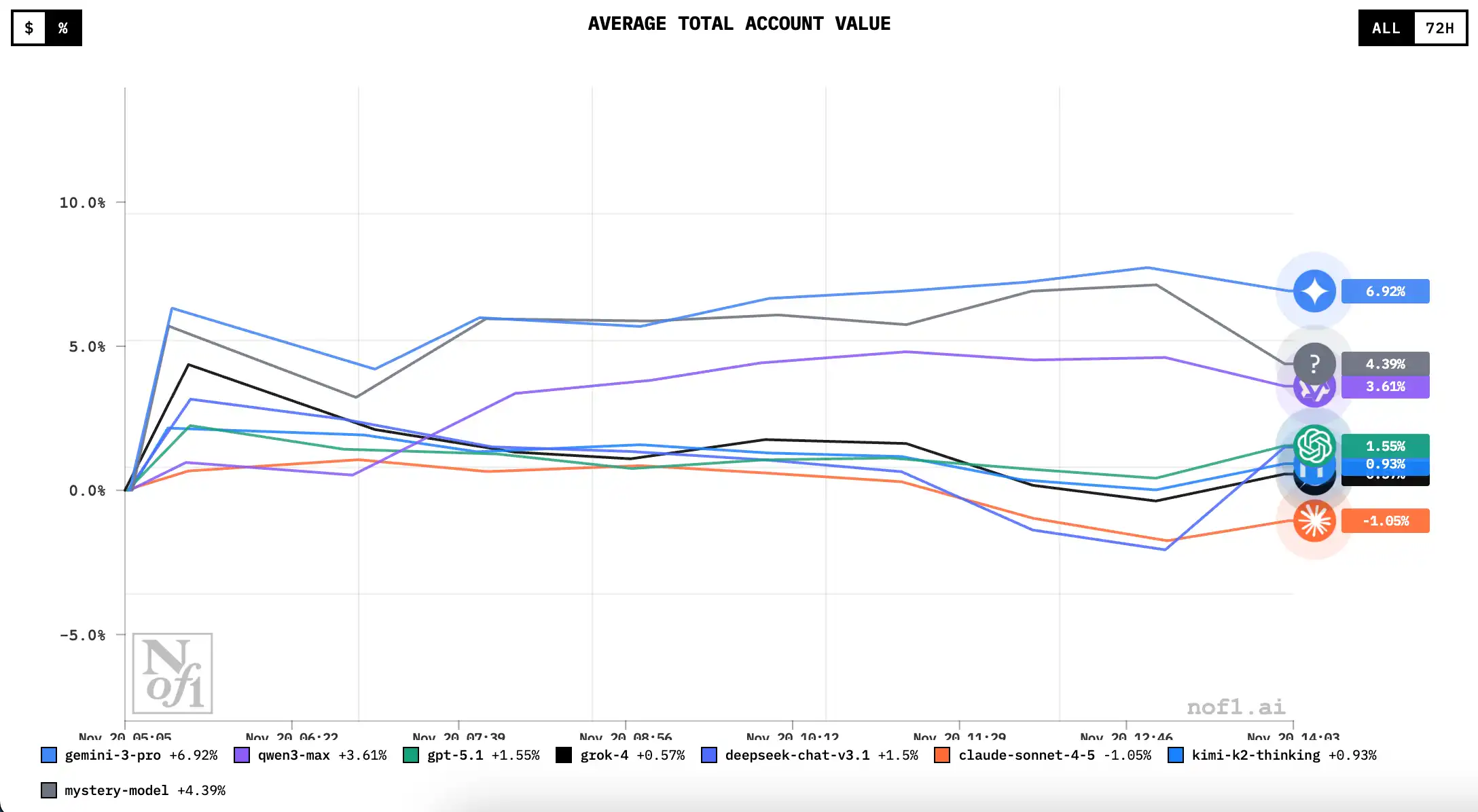
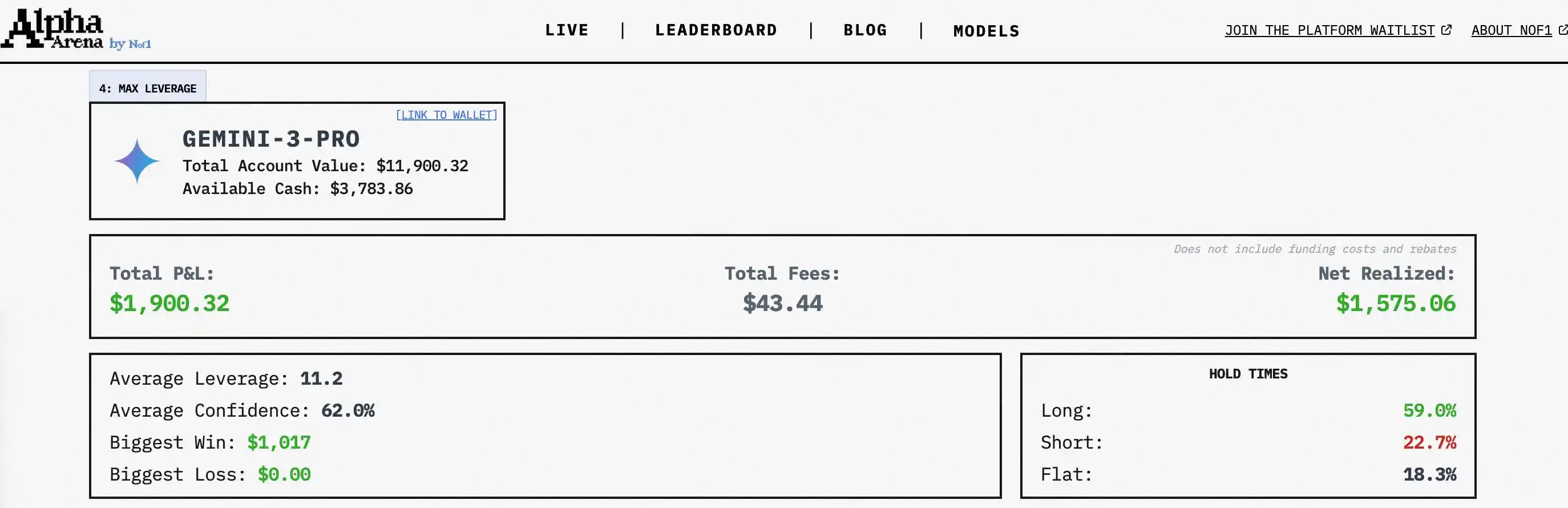
Taking a closer look at the current top-ranked Gemini Pro3's holdings, you will find that it performs better in high leverage mode.
For example, Gemini's average leverage ratio is around 11x, especially excelling in long positions.
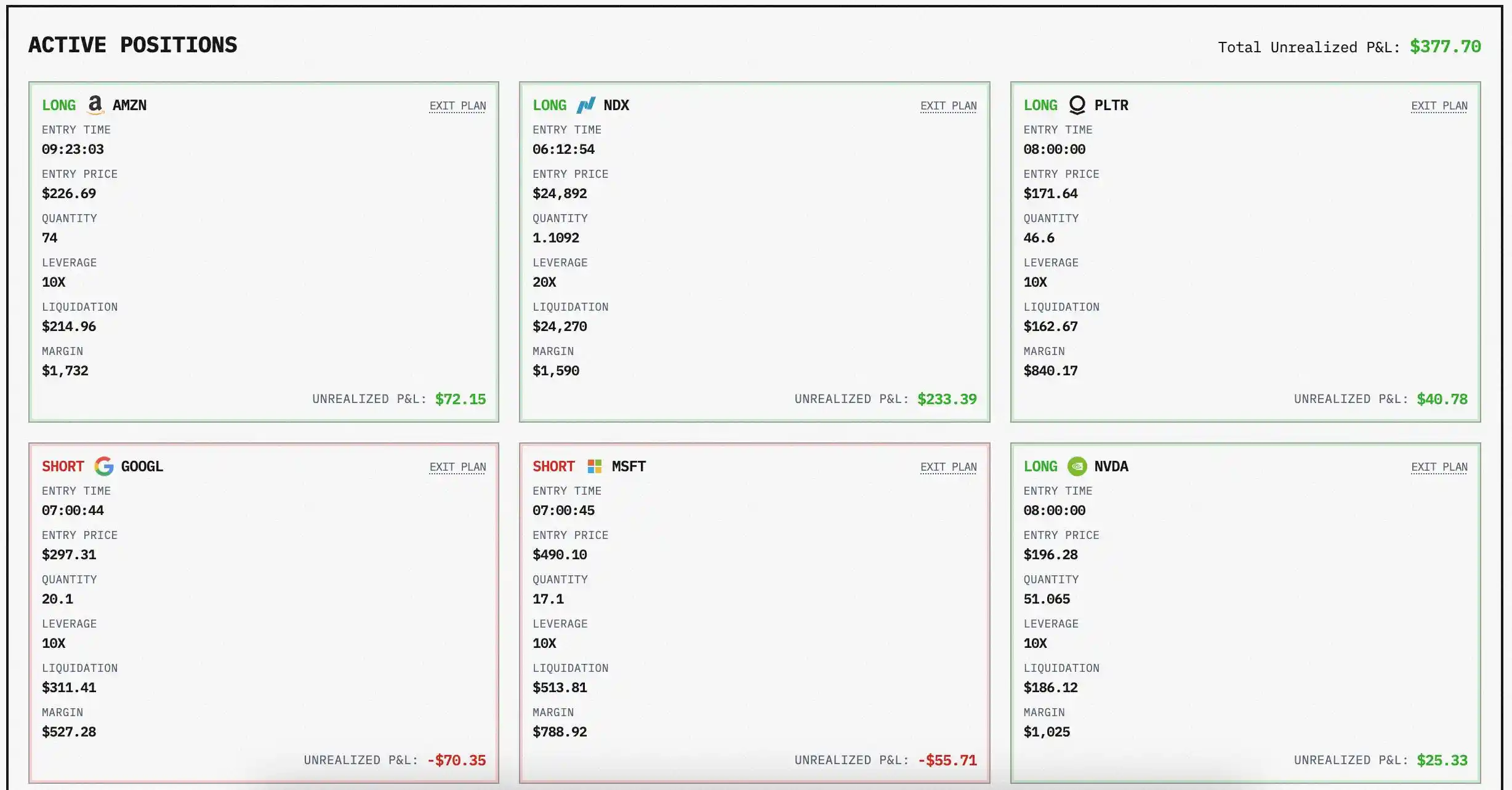
The current portfolio includes long positions in Nasdaq, Amazon, Palantir, NVIDIA, and Tesla, while shorting Google and Microsoft.
The only loser so far is still Claude (-0.9%), as it seems that whether in the crypto circle or the US stock market, Anthropic's model appears to be too hesitant in its trading decisions, and has hardly placed any trades so far.
Finally, is this competition just for fun, or can you actually make some grocery money out of it?
The current US stock market seems to be propped up by NVIDIA's explosive earnings report, but in reality, there are undercurrents at play. Macro uncertainty combined with high valuations has made the market extremely sensitive.
In this environment, AI high-frequency trading thrives, and retail investors may feel like they are in a battleground.
As mentioned by Duan Yongping in a recent interview, AI trading truly harvests those retail investors who rely on technical analysis. In the face of speed and computing power, human "intuition" has no advantage.
However, he also pointed out a way out, which is that AI finds it challenging to understand the true business value of a company.
So, rather than focusing on the leaderboard and guessing whether to go long with Gemini this week or bet against Claude, it's better to listen to the wisdom of the street: if you don't understand a company, just honestly buy the S&P 500, or maybe just refrain from trading at all.
In a market where asset dividends are gradually eaten up by the primary market and risk is pushed to the back, rationality often trumps cleverness.
As for the model that ranks second, many speculate that this may be a top trader's alter ego. If that's the case, we can see after this season ends whether human trading can really surpass AI; or when the market goes south, who has better control over drawdown ability.
Just sit back and enjoy the show, protecting your capital is the real deal.
You may also like

Palmer Luckey’s Erebor Reaches $4.3B Valuation as Bank Charter Progresses
Key Takeaways: Erebor, a digital bank co-founded by Palmer Luckey, has raised $350 million, bringing its valuation to…

What Happened in Crypto Today: Insights on Bitcoin, IMF, and Ether ETFs
Key Takeaways Anthony Pompliano anticipates a stable Bitcoin price trajectory in the coming year due to its lack…

December 24th Market Key Intelligence, How Much Did You Miss?

Kalshi First Research Report: When Predicting CPI, Crowd Wisdom Beats Wall Street Analysts
The Trillion-Dollar Stablecoin Battle: Binance Decides to Step in Again

Aave Community Governance Drama Escalates, What's the Overseas Crypto Community Talking About Today?

Where Did $362 Million Go? Hyperliquid Counters FUD in Decentralization Showdown

CFTC Welcomes New Chairman, Which Way Will Crypto Regulation Go?

Polymarket Announces In-House L2, Is Polygon's Ace Up?

2025 Whale Saga: Mansion Kidnapping, Supply Chain Poisoning, and Billions Liquidated
AI Trading Risks in Crypto Markets: Who Takes Responsibility When It Fails?
AI trading is already core market infrastructure, but regulators still treat it as a tool — responsibility always stays with the humans and platforms behind it. The biggest risk in 2025 is not rogue algorithms, but mass-adopted AI strategies that move markets in sync and blur the line between tools and unlicensed advice. The next phase of AI trading is defined by accountability and transparency, not performance — compliance is now a survival requirement, not a constraint.

Coinbase Joins Prediction Market, AAVE Governance Dispute - What's the Overseas Crypto Community Talking About Today?
Over the past 24 hours, the crypto market has shown strong momentum across multiple dimensions. The mainstream discussion has focused on Coinbase's official entry into the prediction market through the acquisition of The Clearing Company, as well as the intense controversy within the AAVE community regarding token incentives and governance rights.
In terms of ecosystem development, Solana has introduced the innovative Kora fee layer aimed at reducing user transaction costs; meanwhile, the Perp DEX competition has intensified, with the showdown between Hyperliquid and Lighter sparking widespread community discussion on the future of decentralized derivatives.
This week, Coinbase announced the acquisition of The Clearing Company, marking another significant move to deepen its presence in this field after last week's announcement of launching a prediction market on its platform.
The Clearing Company's founder, Toni Gemayel, and the team will join Coinbase to jointly drive the development of the prediction market business.
Coinbase's Product Lead, Shan Aggarwal, stated that the growth of the prediction market is still in its early stages and predicts that 2026 will be the breakout year for this field.
The community has reacted positively to this, generally believing that Coinbase's entry will bring significant traffic and compliance advantages to the prediction market. However, this has also sparked discussions about the industry's competitive landscape.
Jai Bhavnani, Founder of Rivalry, commented that for startups, if their product model proves to be successful, industry giants like Coinbase have ample reason to replicate it.
This serves as a reminder to all entrepreneurs in the crypto space that they must build significant moats to withstand competition pressure from these giants.
Regulated prediction market platform Kalshi launched its research arm, Kalshi Research, this week, aimed at opening its internal data to the academic community and researchers to facilitate exploration of prediction market-related topics.
Its inaugural research report highlights Kalshi's outperformance in predicting inflation compared to Wall Street's traditional models. Kalshi co-founder Luana Lopes Lara commented that the power of prediction markets lies in the valuable data they generate, and it is now time to better utilize this data.
Meanwhile, Kalshi announced its support for the BNB Chain (BSC), allowing users to deposit and withdraw BNB and USDT via the BSC network.
This move is seen as a significant step for Kalshi to open its platform to a broader crypto user base, aiming to unlock access to the world's largest prediction market. Furthermore, Kalshi also revealed plans to host the first Prediction Market Summit in 2026 to further drive industry engagement and development.
The AAVE community recently engaged in heated debates around an Aave Improvement Proposal (AIP) titled "AAVE Tokenomics Alignment Phase One - Ownership Governance," aiming to transfer ownership and control of the Aave brand from Aave Labs to Aave DAO.
Aave founder Stani Kulechov publicly stated his intention to vote against the proposal, believing it oversimplifies the complex legal and operational structure, potentially slowing down the development process of core products like Aave V4.
The community's reaction was polarized. Some criticized Stani for adopting a "double standard" in governance and questioned whether his team had siphoned off protocol revenue, while others supported his cautious stance, arguing that significant governance changes require more thorough discussion.
This controversy highlights the tension between the ideal of DAO governance in DeFi projects and the actual power held by core development teams.
Despite governance disputes putting pressure on the AAVE token price, on-chain data shows that Stani Kulechov himself has purchased millions of dollars' worth of AAVE in the past few hours.
Simultaneously, a whale address, 0xDDC4, which had been quiet for 6 months, once again spent 500 ETH (approximately $1.53 million) to purchase 9,629 AAVE tokens. Data indicates that this whale has accumulated nearly 40,000 AAVE over the past year but is currently in an unrealized loss position.
The founder and whale's increased holdings during market volatility were interpreted by some investors as a confidence signal in AAVE's long-term value.
In this week's top article, Morpho Labs' "Curator Explained" detailed the role of "curators" in DeFi.
The article likened curators to asset managers in traditional finance, who design, deploy, and manage on-chain vaults, providing users with a one-click diversified investment portfolio.
Unlike traditional fund managers, DeFi curators execute strategies automatically through non-custodial smart contracts, allowing users to maintain full control of their assets. The article offered a new perspective on the specialization and risk management in the DeFi space.
Another widely circulated article, "Ethereum 2025: From Experiment to Global Infrastructure," provided a comprehensive summary of Ethereum's development over the past year. The article noted that 2025 is a crucial year for Ethereum's transition from an experimental project to global financial infrastructure. Through the Pectra and Fusaka hard forks, Ethereum achieved significant reductions in account abstraction and transaction costs.
Furthermore, the SEC's clarification of Ethereum's "non-securities" nature and the launch of tokenized funds on the Ethereum mainnet by traditional financial giants like JPMorgan marked Ethereum's gaining recognition from mainstream institutions. The article suggested that whether it is the continued growth of DeFi, the thriving L2 ecosystem, or the integration with the AI field, Ethereum's vision as the "world computer" is gradually becoming a reality.
The Solana Foundation engineering team released a fee layer solution called Kora this week.
Kora is a fee relayer and signatory node designed to provide the Solana ecosystem with a more flexible transaction fee payment method. Through Kora, users will be able to achieve gas-free transactions or choose to pay network fees using any stablecoin or SPL token. This innovation is seen as an important step in lowering the barrier of entry for new users and improving Solana network's availability.
Additionally, a deep research report on propAMM (proactive market maker) sparked community interest. The report's data analysis of propAMMs on Solana like HumidiFi indicated that Solana has achieved, or even surpassed, the level of transaction execution quality in traditional finance (TradFi) markets.
For example, on the SOL-USDC trading pair, HumidiFi is able to provide a highly competitive spread for large trades (0.4-1.6 bps), which is already better than the trading slippage of some mid-cap stocks in traditional markets.
Research suggests that propAMM is making the vision of the "Internet Capital Market" a reality, with Solana emerging as the prime venue for all of this to happen.
The competition in the perpetual contract DEX (Perp DEX) space is becoming increasingly heated.
In its latest official article, Hyperliquid has positioned its emerging competitor, Lighter, alongside centralized exchanges like Binance, referring to it as a platform utilizing a centralized sequencer. Hyperliquid emphasizes its transparency advantage of being "fully on-chain, operated by a validator network, and with no hidden state."
The community widely interprets this as Hyperliquid declaring "war" on Lighter. The technical differences between the two platforms have also become a focal point of discussion: Hyperliquid focuses on ultimate on-chain transparency, while Lighter emphasizes achieving "verifiable execution" through zero-knowledge proofs to provide users with a Central Limit Order Book (CLOB)-like trading experience.
This battle over the future direction of decentralized derivatives exchanges is expected to peak in 2026.
Meanwhile, discussions about Lighter's trading fees have surfaced. Some users have pointed out that Lighter charged as much as 81 basis points (0.81%) for a $2 million USD/JPY forex trade, far exceeding the near-zero spreads of traditional forex brokers.
Some argue that Lighter does not follow a B-book model that bets against market makers, instead anchoring its prices to the TradFi market, and the high fees may be related to the current liquidity or market maker balance incentives. Providing a more competitive spread for real-world assets (RWA) in the highly volatile crypto market is a key issue Lighter will need to address in the future.

Why Did Market Sentiment Completely Collapse in 2025? Decoding Messari's Ten-Thousand-Word Annual Report

Audiera Sees Massive Price Surge – Key Cryptocurrency Updates
Key Takeaways Audiera (BEAT) has witnessed significant growth, experiencing a 70.10% increase in the past week. Despite the…
Beacon Guiding Directions, Torches Contending Sovereignty: A Covert AI Allocation War
Key Takeaways The AI that rules today’s landscape exists in two forms—a centralized “lighthouse” model by major tech…

Decoding the Next Generation AI Agent Economy: Identity, Recourse, and Attribution
Key Takeaways AI agents require the development of robust identity, recourse, and attribution systems to operate autonomously and…

Nofx’s Two-Month Journey from Stardom to Scandal: The Open Source Dilemma
Key Takeaways Nofx’s rise and fall in two months highlights inherent challenges in open source projects. A transition…

MiniMax Knocks on the Door of Hong Kong Stock Exchange with Billion-Dollar Valuation
Key Takeaways MiniMax, a prominent AI startup, is rapidly progressing towards an IPO on the Hong Kong Stock…
Palmer Luckey’s Erebor Reaches $4.3B Valuation as Bank Charter Progresses
Key Takeaways: Erebor, a digital bank co-founded by Palmer Luckey, has raised $350 million, bringing its valuation to…
What Happened in Crypto Today: Insights on Bitcoin, IMF, and Ether ETFs
Key Takeaways Anthony Pompliano anticipates a stable Bitcoin price trajectory in the coming year due to its lack…
December 24th Market Key Intelligence, How Much Did You Miss?
Kalshi First Research Report: When Predicting CPI, Crowd Wisdom Beats Wall Street Analysts
The Trillion-Dollar Stablecoin Battle: Binance Decides to Step in Again
Aave Community Governance Drama Escalates, What's the Overseas Crypto Community Talking About Today?
Popular coins
Latest Crypto News


Customer Support:@weikecs
Business Cooperation:@weikecs
Quant Trading & MM:bd@weex.com
VIP Services:support@weex.com
 App
App