
- Buy Crypto
- Markets
- Futures
- Spot
- Copy Trade
 WE-Launch
CleanCore Solutions Boosts Treasury with Massive 710 Million Dogecoin Haul

Imagine a company diving headfirst into the crypto world, not just dipping a toe but making a splash that’s turning heads. That’s exactly what’s happening with NYSE-listed CleanCore Solutions, which has just beefed up its holdings by adding over 710 million Dogecoin tokens to its treasury. This move pushes them closer to their ambitious goal of stacking up a full billion DOGE, all while emphasizing a smart, transparent approach to growth. It’s like building a fortress in the volatile crypto landscape, where resilience meets opportunity.
Why CleanCore Is Betting Big on Dogecoin for Long-Term Value
CleanCore Solutions isn’t just hoarding Dogecoin for the thrill of it. Their strategy is all about scaling responsibly, with a keen eye on transparency and building lasting resilience. As of today, October 8, 2025, Dogecoin (DOGE) is trading at around $0.32, according to the latest market data, putting the value of their 710 million tokens at roughly $227.2 million. This comes after they raised approximately $175 million through a private placement back on September 5, giving them the firepower to keep accumulating without missing a beat.
The company has made it clear that this isn’t a reckless gamble. Instead, they’re focused on enhancing shareholder value by growing their treasury in a way that supports the long-term market cap relative to net asset value (mNAV). Think of it like tending a garden—you plant seeds carefully, nurture them, and watch them flourish over time, rather than throwing everything in at once and hoping for the best. CleanCore’s CEO, Clayton Adams, highlighted how this aligns perfectly with the broader vision for Dogecoin, often called the “House of Doge.” It’s about expanding real-world utility to drive adoption and create steady demand for DOGE as a global digital asset.
This brand alignment shines through in how CleanCore positions itself alongside Dogecoin’s fun, community-driven ethos. While traditional companies might stick to stocks and bonds, CleanCore is embracing DOGE’s meme-powered appeal, blending it with their own innovative solutions in cleaning technology. It’s a match that underscores resilience and accessibility, much like how Dogecoin has evolved from a joke to a serious player in crypto, helping CleanCore appeal to a younger, tech-savvy investor base.
Navigating Concerns Around mNAV in Crypto Treasuries
Not everything is smooth sailing, though. CleanCore has voiced some worries about mNAV, that key metric showing how a company’s market cap stacks up against its net assets. They’re committed to growing thoughtfully to avoid the pitfalls that have tripped up others. Compare this to smaller firms that sometimes overexpose themselves to crypto volatility—it’s like putting all your eggs in one basket during a storm. Industry experts, like those at research firms, have pointed out that mNAV can overlook operational strengths beyond just holding crypto, and it might not fully account for things like convertible debt.
This caution echoes recent warnings from financial analysts, who note that smaller players in the digital asset treasury space risk big losses if mNAVs dip too low. If that happens, we could see a wave of consolidations, with bigger fish swallowing the smaller ones. Evidence backs this up: Just look at how market fluctuations have hammered some treasuries in the past year, leading to mergers that strengthened the survivors. CleanCore, by contrast, is playing it smart, aiming for sustainability that stands out in a crowded field.
On the stock side, CleanCore Solutions Inc. (ZONE) wrapped up trading on that Tuesday down 8.44% at $2.06, with a modest 1.46% bump in after-hours to $2.09. But the real excitement is in their crypto pivot, which has sparked buzz across social media.
Latest Buzz: Twitter Talks, Google Searches, and Fresh Updates on Dogecoin Adoption
Diving into what’s hot right now, Google searches are exploding with questions like “Why are companies adding Dogecoin to treasuries?” and “What’s the future of DOGE as a corporate asset?” People are curious about how this meme coin is morphing into a legitimate investment vehicle, especially with real-world examples like CleanCore’s move. On Twitter, discussions are heating up around #DogecoinTreasury and #CryptoAdoption, with users debating if this signals a new era for altcoins. A recent tweet from a prominent crypto influencer on October 7, 2025, praised CleanCore’s strategy, saying, “This is how you build crypto resilience—transparent accumulation like @CleanCoreSolutions is doing with DOGE. Game changer!”
Adding to the momentum, the first Dogecoin-based ETF in the US, the REX-Osprey DOGE ETF (DOJE), launched on September 18 with an impressive $6 million in first-day volume. Fast-forward to today, and its assets under management have grown to over $150 million, per the latest filings, showing sustained interest. Meanwhile, other firms are following suit—take Nasdaq-listed CEA Industries Inc., which disclosed on that same Tuesday holding 480,000 BNB tokens bought at an average of $860 each. That investment, costing about $412.8 million, is now worth around $650 million based on current prices, highlighting the potential upside in crypto treasuries.
If you’re looking to get in on the action yourself, consider platforms that make trading seamless and secure. WEEX exchange stands out here, offering a user-friendly interface with top-notch security features and low fees that let you dive into Dogecoin and other cryptos without the hassle. It’s like having a reliable co-pilot in the wild world of digital assets, backed by a track record of innovation and trader trust that enhances your overall experience.
Wrapping Up the Dogecoin Treasury Trend
In a nutshell, CleanCore’s push into Dogecoin isn’t just about numbers—it’s a story of strategic growth in an evolving market. By comparing their measured approach to the risks faced by overexposed smaller firms, it’s clear why this could pay off big. With real data showing unrealized gains exceeding $20 million at the time of their announcement, and ongoing adoption driving
You may also like

The Trillion-Dollar Stablecoin Battle: Binance Decides to Step in Again

Coinbase Joins Prediction Market, AAVE Governance Dispute - What's the Overseas Crypto Community Talking About Today?
Over the past 24 hours, the crypto market has shown strong momentum across multiple dimensions. The mainstream discussion has focused on Coinbase's official entry into the prediction market through the acquisition of The Clearing Company, as well as the intense controversy within the AAVE community regarding token incentives and governance rights.
In terms of ecosystem development, Solana has introduced the innovative Kora fee layer aimed at reducing user transaction costs; meanwhile, the Perp DEX competition has intensified, with the showdown between Hyperliquid and Lighter sparking widespread community discussion on the future of decentralized derivatives.
This week, Coinbase announced the acquisition of The Clearing Company, marking another significant move to deepen its presence in this field after last week's announcement of launching a prediction market on its platform.
The Clearing Company's founder, Toni Gemayel, and the team will join Coinbase to jointly drive the development of the prediction market business.
Coinbase's Product Lead, Shan Aggarwal, stated that the growth of the prediction market is still in its early stages and predicts that 2026 will be the breakout year for this field.
The community has reacted positively to this, generally believing that Coinbase's entry will bring significant traffic and compliance advantages to the prediction market. However, this has also sparked discussions about the industry's competitive landscape.
Jai Bhavnani, Founder of Rivalry, commented that for startups, if their product model proves to be successful, industry giants like Coinbase have ample reason to replicate it.
This serves as a reminder to all entrepreneurs in the crypto space that they must build significant moats to withstand competition pressure from these giants.
Regulated prediction market platform Kalshi launched its research arm, Kalshi Research, this week, aimed at opening its internal data to the academic community and researchers to facilitate exploration of prediction market-related topics.
Its inaugural research report highlights Kalshi's outperformance in predicting inflation compared to Wall Street's traditional models. Kalshi co-founder Luana Lopes Lara commented that the power of prediction markets lies in the valuable data they generate, and it is now time to better utilize this data.
Meanwhile, Kalshi announced its support for the BNB Chain (BSC), allowing users to deposit and withdraw BNB and USDT via the BSC network.
This move is seen as a significant step for Kalshi to open its platform to a broader crypto user base, aiming to unlock access to the world's largest prediction market. Furthermore, Kalshi also revealed plans to host the first Prediction Market Summit in 2026 to further drive industry engagement and development.
The AAVE community recently engaged in heated debates around an Aave Improvement Proposal (AIP) titled "AAVE Tokenomics Alignment Phase One - Ownership Governance," aiming to transfer ownership and control of the Aave brand from Aave Labs to Aave DAO.
Aave founder Stani Kulechov publicly stated his intention to vote against the proposal, believing it oversimplifies the complex legal and operational structure, potentially slowing down the development process of core products like Aave V4.
The community's reaction was polarized. Some criticized Stani for adopting a "double standard" in governance and questioned whether his team had siphoned off protocol revenue, while others supported his cautious stance, arguing that significant governance changes require more thorough discussion.
This controversy highlights the tension between the ideal of DAO governance in DeFi projects and the actual power held by core development teams.
Despite governance disputes putting pressure on the AAVE token price, on-chain data shows that Stani Kulechov himself has purchased millions of dollars' worth of AAVE in the past few hours.
Simultaneously, a whale address, 0xDDC4, which had been quiet for 6 months, once again spent 500 ETH (approximately $1.53 million) to purchase 9,629 AAVE tokens. Data indicates that this whale has accumulated nearly 40,000 AAVE over the past year but is currently in an unrealized loss position.
The founder and whale's increased holdings during market volatility were interpreted by some investors as a confidence signal in AAVE's long-term value.
In this week's top article, Morpho Labs' "Curator Explained" detailed the role of "curators" in DeFi.
The article likened curators to asset managers in traditional finance, who design, deploy, and manage on-chain vaults, providing users with a one-click diversified investment portfolio.
Unlike traditional fund managers, DeFi curators execute strategies automatically through non-custodial smart contracts, allowing users to maintain full control of their assets. The article offered a new perspective on the specialization and risk management in the DeFi space.
Another widely circulated article, "Ethereum 2025: From Experiment to Global Infrastructure," provided a comprehensive summary of Ethereum's development over the past year. The article noted that 2025 is a crucial year for Ethereum's transition from an experimental project to global financial infrastructure. Through the Pectra and Fusaka hard forks, Ethereum achieved significant reductions in account abstraction and transaction costs.
Furthermore, the SEC's clarification of Ethereum's "non-securities" nature and the launch of tokenized funds on the Ethereum mainnet by traditional financial giants like JPMorgan marked Ethereum's gaining recognition from mainstream institutions. The article suggested that whether it is the continued growth of DeFi, the thriving L2 ecosystem, or the integration with the AI field, Ethereum's vision as the "world computer" is gradually becoming a reality.
The Solana Foundation engineering team released a fee layer solution called Kora this week.
Kora is a fee relayer and signatory node designed to provide the Solana ecosystem with a more flexible transaction fee payment method. Through Kora, users will be able to achieve gas-free transactions or choose to pay network fees using any stablecoin or SPL token. This innovation is seen as an important step in lowering the barrier of entry for new users and improving Solana network's availability.
Additionally, a deep research report on propAMM (proactive market maker) sparked community interest. The report's data analysis of propAMMs on Solana like HumidiFi indicated that Solana has achieved, or even surpassed, the level of transaction execution quality in traditional finance (TradFi) markets.
For example, on the SOL-USDC trading pair, HumidiFi is able to provide a highly competitive spread for large trades (0.4-1.6 bps), which is already better than the trading slippage of some mid-cap stocks in traditional markets.
Research suggests that propAMM is making the vision of the "Internet Capital Market" a reality, with Solana emerging as the prime venue for all of this to happen.
The competition in the perpetual contract DEX (Perp DEX) space is becoming increasingly heated.
In its latest official article, Hyperliquid has positioned its emerging competitor, Lighter, alongside centralized exchanges like Binance, referring to it as a platform utilizing a centralized sequencer. Hyperliquid emphasizes its transparency advantage of being "fully on-chain, operated by a validator network, and with no hidden state."
The community widely interprets this as Hyperliquid declaring "war" on Lighter. The technical differences between the two platforms have also become a focal point of discussion: Hyperliquid focuses on ultimate on-chain transparency, while Lighter emphasizes achieving "verifiable execution" through zero-knowledge proofs to provide users with a Central Limit Order Book (CLOB)-like trading experience.
This battle over the future direction of decentralized derivatives exchanges is expected to peak in 2026.
Meanwhile, discussions about Lighter's trading fees have surfaced. Some users have pointed out that Lighter charged as much as 81 basis points (0.81%) for a $2 million USD/JPY forex trade, far exceeding the near-zero spreads of traditional forex brokers.
Some argue that Lighter does not follow a B-book model that bets against market makers, instead anchoring its prices to the TradFi market, and the high fees may be related to the current liquidity or market maker balance incentives. Providing a more competitive spread for real-world assets (RWA) in the highly volatile crypto market is a key issue Lighter will need to address in the future.

Audiera Sees Massive Price Surge – Key Cryptocurrency Updates
Key Takeaways Audiera (BEAT) has witnessed significant growth, experiencing a 70.10% increase in the past week. Despite the…

CZ Year-End Q&A Summary: In addition to Giggle Academy, what other projects is he working on?

Hands-On Guide to Participating in CZ-Supported predict.fun

Whale’s Selling Frenzy Shakes ASTER Market, Testing $0.6 Support
Key Takeaways A massive whale offloaded approximately 3 million ASTER tokens, intensifying the bearish sentiment in the market.…

Next year, will Pump.fun still be able to tell a new story?

Key Market Information Discrepancy on December 18th - A Must-See! | Alpha Morning Report

Memecoin Boom Transforms into a Bust One Year After Reaching $150 Billion Peak
Key Takeaways The meteoric rise of memecoins, hitting a massive $150.6 billion market cap in late 2024, has…
The US Supreme Court's Tariff Ruling is Imminent, With Trump Issuing Frequent Warnings, Could He Be on the Verge of Losing?

Key Market Intelligence on December 16th, how much did you miss out on?

Dialogue 1: The original goal was to make Binance the top global exchange; CZ was once turned down with a cheeky "You can't afford me".

Bitcoin Drops Below $86,000, but Is the Plunge Just Getting Started?

WEEX Labs: The Next Act of Memecoin, The Flashmob Era

Juventus Football Club Owner Rejects Tether’s Takeover Bid
Key Takeaways Juventus’ owner Exor rejected Tether’s $1 billion acquisition proposal. Exor insists on maintaining long-held ownership over…

BeatSwap's BTX Listed on Multiple Exchanges such as Binance, Gate, MEXC
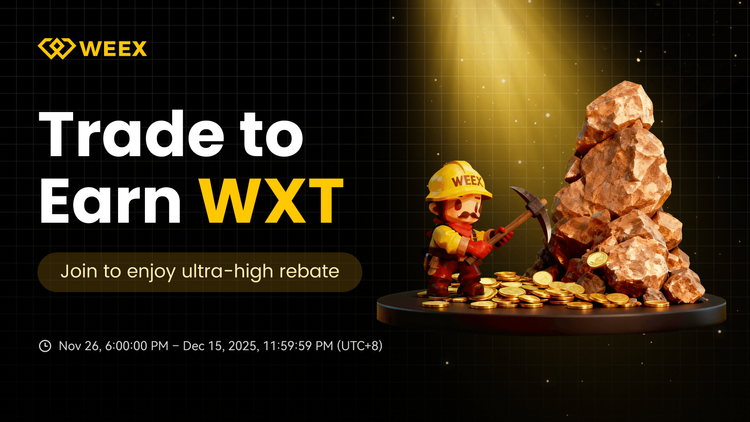
The Hidden Truth of Trade to Earn: Without Capital, Rewards Are Just Delayed Fees
Trading fees have long been a built-in cost structure for users — Trade to Earn introduces a model that redirects part of this value back to participants. WEEX’s $2,000,000 WXT buyback adds real capital support to its Trade to Earn campaign, strengthening reward credibility and value protection.

Crypto AI Hackathon by WEEX: Join the Crypto Trading Compete for an $880K Prize Pool with a Bentley Grand Prize
The WEEX AI Trading Hackathon is currently open for registration, and we're excited to reveal the incredible prize pool for the grand finale. With everything from luxury cars to substantial financial support, this prize pool not only rewards the top performers but also offers invaluable resources for future growth.
The Trillion-Dollar Stablecoin Battle: Binance Decides to Step in Again
Coinbase Joins Prediction Market, AAVE Governance Dispute - What's the Overseas Crypto Community Talking About Today?
Over the past 24 hours, the crypto market has shown strong momentum across multiple dimensions. The mainstream discussion has focused on Coinbase's official entry into the prediction market through the acquisition of The Clearing Company, as well as the intense controversy within the AAVE community regarding token incentives and governance rights.
In terms of ecosystem development, Solana has introduced the innovative Kora fee layer aimed at reducing user transaction costs; meanwhile, the Perp DEX competition has intensified, with the showdown between Hyperliquid and Lighter sparking widespread community discussion on the future of decentralized derivatives.
This week, Coinbase announced the acquisition of The Clearing Company, marking another significant move to deepen its presence in this field after last week's announcement of launching a prediction market on its platform.
The Clearing Company's founder, Toni Gemayel, and the team will join Coinbase to jointly drive the development of the prediction market business.
Coinbase's Product Lead, Shan Aggarwal, stated that the growth of the prediction market is still in its early stages and predicts that 2026 will be the breakout year for this field.
The community has reacted positively to this, generally believing that Coinbase's entry will bring significant traffic and compliance advantages to the prediction market. However, this has also sparked discussions about the industry's competitive landscape.
Jai Bhavnani, Founder of Rivalry, commented that for startups, if their product model proves to be successful, industry giants like Coinbase have ample reason to replicate it.
This serves as a reminder to all entrepreneurs in the crypto space that they must build significant moats to withstand competition pressure from these giants.
Regulated prediction market platform Kalshi launched its research arm, Kalshi Research, this week, aimed at opening its internal data to the academic community and researchers to facilitate exploration of prediction market-related topics.
Its inaugural research report highlights Kalshi's outperformance in predicting inflation compared to Wall Street's traditional models. Kalshi co-founder Luana Lopes Lara commented that the power of prediction markets lies in the valuable data they generate, and it is now time to better utilize this data.
Meanwhile, Kalshi announced its support for the BNB Chain (BSC), allowing users to deposit and withdraw BNB and USDT via the BSC network.
This move is seen as a significant step for Kalshi to open its platform to a broader crypto user base, aiming to unlock access to the world's largest prediction market. Furthermore, Kalshi also revealed plans to host the first Prediction Market Summit in 2026 to further drive industry engagement and development.
The AAVE community recently engaged in heated debates around an Aave Improvement Proposal (AIP) titled "AAVE Tokenomics Alignment Phase One - Ownership Governance," aiming to transfer ownership and control of the Aave brand from Aave Labs to Aave DAO.
Aave founder Stani Kulechov publicly stated his intention to vote against the proposal, believing it oversimplifies the complex legal and operational structure, potentially slowing down the development process of core products like Aave V4.
The community's reaction was polarized. Some criticized Stani for adopting a "double standard" in governance and questioned whether his team had siphoned off protocol revenue, while others supported his cautious stance, arguing that significant governance changes require more thorough discussion.
This controversy highlights the tension between the ideal of DAO governance in DeFi projects and the actual power held by core development teams.
Despite governance disputes putting pressure on the AAVE token price, on-chain data shows that Stani Kulechov himself has purchased millions of dollars' worth of AAVE in the past few hours.
Simultaneously, a whale address, 0xDDC4, which had been quiet for 6 months, once again spent 500 ETH (approximately $1.53 million) to purchase 9,629 AAVE tokens. Data indicates that this whale has accumulated nearly 40,000 AAVE over the past year but is currently in an unrealized loss position.
The founder and whale's increased holdings during market volatility were interpreted by some investors as a confidence signal in AAVE's long-term value.
In this week's top article, Morpho Labs' "Curator Explained" detailed the role of "curators" in DeFi.
The article likened curators to asset managers in traditional finance, who design, deploy, and manage on-chain vaults, providing users with a one-click diversified investment portfolio.
Unlike traditional fund managers, DeFi curators execute strategies automatically through non-custodial smart contracts, allowing users to maintain full control of their assets. The article offered a new perspective on the specialization and risk management in the DeFi space.
Another widely circulated article, "Ethereum 2025: From Experiment to Global Infrastructure," provided a comprehensive summary of Ethereum's development over the past year. The article noted that 2025 is a crucial year for Ethereum's transition from an experimental project to global financial infrastructure. Through the Pectra and Fusaka hard forks, Ethereum achieved significant reductions in account abstraction and transaction costs.
Furthermore, the SEC's clarification of Ethereum's "non-securities" nature and the launch of tokenized funds on the Ethereum mainnet by traditional financial giants like JPMorgan marked Ethereum's gaining recognition from mainstream institutions. The article suggested that whether it is the continued growth of DeFi, the thriving L2 ecosystem, or the integration with the AI field, Ethereum's vision as the "world computer" is gradually becoming a reality.
The Solana Foundation engineering team released a fee layer solution called Kora this week.
Kora is a fee relayer and signatory node designed to provide the Solana ecosystem with a more flexible transaction fee payment method. Through Kora, users will be able to achieve gas-free transactions or choose to pay network fees using any stablecoin or SPL token. This innovation is seen as an important step in lowering the barrier of entry for new users and improving Solana network's availability.
Additionally, a deep research report on propAMM (proactive market maker) sparked community interest. The report's data analysis of propAMMs on Solana like HumidiFi indicated that Solana has achieved, or even surpassed, the level of transaction execution quality in traditional finance (TradFi) markets.
For example, on the SOL-USDC trading pair, HumidiFi is able to provide a highly competitive spread for large trades (0.4-1.6 bps), which is already better than the trading slippage of some mid-cap stocks in traditional markets.
Research suggests that propAMM is making the vision of the "Internet Capital Market" a reality, with Solana emerging as the prime venue for all of this to happen.
The competition in the perpetual contract DEX (Perp DEX) space is becoming increasingly heated.
In its latest official article, Hyperliquid has positioned its emerging competitor, Lighter, alongside centralized exchanges like Binance, referring to it as a platform utilizing a centralized sequencer. Hyperliquid emphasizes its transparency advantage of being "fully on-chain, operated by a validator network, and with no hidden state."
The community widely interprets this as Hyperliquid declaring "war" on Lighter. The technical differences between the two platforms have also become a focal point of discussion: Hyperliquid focuses on ultimate on-chain transparency, while Lighter emphasizes achieving "verifiable execution" through zero-knowledge proofs to provide users with a Central Limit Order Book (CLOB)-like trading experience.
This battle over the future direction of decentralized derivatives exchanges is expected to peak in 2026.
Meanwhile, discussions about Lighter's trading fees have surfaced. Some users have pointed out that Lighter charged as much as 81 basis points (0.81%) for a $2 million USD/JPY forex trade, far exceeding the near-zero spreads of traditional forex brokers.
Some argue that Lighter does not follow a B-book model that bets against market makers, instead anchoring its prices to the TradFi market, and the high fees may be related to the current liquidity or market maker balance incentives. Providing a more competitive spread for real-world assets (RWA) in the highly volatile crypto market is a key issue Lighter will need to address in the future.
Audiera Sees Massive Price Surge – Key Cryptocurrency Updates
Key Takeaways Audiera (BEAT) has witnessed significant growth, experiencing a 70.10% increase in the past week. Despite the…
CZ Year-End Q&A Summary: In addition to Giggle Academy, what other projects is he working on?
Hands-On Guide to Participating in CZ-Supported predict.fun
Whale’s Selling Frenzy Shakes ASTER Market, Testing $0.6 Support
Key Takeaways A massive whale offloaded approximately 3 million ASTER tokens, intensifying the bearish sentiment in the market.…
Popular coins
Latest Crypto News


Customer Support:@weikecs
Business Cooperation:@weikecs
Quant Trading & MM:bd@weex.com
VIP Services:support@weex.com
 App
App