
- Buy Crypto
- Markets
- Futures
- Spot
- Copy Trade
 Earn
Earn- More
Coinbase Pressure Mounts as Interest-Bearing Stablecoins Reach Key Decision Week

Original Title: Coinbase raises pressure as crypto bill moves to Senate markup
Original Authors: Emily Mason, Olga Kharif and Lydia Beyoud, Bloomberg
Translation: Peggy, BlockBeats
Editor's Note: As cryptocurrency regulation in the United States is gradually taking shape, the stablecoin "reward mechanism" has become a new focal point of controversy. Coinbase has warned that if Congress restricts platforms from offering stablecoin rewards to users in the upcoming market structure bill under consideration, it may withdraw its support for the bill.
On the surface, this is a dispute over a business incentive rule; in essence, it affects the boundary of interests between the crypto platform and the traditional banking system. The banking industry is concerned that stablecoin rewards could drain deposits, weakening the credit base; while platforms like Coinbase believe that this mechanism is related to the scale of stablecoins, the network effect of the US dollar, and industry competition fairness.
The following is the original text:
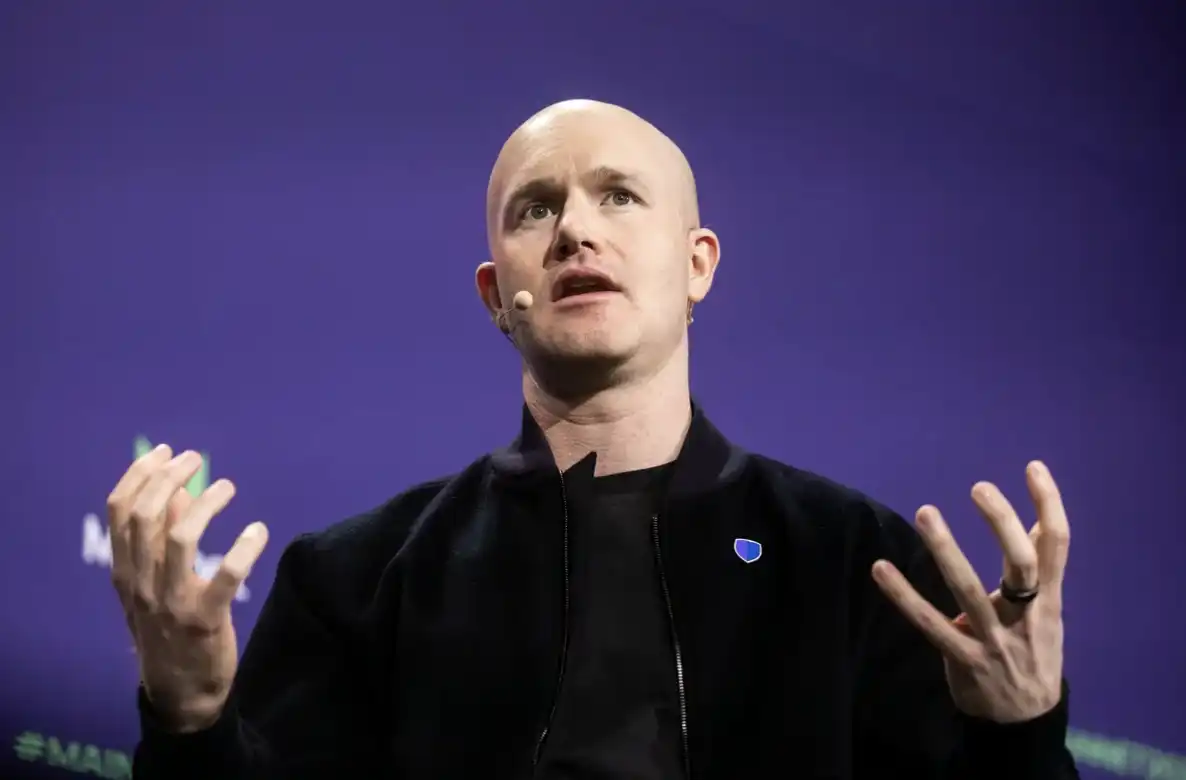
Coinbase's CEO Brian Armstrong
Coinbase Global Inc. is increasing pressure on U.S. lawmakers in an attempt to retain its ability to provide rewards to customers holding stablecoins. The company believes that if certain restrictions currently under discussion are included in a significant cryptocurrency bill expected to be released on Monday, this business will be at risk.
According to a person familiar with the company's thinking, if the bill text includes anything beyond "strengthened disclosure of reward-related information," the largest U.S. crypto exchange may reconsider whether to continue supporting the digital asset market structure bill. The bill is expected to enter the markup stage in at least one Senate committee on Thursday.
Coinbase did not respond to a request for comment.
Industry sources said that one option under consideration is to limit eligibility for rewards to regulated financial institutions. This approach has some support from the banking industry, as they believe that interest-bearing stablecoin accounts could "siphon off" deposits from the traditional banking system. Coinbase has applied for a national trust charter, which, if approved, could allow it to continue offering such rewards under the above rules. However, crypto-native companies are pushing to retain the "platform reward" model without a license and have warned that broader restrictions could disrupt the industry's competitive landscape.
The threat of "Support Withdrawal" is not insignificant. The cryptocurrency industry is the top industry in terms of corporate political spending during the 2023-2024 election cycle, funneling significant funds to favored candidates. Coinbase, led by co-founder and CEO Brian Armstrong, donated $1 million to Donald Trump's presidential inauguration and was also one of the companies funding the construction of a dining hall at the White House.
For Coinbase, the issue of incentives is crucial. The exchange shares part of the interest income generated from Circle Internet Group Inc.'s ref="/wiki/article/usd-coin-usdc-269">USDC stablecoin reserves with Circle. The USDC held on the Coinbase platform provides a stable source of income, especially crucial during bear markets. Coinbase also holds a small amount of Circle's stock; Circle is currently the largest compliant stablecoin issuer under a U.S. law passed in July.
For instance, Coinbase incentivizes users to hold USDC on the platform by offering a 3.5% reward for USDC in Coinbase One accounts. If market structure legislation prohibits such incentive measures, the stablecoin holdings on the platform may decrease, affecting Coinbase's overall stablecoin revenue. According to Bloomberg data, this revenue is expected to reach $1.3 billion by 2025.
Of course, the devil is in the details, and the impact is not yet fully clear, depending on the specific wording of the legislation. However, sources familiar with the matter have indicated that the legislation will include relevant references to incentives.
《GENIUS Act》
The second Trump administration swiftly brought a "positive" development to the digital asset industry, including the first federal-level stablecoin issuance regulatory framework passed in July, known as the "GENIUS Act." Following the signing of this act, a series of announcements from retailers to traditional financial institutions expressing intent to enter the stablecoin space have emerged. Even before the act officially became law, World Liberty Financial, co-founded by members of the Trump family, had already launched a proprietary stablecoin called USD1.
Despite government support to expedite the legislation, the "Stablecoin Reward" issue is eroding the bipartisan consensus of the market structure bill. Coinbase's warning of possible support withdrawal indicates that the escalating tension may slow down the legislative process and even result in the legislation not being completed this year. Bloomberg Intelligence analyst Nathan Dean suggests that if there is a lack of bipartisan support during the deliberation stage, the probability of passing relevant legislation in the first half of this year may drop to below 70%.
The "GENIUS Act" prohibits stablecoin issuers from paying users any form of interest or earnings solely for holding the token, but does not prohibit third-party distribution partners like Coinbase from offering rewards based on customer balances.
The banking industry strongly opposes exchanges providing stablecoin rewards, arguing that it would erode deposit sizes in the banking system and undermine community lending capacity.
The American Bankers Association wrote in a recent letter: "If billions of dollars are drawn away from community bank lending, small businesses, farmers, students, and homebuyers in towns like ours will be impacted. Cryptocurrency exchanges and their affiliated stablecoin firms are not designed to fill this lending gap and cannot offer FDIC-insured products, but they often conveniently omit this fact in their aggressive marketing."
In contrast, the crypto industry portrays the banking sector's efforts as an attempt to overturn the consensus already reached in the "GENIUS Act." Coinbase's Chief Policy Officer Faryar Shirzad recently wrote on the X platform, emphasizing the importance of maintaining a reward mechanism linked to stablecoins to uphold the dollar's dominance. He also noted that China has recently announced plans to start paying interest on its central bank digital currency, the digital yuan.
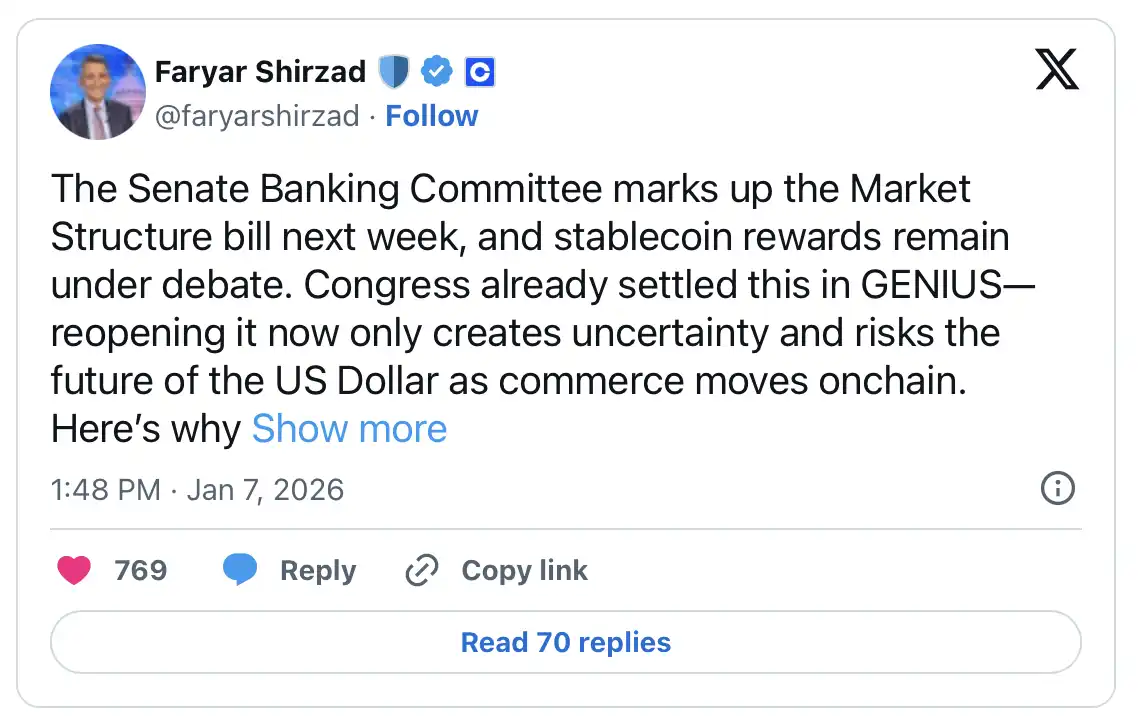
This tension has put senators in a dilemma. Industry insiders and observers indicate that on one hand, the government is pushing for more legislation; on the other hand, they are forced to make a choice on an almost uncompromising issue.
Insiders suggest a possible middle ground: allowing only entities holding a banking charter or financial institutions to offer rewards to users based on stablecoin balances. The Office of the Comptroller of the Currency (OCC) recently conditionally approved five cryptocurrency companies to become national trust banks. However, these approvals have faced strong opposition from banking lobbying groups, which believe that cryptocurrency companies are stretching the boundaries of the "limited-purpose trust charter" and may pose a threat to the stability of the U.S. financial system. Given the existing approval precedents, allowing chartered companies to provide yield if included in the market structure bill may appease some participants in the crypto industry.
Nevertheless, some industry insiders believe that even if restrictions are imposed, it will only trigger a game of "whack-a-mole" – crypto firms will constantly seek new ways to reward users.
Payment giant Stripe's President of Technology and Business, William Gaybrick, stated in an interview last year: "There is no world where we can't reward consumers within an app. In a scenario where you hold stablecoin within an app, that app will always find some way to reward your behavior."
You may also like

Most US debanking cases stem from government pressure, says report
Key Takeaways A report from the Cato Institute indicates that most debanking incidents in the US originate from…

South Korea to lift ban on corporate crypto investment: Report
Key Takeaways South Korea’s Financial Services Commission (FSC) is set to end a nine-year ban on corporate crypto…

UK Lawmakers Urge Ban on Political Donations in Crypto
Key Takeaways: A group of senior UK lawmakers is pushing for a legislative ban on political donations in…

Russia Targets Illegal Crypto Miners; India Advocates for CBDCs: A Global Overview
Key Takeaways Russia is intensifying efforts to regulate illegal cryptocurrency mining, proposing significant fines and penalties. India’s Reserve…

Crypto Rich Threaten to Depart California Amid New Tax Proposal
Key Takeaways Proposed California tax imposes a 5% assets tax on residents with over $1 billion, sparking debate…
South Korea to Lift Longstanding Ban on Corporate Crypto Investments
Key Takeaways South Korea is lifting a nine-year ban on corporate cryptocurrency investments, allowing firms to invest up…

Ethereum Needs Superior Decentralized Stablecoins: Vitalik Buterin
Key Takeaways: Vitalik Buterin emphasizes the need for decentralized stablecoins that are not overly reliant on any single…

Crypto Crucial: Will Tax Threats Push California’s Wealthiest to Flee?
Crypto billionaires in California are contemplating relocation due to a proposed wealth tax targeting assets over $1 billion.…

SEC now fully Republican, set for pro-crypto rulemaking in 2026
Key Takeaways The SEC is now completely under Republican control following the departure of Caroline Crenshaw, indicating a…

Top UK Lawmakers Advocate for Ban on Crypto Political Donations
Key Takeaways Seven UK parliamentary committee chairs call for legislation to ban crypto donations, citing concerns over transparency…

Coinbase Warns of Withdrawal Over Senate Crypto Bill: Report
Key Takeaways Coinbase is considering retracting its support for a significant crypto legislation pending in the U.S. Senate…

UK Backbenchers Committee Demands Total Ban on Crypto Political Contributions
Key Takeaways: A group of senior Labour MPs are advocating for a total ban on cryptocurrency donations to…
India Tightens KYC Requirements for Crypto User Onboarding
Key Takeaways New KYC rules in India mandate stricter verification processes for crypto users, including live selfies and…

Stablecoins Enable $500K to $2.5M Real Estate Deals Across UK, France, and Malta
Key Takeaways Stablecoins are rapidly becoming a preferred financial instrument for substantial real estate acquisitions in Europe, with…
Senate Agriculture Chair Considers Postponement of Crypto Bill Vote Amid Growing Bipartisan Discussions
Key Takeaways: Senate Agriculture Chair John Boozman considers delaying the upcoming vote on the cryptocurrency legislation as bipartisan…

Pump Fun Co-Founder Cites Fee Model Failures and Announces System Overhaul
Key Takeaways Pump.fun admits its fee model failed, leading to a major system revamp where traders decide token…

Old Order's Backlash: Market Predicted to Be 'Paused' in Tennessee
After Forty Years of Sanctions, How Iran Is Rebooting Financial Channels Through Crypto
Most US debanking cases stem from government pressure, says report
Key Takeaways A report from the Cato Institute indicates that most debanking incidents in the US originate from…
South Korea to lift ban on corporate crypto investment: Report
Key Takeaways South Korea’s Financial Services Commission (FSC) is set to end a nine-year ban on corporate crypto…
UK Lawmakers Urge Ban on Political Donations in Crypto
Key Takeaways: A group of senior UK lawmakers is pushing for a legislative ban on political donations in…
Russia Targets Illegal Crypto Miners; India Advocates for CBDCs: A Global Overview
Key Takeaways Russia is intensifying efforts to regulate illegal cryptocurrency mining, proposing significant fines and penalties. India’s Reserve…
Crypto Rich Threaten to Depart California Amid New Tax Proposal
Key Takeaways Proposed California tax imposes a 5% assets tax on residents with over $1 billion, sparking debate…
South Korea to Lift Longstanding Ban on Corporate Crypto Investments
Key Takeaways South Korea is lifting a nine-year ban on corporate cryptocurrency investments, allowing firms to invest up…


 App
App