
- Buy Crypto
- Markets
- Futures
- Spot
- Copy Trade
 WE-Launch
Cyber Capital Founder: Ripple is Fully Centralized, Please Remain Vigilant

Original Author: Justin Bons, Founder of Cyber Capital
Original Translator: Luffy, Foresight News
Ripple (XRP) is a centralized and permissioned network, contrary to statements made by its executives. XRP misleads investors by falsely claiming its decentralized nature when, in fact, the network is fully controlled by the foundation.
The XRP consensus is based on a Unique Node List (UNL), where trusted nodes are determined by a centralized entity (including the foundation). The XRP consensus is not based on PoS or PoW but on PoA (Proof of Authority), yet they claim to be more decentralized than Bitcoin and Ethereum...
All of this is supported by Ripple's own documentation, and it's hard to find any researchers outside of XRP who would classify this design as "decentralized"; however, they are deceiving the public.
However, users can modify their UNL and choose whom to trust. The language used here is very subtle. A truly decentralized cryptocurrency is "trustless" because it requires no "trust" at all, and choosing whom to trust is entirely different from being trustless!
XRP is not trustless at all, and what's worse is: if your UNL does not overlap sufficiently with the rest of the network, you are at risk. According to Ripple's documentation: a 90% UNL overlap is required to prevent forks.
This means that in practice, you need direct permission from the XRP foundation to participate in the consensus, which is almost centralization in terms of blockchain design... Let's take a deeper look at these UNLs below.
We have established that the UNL is the trusted third party chosen by the XRP foundation, and as we delve deeper into these UNLs, this point is further confirmed: for a long time, there was only one UNL, the dUNL managed by the XRP foundation.
However, this list is not static but dynamic. The XRP foundation can, in a completely centralized manner, change the list of validators without any notice, kicking out anyone who violates authority.
Over time, now there are two UNLs, namely the dUNL and XRPLF, both directly funded by the XRP foundation. This adds another layer of de facto control over the network; let me explain:
Blockchain allows mutually untrusting parties to coordinate, all thanks to the underlying incentive mechanism (PoS or PoW). However, XRP lacks block rewards and incentives; it is purely based on trust. So, how do different Unique Node Lists (UNLs) coordinate with each other?
XRP's premise is based on the idea that different parties can spontaneously organize around a new UNL without the need for the aforementioned incentive mechanism. This notion is clearly fallacious because this is precisely the problem blockchain aims to solve: a new UNL cannot achieve coordination.
If a new UNL cannot coordinate, it means the foundation holds de facto control. Control over validators equals control over the network, resembling a permissioned blockchain.
In all other blockchains, you cannot choose validators as they are trustless and permissionless. This is why validators can be anonymous—secured by cryptoeconomic game theory, not trust. This is the fundamental difference of XRP.
XRP is fundamentally not a cryptocurrency. Since it is neither PoS nor PoW, it is a PoA. What else could it be? A consensus algorithm requires a validation mechanism, with trust as the system’s foundation, thus: XRP is a PoA!
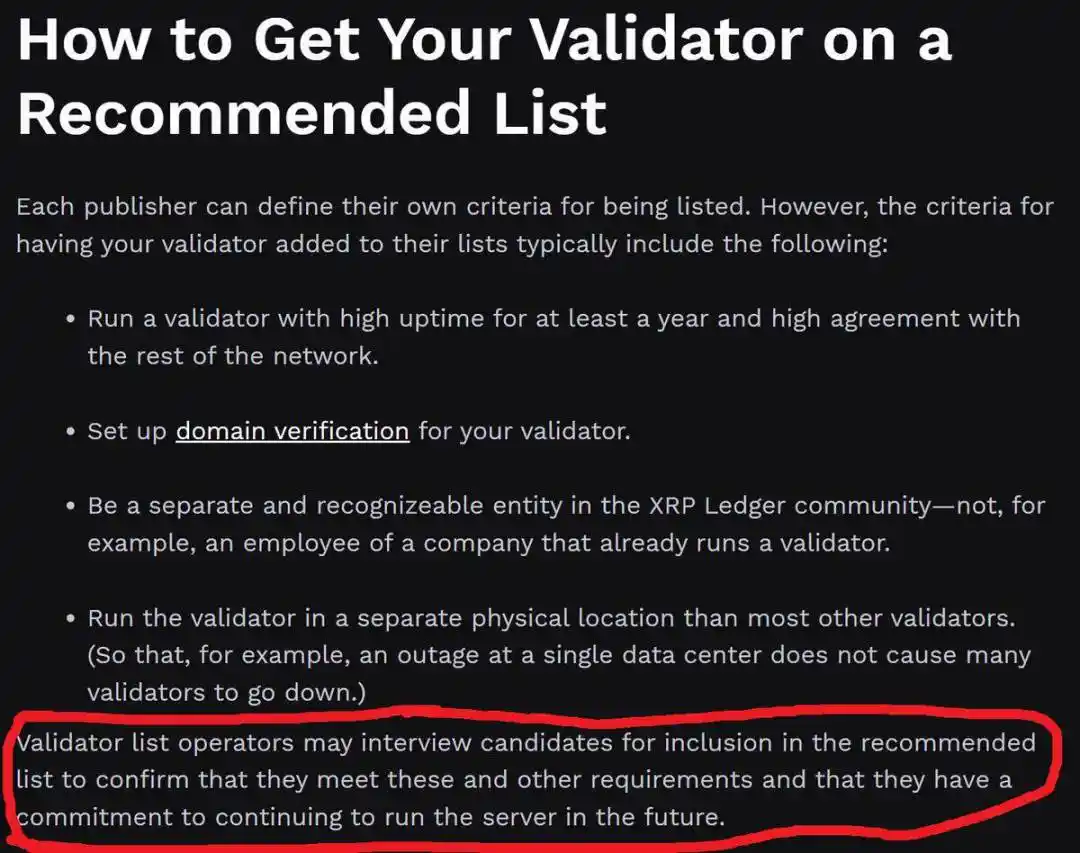
A PoA system always has a central authority to appoint validators. So, what about the fact that there are currently two "official" UNLs? This fact contradicts my assertion that different UNLs cannot coordinate. This is where things truly start to get crazy:
Upon careful inspection, I discovered that all UNLs are, in fact, identical, using the same set of validators, further proving that the foundation effectively controls the XRP network!
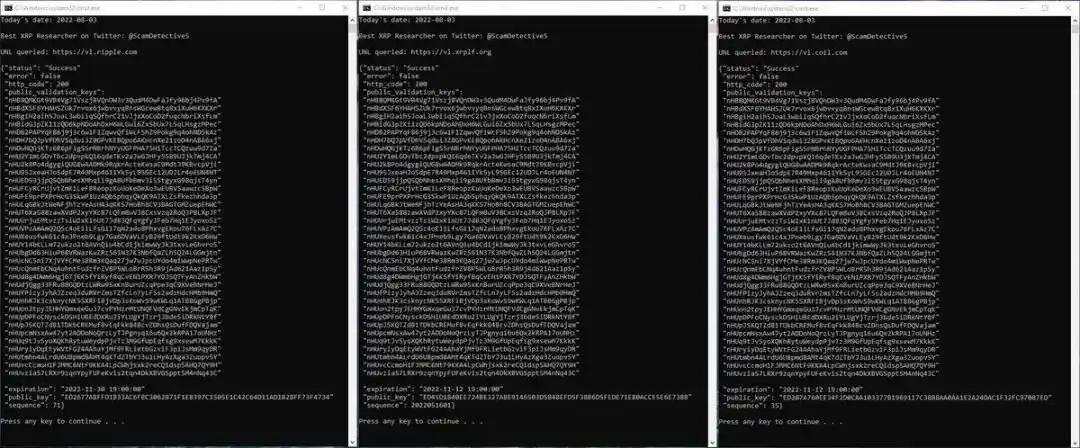
This screenshot is from 2 years ago, but I confirm the situation remains the same today, demonstrating that new UNLs cannot coordinate. Thus, the foundation's list becomes the de facto list since all UNLs must comply, or there is a risk of fork.
This also allows the foundation to conduct audits if compelled, given their high level of control. This operates drastically differently from cryptocurrencies and explains why halting the network only requires 20% of validators...
Running trusted validators also has no incentives. Unlike PoW or PoS, where the cost of attack reflects the block reward to miners/stakers, the decentralized standard heavily relies on block rewards. On XRP, this decentralization measure stands at zero.
I have been researching XRP since the early days, and I vividly remember when people recognized the trade-off of decentralization. As the community and leadership's stance became more extreme, this situation gradually changed. I say this not to disparage investors but to empower them.
Help break the XRP echo chamber and stop being someone else's liquidity out. XRP's pre-mining rate of 99.8% makes it one of the most unfairly distributed cryptocurrencies in history. As no new XRP was created, all newly circulating XRP was purchased from the founders.
I have always been intrigued by the early discussions about Ripple's decentralization, pretending that XRP is permissionless is not the right answer. The real solution is to use PoS to replace the UNL list, transforming XRP into a more traditionally decentralized blockchain.
They could also openly admit that facts are facts, and I will not dispute that. However, using lies to attract ignorant retail investors is wrong. This is where we as an industry need to draw the line and self-regulate!
XRP may currently be able to bribe or deceive the SEC, but they cannot deceive us, the cryptocurrency natives. Regardless of how complex and in-depth the rebuttals may be, it will not change some simple facts: XRP is now fully permissioned and centralized.
If you truly care about XRP, take it seriously. Because within this critical post exists a path that can help XRP succeed: owning up to its centralization or transitioning to decentralization. The truth sets us free, either walk away from XRP or exert pressure for change; nothing is irredeemable.
You may also like

From Wuhan to Silicon Valley, Manus did it in just nine months.
You may call it a “wrapper,” but it wrapped its way all the way to Meta.

How AI Helps Crypto Traders Analyze Markets, Manage Risk, and Trade Smarter
Crypto trading is no longer just about having a good idea—it is about executing consistently in a market that never stops. As data volumes and market speed increase, traditional manual analysis reaches its limits. AI helps traders move beyond these limits by transforming how markets are analyzed, how sentiment is interpreted, and how risk is controlled. This article explores how AI is reshaping crypto trading — and what that means for traders today.
WEEX × LALIGA: Seven Stars That Represent a Shared Standard of Excellence
True excellence in football is never accidental. It is built on discipline, consistency, and the ability to deliver under pressure — season after season. The same principles apply in professional trading, where long-term performance matters more than short-lived momentum. As an official regional partner of LALIGA, WEEX highlights seven outstanding players who embody the league’s competitive spirit and global appeal. Each brings a unique style to the pitch, yet all share values that closely align with WEEX’s commitment to stability, precision, and professional execution. This partnership is built on shared standards — where consistency and control define performance under pressure.

Arkstream Capital: When Cryptocurrency Returns to 'Financial Logic' by 2025

The Year Trump Embraced Cryptocurrency

IOSG: Port and New City, Two Cryptoverse Views of BNB Chain and Base
WEEX Partners with LALIGA to Expand Global Reach and Integrate Crypto into Mainstream Sports Culture
Hong Kong, Jan. 1, 2026. WEEX has entered into a new partnership with LALIGA, as an official regional partner of LALIGA in Taiwan and Hong Kong. The agreement brings WEEX into LALIGA’s network of regional collaborators and opens the door to new ways of engaging both fans and traders during the season.

Perpetual Contract Genesis: Pricing Liquidity with a Magic Formula, Transparency Prevents it from Reaching its Full Potential

Decode Stock on Chain: Why Are Crypto Enthusiasts Investing in US Stocks While Wall Street Is Going Blockchain Unfriendly?

Key Market Intelligence as of December 31st, how much did you miss out on?

Long-standing domestic public blockchain NEO sees feud between two co-founders, with opaque finances as the core reason

Hong Kong Virtual Asset Trading Platform New Regulations (Part 2): New Circular Issued, Has the Boundary of Virtual Asset Business Been Redefined?

DeFi 2.0 Explosion Post-Disorderly Restructuring in 2026
Fed's Latest Meeting Minutes: Divergence Persists, But "Most" Officials Advocate Continued Rate Cuts
AI Trading in Crypto: How Traders Actually Apply AI in Real Crypto Markets
Artificial intelligence has moved beyond experimentation in crypto markets. In 2025, AI-driven trading tools are increasingly used by traders who want better discipline, faster execution, and more structured decision-making in volatile markets. This guide explains how AI is actually used in crypto trading, step by step — with a focus on how these strategies are executed in real trading environments.
The first large-scale adoption of a "yield-bearing stablecoin" was in China

Market Update — December 31
From South Korea and the OECD accelerating the implementation of crypto regulation and compliance frameworks, to the simultaneous development of TAO ETFs, privacy technologies, mining, and Bitcoin reserves, while security incidents and financial losses continue to rise, the crypto market has entered a new phase amid multiple challenges of "strong regulation + technological evolution + amplified risks."

Lighter Token Distribution Sparks Controversy, Zama Launches USDT Private Transfers, What is the Overseas Crypto Community Talking About Today?
From Wuhan to Silicon Valley, Manus did it in just nine months.
You may call it a “wrapper,” but it wrapped its way all the way to Meta.
How AI Helps Crypto Traders Analyze Markets, Manage Risk, and Trade Smarter
Crypto trading is no longer just about having a good idea—it is about executing consistently in a market that never stops. As data volumes and market speed increase, traditional manual analysis reaches its limits. AI helps traders move beyond these limits by transforming how markets are analyzed, how sentiment is interpreted, and how risk is controlled. This article explores how AI is reshaping crypto trading — and what that means for traders today.
WEEX × LALIGA: Seven Stars That Represent a Shared Standard of Excellence
True excellence in football is never accidental. It is built on discipline, consistency, and the ability to deliver under pressure — season after season. The same principles apply in professional trading, where long-term performance matters more than short-lived momentum. As an official regional partner of LALIGA, WEEX highlights seven outstanding players who embody the league’s competitive spirit and global appeal. Each brings a unique style to the pitch, yet all share values that closely align with WEEX’s commitment to stability, precision, and professional execution. This partnership is built on shared standards — where consistency and control define performance under pressure.


 App
App