
- Buy Crypto
- Markets
- Futures
- Spot
- Copy Trade
 Earn
Earn- More
DeFi's Potential $8 Billion Dollar Thunderstorm, Only $1 Billion Unleashed So Far

Fund Manager, a once trusted yet now disillusioned figure in the stock market, carried the wealth dreams of countless retail investors during the heyday of A-shares.
At that time, everyone was chasing after fund managers who graduated from prestigious universities and had impressive resumes, believing that funds were a less risky and more professional option compared to direct stock trading.
However, when the market plummeted, investors realized that the so-called "professionalism" could not withstand systemic risk. What's even worse is that while fund managers took their management fees and performance bonuses, gains were attributed to their skills, but losses came from the investors' pockets.
Today, as the role of "Fund Manager" arrives on-chain under the new name "Curator," the situation has become even more dangerous. They don't need to pass any qualification exams, don't need to undergo scrutiny from any regulatory bodies, and don't even need to disclose their real identities.
All they need to do is create a "Vault" on a DeFi protocol, use outrageously high annual percentage yields as bait, and attract hundreds of millions of dollars in funds. Where this money goes, what it's used for, investors have no idea.
$93 Million Gone in Smoke
On November 3, 2025, when Stream Finance suddenly announced the suspension of all deposits and withdrawals, a storm engulfing the DeFi world reached its climax.
The next day, an official statement was released: an external fund manager was liquidated during the market's intense volatility on October 11, resulting in approximately $93 million in fund asset losses. Stream's native stablecoin xUSD plummeted in price, crashing from $1 to a low of $0.43 in just a few hours.
This storm was not without warning. 172 days earlier, Yearn's core developer Schlag had issued a warning to the Stream team. At the eye of the storm, he was blunt:
"Just one conversation with them and spending 5 minutes browsing through their Debank would make you realize this will end in a bad way."
Stream Finance is fundamentally a yield aggregation DeFi protocol that allows users to deposit funds into Vaults managed by so-called "external curators" to earn yields. The protocol claims to invest funds in various on-chain and off-chain strategies to earn returns.
This recent rug pull was caused by two main reasons: first, the Curator used user funds for opaque off-chain transactions and was liquidated on October 11; second, on-chain analysts further discovered that Stream Finance engaged in recursive borrowing with the Elixir protocol's deUSD, leveraging a small amount of real capital to multiply leverage several times. Although this "left foot stepping on the right foot to reach the sky" pattern was not a direct cause of the loss, it greatly amplified the protocol's systemic risk and set the stage for subsequent chain reactions.
These two issues combined led to a catastrophic chain reaction: $160 million of user funds were frozen, the entire ecosystem faced $285 million in systemic risk, the Euler protocol incurred $137 million in bad debt, and Elixir's deUSD, which is 65% backed by Stream assets, had $68 million teetering on the brink of collapse.
So, what is this "Curator" model that was easily spotted by seasoned developers yet still attracted over $8 billion in funds, and how did it gradually steer DeFi away from its transparent and trustworthy ideal to the systemic crisis we face today?
The Fatal Transformation of DeFi
To understand the root cause of this crisis, we must go back to the origins of DeFi.
Traditional DeFi protocols represented by Aave and Compound are based on the core principle of "Code is law." Every deposit and every loan must adhere to the rules hardcoded in smart contracts, open and transparent, and tamper-proof. Users deposit their funds into a large public pool, and borrowers need to provide overcollateralization to borrow funds.
The entire process is algorithm-driven, with no human managers intervening, and the risks are systemic and quantifiable, such as smart contract vulnerabilities or liquidation risks under extreme market conditions, but never the artificial risk of a "fund manager."
However, this cycle, the new generation of DeFi protocols represented by Morpho and Euler have implemented a new form of fund management in pursuit of yield. They believed that Aave's public pool model was inefficient, with a significant amount of funds idle and unable to maximize returns.
Therefore, they introduced the "Curator" (Professional Fund Manager). Users no longer deposit their money into a unified pool but choose individual "Vaults" managed by the Curator. Users deposit their funds into the Vaults, and the Curator is fully responsible for how to invest and yield on this money.
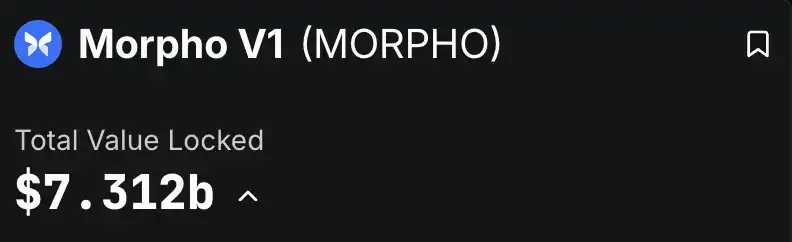
The speed of expansion of this model is astonishing. According to DeFiLlama data, as of now, the total value locked in just two major protocols, Morpho and Euler, has exceeded 8 billion USD, with Morpho V1 reaching 7.3 billion USD and Euler V2 reaching 1.1 billion USD. This means that more than 8 billion USD of actual assets are being entrusted to a large number of Curators with diverse backgrounds.
On the surface, this sounds great — professionals doing what they do best, and users effortlessly earning higher yields than Aave. However, peeling back the layer of this "on-chain finance" facade reveals a core very similar to that of P2P.
The primary risk in P2P lending used to be that as a lender, the average user could not assess the true creditworthiness and repayment ability of the borrower on the other end. Behind the platform's promise of high interest rates was an unpredictable default risk.
The Curator model perfectly replicates this point, where the protocol itself is merely a matching platform, and users' funds appear to be entrusted to professional Curators but are actually invested in a black box.
Take Morpho, for example. On their website, users can see various vaults established by different Curators, each vault boasting an enticing APY (Annual Percentage Yield) and a brief strategy description.
For example, the "Gauntlet" and "Steakhouse" shown in this image are the Curators of the corresponding vaults.
Users simply need to click on deposit to stake their assets, such as USDC, into these vaults. However, the issue arises here: apart from the vague strategy description and fluctuating historical APY, users often have no insight into the inner workings of these vaults.
The core information regarding vault risk is hidden in an inconspicuous "Risk" page. Even if a user ventures into that page, they can only see the specific holdings of the vault. Key information determining asset security, such as leverage and risk exposure, is nowhere to be found.
The manager of this vault has not even provided a risk disclosure.
Inexperienced users find it challenging to assess the safety of the underlying assets in the vault.
Morpho's CEO, Paul Frambot, once said, "Aave is the bank, and Morpho is the bank's infrastructure." However, the implication of this statement is that they only provide tools, and the actual "banking business," namely risk management and fund allocation, is outsourced to these Curators.
The so-called "decentralization" is limited to the moment of deposit and withdrawal, while the most important risk management stage in the asset lifecycle is completely in the hands of an unchecked "steward."
It is truly said: "Decentralization to send money, centralization to manage money."
The reason why traditional DeFi protocols are relatively safe is precisely because they minimize the "human" variable. However, the Curator mode of DeFi protocols brings back the biggest and most unpredictable risk - the "human" element - into the blockchain. When trust replaces code, when transparency becomes a black box, the cornerstone of DeFi security has already collapsed.
When the "Steward" Colludes with the Protocol
The Curator mode has only opened Pandora's Box, and the unspoken collusion of interests between the protocol and the Curator has completely unleashed the devil inside.
The Curator's profit model usually involves charging management fees and performance fees. This means they have a strong motivation to pursue high-risk, high-return strategies. Since the principal belongs to the users, they are not responsible for losses. But if they win the gamble, the majority of the profits go into their own pockets.
This "profit internalization, risk externalization" incentive mechanism is almost tailor-made for moral hazard. As criticized by Arthur, the founder of DeFiance Capital, under this model, the Curators' mentality is: "If I mess up, it's your money. If I do it right, it's my money."
More frighteningly, the protocol not only fails to play the role of a regulator but becomes an accomplice in this dangerous game. In order to attract Total Value Locked (TVL) in the fierce market competition, the protocol needs to use astonishingly high APYs (Annual Percentage Yields) to attract users. And these high APYs are created by those Curators implementing aggressive strategies.
Therefore, the protocol not only turns a blind eye to the Curators' risky behavior but may even actively collaborate with or encourage them to set up high-yield vaults as a marketing gimmick.
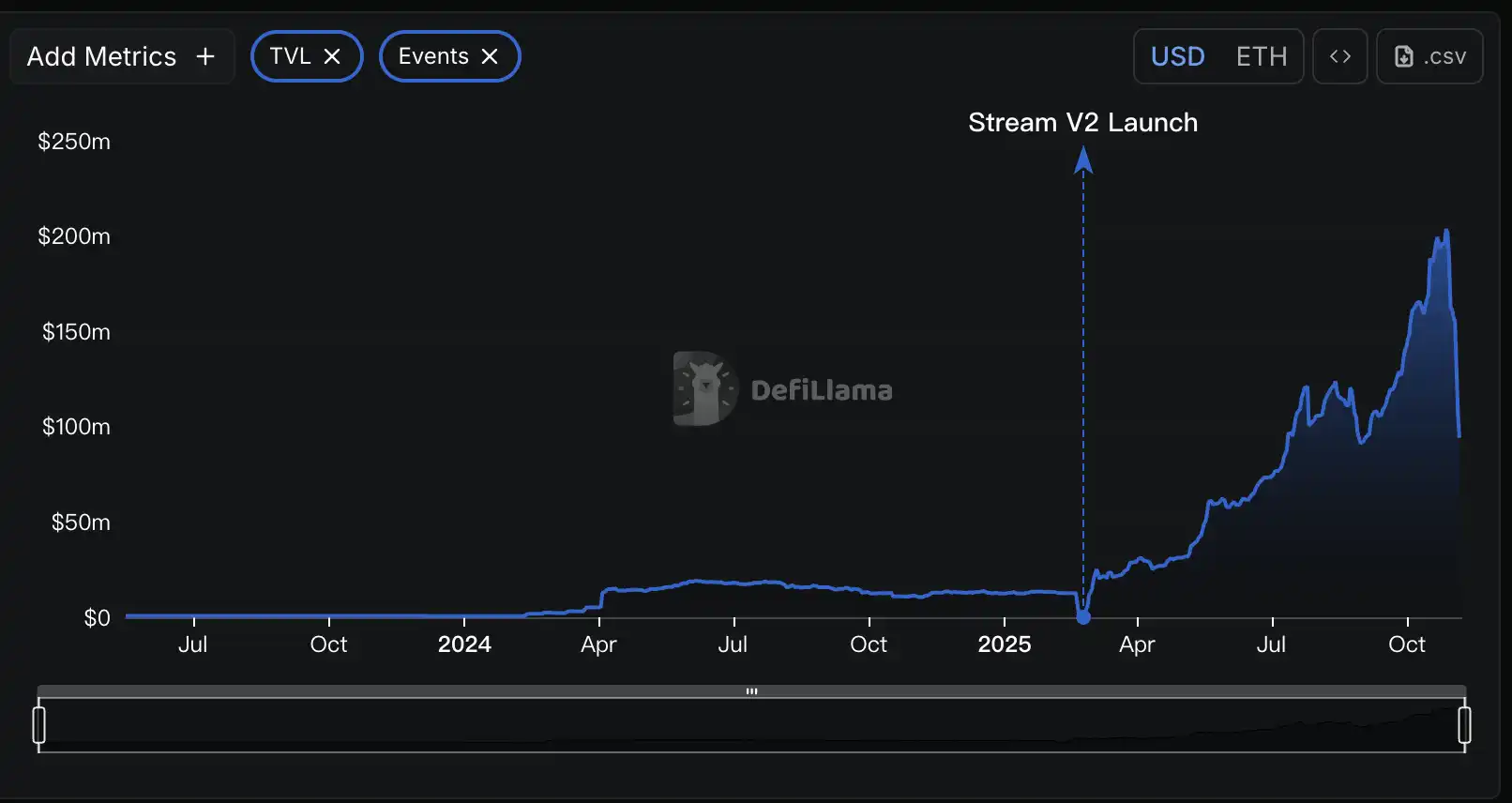
Stream Finance is a typical example of this opaque operation. According to on-chain data analysis, Stream claims to have a TVL of up to $500 million. However, according to DeFi Llama data, Stream's TVL peaked at only $200 million, meaning that over three-fifths of user funds have flowed into undisclosed off-chain strategies operated by some mysterious proprietary traders, completely deviating from the transparency that DeFi should have.
Another Curator Protocol RE7 Labs, in a statement released after the Stream incident, exposed this bundled interest, revealing the extent of this practice. They acknowledged that they had already identified the "centralized counterparty risk" through due diligence before launching Stream's stablecoin, xUSD. However, due to "significant user and network demand," they still decided to launch the asset and set up an independent lending pool for it. In other words, for traffic and popularity, they chose to dance with risk.
When the protocol itself becomes an advocate and beneficiary of high-risk strategies, the so-called risk review becomes a mere formality. Users no longer see genuine risk warnings but a carefully orchestrated marketing scam. They are led to believe that those double-digit or triple-digit APYs are DeFi's magic, unaware that behind this lies a trap leading to the abyss.
The Domino Effect's Collapse
On October 11, 2025, the cryptocurrency market experienced a bloodbath. In just 24 hours, the total amount liquidated across the network approached $20 billion, bringing a liquidity crisis and hidden risks that are now spreading throughout the entire DeFi ecosystem.
Analyses on Twitter widely believe that many DeFi protocols' Curators, in pursuit of profits, broadly adopted a high-risk play off-chain: "Selling Volatility."
The essence of this strategy is to bet on market stability. As long as the market remains calm, they can continue to make money through fees. However, once the market experiences significant fluctuations, they risk losing everything. The market crash on October 11 became the trigger that ignited this powder keg.
Stream Finance was the first significant domino to fall in this disaster. Its officials confirmed afterward that an external fund manager was liquidated during the market's significant fluctuation on October 11, resulting in approximately $93 million in fund asset losses. Although the officials did not disclose the specific strategy employed, market analysis commonly points to high-risk derivative trading.
However, this was only the beginning of the disaster. As Stream's xUSD, xBTC, and other tokens were widely used as collateral and assets in DeFi protocols, its collapse quickly triggered a chain reaction that affected the entire industry.
According to preliminary analysis by the DeFi research firm Yields and More, direct debt exposure related to Stream reached as high as $285 million, revealing a vast risk contagion network: the biggest victim being the Elixir protocol. As one of Stream's primary lenders, Elixir lent up to $68 million in USDC, which accounted for 65% of Elixir's stablecoin deUSD total reserve.
RE7 Labs, once a collaborator, has now become a victim. Its treasury, involved in multiple lending protocols, faces millions of dollars in default risk due to accepting xUSD and Elixir-related assets as collateral.
The broader contagion unfolds through a complex "rehypothecation" path, where Stream's token is collateralized across mainstream lending protocols such as Euler, Silo, Morpho, which are further nested within other protocols. A node's collapse swiftly propagates through the entire system via this spiderweb-like financial network.
The hidden thunderbolt planted by the October 11 liquidation event extends far beyond just Stream Finance. As warned by Yields and More: "This risk map is still incomplete, and we expect more affected liquidity pools and protocols to be discovered."
Another protocol, Stables Labs, and its stablecoin USDX have recently faced a similar situation, drawing community scrutiny.
Situations like those of Stream Finance expose a fatal flaw in CeDeFi model: when a protocol lacks transparency and power is overly concentrated in the hands of a few, users' fund safety entirely relies on the project's integrity, lacking effective technological and regulatory constraints.
You Are the Yield
From Aave's transparent on-chain bank to Stream Finance's asset management black box, DeFi has undergone a lethal evolution in just a few years.
When the ideal of "decentralization" is alienated into the frenzy of "deregulation," when the narrative of "professional management" obscures the opaque reality of fund operations, what we get, as Yearn developer Schlag puts it, is not better finance but a "worse banking system."
The most profound lesson of this crisis is that we must reexamine the core value of DeFi: transparency is far more critical than the decentralization label itself.
An opaque decentralized system is much riskier than a regulated centralized system because it lacks both the endorsement of centralized institutions and legal constraints and the open, verifiable checks and balances that a decentralized system should have.
Bitwise's Chief Investment Officer Matt Hougan once said to all investors in the crypto world, "There is simply no double-digit return without risk in the market."
For every investor lured by a high APY, before clicking the "Deposit" button next time, one should soul-search with a question:
Do you really understand where this yield is coming from? If you don't, then you are the yield.
You may also like

ETH Ecosystem Month: A $1.5 Million Trading Opportunity Focused on Ethereum Assets
Explore ETH trading opportunities on WEEX with ETH Ecosystem Month. A $1.5M campaign covering ETH spot trading, ETH futures rewards, leaderboards, and referral incentives across the Ethereum ecosystem.

Trade Finance: Unleashing Blockchain’s Most Potent Opportunity
Key Takeaways Blockchain technology has the potential to revolutionize the $9.7-trillion global trade finance market by addressing its…

New SEC Submissions Discuss Self-Custody and DeFi Regulation
Key Takeaways Recent submissions to the SEC tackle the regulation of self-custody rights and decentralized finance (DeFi) markets.…

Pendle Announces Token Upgrade as Its DeFi Yield Platform Scales
Key Takeaways Pendle has announced a significant upgrade to its native token, introducing sPENDLE to enhance liquidity and…

Pendle Announces Token Upgrade as Its DeFi Yield Platform Evolves
Key Takeaways Pendle introduces sPENDLE to enhance liquidity and diversify revenue. Boros platform enhances onchain rates trading, emphasizing…

AI News Today: Can AI Make Blockchain Systems More Reliable in Live Crypto Markets?
Learn how AI is used in blockchain systems to detect risks, improve reliability, and support secure crypto trading in live crypto market environments.

Analyzing the Impact of Cryptocurrency Regulations
Key Takeaways: Cryptocurrency regulations continue to evolve, impacting both global markets and individual investors. Rules and guidelines vary…

ETHGas Airdrop Eligibility Scrubbing, WLFI Proposal Sparks Controversy, What's Today's Overseas Crypto Community Buzzing About?

Tokenomics' Year of Reckoning

2026 Airdrop Interoperability Guide: Navigating 182 Projects Across Eight Key Tracks
Discover comprehensive interaction strategies for 182 projects across eight tracks to capitalize on 2026 airdrop opportunities. Understand the…

The CLARITY Act Stalling is a Boon for the Crypto Industry
Key Takeaways The delay in passing the CLARITY Act is seen as beneficial for the crypto market. Coinbase’s…

Paradex Rollback Roasted, HIP-3 Competition Heats Up, What’s New in the Mainstream Ecosystem?
Key Takeaways The NYSE’s move towards an on-chain securities trading platform signals a transformative intersection of blockchain and…

Key Market Insights for January 20th: What You Need to Know
Key Takeaways The newly open-sourced X Algorithm from Musk promises ongoing improvements, enhancing efficiency and functionality. ‘Distinguished Wall…

Why Can Coinbase Halt a CLARITY Act Vote with Just One Sentence?
Key Takeaways Coinbase CEO Brian Armstrong’s opposition to the Clarity Act halted a critical Senate vote, showcasing the…
ETHGas Foundation Coin Issuance, Believe Emotional Transaction Mechanism “Train Wreck”, What Key Points are Overseas Watching?
Key Takeaways Zama is preparing for a token sale using a Dutch auction on CoinList, drawing polarized reactions…

US Crypto Market Structure Bill Stalled as Industry Withdraws Support
Key Takeaways: The US crypto market structure bill has faced significant delays due to disagreements among lawmakers and…

WLFI Faces Backlash After ‘Team Wallets’ Push Through USD1 Growth Proposal
Key Takeaways World Liberty Financial (WLFI) is under scrutiny after nine dominant wallets exerted significant control over a…

DeFi Protocol Pendle Revamps Governance Token Amid Low Adoption
Key Takeaways Pendle plans to replace its governance token vePENDLE with the new sPENDLE to enhance flexibility and…
ETH Ecosystem Month: A $1.5 Million Trading Opportunity Focused on Ethereum Assets
Explore ETH trading opportunities on WEEX with ETH Ecosystem Month. A $1.5M campaign covering ETH spot trading, ETH futures rewards, leaderboards, and referral incentives across the Ethereum ecosystem.
Trade Finance: Unleashing Blockchain’s Most Potent Opportunity
Key Takeaways Blockchain technology has the potential to revolutionize the $9.7-trillion global trade finance market by addressing its…
New SEC Submissions Discuss Self-Custody and DeFi Regulation
Key Takeaways Recent submissions to the SEC tackle the regulation of self-custody rights and decentralized finance (DeFi) markets.…
Pendle Announces Token Upgrade as Its DeFi Yield Platform Scales
Key Takeaways Pendle has announced a significant upgrade to its native token, introducing sPENDLE to enhance liquidity and…
Pendle Announces Token Upgrade as Its DeFi Yield Platform Evolves
Key Takeaways Pendle introduces sPENDLE to enhance liquidity and diversify revenue. Boros platform enhances onchain rates trading, emphasizing…
AI News Today: Can AI Make Blockchain Systems More Reliable in Live Crypto Markets?
Learn how AI is used in blockchain systems to detect risks, improve reliability, and support secure crypto trading in live crypto market environments.


 App
App