
- Buy Crypto
- Markets
- Futures
- Spot
- Copy Trade
 WE-Launch
DiDi in Latin America is already a digital banking giant

On the other side of the world, Didi has long ceased to be just a commission-earning ride-hailing company and has become a digital banking giant. The financial business that was once seen as a ride-hailing accessory now has over 25 million users in Latin America.
Shifting our focus to China, Didi's presence is clear and entrenched. Despite having hundreds of millions of monthly active users, in the more fertile landscape of finance, faced with the stronghold built by WeChat Pay and Alipay, Didi has always been an awkward outsider, only able to guard its own turf of transportation.
However, on the bustling streets of Mexico City, in the congested traffic of São Paulo, tens of thousands of people who have never set foot in a bank hold their first Mastercard, proudly displaying Didi's logo.
Here, it is not just a driver taking people home but also a true master of the underlying fund flows, a provider of financial services crucial to the survival of countless ordinary Latin Americans.
Looking back at Didi's rise in Latin America, this is not just a geographical expansion but more like a "reverse evolution" forced by the environment.
In China, where the roads were already paved by others, Didi only needed to be a driver. But in Latin America, facing a vast wilderness, it was forced to learn to build roads and bridges. This ability to build infrastructure was once the forte of Chinese internet companies in the early years but has gradually been forgotten due to the overly developed domestic infrastructure.
Ambitions Strangled by "Perfection"
Didi's defeat in the Chinese financial battlefield was not because it did anything wrong but because it was born in an overly mature era where the market's infrastructure had been built to perfection. Sometimes, perfection can also be a curse.
In the grand narrative of China's internet business history, 2016 was a watershed year. With the strategic advances of WeChat Pay and Alipay, the mobile payment war in China had effectively ended. The duopoly held over 90% of the market share, turning mobile payments into a nationally accessible infrastructure like water, electricity, and gas.
For consumers, this was ultimate convenience. But for latecomers like Didi, it became an invisible barrier.
In the following years, although Didi went to great lengths to obtain 8 financial licenses, including for payment, online lending, and consumer finance, in an effort to build its own ecosystem. When the duopoly had become the underlying operating system of the business world, other payment tools were destined to be merely functional plugins attached to this system.
At a deeper level, the paradox lies in the fact that traffic has never naturally equated to "retained traffic."
Despite Didi's massive passenger volume, the transportation scenario has a fatal genetic flaw—short stays with no retention. In an extreme payment environment built by a duopoly, funds are debited from the user's bank account, enter the driver's account, and are then quickly withdrawn.
In this process, Didi is merely an efficient pipeline, not a fund reservoir. Compared to the fund retention from Alibaba's e-commerce transactions and the fund circulation from Tencent's social red envelopes, Didi's traffic is "use and go."
This sense of suffocation ultimately reached its peak amid the drastic change in the regulatory environment.
The delisting storm of the summer of 2021, along with the subsequent colossal $8 billion fine, like heavy caesuras, completely ended Didi's domestic financial ambitions. Under such high-pressure circumstances, Didi not only missed the expansion window but also lost strategic maneuvering space. It could only shrink and cautiously survive.
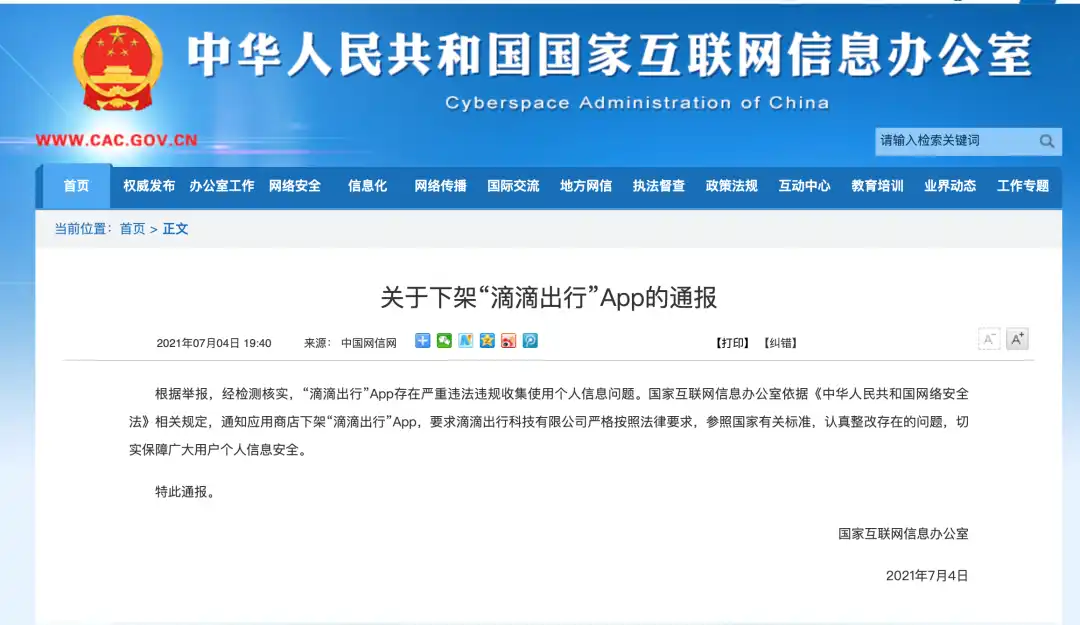
Official delisting notice of Didi
Thus, Didi's financial story in China seems to have come to an end.
It is trapped in a "perfect" walled city. The road is too smooth; it doesn't need to be repaired. The bridge is too stable; it doesn't need to be built.
This seems like an unsolvable stalemate. But on the other side of the Pacific Ocean, a completely opposite business script is unfolding. In that deserted land, not only has it not become an obstacle, but it has become Didi's biggest dividend.
Rebuilding Trust in the Cash Continent
When Didi's vanguard first set foot on the Latin American continent, what they saw was not an undeveloped blue ocean but a massive social divide.
According to World Bank statistics, in Latin America, about half of adults do not have a bank account. In Mexico, with a population of 130 million, this means that over 66 million ordinary people are locked out of the modern financial system.
This is a suffocating "financial vacuum." In this vacuum, cash is the only faith.
In Mexico, nearly 90% of retail transactions are still conducted in cash. For Chinese internet companies accustomed to a cashless society, this "cash worship" is nothing short of a nightmare. In China, funds flow in the cloud, sleek and efficient; but in Latin America, because the vast majority of passengers do not have a bank account, they can only pull out crumpled, even sweat-stained bills to pay for their ride.
This directly led to the collapse of efficiency. Drivers were paid with a bag of loose change, but the DiDi platform couldn't take a cut from it. Many drivers were banned due to outstanding fees, causing the system to almost come to a standstill.
But more terrifying than efficiency was the out-of-control security.
In the complex security environment of Latin American streets, drivers carrying a large amount of cash became mobile "ATMs." Robberies were rampant, and every payment collection stop could be a life-or-death gamble.
Here, we must introduce a crucial reference point: Uber.
As the originator of ride-hailing, Uber entered Latin America earlier than DiDi. However, faced with the same cash issue, Uber's choice reflected a fundamental difference in strategic DNA between East and West internet giants.
Uber represents the typical "Silicon Valley-style cleanliness," with specialized division of labor. In the mature American market, finance belongs to Wall Street, and Uber simply focused on connecting. This mindset led them to arrogantly persist in only doing what they were good at when facing the challenges of Latin America.
The cost was severe. In 2016, Uber in Brazil suffered a literal "bloody lesson." After being forced to accept cash payments, the number of driver robberies skyrocketed tenfold in just one month. According to Reuters, at least 6 drivers lost their lives as a result.
Faced with such a sharp increase in the risk of death, Silicon Valley's typical choice is often to retreat and wait for the environment to mature slowly.
Meanwhile, DiDi represents the super app mindset of China and even Asia: omnipotent substitution.
Companies that grew up in the fierce commercial alleys of China deeply understand a truth: if society lacks roads, you have to build roads; if society lacks credit, you have to establish credit.
Therefore, DiDi chose a heavier, more down-to-earth, but also more effective path. It decided to transform the environment.
DiDi set its sights on the ubiquitous red and yellow signs found on the streets of Mexico—the OXXO convenience store.

Mexican National Convenience Store
This retail giant, with 24,000 stores, processes nearly half of Mexico's cash transactions and serves as the de facto "national cash register." DiDi astutely identified this connection point and made a decision rooted in a highly pragmatic Chinese approach: turning the convenience store into its own human ATM.
An unnoticed financial experiment has begun.
As a driver finishes a long day, pockets full of cash, there is a change. No longer does he need to carry the money home with worry. Instead, he parks his car at the OXXO convenience store, shows the cashier a barcode in the DiDi App, and hands over the cash. With the crisp sound of the barcode scanner, the physical world's paper money instantly transforms into a digital balance in the DiDi Pay account.
This sound carries extraordinary significance.
It's not just a top-up; it's the transfer of offline cash to online. Through leveraging the ubiquitous convenience store network, DiDi has cost-effectively established a fund transfer system independent of traditional banks.
Once the funds enter DiDi Pay, DiDi is no longer just a ride-hailing platform; it has become the driver's "shadow bank."
Subsequently, DiDi rapidly built application scenarios on this account. In Brazil, DiDi's 99Pay deeply integrated the local instant payment system PIX, allowing tens of millions of underserved people to experience real-time financial dignity for the first time.
This approach has built a blood-based moat: security.
In China, mobile payments are for "speed"; but in the complex security environment of Latin America, mobile payments are for "life."
Every attempt to go cashless signifies one less opportunity for a driver to be robbed at gunpoint. When a driver realizes that using DiDi Pay can protect him from fear, his loyalty to this platform will surpass all commercial subsidies.
At this point, DiDi has finally paved its first highway in Latin America. It's not addressing luxury needs but the continent's most pressing desire—to make money flow and transactions secure.
When Footprints Transform into Credit
After the road was paved, DiDi suddenly discovered it was stepping on an untapped gold mine. This gold mine's name is data.
However, the data here does not refer to traditional financial transactions. In Mexico or Brazil, most drivers and passengers are blank slates in the records of traditional financial institutions. Banks cannot see them, don't know if they have repayment capability, and naturally refuse to lend them money.
Banks are blind, but DiDi can see.
Through the app, DiDi possesses an almost omniscient "God's-eye view." It clearly knows when a driver starts his day, how many kilometers he drives, and whether he's diligent; it also knows where a passenger lives, works, and their spending frequency.
These seemingly trivial travel footprints have been recoded by DiDi's risk control model, transformed into a new credit category—“Behavioral Credit.”
This is a more personalized evaluation than bank statements. A driver who sets off every morning at 6 on the dot, rain or shine, even if, for various reasons, they have no bank deposits, is still considered a highly creditworthy customer in DiDi's algorithmic logic. Diligence is, for the first time, priced as credit here.
Based on this endogenous credit creation, DiDi naturally launched a lending product called “DiDi Préstamos.” For millions of Latin American users, this may be the first time in their lives they have obtained formal financial credit. Data shows that about 70% of DiDi's credit users had never borrowed a cent before this.

Local advertisement for DiDi Préstamos
This is not just a business breakthrough but also a sociologically meaningful experiment.
In Latin America, a vast population engaged in the “gray economy” has long been in an invisible state due to the lack of credit records. Inadvertently, DiDi has accomplished what governments have been unable to do for decades—a “digital empowerment.” A street vendor selling tacos or a driver of a used car, by joining DiDi's ecosystem, has, for the first time, a documented economic identity, stepping from the underground into the sunlight.
The ability to “normalize informal economies” is the foundation where DiDi has deepest roots in Latin America.
The moat brought about by this evolution is astonishing, sparking a “gene” war even in Latin America.
The digital financial battlefield in Latin America has long been fiercely contested, with digital banking giants like Nubank and e-commerce dominators like Mercado Libre. However, DiDi possesses a leveling advantage that none of them have: an exceedingly high-frequency life scenario.
Nubank's gene is banking, which is low frequency; Mercado Libre's gene is e-commerce, which is mid-frequency. Whereas, DiDi's gene is travel, a high frequency.
You might shop online only once a month, visit a bank only a few times a year, but you leave the house every day. In terms of cultivating payment habits, “travel” is the highest-dimensional battlefield. Through high-frequency travel and food delivery scenes (DiDi Food), DiDi has successfully penetrated the low-frequency financial service barrier.
With traffic, there must also be "retention."
In order to completely intercept the funds circulating rapidly on the platform, DiDi rolled out its ultimate weapon: leveraging Latin America's high-interest environment to wage an interest rate war.
It introduced the "DiDi Cuenta" savings product with an annualized interest rate of up to 15%. This is a number that sounds almost crazy in China and might even be suspected of being a Ponzi scheme. However, in Mexico where the benchmark interest rate has stayed in the double digits for years, this is simply a routine battle among major digital banks to attract deposits.
DiDi was just adapting to the local customs, but in doing so, it achieved a crucial turning point. It finally shed the awkward role of being a mere pass-through deity of wealth and truly transformed into a financial reservoir capable of wealth accumulation.
Industry Synergy
Once the credit system and funding pool were established, DiDi's ambition was no longer limited to finance alone.
It began playing a role with greater strategic significance: the "Trojan Horse" of China's industrial expansion overseas. It aimed to use finance as a key to unlock the door to heavy asset consumption in Latin America.
The first wave was the overseas expansion of consumer goods.
In 2025, AliExpress, a subsidiary of Alibaba, partnered with DiDi in Mexico to launch a "buy now, pay later" service. The impact was immediate. During the promotion period, AliExpress's order volume surged by 300%, and the sales of some Chinese merchants even increased by 18 times.
For young Mexicans without credit cards, DiDi's credit payment became a bridge connecting them to "Made in China."
But this was just the prelude. A more profound layout occurred in the overseas map of China's high-end manufacturing, especially in new energy vehicles.
Today, Latin America has become a new battleground for Chinese automakers such as BYD, Chery, and Great Wall. However, the biggest obstacle they face is not product competitiveness, but the lack of financial tools. Local drivers want to buy electric vehicles to save on fuel costs, but due to the failure of risk control models, traditional banks in Latin America not only have extremely slow approval processes but often outright reject loan applications.
At this point, DiDi became the crucial connector.
With millions of drivers in need of vehicle upgrades in one hand and precise risk control data and credit funds in the other, DiDi connected Chinese automakers eager to penetrate the market. It not only issued credit cards to drivers but also directly played the role of an automotive financial service provider.
Through DiDi's financial solution, drivers could purchase Chinese-manufactured electric vehicles in installments, using the income from ride-hailing to repay the loans.
This is a highly profound industry collaboration. DiDi is becoming the infrastructure for high-end Chinese manufacturing landing in Latin America. It has not only paved the way for finance but also for energy transition.
At this point, a complete closed-loop has finally emerged.
In Latin America, DiDi has transformed itself into a super interface that connects online and offline, and links Chinese manufacturing with Latin American consumption.
The "super app" dream that it failed to realize in China due to a mature environment has miraculously become a reality in the wilderness on the other side of the earth in the most primitive yet hardest way.
Builder's Instinct
With 11.62 billion orders in a single quarter, a 35% revenue growth rate, and nearly 300 billion in transaction volume, DiDi, with this weighty financial report, has set a new milestone for China's internet companies going global.
This performance not only signifies commercial success but also represents a correction to the logic of the "China model going global."
In the past, we often believed that by leveraging the technology and efficiency gap, China's mature internet model could be directly transplanted to emerging markets. However, DiDi's practice in Latin America proves that simple replication is a dead-end. You cannot just take advanced machines there; you also have to redo all the dirty work that was done when those machines were built.
The most crucial thing DiDi did right in Latin America was to completely abandon the arrogance of a tech company. It crouched down, went back to ten years ago, and did all over again the QR code promotion and cash promotions that Alipay and WeChat Pay had once done when building a machine in a foreign land.
In the past, we used to think that the advantage of the China model lay in algorithms and efficiency. However, DiDi's story illustrates that the most terrifying ability of Chinese companies is the instinct to create something out of nothing in a scarce environment.
In China, this instinct has been suppressed due to overly perfect infrastructure. DiDi was trapped between WeChat and Alipay, only able to act as an efficient dispatcher. But in Latin America, when it was thrown into a wilderness, this repressed gene underwent an astonishing eruption. It did not consider itself a lofty tech company but rather lived as the most humble "infrastructure construction foreman."
This also foreshadows a certain fate and opportunity for Chinese companies going global; attempting to directly transplant the domestic "perfect model" is not feasible, and we can only earn respect by exporting the "ability to alleviate pain." In those emerging markets that are as noisy, chaotic, and full of aspiration as China was ten years ago, lies the biggest surprise of the second half of China's internet.
You may also like

The State of Cryptocurrency Valuations in 2025
Key Takeaways In 2025, 85% of new tokens saw their valuations fall below their initial issuance value. The…

Trump’s World Liberty Financial Token Ends 2025 Down Over 40%
Key Takeaways World Liberty Financial, a Trump family crypto project, faces substantial losses in 2025. The project initially…

Former SEC Counsel Explains What It Takes to Achieve Compliance in RWA Tokenization
Key Takeaways Shifts in the SEC’s regulatory approach to cryptocurrency are aiding the growth of compliance in Real-World…

Bank of Japan Statement in Full: 25 Basis Point Rate Hike, Further Adjustments Under Consideration

Exploring the Current State and Future Prospects of Cryptocurrency
Key Takeaways The cryptocurrency market continually evolves, characterized by significant volatility and potential for substantial gains and losses.…

The US Supreme Court's Tariff Ruling is Imminent, With Trump Issuing Frequent Warnings, Could He Be on the Verge of Losing?

The Original Article was too Short or Empty
Key Takeaways The article emphasizes the critical role of complete data in writing comprehensive content. Accurate extraction techniques…
Title: Understanding the Dynamics of the Cryptocurrency Market
Key Takeaways: A comprehensive exploration of cryptocurrency market trends, giving insights into current dynamics and future possibilities. Illustration…

World Liberty Financial Price Prediction – WLFI Price Set to Decline to $ 0.100540 By Dec 20, 2025
Key Takeaways World Liberty Financial (WLFI) is projected to see a decrease in its price by -23.23% over…

U.S. Bank Industry Embraces Blockchain Transition
Key Takeaways The U.S. banking sector is transitioning towards blockchain technology as regulatory discussions turn into implementation. The…

Fed Chair Candidate Upsets Expectations, Powell Surges Ahead: Will "Rate Cuts + Balance Sheet Reduction" Become the New Main Theme?
How Prediction Markets Raise Insider Trading and Credit Risks
Key Takeaways: Prediction markets are becoming significant financial players, turning opinions into tradable assets but raising concerns about…
No One’s Having Fun in the Casino Economy, America’s Youth Is Losing Confidence in the Future

BeatSwap's BTX Listed on Multiple Exchanges such as Binance, Gate, MEXC

Matrixdock Boards SBMA's *Crucible*, Tokenized Gold Transparency Mechanism Enters Precious Metals Industry Discourse Perspective

World Liberty Financial Expected to Decline to $0.114447 by December 14, 2025
Key Takeaways: World Liberty Financial (WLFI) has seen a recent uptick, with the coin’s price currently 36.85% above…
World Liberty Financial Expected to Drop to $0.114447 by December 14, 2025
Key Takeaways World Liberty Financial (WLFI) is predicted to experience a 23.09% decrease in price, dropping to $0.114447…
World Liberty Financial Forecast: A Closer Look at WLFI’s Market Dynamics by December 2025
Key Takeaways World Liberty Financial (WLFI) is predicted to decrease by 23.09% to a price of $0.114447 by…
The State of Cryptocurrency Valuations in 2025
Key Takeaways In 2025, 85% of new tokens saw their valuations fall below their initial issuance value. The…
Trump’s World Liberty Financial Token Ends 2025 Down Over 40%
Key Takeaways World Liberty Financial, a Trump family crypto project, faces substantial losses in 2025. The project initially…
Former SEC Counsel Explains What It Takes to Achieve Compliance in RWA Tokenization
Key Takeaways Shifts in the SEC’s regulatory approach to cryptocurrency are aiding the growth of compliance in Real-World…
Bank of Japan Statement in Full: 25 Basis Point Rate Hike, Further Adjustments Under Consideration
Exploring the Current State and Future Prospects of Cryptocurrency
Key Takeaways The cryptocurrency market continually evolves, characterized by significant volatility and potential for substantial gains and losses.…
The US Supreme Court's Tariff Ruling is Imminent, With Trump Issuing Frequent Warnings, Could He Be on the Verge of Losing?
Popular coins
Latest Crypto News


Customer Support:@weikecs
Business Cooperation:@weikecs
Quant Trading & MM:bd@weex.com
VIP Services:support@weex.com
 App
App