
- Buy Crypto
- Markets
- Futures
- Spot
- Copy Trade
 WE-Launch
Disclaimer: Why Lighter is Severely Underestimated

Original Title: The Case of Lighter
Original Author: Playrisk
Original Translation: SpecialistXBT, BlockBeats
TL;DR
Compared to other Perp Dexs, Lighter's valuation is a steal, not to mention when compared to multiples during the peak of a bull market.
Currently, most of the circulating chips are priced by early users of Hyperliquid. These people got rich by holding Perp Dex's tokens, and even for risk hedging, they would buy Lighter. 99% of VCs have missed out on $HYPE and are in urgent need of the next target.
Narrative occupies the majority of the token's valuation, and Lighter's signal is already very clear.
Today's token price is supported solely by "programmatic" spot buying (such as automatic buybacks). Unless the spot buying is strong enough, the token is unlikely to rise in value (refer to the lessons of ETHFI, GRASS). Currently, only the Perp Dex track has truly implemented this logic.
Lighter's Vlad has a close relationship with Robinhood's Vlad, and Robinhood is likely to direct orders to Lighter in the future.
The 0 fee rate business model is highly favored by users.
Whales all need privacy; no one wants their liquidation price to be watched by the whole network.
Valuation Analysis
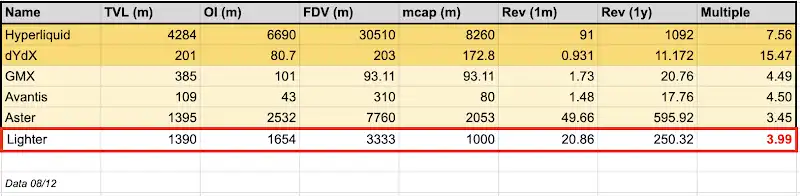
From the current OTC market perspective, Lighter's Fully Diluted Valuation (FDV) is around 3.3 billion USD. Assuming an airdrop ratio of 30%, its initial circulating market cap is approximately 750 million USD. For comparison, Hyperliquid's circulating market cap is as high as 8.2 billion USD.
Looking at revenue alone (Note: Lighter's revenue has not been market-validated for a year like Hyperliquid), by simply annualizing based on the revenue of the past month, Lighter's annualized revenue could reach 250 million USD. This means that Lighter's Price-to-Sales ratio (market cap/revenue) multiple is only 2.5 times, far lower than Hyperliquid's 7.6 times, ridiculously cheap.
Take a closer look at a closer competitor, Aster. Aster's TVL is comparable to Lighter's, with an Open Interest (OI) of about one billion more than Lighter's. However, its FDV reaches up to 7 billion, with a circulating market cap of around 2 billion. In contrast, Lighter's trading price is only one-third of Aster's.
Ask yourself: Even considering Aster's Binance/CZ halo, is Lighter's price at only one-third of Aster's reasonable? In my opinion, based on the current valuation, Lighter is severely undervalued fundamentally.
Looking at the fundamentals, you will find that only two tokens can sustain a high revenue multiple in the long run: Hyperliquid and DYDX. Why? The former has the most transparent buyback mechanism, while the latter has stood the test of time in this industry. Unlike other listed Perp Dexes, Lighter does not have a top-tier influencer like CZ or liquidity support from Coinbase to artificially pump, nor does it face the dilemma of "lack of real users" like other competitors.
Additionally, it is important to note that the over-the-counter market (SOTC) usually carries a discount because buyers bear default risks (if the opening price is twice as high as the OTC transaction price, sellers have an incentive to default), which causes people not to offer high prices in OTC but to wait and see the actual listing performance.
I choose to annualize based on the revenue of the last month for a reason: in the crypto world, everyone only has a 7-second memory, and no one has the ability to see clearly or trade for the future a year later. Therefore, only the immediate revenue of the last month is the most important indicator.
Funds Flow
The reason why Hyperliquid was able to break out on an independent trend is that many early LPs did not believe in its model. This led to those sharp-sighted retail investors sweeping all the chips and then selling to the belated buyers at a high price.
In conversations with a large number of VCs over the past few months, I have noticed a phenomenon: except for Paradigm, almost everyone missed out on Hyperliquid. This means that every VC with a liquidity fund (the vast majority of them do) will try to catch the next $HYPE.
Who is the next Hyperliquid? It's quite simple; just do a "pattern matching" between Lighter's storyline and Hyperliquid, and you'll find it's Lighter.
Looking at the token distribution, you will find: the large holders of Hyperliquid have also become the large holders and deep users of Lighter. The secret to wealth for this group of people is simple: Hold
errorToken Buyback
Passive spot buying is the only thing that can support the coin price. BTC has MicroStrategy's Saylor, ETH has Tom Lee, but for altcoins, the market only recognizes income buybacks. If you want to keep the price firm, you need passive buying in the form of buybacks. Hyperliquid understands this well.
Lighter is essentially a replica of Hyperliquid. Founder Vlad has made it clear that they will conduct buybacks. While you can't expect them to buy back 97% of the tokens, buying back 30% or 50% is reasonable. As long as there is an eight-figure (tens of millions) passive buy, this is attractive enough.
Note: In their $68 million financing (mainly for the insurance fund), the team has allocated some funds for token buybacks at TGE. This is similar to the early Hyperliquid's $75 million spot buy.
Deep Integration with Robinhood
Vlad Tenev (Robinhood's Vlad1) previously interned at Addepar for Vlad (Vlad2) from Lighter, and that's how they met. Robinhood is an investor in Lighter, and Vlad1 is also an advisor to Lighter.
There have been numerous rumors in the industry about using Lighter on Robinhood's chain. Lighter's goal is composability and will be integrated into Ethereum L1, ultimately achieving collateralized LLP token lending. This composability aligns with Robinhood's vision of "tokenizing everything" and putting everything on-chain.
While this is speculation, I support the argument that Robinhood will acquire a significant stake in Lighter (whether through tokens or equity). Given the similarity of their Payment for Order Flow (PFOF) models, I speculate that once Robinhood holds Lighter shares, it will redirect a significant portion of its traffic to Lighter. This will further strengthen this narrative.
RWA Trading
Although not limited to Lighter, RWA contract trading has proven to be a key early product-market fit. Data shows that Lighter's daily trading volume for all RWA products is $517 million, with an open interest (OI) of $271 million. Compared to Hyperliquid, Lighter is quickly catching up and even surpassing.
One key distinction is that Lighter's RWA service is not provided by a third party in the ecosystem, but rather self-operated. This makes coordination and onboarding of new assets smoother and faster. Additionally, Lighter's majority of trading volume comes from its FX contract, while Hyperliquid is mainly index contracts (80%). Ultimately, this will evolve into a pure competition of liquidity and order book depth to vie for users.
Hyperliquid's First True Competitor
The derivative market is growing rapidly, and despite a loyal fan base on Twitter shouting "Hyperliquid is the only one," the market is large enough to accommodate multiple top players. Robinhood has also opened up futures trading, as futures have a strong foothold in the crypto space and are indeed a superior trading method compared to options.
Solving the full collateral issue is the most critical challenge that Hyperliquid has outsourced to Flood and Fullstack Trade. To my knowledge, Flood is at least 6 months away from solving this problem. Lighter's larger team is more likely to tackle this challenge. Yes, Hyperliquid has a first-mover advantage, but if Lighter can swiftly integrate this feature, they may well take a slice of their cake.
Privacy
While Hyperliquid has built a cult-like community culture, its architecture has a fatal flaw for whales: complete transparency.
On Hyperliquid, leaderboards and on-chain data broadcast every large position, entry price, and liquidation point to the world. This turns trading into a PvP arena where predatory players like me can specifically hunt whales' liquidation orders and front-run large funds. Leveraging liquidation data to predict short-term tops and bottoms is traceable, and I know many traders continue to profit through this strategy.
Lighter positions itself as the antidote to this risk. By obfuscating trading flows and shielding position data, its operation is more akin to an on-chain dark pool rather than a standard DEX. For "smart money" and large funds, anonymity is not just a feature—it is a necessity. If you have a significant amount of funds, you absolutely cannot trade in a place that directly exposes your hand and liquidation point to the counterparty. As DeFi matures, venues that can protect user alpha will inevitably attract the largest flows of funds.
You may also like

Former SEC Counsel Explains What It Takes to Make RWAs Compliant
Key Takeaways The SEC’s shifting approach is aiding the growth of Real-World Assets (RWAs), but jurisdictional and yield…

Extended Crypto ETF Outflows Indicate Institutional Pullback: Glassnode
Key Takeaways: Recent outflows from Bitcoin and Ether ETFs suggest a withdrawal of institutional interest. Institutional disengagement has…

December 24th Market Key Intelligence, How Much Did You Miss?

Aave Community Governance Drama Escalates, What's the Overseas Crypto Community Talking About Today?

Where Did $362 Million Go? Hyperliquid Counters FUD in Decentralization Showdown

2025 Whale Saga: Mansion Kidnapping, Supply Chain Poisoning, and Billions Liquidated

Absorb Polymarket Old Guard, Coinbase Plunges Into Prediction Market Abyss
Coinbase Joins Prediction Market, AAVE Governance Dispute - What's the Overseas Crypto Community Talking About Today?
Over the past 24 hours, the crypto market has shown strong momentum across multiple dimensions. The mainstream discussion has focused on Coinbase's official entry into the prediction market through the acquisition of The Clearing Company, as well as the intense controversy within the AAVE community regarding token incentives and governance rights.
In terms of ecosystem development, Solana has introduced the innovative Kora fee layer aimed at reducing user transaction costs; meanwhile, the Perp DEX competition has intensified, with the showdown between Hyperliquid and Lighter sparking widespread community discussion on the future of decentralized derivatives.
This week, Coinbase announced the acquisition of The Clearing Company, marking another significant move to deepen its presence in this field after last week's announcement of launching a prediction market on its platform.
The Clearing Company's founder, Toni Gemayel, and the team will join Coinbase to jointly drive the development of the prediction market business.
Coinbase's Product Lead, Shan Aggarwal, stated that the growth of the prediction market is still in its early stages and predicts that 2026 will be the breakout year for this field.
The community has reacted positively to this, generally believing that Coinbase's entry will bring significant traffic and compliance advantages to the prediction market. However, this has also sparked discussions about the industry's competitive landscape.
Jai Bhavnani, Founder of Rivalry, commented that for startups, if their product model proves to be successful, industry giants like Coinbase have ample reason to replicate it.
This serves as a reminder to all entrepreneurs in the crypto space that they must build significant moats to withstand competition pressure from these giants.
Regulated prediction market platform Kalshi launched its research arm, Kalshi Research, this week, aimed at opening its internal data to the academic community and researchers to facilitate exploration of prediction market-related topics.
Its inaugural research report highlights Kalshi's outperformance in predicting inflation compared to Wall Street's traditional models. Kalshi co-founder Luana Lopes Lara commented that the power of prediction markets lies in the valuable data they generate, and it is now time to better utilize this data.
Meanwhile, Kalshi announced its support for the BNB Chain (BSC), allowing users to deposit and withdraw BNB and USDT via the BSC network.
This move is seen as a significant step for Kalshi to open its platform to a broader crypto user base, aiming to unlock access to the world's largest prediction market. Furthermore, Kalshi also revealed plans to host the first Prediction Market Summit in 2026 to further drive industry engagement and development.
The AAVE community recently engaged in heated debates around an Aave Improvement Proposal (AIP) titled "AAVE Tokenomics Alignment Phase One - Ownership Governance," aiming to transfer ownership and control of the Aave brand from Aave Labs to Aave DAO.
Aave founder Stani Kulechov publicly stated his intention to vote against the proposal, believing it oversimplifies the complex legal and operational structure, potentially slowing down the development process of core products like Aave V4.
The community's reaction was polarized. Some criticized Stani for adopting a "double standard" in governance and questioned whether his team had siphoned off protocol revenue, while others supported his cautious stance, arguing that significant governance changes require more thorough discussion.
This controversy highlights the tension between the ideal of DAO governance in DeFi projects and the actual power held by core development teams.
Despite governance disputes putting pressure on the AAVE token price, on-chain data shows that Stani Kulechov himself has purchased millions of dollars' worth of AAVE in the past few hours.
Simultaneously, a whale address, 0xDDC4, which had been quiet for 6 months, once again spent 500 ETH (approximately $1.53 million) to purchase 9,629 AAVE tokens. Data indicates that this whale has accumulated nearly 40,000 AAVE over the past year but is currently in an unrealized loss position.
The founder and whale's increased holdings during market volatility were interpreted by some investors as a confidence signal in AAVE's long-term value.
In this week's top article, Morpho Labs' "Curator Explained" detailed the role of "curators" in DeFi.
The article likened curators to asset managers in traditional finance, who design, deploy, and manage on-chain vaults, providing users with a one-click diversified investment portfolio.
Unlike traditional fund managers, DeFi curators execute strategies automatically through non-custodial smart contracts, allowing users to maintain full control of their assets. The article offered a new perspective on the specialization and risk management in the DeFi space.
Another widely circulated article, "Ethereum 2025: From Experiment to Global Infrastructure," provided a comprehensive summary of Ethereum's development over the past year. The article noted that 2025 is a crucial year for Ethereum's transition from an experimental project to global financial infrastructure. Through the Pectra and Fusaka hard forks, Ethereum achieved significant reductions in account abstraction and transaction costs.
Furthermore, the SEC's clarification of Ethereum's "non-securities" nature and the launch of tokenized funds on the Ethereum mainnet by traditional financial giants like JPMorgan marked Ethereum's gaining recognition from mainstream institutions. The article suggested that whether it is the continued growth of DeFi, the thriving L2 ecosystem, or the integration with the AI field, Ethereum's vision as the "world computer" is gradually becoming a reality.
The Solana Foundation engineering team released a fee layer solution called Kora this week.
Kora is a fee relayer and signatory node designed to provide the Solana ecosystem with a more flexible transaction fee payment method. Through Kora, users will be able to achieve gas-free transactions or choose to pay network fees using any stablecoin or SPL token. This innovation is seen as an important step in lowering the barrier of entry for new users and improving Solana network's availability.
Additionally, a deep research report on propAMM (proactive market maker) sparked community interest. The report's data analysis of propAMMs on Solana like HumidiFi indicated that Solana has achieved, or even surpassed, the level of transaction execution quality in traditional finance (TradFi) markets.
For example, on the SOL-USDC trading pair, HumidiFi is able to provide a highly competitive spread for large trades (0.4-1.6 bps), which is already better than the trading slippage of some mid-cap stocks in traditional markets.
Research suggests that propAMM is making the vision of the "Internet Capital Market" a reality, with Solana emerging as the prime venue for all of this to happen.
The competition in the perpetual contract DEX (Perp DEX) space is becoming increasingly heated.
In its latest official article, Hyperliquid has positioned its emerging competitor, Lighter, alongside centralized exchanges like Binance, referring to it as a platform utilizing a centralized sequencer. Hyperliquid emphasizes its transparency advantage of being "fully on-chain, operated by a validator network, and with no hidden state."
The community widely interprets this as Hyperliquid declaring "war" on Lighter. The technical differences between the two platforms have also become a focal point of discussion: Hyperliquid focuses on ultimate on-chain transparency, while Lighter emphasizes achieving "verifiable execution" through zero-knowledge proofs to provide users with a Central Limit Order Book (CLOB)-like trading experience.
This battle over the future direction of decentralized derivatives exchanges is expected to peak in 2026.
Meanwhile, discussions about Lighter's trading fees have surfaced. Some users have pointed out that Lighter charged as much as 81 basis points (0.81%) for a $2 million USD/JPY forex trade, far exceeding the near-zero spreads of traditional forex brokers.
Some argue that Lighter does not follow a B-book model that bets against market makers, instead anchoring its prices to the TradFi market, and the high fees may be related to the current liquidity or market maker balance incentives. Providing a more competitive spread for real-world assets (RWA) in the highly volatile crypto market is a key issue Lighter will need to address in the future.

Why Did Market Sentiment Completely Collapse in 2025? Decoding Messari's Ten-Thousand-Word Annual Report

Fintechs’ Prediction Market Add-ons and the Risk of User Churn: Insights from Inversion CEO
Key Takeaways Fintech platforms like Robinhood are increasingly adding prediction markets, which may result in higher user churn…

Former SEC Counsel Explains What It Takes to Achieve Compliance in RWA Tokenization
Key Takeaways Shifts in the SEC’s regulatory approach to cryptocurrency are aiding the growth of compliance in Real-World…

Open Source Achilles' Heel: Nofx and Its 9,000-Star Drama, Forking Fiasco, and Open Source Controversy
Upcoming Lighter TGE: What Is a Reasonable Valuation? As a finance and blockchain translation expert, you are familiar with the field's slang and terminology.

Security Tokenization and Prediction Markets: 7 Major Crypto Boons to Watch in 2026

Aave Yield Distribution Dispute, Solana Surpasses Ethereum in Revenue, What's the Overseas Crypto Community Talking About Today?

Breaking Frontiers: Web3 Lawyer Decodes Latest Developments in Stock Tokenization
Messari 2026 Research Report: Insights into Seven Key Crypto Trends

Key Market Insights from December 19th, How Much Did You Miss Out?
Former SEC Counsel Explains What It Takes to Make RWAs Compliant
Key Takeaways The SEC’s shifting approach is aiding the growth of Real-World Assets (RWAs), but jurisdictional and yield…
Extended Crypto ETF Outflows Indicate Institutional Pullback: Glassnode
Key Takeaways: Recent outflows from Bitcoin and Ether ETFs suggest a withdrawal of institutional interest. Institutional disengagement has…
December 24th Market Key Intelligence, How Much Did You Miss?
Aave Community Governance Drama Escalates, What's the Overseas Crypto Community Talking About Today?
Where Did $362 Million Go? Hyperliquid Counters FUD in Decentralization Showdown
2025 Whale Saga: Mansion Kidnapping, Supply Chain Poisoning, and Billions Liquidated
Popular coins
Latest Crypto News


Customer Support:@weikecs
Business Cooperation:@weikecs
Quant Trading & MM:bd@weex.com
VIP Services:support@weex.com
 App
App