
- Buy Crypto
- Markets
- Futures
- Spot
- Copy Trade
 WE-Launch
ERC-8004: The Rise of Digital Assets and the Machine Economy

Original Article Title: DIGITAL ASSETS: ERC-8004 and the Rise of the Machine Economy
Original Article Author: Laurence Smith, Fintech Blueprint
Translation: Peggy, BlockBeats
Editor's Note: In the wave of AI and blockchain integration, the release of ERC-8004 marks the entrance of the machine economy into the "Trust Era." Led by the Ethereum Foundation's dAI team and Consensys, this protocol, launched in collaboration with heavyweight institutions such as MetaMask, Google, and Coinbase, provides on-chain identity, reputation, and verification mechanisms for AI agents for the first time, breaking the long-standing isolation of autonomous software from each other.
This article delves into how ERC-8004 constructs an open infrastructure for agent discovery and collaboration, and explores its potential in emerging AI crypto ecosystems such as Tempo and Thinking Machines. With over a hundred teams already starting to build, ERC-8004 is not only a technical standard but also the trust foundation of the machine economy.
The following is the original content:
ERC-8004: A Protocol Standard for Establishing Trust Among AI Agents
Last week, the Ethereum Foundation's dAI team and Consensys released the ERC-8004 protocol, which allows AI agents to discover, validate, and transact with each other. Signatories include MetaMask, Ethereum Foundation, Google, Coinbase, EigenLayer, ENS, and The Graph.
Until now, autonomous software, including robots, models, or smart contracts, has been operating independently. The emergence of frameworks such as A2A (Agent-to-Agent) and MCP (Model Context Protocol) has enabled agents to communicate with each other.
A2A provides a shared language for software agents to send structured messages; while MCP, introduced by Anthropic, allows AI models to exchange context and coordinate tasks. These two have contributed to achieving interoperability but still lack a "trust" mechanism. That is, they cannot determine a agent's true identity, whether its record is reliable, or if its output is verifiable.
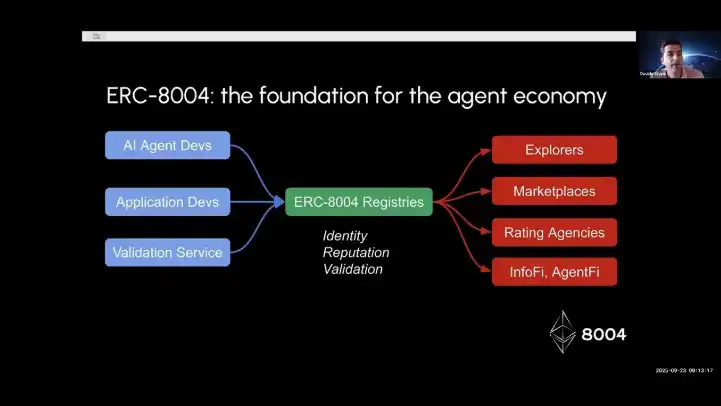
ERC-8004 introduces a set of neutral on-chain registries that address this issue through on-chain identity, reputation, and verification mechanisms.
Each agent receives a portable on-chain identity, an ERC-721 token representing a machine NFT. This token points to a registration file describing the agent's name, skills, wallet, and endpoint. Because it is standardized and based on neutral infrastructure, it can be indexed by any marketplace or browser.
Agents can leave feedback for each other, tag by task, and associate it with Proof of Economic Payment (x402 – short for EIP-402, a cryptographic receipt that binds on-chain payments to off-chain interactions). For higher trust use cases, validators can confirm outputs through hardware enclaves, proof-of-stake mechanisms, or zkML verification. In short, this is an open rating and auditing layer for autonomous agents.
This standard lays the foundation for machine-to-machine economic activity. It builds a world without human intermediaries, allowing agents to trust each other in negotiation, transactions, and collaboration. It extends the logic of disintermediation in blockchain's currency and contract space to AI agents, removing platform middlemen between them.
Reportedly, over a hundred teams are already building according to this specification.
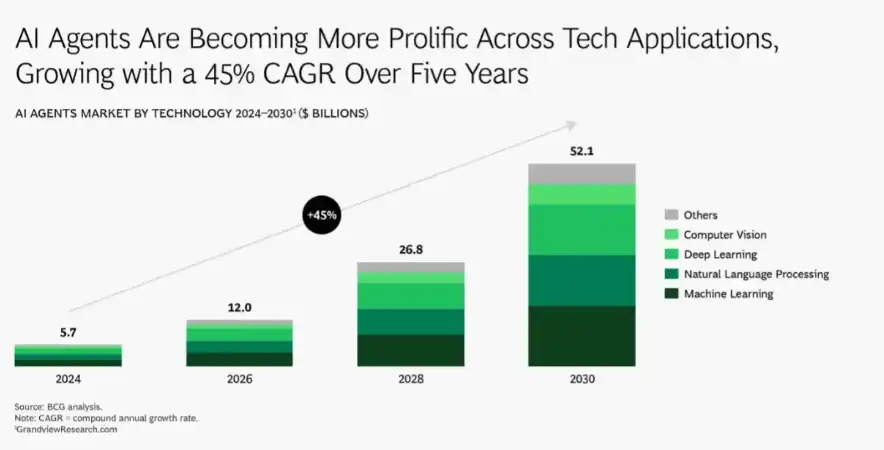
Massive Investments in AI and Crypto Infrastructure
The release of ERC-8004 comes at a time when the AI economic infrastructure is receiving massive investments. Payment-focused Layer 1 blockchain Tempo recently raised $5 billion, reaching a valuation of $50 billion; AI startup Thinking Machines, founded by former OpenAI executives, raised $20 billion, reaching a valuation of $120 billion.
We are witnessing the largest funding rounds in the history of AI and crypto convergence.
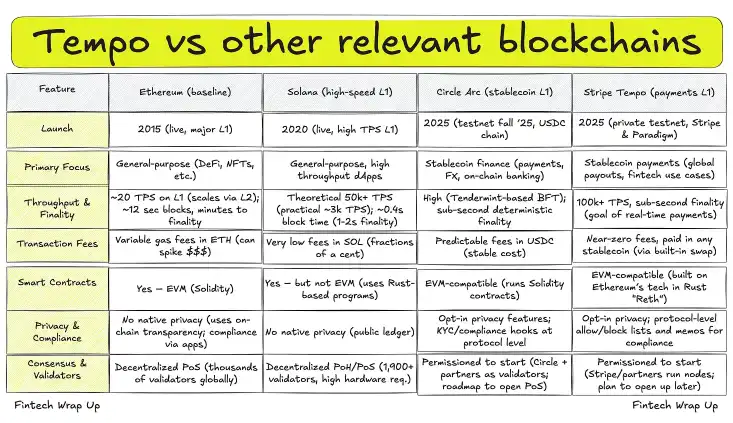
Tempo is building a closed payment network optimized for stablecoins and real-world finance. This essentially mirrors the enterprise version of Ethereum's vision: a high-throughput, low-cost global transaction settlement channel. In Tempo's world, agents can process payments at machine speeds, but its internal private ecosystem is governed by its validators and fee model.
ERC-8004 can provide an open discovery and reputation layer for this ecosystem. Tempo does not need to define which agents or merchants can transact but can integrate the ERC-8004 registry so that any verified agent with a public on-chain identity can access its payment network. This will transition Tempo from a closed settlement layer to a programmable settlement layer, achieving interoperability with the broader Ethereum agent economy.
Thinking Machines operates on a higher level. Although its ultimate goal is not yet clear, its existing products focus on training models to enhance their robustness and flexibility. This contributes to the deployment of autonomous agents on the internet that can reason, collaborate, and transact. Currently, these agents still exist in closed, vertically integrated environments.
By adopting ERC-8004, Thinking Machines can build training tools for an open economy: each model or agent can be discovered and verified on-chain, possess an ERC-721 identity token, and establish real economic reputation through x402 verified interactions. In practical terms, this means a Thinking Machines agent can contract with a data provider agent on Ethereum, pay through Tempo or another chain, and report results back to the chain without human intervention.
In essence, ERC-8004 can unlock a programmable market. It empowers autonomous agents to contract, settle, and build reputation on-chain, which is precisely what DeFi is all about serving humanity.
For fintech, the short-term impact is minimal; few companies will overnight replace APIs with agents. However, once agents can prove identity, reputation, and payment, they can handle various tasks from credit scoring to transaction execution without requiring platform intermediaries.
You may also like

Blockchains Quietly Prepare for Quantum Threat as Bitcoin Debates Timeline
Key Takeaways: Several blockchains, including Ethereum, Solana, and Aptos, are actively preparing for the potential threat posed by…

Former SEC Counsel Explains What It Takes to Make RWAs Compliant
Key Takeaways The SEC’s shifting approach is aiding the growth of Real-World Assets (RWAs), but jurisdictional and yield…

Trend Research Quietly Becomes One of Ethereum’s Largest Whales with Major ETH Acquisition
Key Takeaways Trend Research has acquired 46,379 ETH, boosting their total holdings to about 580,000 ETH. The company,…

Web3 and DApps in 2026: A Utility-Driven Year for Crypto
Key Takeaways The transition to utility in the crypto sector has set a new path for 2026, emphasizing…

Base's 2025 Report Card: Revenue Grows 30X, Solidifies L2 Leadership

Are Those High-Raised 2021 Projects Still Alive?

Aave Community Governance Drama Escalates, What's the Overseas Crypto Community Talking About Today?

Polymarket Announces In-House L2, Is Polygon's Ace Up?

Ether pumps to outsiders, dumps in-house. Can Tom Lee's team still be trusted?

The Secret Centralization Landscape of Stablecoin Payments: 85% of Transaction Volume Controlled by Top 1000 Wallets

Audiera Sees Massive Price Surge – Key Cryptocurrency Updates
Key Takeaways Audiera (BEAT) has witnessed significant growth, experiencing a 70.10% increase in the past week. Despite the…

Market Outlook: The Future of Cryptocurrency by 2026
Key Takeaways The report focuses on the impact of critical factors like Bitcoin, Ethereum, and Solana, alongside regulatory…

Stability in the Crypto World: Understanding Stablecoin Usage and Its Implications
Key Takeaways Stablecoin use in payments has rapidly increased alongside blockchain technology advancements. Stablecoins USDT and USDC dominate…
Trump’s World Liberty Financial Token Ends 2025 Down Over 40%
Key Takeaways World Liberty Financial, a Trump family crypto project, faces substantial losses in 2025. The project initially…
Blockchains Quietly Prepare for Quantum Threat Amid Bitcoin’s Debate Over Timeline
Key Takeaways Many blockchains are preparing for potential threats from quantum computing by integrating post-quantum technologies. Ethereum views…
Ronin and ZKsync’s Onchain Metrics Experienced Notable Declines in 2025
Key Takeaways Some of the major blockchain networks, including Ronin and ZKsync, saw a significant reduction in onchain…

Stablecoin Weekly Report | Decrypting How Crypto is Reinventing the Internet's Killer Apps through Coinbase's System Upgrade

Security Tokenization and Prediction Markets: 7 Major Crypto Boons to Watch in 2026
Blockchains Quietly Prepare for Quantum Threat as Bitcoin Debates Timeline
Key Takeaways: Several blockchains, including Ethereum, Solana, and Aptos, are actively preparing for the potential threat posed by…
Former SEC Counsel Explains What It Takes to Make RWAs Compliant
Key Takeaways The SEC’s shifting approach is aiding the growth of Real-World Assets (RWAs), but jurisdictional and yield…
Trend Research Quietly Becomes One of Ethereum’s Largest Whales with Major ETH Acquisition
Key Takeaways Trend Research has acquired 46,379 ETH, boosting their total holdings to about 580,000 ETH. The company,…
Web3 and DApps in 2026: A Utility-Driven Year for Crypto
Key Takeaways The transition to utility in the crypto sector has set a new path for 2026, emphasizing…
Base's 2025 Report Card: Revenue Grows 30X, Solidifies L2 Leadership
Are Those High-Raised 2021 Projects Still Alive?
Popular coins
Latest Crypto News


Customer Support:@weikecs
Business Cooperation:@weikecs
Quant Trading & MM:bd@weex.com
VIP Services:support@weex.com
 App
App