
- Buy Crypto
- Markets
- Futures
- Spot
- Copy Trade
 WE-Launch
First Day Crash: The Mystery of Bitcoin Whale Twenty One's Valuation Discount

Original Title: "Twenty One Plunges Nearly 20% on First Day of Trading, the Mystery of BTC DAT's Third Largest Valuation"
Original Author: Ding Dang, Odaily Planet Daily
Backed by stablecoin giant Tether and the Japanese conglomerate SoftBank Group, the "Bitcoin Asset Reserve Company" Twenty One Capital (NYSE: XXI) officially debuted on the New York Stock Exchange on December 9th. However, despite its "heavy asset" and "strong endorsement" advantages, the stock price plummeted on the first day of trading, with an intraday decline of nearly 20%, providing an unfriendly initial response from the capital market.
Founded in early 2025, Twenty One is led by Strike's founder and CEO Jack Mallers, positioning itself as a company focused on Bitcoin as its core asset allocation. It is strongly supported by stablecoin issuer Tether, the Japanese SoftBank Group, and Wall Street investment bank Cantor Fitzgerald.
It is noteworthy that Twenty One did not go public through a traditional IPO but completed a SPAC merger with Cantor Equity Partners to go public through a reverse takeover, and officially listed on the NYSE on December 9th, with Cantor Equity Partners being a key platform under Cantor Fitzgerald. The company is led by Brandon Lutnick, the son of the U.S. Secretary of Commerce, and he personally led this merger. In the announcement, he emphasized that Cantor's partnership was instrumental in bringing innovative participants such as Tether and SoftBank together. This relationship added an "institutional dimension of reputation" to Twenty One Capital, especially in the crypto-friendly policy environment promised by the Trump administration.
However, the sentiment in the capital market is evidently more complex. The company initially traded under the CEP code and saw its share price surge from $10.2 to $59.6 after the announcement, marking an almost 6x increase, with the market's initial enthusiasm for the "Bitcoin Reserve Company" narrative nearly depicted in the candlesticks. But as speculative sentiment waned, the stock price swiftly retreated and is now hovering around $11.4, erasing nearly all of the initial premium.
This sharp contrast is seen in its substantial Bitcoin holdings. As of the listing, Twenty One holds 43,514 BTC, with a market value of approximately $4.03 billion, ranking third in the global corporate Bitcoin holdings list, behind only Strategy and MARA Holdings.
Valuation Puzzle: The Causes Behind Extreme Discount
What truly puzzles the market is its valuation structure. At the current stock price level, Twenty One's overall market value is only about $186 million, with a market multiple (mNAV) as low as 0.046. In other words, the capital markets are only willing to price its Bitcoin asset at around 4.6% of its book value. Why such an extreme discount?
A deep dive into its asset acquisition reveals that Twenty One's Bitcoin reserve was not primarily formed through long-term open market purchases but rather highly reliant on a "shareholder bailout" model: its initial reserve of about 42,000 BTC came from a direct investment by Tether. Then on May 14, 2025, the company further increased its holdings by 4,812 BTC through Tether at a cost of approximately $4.587 billion, corresponding to a per-coin cost of about $95,300; and before the IPO, through PIPE financing and convertible bond mechanisms, it completed an additional plan to acquire about 5,800 BTC.
The advantage of this model lies in its high efficiency, bypassing the lengthy process of secondary market accumulation and allowing for rapid scaling of reserves in a short period of time; however, the cost is equally evident: highly concentrated assets coming from a few related parties, making it difficult for investors to fully penetrate their internal trading structure, custody form, and potential protocol constraints, where transparency and sustainability naturally become significant discount factors in market pricing.
The Collective Predicament of "Digital Asset Reserve Companies"
From an industry perspective, Twenty One's issue is no longer an isolated case. According to defillama.com data, there are currently over 70 "coin-share companies" globally (i.e., publicly traded companies holding crypto assets). Among the top 20 holders, most companies' mNAV has fallen below 1, including the pioneer of this model, Strategy.
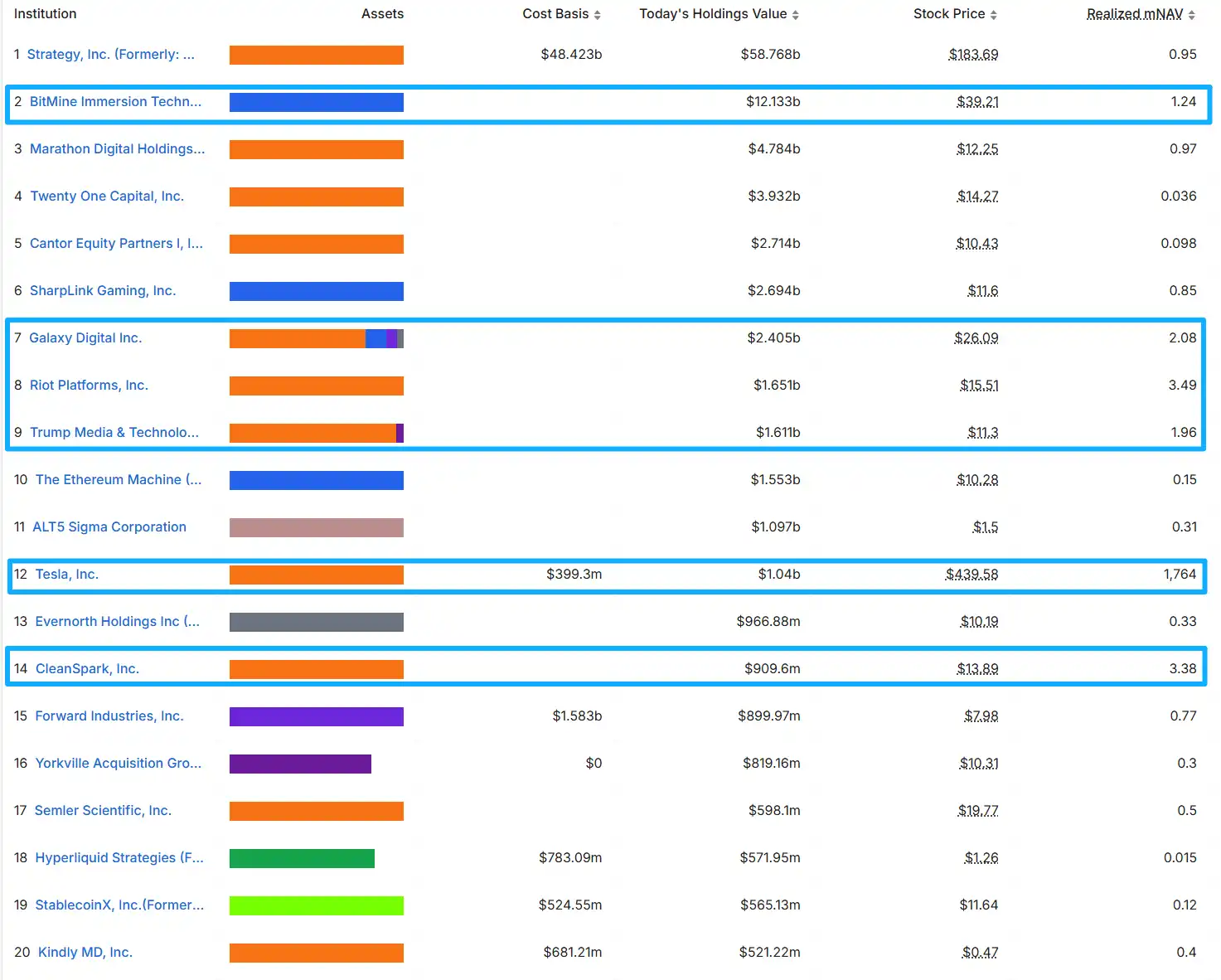
With the overall retreat of the current crypto market, these "coin-share companies" have shifted from the narrative core to the edge assets in the risk control model, and the market's valuation of these crypto asset reserve companies has generally turned cautious.
However, there is a magnitude difference between Strategy and Twenty One. Strategy currently holds about 660,600 BTC, accounting for about 3% of the total Bitcoin supply, a scale more than 15 times that of Twenty One. This volume not only gives it a stronger market voice but also symbolizes a certain "systemic anchor." When Strategy's mNAV falls below 1, the market naturally raises deeper questions: will it be forced to sell coins? Will a debt structure lead to a sell-off? Has the DAT model lost its logical basis in the face of macro cycles?
In fact, with the significant retreat of the crypto market in 2025, the DAT model faces a severe test. At the core of this model is the accumulation of Bitcoin through debt and equity financing, considering it as the "ultimate asset" to hedge against inflation and currency devaluation. However, when the price of Bitcoin experiences significant volatility, the stability of this model begins to shake. Some companies, although holding a large amount of BTC, face valuation pressure due to operating costs and market sentiment. While Twenty One's extreme discount is related to its asset acquisition method, it also reflects the market's centralized pricing of risk for the entire DAT model.
Conclusion: The narrative continues, but the market needs time
During the Binance Blockchain Week on December 4th, Michael Saylor provided a broader perspective. Under the title "Why Bitcoin Is Still the Ultimate Asset: The Next Chapter of Bitcoin," he once again reiterated his core judgment on Bitcoin's next decade: Bitcoin is transitioning from an investment to the "base capital" of the global digital economy, and the rise of the digital credit system will reshape the traditional $300 trillion credit market. From policy shifts and changes in banking attitudes to the institutional absorption of ETFs and the explosive growth of digital credit tools, Saylor depicts an accelerating new financial order that is emerging: digital capital provides energy, digital credit provides structure, and Bitcoin will be the underlying asset supporting everything.
From this perspective, companies like Twenty One indeed have a kind of "forward correctness" potential — if Bitcoin ultimately completes its transition from a high-risk asset to "digital gold," these companies may become the core carriers of this transition process.
However, the problem lies in the fact that "forward correctness" does not automatically equal "reasonable pricing at present." The market still needs time to validate Bitcoin's true role in the macro system and to reassess the resilience of the DAT model in different cyclical environments.
You may also like

Blockchains Quietly Prepare for Quantum Threat as Bitcoin Debates Timeline
Key Takeaways: Several blockchains, including Ethereum, Solana, and Aptos, are actively preparing for the potential threat posed by…

Three Signs that Bitcoin is Discovering its Market Bottom
Key Takeaways: Indicators suggest the selling pressure on Bitcoin is diminishing, hinting at a potential bottom. With improving…

Trump’s World Liberty Financial Token Ends 2025 Significantly Down
Key Takeaways World Liberty Financial, led by the Trump family, witnessed its token value drop by over 40%…

Kraken IPO and M&A Deals to Reignite Crypto’s ‘Mid-Stage’ Cycle
Key Takeaways: Kraken’s upcoming IPO may draw significant interest and capital from traditional finance (TradFi) investors, boosting the…

Extended Crypto ETF Outflows Indicate Institutional Pullback: Glassnode
Key Takeaways: Recent outflows from Bitcoin and Ether ETFs suggest a withdrawal of institutional interest. Institutional disengagement has…

HashKey Secures $250M for New Crypto Fund Amid Strong Institutional Interest
Key Takeaways HashKey Capital successfully secured $250 million for the initial close of its fourth crypto fund, showcasing…

JPMorgan Explores Cryptocurrency Trading for Institutional Clients
Key Takeaways JPMorgan Chase is considering introducing cryptocurrency trading services to its institutional clientele, marking a notable shift…
El Salvador’s Bitcoin Dreams Faced Reality in 2025
Key Takeaways El Salvador’s ambitious Bitcoin strategy, introduced in 2021, faced significant challenges and revisions by 2025, particularly…

Price Predictions for 12/22: SPX, DXY, BTC, ETH, BNB, XRP, SOL, DOGE, ADA, BCH
Key Takeaways: Bitcoin’s recovery efforts are met with strong resistance, indicating potential bearish trends at higher levels. Altcoins…

Bitcoin Perpetual Open Interest Surges as Traders Look Forward to Year-End Rally
Key Takeaways Bitcoin perpetual open interest has risen to 310,000 BTC, reflecting a bullish sentiment among traders as…

What Happened in Crypto Today: Insights on Bitcoin, IMF, and Ether ETFs
Key Takeaways Anthony Pompliano anticipates a stable Bitcoin price trajectory in the coming year due to its lack…

Venture Capital Post-Mortem 2025: Hashrate is King, Narrative is Dead
Are Those High-Raised 2021 Projects Still Alive?

Aave Community Governance Drama Escalates, What's the Overseas Crypto Community Talking About Today?

Key Market Information Discrepancy on December 24th - A Must-See! | Alpha Morning Report

2025 Whale Saga: Mansion Kidnapping, Supply Chain Poisoning, and Billions Liquidated

Believing in the Capital Market - The Essence and Core Value of Cryptocurrency

Absorb Polymarket Old Guard, Coinbase Plunges Into Prediction Market Abyss
Blockchains Quietly Prepare for Quantum Threat as Bitcoin Debates Timeline
Key Takeaways: Several blockchains, including Ethereum, Solana, and Aptos, are actively preparing for the potential threat posed by…
Three Signs that Bitcoin is Discovering its Market Bottom
Key Takeaways: Indicators suggest the selling pressure on Bitcoin is diminishing, hinting at a potential bottom. With improving…
Trump’s World Liberty Financial Token Ends 2025 Significantly Down
Key Takeaways World Liberty Financial, led by the Trump family, witnessed its token value drop by over 40%…
Kraken IPO and M&A Deals to Reignite Crypto’s ‘Mid-Stage’ Cycle
Key Takeaways: Kraken’s upcoming IPO may draw significant interest and capital from traditional finance (TradFi) investors, boosting the…
Extended Crypto ETF Outflows Indicate Institutional Pullback: Glassnode
Key Takeaways: Recent outflows from Bitcoin and Ether ETFs suggest a withdrawal of institutional interest. Institutional disengagement has…
HashKey Secures $250M for New Crypto Fund Amid Strong Institutional Interest
Key Takeaways HashKey Capital successfully secured $250 million for the initial close of its fourth crypto fund, showcasing…
Popular coins
Latest Crypto News


Customer Support:@weikecs
Business Cooperation:@weikecs
Quant Trading & MM:bd@weex.com
VIP Services:support@weex.com
 App
App