
- Buy Crypto
- Markets
- Futures
- Spot
- Copy Trade
 Earn
Earn- More
I spent a year trading cryptocurrencies, and the profit is not as good as my mom's stock trading.

This has been a year of "everything up," but the cryptocurrency circle has been widely recognized as "extremely difficult to make money" this year.
Compared to the past few years, 2025 seems like a rare "lucky year." The US stock market has hit new highs, A-share core assets have rebounded, gold has reached historic prices, commodities have collectively bounced back, and almost all markets are up.
However, in the cryptocurrency circle, even though Bitcoin hit a new all-time high of $120,000, many people complained that this is the "most difficult year to make money" in the crypto world. When friends discussed their family's investment activities this year, they said, "This year, the returns from trading crypto are completely incomparable to my mom's A-share trading."
A-Share: Once-a-Decade Bull Market
"This year, both my own and my family's A-share accounts had a 100% success rate." In a finance major at a university in Hangzhou, Professor Cai, who has been studying and teaching the A-share market for over twenty years, told BlockBeats.
If Professor Cai's experience is "the intuition of an old hand," then the data from his students is even more convincing: "Among the students I communicate with more, many have made a lot of money. Those who have bought and sold more than twenty stocks all have a 100% success rate."
The data also confirms this "across-the-board" market.
In the first three quarters of this year, according to China's most mainstream industry classification standard, 28 out of 31 sectors in the first-level industry classification by Shenwan showed an increase, accounting for over 90%. Wind data shows that over 80% of stocks have risen during the year, with as many as 448 stocks doubling in price.
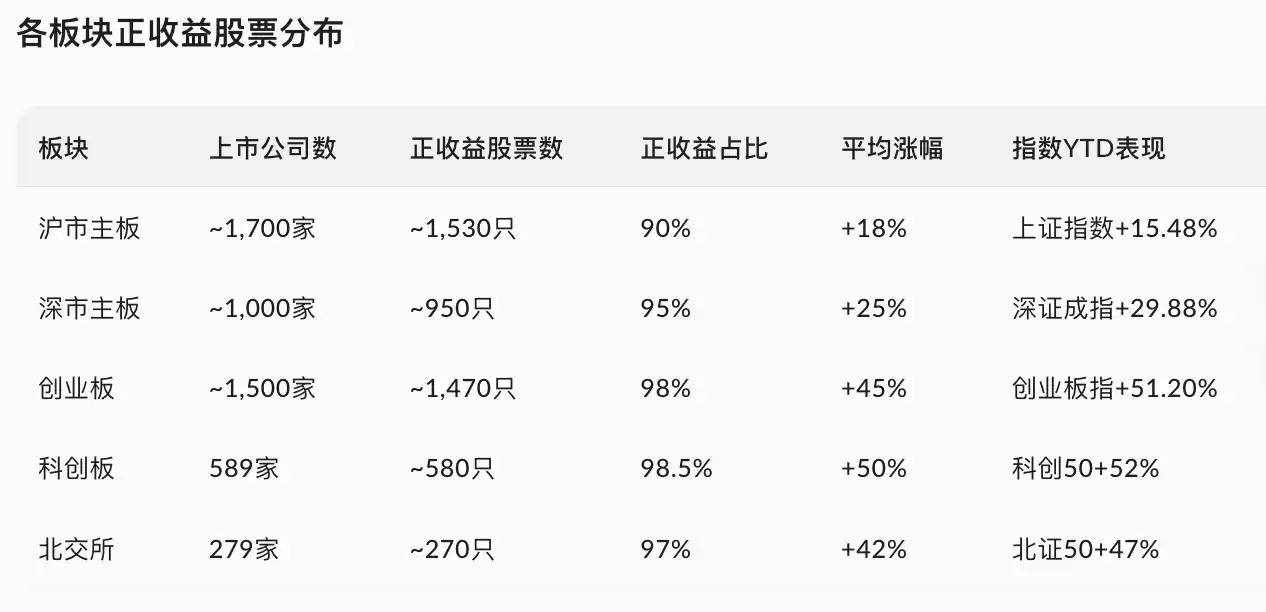
Compared to the main board market, the ChiNext Board and the STAR Market have seen more vigorous gains.
A representative stock is "Shangwei New Materials," the first "20x Magic Stock" in the A-share market this year.
"This was originally a chemical company on the Sci-Tech Innovation Board. The reason for the rise is that the announcement stated that the controlling shareholder has changed to Zhiyuan Hengyue, a company closely related to Zhiyuan Robotics, tapping into the artificial intelligence sector."
Footnote by BlockBeats: Zhiyuan Robotics, a star company in the "Embodied Intelligence" track, was co-founded by Peng Zhihui (Zhihui Jun), a former "Teen Genius" at Huawei, and former Vice President Deng Taihua.
This news ignited the market's imagination. On social media, headlines such as "Zhiyuan Robotics Backdoor Listing" and "A-share version of NVIDIA" emerged endlessly. Despite the company's repeated clarifications that there is no plan for asset restructuring in the short term, the sentiment has already been ignited.
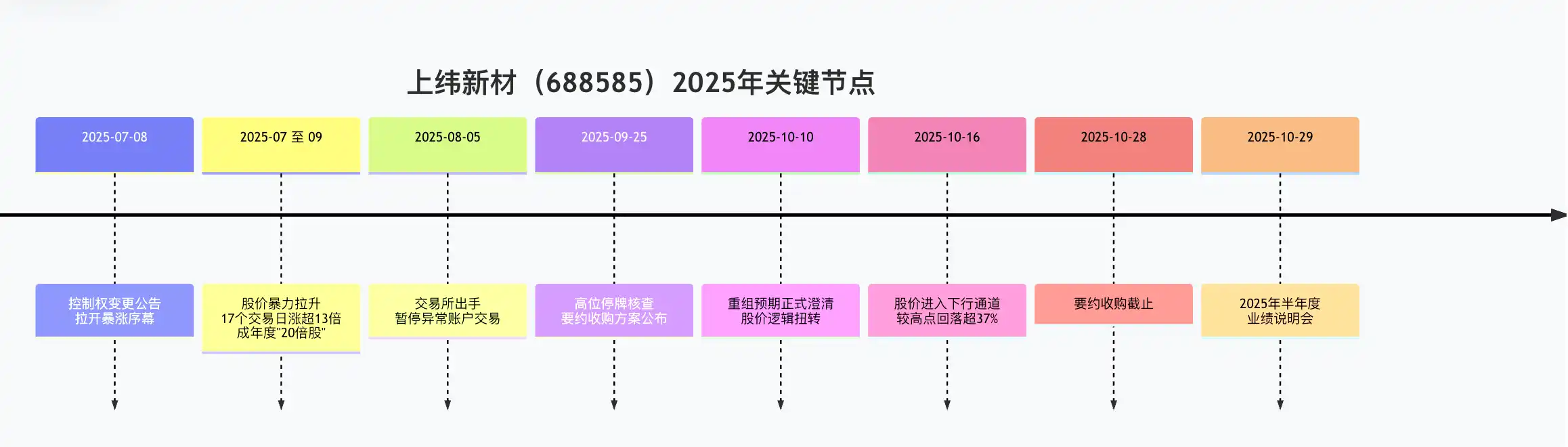
In just 17 trading days, the stock price soared from single digits all the way up, increasing more than 13 times. As of September 25, Shangwei New Materials has accumulated a year-to-date gain of over 2030%, becoming the first "20-Bagger Stock" in the A-share market in 2025.
In Professor Cai's view, the skyrocketing trend in the A-share market this year is not abnormal.
"When there is a significant drop, there will be a rise. In terms of time cycles, the A-share market sees a bull market about every ten years. Last year was a bear-to-bull transition, and this year is the main upward wave of the bull market," Professor Cai said.
In the bull market of 2005, the Shanghai Composite Index rose from 998 points in 2004 to 6124 points in 2007; in the bull market of 2015, the index rose from 1849 points in 2013 to 5178 points in 2015. The time interval between these two bull markets is roughly around 10 years, and another decade has passed in the blink of an eye.
Hong Kong Stock Market: Even Elephants Can Turn Around
Before looking at the US stock market, it might be worth taking a look at the Hong Kong stock market.
As of the time of writing, the Hang Seng Index has accumulated a nearly 29% gain for the year, breaking through 26000 points in September, hitting a four-year high.
Tech giants once again became the protagonists of this round of the market. The Internet sector led by companies such as Alibaba, Tencent, Meituan, and Xiaomi drove the Hang Seng Tech Index to go all-out on the offensive.
They say "an elephant is hard to turn around," but this year's market trends are a bit of an exception.
For example, in this round of Alibaba's surge, many people were not initially optimistic. After all, in the past few years, it has fallen sharply and almost become synonymous with the low ebb of Chinese concept stocks.
However, since the beginning of the year, Alibaba Cloud has achieved double-digit growth for two consecutive quarters, with a 26% year-on-year growth in the second quarter, hitting a nearly three-year high. The AI business has maintained triple-digit growth for eight consecutive quarters. Reflected in the stock price, Alibaba's stock price has doubled year-to-date, becoming the most dazzling presence among large companies.
On the other hand, Tencent is also unwilling to be left behind. In the second quarter of 2025, Tencent's domestic market game revenue increased by 24% year-on-year, and the advertising business also saw a 20% increase due to AI algorithm optimization. Starting from 2024, Tencent has expanded its buyback program to as high as HK$112 billion, the largest in nearly a decade. Tencent's stock price has also risen by over 50% during this year, with its Hong Kong market value returning to HK$6 trillion, nearly tripling in three years.
Additionally, the most noteworthy thing in the Hong Kong stock market this year is the lucrative effect of the IPO market.
"This year, making money through IPOs is a one-shot deal, surpassing others who have been trading for half a year." This was the first thing Arez said in a conversation with BlockBeats about the rhythm of the law.
The data indeed speaks for itself.
In the first three quarters of 2025, there were a total of 68 new listings on the Hong Kong stock market, with 48 of them rising on the first day, 4 remaining flat, and only 16 breaking below the IPO price, resulting in a first-day break rate of only 24%, hitting a new low since 2017.
Especially in the second half of the year, among the 24 new listings from July to September, only 3 broke below the IPO price, and the visible effect of making money was evident. Correspondingly, there was a significant increase in first-day return rates—an average of 28%, nearly three times that of last year.
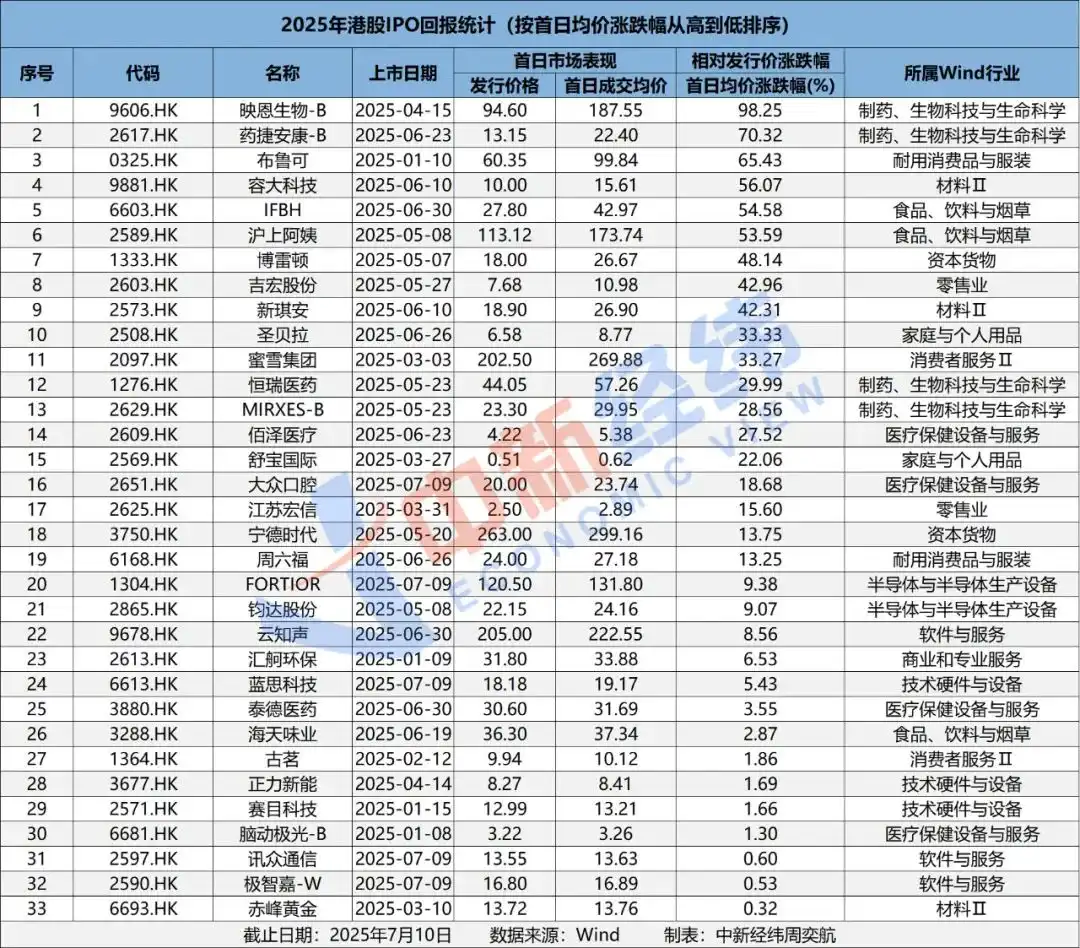
"The money-making effect of participating in Hong Kong IPOs was also reflected in the second half of 2024, such as Maogeping's 70% surge on the first day of listing, kicking off a small upturn in the IPO market. This year, it's a full-scale bull market,"
Arez exchanged views with BlockBeats half a year ago, as the track of brushing up currency circle projects was not thriving. So, their studio specifically established a Hong Kong IPO subscription team to handle Hong Kong IPO projects.
「Then we successively won the IPO lottery of companies such as Bruker, Meixue, Shanghai Auntie, Ning Wang, Innovent Biologics, and so on. It can be said that participating in IPOs this year made it very easy to earn over 100,000 RMB. After all, for companies like Innovent Biologics, just one lottery win can earn you ten thousand RMB, and many banks and securities firms can provide up to 10x leverage, so the capital utilization rate is also very high,」 Arez said.
「Moreover, this year there were a particularly large number of A+H dual listing IPOs, making the process very stable.」 Several top A-share companies went public in Hong Kong this year, such as CATL and CSPC Pharmaceutical Group. Since the A-share market already has mature pricing, there is generally a discount when listed in Hong Kong, providing a "valuation safety net" that significantly reduces the risk of IPO participation.
「For example, the profit from participating in the CATL IPO felt like it was picked up for free,」 Arez said with a smile to BlockBeats: 「Everyone knows that Hong Kong stocks are usually at a discount, but no one expected it to be this lucrative.」
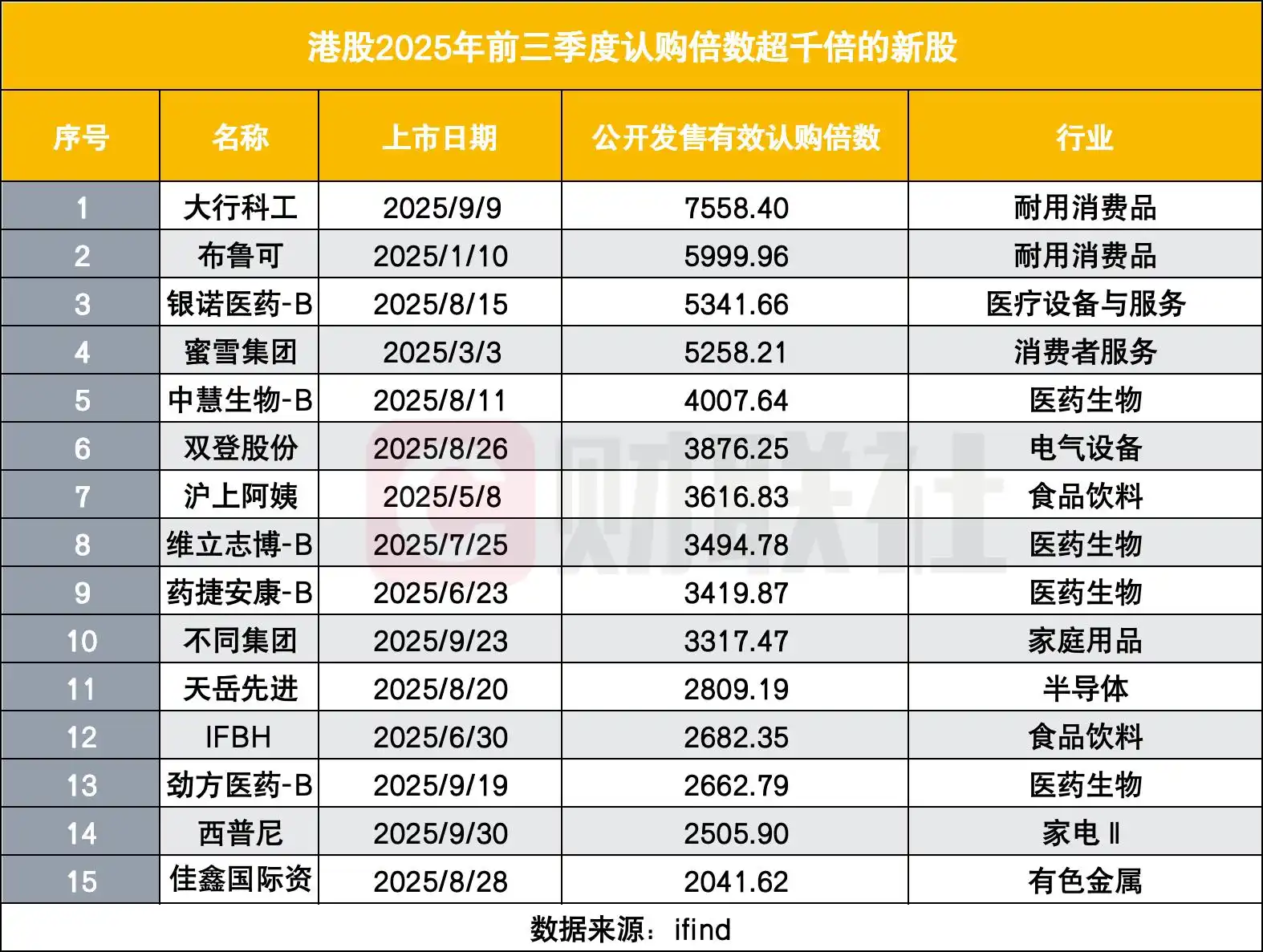
As the money-making effect becomes apparent, IPO lotteries in Hong Kong even show a somewhat "popular" trend. Compared to last year, this year's IPO lotteries in Hong Kong are significantly livelier, with oversubscriptions entering the era of thousands of times oversubscribed. 「The most exaggerated is like CIMC Enric, which was oversubscribed nearly 8000 times directly.」
According to statistics, in the first three quarters of 2025, there were a total of 68 new stocks listed in Hong Kong, with 98% receiving oversubscriptions, and 86% of new stocks having oversubscriptions exceeding 20 times, doubling compared to the same period last year. There were 15 stocks with oversubscriptions exceeding a thousand times, accounting for nearly a quarter.
Among them, CIMC Enric led the season with an oversubscription ratio of 7558 times, becoming the "Subscription King" of the season; Bruker and Innovent Biologics followed closely, with oversubscription heat of 5999 times and 5341 times, respectively. In this context, participating in IPO lotteries in Hong Kong has become a new generation of "risk-free financial management."
Gold: Everyone is Searching for Certainty
On the other end of the spectrum, there is the soaring price of gold.
Starting from $2590 per ounce at the beginning of the year, gold fluctuated upward after hitting a low for the year on January 3rd, setting multiple historical highs and now stabilizing around $4100 per ounce, with a year-to-date increase of over 58%.
The S&P Global Gold Index has surged 129%, becoming the best-performing sector among all of S&P's industry indices. Even the price of silver has jumped to its highest level in decades, with a cumulative increase of over 70% since the beginning of the year.
Driving this precious metals bull market is not just risk aversion. Risks such as the U.S. government shutdown, ongoing central bank purchases, and concerns about sovereign debt inflation—all macro narratives point in the same direction: money is seeking a safer vessel.
“For gold mining stocks, this has been a fantastic year. They are holding so much cash they don't know what to do with it,” exclaimed Zhuo Chen in an interview.
Zijin Mining, the top A-share gold company by market value, is the representative of this feast.
As of the third quarter, the company's revenue reached 254.2 billion yuan, with a net profit of 37.864 billion yuan. If the A-share and H-share market values are combined (total market value of A+H), Zijin Mining's total market value has exceeded 1 trillion yuan.
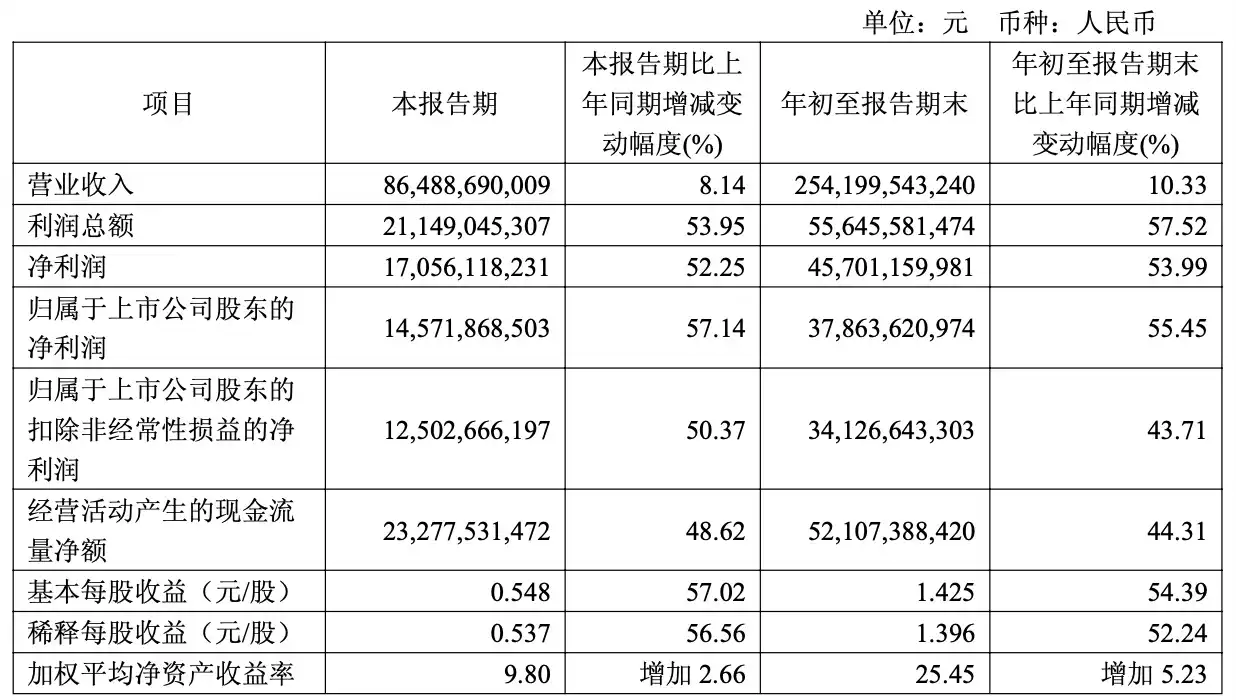
Source: Zijin Mining Third Quarterly Report
At the end of August, Zijin Mining once again spent a huge sum to acquire an 84% stake in Anhui Jinsha Molycopper, acquiring the world's second-largest molybdenum mine—Shapingou Molybdenum Mine, with an annual capacity of 10 million tons.
This transaction has put China directly in control of one-third of the world's molybdenum resources.
Almost simultaneously, Zijin's "Zijin Gold International" landed on the Hong Kong Stock Exchange on September 30. On its first day, it doubled, becoming the second-largest IPO of the year.
Not only the A-share gold sector, but the best-performing U.S. stock sector this year is also undoubtedly non-gold mining.
Data shows that since the beginning of this year, Newmont's stock price has risen by 137%, Barrick's by 118%, and Agnico Eagle's by 116%. In comparison, the star companies in the U.S. AI sector have seen NVIDIA rise by 40%, Oracle by 72%, Google’s parent company Alphabet by 30%, and Microsoft by 25%.
Although the U.S. gold sector has shown outstanding growth, this is still not enough to cover all the gains in the U.S. stock market this year.
The Renaissance of Meme Stocks
As of late October, all three major U.S. stock indexes have seen gains of over 20% for the year, with the S&P 500 index hitting a record high close of 6,753.72 on October 8. NVIDIA's market value surpassed $4 trillion, and Microsoft, Meta, and Apple have all reached new all-time highs.
In addition to these mainstream US stocks, Matt, who often frequents Reddit channels such as "WallStreetBets" and "StocksToBuyToday," witnessed the revival of a new round of meme stock craze in the forum. He and BlockBeats shared several meme stocks in the US stock market this year.
"If we were to talk about the biggest meme stock in the Nasdaq in the past three months, I believe it is OpenDoor, which is very similar to the GameStop phenomenon back then. It surged 245% in July, 141% in August, and 79% in September. The stock price soared from $0.5 to a peak of $10.87, with a maximum increase of 2000%," Matt said, sounding excited.
Interestingly, this company that facilitates instant real estate transactions has been in annual losses since its inception. The stock price plummeted from a high of $35.8 per share in 2021 to $0.5 per share in June 2025, and even received a delisting warning from Nasdaq.
"The turning point came when a prominent investor expressed on social media that OpenDoor has the potential to be a hundred-bagger stock, attracting a group of retail investors on Reddit called the Open Army, directly propelling the stock price to skyrocket. They hailed OpenDoor as a new meme stock and even successfully 'forced' a board reorganization," he added.
Another meme stock that Matt recently participated in is Beyond Meat, the former "plant-based meat leader," whose stock price surged by 1100% in a few days. "Similarly, despite continuous annual losses and extremely high institutional short positions, even up to 80%, the more bearish the institutions are, the more retail investors like it. That's the power of retail investors."
Interestingly, one of the most outstanding stock sectors this year is still related to crypto—but not to cryptocurrency itself.
Compared to the dazzling performance of "Bitcoin concept stocks," Bitcoin's rise seems much less impressive, despite hitting an all-time high during the year, with an annual increase of only about 15%.
The Decline of the Crypto Market
Nothing with a price can keep rising forever.
After experiencing multiple narrative cycles, the crypto market has become a "market without a main theme."
While traditional capital markets find new growth logics in AI, energy, and manufacturing, the crypto market remains trapped in a context of self-perpetuating narratives.
A decline in trading volume is the most telling sign of the problem. In Q3 2025, the global centralized cryptocurrency exchange spot trading volume dropped by 32% year-on-year. Retail sentiment has been worn down, market makers are no longer active, and market depth has decreased.
On-chain funds are quiet, token prices are range-bound, and project teams are silent. Even on social media, there is less criticism of exchanges that have been involved in incidents.
The people in the crypto circle, filled with myths of getting rich quick, have become the "subject of self-exploitation." They watch the market 24/7 because "opportunity waits for no one"; they crazily participate in airdrops, meme coin rushes, and chase hot trends because "not striving hard enough will lead to elimination"; if they lose money, they blame themselves for "not being smart enough," and if they make money, they feel "it's still not enough."
Three quarters of 2025 have passed, efforts have not received feedback, and fatigue has become inevitable.
"Those who should leave have left, and those who stayed no longer wish to gamble." Arez's pessimism towards the crypto world seems to represent many. "In 2024, I was still watching the market closely online, but this year, I don't even have the desire to open a trading platform."
The crypto world has indeed lost this year. However, what it lost is an inevitable battle within a cycle.
When the macro environment provides a clear rationale for the rise of traditional assets, when tightening regulations increase the cost of speculation, when the narrative is exhausted and new funds no longer enter—the downturn of the crypto world was almost inevitable.
But this does not mean that the story of cryptocurrency has come to an end.
"If you believe in China's national destiny, you will dollar-cost average the CSI 300; if you believe in China's technological breakthrough, you will dollar-cost average the ChiNext Index; if you believe in America's destiny, you will dollar-cost average the S&P 500; if you believe in the human tech revolution, you will dollar-cost average the Nasdaq. If you believe that humanity will eventually perish, you will dollar-cost average gold." This is a popular recent statement on Twitter.
Behind every type of asset is a belief. Perhaps the crypto world's belief needs some new time and people to rewrite it.
You may also like

What the Tightest Part of the LALIGA Season Teaches About Crypto Trading Under Pressure
As pressure builds late in the LALIGA season, decision quality becomes the real differentiator. The same logic applies to disciplined crypto trading under volatility.
![[WEEX VIP Spot Sprint] Best VIP Traders Awards: Win a Share of $100,000 in Rewards](https://images-cms.weex.com/medium_Win_a_Share_of_100_000_in_Rewards_75e69c3539.PNG)
[WEEX VIP Spot Sprint] Best VIP Traders Awards: Win a Share of $100,000 in Rewards
Discover how WEEX VIP traders participate in the VIP Spot Sprint and compete for a share of the $100,000 rewards pool. Clear rules, performance-based rankings.

Bitcoin 30-Day Realized Losses and Gold Reaching Record Highs
Key Takeaways Bitcoin holders have experienced a rare stretch of 30-day realized losses for the first time since…

Central banks vs Bitcoin: Who truly earns the public’s trust?
Key Takeaways The debate over trust between central banks and Bitcoin continues, receiving global attention at the World…

Kaspa is Expected to Decline to $0.032939 by January 26, 2026
Key Takeaways Kaspa’s price is projected to drop 23.07% within the next five days. Current market sentiment for…

Bitcoin Fills New Year CME Gap with Sub-$88K BTC Price Drop
Key Takeaways Bitcoin’s price has closed a significant CME gap that appeared at the beginning of the year,…

Bitcoin Exhibits Resilience at $92K Amidst Economic Fluctuations: Is the Downturn Over?
Key Takeaways: Bitcoin remains robust at $92,000, though ETF outflows and geopolitical concerns loom. BTC futures premium close…

Crypto Mortgages in the US Tackle Valuation Risks and Regulatory Challenges
Key Takeaways The adoption of crypto mortgages is facing challenges around valuation risks and regulatory uncertainties in the…

Can Bitcoin Regain $90K? Bulls at Risk as Long-Term Holders Increase Selling
Key Takeaways: Bitcoin has declined below the $90,000 mark amid increased selling pressure from whales and long-term holders.…

Michael Saylor’s Strategy Surpasses 700,000 Bitcoin with a New $2.1B Acquisition
Key Takeaways: Michael Saylor’s Strategy has significantly increased its Bitcoin holdings to an impressive 709,715 BTC after purchasing…
Bitcoin Pursues $90K: Trump to Fast-Track Crypto Legislation
Key Takeaways Bitcoin is gaining momentum as President Trump indicates imminent crypto-friendly legislation. Trump’s World Economic Forum speech…

What Happened in Crypto Today: Key Updates and Insights
Key Takeaways A crucial crypto bill’s progress is delayed as the Senate pivots its focus to broader affordability…

Crypto’s Decentralization Dream Falters at Interoperability
Key Takeaways The promise of decentralization in the crypto industry is hindered by centralized intermediaries managing interoperability between…
Original Content Blocked: Importance of API Management
Key Takeaways: API management is crucial in preventing disruptions due to excessive requests. Implementing effective controls and monitoring…

SlowMist Unveils Linux Snap Store Attack Targeting Crypto Wallet Phrases
Key Takeaways: A newly identified threat vector on Linux’s Snap Store exploits trusted applications to target crypto recovery…

Midnight Price Prediction – NIGHT Price Anticipated to Decline to $ 0.047821 By January 25, 2026
Key Takeaways Midnight’s price is anticipated to decrease by 23.24% in the following five days, with a prediction…

AI News Today: Can AI Make Blockchain Systems More Reliable in Live Crypto Markets?
Learn how AI is used in blockchain systems to detect risks, improve reliability, and support secure crypto trading in live crypto market environments.

Tokenomics' Year of Reckoning
What the Tightest Part of the LALIGA Season Teaches About Crypto Trading Under Pressure
As pressure builds late in the LALIGA season, decision quality becomes the real differentiator. The same logic applies to disciplined crypto trading under volatility.
[WEEX VIP Spot Sprint] Best VIP Traders Awards: Win a Share of $100,000 in Rewards
Discover how WEEX VIP traders participate in the VIP Spot Sprint and compete for a share of the $100,000 rewards pool. Clear rules, performance-based rankings.
Bitcoin 30-Day Realized Losses and Gold Reaching Record Highs
Key Takeaways Bitcoin holders have experienced a rare stretch of 30-day realized losses for the first time since…
Central banks vs Bitcoin: Who truly earns the public’s trust?
Key Takeaways The debate over trust between central banks and Bitcoin continues, receiving global attention at the World…
Kaspa is Expected to Decline to $0.032939 by January 26, 2026
Key Takeaways Kaspa’s price is projected to drop 23.07% within the next five days. Current market sentiment for…
Bitcoin Fills New Year CME Gap with Sub-$88K BTC Price Drop
Key Takeaways Bitcoin’s price has closed a significant CME gap that appeared at the beginning of the year,…


 App
App