
- Buy Crypto
- Markets
- Futures
- Spot
- Copy Trade
 WE-Launch
Liquidation is Uniswap's last resort

Waking up this morning to find UNI up nearly 40%, with the entire DeFi sector experiencing a general surge.
The reason for the surge is that Uniswap has revealed its final trump card. Uniswap founder Hayden released a new proposal focusing on the long-debated "fee switch" topic. In fact, this proposal has been put forward 7 times in the past two years, making it old news to the Uniswap community.
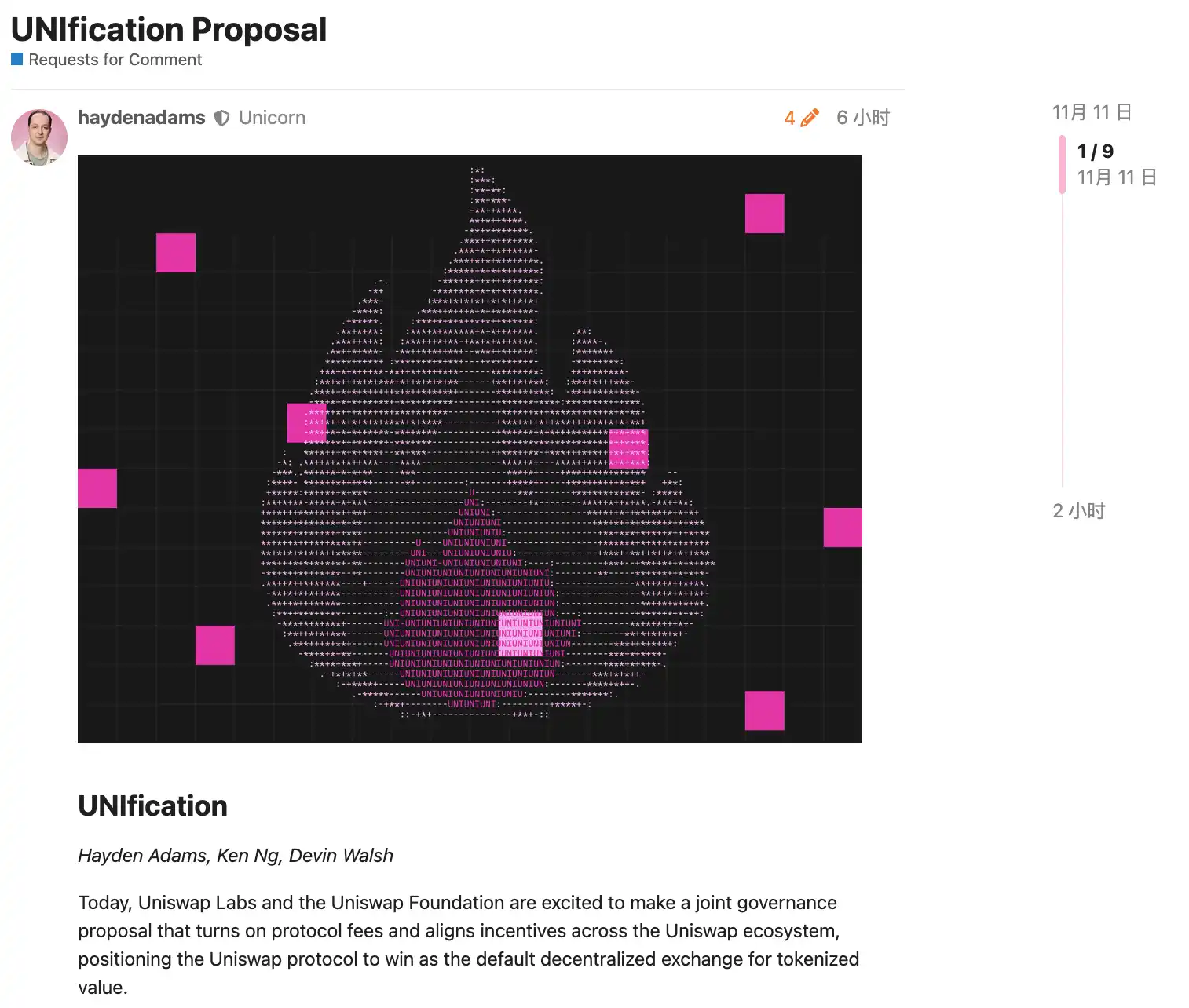
However, this time is different as the proposal is personally initiated by Hayden himself. In addition to the fee switch, it also covers measures such as token burning, Labs, and Foundation merger. Some large holders have already expressed their support, and the proposal has a high 79% probability of passing in the prediction market.
2 Years, 7 Failures, The Perseverance of the "Fee Switch"
The fee switch is actually a quite common mechanism in the DeFi space. Taking Aave as an example, in 2025, it successfully activated the fee switch, using a "buyback + distribution" model to allocate protocol revenue to AAVE token buybacks, driving the price from $180 to $231, achieving a 75% annualized increase.
In addition to Aave, the fee switches of protocols like Ethena, Raydium, Curve, and Usual have also seen significant success, providing a sustainable tokenomics example for the entire DeFi industry.
With so many successful precedents, why has Uniswap been unable to implement it?
a16z Gives In, but Uniswap's Troubles Have Just Begun
Here we have to mention a key player—a16z.
In Uniswap's history, where the number of formal voters is generally low, usually only around 40 million UNI is needed to reach the voting threshold. However, this venture capital giant previously controlled about 55 million UNI tokens, exerting a direct influence on the voting outcome.
They have always been opponents of relevant proposals.
As early as the two temperature checks in July 2022, they chose to abstain, expressing concerns only on the forum. But by the third proposal in December 2022, when pools like ETH-USDT, DAI-ETH were preparing to activate a 1/10 fee rate through on-chain voting, a16z cast a clear dissenting vote, deploying 15 million UNI voting power. This vote ended with a 45% support rate, failing due to insufficient formal voters, despite the majority being in favor. On the forum, a16z explicitly stated: "We ultimately cannot support any proposal that does not consider legal and tax factors." This was their first public opposition.
In subsequent proposals, a16z has consistently held this position. In May and June 2023, GFX Labs introduced two fee-related proposals in succession. Although the June proposal received 54% support, it ultimately failed again due to insufficient on-chain voters, influenced by a16z's casting of 15 million opposed votes. In the governance upgrade proposal in March 2024, the same scenario unfolded once more — with approximately 55 million UNI in support, but thwarted by a16z's opposition. The most dramatic event occurred from May to August 2024, when the proposers attempted to establish the Wyoming-based DUNA entity to mitigate legal risk. The vote was originally scheduled for August 18 but was indefinitely postponed due to a "new issue from an unnamed vested interest," widely believed to be a16z.
So, what is a16z really concerned about? The core issue lies in legal risk.
They believe that once the fee switch is activated, the UNI token may be classified as a security. According to the well-known Howey test in the United States, if an investor has a reasonable expectation of "profits derived from the efforts of others," the asset may be deemed a security. The fee switch precisely creates such an expectation — the protocol generates revenue, and token holders share in the profits, closely resembling the profit-sharing model of traditional securities. a16z partner Miles Jennings was blunt in his forum comments: "DAOs without legal entities face personal liability exposure."
In addition to securities law risk, tax issues are equally thorny. Once fees flow into the protocol, the IRS may require the DAO to pay corporate taxes, with preliminary estimates suggesting a tax liability of up to $10 million. The problem is that the DAO itself is a decentralized organization without a traditional legal entity and financial structure. The unresolved questions of how to pay taxes and who will bear this cost remain. Activating the fee switch hastily, without a clear solution, may expose all governance token holders to tax risks.
As of now, UNI remains the largest single token holding in a16z's cryptocurrency portfolio, with approximately 64 million UNI, retaining significant influence over voting outcomes.
However, as we all know, with the election of President Trump and the turnover at the SEC, the crypto industry has experienced a politically stable spring, reducing Uniswap's legal risks, indicating a gradual softening of a16z's stance. Evidently, this is no longer a concern, and the likelihood of this proposal being approved has greatly increased.
However, this does not mean that there are no other contradictions; Uniswap's fee switch mechanism still has some controversial points.
You Can't Have Your Cake and Eat It Too
To understand these new points of contention, we first need to briefly explain how this fee switch actually works.
From a technical implementation perspective, this proposal made detailed adjustments to the fee structure. In the V2 protocol, the total fee remains at 0.3%, with 0.25% allocated to LPs and 0.05% retained by the protocol. The V3 protocol is more flexible, setting the protocol fee at one-fourth to one-sixth of the LP fee. For example, in a 0.01% liquidity pool, the protocol fee is 0.0025%, equivalent to a 25% profit share; whereas in a 0.3% pool, the protocol fee is 0.05%, representing approximately 17%.
According to this fee structure, Uniswap is conservatively estimated to generate an annualized income of $10 million to $40 million, which could reach $50 million to $120 million in a bull market scenario based on historical peak trading volumes. At the same time, the proposal also includes the immediate burning of 100 million UNI tokens, equivalent to 16% of the circulating supply, and establishes a continuous burn mechanism.
In other words, through the fee switch, UNI will transform from a "worthless governance token" into a true income-generating asset.
Of course, this is great news for Uni holders, but the problem lies precisely here. Because the essence of the "fee switch" is a redistribution of earnings between LPs and the protocol.
The total amount of fees paid by traders will not change; it's just that the earnings that were originally entirely owned by LPs will now have to allocate a portion to the protocol. The cost comes from the source; as protocol earnings increase, LP income will inevitably decrease.
You can't have your cake and eat it too. Uniswap clearly chose the latter in the dilemma of "LP or protocol income?"
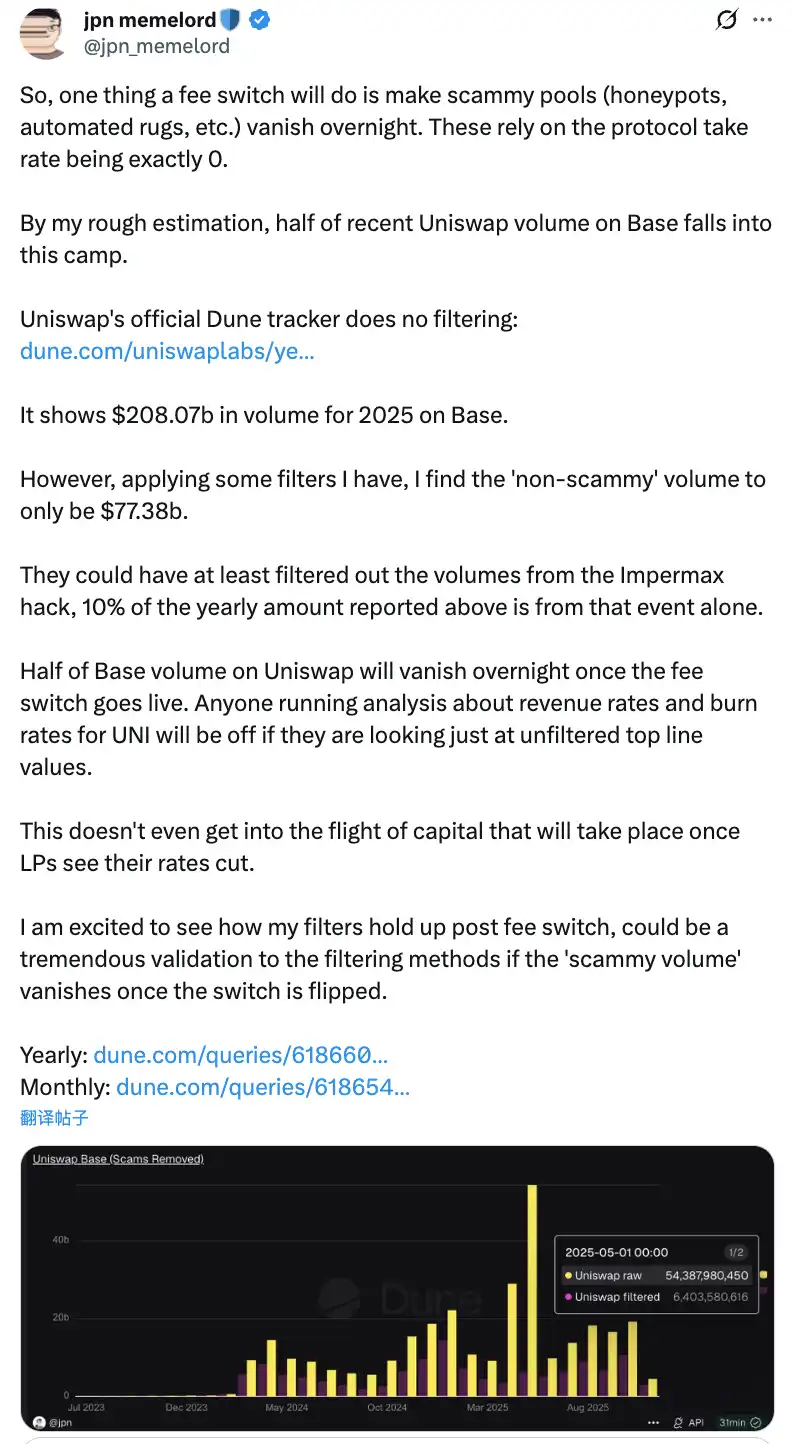
Community discussions once the "fee switch" is activated will lead to half of Uniswap's transaction volume on the Base chain disappearing overnight
The potential negative impact of this redistribution is significant. In the short term, LP earnings will be reduced by 10% to 25%, depending on the protocol fee split. More critically, according to model predictions, there may be a migration of 4% to 15% of liquidity from Uniswap to competing platforms.
In order to mitigate these negative impacts, the proposal also puts forward some innovative compensation measures. For example, internalizing MEV through the PFDA mechanism can provide additional yield to LPs, with each $10,000 transaction generating an additional return of $0.06 to $0.26. The Hooks feature in the V4 version supports dynamic fee adjustments, and aggregator hooks can open up new revenue streams. Additionally, the proposal adopts a phased implementation strategy, starting with a pilot of the core liquidity pool, monitoring the impact in real time, and making adjustments based on data.
The Dilemma of Fee Switch
Despite these mitigation measures, whether it can truly dispel LPs' concerns and ultimately land this proposal may still require time to validate. After all, even if Hayden himself takes action, he may not necessarily be able to rescue Uniswap from this dilemma.
Because the more direct threat comes from market competition, especially in the head-on clash between Uniswap on the Base chain and Aerodrome.
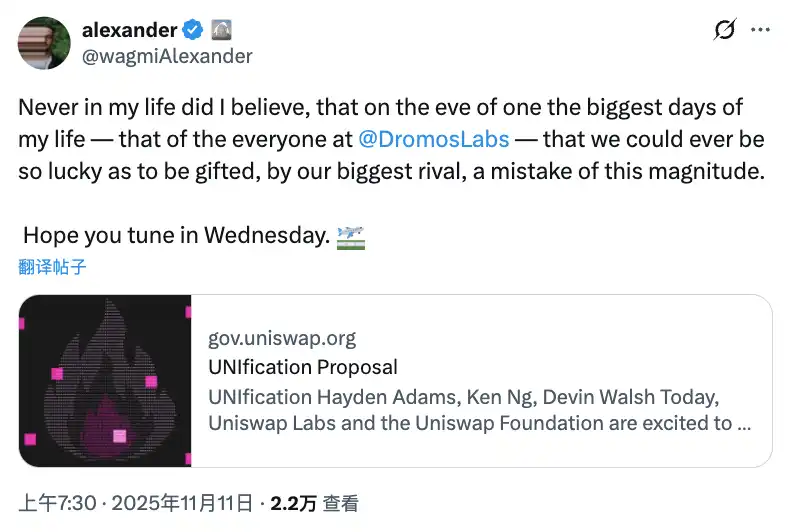
Following Uniswap's proposal, Alexander, the CEO of Dromos Labs, the development team behind Aerodrome, sarcastically remarked on X: "I never thought that on the eve of the most important day for Dromos Labs, our biggest competitor would deliver such a significant mistake."
Aerodrome Crushing Uniswap on the Base Chain
Data shows that in the past 30 days, Aerodrome's trading volume was approximately $204.65 billion, occupying 56% of the market share on the Base chain, while Uniswap's trading volume on Base was around $120-150 billion, holding only 40-44% market share. Aerodrome not only leads by 35-40% in trading volume, but also surpasses Uniswap in TVL with $473 million compared to Uniswap's $300-400 million.
The root of the gap lies in the significant difference in LP yield. Taking the ETH-USDC pool as an example, Uniswap V3's annualized yield is around 12-15%, solely from trading fees. Meanwhile, Aerodrome can provide 50-100% or even higher annualized yield through AERO token incentives, which is 3-7 times that of Uniswap. In the past 30 days, Aerodrome distributed $12.35 million in AERO incentives, precisely guiding liquidity through the veAERO voting mechanism. In contrast, Uniswap mainly relies on organic fees, occasionally rolling out targeted incentive programs, but on a much smaller scale compared to its competitor.
As pointed out by someone in the community: "The reason Aerodrome is able to outperform Uniswap in Base trading volume is because liquidity providers only care about the return on their investment of one dollar of liquidity. Aerodrome excels in this aspect." This observation hits the nail on the head.
For LPs, they will not stay because of Uniswap's brand influence; they only look at the yield. And on Base, a burgeoning L2 solution, Aerodrome, as a native DEX, has established a powerful first-mover advantage with a specially optimized ve(3,3) model and significant token incentives.
In this context, if Uniswap activates the fee switch, further reducing LP returns, it could accelerate liquidity migration to Aerodrome. According to modeling predictions, the fee switch may lead to a 4-15% liquidity loss, and in a highly competitive battlefield like Base, this ratio could be even higher. Once liquidity decreases, slippage increases, and trading volume subsequently declines, forming a negative spiral.
Can a New Proposal Save Uniswap?
From a purely numerical perspective, the fee switch can indeed bring significant revenue to Uniswap. According to community member Wajahat Mughal's detailed calculations, the situation is already quite remarkable based only on V2 and V3.
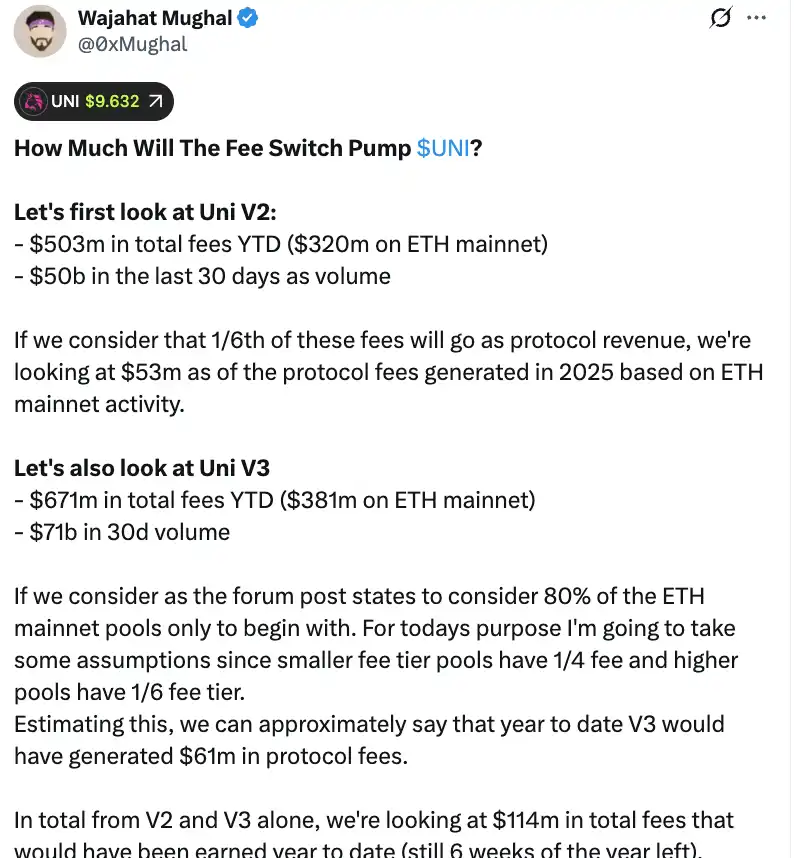
The V2 protocol has generated a total fee of $503 million from the beginning of 2025, with the Ethereum mainnet contributing $320 million, and the recent 30-day trading volume reaching $500 billion. If calculated based on a 1/6 fee split, considering Ethereum mainnet activity, the projected protocol fee income for 2025 could reach $53 million. The performance of the V3 protocol is even stronger, with a total fee of $671 million from the beginning of the year, where the Ethereum mainnet accounts for $381 million, and the 30-day trading volume is as high as $710 billion. Taking into account the fee split proportions for different fee tier pools—where low fee tier pools take 1/4 of the protocol fee and high fee tier pools take 1/6—V3 may have already generated $61 million in protocol fees since the beginning of the year.
Combining V2 and V3, the projected protocol fee income since the beginning of the year has already reached $1.14 billion, and this is with still 6 weeks left until the year-end. More importantly, this number is far from Uniswap's full revenue potential. This calculation does not include the remaining 20% of V3 pools, fees from all chains outside the Ethereum mainnet (especially the Base chain, which generates fees almost equivalent to the Ethereum mainnet), V4 trading volume, protocol fee discount auctions, UniswapX, aggregation hooks, and Unichain's sorter revenue. If all of these factors are taken into account, annualized revenue could easily surpass $130 million.
With the plan to burn 1 billion UNI tokens immediately (worth over $8 billion at current prices), Uniswap's tokenomics will undergo a fundamental change. The fully diluted valuation post-burn will decrease to $7.4 billion, with a market cap of around $5.3 billion. Calculated with an annual income of $130 million, Uniswap will be able to buy back and burn approximately 2.5% of the circulating supply annually.
This means that UNI's P/E ratio is around 40x, which may not seem cheap, but considering there are still many revenue-generating mechanisms yet to be fully unleashed, this number has significant room to decrease. As someone in the community has remarked: "This is the first time the UNI token has truly become appealing to hold."
However, behind these impressive numbers, there are also significant concerns that cannot be ignored. Firstly, the trading volume in 2025 is significantly higher than in the past few years, largely benefiting from the bull market. Once the market enters a bear cycle, trading volume will plummet, and protocol fee revenue will also shrink. Using revenue forecasts based on bull market data as the basis for long-term valuation is evidently somewhat misleading.
Secondly, the specific operation of the buyback mechanism is still unknown. Will it adopt an automated buyback system similar to Hyperliquid, or will it be executed through other means? Details such as the frequency of buybacks, price sensitivity, and market impact will directly influence the actual effectiveness of the burn mechanism. If executed improperly, large-scale market buybacks could instead trigger price fluctuations, putting UNI holders in an awkward position of "robbing Peter to pay Paul."
While platforms like Aerodrome, Curve, Fluid, Hyperliquid, and others are all attracting liquidity through high incentives, will Uniswap's reduction in LP rewards accelerate capital outflows? The data looks promising, but if the foundational liquidity is lost, even the most beautiful revenue forecasts will be only a castle in the air.
A fee switch can bring value support to UNI, this is beyond doubt. But whether it can truly "save" Uniswap, allowing this former DeFi leader to return to its peak, probably still requires a dual test of time and the market.
You may also like

Aave’s $10M Token Purchase Raises Concerns Over Governance Power
Key Takeaways: Aave founder Stani Kulechov’s $10 million AAVE token purchase sparks debates over governance power concentration. Concerns…

Web3 and DApps in 2026: A Utility-Driven Year for Crypto
Key Takeaways The transition to utility in the crypto sector has set a new path for 2026, emphasizing…
How to Evaluate a Curator?

December 24th Market Key Intelligence, How Much Did You Miss?

Base's 2025 Report Card: Revenue Grows 30X, Solidifies L2 Leadership

From Aave to Ether.fi: Who Captured the Most Value in the On-Chain Credit System?

Venture Capital Post-Mortem 2025: Hashrate is King, Narrative is Dead

DeFi Hasn't Collapsed, So Why Has It Lost Its Allure?

NIGHT, with a daily trading volume of nearly $10 billion, is actually coming from the "has-been" Cardano?
Aave Community Governance Drama Escalates, What's the Overseas Crypto Community Talking About Today?

2025 Token Postmortem: 84% Peak at Launch, High-Cap Project Turns into a "Rug Pull" Epicenter?
Polymarket Announces In-House L2, Is Polygon's Ace Up?

Coinbase Joins Prediction Market, AAVE Governance Dispute - What's the Overseas Crypto Community Talking About Today?
Over the past 24 hours, the crypto market has shown strong momentum across multiple dimensions. The mainstream discussion has focused on Coinbase's official entry into the prediction market through the acquisition of The Clearing Company, as well as the intense controversy within the AAVE community regarding token incentives and governance rights.
In terms of ecosystem development, Solana has introduced the innovative Kora fee layer aimed at reducing user transaction costs; meanwhile, the Perp DEX competition has intensified, with the showdown between Hyperliquid and Lighter sparking widespread community discussion on the future of decentralized derivatives.
This week, Coinbase announced the acquisition of The Clearing Company, marking another significant move to deepen its presence in this field after last week's announcement of launching a prediction market on its platform.
The Clearing Company's founder, Toni Gemayel, and the team will join Coinbase to jointly drive the development of the prediction market business.
Coinbase's Product Lead, Shan Aggarwal, stated that the growth of the prediction market is still in its early stages and predicts that 2026 will be the breakout year for this field.
The community has reacted positively to this, generally believing that Coinbase's entry will bring significant traffic and compliance advantages to the prediction market. However, this has also sparked discussions about the industry's competitive landscape.
Jai Bhavnani, Founder of Rivalry, commented that for startups, if their product model proves to be successful, industry giants like Coinbase have ample reason to replicate it.
This serves as a reminder to all entrepreneurs in the crypto space that they must build significant moats to withstand competition pressure from these giants.
Regulated prediction market platform Kalshi launched its research arm, Kalshi Research, this week, aimed at opening its internal data to the academic community and researchers to facilitate exploration of prediction market-related topics.
Its inaugural research report highlights Kalshi's outperformance in predicting inflation compared to Wall Street's traditional models. Kalshi co-founder Luana Lopes Lara commented that the power of prediction markets lies in the valuable data they generate, and it is now time to better utilize this data.
Meanwhile, Kalshi announced its support for the BNB Chain (BSC), allowing users to deposit and withdraw BNB and USDT via the BSC network.
This move is seen as a significant step for Kalshi to open its platform to a broader crypto user base, aiming to unlock access to the world's largest prediction market. Furthermore, Kalshi also revealed plans to host the first Prediction Market Summit in 2026 to further drive industry engagement and development.
The AAVE community recently engaged in heated debates around an Aave Improvement Proposal (AIP) titled "AAVE Tokenomics Alignment Phase One - Ownership Governance," aiming to transfer ownership and control of the Aave brand from Aave Labs to Aave DAO.
Aave founder Stani Kulechov publicly stated his intention to vote against the proposal, believing it oversimplifies the complex legal and operational structure, potentially slowing down the development process of core products like Aave V4.
The community's reaction was polarized. Some criticized Stani for adopting a "double standard" in governance and questioned whether his team had siphoned off protocol revenue, while others supported his cautious stance, arguing that significant governance changes require more thorough discussion.
This controversy highlights the tension between the ideal of DAO governance in DeFi projects and the actual power held by core development teams.
Despite governance disputes putting pressure on the AAVE token price, on-chain data shows that Stani Kulechov himself has purchased millions of dollars' worth of AAVE in the past few hours.
Simultaneously, a whale address, 0xDDC4, which had been quiet for 6 months, once again spent 500 ETH (approximately $1.53 million) to purchase 9,629 AAVE tokens. Data indicates that this whale has accumulated nearly 40,000 AAVE over the past year but is currently in an unrealized loss position.
The founder and whale's increased holdings during market volatility were interpreted by some investors as a confidence signal in AAVE's long-term value.
In this week's top article, Morpho Labs' "Curator Explained" detailed the role of "curators" in DeFi.
The article likened curators to asset managers in traditional finance, who design, deploy, and manage on-chain vaults, providing users with a one-click diversified investment portfolio.
Unlike traditional fund managers, DeFi curators execute strategies automatically through non-custodial smart contracts, allowing users to maintain full control of their assets. The article offered a new perspective on the specialization and risk management in the DeFi space.
Another widely circulated article, "Ethereum 2025: From Experiment to Global Infrastructure," provided a comprehensive summary of Ethereum's development over the past year. The article noted that 2025 is a crucial year for Ethereum's transition from an experimental project to global financial infrastructure. Through the Pectra and Fusaka hard forks, Ethereum achieved significant reductions in account abstraction and transaction costs.
Furthermore, the SEC's clarification of Ethereum's "non-securities" nature and the launch of tokenized funds on the Ethereum mainnet by traditional financial giants like JPMorgan marked Ethereum's gaining recognition from mainstream institutions. The article suggested that whether it is the continued growth of DeFi, the thriving L2 ecosystem, or the integration with the AI field, Ethereum's vision as the "world computer" is gradually becoming a reality.
The Solana Foundation engineering team released a fee layer solution called Kora this week.
Kora is a fee relayer and signatory node designed to provide the Solana ecosystem with a more flexible transaction fee payment method. Through Kora, users will be able to achieve gas-free transactions or choose to pay network fees using any stablecoin or SPL token. This innovation is seen as an important step in lowering the barrier of entry for new users and improving Solana network's availability.
Additionally, a deep research report on propAMM (proactive market maker) sparked community interest. The report's data analysis of propAMMs on Solana like HumidiFi indicated that Solana has achieved, or even surpassed, the level of transaction execution quality in traditional finance (TradFi) markets.
For example, on the SOL-USDC trading pair, HumidiFi is able to provide a highly competitive spread for large trades (0.4-1.6 bps), which is already better than the trading slippage of some mid-cap stocks in traditional markets.
Research suggests that propAMM is making the vision of the "Internet Capital Market" a reality, with Solana emerging as the prime venue for all of this to happen.
The competition in the perpetual contract DEX (Perp DEX) space is becoming increasingly heated.
In its latest official article, Hyperliquid has positioned its emerging competitor, Lighter, alongside centralized exchanges like Binance, referring to it as a platform utilizing a centralized sequencer. Hyperliquid emphasizes its transparency advantage of being "fully on-chain, operated by a validator network, and with no hidden state."
The community widely interprets this as Hyperliquid declaring "war" on Lighter. The technical differences between the two platforms have also become a focal point of discussion: Hyperliquid focuses on ultimate on-chain transparency, while Lighter emphasizes achieving "verifiable execution" through zero-knowledge proofs to provide users with a Central Limit Order Book (CLOB)-like trading experience.
This battle over the future direction of decentralized derivatives exchanges is expected to peak in 2026.
Meanwhile, discussions about Lighter's trading fees have surfaced. Some users have pointed out that Lighter charged as much as 81 basis points (0.81%) for a $2 million USD/JPY forex trade, far exceeding the near-zero spreads of traditional forex brokers.
Some argue that Lighter does not follow a B-book model that bets against market makers, instead anchoring its prices to the TradFi market, and the high fees may be related to the current liquidity or market maker balance incentives. Providing a more competitive spread for real-world assets (RWA) in the highly volatile crypto market is a key issue Lighter will need to address in the future.

The Secret Centralization Landscape of Stablecoin Payments: 85% of Transaction Volume Controlled by Top 1000 Wallets

Audiera Sees Massive Price Surge – Key Cryptocurrency Updates
Key Takeaways Audiera (BEAT) has witnessed significant growth, experiencing a 70.10% increase in the past week. Despite the…

Stability in the Crypto World: Understanding Stablecoin Usage and Its Implications
Key Takeaways Stablecoin use in payments has rapidly increased alongside blockchain technology advancements. Stablecoins USDT and USDC dominate…
Major Cryptocurrency Exchange Updates and Insights
Key Takeaways Cryptocurrency exchanges are continually evolving, adapting to new technologies, and regulatory environments. Decentralized Finance (DeFi) is…

Understand Tokenization, Differentiating Between the DTCC Model and the Direct Ownership Model
Aave’s $10M Token Purchase Raises Concerns Over Governance Power
Key Takeaways: Aave founder Stani Kulechov’s $10 million AAVE token purchase sparks debates over governance power concentration. Concerns…
Web3 and DApps in 2026: A Utility-Driven Year for Crypto
Key Takeaways The transition to utility in the crypto sector has set a new path for 2026, emphasizing…
How to Evaluate a Curator?
December 24th Market Key Intelligence, How Much Did You Miss?
Base's 2025 Report Card: Revenue Grows 30X, Solidifies L2 Leadership
From Aave to Ether.fi: Who Captured the Most Value in the On-Chain Credit System?
Popular coins
Latest Crypto News


Customer Support:@weikecs
Business Cooperation:@weikecs
Quant Trading & MM:bd@weex.com
VIP Services:support@weex.com
 App
App