
- Buy Crypto
- Markets
- Futures
- Spot
- Copy Trade
 Earn
Earn- More
MicroStrategy Joins Nasdaq 100, Bitcoin Buy Pressure Flywheel Activated

Original Article Title: How I Missed My First 100X as a VC
Original Article Author: Marco Manoppo
Original Article Translation: Azuma, Odaily Planet Daily
Editor's Note: Marco Manoppo, an investor at Primitive Ventures, has been quite productive recently. Following his article last week on missing out on Virtuals (see "VC Account: How I Missed a 100X Return Opportunity on Virtuals"), Manoppo has published a new article today.
In this article, Manoppo outlines the trend of Bitcoin moving closer to traditional finance, especially after MicroStrategy (Ticker: MSTR) officially entered the Nasdaq 100 index, and the potential impact of passive investment funds on Bitcoin buying pressure. Against this backdrop, Manoppo states that despite some recent retracements in the cryptocurrency market, it is currently in a price discovery range, but he is more bullish on Bitcoin than ever before.
Below is the full content of Manoppo's article, translated by Odaily Planet Daily.

After eight consecutive weeks of gains, the cryptocurrency market has finally seen some pullback. Despite us being in a price discovery area, my bullish sentiment for Bitcoin is stronger than ever. The reason is simple: Bitcoin as an asset class is now entering the TradFi (Traditional Finance) system.
Growth of Passive Funds
To understand what the TradFi system is, one needs to evaluate the growth of passive funds in investing. Simply put, passive funds are investment products that aim to track and replicate the performance of specific market indices or market segments, rather than trying to outperform them. They follow a set of rules and methodologies to cater to their target market and required risk allocation.
SPY (SPDR S&P 500 ETF Trust) and VTI (Vanguard Total Stock Market ETF) are well-known passive funds. Most investment enthusiasts may still remember Buffett's bet with a hedge fund manager, believing that the performance of the S&P 500 index would outperform most active fund managers — Buffett has been proven correct. Since 2009, passive funds have consistently performed well, becoming the preferred investment method for most people.
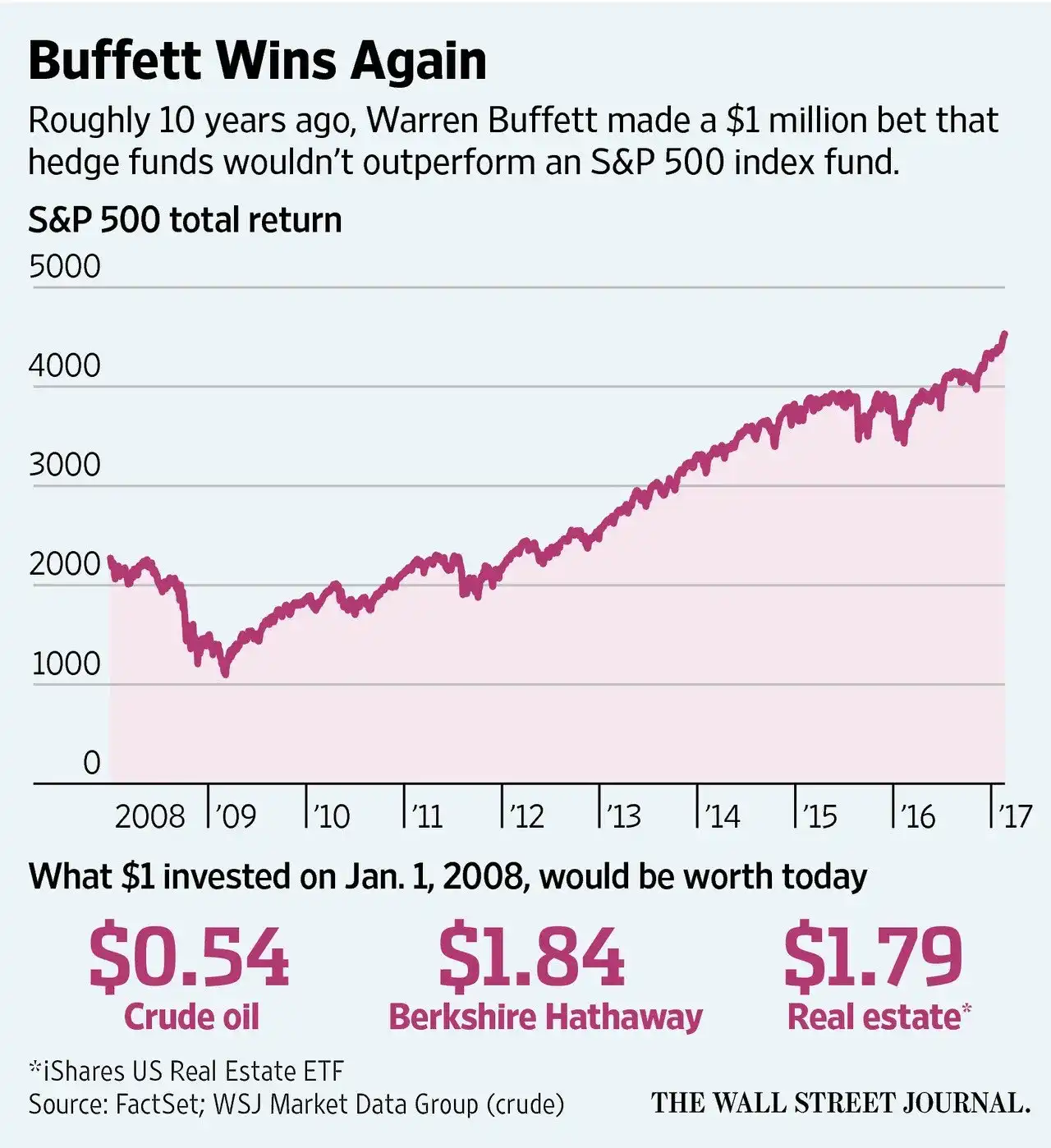
To delve into all the intricate factors driving the development of passive funds, a lengthy article would be needed, but we can summarize it into a few simple factors:
Better Cost Efficiency
Compared to actively managed funds, passive funds (such as index funds and ETFs) typically have a much lower expense ratio. This is because they do not require fund managers to do a significant amount of "active work." Once the rules and methods are set, algorithms take over, with only some human intervention during quarterly rebalancing. Lower costs usually mean better investment net returns, making passive funds more attractive to cost-conscious investors.
Lower Entry Barriers, Wider Distribution
In short, you have easier access to passive funds. Compared to active funds, investors do not need to struggle to select a fund manager; an industry already exists around distributing financial products to your grandparents. For regulatory reasons, passive funds often integrate more easily into the financial supply chain. Most active funds are often restricted in distribution materials, while passive funds have truly integrated into 401k plans, pension systems, and more.
More Stable Performance
The wisdom of the crowd often leads to better outcomes. Over the past 15 years, most active fund managers have failed to outperform the benchmark. While investing in passive funds, you may never get a 10x return as you might from early investment in Tesla or Shopify, but on the flip side, most people are not willing to put 50% of their net worth on a single stock. High risk, high reward is not always so appealing.
Here are some more interesting statistics:
· In the U.S., passive fund assets have quadrupled over the past decade, growing from $3.2 trillion at the end of 2013 to $15 trillion by the end of 2023.
· As of December 2023, passive funds' total assets under management (AUM) in the U.S. officially exceeded active funds for the first time in history.
· As of October 2024, U.S. equity index funds held $13.13 trillion in global assets, with $10.98 trillion in U.S. assets; while actively managed equity funds held $9.78 trillion in global assets, with $7.26 trillion in U.S. assets.
· Currently, index funds account for 57% of U.S. stock fund assets, up from 36% in 2016.
· In the first ten months of 2024, U.S. stock index funds saw inflows of $415.4 billion, while actively managed funds saw outflows of $341.5 billion during the same period.
This is why the entire traditional financial sector or cryptocurrency fund managers with experience in the traditional financial sector are so enthusiastic about the Bitcoin ETF narrative. They know that this is the starting point to open a larger gate, one that will truly bring Bitcoin into the average person's retirement portfolio.
Cryptocurrency Investment Products
But what is the relationship between Bitcoin ETFs and passive funds?
Although the three major index providers (S&P Dow Jones Indices, FTSE Russell, MSCI) have been tirelessly developing cryptocurrency indices, adoption has been relatively slow and currently only single-asset cryptocurrency investment products are available. Of course, this is because these products are easier to launch, so every institution is racing to become the first to launch a Bitcoin ETF. Today, we are seeing major institutions working on advancing an ETH staking ETF and more investment products based on altcoins.
However, the real game-changing product would be one that is a mix of Bitcoin with other investments. Imagine an investment portfolio composed of 95% S&P 500 Index and 5% Bitcoin, or 50% gold and 50% Bitcoin. Fund managers would be keen to promote such a product — they are also more easily integrated into the financial supply chain, increasing their distribution channels.
Nevertheless, the launch and promotion of these products will still take time. And given that they will be introduced as a new product, it is not expected to automatically benefit from the existing monthly purchasing power that popular passive products have.
MSTR Makes TradFi (3,3) Possible
Now it's MicroStrategy's (MSTR) turn to step into the spotlight.
With MSTR being included in the Nasdaq 100 Index, passive funds like QQQ (Invesco QQQ Trust, an ETF that tracks the Nasdaq 100 Index) will be forced to automatically purchase MSTR, and MSTR, in turn, will be able to use these funds to buy more Bitcoin. In the future, new "Bitcoin-Equity-Gold" hybrid passive investment products may take over MSTR's role, but in the foreseeable 3-5 years, MSTR, as a "Bitcoin treasury company," is more likely to play this role more easily because they are a mature U.S. publicly traded company and are more qualified to be included in top passive fund indices faster than newly launched passive investment products.
Therefore, as long as MSTR continues to utilize these funds to purchase more Bitcoin, the buy-side pressure on Bitcoin will continue to increase.
If this sounds too good to be true... that's because there are a few minor caveats to enabling MSTR to more effectively play this role. For example, the current requirement for inclusion in the S&P 500 index mandates that a company has been profitable in the most recent quarter as well as the last four quarters cumulatively, making it unlikely for MSTR to be included. However, new accounting rules set to take effect starting January 2025 will allow MSTR to declare the value change of its held BTC as net income, potentially making MSTR eligible for S&P 500 inclusion.
This is essentially the TradFi's (3, 3) system.
5-Minute Mental Math and Assumptions
I spent 5 minutes doing some quick calculations. If there are any errors in the calculations or suggestions on the assumptions made, feel free to point them out.
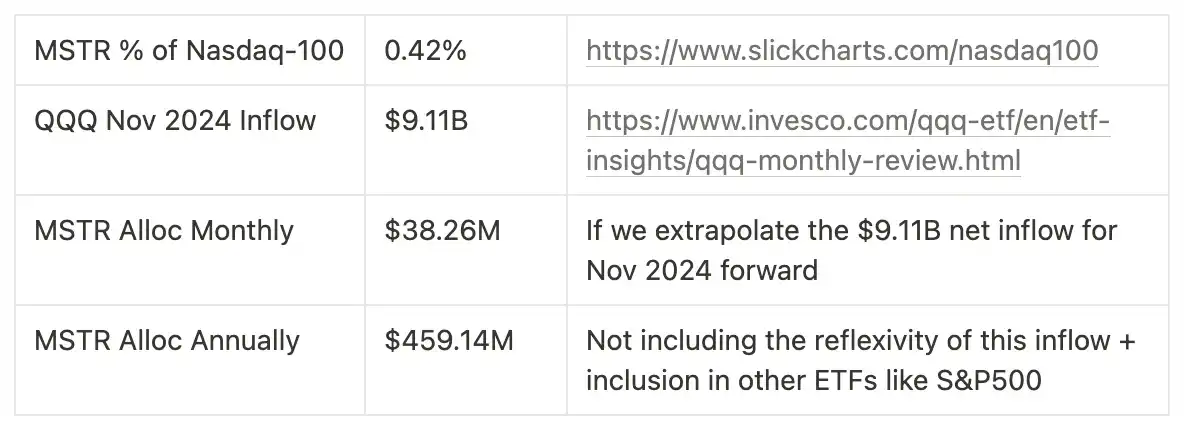
Odaily Note: Taking MSTR's 0.42% weight in the Nasdaq 100 index as an example, with QQQ's net inflow of $9.11 billion in 2024, this corresponds to a monthly net inflow into MSTR of $38.26 million, totaling $459 million annually.
In essence—the entire traditional finance passive investment ecosystem will unknowingly buy more Bitcoin due to MicroStrategy (MSTR) being included in major indices, similar to how they all hold Nvidia stock without realizing it, creating a (3, 3)-like effect on Bitcoin's price.
You may also like

Former Star Public Blockchain Berachain in Crisis: Price Collapse, Layoffs, Developer Exodus

Senate Committee Delays Crypto Bill Due to Coinbase’s Objections
Key Takeaways The Senate Banking Committee has postponed its planned markup of a major crypto market structure bill…

Eric Adams Denies “Rug Pull” Allegations Linked to NYC Token Despite Significant Losses
Key Takeaways: Eric Adams firmly denies allegations implying that money was moved out of the NYC Token. Market…

XRP Price Action: Crypto Bill Could Grant XRP the Same Legal Designation as Bitcoin
Key Takeaways A new legislative draft in the United States might classify XRP alongside Bitcoin (BTC) and Ethereum…

Coinbase CEO Raises Red Flags Regarding US Crypto Bill
Key Takeaways Coinbase CEO Brian Armstrong voices opposition to the proposed Senate crypto bill, citing significant concerns. The…

Asia Market Open: Bitcoin Nears $96K Amid Mixed Asian Stocks and Wall Street Slump
Key Takeaways Bitcoin’s price edges closer to $96,000 amid mixed signals from Asian stock markets and a recent…

Ethereum Price Prediction: SharpLink Activates Multi-Billion ETH Strategy – How Soon Might ETH Achieve a New All-Time High?
Key Takeaways SharpLink has strategically deployed $170 million in Ethereum on the Linea network, showcasing a productive use…

Transforming the Cryptocurrency Landscape: A 2026 Outlook
Key Takeaways Cryptocurrency systems have seen expansive growth and technological innovation. The introduction of new regulations has reshaped…
Pi Coin Price Prediction: Mainnet Tokens Just Unlocked – What Does This Mean for Holders?
Key Takeaways Daily token unlocks are increasing the supply of Pi Coin, affecting its short-term price stability. Pi…

Best Crypto to Buy Now January 14 – XRP, PEPE, Internet Computer
Key Takeaways The current crypto landscape is at a pivotal junction with potential changes in U.S. regulations offering…
New ChatGPT Forecasts for XRP, Ethereum, and Solana by 2026
Key Takeaways ChatGPT predicts a potential bull market for XRP, Ethereum, and Solana by 2026, supported by the…
Zcash Foundation Emerges Unchallenged as SEC Probe Concludes with No Enforcement Actions
Key Takeaways SEC Completes Probe: The U.S. Securities and Exchange Commission (SEC) has concluded its extensive investigation into…

BonkFun Cuts Creator Fees to Zero: Are We Witnessing a New Era in Meme Coin Launchpad Wars?
Key Takeaways BonkFun has eliminated creator fees for its “BONK Classic” launches, with a reduced swap fee of…
Mantra Slashes Staff and Restructures Following ‘Brutal’ OM Token Collapse
Key Takeaways The OM token experienced a dramatic price collapse, prompting a significant restructure within Mantra, including job…

XRP Price Prediction: Ripple Ready to Scale Payments Across Europe — Is $3 Next?
Key Takeaways Ripple has obtained the Electronic Money Institution (EMI) license from Luxembourg’s Commission de Surveillance du Secteur…

Crypto Price Prediction Today 14 January: XRP, PEPE, Maxi Doge
Key Takeaways Amidst a blossoming crypto market, altcoins such as XRP, PEPE, and Maxi Doge are showing promising…

Senate Crypto Bill Hands Treasury “Patriot Act–Style” Surveillance Powers
Key Takeaways The Senate crypto bill proposes new sweeping surveillance powers for the U.S. Treasury, reminiscent of the…

Bitnomial Debuts the First U.S.-Regulated Aptos Futures
Key Takeaways: Bitnomial has launched the first U.S.-regulated futures contracts for Aptos, extending a new avenue for institutional…
Former Star Public Blockchain Berachain in Crisis: Price Collapse, Layoffs, Developer Exodus
Senate Committee Delays Crypto Bill Due to Coinbase’s Objections
Key Takeaways The Senate Banking Committee has postponed its planned markup of a major crypto market structure bill…
Eric Adams Denies “Rug Pull” Allegations Linked to NYC Token Despite Significant Losses
Key Takeaways: Eric Adams firmly denies allegations implying that money was moved out of the NYC Token. Market…
XRP Price Action: Crypto Bill Could Grant XRP the Same Legal Designation as Bitcoin
Key Takeaways A new legislative draft in the United States might classify XRP alongside Bitcoin (BTC) and Ethereum…
Coinbase CEO Raises Red Flags Regarding US Crypto Bill
Key Takeaways Coinbase CEO Brian Armstrong voices opposition to the proposed Senate crypto bill, citing significant concerns. The…
Asia Market Open: Bitcoin Nears $96K Amid Mixed Asian Stocks and Wall Street Slump
Key Takeaways Bitcoin’s price edges closer to $96,000 amid mixed signals from Asian stock markets and a recent…


 App
App