
- Buy Crypto
- Markets
- Futures
- Spot
- Copy Trade
 Earn
Earn- More
OKX & AiCoin Review | Who Earned the Most in Grid Trading Strategy? Unveiling the 6 Major AI Trading "Personalities"

Source: OKX
Recently, the "AI Coin Trading Live Arena" launched by the startup team NOF1 has sparked a frenzy in the crypto and fintech community. This competition provided each AI model with $10,000 in real funds to autonomously trade in the crypto market, making AI's "financial IQ" a hot topic.
Beneath this wave of enthusiasm, a more practical question has emerged: Can ordinary users use AI to enhance already relatively mature fixed trading strategies? To explore the answer, OKX and AiCoin jointly initiated a special experiment: using the same GPT-5, Claude Sonnet 4.5, Gemini 2.5 Pro, DeepSeek V3.1, Qwen3 Max, and Grok-4 AI models (for ease of reading, the following will use the abbreviations of each AI), to provide parameters for the OKX BTC contract grid strategy. Through rigorous backtesting under uniform market conditions, the real level of these AI "traders" was evaluated.
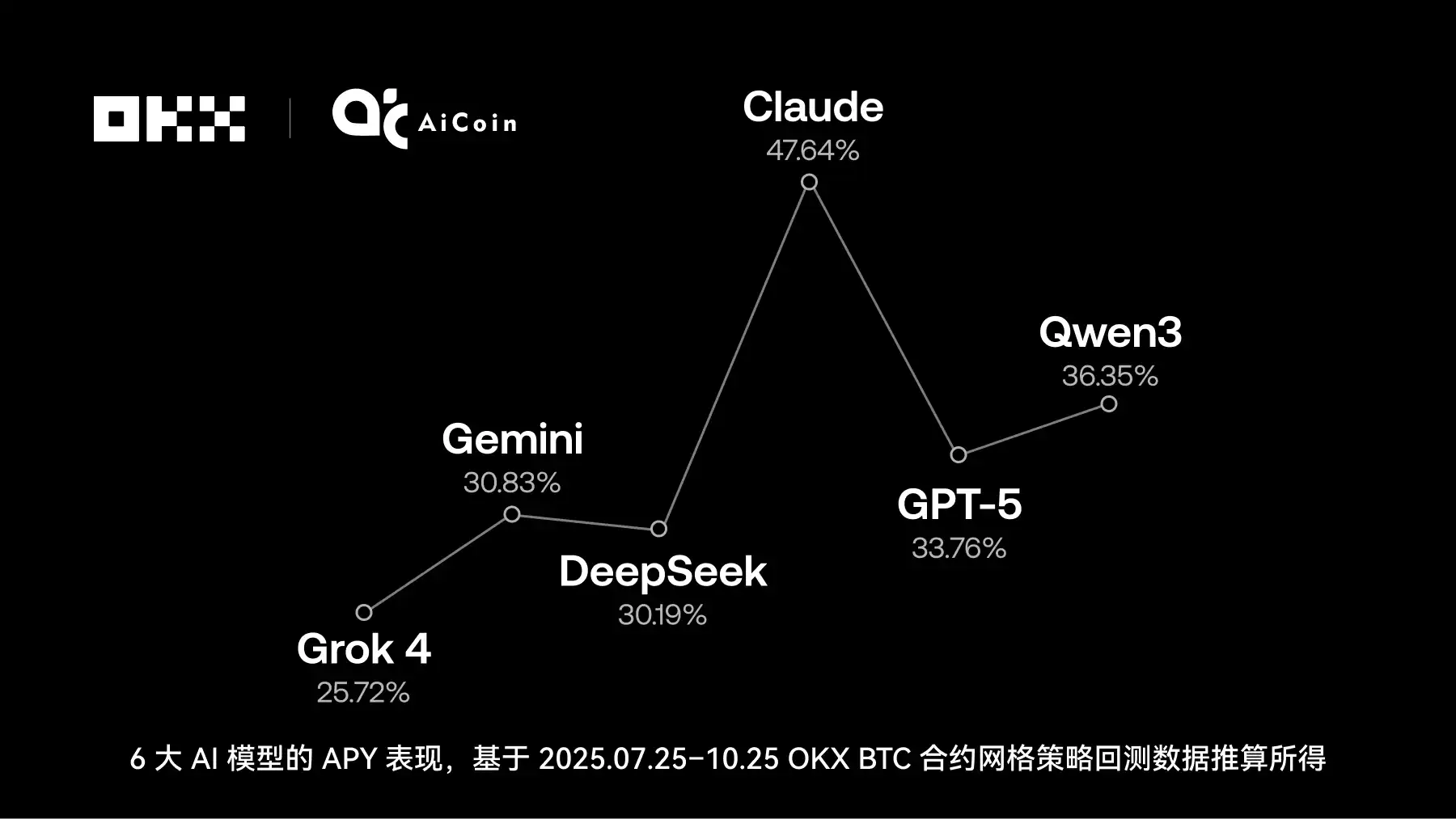
Without considering transaction fees, in addition to the strategy's own returns, if we factor in the additional earnings from OKX's strategy's "Auto Earn" feature (earnings adjust in real-time with the market, previously reaching around 50%, currently at 3%), then Claude's highest APY in the OKX BTC contract grid strategy can reach 50.64%.
Users only need to upgrade the OKX App to version 6.141.0 or above to automatically enjoy the additional earnings from the "Auto Earn" feature, with funds remaining in the strategy account and available for margin use without increasing risk.
Methodology
Evaluation requirements: Each AI, based on OKX's BTC/USDT perpetual 1-hour chart, provides a set of parameters for an AI grid, including price range and number of grids, direction (long, short, neutral), and pattern (arithmetic progression, geometric progression). At the same time, following a uniform capital limit, the investment amount is $100,000 USDT, and all using 5x leverage.
After all parameters are submitted, validation will be conducted in a uniform backtesting environment: The target is the grid strategy of the BTC/USDT perpetual contract on OKX, with a 15-minute candlestick period (or with some deviation), and the backtesting period uniformly set to historical data from July 25, 2025, to October 25, 2025. Then, through AiCoin's platform's batch backtesting feature, a simulation validation will be carried out. This tool will automatically simulate order placement and execution processes based on the input grid parameters and output detailed trade data and profit statistics. The backtesting results will focus on key metrics such as total profit, return rate, win rate, maximum drawdown, and Sharpe ratio to ensure a fair and transparent comparison of each AI strategy under completely identical market conditions.
Strategy Parameter Analysis: AI "Personality" Differences
Comparing the key grid parameters of six major AI models reveals the core differences in their strategy designs:
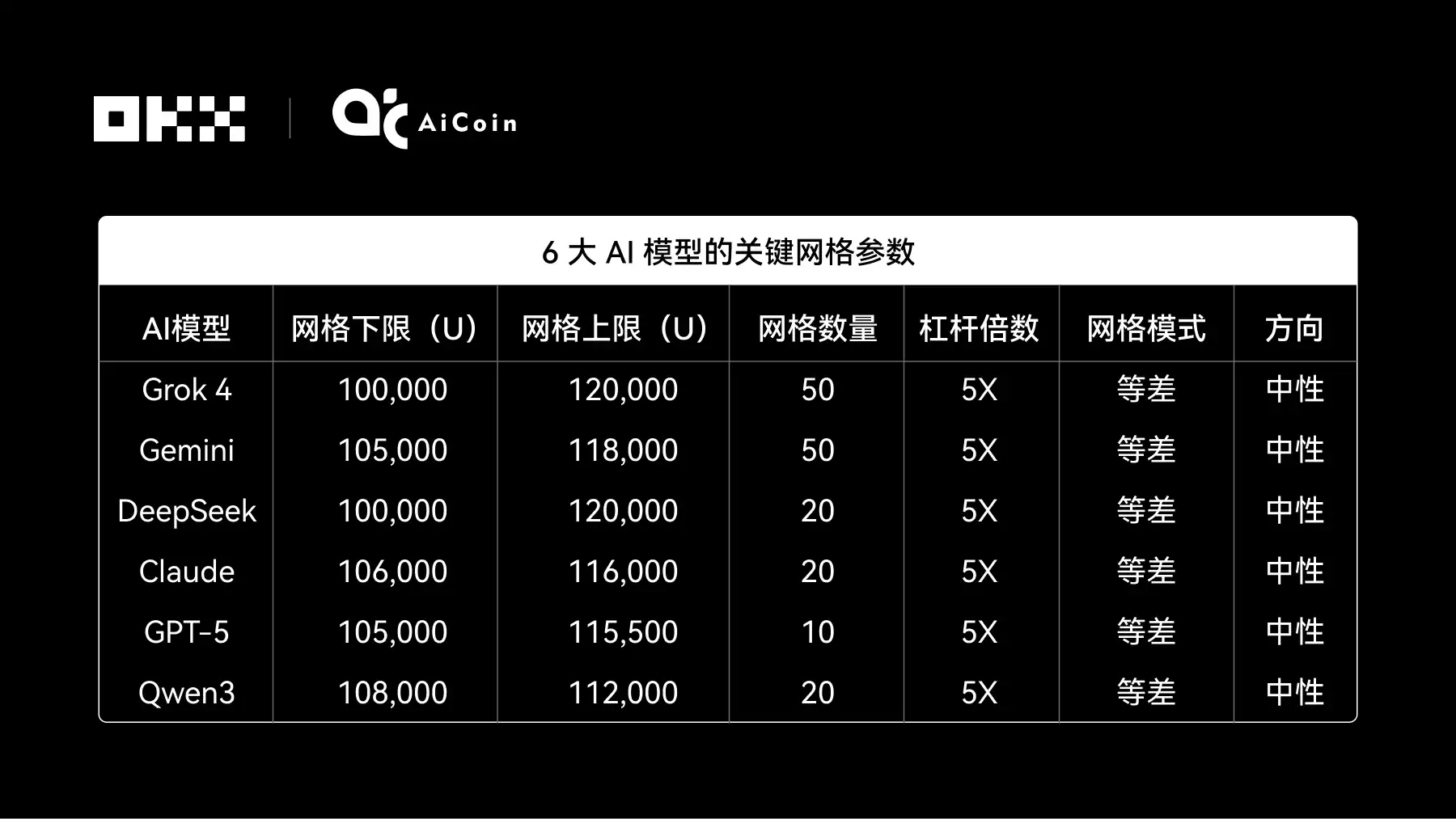
From the table above, it can be seen that all AIs have chosen an arithmetic, rather than a geometric, grid pattern; and a neutral grid strategy, meaning simultaneous arbitrage trading without the need to predict a one-sided trend. In addition, there are significant differences in the price ranges and grid densities provided by each AI:
1) Ultra-High-Frequency Small Amount Faction represented by Grok-4 and Gemini tends to accumulate tiny profits through high-density, high-frequency trading
Both of them use the highest 50-grid layout and the smallest single-grid capital. Gemini's single-grid price interval is the most price-sensitive among all strategies, aiming for ultimate high-frequency arbitrage; while Grok-4 combines a broader 20,000U range to pursue intensive order placement over a wider range. Due to the small single-grid capital, the security of these strategies is relatively higher, but they require the market to maintain a high-frequency oscillation.
2) Steady and Moderate Faction includes DeepSeek and Claude, which use medium-density grids and single-grid capital
Claude's 10,000U range and parameter settings are moderate and balanced. DeepSeek, on the other hand, opts for the widest 20,000U range, aiming to trade at a moderate frequency for more substantial single-trade returns in anticipation of large fluctuations.
3) Large Amount Low-Frequency Faction GPT-5 adopts an extreme "capture big, release small" strategy
It sets the minimum 10-grid layout and the highest single-grid capital, with the largest single-grid price interval, meaning its trading frequency is the lowest, but the single arbitrage profit is the most considerable. This strategy sacrifices profits from small oscillations, focusing on capturing large trend waves. Therefore, its win rate may be higher, but as the single-grid investment is large, once the price breaks out of the range, its liquidation (drawdown) risk is the highest among all strategies.
4) Narrow-Range High-Density Faction Qwen3 aims for efficient arbitrage within a limited range
It adopts the narrowest 4,000U price range among all models, combined with a medium 20-grid layout, making its single-grid price interval relatively small. This is an extremely concentrated strategy that focuses on high-density arbitrage within a specific narrow range. It requires a high level of prediction accuracy, and once the price moves out of the predefined range, the strategy will quickly become ineffective.
Comprehensive Performance Analysis: Claude Dominates, GPT-5 Holds Steady
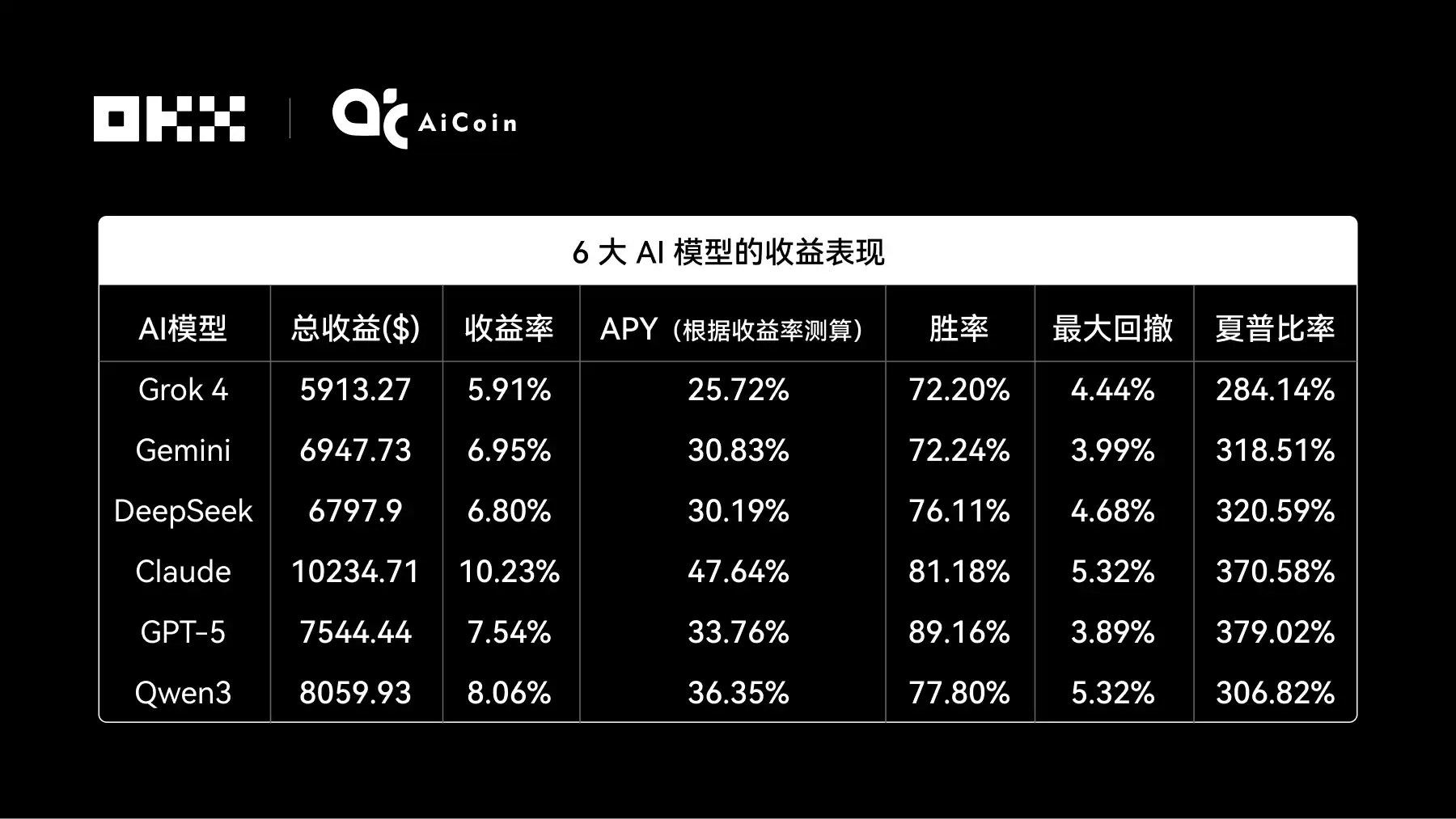
Although AI is not subject to emotional interference, the final data shows that the performance of AI "traders" still highly depends on their data training and model design. Through a comprehensive comparison of metrics such as returns, risk control, and win rate, the strategies of various AI models exhibited significant differentiation under the same capital and leverage conditions, revealing the trade-offs of different AIs in the actual market conditions (Note: Backtesting does not guarantee future returns. While AI can select favorable market conditions, there is still inherent uncertainty in actual performance):
After a holistic evaluation of each model, who truly emerges as the "smart trader"?
1) Return Champion and Risk Taker: Claude
Total Return Leader: Claude stands far ahead with a 10.23% highest return rate, indicating that its combination of a robust range and a moderate grid successfully captured the major price swing range, showcasing the highest effectiveness of the strategy.
Risk and Reward: It also boasts a Sharpe ratio as high as 370.58%, second only to GPT-5, demonstrating excellent risk-adjusted returns. However, its 5.32% maximum drawdown suggests that its high returns are based on enduring larger floating loss volatility, showing a strategy with strong market adaptability and a certain level of risk-taking.
2) Risk Management Master and Efficiency Exemplar: GPT-5
Outstanding Risk Management: GPT-5 perfectly interprets the essence of "don't try to make every penny in the market" strategy. Its low-density grid strategy filters out a significant amount of market noise, resulting in the lowest 3.89% maximum drawdown.
High Efficiency Profits: It secures the top spot with the highest 89.16% win rate and the highest 379.02% Sharpe ratio, proving the robustness and efficiency of its large-scale, low-frequency strategy. GPT-5 is the best example of risk-adjusted returns, reflecting the advantage of reducing trade frequency and focusing on capturing larger volatility opportunities.
3) Strategy Divergence and the Dilemma of High-Frequency Trading
Arbitrage Specialist: Qwen3 ranks third with a 8.06% return rate, showing a decent performance. However, its highly concentrated 4,000U narrow range strategy heavily relies on high-density oscillations within that range. Its equally high 5.32% maximum drawdown, tied with Claude, confirms its high risk concentration—once the market surpasses the narrow range, the strategy faces rapid risk of failure.
High-Frequency Low-Efficiency: Grok-4 and Gemini Although they both employ a similar 50-grid high-density grid strategy, their performance lags behind (Grok-4 has the lowest yield at 5.91%). Their low win rate (around 72%) and lower Sharpe ratio (Grok-4 lowest at 284.14%) suggest that overly frequent small trades may erode profits due to transaction costs such as fees and slippage, failing to demonstrate the advantage of high-frequency trading.
Robust but Unremarkable: Gemini-2.5-Pro has the second-lowest maximum drawdown (3.99%), showing a robust performance, but its yield performance is average, positioning it as a moderate practitioner; DeepSeek-Chat demonstrates robust win rate and drawdown performance (76.11% win rate, 4.68% drawdown), falling between high-frequency and low-frequency strategies.
Key Takeaways: The market has validated that the low-frequency high-profit (GPT-5) and range-precise capture (Claude) strategies outperform the ultra-high-frequency small-profit (Grok-4/Gemini) strategies. GPT-5 emerges victorious with outstanding risk control and the highest Sharpe ratio, while Claude takes the lead with absolute return advantage, representing two successful endpoints of risk control and aggressive returns.
Inspiration and Risk Warning for Strategy Users
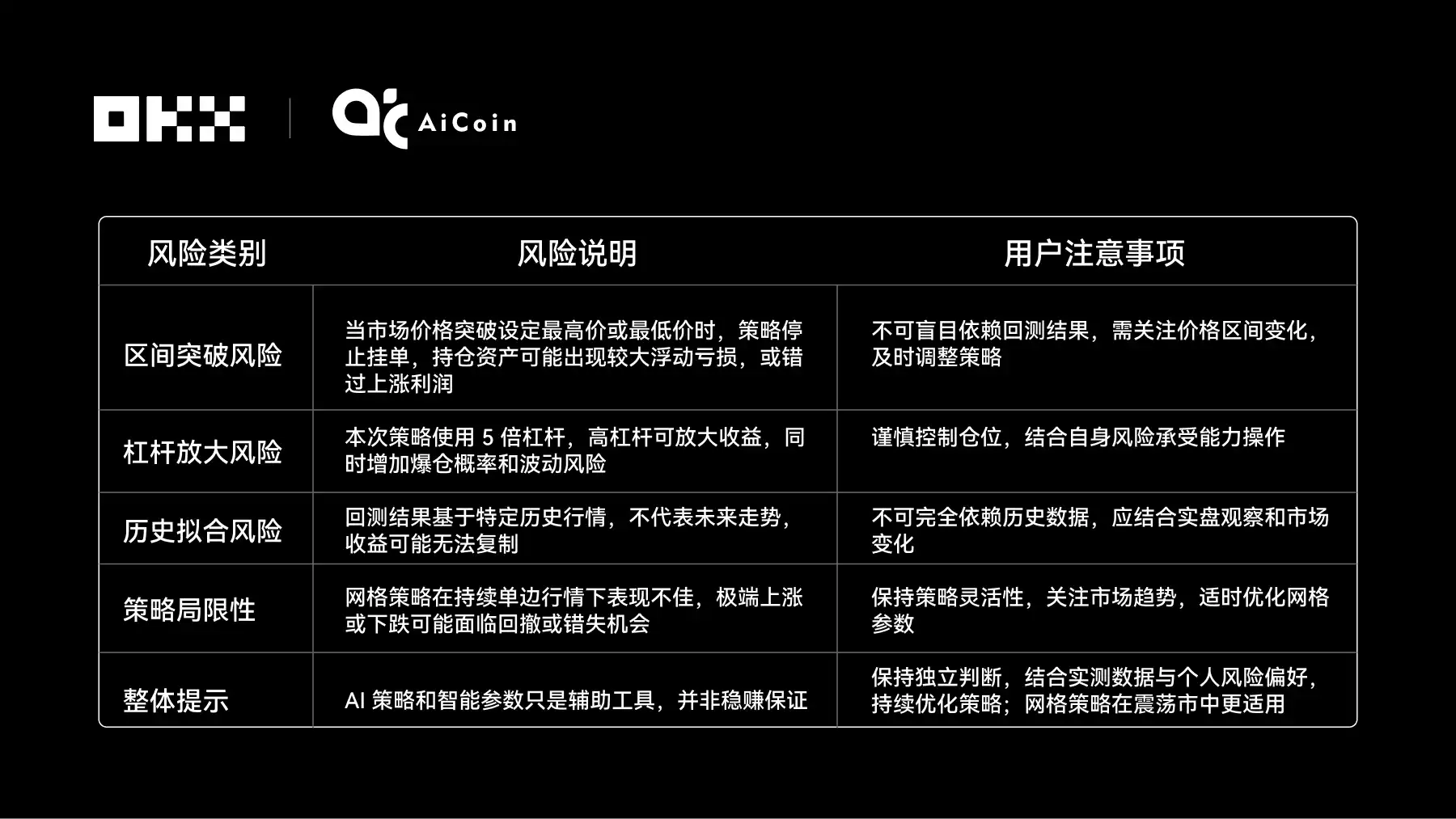
This AI grid trading showdown is not only a technical demonstration but also a vivid trading strategy "lesson." There is no universal strategy, only market-adapted strategies. The core insight from the segmentation of the strategies in this evaluation is that a strategy's success depends on its alignment with the current market conditions: GPT-5's success case clearly tells users that an excellent strategy should not only be profitable but also control drawdown. When setting up a grid, users must prioritize the importance of a high win rate and high Sharpe ratio over just a high yield and set a reasonable stop-loss based on their risk tolerance.
Furthermore, the combination of grid count and price ranges defines the strategy's "character," and users should choose based on their assessment of the market phase.
• Low-Frequency High-Profit vs. High-Frequency Small-Profit: GPT-5's low-density strategy has proven that in specific market conditions, filtering market noise and capturing large swings is more efficient. On the other hand, Grok-4/Gemini's high-density strategy, while trading frequently, fails to achieve the highest returns due to transaction costs, implying that high-frequency small-profit strategies have more stringent requirements based on market conditions.
• Precision Arbitrage: Both Claude's high-yield strategy and Qwen3's narrow-range strategy demonstrate the importance of accurately assessing market trends.
Users can combine the results of this review with OKX platform functionality to make reasoned adjustments.
• Novice or Conservative Users: Can refer to GPT-5's low-density, high-single-lot capital strategy to pursue stability, reduce trading frequency, and psychological pressure.
• Experienced or Return-Driven Users: Can refer to Claude's scheme, which, after accurately assessing the market, uses a medium-density grid to amplify returns, but be prepared to endure significant volatility.
• Using AI Tools to Assist Decision-Making and Adjustment: The parameter combinations provided by the AI model are based on backtesting optimization of historical market data. Users can refer to the parameter design concepts provided by the AI strategy feature of OKX platform for strategy trading but ultimately need to dynamically adjust them based on their own judgment of the currency's trend and volatility. For example: in the face of a one-sided market, they can narrow the range or reduce the grid, and to capture a major market movement, they can increase the range.
• Do Not Invest All Funds in a Single Strategy; Diversify Assets and Targets Reasonably: Utilize OKX's "Take Profit/Stop Loss" feature or regularly close positions to lock in profits, and set stop-loss orders outside the grid range to address losses in the event of a sharp trend reversal.
A Sneak Peek at the End: In addition to backtesting data, we are continuously collecting data on the real-time performance of the six major AI models on OKX BTC contract grid strategy. For more updates, please stay tuned to the official channels of OKX and AiCoin. Stay tuned!
Disclaimer:
This article is for reference only. The article represents the author's views and not those of OKX. This article is not intended to provide (i) investment advice or recommendations; (ii) an offer to buy, sell, or hold digital assets; (iii) financial, accounting, legal, or tax advice. We do not guarantee the accuracy, completeness, or usefulness of such information. Holding digital assets (including stablecoins and NFTs) involves high risks and may experience significant fluctuations. You should carefully consider whether trading or holding digital assets is suitable for you based on your financial situation. For your specific circumstances, please consult your legal/tax/investment professional. Please take responsibility for understanding and complying with local applicable laws and regulations.
This article is a contribution and does not represent the views of BlockBeats.
You may also like
40 Tournaments Per Year, 700 Million Viewers: How Fight.ID Is Leading Global Esports into Web3
Does the fan economy not work in Web3? Fight.ID wants to give it another try—using the UFC event cycle.
AI News Today: Can AI Make Blockchain Systems More Reliable in Live Crypto Markets?
Learn how AI is used in blockchain systems to detect risks, improve reliability, and support secure crypto trading in live crypto market environments.

What Is AI Trading in Crypto Markets and Why WEEX Alpha Awakens Matters in 2026
Learn what AI trading is and how WEEX Alpha Awakens tests AI trading strategies in live crypto markets, helping traders evaluate real AI trading platforms in 2026.
AI Wars Forked Entry Enters Key Phase as 8–10 AI Strategies Per Group Compete for a Single Final Spot
WEEX AI Wars is an AI trading competition and hackathon focused on real-market execution. Learn how AI trading strategies, algorithmic trading, and the prize pool work.

2026 Airdrop Interoperability Guide: Navigating 182 Projects Across Eight Key Tracks
Discover comprehensive interaction strategies for 182 projects across eight tracks to capitalize on 2026 airdrop opportunities. Understand the…

ARK Founder “Wood Sister” 2026 Forecast: Gold Hits a Peak, Dollar Recovers, Bitcoin Sets Its Path
Key Takeaways Cathie Wood anticipates a “golden age” for the US stock market influenced by deregulation, tax cuts,…

These Vibe Coding Crypto Games Are So Immersive
Key Takeaways Vibe coding in the crypto world provides immersive gaming experiences with instant dopamine feedback. Popular games…

Only KYC Can Stop Insider Trading on Prediction Markets, Messari Says
Key Takeaways KYC regulations are essential in curbing insider trading on prediction platforms but are not foolproof. Non-KYC…

Tether Freezes $182 Million in Assets in One Day, Is USDT Still a Neutral Coin?
Key Takeaways: Tether recently froze around $182 million USDT on the Tron blockchain, aligning with U.S. government sanctions.…

WEEX Football Trading Season: When the LALIGA Season Tightens, Every Decision Matters
The excitement of LALIGA never stops. From intense matchups on the pitch to shifting league standings, competition unfolds week after week. As an official regional partner of LALIGA, WEEX brings that same competitive rhythm into trading — where consistency, strategy, and timing matter just as much.

How AI Trading Systems Perform in Live Markets: Inside the WEEX AI Hackathon Beta Test
WEEX launched a Beta Test to provide participants with a proving ground that closely mirrors real trading conditions, allowing strategy stability, execution capability, and risk control to be tested by the market in advance, while refining an AI trading infrastructure that can truly be deployed in live markets.
Market Correction Drives Major Drop in Meme Coins, WhiteWhale Suffers Significant Losses
Key Takeaways WhiteWhale’s price has plunged by 32.3% over the last 24 hours and is currently 75% below…

Meme Coins Tumble: WhiteWhale and Others Face Severe Losses
Key Takeaways WhiteWhale has experienced a significant decline, dropping by 75% from its peak. The market correction has…

Market Correction Reveals Dramatic Price Shifts in Meme Coins
Key Takeaways WhiteWhale has experienced a steep decline, dropping 75% from its peak. In contrast, $BLACKWHALE surged by…

Market Correction Sparks Unsettling Decline in Meme Coins
Key Takeaways The cryptocurrency market correction has significantly impacted meme coins, notably leading to a 75% drop in…

Meme Coin Market Faces Sharp Decline as WhiteWhale Falls 75%
Key Takeaways WhiteWhale has plummeted 75% from its peak amid the current market correction. Several meme coins, including…
Market Correction Drives Meme Coins’ Value Decline
Key Takeaways The meme coin “WhiteWhale” has experienced a significant 75% drop from its previous high, signaling a…

WhiteWhale Faces 75% Decline Amidst Market Correction
Key Takeaways WhiteWhale has experienced a drastic 75% drop from its previous high on January 10th due to…
40 Tournaments Per Year, 700 Million Viewers: How Fight.ID Is Leading Global Esports into Web3
Does the fan economy not work in Web3? Fight.ID wants to give it another try—using the UFC event cycle.
AI News Today: Can AI Make Blockchain Systems More Reliable in Live Crypto Markets?
Learn how AI is used in blockchain systems to detect risks, improve reliability, and support secure crypto trading in live crypto market environments.
What Is AI Trading in Crypto Markets and Why WEEX Alpha Awakens Matters in 2026
Learn what AI trading is and how WEEX Alpha Awakens tests AI trading strategies in live crypto markets, helping traders evaluate real AI trading platforms in 2026.
AI Wars Forked Entry Enters Key Phase as 8–10 AI Strategies Per Group Compete for a Single Final Spot
WEEX AI Wars is an AI trading competition and hackathon focused on real-market execution. Learn how AI trading strategies, algorithmic trading, and the prize pool work.
2026 Airdrop Interoperability Guide: Navigating 182 Projects Across Eight Key Tracks
Discover comprehensive interaction strategies for 182 projects across eight tracks to capitalize on 2026 airdrop opportunities. Understand the…
ARK Founder “Wood Sister” 2026 Forecast: Gold Hits a Peak, Dollar Recovers, Bitcoin Sets Its Path
Key Takeaways Cathie Wood anticipates a “golden age” for the US stock market influenced by deregulation, tax cuts,…


 App
App