
- Buy Crypto
- Markets
- Futures
- Spot
- Copy Trade
 WE-Launch
OKX Web3 Security Team: Protecting Your Private Key Like Protecting Your Eyes

Source: OKX
Not Your Keys, Not Your Coins — Decentralized freedom at the cost of absolute "private key security."
A Chainalysis report from July 2025 shows that 17%-23% of Bitcoin is permanently dormant due to private key loss or device damage. Since the private key represents asset ownership, once lost, it cannot be reset, and there is no customer service to help retrieve it. If the key is compromised and the funds are stolen, recovery is nearly impossible. The online world has granted us freedom but has also placed full responsibility back in our hands. As the online ecosystem thrives, various asset theft incidents have occurred frequently. However, individuals often realize it too late and struggle to identify where the issue occurred — Was the private key leaked? Did they click a phishing link? Download malware? Or was it another operational mistake?
The OKX Web3 Security Team aims to enhance everyone's awareness of private key security through this educational content and once again highlight those security blind spots that are often overlooked.
1. Why Might a Private Key or Mnemonic Phrase Leak?
First and foremost, let's correct a common misconception. Many users believe that a private key or mnemonic phrase leak (referred to as "private key leak" hereafter) usually occurs during wallet usage. In reality, if you download and use a wallet through official channels and utilize a wallet from a reputable brand, the private key generally does not leak during normal usage. Private key leaks mostly occur due to improper storage and acquisition by malicious actors. Once someone possesses your private key, they can import it into any wallet and control the account's assets.
In fact, there are many reasons for private key leaks, and the exact source is often challenging to pinpoint completely. However, through analyzing numerous industry cases and assisting in investigations, we have compiled some typical scenarios and clues (as outlined below).
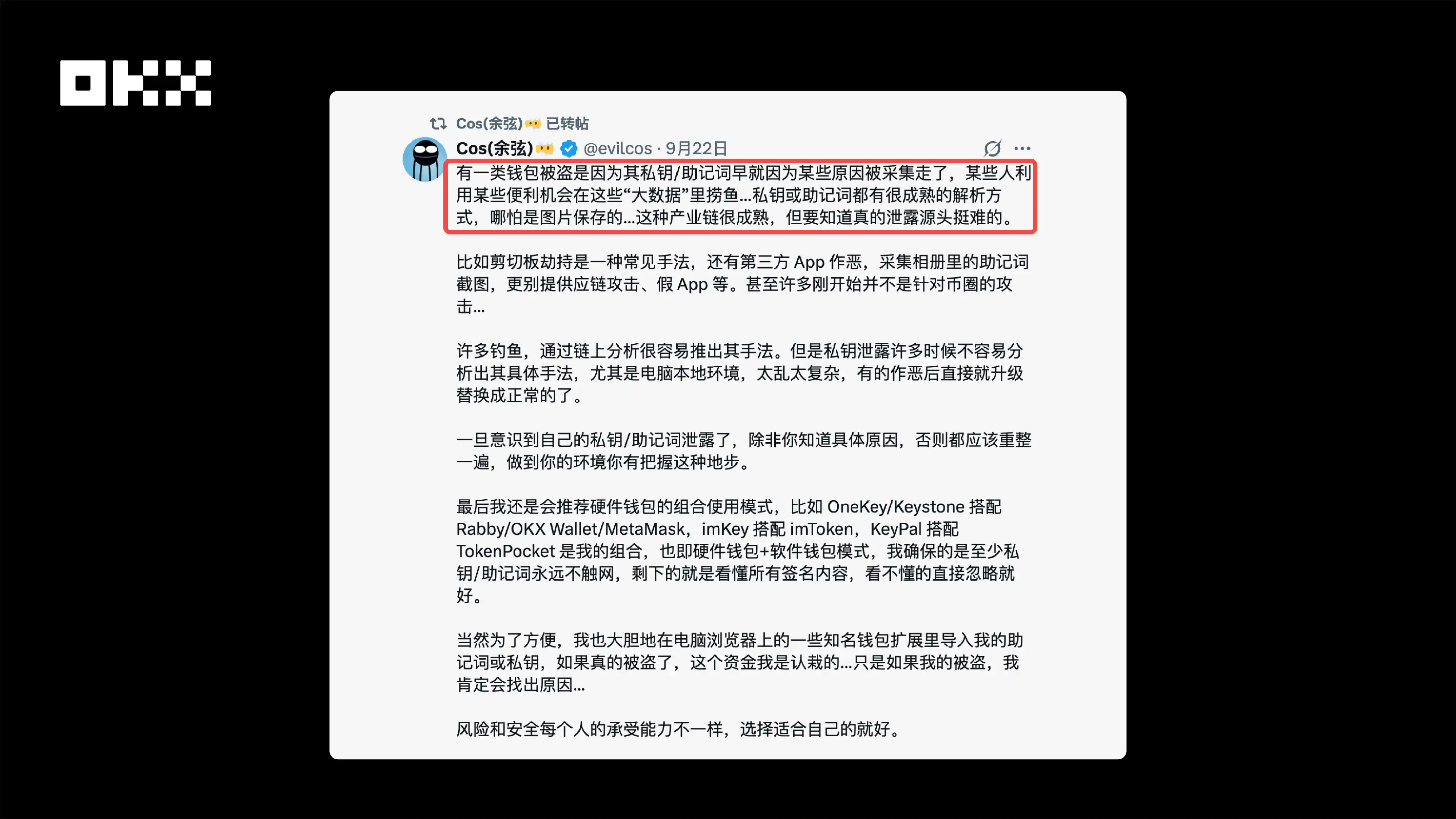
Image: Analysis Challenges in Private Key Theft Shared by SlowMist's Xuandong
2. Common Private Key Leak Scenarios and Mitigation Methods
(1) Most Easily Overlooked Scenario: Leakage During Wallet Creation
Case Study 1: Wallet Creation Assistance by Others. Mr. Li had just started exploring Web3 and, with the help of a "enthusiastic mentor," created a wallet. The mentor assisted him with wallet creation, setting the transaction password, and guided him through deposits and transactions. Although a transaction password was set for the wallet, during the creation process, the mentor had already obtained his private key. A few days later, the 5 ETH Mr. Li had deposited was swiftly transferred out. It was only then he realized that the transaction password was merely for local validation, and anyone with the private key could import it into any wallet and directly transfer his assets.
Security Recommendation: Wallets should be created independently without letting anyone "help" or "act on behalf." If there is suspicion that the private key may have been compromised, assets should promptly be transferred to a new wallet.
Case Study 2: Wallet Creation via Video Conference Screen Sharing. Ms. Zhang, under remote guidance from a "teacher," created a wallet via video conference screen sharing. The teacher demonstrated step by step: downloading the wallet, generating the mnemonic phrase, recharging Gas, and purchasing tokens. The whole process appeared very "intimate," and at the end, she was even reminded, "Never leak your private key to anyone." However, unbeknownst to her, at the moment of screen sharing, the mnemonic phrase might have been recorded. Two weeks later, approximately $12,000 worth of USDT in her account was transferred out.
Security Recommendation: When creating a wallet, disable screen sharing, screen recording, or screen sharing functions. If there is suspicion that the private key may have been compromised, assets should promptly be transferred to a new wallet. Additionally, on the OKX Wallet page displaying the private key and mnemonic phrase, screenshotting, recording, or screen sharing is not allowed, effectively enhancing security.
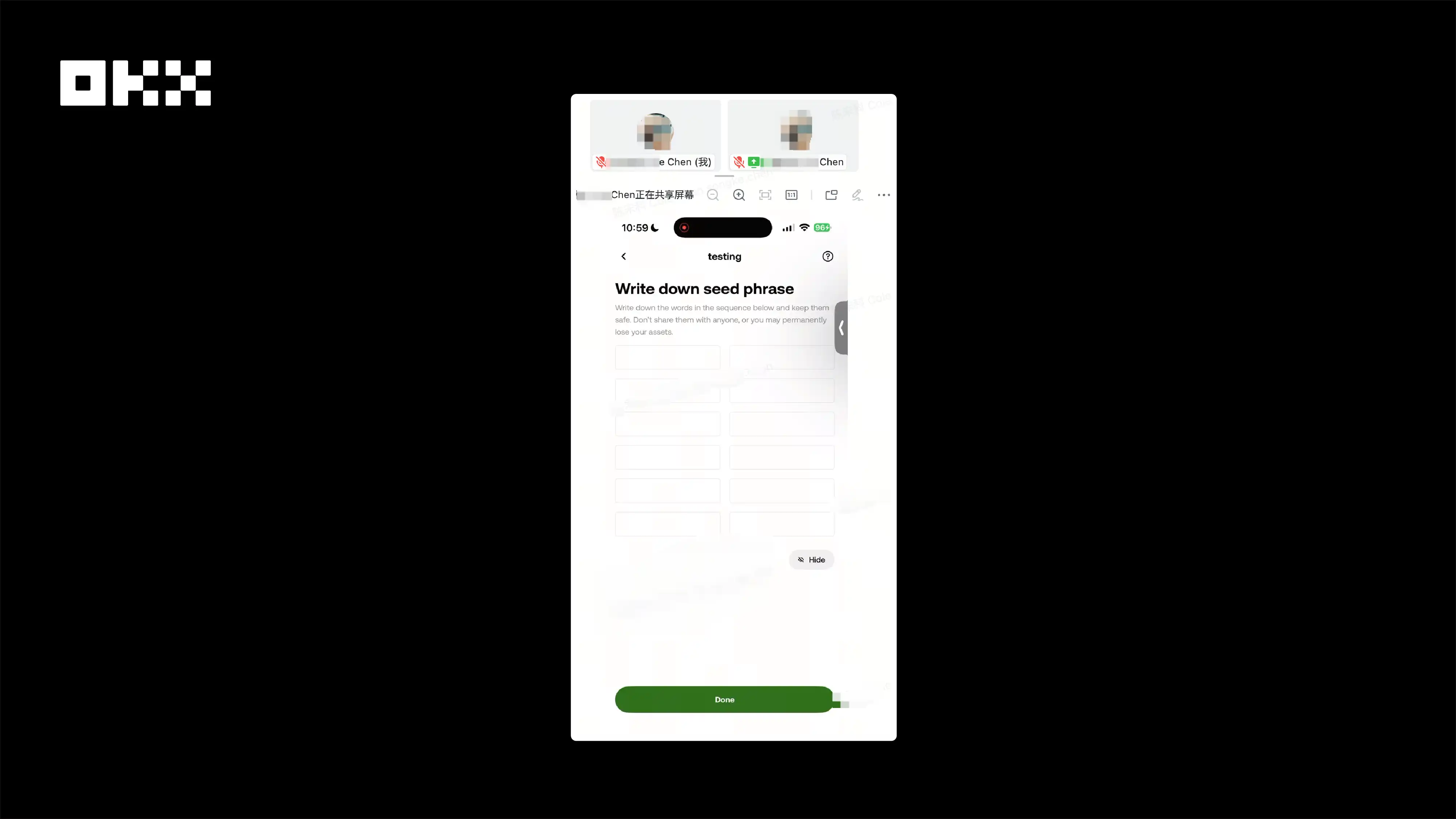
Image: When screen sharing is detected, OKX Wallet automatically hides the mnemonic phrase and private key, preventing others from viewing the text
(II) Most Common Scenario: Improper Private Key Storage Leading to Leakage
Case Study 3: Fake APP, Nightmare of an Android User. Mr. Wang, a cautious user, took a screenshot of the mnemonic phrase after creating a wallet and stored it in his local photo gallery, never uploading it to the cloud, thinking this was safer. However, he downloaded a so-called "enhanced version of Telegram" from a forum, an APP whose icon and interface were nearly identical to the official version. In reality, it continuously scanned the phone's gallery in the background, used Optical Character Recognition (OCR) technology to identify the mnemonic phrase, and automatically uploaded it to a hacker's server. Three months later, all the assets in Mr. Wang's account were emptied, resulting in a loss exceeding $50,000. Technical analysis revealed that his phone also had fake imToken, MetaMask, Google Authenticator, and other malicious APPs.
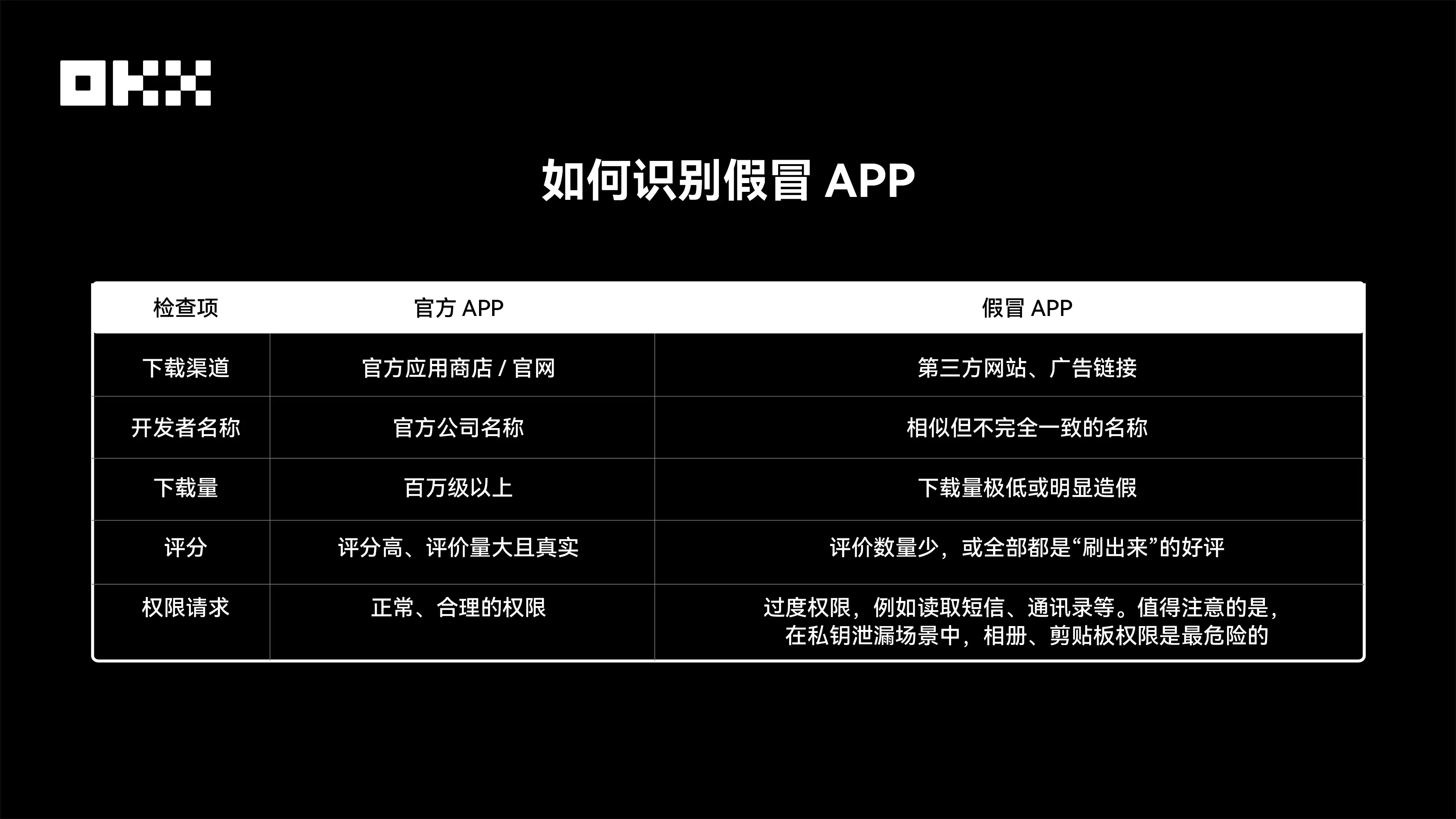
Case Four: BOM Malicious App Leading to Mnemonic Leakage. On February 14, 2025, multiple users experienced concentrated wallet asset theft incidents. Through on-chain data analysis, all these theft cases exhibited typical characteristics of mnemonic/private key leakage. Further revisiting the affected users revealed that most of them had previously installed and used an application called BOM. In-depth investigation showed that this application was actually a carefully disguised fraudulent software. Malicious actors, through user authorization manipulation, illegally obtained mnemonic/private key permissions, enabling systematic asset transfer and attempting to conceal their actions.
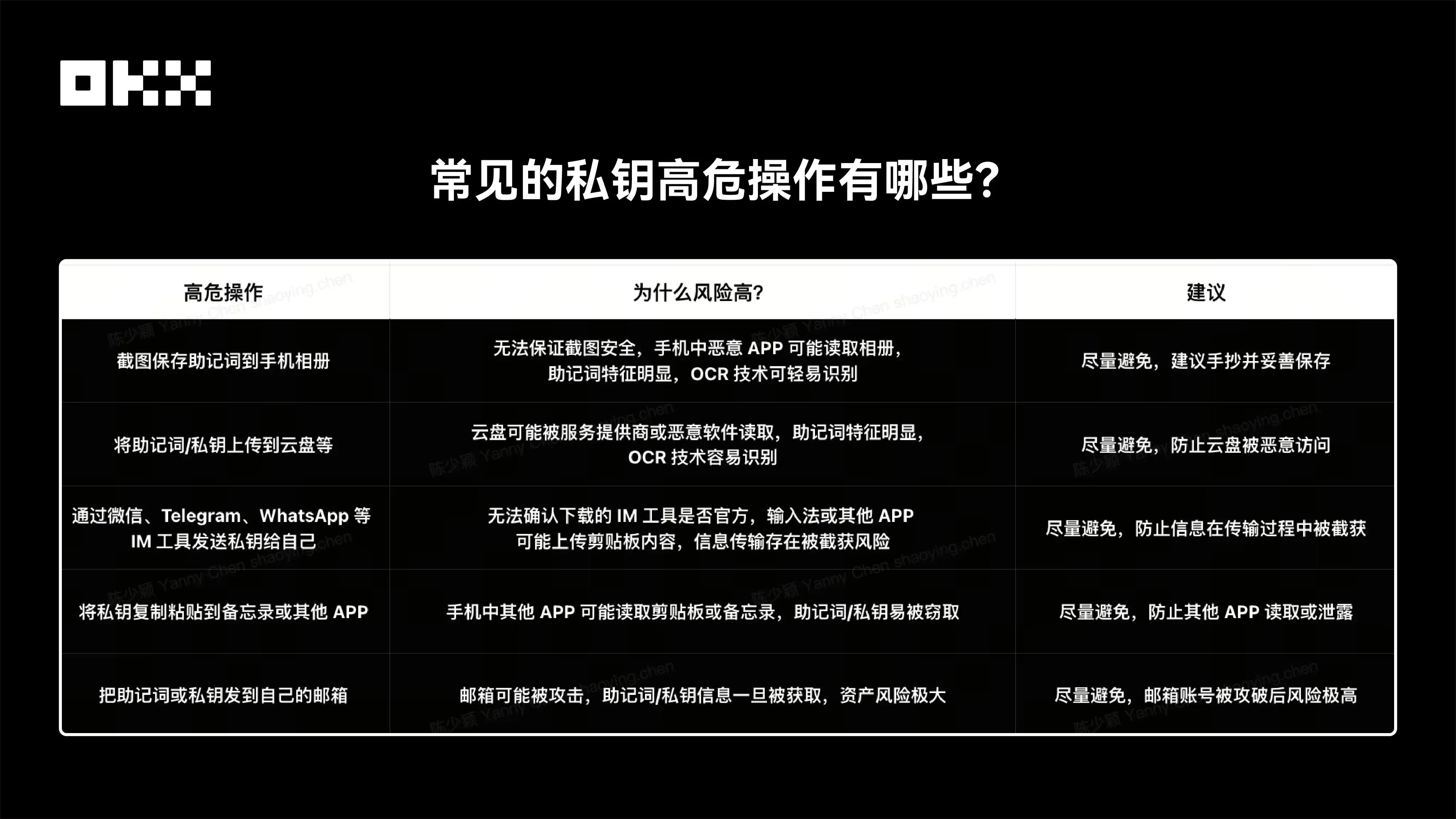
Security Advice: Many users, out of "convenience," develop habits that are ironically the most dangerous. Therefore, it is recommended that everyone: 1) Do not take a screenshot of the mnemonic phrase! It is suggested to manually copy it on paper and store it in a secure place. 2) When downloading an app, make sure to only use the official channels, and do not easily try unknown "enhanced" versions or third-party modifications. 3) If any device anomalies are detected or if the private key has been screenshot before, do not rely on luck and immediately transfer the assets to a new wallet. 4) What has OKX done? To prevent users from taking screenshots on the private key and mnemonic backup pages, we have disabled the screenshot function on these sensitive pages.
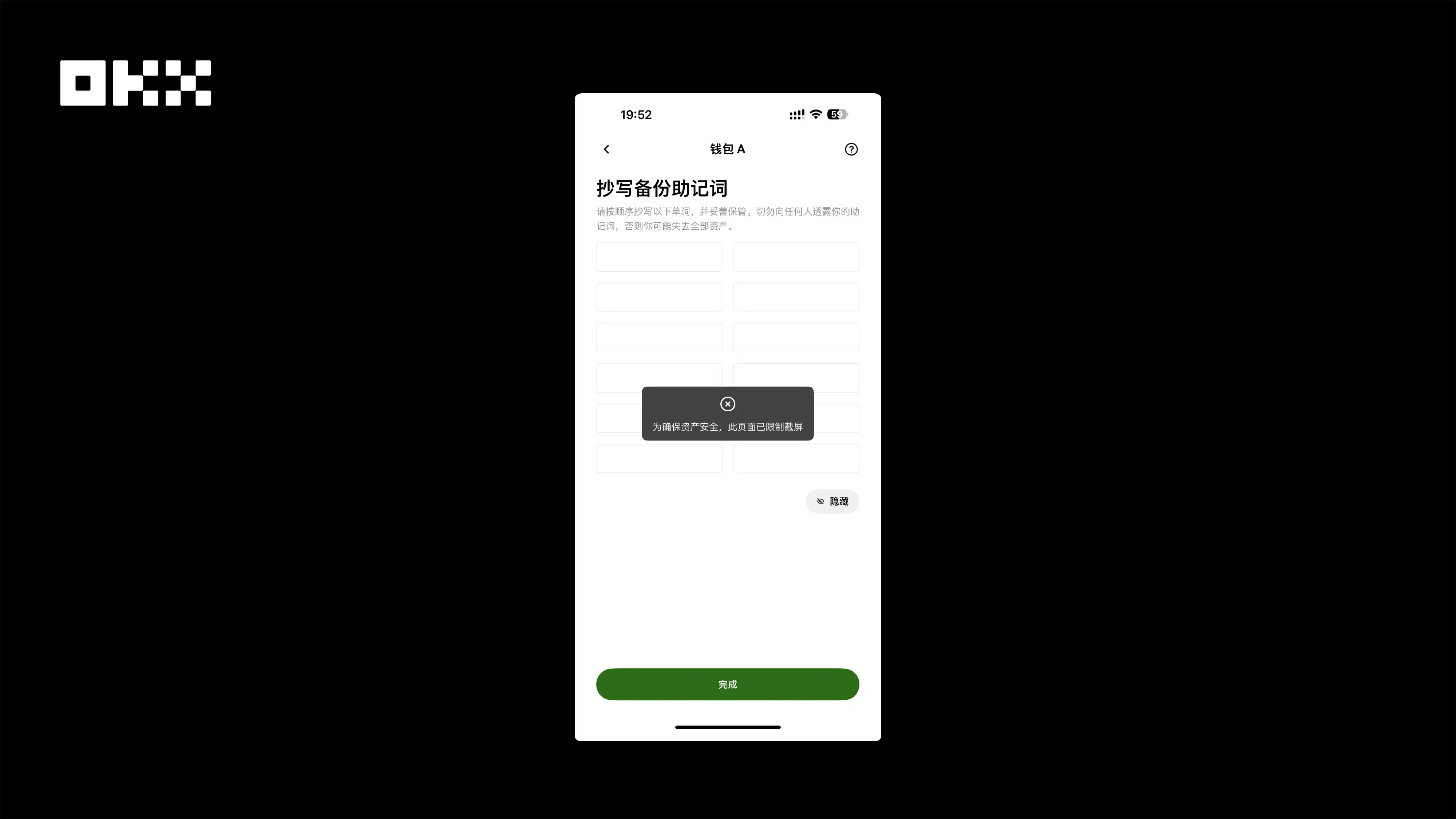
Image: OKX Wallet prohibits screenshots on the private key and mnemonic pages
At the same time, to reduce the risk of users installing fake apps, the Android end also provides a malicious app scanning function.
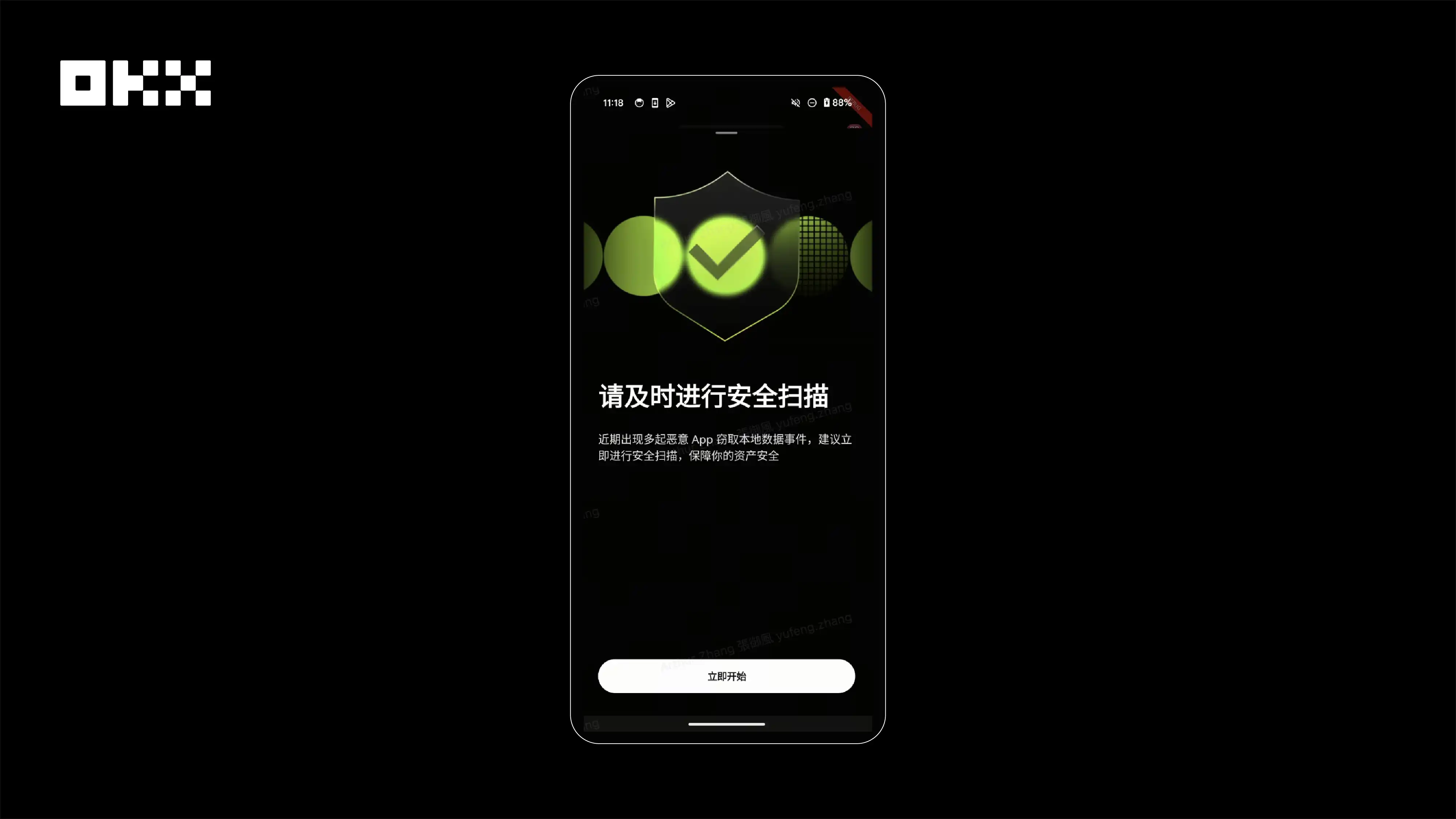
Image: OKX Wallet on Android provides a malicious app scanning function
(III) The Most Common and Easily Deceived Scenario: Phishing of Private Keys
Case Five: Fake Airdrop Phishing. A well-known NFT project announced on Twitter that they would airdrop a new token to holders. Within just 10 minutes after the announcement, multiple phishing websites appeared at the top of Google search results (promoted via paid advertisements). These phishing websites had domain names with just one letter difference (e.g., opensae.io instead of opensea.io), with page designs almost identical to the official website. When users connected their wallets, the page displayed a prompt: "Network congestion, connection failed, please manually enter your mnemonic phrase to claim the airdrop." On that day, more than 50 users fell for the scam, resulting in a total loss of over $200,000. The quickest victim had their assets transferred out within 3.7 seconds of entering their mnemonic phrase.
Case Six: Social Engineering Attack. Ms. Zhao encountered an operational issue in a project's Discord group. An administrator with an avatar and nickname that looked very "official" proactively private messaged her, claiming to be customer support wanting to help her resolve the issue. They sent her a link to a "verification page." Trusting the administrator, Ms. Zhao clicked on the link and entered her mnemonic phrase as instructed. The page looked exactly like the official website. A few minutes later, multiple assets were continuously transferred out of her wallet. It was only then that she realized the so-called administrator was actually a scammer, and any "customer support" asking users to enter their mnemonic phrase or private key on a website is undoubtedly a scam. It is worth noting that in addition to impersonating official administrators, scammers may also impersonate friends, project team members, or other trusted identities.
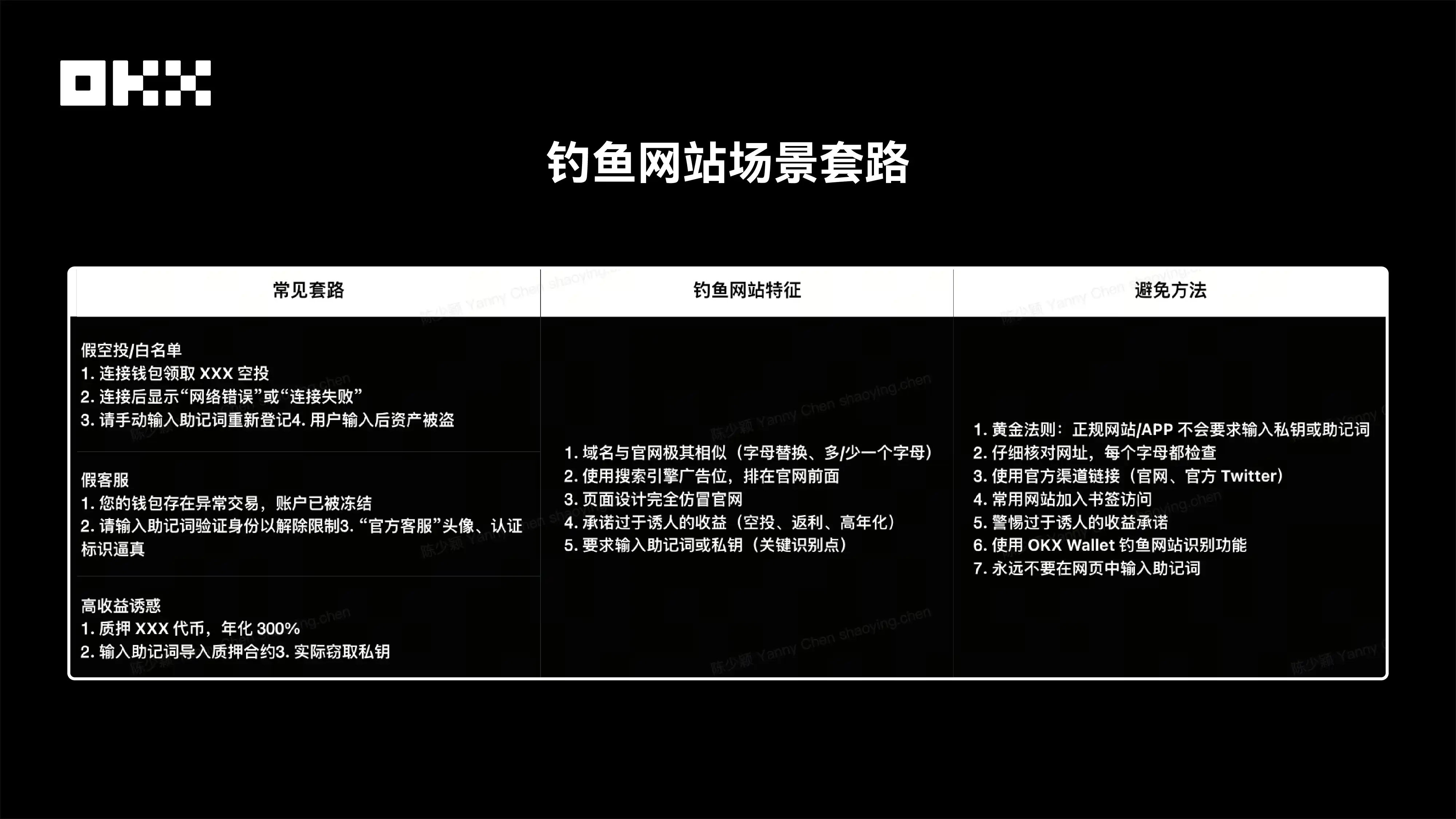
Security Advice: A legitimate DApp will never ask you for your private key, and a trustworthy individual will never request your private key from you. Remember: your private key is the key to your assets, so be sure to store it securely and never disclose it easily.
III. Why Can Wallet Providers Do Little Once a Private Key is Compromised?
Some users, upon discovering a suspected private key leak and assets being moved out, will immediately contact the wallet team, hoping that we can provide more assistance. However, in reality, once the private key has been exposed, the space in which wallet providers can intervene is very limited.
Here, let's briefly explain the basic process we follow when receiving reports of "asset theft," and also explain why many times we cannot directly "recover" on-chain assets:
Firstly, we will assist the user in tracing the flow of funds, analyzing whether on-chain funds may be related to known hacker groups or address clusters. At the same time, we will advise the user to quickly transfer any assets that have not been stolen to reduce the risk of further losses. In cases of significant theft, we will recommend that users promptly contact local law enforcement for assistance through legal channels. Our internal team will also conduct a thorough analysis of the incident, summarize the hacker's modus operandi, and provide insights for future user protection.
As a tool provider, wallets themselves cannot freeze or roll back on-chain assets. Once a hacker obtains the private key, they typically use automated scripts to complete the fund transfer within seconds, with a very rapid speed that is difficult to intervene in. Only when the stolen funds eventually flow into a centralized exchange platform is it possible to apply for temporary freezing through legal channels.
When the funds' trajectory is linked to known hacker clusters we are aware of, we will start from their common modus operandi to help users recall if they recently engaged in any high-risk operations, thereby determining at what point the private key may have been exposed.
OKX has always prioritized user fund security, investing heavily over the years to build a risk control system and design multi-factor authentication mechanisms. Although these processes may seem cumbersome, they are all aimed at better protecting user asset security. It can be said that we are also one of the teams in the industry that has invested the most in security.
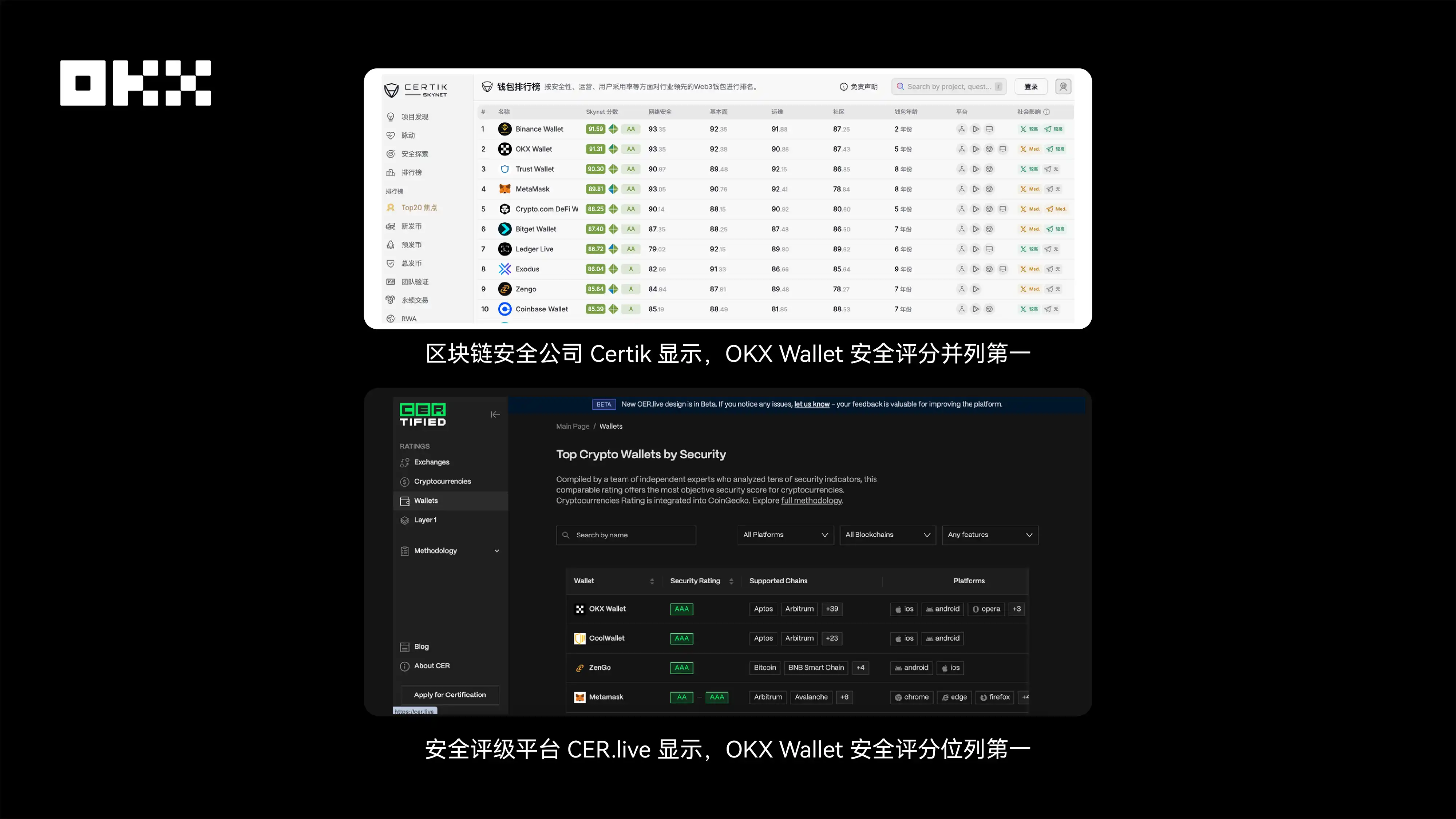
Image: OKX Wallet Security Score Ranks First
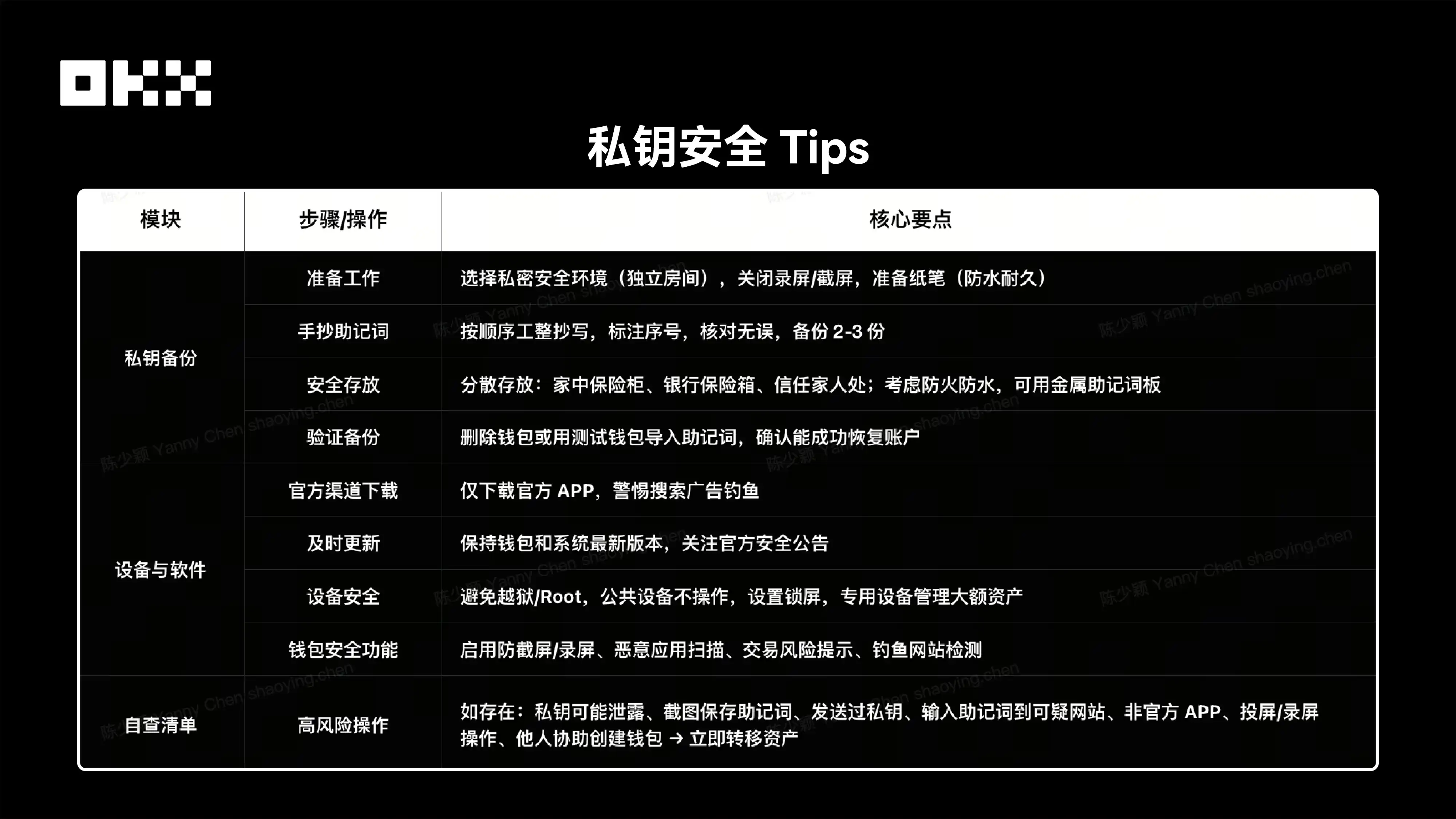
As mentioned earlier, if users lack security awareness or use practices improperly, they may still suffer losses due to reasons such as phishing or private key leakage, regardless of which wallet they use. Therefore, properly safeguarding the private key always remains the most critical security foundation. In addition to continuously enhancing the product's own security capabilities, we also continually strengthen case analysis and share security tips to help users better identify potential risk scenarios.
4. In Summary, Private Key Security Tips
Disclaimer:
This article is for reference only. This article does not intend to provide (i) investment advice or investment recommendations, (ii) an offer, solicitation, or inducement to purchase, sell, or hold digital assets, or (iii) financial, accounting, legal, or tax advice. Digital assets (including stablecoins and NFTs) are subject to market fluctuations, involve high risk, and may depreciate. For questions regarding whether trading or holding digital assets are suitable for you, please consult your legal/tax/investment professional. The OKX Web3 Wallet is only a type of self-custody wallet software service that allows you to discover and interact with third-party platforms, and the OKX Web3 Wallet cannot control the services of such third-party platforms and shall not be held responsible for them. Not all products are available in all regions. You are responsible for understanding and complying with relevant local laws and regulations. The OKX Web3 Wallet and its related services are not provided by the OKX exchange and are governed by the OKX Web3 Ecosystem Service Terms.
This article is contributed content and does not represent the views of BlockBeats.
You may also like

Blockchains Quietly Prepare for Quantum Threat as Bitcoin Debates Timeline
Key Takeaways: Several blockchains, including Ethereum, Solana, and Aptos, are actively preparing for the potential threat posed by…

Three Signs that Bitcoin is Discovering its Market Bottom
Key Takeaways: Indicators suggest the selling pressure on Bitcoin is diminishing, hinting at a potential bottom. With improving…

Trump’s World Liberty Financial Token Ends 2025 Significantly Down
Key Takeaways World Liberty Financial, led by the Trump family, witnessed its token value drop by over 40%…

Kraken IPO and M&A Deals to Reignite Crypto’s ‘Mid-Stage’ Cycle
Key Takeaways: Kraken’s upcoming IPO may draw significant interest and capital from traditional finance (TradFi) investors, boosting the…

Extended Crypto ETF Outflows Indicate Institutional Pullback: Glassnode
Key Takeaways: Recent outflows from Bitcoin and Ether ETFs suggest a withdrawal of institutional interest. Institutional disengagement has…

HashKey Secures $250M for New Crypto Fund Amid Strong Institutional Interest
Key Takeaways HashKey Capital successfully secured $250 million for the initial close of its fourth crypto fund, showcasing…

JPMorgan Explores Cryptocurrency Trading for Institutional Clients
Key Takeaways JPMorgan Chase is considering introducing cryptocurrency trading services to its institutional clientele, marking a notable shift…
El Salvador’s Bitcoin Dreams Faced Reality in 2025
Key Takeaways El Salvador’s ambitious Bitcoin strategy, introduced in 2021, faced significant challenges and revisions by 2025, particularly…

Price Predictions for 12/22: SPX, DXY, BTC, ETH, BNB, XRP, SOL, DOGE, ADA, BCH
Key Takeaways: Bitcoin’s recovery efforts are met with strong resistance, indicating potential bearish trends at higher levels. Altcoins…

Bitcoin Perpetual Open Interest Surges as Traders Look Forward to Year-End Rally
Key Takeaways Bitcoin perpetual open interest has risen to 310,000 BTC, reflecting a bullish sentiment among traders as…
Web3 and DApps in 2026: A Utility-Driven Year for Crypto
Key Takeaways The transition to utility in the crypto sector has set a new path for 2026, emphasizing…

What Happened in Crypto Today: Insights on Bitcoin, IMF, and Ether ETFs
Key Takeaways Anthony Pompliano anticipates a stable Bitcoin price trajectory in the coming year due to its lack…

Kalshi First Research Report: When Predicting CPI, Crowd Wisdom Beats Wall Street Analysts

Venture Capital Post-Mortem 2025: Hashrate is King, Narrative is Dead
The Trillion-Dollar Stablecoin Battle: Binance Decides to Step in Again
Are Those High-Raised 2021 Projects Still Alive?

Aave Community Governance Drama Escalates, What's the Overseas Crypto Community Talking About Today?
Key Market Information Discrepancy on December 24th - A Must-See! | Alpha Morning Report
Blockchains Quietly Prepare for Quantum Threat as Bitcoin Debates Timeline
Key Takeaways: Several blockchains, including Ethereum, Solana, and Aptos, are actively preparing for the potential threat posed by…
Three Signs that Bitcoin is Discovering its Market Bottom
Key Takeaways: Indicators suggest the selling pressure on Bitcoin is diminishing, hinting at a potential bottom. With improving…
Trump’s World Liberty Financial Token Ends 2025 Significantly Down
Key Takeaways World Liberty Financial, led by the Trump family, witnessed its token value drop by over 40%…
Kraken IPO and M&A Deals to Reignite Crypto’s ‘Mid-Stage’ Cycle
Key Takeaways: Kraken’s upcoming IPO may draw significant interest and capital from traditional finance (TradFi) investors, boosting the…
Extended Crypto ETF Outflows Indicate Institutional Pullback: Glassnode
Key Takeaways: Recent outflows from Bitcoin and Ether ETFs suggest a withdrawal of institutional interest. Institutional disengagement has…
HashKey Secures $250M for New Crypto Fund Amid Strong Institutional Interest
Key Takeaways HashKey Capital successfully secured $250 million for the initial close of its fourth crypto fund, showcasing…
Popular coins
Latest Crypto News


Customer Support:@weikecs
Business Cooperation:@weikecs
Quant Trading & MM:bd@weex.com
VIP Services:support@weex.com
 App
App