
- Buy Crypto
- Markets
- Futures
- Spot
- Copy Trade
 WE-Launch
Please have all trading platforms immediately cease promoting contract trial funding behavior to college students

Recently, ETHPanda and LXDAO co-founder Brucexu.eth revealed on social media that some cryptocurrency exchanges are offering so-called "Contract Experience Funds" to college students. This type of fund cannot be withdrawn directly; however, any profits made belong to the student. If there is a loss, there is no need to repay the fund, and sharing high returns on social media can even earn additional rewards.
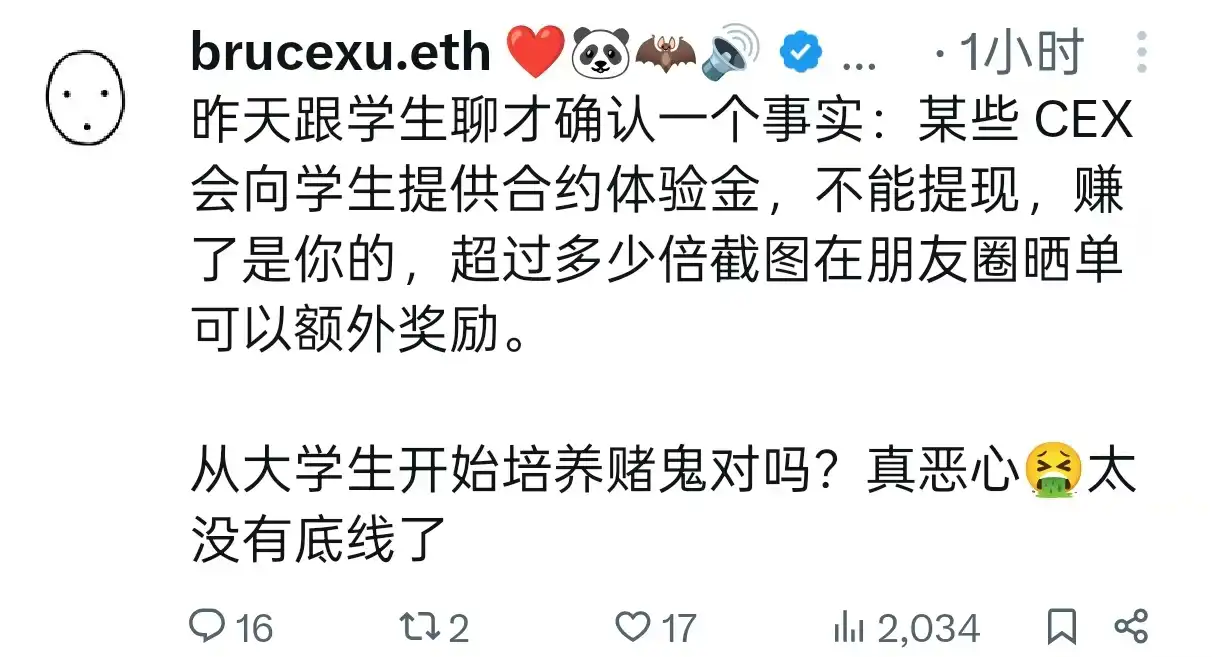
From providing the principal amount to leveraging incentives, and then to social splitting, this entire process is precisely targeting college students for harvesting. This behavior is essentially not about spreading contract knowledge or educating users but rather a gambling inducement disguised as "financial enlightenment," effectively preying on college students with weak risk awareness and inadequate fund management.
Even though the overall cryptocurrency trading platforms are facing a user growth bottleneck, this does not mean that targeting college students for business expansion is acceptable. Such behavior not only poses regulatory risks but also has a long-term negative impact on the industry's image.
High-Risk Financial Instruments Should Not Target College Students
After the integration of technology and finance, the "precise inducement" of young people has become a nearly global issue. Whether it is the structurally designed over-borrowing inducement in the U.S. student loan system or the proliferation of high-interest loans for young people in Internet financial products in Indonesia, the Philippines, and other countries, countless young people worldwide are trapped in debt.
In 2015, just as mobile payments were on the rise in China, consumerism among young people was quietly spreading. At the same time, a group of "Internet finance companies" represented by Qufenqi, Fenqile, and Aiyomi, under the guise of "advance consumption and credit growth," vigorously entered universities.
Qufenqi was the most representative player, penetrating campuses through offline promotion teams and collaborating with mobile phones, computers, and cosmetic vendors to hold "campus sales events" to attract students to use their platform for installment purchases. With just an ID card and student ID, one could "freeload" an iPhone with a monthly payment of less than 300 yuan.
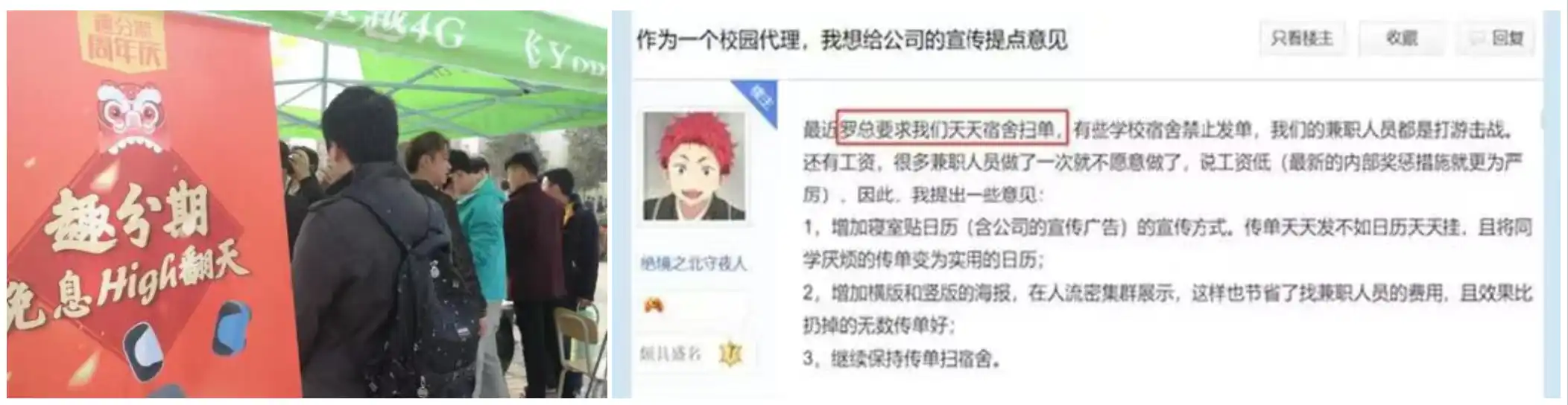
However, the frenzy of this "financial innovation" soon revealed its fangs. Issues such as opaque interest rates, high fees, and unreasonable repayment dates quickly pushed many students into the debt trap of advance consumption. To repay their debts, many students were forced to borrow from different platforms and create a snowball effect of debt.
Even worse, as the difficulty of collection increased, some platforms or underground collection organizations evolved extreme and oppressive methods such as "naked loans," demanding that female students provide indecent photos as "collateral," threatening to expose them if they default. When this event was exposed by the media, it caused shock in Chinese society.

From an ethical standpoint, this trend has completely crossed society's bottom line. Once a hot commodity, FunPay, even in later attempts to transform into a "installment e-commerce platform" and a "B2B financial technology service provider," still carried the label of "campus loan initiator" and faced widespread resistance.
FunPay, later renamed Qudian, launched an auto finance project in 2018, aiming to provide young people with car installment services through a "lease-to-own" model. It also faced resistance. In 2022, Qudian's founder, Luo Min, made a high-profile announcement to enter the market for pre-packaged meals and promoted it through platforms like Douyin (TikTok). However, due to its "campus loan" history attracting public scrutiny, Chinese celebrities who had partnerships with Qudian, such as Jia Nailiang and Fu Seoul, have distanced themselves.
This is a memory of an era and also a painful lesson. There was no clear regulation at that time, no one stood up to stop it, until millions of families paid the price, finally bringing it to an end.
Now, in the cryptocurrency field, contract experience funds are openly promoted to college students, which seems to be the beginning of another disaster—it's not using high-interest loans but rather cultivating a more secretive and harder-to-detect gambling addiction.
Contracts Are Neutral, But Greed Should Not Target Campuses
During this cycle, college students briefly became the focus of Web3 discourse, and many projects and VCs tended to recruit hardworking, eager-to-learn college students as interns. Even crypto exchanges launched campus ambassador referral programs, where students could apply to join and earn commission rewards for referring active users and receive benefits like job opportunities. However, shortly after the launch of this program, it was suspended due to community backlash, and the official platform no longer features this activity.
Today, some exchanges have escalated by directly using contract vouchers to lure college students into "joining the game." Compared to the campus loans of the past, this round of cryptocurrency contract promotion has not even touched basic regulatory red lines.
Many centralized exchanges have servers distributed across various countries, filled with disclaimers in their terms of service, and their employees are located globally. They often do not comply with full regulation from any single country but operate globally, especially expanding aggressively in countries and regions where financial education is not widespread.
In this vacuum, it's hard to expect short-term policies to effectively intervene. This means that public moral constraints and collective action by users are the most realistic and powerful "regulatory tools." Every user, every practitioner, should not remain silent about behaviors that lure college students into participating in contract trading.
As a financial instrument, smart contract transactions are justified, but distinctions must be made in different scenarios. The following three scenarios can be considered morally acceptable use cases:
First is risk hedging, which was the original design purpose of smart contracts. Institutions or sophisticated investors use contracts to hedge against spot price fluctuations, such as miners locking in mining rewards, traders managing position risk, etc. This is a professional practice based on clear assets and risk strategies.
Second is small-scale speculative entertainment by independent and self-responsible adults. Some individual users may use a tiny portion of their funds for short-term trading as a high-risk form of entertainment. The premise here is that they have a certain risk awareness, a complete financial safety net, and a clear understanding of the consequences they face.
Finally, there are the "gamblers" who engage in contract trading akin to visiting a casino in a two-way manner. This is the most common type of contract trading user at present—they do not hedge, do not analyze, and purely rely on gut feelings for trading. While this behavior is not encouraged, if adults are fully aware that they are "gambling," the trades they make on the platform can be seen as a "willing gamble."
However, college students are not gamblers.
They have not yet entered society, do not have sufficient income, risk awareness, or financial literacy. They should be developing their mindset on campus rather than being induced by platforms to build a leveraging logic. Any trading platform that extends its reach to college students is doing something extremely unethical.
Take Action and Pressure Centralized Exchanges (CEX)
Faced with the inducement of college students to participate in high-risk contract trading, the industry can no longer remain silent. This not only deviates from the original intention of financial technology inclusivity but also seriously damages the credibility of the entire crypto industry. Therefore, there must be clear and continuous social feedback to resist these behaviors that involve giving away demo funds, encouraging showing off gains, and guiding leverage operations.
Therefore, we must voice our refusal and draw a line through action:
We can—boycott CEX businesses conducting this type of inducement on social media platforms, refuse to register or deposit on such platforms, utilizing our absence of real money as a reminder that users are not ATMs;
We can—continuously exert public pressure on companies that are still implementing such marketing strategies;
We can—encourage industry KOLs and media personalities to publicly expose and sternly criticize these predatory tactics.
Only by doing so is it possible to pressure platforms into realizing that a regulatory gap does not equate to a moral gap, and the student population should not be the industry's recruitment breakthrough. If the industry genuinely seeks long-term development, it must first abandon growth tactics that come at the expense of destroying the future of a generation. This will not only fail to lead to industry growth or new highs in cryptocurrency prices but will further stigmatize the sector, hindering the industry's progress toward global regulatory compliance and deviating from the true vision of crypto.
This is not the first time we have seen the industry probing the boundaries of ethics. Today it's college student experience funds, tomorrow it could be "contract-based lending," or a personalized "low-value, high-frequency leverage recommendation system" tailored to newcomers to the world of cryptocurrency. There is always someone designing traps specifically for young people who have not yet developed risk awareness.
If we do not want to witness a "naked margin loan" disaster replaying in the crypto world, if we do not want to see young people being groomed into gamblers one by one, we must act from this moment on to resist this behavior. If platforms continue to turn a blind eye, we will unite more KOLs and media to continue exposing these practices until it is all put to an end.
You may also like

a16z Leads $25M Investment, 0xMiden to Run a Privacy Chain on Your Phone
The "Yearn Finance" Effect: Cryptocurrency Funds Experience the Calm Before the Dawn
Bitcoin Eco Goes 10x Again, What Is the New Asset Protocol Alkanes?
「Methane」 is the most popular term in the recent Bitcoin ecosystem, serving as the first fairly minted token of the new Alkanes protocol in the Bitcoin ecosystem. 「Methane」
The market value of METHANE has exceeded 6 million USD, which means each METHANE is worth over 60 USD. The author inquired with some Bitcoin ecosystem players who participated in the minting process, and there is a significant difference in minting costs. If we take 5 USD per token as the minting cost benchmark, then the profit from minting METHANE has already exceeded 10 times.
In the long stagnant situation of the Bitcoin ecosystem, how did this new asset protocol Alkanes emerge?
The predecessor of the Alkanes protocol was called Protorunes, which means 「programmable runes,」 and it has the same founder. This thing also briefly caught the attention of the Bitcoin ecosystem last year, and runes were quite popular at that time.
The protocol's founder @judoflexchop is the Chief Technology Officer of the Bitcoin wallet Oyl Wallet. Although the number of users of this wallet in the Bitcoin ecosystem may not be very high, it is still well-known. Just look at its funding situation to understand why:
On March 8, 2024, the Bitcoin infrastructure company Oyl completed a 3 million USD Pre-Seed round of financing, led by Arca, with participation from Foresight Ventures, Arthur Hayes's family office Maelstrom, Domo, UTXO Management, Taproot Wizards CEO Udi Werthheimer, Kanosei, and FlamingoDAO, among others.
With Arthur Hayes's involvement, this wallet quickly gained prominence in the Bitcoin ecosystem. In the middle of last year, Oyl launched a Bitcoin NFT project called 「Airheads,」 which sparked controversy due to the relatively high minting price. In terms of the NFT's price performance, it was considered a 「failure」 project, but recently it has surged nearly three times in value due to the popularity of the Alkanes protocol.
Although they are all wallets, in the Bitcoin ecosystem, most major wallets are not just wallets. For example, OKX, UniSat, Magic Eden, and the main character of this article, Oyl, have various other Bitcoin ecosystem businesses outside of their wallets, with only Xverse having a more "focused" business scope. Returning to Oyl, in addition to the wallet, they have also developed a Bitcoin RPC called "Sandshrew" and the Alkanes protocol.
Currently, Oyl is fully focused on promoting this protocol, and the official promotion has also adopted the name Alkanes:
Alkanes is a new Bitcoin asset protocol. Overall, it draws on the "Runestone" structure of the Rune protocol, but with greater scalability and support for smart contracts. As mentioned earlier, the predecessor of this protocol was Protorunes. At first glance, Protorunes may seem like a "customized version of Rune," but it is not. In simple terms, the Rune protocol and the "Runestone" structure are like a closed iOS system, while Protorunes and Alkanes are like open-source Android.
Protorunes corresponds to the "Runestone" of the Rune protocol. Here, "Runestone" is not the highly valuable early NFT of the Rune system but rather a "transaction data encapsulation," in short, a piece of information embedded in a Bitcoin transaction that serves as an index to determine if there is any Rune operation in the transaction.
If the indexer discovers the "RUNES" identifier while scanning the OP_RETURN of each transaction, it interprets the data following the identifier, such as etching, minting, transferring, and so on. The "Runestone" acts as an operational guide, and the indexer derives indexing results based on this guide.
The "Runestone" is exclusively for the Rune protocol's operational guide, directly corresponding to the Rune protocol, unlike Protorunes. Simply put, we cannot instruct the indexer of the Rune protocol to perform such actions directly, saying, "I am a sub-asset protocol based on Runestone; please index me together." However, Protorunes can. Everyone can customize their new asset protocol based on the Protorunes data format, and these protocols will be assigned a "Protocol ID." The indexer will read the "Protocol ID" to determine which protocol's specifications to parse.
There are some modular blockchain launch frameworks like Ethereum's, which make things simpler. For developers, they can just use the tools provided by Oyl instead of having to build their own indexer.
On the smart contract implementation front, before OP_CAT's revival, it was basically limited to storing contract data in transactions and executing off-chain indexes, not deviating too much from that approach.
On a technical level, apart from technology, there are two main reasons why this protocol could gain momentum. Firstly, it has received strong support from the Chinese inscription player community. Undoubtedly, the most financially capable group in the Bitcoin ecosystem currently is the Chinese inscription player community. This group is quite unique, as the PvP aspect of Solana meme coins is redundant in the Bitcoin ecosystem, but gaining approval from the Chinese inscription player community is also quite challenging. Once the inscription gains momentum, the spread speed within WeChat groups will be rapid and influential.
Searching for the keyword "Alkanes" on Twitter, one will find that most of the content comes from Chinese users, and the protocol's founder has also posted Chinese tweets thanking the Chinese community for their support. The early Bitcoin ecosystem minting tool, iDclub, created a transaction market for the Alkanes protocol, also coming from Chinese hands.
The second reason is that the project team behind this protocol has a background, and according to their disclosed plans, they don't just intend to launch an asset protocol to "funnel" into their own wallet. They also plan to develop AMM, BTC staking, stablecoins, MEV tools, and a trustless ZK bridge, essentially creating a BTCFi ecosystem around this protocol.
The entire narrative logic is coherent—a smart contract-supported asset protocol used to build applications around it. Without the backing of the project team to explain this narrative, it's hard to convince people. After all, in the Bitcoin ecosystem, players still feel some pain from Atomicals' decline, and there is too much uncertainty when big things are not done by a mature team.
- METHANE, the first fairly minted token of the Alkanes protocol, currently with a market cap of about $6 million. The Chinese meaning of Alkanes is "alkanes," while the Chinese meaning of METHANE is indeed "methane," so players also mention BUTANE "butane" and HEXANE "hexane," but these two tokens currently have market capitalizations of only around $250,000 each.
- DIESEL, from the official team and also the first token deployed by the Alkanes protocol, currently valued at around $12.6 million. This coin has a unique mechanism, with a total supply of only 1,562,500 tokens, 28% reserved for the team, and 72% being produced block by block along with each Bitcoin block, with production halving following Bitcoin's halving schedule. In each block, the miner who submits the highest fee for a DIESEL minting transaction will ultimately receive the block's DIESEL output. In summary, a DIESEL is minted per block, and only one person (the miner whose fee for the minting transaction was the highest) can mine DIESEL in each block. Ordinary players can hardly mint anymore, and scientists will automatically monitor and increase the miner fee continuously.
Since METHANE is fairly launched, the holder base/chip distribution is definitely healthier compared to DIESEL, and it is fully circulating. Therefore, currently on social media platforms, the volume of METHANE is much higher than that of DIESEL. Purely based on volume rather than market value, it would feel like METHANE is leading the pack. There is no information available from the official sources about DIESEL's future empowerment. Thus, in terms of community engagement, METHANE is far superior, while DIESEL excels in official background and potential future empowerment expectations.
This protocol is still in its very early stages. Various wallets have not caught up with support for assets of this protocol yet, so it is best to use Oyl Wallet for interacting with assets of this protocol to ensure asset security.
Essentially, the success of this protocol has ticked off all the key success factors of a new asset protocol in the Bitcoin ecosystem — "Mainnet Asset," "Fair Launch," and "Community Support." Additionally, it has "Smart Contracts" and a narrative on the ecosystem layer. In the long-standing quietness of the Bitcoin ecosystem, it has still managed to stand out. Hopefully, the ecosystem can be further developed and progress even further in the future.
**The Crypto AI Evolution: How Will Automated Trading by AI Agents Reshape the Market?**
This Week in Review | Strategy Adds BTC Sell Risk Warning Sparking Debate; US Tariff Policy Flip-Flops Cause Market Turbulence
Coinbase Experiences Insider Threat? $300 Million Scam Revealed, User Data Accurately Leaked
This Week in Review | Binance Reports Employee "Front-Running"; Hyperliquid Faces Another Attack, Performs "Pulling the Plug" Self-Rescue
Bitcoin Double Spend: A Highly Unlikely yet Interesting Bug
New York Times: Unveiling the Cambodian Money Laundering Empire, the Secret Assembly Line Behind the Crypto Scam
Frequent Hacks - How to Ensure 'Digital Hygiene' Implementation?
50x Hyperliquid Whale Identity Revealed, Turns Out to Be a Fraudster Featured in UK News Headlines?
Original Translation: DeepSeek
Editor's Note: The article reveals the identity of a mysterious Hyperliquid whale involved in illicit activities, who made approximately $20 million in profit through high-leverage positions from January to March 2025. The investigation found that this individual exploited casino game vulnerabilities and phishing attacks to acquire funds, and conducted high-leverage trades on both Hyperliquid and GMX using multiple wallets. Ultimately, the whale was traced back to a connection with William Parker (formerly known as Alistair Packover), a convicted felon with a history of fraud and gambling crimes. Currently, the funds are primarily held in an Ethereum address.
The following is the original article content (rearranged for readability):
An investigation has revealed the identity of a mysterious Hyperliquid whale involved in illicit activities, who made approximately $20 million in profit through high-leverage positions over the past few weeks.
A trader opened multiple high-leverage positions on Hyperliquid and GMX from January to March 2025.
They drew widespread attention this month due to two on-chain transactions:
· Before Trump's announcement of a cryptocurrency reserve, 0xe4d3 opened a large ETH and BTC long position with 50x leverage (earning $10 million).
· 0xf3F4 opened a large BTC short position with 40x leverage (earning $9 million).
I further investigated and identified the primary counterpart of 0xf3f:
0x7ab8c59db7b959bb8c3481d5b9836dfbc939af21
0x312f8282f68e17e33b8edde9b52909a77c75d950
0xab3067c58811ade7aa17b58808db3b4c2e86f603
0xe4d31c2541a9ce596419879b1a46ffc7cd202c62
These addresses are associated with Roobet, Binance, Gamdom, ChangeNOW, Shuffle, Alphapo, BC Game, and Metawin accounts.
0xf3f for X account @qwatio signed a message and claimed to have made $20 million on GMX and HL.
This implies that he must control the wallets related to this cluster for the $20 million figure to be accurate.
I replied to him on X yesterday, but the post was subsequently deleted.
An analysis of the X account used by 0xf3f suggests that the account may have been purchased at some point in time (recent name change, long period of inactivity, relatively old account).
I noticed that they follow @CryptxxCatalyst, who has posted links to multiple phishing websites and has replied to some individuals, attempting to deceive them.
I contacted @realScamSniffer, who regularly tracks these phishing websites.
In January 2025, a public address of a Hyperliquid whale was set as the receiving address for the projection[.]fi phishing website.
0x7ab8c59db7b959bb8c3481d5b9836dfbc939af21
In January 2025, 0x7ab also directly received $17,100 from another phishing victim, and then his wallet was traced this month.
Since 0x7ab is the first EVM address used by 0xf3f, I traced the funds back to withdrawals from four casinos on Solana.
83Dumvk6pTUYjbGrC1fizBziRzDqcyNx73ieJcVbp56b
I contacted one of the casinos, and they clarified that the funds came from an input validation bug in their casino games.
They provided a now-deleted Telegram account: 7713976571, where they had negotiations with the exploiter of this bug.
I found a post from this account in a Telegram group through Open Source Intelligence (OSINT).
I discovered three help posts posted by the same TG ID in a GMX group.
To verify that this is the same person, I noticed that the posting times of these posts coincide with the on-chain transaction time of 0xe4d3.
I traced a recent payment by 0xe4d3 to an unnamed individual who confirmed they had been paid by an HL trader.
They provided a UK phone number for communication.
Public records indicate that this number is likely associated with the name William Parker.
Who is William Parker?
Last year, WP was arrested and sentenced in Finland for stealing approximately $1 million from two casinos in 2023.
Prior to this, WP was known as Alistair Packover (William Peckover) and later changed names.
In the early 2010s, AP made headlines in the UK news for fraud charges related to hackers and gambling (the age in the article matches the current information).
Clearly, WP/AP did not learn from their fraud conviction and is likely to continue gambling.
Currently, funds are primarily held in the following address:
0x51d99A4022a55CAd07a3c958F0600d8bb0B39921
Here is a quick summary:
In January 2025, an individual with a history of crimes leveraged a casino game vulnerability and phished victims, turning a six-figure sum of funds into $20 million through high-leverage on-chain transactions.
「Original Article Link」
AIXBT Suspected Phishing Attack 55.5ETH, How Was AI Lured?
The World's Largest Gambling Hub: Macau's Web3 and Local Life
TON Rollercoaster: A Tale of VC, Exchange, and FOMO Fiesta
Recently, the founder of Yescoin was taken away by the Uncle with a Hat, causing a stir on Twitter. Just a month ago, Zhang Chang was still updating his entrepreneurial reflections, and millions of users also played the Telegram clicker game last year.
Following my curiosity, I discovered in the disclosed information a mention of "missing the best issuance opportunity in May 24 years ago," which inevitably reminded me of the TON ecosystem's madness half a year ago.
Back then, VCs and KOLs were shouting, "TON will become the WeChat of Web3," the social media was filled with the myth of "click and get rich instantly," exchanges were rushing to list TON ecosystem projects, and retail investors were madly creating Telegram alts to "participate in airdrops"... And now, Yescoin's predicament is like a mirror, reflecting the parabolic trajectory of the TON ecosystem from its peak to its decline...
1. VC Hype: From narrative to pump-and-dump's precise design. In 2024, Pantera Capital made a high-profile bullish call on TON, positioning it as the "Web3 super app gateway," igniting market sentiment. At that time, TON's on-chain TVL skyrocketed 20 times in two months to $6 billion, surpassing Ethereum in user growth rate. VCs understood the logic of "traffic equals valuation": Telegram's billion user pool was an unreachable "rich mine" for any public chain.
2. Exchange Rush: The "harvesting race" in the traffic oasis. Exchanges like Binance, OKX, quickly sniffed out the business opportunity and rushed to list TON ecosystem projects. Games like Notcoin, Catizen, quickly gained popularity through "zero barriers + social virality." Notcoin surpassed 35 million users, and Catizen attracted 20 million fans in two months, achieving a billion-dollar market cap upon launch. The influx of Telegram users to exchanges resembled the "Pinduoduo-style virality" of the Web2 era, and exchanges needed this "data-driven growth" story for their financial reports.
3. Telegram's "Sunspiracy": Payment and Business Loop Telegram Founder Durov has publicly supported TON multiple times, even launching the embedded wallet TON Space, connecting the "communication + payment + game" loop. Tether issued stablecoins on the TON chain, officially launched a $5 million developer incentive plan, and every step points to the ambition of transforming Telegram's social empire into a crypto economy.
It is precisely this collusion of the three that has driven the heyday of the TON ecosystem.
Early participants who encountered projects like Notcoin and Dogs saw the token price reach $30. This wave also allowed a group of Telegram ID traders engaged in cross-border e-commerce operations to make a fortune, with some making millions of dollars in a single night. It was quite shocking for me at the time: So this is what airdrops in the TON ecosystem are like?
After Binance listed Notcoin and Dogs, the drama finally reached its climax—Binance finally listed TON, with the coin price surging to $8, followed by the listing of several star projects like Catizen and Hmster.
However, as a deep participant in the TON ecosystem, the author also realized a significant issue: the value of airdrops began to rapidly decline after TON was listed on Binance. It was at this moment that I started shorting TON ecosystem tokens, and looking back, this was an incredibly correct decision.
1. User Fatigue: From "Nationwide Carnival" to "Chaos"
In the later stage of the TON ecosystem, the project teams and trading platforms jointly promoted "TON Ecosystem Month," with gameplay still revolving around check-ins, referrals, and gas consumption. However, the trading platforms gradually woke up to reality: the so-called "1 billion user pool" had a conversion rate of less than 1%, and most people only came for airdrops. As the price dropped from a peak of $8 to less than $3, even the most loyal community members began to sell off.
2. VC, Trading Platform Exit: Narrative Collapse and Capital Cashout
Early investors like Pantera quietly reduced their holdings, and the frequency of trading platforms listing TON-related projects plummeted. Analysts who once shouted "TON will surpass WeChat" began to shift their focus to AI and other emerging narratives. Telegram had already earned enough in fees through ecosystem partnerships and became profitable in 2024, leaving only retail investors lamenting at the parabolic K-line chart: What about the promised web3 WeChat?
The project behind the TON ecosystem has expanded from early mini-games like Catizen and Hmster to more and more mini-games and DeFi applications. However, it's essentially just a change of packaging without any substantial innovation.
As a witness and observer, watching the TON ecosystem's valuation go from $1 billion to $100 million and then to a market value of just a few million dollars, Binance did not list any TON ecosystem projects after Hmster. Watching it go from a feast in a grand banquet hall to a collapsed building.
At the beginning of the TON ecosystem, the author purchased 32 TON tokens, hoping to experience Telegram's rise through these 32 TON tokens, becoming a super app like web3 WeChat, and seeing the wallet balance on the TON network appreciate continuously like gold.
But now the dream is over. It has made us see the scythe of VCs, the traffic magic of trading platforms, and the collective madness of human nature under the temptation of sudden wealth. The TON story is not over yet. Perhaps as Durov said, "Telegram will always belong to the rebels."
It's just the next rebellion. It shouldn't be a betrayal of self-rationality. Can you and I sniff the wind earlier than the VCs and press the button faster than the trading platforms?
Let Gamers Proof: How KGeN is Redefining User Acquisition
The gaming industry has now surpassed the film and music industries in scale, with overall trends still on the rise. However, in recent years, it has faced serious challenges. After experiencing record growth during the pandemic, the industry faced a wave of layoffs and consolidation in 2023-2024, with development costs soaring and investment drastically reduced.
Furthermore, game publishing and distribution have become increasingly difficult. AI-generated content overflow, platform saturation, and player preference for established IP have made it harder for new projects to stand out and acquire highly sticky users more challenging than ever.
Nevertheless, the industry still presents significant opportunities. Gen Z and Gen Alpha, as digital natives, have grown up in virtual worlds such as "Roblox" and "Minecraft," and their purchasing power will continue to drive market expansion.
At the same time, the long-overlooked "Global South" market is experiencing explosive growth. With the proliferation of smartphones, improved internet infrastructure, and income growth, these regions will become key incremental markets for the gaming industry in the next decade.
The first part of this report will explore the latest challenges in game publishing and analyze the high-growth opportunities in the "Global South." The second part will focus on KGeN—a blockchain-based gaming network aimed at reshaping the incentive mechanism between publishers and players. We will also assess the feasibility of Web3 task platforms and analyze the structural changes in the distribution of value in the gaming industry.
It is well known that one of the biggest challenges the current gaming industry faces is publishing. Changes in consumer habits, regulatory policy adjustments, lower barriers to market entry, and ongoing saturation of game content have made it increasingly difficult to successfully launch a game to millions of users.
Players often tend to spend most of their time playing games they are familiar with or series they enjoy, making it challenging for new releases to break through. In 2023, the top ten games ranked by average monthly active users (MAU) had been released for over seven years, and 60% of player gameplay time on new games still concentrated on annual series releases.
In 2024, despite Steam seeing a record 19,000 new game releases, those games only accounted for 15% of total player gameplay time that year.
The mobile gaming market once had a more mature publishing model. The rise of early mobile advertising networks like Facebook and Google, coupled with the proliferation of smartphones, helped many games achieve over a billion users and generate billions of dollars in annual revenue. However, in 2021, Apple and Google made significant changes to their privacy policies, directly affecting how publishers reach their target users.
While these changes haven't ended mobile advertising, they have indeed had a significant impact on user acquisition (UA) strategies and the business models of mobile games. Many publishers have found new ways to scale on mobile, but the market is increasingly favoring well-funded companies, putting smaller teams under greater competitive pressure.
Looking ahead, the industry environment seems challenging to improve. AI can certainly make UA campaign management more efficient, but at the same time, it will lower the barrier to entry, leading to a significant increase in content volume. UGC platforms like Roblox and Fortnite Creative have become common proving grounds for indie developers, but they also face challenges in content curation and promotion, and the widespread adoption of AI will only exacerbate these issues.
This brings us to the Web3 gaming market, where development teams need to overcome a series of additional obstacles. In addition to the aforementioned challenges, Web3 games must adhere to stricter policies on mobile, Steam (the largest PC game distribution platform), and console platforms. Furthermore, Web3 games are even directly banned in some key markets (such as South Korea and China).
It is worth noting that the distribution status of Web3 games on consoles is gradually changing. The recent release of "Off The Grid" has set a precedent for Web3 games to enter this market that was once considered a "no-go zone," and we look forward to more games following this path in the future.
Additionally, the Web3 gaming market remains a niche subsector of the overall gaming industry, with approximately 6 to 7 million active wallet addresses interacting with over 3,000 on-chain gaming protocols. However, it is important to note that these data points do not rule out the presence of a significant number of bot accounts in the Web3 space, and only about 200 protocols truly have over 100 active on-chain accounts.
For such a relatively small market (considering the global total of over 3 billion gamers), its challenges have been further exacerbated in the past two years by the rapid growth of the emerging Web3 gaming ecosystem. Data from Game7 indicates that although the average number of new Web3 games has decreased by 45% since 2021, the average number of new networks has grown by 187% during the same period. In 2024 alone, 104 new networks/ecosystems were announced online, while only 263 new Web3 games were released during the same period.
The issue lies in the fact that most of these emerging networks have failed to attract new players successfully. All of these problems ultimately lead to a phenomenon we have detailed in multiple reports—the battle for player liquidity. As the competition in the gaming market intensifies, Web3 projects are competing around the same limited pool of wallet users, and they have little effective means to break through this limitation and achieve scalable growth.
Facing significant challenges, a group of Web3 companies are exploring a new user acquisition (UA) model based on blockchain. Innovative incentive mechanisms and on-chain reputation systems are becoming potential pathways for these companies to gain a competitive advantage through Web3 integration.
Many Web3 companies have demonstrated significant Product-Market Fit (PMF) in emerging markets. Compared to the increasingly saturated T1 market dominated by Web2 giants, those able to leverage a global payment network enabled by blockchain to truly tap into emerging markets may have huge growth opportunities.
Among numerous regions, one that has shown sustained above-average growth rates and a high degree of acceptance of blockchain applications is the Global South.
The Global South is a term used to describe countries and regions with a relatively lower level of economic development, typically located south of industrialized nations. Due to rapid improvements in internet infrastructure, high smartphone penetration rates, and income growth, this vast region is often seen as an underdeveloped yet potentially enormous gaming market.
Key characteristics of the gaming market in the Global South include: a massive player base, heavy reliance on mobile devices for gaming, and a generally lower willingness to pay. Historically, these markets have been used by game publishers for soft-launch user acquisition testing and front-end data optimization.
However, the youth in these regions are the first generation to grow up with smartphones, and they have a strong preference for gaming content (including games, video content, and esports). As this generation ages and benefits from economic development and increased income, many believe they will become the next generation of paying players, propelling the gaming industry to new heights.
The following are characteristics of key markets in the Global South to demonstrate their importance in the future of the gaming industry.
Despite a relatively slow start, India is rapidly emerging as the largest gaming market in the Global South. In 2017, the country had only 44.9 million gamers, and now that number has grown to around 466 million, expected to exceed 640 million by 2027.
Market revenue is expected to grow by 13.6% in 2024 (reaching $9.43 billion) and surpass $10 billion in 2025, projected to reach $14 billion by 2028 with a 5-year Compound Annual Growth Rate (CAGR) of 11.1%. This growth is mainly driven by the improvement in user in-app purchase habits and the growth in Average Revenue Per User (ARPU) due to the increasing national disposable income.
The Indian market has a strong preference for mobile gaming, largely due to being one of the world's fastest-growing 5G markets and having a robust digital payment infrastructure—the Unified Payments Interface (UPI). UPI transaction volume has grown from 10.78 billion transactions in 2019 to 83.75 billion transactions in 2023, showcasing the rapid rise of the digital economy. Additionally, internet penetration has significantly increased from 14% in 2015 to the current 52%, though still lower than other major global southern gaming markets, indicating significant potential for future growth.
These technological advancements are supported by strong macroeconomic fundamentals, including an average annual economic growth rate of 7-9% over the past three years and the rising income levels of a young and expanding middle class.
India's gaming preferences exhibit a unique pattern compared to other major markets:
· Mobile gaming dominates, contributing 77.9% of total revenue;
· PC gaming and console gaming only account for 14.5% and 7.7%, respectively.
In terms of revenue composition, the income distribution of different game types is as follows:
· Real Money Gaming (RMG) is the largest segment market, with an annual revenue of $2 billion;
· Casual and Hyper-Casual gaming follow closely behind, with total revenue of $700 million;
· The market size of other game categories is approximately $400 million.
Southeast Asia (SEA) consists of Indonesia, Malaysia, the Philippines, Singapore, Thailand, and Vietnam, and is one of the most mature gaming markets in the global south. According to Niko Partners data, the region's gaming revenue reached $5.1 billion in 2023, an 8.8% year-on-year growth, and is projected to reach $7.1 billion by 2028, with a 5-year compound annual growth rate (CAGR) of 6.7%. In 2023, Southeast Asia had 277 million gamers, expected to grow to 332 million by 2028, with a 5-year CAGR of 3.7%.
According to Sensor Tower's H1 2024 report:
· Indonesia had the highest mobile game downloads, reaching 2.4 billion times (41% of the region's total downloads);
· Thailand had the highest In-App Purchase (IAP) revenue, reaching $400 million, closely followed by Indonesia at $300 million.
Despite differences among countries in the region, community and a culture of competition are common features. Word of mouth is the primary source of information, and top-performing games usually have social features.
Similar to most countries in the global South, the penetration of smartphones and the development of broadband infrastructure are key drivers of market growth. Southeast Asia is particularly notable:
· By 2022, the smartphone penetration rate in all major countries exceeded 80%;
· It is projected that by 2026, the average penetration rate will reach 90.1%.
Latin America (LATAM) is another significant market to watch, with a large population and a strong gaming culture, especially in the esports sector. In 2022, the region is estimated to have 316 million gamers, with a concentration of players in Brazil, which had 101 million players that year, generating $27 billion in game revenue.
The Brazilian market shows a strong preference for mobile games:
· 60% of players have played a mobile game at least once in the past six months;
· Smartphone penetration is expected to reach 83% by 2025, indicating significant growth potential in the mobile gaming market.
In terms of monetization, the Brazilian market exhibits a strong payment habit: 43% of players have made in-game purchases, with main motivations including unlocking exclusive content (39%), character customization (35%), and game progress (30%). This indicates a maturing market that is moving beyond basic monetization models. These spending patterns suggest that the market is maturing, gradually evolving from basic monetization models to more complex game economies.
The Brazilian market is poised to continue leading the growth of the Latin American gaming industry in the future, benefiting mainly from: 140 universities nationwide offering over 4,000 game-related courses, with 1,042 game studios across Brazil generating around $251.6 million in total revenue. The recent legal framework passed officially recognizes game development as a profession and provides incentives such as tax breaks.
The African gaming market is at a critical development stage, with revenue expected to surpass $1 billion in 2024, showing steady growth from $863 million in 2022. The core driver of this market is mobile gaming, holding nearly 90% market share, reflecting both the reality of infrastructure and consumer preferences.
A domestic study shows that 92% of African gamers play games on their mobile phones, while the prevalence of computers (51%) and game consoles (31%) is relatively low. This mobile-first approach has been partially validated; however, the research sample size was only 2588, making it difficult to comprehensively represent the entire continent's market situation.
Main Challenges: High data costs (42%) are the biggest obstacle, followed by hardware prices (31%) and network connectivity issues (31%).
Payment systems are both a challenge and an opportunity: Although 63% of players engage in in-game purchases, payment methods vary by region. Kenya leads in mobile payments, with 67% of players using mobile wallets for game expenditure. Credit cards (45%) and mobile payments (40%) are the most common payment methods across Africa.
The MENA (Middle East and North Africa) region is the fastest-growing game market globally, with revenue set to grow by 4.7% in 2023, reaching $7.1 billion, far surpassing the global market's 0.6% growth rate. High-speed growth is expected to continue in the future, with a projected Compound Annual Growth Rate (CAGR) of 9.4% from 2024 to 2030.
By 2027, the MENA-3 (Saudi Arabia, United Arab Emirates, Egypt) core market revenue in the region is expected to reach $2.9 billion, with a CAGR of 8.3%; market drivers include a high proportion of young population driving gaming market activity, significant increases in internet penetration in Qatar and the UAE, and wide adoption of new technologies.
The gaming landscape in this region is dominated by three strong markets—Saudi Arabia, UAE, and Egypt—collectively known as the MENA-3, showing outstanding performance, with a 7.8% year-over-year growth to $1.92 billion by 2023, and forecasted to reach $2.9 billion by 2028, with a five-year CAGR of 8.3%. Saudi Arabia leads the pack, accounting for 60.6% of total gaming revenue and 30.3% of the total number of gamers in the Middle East and North Africa, demonstrating the country's dominant position in the regional ecosystem.
KGeN is a blockchain-powered gaming network that leverages on-chain and off-chain data, an incentive-based task platform, and a decentralized reputation system to drive user engagement across different games. Unlike other user acquisition (UA) platforms and networks, KGeN returns publishers' funds to users, propelling its growth flywheel.
At the core of KGeN is a decentralized player data network covering millions of micro-game communities (KGeN Tribes). This network adopts a novel data model called Proof of Gamer (PoG) engine, creating a cross-chain player reputation layer and providing publishers with a highly engaged target user base at a cost much lower than many existing networks.
As more players join KGeN and the PoG dataset grows, more game studios and publishers have been able to establish partnership relationships. This has further driven ecosystem rewards, increasing the value of participating players. Since January 2024, this growth flywheel has shown significant effects, with a total of registered accounts growing by over 700%, Monthly Active Users (MAU) growing by 1333%, and total data attributes growing by 992%. This has made KGeN the most active Web3 task and player reputation network in the market.
The KGeN ecosystem is currently undergoing gradual decentralization, protecting the PoG engine through a distributed oracle network and providing greater transparency to all core stakeholders. This oracle network and the KGeN Store are both powered by the KGEN token.
At the core of KGeN's growth is its grassroots tribes and tribal leader network, which is also key to its continued expansion in the Global South. Tribes represent thousands of micro-communities that have joined the KGeN ecosystem, such as colleagues, esports organizations, influencers, and game-centric social groups. As of December 2024, KGeN self-reported a total of 2,525 tribes, with 152 tribes having over 100 members.
Tribes are a core way KGeN drives referral-based user acquisition. When creating a tribe, tribal leaders invite up to five tribe members and have them complete at least one task to earn points. These points contribute to the KGeN leaderboard, which is one of KGeN's primary reward systems (further detailed below). This incentive-driven funnel mechanism has proven to be highly effective, with approximately 1.7 million KYC-verified KGeN accounts (39% of MAU, 13% of registered accounts) acquired through tribes.
Tribal leaders are incentivized not only to onboard new members but also to coordinate tribe activities and maintain community engagement if they wish to maximize their earning potential. This is because a portion of the tribe's total earnings is redistributed to tribal leaders, becoming a key growth incentive mechanism for the ecosystem.
KGeN's largest current market is India, benefiting from the company's origins and its strong influence in the region's micro-game communities. However, over 30% of independent active wallets and transactions occur on Kaia, which is LINE's proprietary blockchain for the LINE messaging app. LINE's biggest markets are Japan (86 million users), Thailand (47 million users), Taiwan (21 million users), and Indonesia (13 million users), indicating strong growth potential for KGeN in Asia.
In order to replicate the success in other markets in the Global South, KGeN is encouraged to adopt a similar grassroots growth strategy. Collaborating with local gaming micro-communities such as schools, internet cafes, small-scale esports organizations, and online communities will gradually expand its reach while creating opportunities to deepen social dynamics, further driving user engagement and retention.
Another potential issue is the relative lack of community social features in the KGeN PC portal and mobile app. As we will discuss in detail in the report, enhancing social features is one way to increase ecosystem engagement. The more time users spend engaging with the ecosystem, the richer the user data, the more opportunities for interaction with the K-Quest and K-Drop features, and the greater the monetization potential.
KGeN Play serves as the front-end interface for most player participation in the ecosystem, where all reward tasks are posted. This typically marks the beginning of the user journey and will become the primary gateway for users to interact with the KGen network while also building their own PoG reputation score.
KGeN Play can be accessed through the PC portal or mobile app. Users will have the best experience via the PC portal, but the mobile app provides a quick solution for users on the go and will play a crucial role in the Global South expansion.
Upon creating an account, a blockchain wallet is automatically generated in the background, storing all user assets and the non-transferable Player Reputation NFT. Once the minimum withdrawal threshold is reached, users will be prompted to verify their phone number via OTP and take full control of their wallet—a crucial step directly feeding into the PoG engine. The KGeN wallet is basic in functionality but offers a seamless onboarding process, supports multi-chain and gasless transactions, and executes its three primary functions (checking balance, viewing transaction history, and withdrawals) with low friction.
Before users realize they have a blockchain wallet, they first need to start earning rewards. To do so, users need to engage in various activities posted on the KGeN Play portal. Task activities are divided into K-Drops and K-Quests.
Both K-Drops and K-Quests are time-limited, limited-quantity activities that reward participants with K-Points, leaderboard-based achievements, K-Cash, or tokens. The core difference between the two is that K-Drops provide automatic real-time validation via endpoint API integration, while K-Quests rely on a manual verification process.
Unsurprisingly, the completion rate of task platforms leveraging real-world financial incentives, especially those targeting a global Southern audience, is higher than average. What sets KGeN apart is its integration of KGeN Play with the PoG Engine, providing high conversion rate target activities.
The PoG Engine is a decentralized player ranking system hosted by a distributed node network. PoG consists of five core pillars, each pillar containing five to ten attributes. These data points track player skills, "humanness," engagement, wealth, and social networks to build a multifaceted cross-chain reputation system.
This ultimately forms a PoG vanity score, leveraging the composability inherent in blockchain technology, allowing players to showcase their player ID across different ecosystems. Meanwhile, publishers and advertisers can leverage the PoG Engine to access a globally Southern-priced, highly engaged player base.
The five core pillars are divided into Proof of Humanness (PoH), Proof of Play (PoP), Proof of Skill (PoS), Proof of Commerce (PoC), and Proof of Social Network (PoSN).
PoH lives up to its name—it tracks various data points to reduce the likelihood of users being bots. This may include KYC status or the number of connected social apps and is one of the most valuable attributes in the eyes of publishers. In addition to tracking "humanness," PoH further segments user groups based on platform preferences and geographical location. This pillar not only aids user targeting but also enhances trust in user quality and the entire network.
PoP determines a player's engagement with the KGeN network and the types of games they have played. It tracks metrics related to retention, gameplay patterns, preferences, and user habits. This pillar improves targeting by further segmenting different user types, earning high praise from publishers as another set of attributes.
PoS recognizes a player's abilities, competitiveness, engagement, and evolving achievements over time. It gathers data from in-game achievements, tournaments, and ecosystem activities to rank players. This pillar highlights the most active players and provides them with social capital.
PoC identifies users' monetization potential, which may come from direct purchases, on-chain transactions, on-chain history, or net assets. This not only enhances the efficiency of targeting and user acquisition activities but also showcases the various ways users add value. Aside from early activities like game testing, PoC will eventually become the most valuable dataset for publishers in the post-IDFA era.
The PoSN scales users' social profiles and establishes their social graph within the KGeN network. This pillar filters out non-gaming data, tracks social accounts, clan activities, and network size to understand their social preferences, influence, and impact within the gaming community.
The PoG Engine currently consists of over 270 million data attributes, sourced from over 13 million registered accounts and 4.4 million MAU. Since January 2024, the PoH, PoP, PoS, PoC, and PoSN cohorts have grown by approximately 214%, 1320%, 777%, 384%, and 487%, respectively. The significant growth in PoP and PoS-related data particularly highlights how ecosystem engagement has steadily increased over time.
Utilizing the PoG Engine, KGeN is leading an alternative UA framework called "effective Cost per Acquisition" (eCAC). KGeN does not charge for simple impressions or top-of-the-funnel installs but only for active users reaching the middle or bottom of the user funnel.
For instance, during an event with Karate Combat, KGeN reported almost a 40% reduction in eCAC, while charging no fees for top-of-the-funnel installs and achieving a 5% conversion rate at the bottom of the funnel. In a four-week mission event with Game7, KGeN stated they introduced 50,000 PoH-verified users, with an eCAC 55% lower than competitors. User registrations, wallet connections, and avatar creations are all free, meaning customers only pay for users who complete at least four tasks and mint an SBT (estimated conversion rate of 20%).
The PoH and PoP cohorts are particularly valuable as these data points offer relatively higher engagement ROI for commercial clients. This is especially crucial for Web3 projects leveraging financial incentives, which often face challenges from bad actors and bots. However, these data points are not flawless, and even KYC could be manipulated.
Nevertheless, KGeN's ability to highly ascertain user quality has brought significant added value to its partners. As we will detail in the report, ad fraud has led to around $840 billion in wasted digital ad spend. This is also a key reason why over 60% of KGeN partners have become repeat customers since August 2024.
Over time, the growth flywheel that is crucial for KGeN's future expansion will gain momentum. As long as there is demand for a positive PoG score, engagement with KGeN Play will increase (this can be further accelerated through financial incentives based on the PoG score). This activity will drive the PoG engine, increase the total number of attributes, and enrich KGeN's user database. Subsequently, more publishers will be attracted to the ecosystem, increasing the variety of products on KGeN Play and KGeN Store, thereby attracting more users.
The PoG score is at the core of KGeN's business model and is key to its ability to offer customers competitive low-cost eCAC. A key question is, what drives this user behavior?
As long as the incentive is financial in nature, the platform will undoubtedly demonstrate promising results. However, this creates an external motivational force that dictates how users engage with the platform and its partners.
Users driven by external motivation are less likely to continue playing the games they were initially attracted to because of rewards. Furthermore, research suggests that providing external rewards for behavior that was originally intrinsically rewarding diminishes intrinsic motivation—a phenomenon known as the overjustification effect.
Users with intrinsic motivation seek value in things they enjoy, such as social interaction, recognition and respect, progress, and fun. If powerful network effects over time can transform the core value proposition of the PoG score into something rooted in social capital and enjoyment, motivation will gradually internalize, thereby increasing the potential value provided to partner publishers.
KGeN's economy will consist of two core assets: KCash and KGEN tokens. KCash has been live for some time, primarily serving as an off-chain reward currency, but it can also be purchased directly with fiat. KCash's primary use case is in the KStore, where it can be used to purchase in-app purchases (IAP), gift cards, or participate in VIP tournaments and missions.
Driving the growth flywheel of the KGeN ecosystem is the KGEN token. This is a utility token, with 40% allocated to the community (8% of which unlocks at the Token Generation Event (TGE)), with a four-year lockup for the team and investors. 12.6% of the total token supply will unlock at the TGE, excluding the circulating supply locked with liquidity providers or exchanges.
Recently announced, ahead of the TGE, KGeN will conduct a K-Points -> rKGEN airdrop event. rKGEN distribution is based on users' total K-Points, time on KGeN, and engagement. Once the token is live, rKGEN can be converted to KGEN tokens at a 1:1 ratio. However, some users will be able to start staking rKGEN for additional token rewards before the TGE.
K-Points -> rKGEN Airdrop model prioritizes transparency and clear communication to maximize community sentiment and token distribution before the TGE. If executed successfully, this may help build momentum at launch and ensure additional CEX listings, but comes with its own set of risks.
A fuzzy reward system has been proven to increase engagement in various domains. While pure point-based airdrop events offer lower transparency, they provide teams with greater flexibility in token airdrop distribution. This design concept raises a question: post-TGE, will the KGeN Play activities leverage the K-Points -> KGEN reward system, or opt for direct token payments?
At launch, we assume the KGEN token will primarily be used for incentives. However, over time and as the network matures, we anticipate more users will use the token in the KGeN Store to enjoy discounts more favorable than fiat purchases.
Another potential form of token consumption could be subscription fees. As users increasingly rely on the network to host their reputation scores, game achievements, and social touchpoints, KGeN may decide to limit the number of tasks available to free users. This would effectively curb much of the revenue potential on the network and serve as an additional bot protection measure.
Nevertheless, unless non-financial rewards hold significant intrinsic value for users, many will not spend tokens unless they can realize a positive return on investment. To prevent this from becoming an inflationary consumption (i.e., more tokens are released than removed), KGeN should provide third-party token, KCash, or NFT. Ultimately, the most sustainable consumption is that driven by internal motivations such as entertainment and social capital.
In addition to direct token consumption, there will also be token staking. Apart from users seeking simple staking rewards, tribe leaders can stake tokens to increase their member cap and gain additional platform tools. Issuers can also participate in tiered staking programs to acquire more free top-of-funnel users in their UA campaigns—we anticipate this feature will receive more attention as the platform continues on its current growth trajectory.
A typical token staking is an inflationary model that will ultimately dilute the token supply in exchange for alleviating sell pressures in the future. While there are potential short-term benefits, it's encouraging to see KGeN incentivizing non-inflationary staking for tribe leaders and issuers.
The KGeN Oracle Network is a distributed network consisting of permissioned nodes that together form the backbone of the PoG Engine. Each oracle's task is to store PoG data, calculate PoG scores (and collectively verify their accuracy), and submit these scores to the Aptos blockchain for settlement. As a reward for providing this service, oracle operators will receive a fixed amount of KGEN tokens income based on revenue prediction, as well as stablecoin income related to the amount invested in the oracle.
The Oracle Network will eventually decentralize a process that is typically done in a centralized manner. This will be a gradual process expected to take at least three years. In the initial stage, oracles will primarily retrieve PoG data from centralized servers and participate in computation, validation, and settlement—decentralized storage of PoG data will begin in the second stage.
Another core component of the Oracle Network is the Oracle Key. The key is an NFT required to participate in the network. The more an oracle operator spends on their Oracle License, the more keys they receive. KGeN also indicates that additional key sales to the public may be available in the future.
Oracle Keys will remain locked in an account until the network transitions to the second stage, at which point they will become tradable, and key holders can delegate their keys to oracle operators. Key delegation is similar to a typical staking mechanism, temporarily locking the key NFT in exchange for KGEN token rewards from the key reward pool.
The weight of oracles in the key reward pool is calculated based on three variables: the number of keys staked to the oracle, the protocol's base reward, and the oracle's performance. Performance is only relevant when KGeN transitions to the second stage, and the specific calculation method is yet to be determined. The base reward is emission-based and serves as an indicator of the overall network health. While specific details are still to be confirmed, the goal is for the base reward for all oracles to increase as the network's value grows.
The Oracle Network combines aspects of both node and delegated proof of stake (DPoS) frameworks to decentralize the PoG Engine. In a fully centralized framework, KGeN's centralized data center represents a single point of failure for data corruption or deletion. Furthermore, core stakeholders (i.e., players and publishers) hold some trust assumptions, namely that these PoG scores have not been manipulated.
In this scenario, the benefits of decentralization are quite subjective to users. In some circles, it may be challenging to find a player who would actively complain about the centralized nature of their Xbox Gamerscore or Steam account. Similarly, publishers are primarily concerned with scalable UA rather than decentralization.
However, this overlooks the potential network effects and aligned incentives that the token model can help achieve. By providing stakeholders with a way to benefit from KGeN's growth, you can create brand advocates who support the project. Assuming that KGeN's growth flywheel translates into positive token price action, more stakeholders will be attracted to the ecosystem, further accelerating network effects.
KGeN is not the only company with this ambition. As we discussed earlier, issuance is seen by many as one of the biggest challenges facing the current gaming industry. Whether expanding user acquisition (UA) activities profitably or optimizing core engagement metrics by increasing player liquidity, multiple industry participants are addressing these issues with varying degrees of success.
Next, we will focus on analyzing some companies operating in the Web2 and Web3 markets, comparing their business models, uncovering potential opportunities, and highlighting some key considerations.
In the Web2 market, there are two typical cases that have many synergies with KGeN's current business model and also reveal key opportunities for future growth. The first is Facebook, whose core competency lies in deep mining of user profiles and behavioral analysis. The second is Applovin, an ad tech company that spans the mobile ad ecosystem and has captured a substantial market share in mobile user acquisition (UA) with its powerful AI-enabled tools.
Facebook:
After experimenting with various ad formats, Facebook found its footing in the twilight of the web games era and the rise of mobile.
Companies like King ("Candy Crush Saga"), Playtika ("Slotomania"), and Zynga ("Farmville") successfully built games on Facebook's web platform and then sought ways to break through natural traffic growth. These gaming companies poured unprecedented levels of investment into Facebook ads, to the extent that in the first half of 2011, Zynga contributed 12% of Facebook's revenue.
From 2013 to 2016, Facebook gradually shifted its focus to mobile ads and in 2014 held almost 30% of the mobile ad market share, a figure that was 0% just two years earlier, making it the industry's second-largest player behind Google.
The success of Facebook's advertising business lies in the precise tracking of user behavior, game engagement, and spending patterns to optimize targeting and ad delivery. The platform's core value is its ability to identify and reach high-value users accurately—those players with higher game engagement and willingness to pay, for whom developers are willing to pay a higher price for targeted advertising.
By integrating with game SDKs, Facebook further strengthens this capability, allowing it to track post-install user behavior and optimize downstream metrics such as ROAS (Return on Ad Spend). Additionally, Facebook's social features provide game developers with additional organic growth channels.
To some extent, KGeN has adopted a similar strategy to Facebook, focusing on player data as a core value. However, Facebook's target users are mainly in the casual gaming space, covering hundreds of millions of users, while KGeN is more focused on the mid-core and hardcore gaming categories, with its user base consisting entirely of gamers.
To further solidify its position as a decentralized Facebook ad network, KGeN can increase its investment in its own product's social features (they plan to gradually introduce new messaging and tournament features). This will not only help KGeN gather more data on user journeys, preferences, and behaviors but also provide developers with additional distribution channels.
Applovin:
Applovin is a highly mature advertising technology platform whose business model relies on optimizing ad delivery and enhancing delivery effectiveness, while using its Supply-Side Platform (SSP) data for pricing analysis. The company has a presence at both ends of the mobile advertising market:
Its Supply-Side Platform (SSP) MAX, through acquisitions like MoPub, Machine Zone, and its in-house game studio Lion Studios, has accumulated a vast amount of data to help developers sell ad inventory at the best prices.
Its Demand-Side Platform (DSP) AppDiscovery helps advertisers buy ad inventory based on user acquisition (UA) goals and cost metrics.
Following Apple's introduction of the App Tracking Transparency (ATT) privacy policy, traditional user-level tracking has been disrupted. However, leveraging its end-to-end data integration advantage, Applovin can provide user valuation to developers within compliance, thus maintaining ad targeting accuracy.
At the core of the Applovin ecosystem is its machine learning engine AXON, which combines mobile app user behavior data with platform bidding data to predict the apps that users are most likely to download and engage with.
This bidirectional data flow model gives Applovin a competitive edge, allowing it to not only acquire data from ad demand sources but also understand the supply side's market dynamics and pricing information, enabling industry-leading data insights and ad optimization capabilities.
Undeniably, Applovin's ad tech platform surpasses KGeN in maturity and scalability. However, similar to Applovin, KGeN also has the opportunity to collaborate directly with partners to drive integration of its own SDK or to loop game data back into the PoG engine.
This not only significantly enriches the PoG database but also enhances tracking capabilities. Moreover, this more comprehensive data ecosystem will support KGeN's latest offering, POG-E LLM (Large Language Model enhanced through KGeN's proprietary data training), enabling it to recommend more suitable missions to players who are easier to convert to paying users, similar to AXON.
Mystplay:
Mystplay is one of the fastest-growing reward-based UA platforms in the Web2 space. Its core product is a standalone game discovery app where users can earn points by trying out games on the platform, which can be exchanged for gift cards.
Reward-based UA platforms are rapidly gaining prominence in the gaming industry, with 68% of developers believing that compared to other UA channels, reward-based marketing delivers higher ROAS. These platforms commonly claim that users acquired through them exhibit superior retention and revenue performance compared to industry averages. For instance, some cases of Mystplay show that rewarded users can achieve a 20%-50% increase in 7-day retention rates or ROAS. Currently, other well-known reward-based UA platforms include Adjoe, Almedia (Freecash), Tapjoy, MyAppFree (MAF), among others.
Mystplay's unique strengths lie in its rich social features (such as chat, weekly competitions, and leaderboards) and its AI-driven recommendation engine, which can match players with games that best suit them, enhancing user stickiness and gameplay duration. Mystplay follows a quality-driven UA strategy, leading to rapid growth over the past 24 months.
As of 2022, Mystplay has around 16 million registered users, with over 2 million monthly active users (MAU) in 2023 and partnerships with over 400 games. It is frequently ranked as one of the top 10 performing Android distribution platforms. The annual revenue is estimated to be around $55 million, with a team size that has grown by approximately 43% in the past year and achieved a 445% growth in four years, successfully making it to the Deloitte Tech Fast 50 in 2024.
At first glance, Mystplay's value proposition is very similar to KGeN's. However, Mystplay mainly targets the European and American primary markets and, constrained by the lack of globally accepted blockchain payment channels, has had to adopt a "quality over quantity" strategy. Therefore, Mystplay relies on AI for precise matching to improve conversion rates and retention rates, which is a key direction that KGeN can learn from.
In the Web3 market, competitors are mainly divided into two categories: publisher ecosystems and task platforms. The ultimate goal of both is to drive user growth through collaborative projects.
Web3 Publisher Ecosystems:
Publisher ecosystems typically provide Web3 User Acquisition (UA) optimization support to partners through various means: offering tokens for UA spending, using ecosystem token inflation for UA incentives, and more. Representative ecosystems employing these models include Ronin, Immutable, Xai, and Catizens, with their fully diluted valuations standing at $16.5 billion, $23.4 billion, $2.882 billion, and $2.616 billion, respectively.
Due to some fundamental differences, there is no direct competition between publisher ecosystems and KGeN. The revenue model of publisher ecosystems is primarily based on the fee structure of developer activities, while KGeN's core lies in "controlling" the user journey and being able to operate freely across different blockchains and games. This lack of direct competition allows KGeN to avoid being trapped in zero-sum exclusive protocol competition, thereby expanding its Total Addressable Market (TAM).
However, as mentioned in the Applovin section, KGeN often struggles to obtain many key data points after users reach the target location (in-game or in-app). Publisher ecosystems like Ronin, which have end-to-end user data (especially on-chain data and wallet profiles), have a greater advantage in user behavior visibility. Additionally, publisher ecosystems deepen their competitive moat by providing funds and infrastructure support to applications.
Task Platforms:
Reward tasks are widely used by Web3 projects in various fields to increase market awareness and distribute assets to stakeholders. This is particularly evident for game projects that look to accelerate growth through UA incentives, enhance user retention through reward mechanisms, and maximize protocol activity.
The core advantage of task platforms is their ability to aggregate tasks from multiple projects, providing users with a one-stop task participation experience while enabling issuers to reach a broader audience.
Currently, KGeN is also a task discovery platform competing for user attention with other Web3 task platforms. Its strong community base in India and Brazil has given it a first-mover advantage in these markets. However, this does not guarantee its continued success in the future. The following analysis will delve into the success factors of blockchain-driven task platforms and assess the strengths and weaknesses of KGeN's current model.
Essentially, all task platforms offer "quest-to-earn" services, with the differences mainly seen in scale and their ability to deliver value-driven results for issuers.
The market demand for high-quality User Acquisition (UA) results has grown exponentially. As traffic distribution becomes increasingly challenging, a significant amount of UA budgets are wasted on low-quality interactions annually. It is estimated that in 2023 alone, digital advertising's wasted spending due to bot traffic will amount to a staggering $840 billion.
While fraud issues are less prevalent in Owned Inventory (SRN) platforms (such as TikTok, Snapchat, and Instagram), malicious actors persist in large-scale UA campaigns using last-click attribution. Some industry leaders (such as Applovin) have partnered with third-party anti-fraud tech solutions to reduce criticism from gamers and issuers. However, publishers and advertisers using programmatic ads still need to establish trust in ad platforms.
For KGeN, its Proof of Growth (PoG) engine (especially PoH and PoP scores) constitutes a key competitive advantage for the platform in the high bot traffic market. By gradually decentralizing the PoG engine, KGeN seeks to reduce remaining trust assumptions. The market's demand for these verifiable high-interaction users is strong, as evidenced by KGeN's continued revenue growth and high rate of repeat customers.
That being said, when measuring the success of UA activities, merely looking at effective Customer Acquisition Cost (eCAC) is not sufficient. KGeN needs to effectively monetize users, gather more data on the user journey (especially PoC-related data), and utilize this data to provide partners with precise targeting and optimization to ensure profitability.
When examining the key factors that allow a Web3 task platform to succeed in a scalable competition, we can make the following assumptions:
As long as the switching cost is low and there is sufficient economic incentive between platforms, the same group of users will attempt to participate in tasks across all platforms.
When time becomes a primary limiting factor, users will focus their energy on the activities with the highest ROI.
Based on this assumption, and excluding the narrative fluctuations in the Web3 space, we can use two key metrics to measure the scalability competitiveness and user retention capability of a Web3 task platform: Total Potential Rewards (TPR) and Locked Platform Value (LPV).
TPR (Total Potential Rewards) refers to the total financial rewards users can receive throughout the platform's lifecycle. TPR is mainly influenced by the tokenomics (such as allocation ratio, inflation mechanism, etc.), the number of available incentive mechanisms, the ratio of cash rewards to token rewards, the frequency of task rewards, and is also constrained by some external factors, such as token price and liquidity.
LPV (Locked Platform Value) measures the level of "control" the protocol has over users and the perceived level of user quality. Factors influencing LPV include the ratio of new wallets to high-asset wallets in associated wallets, user loyalty, reputation-based reward systems (more favorable towards long-term active users), on-chain and off-chain transaction history, and the user data held by the protocol (which also feeds back into TPR as more precise user data can increase the protocol's ad revenue, further enhancing the user reward pool).
Regarding TPR, we can assume that, in the absence of monopoly pricing power, over time, the UA incentive rewards between different platforms will gradually converge.
For LPV, the most valuable platforms for advertisers are those with the largest user base and those with the deepest user data (enhancing targeted advertising and monetization capabilities).
KGeN currently has the highest number of registered accounts and the highest number of 30-day active wallets among all task platforms. Additionally, as mentioned earlier, PoH (Proof of Humanity) and PoP (Proof of Participation) are crucial metrics that many other platforms lack. These two factors give KGeN a significant competitive advantage in terms of LPV, and this advantage will continue to grow as PoC (Proof of Contribution) data is further refined.
In contrast, the comparison on the TPR side is not as straightforward. One key factor is the number of active tasks at any given time and the frequency of new task launches. Some platforms may artificially boost these numbers through unsustainable high inflation token issuance, but for the purpose of this comparison, it is assumed that all rewards are calculated in USD to allow for a more objective comparison.
As mentioned earlier, KGeN is leading in both total registered accounts and monthly active users (MAU), both of which are important benchmarks for issuers to assess market demand. Additionally, KGeN has officially stated that the company has never subsidized any UA activity on KGeN Play, hence it can be inferred that the market demand for its services is at least on par with, if not higher than, Web3 competitors.
Post TGE (Token Generation Event), other key factors affecting TPR include token price, token reward distribution mechanism, and overall reward allocation. The specific issuance rates of the latter two are currently unpredictable, but it is noteworthy that KGeN's community reward allocation stands at as high as 40%, placing it at the upper end of industry reward allocations.
Regarding token price, assuming the reward for a single task remains constant, in order to establish a competitive position in the market, the market capitalization of the KGeN token would need to reach at least $140 million at launch to compete with Zentry ($138 million market cap) and YGG ($132 million market cap). In terms of FDV (Fully Diluted Valuation), the current most valuable task platform is Carv, exceeding $600 million (although Carv seems to be transitioning from a task platform to a multi-chain data infrastructure provider).
In order to have global competitiveness in both the Web3 and Web2 markets, KGeN needs to continue expanding into the Global South market to achieve market coverage comparable to giants like Applovin. At the same time, KGeN needs to maintain its eCAC cost advantage at this scale and prove the monetizable value of these users through attributes like PoC (Proof of Contribution).
KGeN has built a strong core growth flywheel, but currently relies to a large extent on external incentives during the user acquisition phase. However, as the network scale continues to grow, KGeN has the opportunity to evolve into a key distribution layer in the Web3 ecosystem, going beyond early financial incentives to truly unlock the massive potential of network effects.
External incentive (such as a reward mechanism) can be used not only for initial growth but also to effectively guide users to develop new skills or acquire new knowledge, gradually transforming into the user's internal drive. Therefore, in the future expansion stages, KGeN should strategically utilize external rewards to guide user participation in non-active tasks such as friend referrals, marketing, user feedback, community governance, bug bounty programs, among others. At the same time, the platform should avoid predictable fixed financial returns (ROI) and instead prioritize in-game items, privileges, social benefits, or other non-monetary reward methods to increase user stickiness and community loyalty.
More importantly, KGeN has the opportunity to significantly enhance the data value of the PoC (Proof of Consumption) dimension through on-chain transactions and behavioral data, combining user wallet activities with user behavior, consumption preferences, social interactions, and other data to build a unique, deep, and widely applicable data ecosystem. This data-driven capability will significantly surpass traditional Web2 UA platforms, providing unprecedented user behavior insights to optimize advertisement placement and user value discovery.
As the PoG (Proof of Gamer) engine matures, it will gradually evolve into a standardized reputation and identity system for Web3. As a composable reputation layer, PoG will be widely adopted by more projects, supporting game publishers to launch more SKUs and expand on-chain transaction volumes. It will also become the underlying infrastructure for various applications including decentralized finance (DeFi), esports events, community governance, AI model training, among others. This widespread adoption across projects will further enhance KGeN's network effects, establishing an irreversible market leadership advantage.
Simultaneously, KGeN should implement flexible incentive and monetization mechanisms, reduce arbitrage behavior, optimize user structures, and nurture high-value user groups through blurred rewards and set income payment thresholds. This will drive the healthy growth of the network, further consolidating KGeN's strategic position in the Web3 ecosystem.
Data capability is the core competitive advantage of KGeN. The network not only provides a high-quality player pool in the early stages (such as a gold user group) but can also perfect attribution models by building bidirectional data flows during the scaling phase and optimizing in real-time through AI technology. In the future, KGeN should rapidly develop a data-sharing mechanism between advertisers and publishers, build highly differentiated AI data tools such as personalized recommendation engines, real-time user matching algorithms, and dynamic optimization tools. This will establish an irreplicable data barrier and strengthen the gaming network's competitive advantage in global south and other emerging markets.
KGeN has become one of the largest Web3 gaming networks, with over 270 million data attributes covering more than 13 million registered accounts. Leveraging its unique growth flywheel, KGeN not only effectively reduces the publisher's eCAC cost but also significantly increases the long-term value of users.
KGeN has established a first-mover advantage in the global Southern market, giving it significant market dominance and strategic depth. With 4.4 million MAU active users and strong community operation capabilities, KGeN has become the ideal partner for entering emerging markets and the preferred Web3 UA Distribution Layer.
As a composable Reputation Layer, the PoG Engine has been successfully used to generate users' on-chain reputation scores and has gained widespread recognition. Its decentralized design enhances the network's trustworthiness and resilience, reducing manipulation risks. In the future, KGeN will further expand the application scope of the PoG Engine, build a deeper data ecosystem, and support various scenarios, including precise UA optimization, user reputation evaluation, and AI large-scale data training.
Looking ahead, KGeN is committed to becoming the core distribution network (Distribution Layer) of the Web3 ecosystem, continuously improving monetization capabilities, enhancing the ROAS calculation system, accelerating the development and application of AI and data tools, and solidifying its strategic position in the next generation of the Internet era.
Hundredfold Leverage Life-and-Death Showdown: Taking Stock of the Recent Crazy Gambling and High Stakes of Crypto Whales
Tako Debate - The Pros and Cons of Anonymous Socializing
BlockBeats News, March 3rd, the "Pros and Cons of Anonymous Community" themed text debate hosted by Tako officially took place on the Tako platform yesterday, with the specific "circle" being "Human Spectator Handbook." The second round of community voting after the start of the debate has now begun, and the voting will last for 24 hours. The side with the higher percentage increase in votes will be the winning side. Users can click on the original article link to vote for their favorite participant.
On March 2nd, Tako invited 8 debaters on the platform to express their views and engage in a lively discussion on the following topic within the "Human Spectator Handbook" circle on Tako!
Affirmative Side: The Anonymous Mechanism Lowers Social Barriers, Empowering Marginalized Groups to Speak Out
Negative Side: The Anonymous Mechanism Encourages Human Nature's Dark Side, Accelerating the Spread of False Information
Affirmative Side Guests:
@CryptoAmandaL / @Gink5814 / @mirrorzk / @EEEEdison1992
Negative Side Guests:
@0xbfun / @Hutflow / @QFbrc20_66 / @_0xSea_
Once again, thank you to all the participating debaters for their active involvement, which has also sparked many community UGC discussions during the debate!
Below is a summary of the sub-topics of this debate. Come see if any side has convinced you to switch allegiances!
Topic One: Can Anonymity Lower Social Barriers and Help Marginalized Groups Speak Out
Amanda @CryptoAmandaL
(Affirmative)
She is straightforward, believing that the anonymity mechanism can break identity constraints, allowing vulnerable or marginalized groups to no longer be "silenced" due to factors such as gender or social status.
For example, sexual minorities and women are more willing to share sensitive topics in an anonymous environment, such as workplace sexual harassment and domestic violence; anonymous communities like "r/TwoXChromosomes" provide a safe space for speaking out.
Conclusion: Anonymity reduces social anxiety and allows more people to have equal opportunities for expression.
Duck @0xbfun
(Negative)
He questions whether an anonymous environment can truly help vulnerable groups: if the online atmosphere itself is toxic, anonymity is ineffective and may even perpetuate their "hidden" status.
He believes the fundamental issue lies in community culture rather than the level of anonymity.
Amanda @CryptoAmandaL
(Affirmative) response
She argues that anonymity is not the root of the problem; with proper regulation, malicious behavior can be deterred. In contrast, the threat of discrimination under real names makes the marginalized hesitant to speak out. She questions, "Are marginalized groups freer without anonymity?" and believes that anonymity is precisely their "safe haven."
Topic Two: Anonymity and "Human Nature's Dark Side," Rumors, and Information Authenticity
Amanda @CryptoAmandaL
(Affirmative)
She emphasizes that rumors and malice are not unique to anonymity; false information also exists under real names. The MeToo movement relied on anonymous disclosures to bring many truths to light.
She believes the focus should be on content moderation or verification, rather than a blanket ban on anonymity.
Duck @0xbfun
(Negative)
He repeatedly mentions that "anonymity does not control malice; human nature goes straight to 'cheat mode,'" suggesting that a large number of trolls and rumors are hard to trace, which can overwhelm the community with negative energy.
He proposes improvement mechanisms such as "AI patrols" or "online courts," but still insists that "simple anonymity" is more likely to lead to a breakdown of trust.
Amanda's and the Negative side's clash
Amanda refutes the notion that all rumors spreading can be attributed to anonymity, as false information can arise in a named environment as well. She is more concerned with "how to manage" rather than "what's wrong with anonymity."
Topic Three: The Impact of Anonymity on UGC Ecology and the Sustainable Development of Social Platforms
0xSea @_0xSea_
Expressed a strong "Death of Anonymity" viewpoint: successful social/community products often rely on a "healthy relationship chain" and positive UGC, requiring an ID to accumulate followers and content.
Pointed out that mainstream social platforms like Facebook and WeChat succeed based on real-name relationships and network effects; complete anonymity cannot foster valuable content or establish a fanbase or relationship chain.
Emphasized that a pseudonym is actually a form of "semi-real-name," as long as there is a continuous recognizable ID, one can build credibility. If every post is purely anonymous, without any traceable ID, reputation and content accumulation would not be possible.
Believed that a good community requires a traceable ID to allow high-quality UGC to continue to be produced and disseminated.
Amanda @CryptoAmandaL
(Pro side)
Responded: One cannot blanketly dismiss the value of anonymity based on worst-case scenarios.
Anonymity can be complemented by technological and rule-based management to meet the needs of specific users. She also cited examples of many people using "alt accounts" even on real-name platforms, proving that anonymity (or partial anonymity) is a practical necessity.
Topic Four: Satoshi Nakamoto and BTC: Anonymous Success or Pseudonymous Long-Term Credit?
Gink @Gink5814
(Pro side)
Viewed Satoshi Nakamoto as an "anonymous success model," where the Bitcoin revolution was brought about by the fact that "no one knows who he/she is." Also provided an example of the Reddit "wallstreetbets" anonymous group collectively disrupting Wall Street. Believed that true memes come from a community rather than a celebrity.
Believed that an anonymous community could potentially nurture "new wealth codes."
On the blockchain, through ZK technology, a balance between privacy and reputation can be achieved — anonymity does not equate to lack of credit.
In his view, the "on-chain footprint" is more valuable than an ID card, as through encryption, one can both conceal their real identity and retain performance or contribution records.
0xSea @_0xSea_
(Con side)
Argued that Satoshi Nakamoto was not a "random anonymous" figure but had an identifiable pseudonym "Satoshi," gaining community trust and attention through consistent posting and open-source code contributions. If completely anonymous with every post marked as anonymous, no influence would have been established.
Emphasized that an ID that can accumulate credit is not considered pure anonymity.
Hut @Hutflow
(Opposition)
Points out that the success of BTC does not equate to "anonymity inevitably succeeding," as anonymity has also fostered many scams and online violence. Not all anonymous entities can be as successful as Satoshi Nakamoto.
Topic Five: Anonymity and Personal Privacy, Psychological Unburdening
Mirror @mirrorzk
(Proponent)
Emphasizes that anonymity is a form of release and guidance for those with mental illnesses or violent fantasies. He gives the example that "intrusive thoughts" require a safe outlet, otherwise they may escalate to extremes.
He also references a study (CHI conference) indicating that anonymity can enhance self-disclosure and has a more significant promoting effect on negative content expression.
QingFeng @QFbrc20_66
Admits that in extremely rare circumstances, anonymity is appropriate, such as doing good deeds anonymously or protecting special groups. However, he believes that most people ultimately need to return to real life and, to some extent, need to provide some form of identification when going downstairs to buy things.
He says he "prefers to live openly in the sunshine," likening "complete anonymity" to a "sewer rat" that cannot stand the light.
Topic Six: Balancing the Freedom of Anonymity with Community Governance
EdisonChen (Proponent)
Argues that anonymity is part of freedom, and without anonymity, there is no real freedom of speech.
He mentions that technological means (ZK) can obtain group credit without revealing true identity, thus balancing privacy and credibility.
Pear @0xbfun
(Opposition)
Believes that anonymity is like a "nuclear reaction," capable of both generating power and causing destruction. There must be stronger regulations or filtering mechanisms; otherwise, malicious speech and rumors are likely to erode the system.
He emphasizes that "simple anonymity" often ruins the long-term development of a community.
0xSea @_0xSea_
Taking a product manager's perspective, he is concerned that anonymity cannot achieve scalable competition and user retention.
He further distinguishes between "government perspective real-name" and "community perspective real-name," stating that as long as users have a fixed ID and have established credit precipitation, it is not purely anonymous. He also believes that Wikipedia is mostly "PGC" rather than a true UGC community and cannot be likened to large-scale social media platforms.
Topic Seven: Defining the Boundaries of Anonymity (Pure Anonymity vs. Pseudonym vs. Pseudo-Real-Name)
Amanda @CryptoAmandaL
(Pro) defines "anonymity" as "users expressing opinions or interacting without revealing their real identity," emphasizing its ability to protect the vulnerable. However, she did not distinguish in detail between "single non-identifiable anonymity" and "continuously ID-ed pseudonym."
0xSea @_0xSea_
(Con) has repeatedly mentioned: if someone has a stable and accumulatable creditable ID, then from a community product perspective, this is already considered "quasi real-name" or pseudonym, rather than "purely anonymous."
He said, "If the speaking ID is always called anonymous, there is no way to distinguish who is who, making it impossible to establish fan relationships and credit."
Gink @Gink5814
(Pro) using Satoshi Nakamoto as an example, mentioned that Satoshi is a non-sovereign pseudonym; blockchain technology can also allow individuals to accumulate an on-chain footprint and record in an "anonymous" manner, equivalent to "pseudonym + reputation system." In his view, this is also a form of "anonymity" as it is not tied to a government ID or passport.
Qingfeng @QFbrc20_66
(Con) leans more towards dividing anonymity into a state of "truly invisible" and a state of "having a fixed online handle, but not equivalent to real-name identity verification." To him, the latter is not true anonymity but masked while still being traceable in terms of identity/credit.
Second Round of Community Voting
Intersection of Views and Reflection
From this debate, it is evident that whether "anonymity" in social contexts is a benefit or a harm does not have a single answer. There are also multiple forms such as "pure anonymity," "pseudonym/online handle," and "real name/quasi real name."
Proponents (Amanda, Gink, EdisonChen, Mirror, etc.) value anonymity for its positive impact on vulnerable groups, freedom of speech, emotional release, and innovation (blockchain). They also believe that through regulation and technology (such as AI filtering, ZK), malicious behavior can be mitigated, retaining the benefits of "anonymity lowering barriers."
Opponents (Dali, 0xSea, LittleHouse, Qingfeng, etc.), on the other hand, believe that "simple anonymity" tends to amplify human nature's evil and rumors, which are detrimental to the long-term operation of communities. They emphasize that the community needs an "identifiable or accumulable" ID to form a robust UGC ecosystem and user relationship chain.
In the Satoshi Nakamoto case, the two sides hold different views: proponents see it as an exemplary case of anonymity, while opponents see it as a classic case of pseudonymity/identifiable credit.
On the psychological and privacy levels, proponents point out that anonymity is crucial for emotional release and privacy protection, while opponents believe that ultimately people need to return to reality and that complete anonymity is not a universal need for most people.
Around the "boundary of anonymity," the two sides reached consensus or disagreement in their discussions: Consensus: There are not only the two extremes of "government real-name" and "absolute anonymity," but also an intermediate form like "pseudonym/username," which can accumulate credit and to some extent protect privacy. Disagreement: Proponents tend to consider "pseudonym" as part of anonymity, while opponents emphasize that "identifiable ID = not truly anonymous." This also determines their differing views on whether "anonymous community content can settle."
Perhaps these disagreements also reflect the multi-faceted nature of anonymity: it can bring true freedom of speech and a sense of security, but it can also drown communities in rumors and attacks. In the end, it depends on how platform design, technological support, and community culture work together to find a balance between "anonymous freedom" and "healthy governance." As many have said, anonymity itself is neither absolutely good nor bad; it is a form of freedom and a fundamental right. The key is how it is appropriately used and how the governance mechanism behind it operates.
HyperEVM launching in the chaotic world, Is this the "Pathfinder Master" making a winning move?
The cryptocurrency market has been extremely volatile this month, with one wave after another. First, TRUMP sent the market into a frenzy, then CZ's pet dog sparked a PvP craze, followed by the exposure of explosive scandals involving the "First Lady Coin" and the "Argentina Coin." The entire market's attention has been dominated by meme coins endorsed by celebrities and governments, but retail investors ultimately found themselves facing repeated rug pulls, leaving them exhausted.
Just at this moment, Perp DEX, which has been on a path of continuous growth since last year's TGE, suddenly announced the launch of the HyperEVM mainnet at this delicate timing. It must be said that after a month of market weakness, there is a strong need for a high-quality project that can truly build the crypto world. HyperEVM chose to go live at this critical moment like a "dip-buying master," rapidly sparking intense discussions and attention.
Over the past month, the crypto world has entered an era of "gift collapses and joyous chaos." With "Rug Pull Schemes," rug pulls, and PvP casinos, almost all retail investors have been battered in the hellishly difficult bull market zero-sum games. Amid this chaotic world, Hyperliquid sensed an opportunity and skillfully hit almost every market turning point.
As the center of one vortex after another, Solana has seen the community's narrative of "born from meme, die by meme" gaining momentum, and with the large unlocking event expected in March bringing greater market uncertainty, SOL's price has already dropped by 30% in a month.
Upon the announcement of the HyperEVM launch, Hyperliquid quickly became a new market hotspot. According to deBridge statistics, a large amount of capital has flowed from Solana to Hyperliquid; CoinMarketCap market data shows that HYPE's trading volume surged by 261% in the past 24 hours. It seems that degens have indeed been driven to the brink of mental collapse by various insider trading activities, and even without the promise of tenfold or hundredfold opportunities, they are more willing to trade on blockchains that are actually building for crypto development.
As the meme frenzy fades and Solana experiences a downturn, degens are starting to look around, seeking new gold-mining opportunities, collectively turning their attention to the BNB Chain with CZ's return and high-frequency shilling. However, reality falls short, with numerous investors experiencing the embarrassment of being unable to buy in, unable to sell out during the PvP battle, network congestion, page lagging, getting rugged, encountering numerous rug pull schemes... Users found that the BNB Chain was far from providing the smooth user experience typically seen on Solana. The launch of HyperEVM aptly filled the investors' thirst for new ecosystems.
Related reading: "CZ No Longer Shilling Memes, Can BNB Chain Still Become the 'Next Solana'?"
In the DeFi sector where Hyperliquid is located, the real-time performance requirements for high-frequency trading pairs on the blockchain are becoming increasingly apparent. In this race, Monad has always been seen as Hyperliquid's competitor. This time, Hyperliquid launched its EVM even before Monad released its testnet. And Monad? Despite high market demand, it has not even launched its token yet. Faced with Hyperliquid's move, Monad had no chance to counterattack and instead early on absorbed a wave of market attention and liquidity.
Related reading: "Blockchain Triumvirate: MegaETH, Hyperliquid, and Monad - Who Will Lead the Future?"
After a significant pullback in SOL, the price of ETH is gradually rising. As many DeFi protocols (such as Uniswap, Aave, Compound, etc.) require ETH as the base asset for trading pairs, collateral, or liquidity providers, the rising ETH price means that the ETH assets in these protocols are also appreciating, boosting investor confidence and attracting more funds into the DeFi sector, thus increasing the overall activity and trading volume in the DeFi market. Additionally, the entire DeFi market is transitioning towards stable yield farming, and this time, the Hyperliquid upgrade is likely to bring more opportunities to earn liquidity rewards.
On the afternoon of February 18, when the HyperEVM launch announcement was made, according to CoinGecko data, Hyperliquid's native token HYPE's price quickly surged from $1.25 to $1.45 within the first hour, with the trading volume spiking to 2.3 million HYDRA tokens during that period. Additionally, other DeFi tokens saw similar price spikes, such as AAVE rising from $105 to $112 and Compound (COMP) rising from $75 to $82. HYPE's market cap also increased by 15.2% in the first hour after the announcement, reaching $345 million. The rapid price fluctuation and market cap growth indicate market confidence in Hyperliquid's development and its potential impact on the DeFi ecosystem.
On the other hand, the AI sector, which has been hot since the end of last year, has been lukewarm ever since being drained by TRUMP. However, the newly launched HyperEVM, with its high throughput and low latency characteristics, is very suitable to become an ideal platform for AI-driven trading strategies. In the narrative cycle of AI + Crypto, Hyperliquid's EVM launch may indirectly affect AI-related tokens, especially DeFAI projects with practical applications in the AI sector, which are likely to start a new round of deployment in the Hyperliquid ecosystem. In addition, AI projects in the Hyperliquid ecosystem may take advantage of this wave of attention to achieve a counter-trend rise, making it a good opportunity to buy the dip.
Related Reading: "Hyperliquid Ecosystem AI Game Project Token FARM Goes Live for 1 Hour, Market Cap Breaks $10 Million"
HyperEVM is a general-purpose EVM-compatible chain that supports Ethereum's common tools. The EVM is permissionless, allowing anyone to deploy smart contracts, and these smart contracts can directly access on-chain perpetual contracts and spot liquidity on L1.
If you want to add the Hyperliquid Network to your wallet, first go to settings and select "Add Custom Network." Next, fill in the following information: Chain ID is 999, Network Name is Hyperliquid, input the RPC URL, and choose $HYPE as the Currency Symbol. After filling out the information, click Confirm, and you will see the Hyperliquid Network appear in the EVM Network list.
To bridge to HyperEVM, you can follow the steps below. First, go to the website, then click on "Spot" and select $HYPE.
Next, click the "Send" button, enter the following address in the address field: 0x2222222222222222222222222222222222222222. Finally, enter the amount and click "Send" to complete the transaction.
Currently, Hyperliquid's yield is very attractive. According to X User @0xDeFiDevin, Hyperliquid users can currently achieve up to a 50% Delta Neutral yield by combining GammaSwap. By providing liquidity to the weETH/USDC pool on GammaSwap to earn 80% yield, then using half of that liquidity position to short ETH with 1x leverage on Hyperliquid to gain a 10% funding rate. Through this combination strategy, one can effectively maximize returns, diversify risks, and ultimately achieve a net yield of 56%.
Many DeFi teams have previously prepared to launch alongside EVM. Most "well-known" DeFi protocol types (AMMs, lending, liquidity staking, CDPs) are expected to go live with the EVM launch. These projects will enhance overall capital efficiency by allowing HYPE holders to use HYPE as collateral in lending and market protocols. Here are some of the projects that have already launched on the mainnet:
Parsec (@parsec_finance)
Purrsec is a full-featured EVM explorer with extensive contract tagging and ecosystem integration, supporting custom layouts for different address types and providing contract verification capabilities. Additionally, Purrsec enables users to monitor cross-chain deposits, addresses (integrating EVM and L1 portfolios), hot contracts, ecosystem tags, and L1 perpetual contract metrics. Furthermore, more features are to be released, highlighting the unique connection between HyperEVM and Hyperliquid L1.
HyperSwap (@HyperSwapX)
HyperSwap is the native DEX of HyperEVM. HyperEVM allows users to deposit tokens into the treasury to earn yield, borrow stablecoins against collateral, or provide instant liquidity on HyperSwap as LP. These features seamlessly integrate. Moreover, some developers have already started building protocols on HyperEVM, including lending their Hyperliquid perpetual contract positions, borrowing stablecoins against Hyperliquid Vault (HLP) collateral, launching meme coins with one click, and utilizing the LST protocol for asset recycling.
Kittenswap (@KittenswapHype)
Kittenswap offers a fork of Velodrome v1, introducing Velodrome's VE model and incentive mechanism. The project's TGE allocated 15,000 tokens, accounting for 15% of the total supply; an airdrop allocated 20,000 tokens, representing 20% of the total supply. Currently, liquidity can be provided for tokens, exchanges between different tokens can be made, and participation in veKITTEN airdrops can be earned through points. Voting and metric features will be released simultaneously with the launch of the $KITTEN token.
In addition, after the launch of HyperEVM, several projects will gradually go live on the mainnet. Among them, lending projects include @felixprotocol, @hypurrfi, @sentimentxyz, @HyperYieldx, @hyperlendx, @KeikoFinance, @HyperstableX, @hyperdrivedefi, and @kiblprotocol. The main liquidity staking tokens on HyperEVM include Kinetiq and Thunderhead. Apart from HyperSwap and KittenSwap mentioned above, other AMM projects such as Curve will also provide incentives upon mainnet launch.
Further Reading: "HyperEVM DeFi: A Future Guide"
Since its launch, Hyperliquid first broke the listing black box of centralized exchanges and has now returned to the spotlight with a more complete L1 ecosystem. How will the future of the crypto world evolve? The only certainty is that there is always significant uncertainty in the specific path of evolution.
Perhaps as Hyperliquid's founder Jeff said, cryptocurrency will reshape the operational paradigm of the financial system, and traditional finance will ultimately migrate to the crypto ecosystem. The focus should always be on building the foundational infrastructure with enduring value, establishing it as an indispensable cornerstone of the future financial infrastructure. "Regardless of how the industry evolves in the next decade, these modules we build will continue to create value."
a16z Leads $25M Investment, 0xMiden to Run a Privacy Chain on Your Phone
The "Yearn Finance" Effect: Cryptocurrency Funds Experience the Calm Before the Dawn
Bitcoin Eco Goes 10x Again, What Is the New Asset Protocol Alkanes?
「Methane」 is the most popular term in the recent Bitcoin ecosystem, serving as the first fairly minted token of the new Alkanes protocol in the Bitcoin ecosystem. 「Methane」
The market value of METHANE has exceeded 6 million USD, which means each METHANE is worth over 60 USD. The author inquired with some Bitcoin ecosystem players who participated in the minting process, and there is a significant difference in minting costs. If we take 5 USD per token as the minting cost benchmark, then the profit from minting METHANE has already exceeded 10 times.
In the long stagnant situation of the Bitcoin ecosystem, how did this new asset protocol Alkanes emerge?
The predecessor of the Alkanes protocol was called Protorunes, which means 「programmable runes,」 and it has the same founder. This thing also briefly caught the attention of the Bitcoin ecosystem last year, and runes were quite popular at that time.
The protocol's founder @judoflexchop is the Chief Technology Officer of the Bitcoin wallet Oyl Wallet. Although the number of users of this wallet in the Bitcoin ecosystem may not be very high, it is still well-known. Just look at its funding situation to understand why:
On March 8, 2024, the Bitcoin infrastructure company Oyl completed a 3 million USD Pre-Seed round of financing, led by Arca, with participation from Foresight Ventures, Arthur Hayes's family office Maelstrom, Domo, UTXO Management, Taproot Wizards CEO Udi Werthheimer, Kanosei, and FlamingoDAO, among others.
With Arthur Hayes's involvement, this wallet quickly gained prominence in the Bitcoin ecosystem. In the middle of last year, Oyl launched a Bitcoin NFT project called 「Airheads,」 which sparked controversy due to the relatively high minting price. In terms of the NFT's price performance, it was considered a 「failure」 project, but recently it has surged nearly three times in value due to the popularity of the Alkanes protocol.
Although they are all wallets, in the Bitcoin ecosystem, most major wallets are not just wallets. For example, OKX, UniSat, Magic Eden, and the main character of this article, Oyl, have various other Bitcoin ecosystem businesses outside of their wallets, with only Xverse having a more "focused" business scope. Returning to Oyl, in addition to the wallet, they have also developed a Bitcoin RPC called "Sandshrew" and the Alkanes protocol.
Currently, Oyl is fully focused on promoting this protocol, and the official promotion has also adopted the name Alkanes:
Alkanes is a new Bitcoin asset protocol. Overall, it draws on the "Runestone" structure of the Rune protocol, but with greater scalability and support for smart contracts. As mentioned earlier, the predecessor of this protocol was Protorunes. At first glance, Protorunes may seem like a "customized version of Rune," but it is not. In simple terms, the Rune protocol and the "Runestone" structure are like a closed iOS system, while Protorunes and Alkanes are like open-source Android.
Protorunes corresponds to the "Runestone" of the Rune protocol. Here, "Runestone" is not the highly valuable early NFT of the Rune system but rather a "transaction data encapsulation," in short, a piece of information embedded in a Bitcoin transaction that serves as an index to determine if there is any Rune operation in the transaction.
If the indexer discovers the "RUNES" identifier while scanning the OP_RETURN of each transaction, it interprets the data following the identifier, such as etching, minting, transferring, and so on. The "Runestone" acts as an operational guide, and the indexer derives indexing results based on this guide.
The "Runestone" is exclusively for the Rune protocol's operational guide, directly corresponding to the Rune protocol, unlike Protorunes. Simply put, we cannot instruct the indexer of the Rune protocol to perform such actions directly, saying, "I am a sub-asset protocol based on Runestone; please index me together." However, Protorunes can. Everyone can customize their new asset protocol based on the Protorunes data format, and these protocols will be assigned a "Protocol ID." The indexer will read the "Protocol ID" to determine which protocol's specifications to parse.
There are some modular blockchain launch frameworks like Ethereum's, which make things simpler. For developers, they can just use the tools provided by Oyl instead of having to build their own indexer.
On the smart contract implementation front, before OP_CAT's revival, it was basically limited to storing contract data in transactions and executing off-chain indexes, not deviating too much from that approach.
On a technical level, apart from technology, there are two main reasons why this protocol could gain momentum. Firstly, it has received strong support from the Chinese inscription player community. Undoubtedly, the most financially capable group in the Bitcoin ecosystem currently is the Chinese inscription player community. This group is quite unique, as the PvP aspect of Solana meme coins is redundant in the Bitcoin ecosystem, but gaining approval from the Chinese inscription player community is also quite challenging. Once the inscription gains momentum, the spread speed within WeChat groups will be rapid and influential.
Searching for the keyword "Alkanes" on Twitter, one will find that most of the content comes from Chinese users, and the protocol's founder has also posted Chinese tweets thanking the Chinese community for their support. The early Bitcoin ecosystem minting tool, iDclub, created a transaction market for the Alkanes protocol, also coming from Chinese hands.
The second reason is that the project team behind this protocol has a background, and according to their disclosed plans, they don't just intend to launch an asset protocol to "funnel" into their own wallet. They also plan to develop AMM, BTC staking, stablecoins, MEV tools, and a trustless ZK bridge, essentially creating a BTCFi ecosystem around this protocol.
The entire narrative logic is coherent—a smart contract-supported asset protocol used to build applications around it. Without the backing of the project team to explain this narrative, it's hard to convince people. After all, in the Bitcoin ecosystem, players still feel some pain from Atomicals' decline, and there is too much uncertainty when big things are not done by a mature team.
- METHANE, the first fairly minted token of the Alkanes protocol, currently with a market cap of about $6 million. The Chinese meaning of Alkanes is "alkanes," while the Chinese meaning of METHANE is indeed "methane," so players also mention BUTANE "butane" and HEXANE "hexane," but these two tokens currently have market capitalizations of only around $250,000 each.
- DIESEL, from the official team and also the first token deployed by the Alkanes protocol, currently valued at around $12.6 million. This coin has a unique mechanism, with a total supply of only 1,562,500 tokens, 28% reserved for the team, and 72% being produced block by block along with each Bitcoin block, with production halving following Bitcoin's halving schedule. In each block, the miner who submits the highest fee for a DIESEL minting transaction will ultimately receive the block's DIESEL output. In summary, a DIESEL is minted per block, and only one person (the miner whose fee for the minting transaction was the highest) can mine DIESEL in each block. Ordinary players can hardly mint anymore, and scientists will automatically monitor and increase the miner fee continuously.
Since METHANE is fairly launched, the holder base/chip distribution is definitely healthier compared to DIESEL, and it is fully circulating. Therefore, currently on social media platforms, the volume of METHANE is much higher than that of DIESEL. Purely based on volume rather than market value, it would feel like METHANE is leading the pack. There is no information available from the official sources about DIESEL's future empowerment. Thus, in terms of community engagement, METHANE is far superior, while DIESEL excels in official background and potential future empowerment expectations.
This protocol is still in its very early stages. Various wallets have not caught up with support for assets of this protocol yet, so it is best to use Oyl Wallet for interacting with assets of this protocol to ensure asset security.
Essentially, the success of this protocol has ticked off all the key success factors of a new asset protocol in the Bitcoin ecosystem — "Mainnet Asset," "Fair Launch," and "Community Support." Additionally, it has "Smart Contracts" and a narrative on the ecosystem layer. In the long-standing quietness of the Bitcoin ecosystem, it has still managed to stand out. Hopefully, the ecosystem can be further developed and progress even further in the future.
**The Crypto AI Evolution: How Will Automated Trading by AI Agents Reshape the Market?**
This Week in Review | Strategy Adds BTC Sell Risk Warning Sparking Debate; US Tariff Policy Flip-Flops Cause Market Turbulence
Coinbase Experiences Insider Threat? $300 Million Scam Revealed, User Data Accurately Leaked
Popular coins
Latest Crypto News


Customer Support:@weikecs
Business Cooperation:@weikecs
Quant Trading & MM:bd@weex.com
VIP Services:support@weex.com
 App
App