
- Buy Crypto
- Markets
- Futures
- Spot
- Copy Trade
 WE-Launch
Upbit's simultaneous trading volume plummets by 80% - Have even the Koreans stopped trading cryptocurrency?

Original Article Title: "Tell a Ghost Story, Even Koreans Are Not Hodling Anymore"
Original Article Author: Liam, Deep Tide TechFlow
If we were to select the world's biggest hodlers, Koreans would certainly be among the top.
South Korea has always been one of the most fervent countries in the crypto world, to the extent that the market even coined a term: "Kimchi Premium." At one point, Koreans were buying Bitcoin at a premium of up to 10% compared to the global price.
However, by the year 2025, the winds had shifted.
The trading volume of South Korea's largest crypto exchange, Upbit, had plummeted by 80% compared to the same period the previous year, and the activity of the Bitcoin-Korean Won trading pair was nowhere near what it used to be. Instead, the South Korean stock market was booming, with the KOSPI index skyrocketing by over 70% in a year and hitting new all-time highs.
On Kakao Talk and Naver forums, retail investors who used to discuss altcoins daily are now talking about "AI semiconductor concept stocks."
As the ghost story of the crypto world approaches, even Koreans are not hodling anymore.
Trading Volume Plummets, Koreans Are Not Hodling Anymore
Over the past few years, South Korea has been a battleground in the global crypto market.
For exchanges and projects, this is where high-net-worth quality clients can be found. To put it more simply, Koreans are often the ones holding the bags for altcoins.
In media and entertainment, there is no shortage of stories about Koreans trading all night, getting rich quick, and then getting liquidated.
So, when someone tells you that the retail investors in this "land of hodlers" are not hodling as much anymore, you might find it absurd.
But numbers don't lie.
The trading volume of Upbit, South Korea's largest exchange, has seen a catastrophic drop.
In November 2025, Upbit's average daily trading volume was only $1.78 billion, compared to $9 billion in December 2024, marking an 80% plunge and continuing to decline for four consecutive months.
Upbit hit its historical peak on December 3, 2024, the night of South Korea's lockdown, with a daily trading volume of $27.45 billion, which was ten times the usual amount.
However, the frenzy of that night marked the peak, and the market quickly cooled down afterward, experiencing a cliff-like volume collapse.
More notably, the volatility of trading volume also saw a significant decrease.
During the peak frenzy at the end of 2024, daily trading volume often fluctuated dramatically between 50-270 billion US dollars; however, as we entered 2025, most of the time the trading volume remained stable in the range of 20-40 billion US dollars, with a significantly narrowed fluctuation range.
The fate of Bithumb, South Korea's second-largest exchange platform, was similar.
By the end of 2024 (December), Bithumb's average daily trading volume was around 24.5 billion US dollars, but by November 2025, it had dropped to only about 8.9 billion US dollars, representing an overall decrease of about 69%, with nearly two-thirds of liquidity lost.
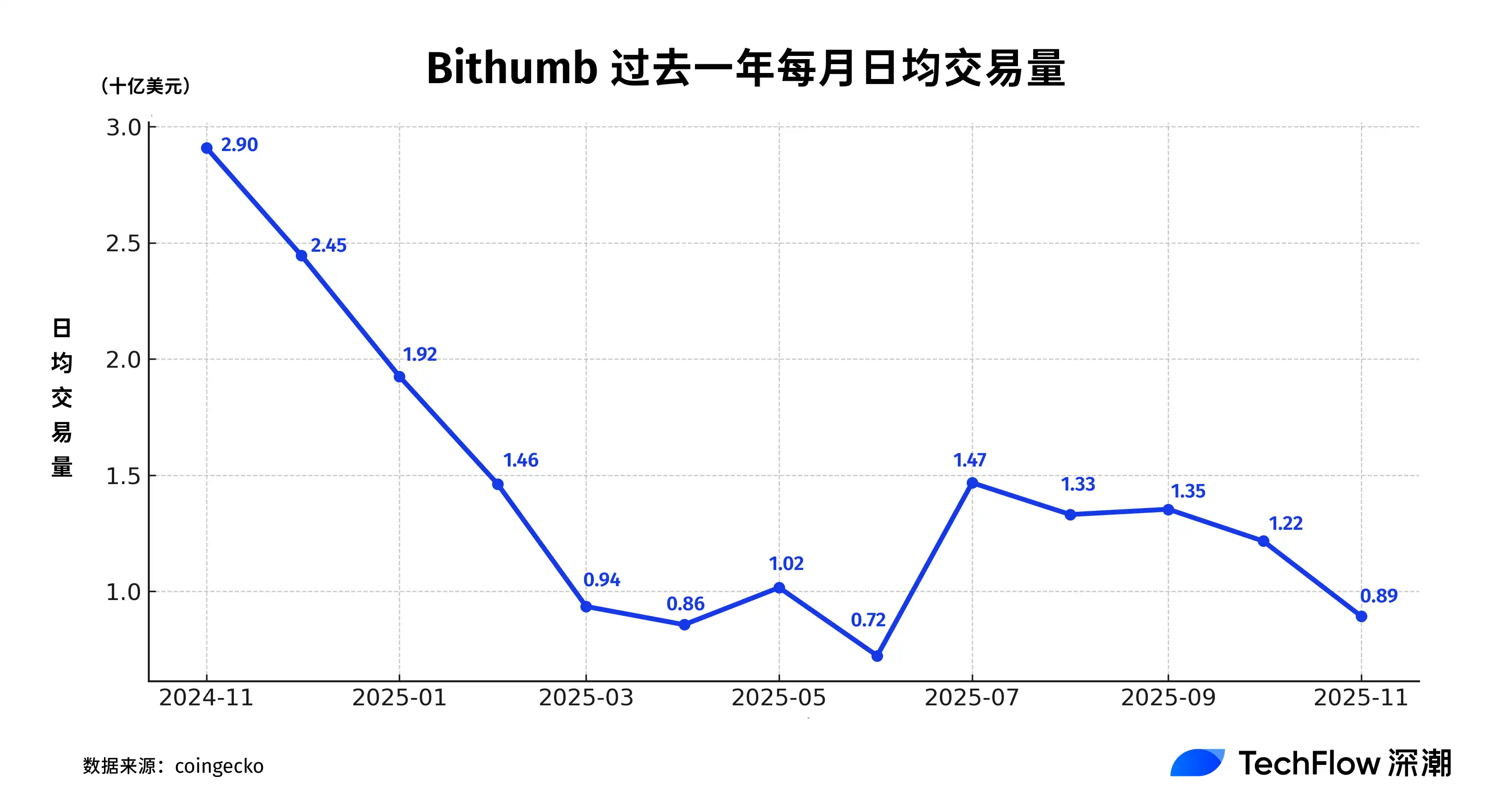
Both of South Korea's largest domestic exchanges (Upbit and Bithumb) experienced a "volume decline" during the same period, indicating not only a cooling of trading but also a comprehensive retreat of South Korean retail investor sentiment.
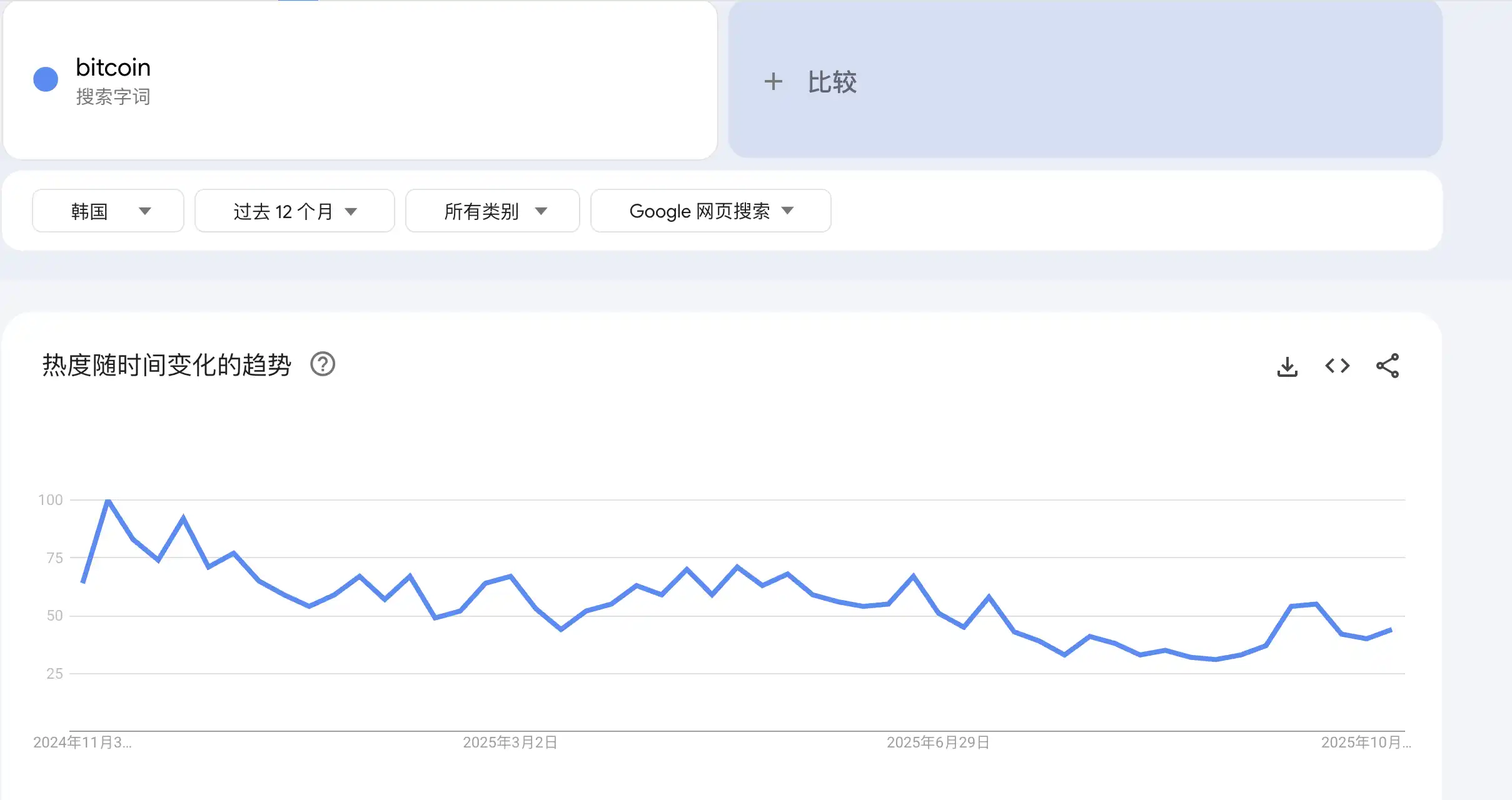
Search data confirms this point. In South Korea's Google search trends, the latest search index for Bitcoin is 44, a 66% drop from the peak of 100 at the end of 2024.
Korean Stock Market Frenzy
So, where did the money of South Koreans go? The answer is: the stock market.
This year's South Korean stock market can be described as the reincarnation of the 2017 Bitcoin bull market, an epic-level frenzy.
The benchmark KOSPI index set intraday historical highs 17 times in just the past October, breaking through the 4200 point mark. In October alone, it surged by nearly 21%, marking the best single month since 2001.
From the beginning of the year until now, the KOSPI index has surged by over 72%, outperforming all other asset classes.
The average daily trading volume of the KOSPI in October reached 16.6 trillion Korean won (about 115 billion US dollars), with a daily high trading volume of 18.9 trillion Korean won, a 44% increase compared to September, causing brokerage apps to lag.
And this is just the index; individual stocks are even more frenzied.
Samsung Electronics has risen by 100% since the beginning of the year; leading memory chip maker SK Hynix's stock price has increased by 70% this quarter and skyrocketed by 240% since the beginning of the year. The two companies collectively have a daily average trading volume of 4.59 trillion Korean won, accounting for 28% of the entire market.
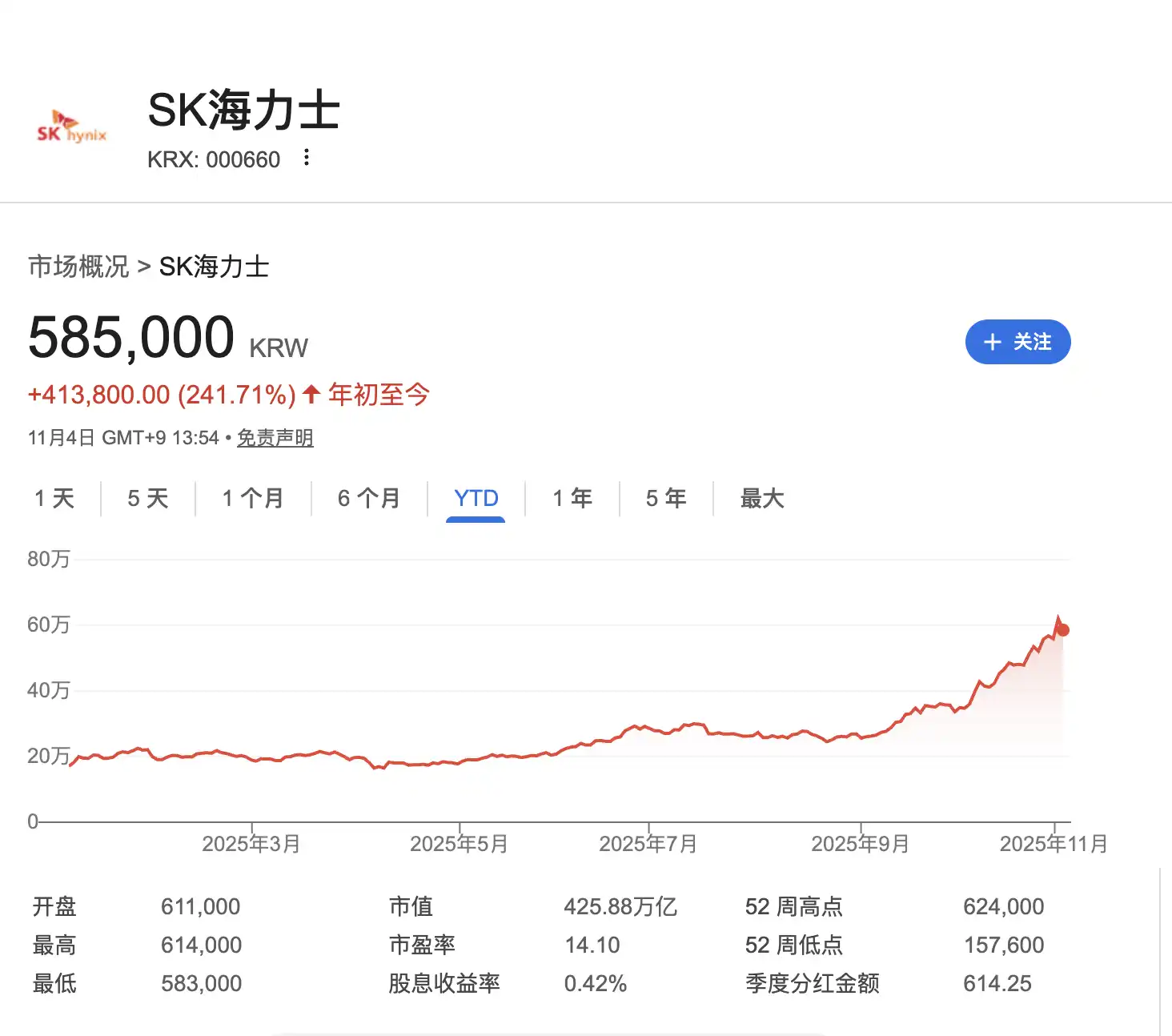
The market heat is so high that even the trading platforms are finding it hard to bear. A South Korean exchange announced on Monday evening that it had issued an "investment caution" notice for SK Hynix's stock due to its overly rapid rise, causing SK Hynix's stock price to plummet on Tuesday.
AI Has Become a "National Belief"
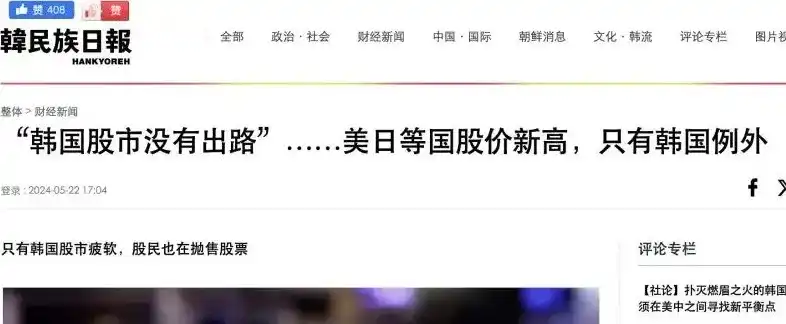
Once upon a time, the South Korean stock market was stagnant, barely seeing any growth for over a decade. Domestic Korean media often spoke negatively, saying "there is no way out for the Korean stock market," leading many Korean investors to speculate on cryptocurrencies or invest in US stocks. So why has the South Korean stock market turned the tide by 2025?
This recent surge in the South Korean stock market may seem like "retail investors going crazy," but the underlying logic is remarkably clear:
Global AI Wave + Policy Drive + Domestic Capital Inflow.
Everyone knows that the spark of this bull market comes from AI.
ChatGPT ignited the second season of the global tech bubble, and South Korea happens to sit at the ammunition depot of the industry chain.
South Korea is a leading country in global memory chip production, with SK Hynix and Samsung Electronics almost monopolizing the High Bandwidth Memory (HBM) market, which is crucial for training large AI models.
This means that every time NVIDIA's or AMD's GPU shipments increase, Korean companies' profit curves will skyrocket in sync.
At the end of October, SK Hynix released its financial report, with third-quarter revenue of $17.1 billion, operating profit of $8 billion, a 62% year-on-year increase, both hitting record highs.
More importantly, SK Hynix has already secured customer demand for all DRAM and NAND production capacity until 2026, with demand outstripping supply.
So Koreans have realized:
AI may be America's narrative, but money is what Korea is making.
If NVIDIA is the soul of US stocks, Korean retail investors have found their faith in SK Hynix.
From the cryptocurrency world to the stock market, they are still chasing the dream of "tenfold returns," but buying Samsung or SK can also earn them the title of "Patriot."
Additionally, do not overlook a key background:
The South Korean government is vigorously supporting the stock market.For a long time, there has been the so-called "Korea Discount" in the South Korean stock market.
Monopolistic conglomerates, chaotic corporate governance, low shareholder returns... have led to undervaluation of South Korean companies, with even Samsung Electronics being undervalued compared to similar global companies in the long term, and SK Hynix experiencing a 240% increase but still having a PE ratio of only 14.
Since the administration of President Yoon Suk-yeol came into office, it has launched a reform plan known as the "Korean Shareholder Value Revolution":
Encouraging companies to increase dividends and buy back shares;
Cracking down on chaebol cross-shareholdings;
Reducing capital gains tax, encouraging pension funds and retail investors to increase their domestic allocation.
This reform has been dubbed by the media as the "National Action to Eliminate Korea's Discount."
As a result, foreign funds have begun to flow back in, local institutions and retail investors have also been actively "buying stocks at home."
Of course, another reality is that there is nowhere else for the money to go.
The South Korean real estate market has cooled off during a high-interest-rate period, U.S. stock valuations are soaring, and the cryptocurrency market can only be passively traded.
Investors need a new gambling table, and the stock market happens to provide a legal gambling arena.
South Korean bank data shows that in the first half of this year, more than 5 million new domestic retail securities accounts were opened, and brokerage app downloads have surged.
The speed of this influx of funds into the KOSPI is faster than retail investors rushing into the cryptocurrency market in 2021.
Meanwhile, South Korean pension funds and insurance funds are also increasing their holdings of domestic tech stocks.
From the nation to institutions to retail investors, everyone is rushing into the stock market, and you could even say that this is a "national-level nationwide bull market."
Speculation Never Sleeps
Unlike the cryptocurrency market, which relies on "emotion" to drive prices, this "bull run" in the South Korean stock market at least has some performance support.
It must be acknowledged that:
This stock market bull run is fundamentally still a nationwide "emotional resonance."
Koreans haven't changed, they just switched to a different gambling table where they not only gamble but also use leverage.
According to Bloomberg, Korean retail investors have significantly increased their leverage, causing the margin loan balance to double in the past 5 years. They have heavily poured into high-leverage and inverse ETFs.
According to ChainNews data, by 2025, Korean retail leveraged funds accounted for 28.7% of total holdings, 9% higher than the previous year; 3x leveraged product holdings increased from 5.1% to 12.8%, and the leverage usage rate among 25-35 year-olds is 41.2%.
This group of retail investors inherently carries the "all-in gene."
However, as Korean retail investors collectively rush into the stock market, a question arises:
"If Koreans are no longer trading coins, who will pick up the altcoins?"
In recent years, the Korean market has often been the last resort for altcoins.
From Dogecoin to PEPE, from LUNA to XRP, almost every round of crazy bull market has seen the shadow of Korean retail investors.
They represent the "ultimate sentiment indicator" of the global crypto market; as long as Korea is still buying, the bubble is not at its peak.
Now, with the trading volumes of Upbit and Bithumb plummeting, the crypto market has lost its final believers and, consequently, its major fuel.
Altcoins are left without buyers.
Perhaps we will have to wait until the heat of this global AI stock market cycle subsides, or until the crypto market can tell a compelling enough story again.
Then, the dormant gamblers will be awakened once more, returning to the chain to continue their bets.
After all, the gamblers have always been here; they just switched to a different casino.
You may also like

Hyperliquid Whales Shift Strategies: BTC Longs Decline, ETH Shorts Dominate
Key Takeaways A significant reduction in Bitcoin long positions has been observed on Hyperliquid, with large holders decreasing…

Crypto Christmas Heist: Over $6 Million Lost, Trust Wallet Chrome Extension Wallet Hacked Analysis
Bitcoin Surges Toward $90,000 as $27 Billion Crypto Options Expire
Key Takeaways Bitcoin’s price is nearing the $90,000 mark amid increased market activity following the holiday lull. The…

Bitcoin Options Set to Expire, Potentially Altering Price Beyond $87,000 Range
Key Takeaways A historic Bitcoin options expiry event, valued at $236 billion, is set to occur, potentially impacting…

Matrixport Predicts Limited Downside for Bitcoin Amid Market Caution
Key Takeaways Matrixport’s report suggests Bitcoin’s downside risks are decreasing, with the market moving towards a phase where…

Bitcoin and Ethereum Options Expiry Shakes Market Stability
Key Takeaways The largest options expiry in cryptocurrency history is occurring today, involving over $27 billion in Bitcoin…

Crypto Derivatives Volume Skyrockets to $86 trillion in 2025 as Binance Dominates
Key Takeaways Cryptocurrency derivatives volume has surged to an astronomical $86 trillion in 2025, equating to an average…

Kraken IPO to Rekindle Crypto’s ‘Mid-Stage’ Cycle: A Comprehensive Analysis
Key Takeaways: Kraken’s anticipated IPO in 2026 could significantly attract fresh capital from traditional financial investors, marking a…
Fed Q1 2026 Outlook: Potential Impact on Bitcoin and Crypto Markets
Key Takeaways: Federal Reserve’s policies could exert significant pressure on cryptocurrencies if rate cuts halt in early 2026.…

Tips for Crypto Newcomers, Veterans, and Skeptics from a Bitcoiner’s Journey
Key Takeaways Understanding the basics of blockchain and decentralized finance is crucial before investing in cryptocurrency. Newcomers should…

Quantum Computing in 2026: No Crypto Doomsday, Time to Prepare
Key Takeaways: Quantum computing still poses a theoretical risk to cryptocurrency security, but immediate threats are minimal due…
El Salvador’s Bitcoin Aspirations Brought Closer to Earth in 2025
Key Takeaways: Early Ambitions vs. Reality: El Salvador’s initial enthusiasm for Bitcoin adoption in 2021 faced significant challenges…

Ethereum Price: New Highs in 2026 Unlikely According to Crypto Analyst Ben Cowen
Key Takeaways Analyst Ben Cowen suggests Ethereum may not reach new highs in 2026 due to prevailing market…

Blockchains Quietly Brace for Quantum Threat Amid Bitcoin Debate
Key Takeaways Cryptocurrency networks, especially altcoins, are enhancing security to prepare for potential quantum computing threats. Bitcoin faces…

Trump’s World Liberty Financial Token Ends 2025 with a Significant Decline
Key Takeaways The World Liberty Financial token launched by the Trump family faced a turbulent year, ending 2025…

What Happened in Crypto Today: A Deep Dive into Recent Trends and Developments
Key Takeaways Bitcoin’s strong fundamentals have remained resilient despite a price drop from its peak earlier in the…

Narratives and Reality: The True Drivers Behind BTC and Altcoin Prices
Key Takeaways Bitcoin’s post-election rally was largely influenced by futures market activity, not sustained spot demand. Spot Bitcoin…
Canton Token Surges Amid DTCC’s Tokenized Treasury Plans
Key Takeaways Canton Coin has surged by approximately 27% due to growing institutional interest and DTCC’s announcement to…
Hyperliquid Whales Shift Strategies: BTC Longs Decline, ETH Shorts Dominate
Key Takeaways A significant reduction in Bitcoin long positions has been observed on Hyperliquid, with large holders decreasing…
Crypto Christmas Heist: Over $6 Million Lost, Trust Wallet Chrome Extension Wallet Hacked Analysis
Bitcoin Surges Toward $90,000 as $27 Billion Crypto Options Expire
Key Takeaways Bitcoin’s price is nearing the $90,000 mark amid increased market activity following the holiday lull. The…
Bitcoin Options Set to Expire, Potentially Altering Price Beyond $87,000 Range
Key Takeaways A historic Bitcoin options expiry event, valued at $236 billion, is set to occur, potentially impacting…
Matrixport Predicts Limited Downside for Bitcoin Amid Market Caution
Key Takeaways Matrixport’s report suggests Bitcoin’s downside risks are decreasing, with the market moving towards a phase where…
Bitcoin and Ethereum Options Expiry Shakes Market Stability
Key Takeaways The largest options expiry in cryptocurrency history is occurring today, involving over $27 billion in Bitcoin…
Popular coins
Latest Crypto News


Customer Support:@weikecs
Business Cooperation:@weikecs
Quant Trading & MM:bd@weex.com
VIP Services:support@weex.com
 App
App