
- Buy Crypto
- Markets
- Futures
- Spot
- Copy Trade
 WE-Launch
Vitalik Revisits Quantum Threat Theory: Is the Foundation of Cryptocurrency Really at Stake?

Original Article Title: "The Resurgence of Quantum Threat, Is the Foundation of Cryptocurrency Shaken?"
Original Article Author: Azuma, Odaily Planet Daily
Lately, the threat of quantum computing to cryptocurrency has once again become a hot topic of discussion online. The reason behind this renewed interest is that several key figures in the quantum computing and cryptocurrency industries have recently made new predictions regarding the development of quantum computing and its potential capabilities.
Firstly, on November 13th, Scott Aaronson, a quantum computing guru and Director of the University of Texas Quantum Information Center, mentioned in an article: "I now believe that before the next US presidential election, we may have a fault-tolerant quantum computer capable of running the Shor algorithm..."
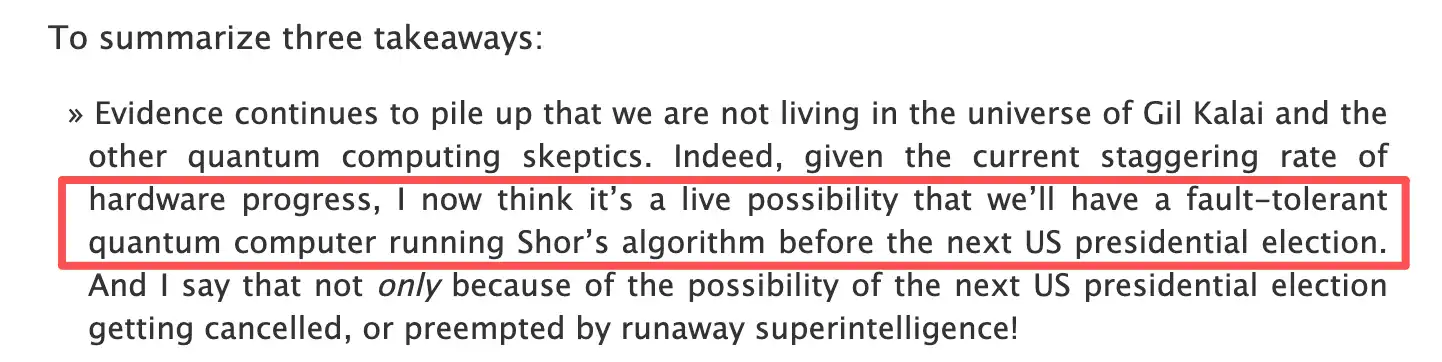
Following that, on November 19th, Ethereum co-founder Vitalik Buterin also spoke at the Devconnect conference in Buenos Aires, stating that Elliptic Curve Cryptography (ECC) could be broken by quantum computing by the US presidential election in 2028, and urged Ethereum to upgrade to a post-quantum algorithm within four years.

What is a Quantum Threat?
Before we interpret Scott and Vitalik's predictions, we need to briefly explain what a "quantum threat" is.
In simple terms, a quantum threat to cryptocurrency refers to the possibility that a sufficiently powerful quantum computer in the future could break the cryptographic foundations protecting the security of current cryptocurrencies, potentially undermining their security model.
Currently, the security of almost all cryptocurrencies (such as Bitcoin and Ethereum) relies on a technology known as "asymmetric encryption," with the two most critical parts being the "private key" and the "public key":
• Private Key: Kept secret by the user, used to sign transactions and prove ownership of assets;
• Public Key: Generated from the private key, can be made public, and is used as a wallet address or part of an address.
The cornerstone of cryptocurrency security lies in the fact that deriving a private key from a public key is currently computationally infeasible. However, quantum computing, leveraging principles of quantum mechanics, can greatly expedite the process of solving certain mathematical problems by running specific algorithms (such as the aforementioned Shor's algorithm), which is precisely the weakness of asymmetric encryption.
Let's further explain what Shor's algorithm is. We won't delve too much into the mathematics here, but in essence, the essence of Shor's algorithm is that it can transform a mathematical problem that is "almost unsolvable" on a classical computer into a "relatively solvable" period-finding problem on a quantum computer, potentially threatening the existing "private key - public key" cryptographic system of cryptocurrency.
For a more straightforward example, you can easily turn a basket of strawberries (analogous to a private key) into jam (analogous to a public key), but obviously cannot reverse the jam back into strawberries. However, suddenly a cheat code (analogous to quantum computing) emerges that may be able to achieve this expediently (analogous to the Shor's algorithm).
Has the Foundation of Cryptocurrency Been Shaken?
So, does this mean cryptocurrency is doomed?
Don't panic, the quantum threat is objectively real, but the issue is not as pressing. The reason for this statement mainly lies in two key points. First, there is still time before a real threat emerges; second, cryptocurrency can implement post-quantum algorithms through upgrades.
Firstly, regarding the first point, even if Scott's prediction comes true before the 2028 elections, it does not mean that cryptocurrency security will truly be compromised; Vitalik's statement is not suggesting that the foundation of Bitcoin and Ethereum will be shaken but merely points out a theoretical risk in the long term.
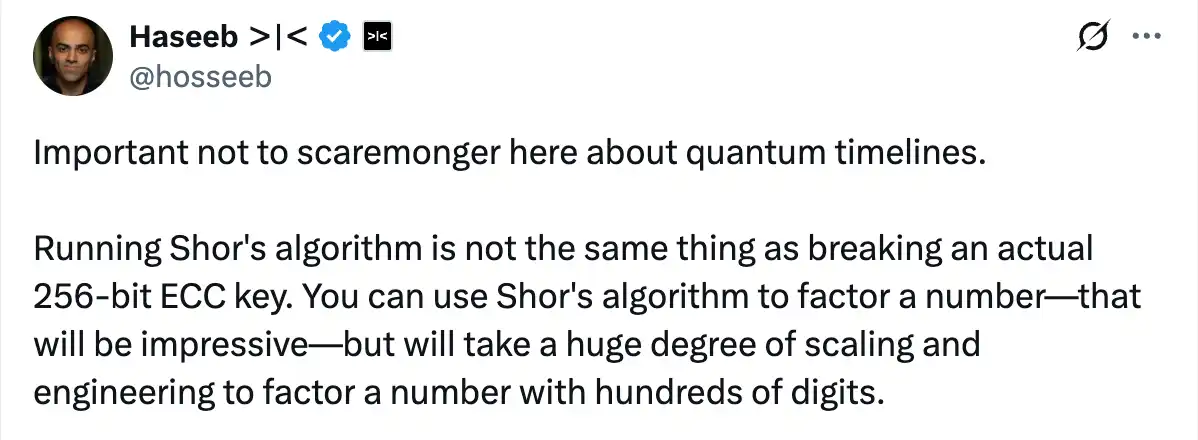
Haseeb, a Dragonfly Capital partner, explained that there is no need to panic about the new timeline for quantum computing, running Shor's algorithm does not equate to breaking a real 256-bit elliptic curve key (ECC key). You can use Shor's algorithm to break one number—that's impressive enough—but breaking down a number with hundreds of digits requires a significantly larger computational scale and engineering capacity... This is something to take seriously but is by no means imminent.
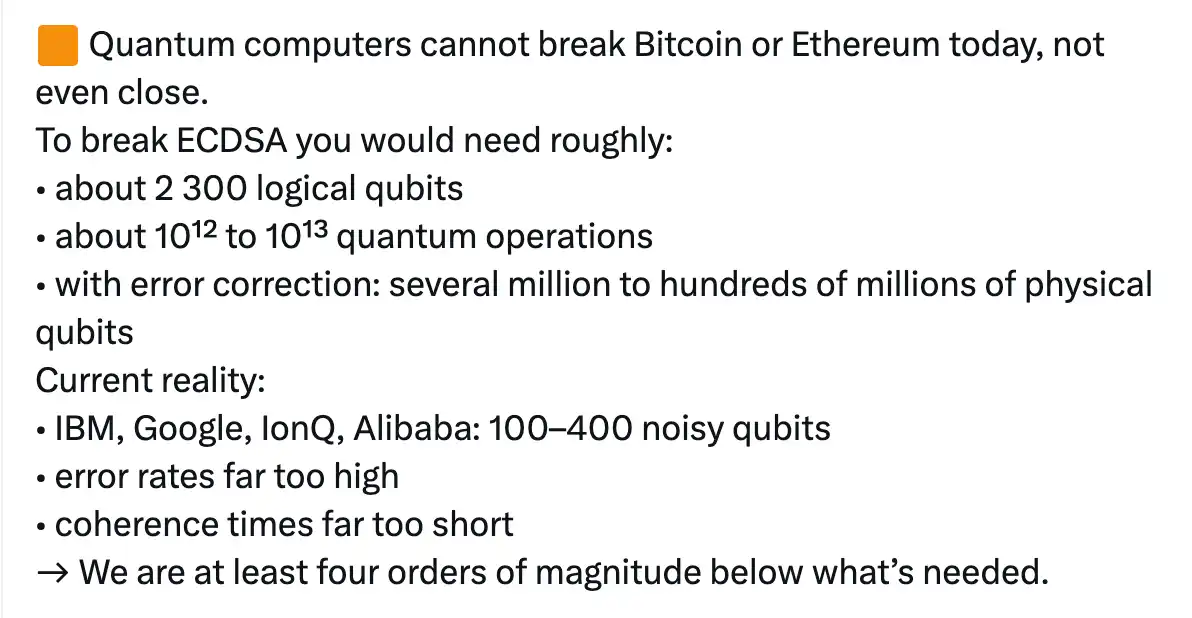
Cryptocurrency security expert MASTR has provided a clearer mathematical answer. Breaking the elliptic curve signature (ECDSA) currently used in cryptocurrencies such as Bitcoin and Ethereum would require approximately 2300 logical qubits, 10¹² to 10¹³ quantum operations, and, with error correction, would require millions to even billions of physical qubits. However, current quantum computers only have 100 to 400 noisy qubits with a high error rate and a short coherence time—the gap between the requirements to break the former is still at least four orders of magnitude.
As for the second point, industry cryptographers are also developing new post-quantum cryptography (PQC) algorithms that can resist quantum computing attacks, and mainstream blockchains have already prepared for this.
As early as March last year, Vitalik wrote an article titled "If Quantum Attack Comes Tomorrow, How Will Ethereum Solve It?" In the article, he mentioned the resilience to quantum threats of Winternitz signatures, STARKs, and even envisioned how Ethereum would urgently upgrade in case of an emergency.
Compared to Ethereum, Bitcoin may not be as flexible in upgrade implementation, but the community has long proposed various potential algorithm upgrade solutions such as Dilithium, Falcon, SPHINCS+. With the recent increase in related discussions, Bitcoin OG figure Adam Back has also stated that post-quantum cryptographic standards can be implemented long before a substantial quantum computing threat emerges.
In summary, the quantum threat is like a distant "master key" that theoretically can unlock all current blockchain cryptographic locks. However, the creators of the locks have long been studying new locks that this master key cannot open and are preparing to replace all the doors with new locks before the master key is created.
This is the current objective reality regarding the quantum threat. We cannot ignore its progress, but there is no need to blind panic because of it.
You may also like

Lido DAO’s Increased Development and Market Dynamics Elevate LDO Price
Key Takeaways Lido DAO’s development activities have surged by 690%, signifying substantial growth. The Lido DAO token (LDO)…

Hyperliquid Whales Shift Strategies: BTC Longs Decline, ETH Shorts Dominate
Key Takeaways A significant reduction in Bitcoin long positions has been observed on Hyperliquid, with large holders decreasing…

December 26th Market Key Intelligence, How Much Did You Miss?

Crypto Christmas Heist: Over $6 Million Lost, Trust Wallet Chrome Extension Wallet Hacked Analysis
Bitcoin Surges Toward $90,000 as $27 Billion Crypto Options Expire
Key Takeaways Bitcoin’s price is nearing the $90,000 mark amid increased market activity following the holiday lull. The…

Bitcoin Options Set to Expire, Potentially Altering Price Beyond $87,000 Range
Key Takeaways A historic Bitcoin options expiry event, valued at $236 billion, is set to occur, potentially impacting…
Ethereum Price Prediction: Whales Accumulate as Market Awaits Key Break
Key Takeaways Ethereum’s price remains in a “no-trade zone” between $2,800 and $3,000 amid low market activity. Whale…

Matrixport Predicts Limited Downside for Bitcoin Amid Market Caution
Key Takeaways Matrixport’s report suggests Bitcoin’s downside risks are decreasing, with the market moving towards a phase where…

Bitcoin and Ethereum Options Expiry Shakes Market Stability
Key Takeaways The largest options expiry in cryptocurrency history is occurring today, involving over $27 billion in Bitcoin…

Trust Wallet Hack Results in $3.5 Million Loss for Major Wallet Holder
Key Takeaways A significant Trust Wallet hack led to the theft of $3.5 million from an inactive wallet.…

PancakeSwap Launches LP Rewards on Base Network
Key Takeaways PancakeSwap has introduced liquidity provider (LP) rewards for 12 v3 pools on the Base network, facilitated…

Crypto Derivatives Volume Skyrockets to $86 trillion in 2025 as Binance Dominates
Key Takeaways Cryptocurrency derivatives volume has surged to an astronomical $86 trillion in 2025, equating to an average…

Ethereum in 2026: Glamsterdam and Hegota Forks, Layer 1 Scaling, and More
Key Takeaways Ethereum is poised for crucial developments in 2026, particularly with the Glamsterdam and Hegota forks. Glamsterdam…

Kraken IPO to Rekindle Crypto’s ‘Mid-Stage’ Cycle: A Comprehensive Analysis
Key Takeaways: Kraken’s anticipated IPO in 2026 could significantly attract fresh capital from traditional financial investors, marking a…
Fed Q1 2026 Outlook: Potential Impact on Bitcoin and Crypto Markets
Key Takeaways: Federal Reserve’s policies could exert significant pressure on cryptocurrencies if rate cuts halt in early 2026.…

Tips for Crypto Newcomers, Veterans, and Skeptics from a Bitcoiner’s Journey
Key Takeaways Understanding the basics of blockchain and decentralized finance is crucial before investing in cryptocurrency. Newcomers should…
Quantum Computing in 2026: No Crypto Doomsday, Time to Prepare
Key Takeaways: Quantum computing still poses a theoretical risk to cryptocurrency security, but immediate threats are minimal due…
El Salvador’s Bitcoin Aspirations Brought Closer to Earth in 2025
Key Takeaways: Early Ambitions vs. Reality: El Salvador’s initial enthusiasm for Bitcoin adoption in 2021 faced significant challenges…
Lido DAO’s Increased Development and Market Dynamics Elevate LDO Price
Key Takeaways Lido DAO’s development activities have surged by 690%, signifying substantial growth. The Lido DAO token (LDO)…
Hyperliquid Whales Shift Strategies: BTC Longs Decline, ETH Shorts Dominate
Key Takeaways A significant reduction in Bitcoin long positions has been observed on Hyperliquid, with large holders decreasing…
December 26th Market Key Intelligence, How Much Did You Miss?
Crypto Christmas Heist: Over $6 Million Lost, Trust Wallet Chrome Extension Wallet Hacked Analysis
Bitcoin Surges Toward $90,000 as $27 Billion Crypto Options Expire
Key Takeaways Bitcoin’s price is nearing the $90,000 mark amid increased market activity following the holiday lull. The…
Bitcoin Options Set to Expire, Potentially Altering Price Beyond $87,000 Range
Key Takeaways A historic Bitcoin options expiry event, valued at $236 billion, is set to occur, potentially impacting…
Popular coins
Latest Crypto News


Customer Support:@weikecs
Business Cooperation:@weikecs
Quant Trading & MM:bd@weex.com
VIP Services:support@weex.com
 App
App