
- Buy Crypto
- Markets
- Futures
- Spot
- Copy Trade
 WE-Launch
Where Did $362 Million Go? Hyperliquid Counters FUD in Decentralization Showdown

Original Title: "Hyperliquid Personally Reconciles, Perfect PR Hides Underlying Competitor Sabotage"
Original Author: angelilu, Foresight News
On December 20, 2025, a technical article titled "Reverse Engineering Hyperliquid" was published on blog.can.ac, which decompiled Hyperliquid's binary file directly, accusing it of 9 serious issues ranging from insolvency to a "God Mode Backdoor." The article bluntly stated:
"Hyperliquid is a centralized exchange platform disguised as a blockchain."
Faced with FUD, Hyperliquid officially responded with a lengthy article. Perhaps this was not just a simple rebuttal but a declaration of war on the route of "who is the true decentralized trading facility." While the official statement successfully clarified the fund security issue, some intriguing "blank spaces" remain in certain sensitive areas of decentralization.
Where Did 3.62 Billion Dollars Go? The Audit Blind Spot of the "Dual Ledger"
The most damaging accusation is this: the user assets within the Hyperliquid system are $3.62 billion less than the on-chain reserves. If true, this would mean it is a "chain FTX" operating on partial reserves.
However, upon verification, this was an information asymmetry misinterpretation caused by an "architectural upgrade." The logic of the critics' audit is as follows: Hyperliquid reserves = USDC balance on the Arbitrum cross-chain bridge. Using this logic, they looked at the cross-chain bridge address and found that the balance was indeed less than the total user deposits.
In response, Hyperliquid stated that it is undergoing a complete evolution from an "L2 AppChain" to an "independent L1." During this process, the asset reserves shifted to a dual-track system as follows:
The accusers completely ignored the native USDC on HyperEVM. According to on-chain data (as of the time of writing):
· Arbitrum cross-chain balance: 39.89 billion USDC (Can be verified on Arbiscan)
· HyperEVM native balance: 3.62 billion USDC (Can be verified on Hyperevmscan)
· HyperEVM Contract Balance: 0.59 Billion USDC
Total Settlement Capacity = 39.89 Billion + 3.62 Billion + 0.59 Billion ≈ 43.51 Billion USDC
This number aligns perfectly with the Total User Balances on HyperCore. The so-called "3.62 Billion Gap" is precisely the native assets that have been migrated to HyperEVM. This is not a fund loss but a transfer of funds between different ledgers.
9-Point Allegation Reconciliation: What Has Been Clarified? What Has Been Avoided?
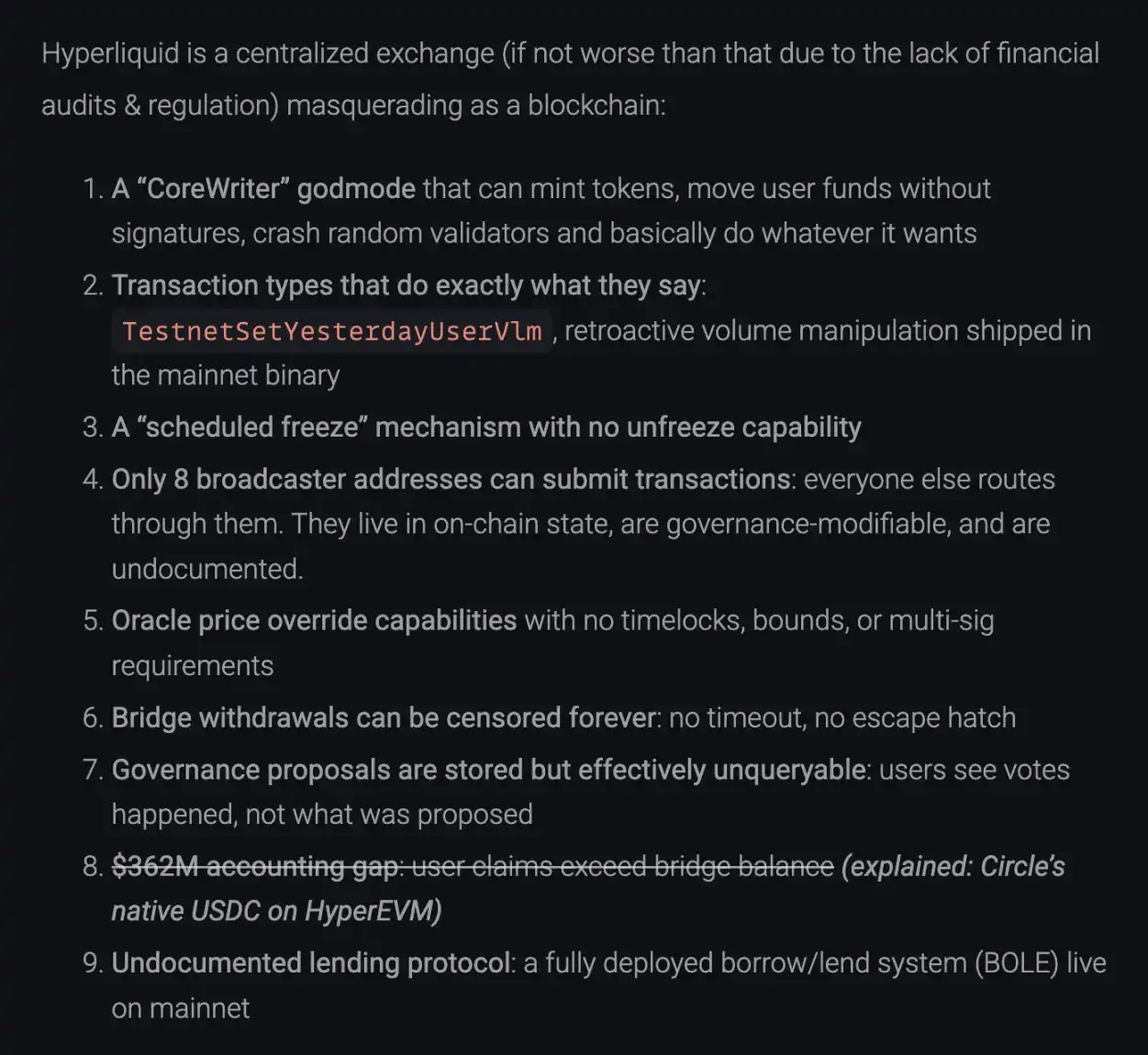
Allegations Clarified
Allegation: 'CoreWriter' God Mode: Allegation claims it can mint money out of thin air, misappropriate funds.
Response: Officially explained as the interface for L1 interacting with HyperEVM (e.g., staking), with limited permissions and no ability to misappropriate funds.
Allegation: 3.62 Billion Fund Gap.
Response: As mentioned above, this does not account for Native USDC.
Allegation: Undisclosed lending protocol.
Response: Officials pointed out that the Spot / Loan feature (HIP-1) documentation has been disclosed, in the pre-release stage, and not operated in secrecy.
Allegations Acknowledged with Reasonable Explanations
Allegation: Binary file contains "Volume Modification" code (TestnetSetYesterdayUserVlm).
Response: Acknowledged. But explained as residual code for the testnet, used to simulate fee logic. The mainnet node has physically isolated this path and cannot execute it.
Allegation: Only 8 broadcast addresses can submit transactions.
Response: Acknowledged. Explained as an MEV (Maximum Extractable Value) resistance measure to prevent users from being front-run. A commitment has been made to implement a "multi-propser" mechanism in the future.
Accusation: The chain can be "strategically frozen" with no possibility of reversal.
Response: Acknowledged. Explained as a standard process for network upgrades that require a full network pause to switch versions.
Accusation: Oracle prices can be instantly overwritten.
Response: Explained as a security system design feature. To promptly settle bad debt in extreme price swings like 10/10, validator oracles indeed do not have a time lock.
Missing / Ambiguous Responses
Upon our review, two accusations were not directly addressed or fully resolved in the official responses:
Accusation: Governance proposals are unqueryable; users can only see that a vote occurred, but on-chain data does not include the specific proposal text.
Response: The official response did not address this point in the lengthy document. This implies that Hyperliquid's governance is currently a "black box" to ordinary users, where you can see the outcome but not the process.
Accusation: The cross-chain bridge has no "Escape Hatch"; withdrawals may be subject to indefinite review, and users cannot forcibly withdraw back to L1.
Response: While the official response explained that the locked bridge during the POPCAT incident was for security, it did not refute the fact of "no Escape Hatch" in the architecture. This indicates that at the current stage, the movement of user assets is heavily reliant on the validator set's approval, lacking the anti-censorship forced withdrawal capability seen in L2 Rollups.
Competitor "Mud-Slinging"
The most intriguing aspect of this incident is how it forced Hyperliquid to reveal its hand and gave us the opportunity to reassess the Perp track landscape. The official response notably engaged in competitor "mud-slinging," targeting Lighter, Aster, and even industry giant Binance.
It stated, "Lighter uses a single centralized sequencer, with its execution logic and zero-knowledge proof (ZK) circuits not open to the public. Aster employs centralized matching and even offers dark pool trading, a feature achievable only with a single centralized sequencer and a non-verifiable execution process. Other protocols with open-source contracts lack a verifiable sequencer."
Hyperliquid bluntly categorizes these competitors as all relying on a "Centralized Sequencer." The team emphasizes: on these platforms, apart from the sequencer operator, no one can see a full state snapshot (including order book history, position details). In contrast, Hyperliquid attempts to eliminate this "privilege" by having all validators execute the same state machine.
And perhaps this wave of "pulling the rug" is precisely because Hyperliquid has raised concerns about the current market share, according to DefiLlama's transaction volume data from the past 30 days, the market landscape has become a three-way standoff:
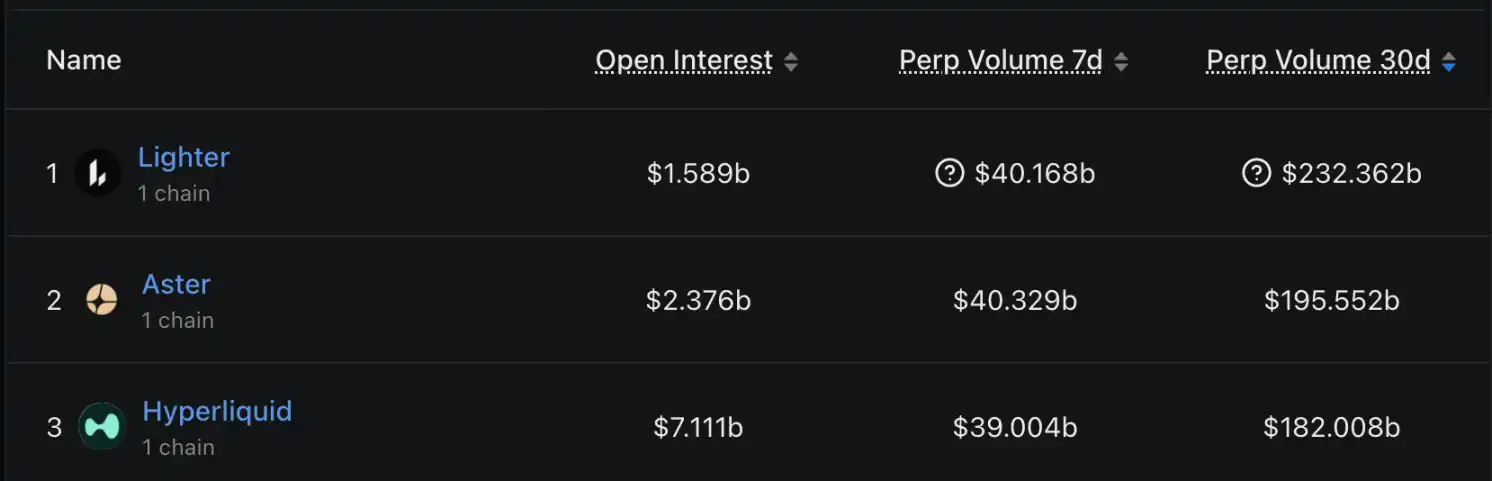
· Lighter: with a transaction volume of $232.3 billion, currently in the first place, holding approximately 26.6%.
· Aster: with a transaction volume of $195.5 billion, in second place, holding approximately 22.3%.
· Hyperliquid: with a transaction volume of $182.0 billion, in third place, holding approximately 20.8%.
Facing the transaction volumes of Lighter and Aster leading from behind, Hyperliquid attempts to play the "transparency" card—meaning "although I have 8 centralized broadcasting addresses, my full state is on-chain and verifiable; while you can't even verify." However, it is worth noting that although Hyperliquid slightly lags behind the top two in transaction volume, in Open Interest (OI), Hyperliquid shows overwhelming strength.
Sentiment Response: Who Is Shorting HYPE?
In addition to technical and financial issues, the community's most pressing concern is the recent rumors of HYPE token being seemingly shorted and price manipulated by "insiders." In response, a Hyperliquid team member first provided a qualitative response on Discord: "The shorting address starting with 0x7ae4 belongs to a former employee," who was once a team member but was dismissed in early 2024. The former employee's personal trading activities are unrelated to the current Hyperliquid team. The platform emphasizes that they currently enforce extremely strict HYPE trading restrictions and compliance checks on all employees and contractors, prohibiting the exploitation of their positions for insider trading.
This response attempts to downgrade the accusation of "team wrongdoing" to "former employee's personal behavior," but in terms of transparency in token distribution and unlocking mechanisms, the community may still expect more detailed disclosures.
Don't Trust, Verify
This clarification tweet by Hyperliquid is a textbook example of crisis PR—not relying on emotional output, but on data, code links, and architectural logic. It didn't just stop at clearing its name but went on the offensive, strengthening its brand and advantage of "on-chain full state" through a comparison with competitors' architectures.
While the FUD has been debunked, the reflection this incident has left on the industry is profound. As DeFi protocols evolve towards Application-Specific Chains (AppChains), the architecture is becoming more complex, and asset distribution is becoming more fragmented (Bridge + Native). The traditional way of "checking contract balances at a glance" has become ineffective.
For Hyperliquid, proving that the "money is there" is just the first step. The real challenge lies in gradually transferring control of those 8 commit addresses while maintaining high performance and MEV resistance, truly achieving the transition from "transparent centralization" to "transparent decentralization." This is the essential path for it to become the "ultimate DEX."
And for users, this incident once again confirms the golden rule of the crypto world: don't trust any narrative; verify every byte.
You may also like

December 24th Market Key Intelligence, How Much Did You Miss?

Base's 2025 Report Card: Revenue Grows 30X, Solidifies L2 Leadership

The Trillion-Dollar Stablecoin Battle: Binance Decides to Step in Again

Aave Community Governance Drama Escalates, What's the Overseas Crypto Community Talking About Today?

Polymarket Announces In-House L2, Is Polygon's Ace Up?

2025 Whale Saga: Mansion Kidnapping, Supply Chain Poisoning, and Billions Liquidated

Coinbase Joins Prediction Market, AAVE Governance Dispute - What's the Overseas Crypto Community Talking About Today?
Over the past 24 hours, the crypto market has shown strong momentum across multiple dimensions. The mainstream discussion has focused on Coinbase's official entry into the prediction market through the acquisition of The Clearing Company, as well as the intense controversy within the AAVE community regarding token incentives and governance rights.
In terms of ecosystem development, Solana has introduced the innovative Kora fee layer aimed at reducing user transaction costs; meanwhile, the Perp DEX competition has intensified, with the showdown between Hyperliquid and Lighter sparking widespread community discussion on the future of decentralized derivatives.
This week, Coinbase announced the acquisition of The Clearing Company, marking another significant move to deepen its presence in this field after last week's announcement of launching a prediction market on its platform.
The Clearing Company's founder, Toni Gemayel, and the team will join Coinbase to jointly drive the development of the prediction market business.
Coinbase's Product Lead, Shan Aggarwal, stated that the growth of the prediction market is still in its early stages and predicts that 2026 will be the breakout year for this field.
The community has reacted positively to this, generally believing that Coinbase's entry will bring significant traffic and compliance advantages to the prediction market. However, this has also sparked discussions about the industry's competitive landscape.
Jai Bhavnani, Founder of Rivalry, commented that for startups, if their product model proves to be successful, industry giants like Coinbase have ample reason to replicate it.
This serves as a reminder to all entrepreneurs in the crypto space that they must build significant moats to withstand competition pressure from these giants.
Regulated prediction market platform Kalshi launched its research arm, Kalshi Research, this week, aimed at opening its internal data to the academic community and researchers to facilitate exploration of prediction market-related topics.
Its inaugural research report highlights Kalshi's outperformance in predicting inflation compared to Wall Street's traditional models. Kalshi co-founder Luana Lopes Lara commented that the power of prediction markets lies in the valuable data they generate, and it is now time to better utilize this data.
Meanwhile, Kalshi announced its support for the BNB Chain (BSC), allowing users to deposit and withdraw BNB and USDT via the BSC network.
This move is seen as a significant step for Kalshi to open its platform to a broader crypto user base, aiming to unlock access to the world's largest prediction market. Furthermore, Kalshi also revealed plans to host the first Prediction Market Summit in 2026 to further drive industry engagement and development.
The AAVE community recently engaged in heated debates around an Aave Improvement Proposal (AIP) titled "AAVE Tokenomics Alignment Phase One - Ownership Governance," aiming to transfer ownership and control of the Aave brand from Aave Labs to Aave DAO.
Aave founder Stani Kulechov publicly stated his intention to vote against the proposal, believing it oversimplifies the complex legal and operational structure, potentially slowing down the development process of core products like Aave V4.
The community's reaction was polarized. Some criticized Stani for adopting a "double standard" in governance and questioned whether his team had siphoned off protocol revenue, while others supported his cautious stance, arguing that significant governance changes require more thorough discussion.
This controversy highlights the tension between the ideal of DAO governance in DeFi projects and the actual power held by core development teams.
Despite governance disputes putting pressure on the AAVE token price, on-chain data shows that Stani Kulechov himself has purchased millions of dollars' worth of AAVE in the past few hours.
Simultaneously, a whale address, 0xDDC4, which had been quiet for 6 months, once again spent 500 ETH (approximately $1.53 million) to purchase 9,629 AAVE tokens. Data indicates that this whale has accumulated nearly 40,000 AAVE over the past year but is currently in an unrealized loss position.
The founder and whale's increased holdings during market volatility were interpreted by some investors as a confidence signal in AAVE's long-term value.
In this week's top article, Morpho Labs' "Curator Explained" detailed the role of "curators" in DeFi.
The article likened curators to asset managers in traditional finance, who design, deploy, and manage on-chain vaults, providing users with a one-click diversified investment portfolio.
Unlike traditional fund managers, DeFi curators execute strategies automatically through non-custodial smart contracts, allowing users to maintain full control of their assets. The article offered a new perspective on the specialization and risk management in the DeFi space.
Another widely circulated article, "Ethereum 2025: From Experiment to Global Infrastructure," provided a comprehensive summary of Ethereum's development over the past year. The article noted that 2025 is a crucial year for Ethereum's transition from an experimental project to global financial infrastructure. Through the Pectra and Fusaka hard forks, Ethereum achieved significant reductions in account abstraction and transaction costs.
Furthermore, the SEC's clarification of Ethereum's "non-securities" nature and the launch of tokenized funds on the Ethereum mainnet by traditional financial giants like JPMorgan marked Ethereum's gaining recognition from mainstream institutions. The article suggested that whether it is the continued growth of DeFi, the thriving L2 ecosystem, or the integration with the AI field, Ethereum's vision as the "world computer" is gradually becoming a reality.
The Solana Foundation engineering team released a fee layer solution called Kora this week.
Kora is a fee relayer and signatory node designed to provide the Solana ecosystem with a more flexible transaction fee payment method. Through Kora, users will be able to achieve gas-free transactions or choose to pay network fees using any stablecoin or SPL token. This innovation is seen as an important step in lowering the barrier of entry for new users and improving Solana network's availability.
Additionally, a deep research report on propAMM (proactive market maker) sparked community interest. The report's data analysis of propAMMs on Solana like HumidiFi indicated that Solana has achieved, or even surpassed, the level of transaction execution quality in traditional finance (TradFi) markets.
For example, on the SOL-USDC trading pair, HumidiFi is able to provide a highly competitive spread for large trades (0.4-1.6 bps), which is already better than the trading slippage of some mid-cap stocks in traditional markets.
Research suggests that propAMM is making the vision of the "Internet Capital Market" a reality, with Solana emerging as the prime venue for all of this to happen.
The competition in the perpetual contract DEX (Perp DEX) space is becoming increasingly heated.
In its latest official article, Hyperliquid has positioned its emerging competitor, Lighter, alongside centralized exchanges like Binance, referring to it as a platform utilizing a centralized sequencer. Hyperliquid emphasizes its transparency advantage of being "fully on-chain, operated by a validator network, and with no hidden state."
The community widely interprets this as Hyperliquid declaring "war" on Lighter. The technical differences between the two platforms have also become a focal point of discussion: Hyperliquid focuses on ultimate on-chain transparency, while Lighter emphasizes achieving "verifiable execution" through zero-knowledge proofs to provide users with a Central Limit Order Book (CLOB)-like trading experience.
This battle over the future direction of decentralized derivatives exchanges is expected to peak in 2026.
Meanwhile, discussions about Lighter's trading fees have surfaced. Some users have pointed out that Lighter charged as much as 81 basis points (0.81%) for a $2 million USD/JPY forex trade, far exceeding the near-zero spreads of traditional forex brokers.
Some argue that Lighter does not follow a B-book model that bets against market makers, instead anchoring its prices to the TradFi market, and the high fees may be related to the current liquidity or market maker balance incentives. Providing a more competitive spread for real-world assets (RWA) in the highly volatile crypto market is a key issue Lighter will need to address in the future.

The Secret Centralization Landscape of Stablecoin Payments: 85% of Transaction Volume Controlled by Top 1000 Wallets

Why Did Market Sentiment Completely Collapse in 2025? Decoding Messari's Ten-Thousand-Word Annual Report

Stability in the Crypto World: Understanding Stablecoin Usage and Its Implications
Key Takeaways Stablecoin use in payments has rapidly increased alongside blockchain technology advancements. Stablecoins USDT and USDC dominate…
Open Source Achilles' Heel: Nofx and Its 9,000-Star Drama, Forking Fiasco, and Open Source Controversy

Stablecoin Weekly Report | Decrypting How Crypto is Reinventing the Internet's Killer Apps through Coinbase's System Upgrade
Upcoming Lighter TGE: What Is a Reasonable Valuation? As a finance and blockchain translation expert, you are familiar with the field's slang and terminology.

Security Tokenization and Prediction Markets: 7 Major Crypto Boons to Watch in 2026

Aave Yield Distribution Dispute, Solana Surpasses Ethereum in Revenue, What's the Overseas Crypto Community Talking About Today?
Messari 2026 Research Report: Insights into Seven Key Crypto Trends

Key Market Insights from December 19th, How Much Did You Miss Out?

Will the Cryptocurrency Industry Thrive in 2026?
December 24th Market Key Intelligence, How Much Did You Miss?
Base's 2025 Report Card: Revenue Grows 30X, Solidifies L2 Leadership
The Trillion-Dollar Stablecoin Battle: Binance Decides to Step in Again
Aave Community Governance Drama Escalates, What's the Overseas Crypto Community Talking About Today?
Polymarket Announces In-House L2, Is Polygon's Ace Up?
2025 Whale Saga: Mansion Kidnapping, Supply Chain Poisoning, and Billions Liquidated
Popular coins
Latest Crypto News


Customer Support:@weikecs
Business Cooperation:@weikecs
Quant Trading & MM:bd@weex.com
VIP Services:support@weex.com
 App
App