
- Buy Crypto
- Markets
- Futures
- Spot
- Copy Trade
 WE-Launch
U.S. Stablecoin Regulation Explained: How the U.S. GENIUS Act Reshapes Crypto Markets

Main Takeaways:
- Dollar-backed stablecoins are now regulated financial instruments, enabling broader institutional adoption.
- Clear rules reduce legal uncertainty and build trust, while concentrating the market among large players.
- Investors should focus on structural strength — reserve quality, transparency, and governance — not short-term price movements.
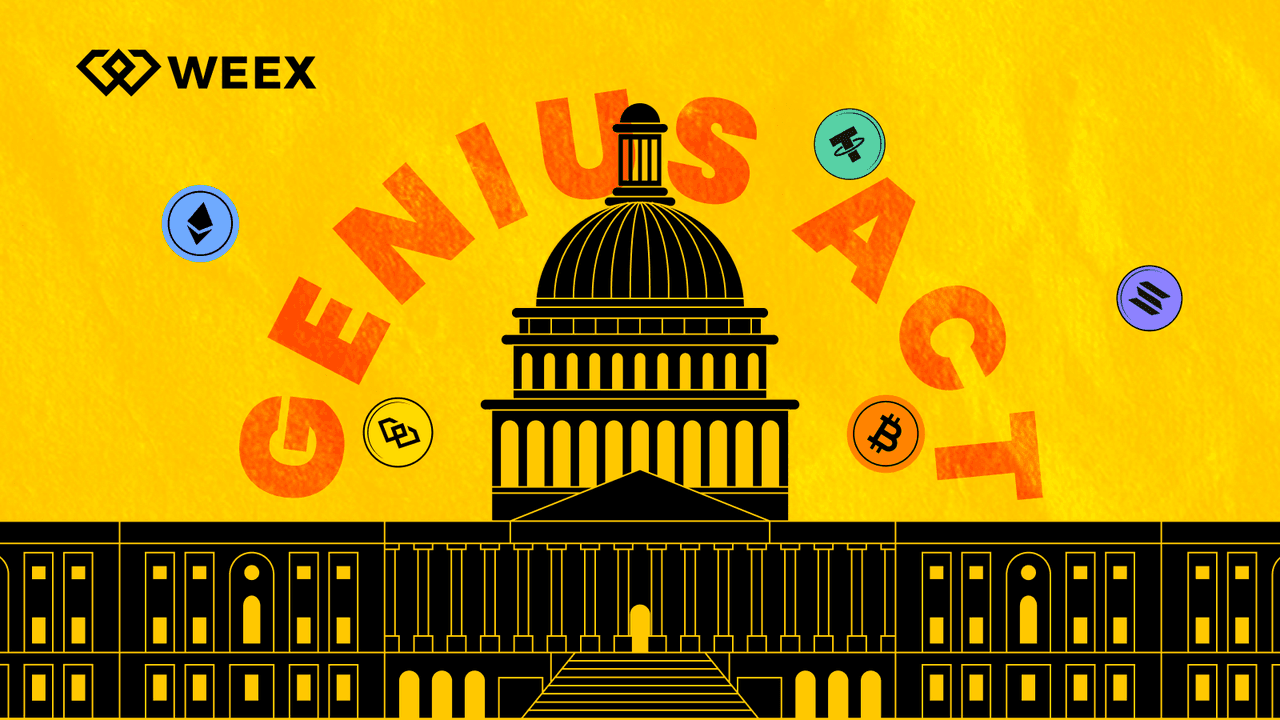
The U.S. GENIUS Act marks the end of blockchain market’s “Wild West” era, transforming dollar-backed digital assets from speculative experiments into regulated pillars of the financial system. By replacing ambiguity with a bank-grade framework, Washington isn’t just setting rules — it is laying the foundation for the next wave of institutional adoption.
Core Provisions
The Act focuses on four key areas: issuance, backing, monitoring, and regulation.
- Issuance by regulated entities only: Only approved banks, licensed non-bank issuers, and qualified state-level institutions are allowed to issue payment stablecoins in the U.S.
- Full reserve backing: Stablecoins must be backed 1:1 by highly liquid, low-risk assets such as cash, insured deposits, or short-term U.S. Treasuries. Riskier assets and rehypothecation are strictly limited.
- Transparency and accountability: Issuers must regularly disclose supply and reserve information, undergo audits, and maintain executive responsibility.
- Legal classification: Payment stablecoins are treated as payment instruments, not securities, placing oversight under banking regulators and ending long-standing jurisdictional uncertainty.
Together, these provisions create a clear, bank-style framework without requiring stablecoin issuers to become full banks.
Positive Impacts on Crypto Markets
The Act catalyzes institutional growth by formalizing stablecoins as core financial infrastructure:
Institutional De-risking: Standardized licensing replaces legal ambiguity, enabling corporations and TradFi to integrate digital assets with operational confidence.
Systemic Trust: Mandatory 1:1 reserves and audits minimize de-pegging risks, while non-security classification provides long-term regulatory certainty.
Utility Expansion: Beyond exchange liquidity, clear rules unlock high-value use cases like B2B cross-border settlements and automated treasury management.
Dollar Primacy: Private-sector innovation extends USD liquidity globally, reinforcing the dollar as the native on-chain settlement currency.
Potential Risks and Structural Side Effects
Concentration Risk: Strict compliance creates high entry barriers, concentrating the market among a few dominant, systemically important players.
Deposit Erosion: Stablecoins compete with traditional banking for settlement, potentially straining bank liquidity during market volatility.
Innovation Stagnation: Narrowly defined reserve and activity rules may limit the evolution of innovative and yield-optimized digital assets.
Redemption Volatility: Rapid, large-scale exits can cause liquidity mismatches, disrupting the broader trading and DeFi ecosystems.
Key Considerations for Investors
As stablecoins become more regulated, investors need to rethink how they assess risk.
- Structure beats brand: Regulatory approval, reserve quality, transparency, governance, and redemption matter more than brand recognition or market capitalization.
- Liquidity matters more than price: The real impact of stablecoin regulation shows in liquidity, on-chain payments, settlement-focused networks, and compliant DeFi infrastructure, rather than short-term price swings.
- Policy is a moving variable: Regulation reduces uncertainty but doesn’t eliminate risk. Future rules like tighter capital requirements or renewed discussions around CBDCs can reshape the competitive landscape.
- Know the rules to trade smarter: Understanding stablecoin rules is essential for informed decisions, as they increasingly influence liquidity, market structure, and long-term viability.
Conclusion
The U.S. Stablecoin Act turns stablecoins into regulated financial infrastructure. It boosts trust, enables institutional adoption, and expands real-world use, while concentrating the market and introducing new risks. Investors should focus on reserve quality, transparency, and governance — stablecoins are no longer just trading tools, but key pillars of the digital financial system.
About WEEX
Founded in 2018, WEEX has developed into a global crypto exchange with over 6.2 million users across more than 130 countries. The platform emphasizes security, liquidity, and usability, providing over 1,200 trading pairs and offering up to 400x leverage in crypto futures trading. In addition to traditional spot and derivatives markets, WEEX is expanding rapidly in the AI era — delivering real-time AI news, empowering users with AI trading tools, and exploring innovative trade-to-earn models that make intelligent trading more accessible to everyone. Its 1,000 BTC Protection Fund further strengthens asset safety and transparency, while features such as copy trading and advanced trading tools allow users to follow professional traders and experience a more efficient, intelligent trading journey.
You may also like

Nockchain (NOCK) Coin Price Prediction & Forecasts for December 2025: Surging 14% Amid Meme Token Buzz
Nockchain (NOCK) Coin has just hit the scene on the Base chain, launching today at 12:00 UTC on…

What is Nock (NOCK) Coin?
Nock (NOCK) Coin is the native asset of the Nockchain ecosystem, a unique blockchain designed to merge community…

REALGARRYTAN Coin Price Prediction & Forecasts for December 2025 – Fresh Launch Sparks Meme Token Rally Potential
The REALGARRYTAN Coin, a new meme token tied to Garry Tan and launched on the Base chain just…

What is RealGarryTan (REALGARRYTAN) Coin?
The cryptocurrency market constantly evolves, offering new investment opportunities for enthusiasts and traders. Recently, the RealGarryTan (REALGARRYTAN) token…
Walmart Tokenized Stock (Ondo) (WMTON) Coin Price Prediction & Forecasts for December 2025 – Could It Rebound After Recent Dip?
As of December 2025, Walmart Tokenized Stock (Ondo) (WMTON) Coin has just hit the market, offering tokenized exposure…

What is Walmart Tokenized Stock (WMTON) Coin?
Walmart Tokenized Stock (WMTON) has recently made its debut on WEEX, giving investors a chance to engage in…

What is Costco Tokenized Stock (COSTON) Coin?
The Costco Tokenized Stock, known by its abbreviation COSTON, has made its way to WEEX, officially listed on…
Goldman Sachs Tokenized Stock (Ondo) (GSON) Coin Price Prediction & Forecasts for December 2025 – Surge Potential Amid RWA Momentum
The Goldman Sachs Tokenized Stock (Ondo) (GSON) Coin has been making waves in the real-world asset (RWA) space,…

What is Goldman Sachs Tokenized Stock (GSON) Coin?
In an exciting development for crypto enthusiasts, the Goldman Sachs Tokenized Stock, known as GSON, has been newly…
NOCK USDT Now on WEEX: Spot Trade Nockchain (NOCK) Coin
WEEX Exchange lists Nockchain (NOCK) Coin for spot trading. Access the NOCK USDT pair now to join the truth economy ecosystem via this new listing.

What is ServiceNow Tokenized Stock (NOWON) Coin?
ServiceNow Tokenized Stock, abbreviated as NOWON, is the latest crypto asset to be listed on WEEX, available for…
What is Nike Tokenized Stock (NKEON) Coin?
The Nike Tokenized Stock (NKEON) Coin, listed on WEEX, offers an innovative way for non-US retail and institutional…
Salesforce Tokenized Stock (Ondo) (CRMON) Coin Price Prediction & Forecasts for December 2025: Could It Surge Amid RWA Momentum?
As a seasoned crypto investor who’s traded through multiple bull and bear cycles, I’ve seen how tokenized assets…
What is Salesforce Tokenized Stock (CRMON) Coin?
The Salesforce Tokenized Stock (CRMON) Coin offers a unique opportunity for crypto enthusiasts to dive into the world…
White Monkey (WM) Coin Price Prediction & Forecast for December 2025: Down 11% But Eyeing a Meme Coin Rebound
White Monkey (WM) Coin has been making waves in the meme coin space on the BNB Chain, drawing…
RAI Token Price Prediction & Forecasts for December 2025 – Potential Rally After Fresh Launch?
As a seasoned crypto investor who’s been trading since the early days of Ethereum, I’ve watched countless tokens…

Pumpfun v2 (PUMPV2) Coin Price Prediction & Forecasts for December 2025: New Meme Launch Sparks Early Surge Potential
Just hours ago, on December 23, 2025, Pumpfun v2 (PUMPV2) Coin made its debut as a fresh meme…
What is Pumpfun v2 (PUMPV2) Coin
As a seasoned crypto investor, I’m excited to delve into the latest addition to the WEEX Exchange: the…
Nockchain (NOCK) Coin Price Prediction & Forecasts for December 2025: Surging 14% Amid Meme Token Buzz
Nockchain (NOCK) Coin has just hit the scene on the Base chain, launching today at 12:00 UTC on…
What is Nock (NOCK) Coin?
Nock (NOCK) Coin is the native asset of the Nockchain ecosystem, a unique blockchain designed to merge community…
REALGARRYTAN Coin Price Prediction & Forecasts for December 2025 – Fresh Launch Sparks Meme Token Rally Potential
The REALGARRYTAN Coin, a new meme token tied to Garry Tan and launched on the Base chain just…
What is RealGarryTan (REALGARRYTAN) Coin?
The cryptocurrency market constantly evolves, offering new investment opportunities for enthusiasts and traders. Recently, the RealGarryTan (REALGARRYTAN) token…
Walmart Tokenized Stock (Ondo) (WMTON) Coin Price Prediction & Forecasts for December 2025 – Could It Rebound After Recent Dip?
As of December 2025, Walmart Tokenized Stock (Ondo) (WMTON) Coin has just hit the market, offering tokenized exposure…
What is Walmart Tokenized Stock (WMTON) Coin?
Walmart Tokenized Stock (WMTON) has recently made its debut on WEEX, giving investors a chance to engage in…
Popular coins


Customer Support:@weikecs
Business Cooperation:@weikecs
Quant Trading & MM:bd@weex.com
VIP Services:support@weex.com
 App
App