
- Buy Crypto
- Markets
- Futures
- Spot
- Copy Trade
 Earn
Earn- More
Esteemed data website DappRadar has announced its shutdown, marking another bittersweet moment in time.

Original Article Title: "DappRadar, Another Tear of the Era"
Original Article Author: Eric, Foresight News
On the evening of November 17, 2025, DappRadar, which has been with the industry for nearly 8 years, announced that it would gradually shut down its service and no longer continue to track blockchain and DApp data.
It is said that "a grain of sand of the era falling on an individual is a mountain," which is a perfect description of DappRadar. Born perhaps in the most turbulent era of the "blockchain is dead" narrative, it accompanied Web3 from its stumbling infancy to its spoon dance year, but ultimately could not withstand the pains of regime change. The exit of products like this, imprinted with the mark of the era, reminds me of what the Nokia CEO said at the end of the announcement of its acquisition by Microsoft 11 years ago:
"We didn't do anything wrong, but somehow, we lost."
Those Years When We Used Data Websites Together
Many newcomers to the Web3 industry may not be aware that DappRadar was once a very important and authoritative source of data. In addition to references from sources such as CoinDesk and Chinese Web3 media, including mainstream Western media such as Bloomberg, Forbes, and the BBC have also cited DappRadar data many times.
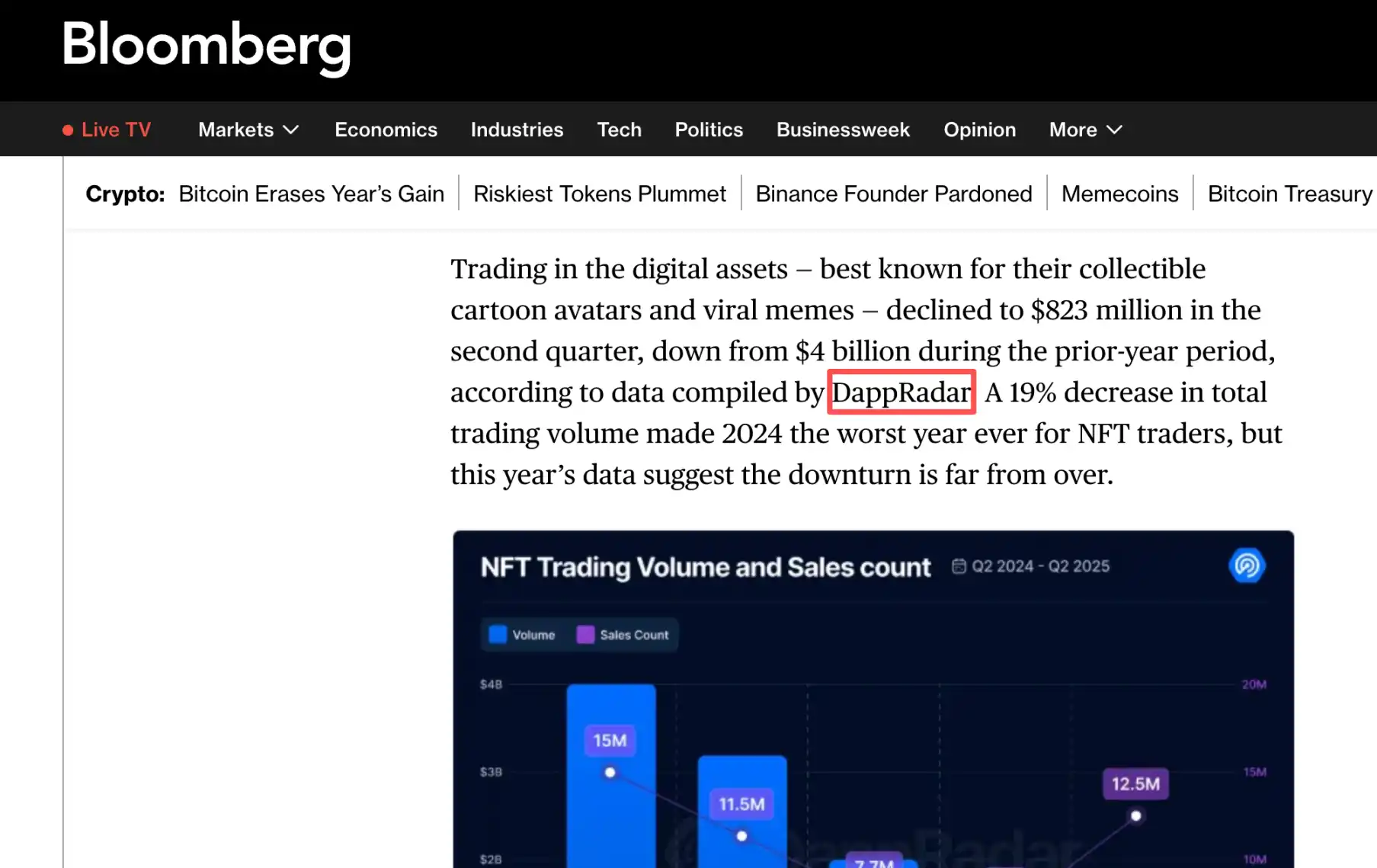
The reason it is called authoritative is that before the rise of professional data websites (such as Nansen, Arkham, DefiLlama, etc.) and professional Web3 marketing tools (such as Cyber, Kaito, etc.), DappRadar was almost the gateway website that all DApps had to be listed on in the early days. The completeness of the projects made its data incomparable in terms of completeness and credibility, almost becoming the only and best way at that time to quickly understand the basic information of new projects.
DappRadar's co-founder, Skirmantas Januskas, is from Lithuania. Unlike many industry giants who hold multiple positions, he has been solely focused on DappRadar from February 2018 to the present. Prior to that, he briefly worked as a software developer at NFQ. Another co-founder, Dunica Dragos, previously worked in operations at the American gaming giant EA in his early years and, like Skirmantas, has been single-mindedly focused on DappRadar since its founding.
DappRadar has received two rounds of investment. In September 2019, DappRadar secured a $2.23 million investment in a seed round from Naspers, Blockchain Ventures, and Angel Invest Berlin. Naspers is the South African multinational media group that famously acquired a 46.5% stake in Tencent for $32 million in 2001 from Li Ka-shing, IDG, and others. Subsequently, in May 2021, DappRadar received a $4.94 million investment in a Series A round from Blockchain.com Ventures, Prosus Ventures, and NordicNinja VC.
The author found a record of an interview with Skirmantas Januskas after completing the fundraising in 2019, at a time when Web3 was at its darkest moment. Despite this, Skirmantas was full of confidence in the industry, believing that as long as the issues of user experience and finding user needs were addressed, "centralized applications would become a thing of the past."
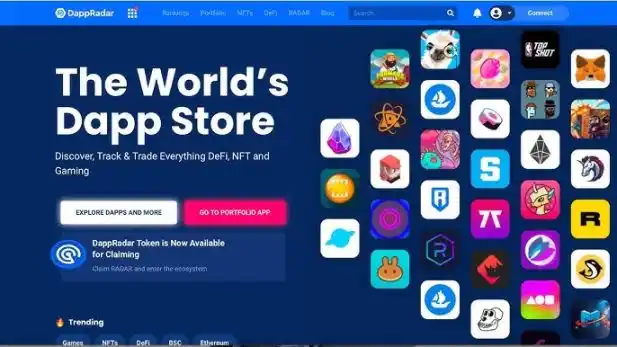
In 2019, this passionate and impulsive visionary expressed his views on DeFi, gaming, and other tracks, all of which eventually saw explosive growth in 2021. While most of the DeFi data pie was snatched by DefiLlama, DappRadar excelled in comprehensive data and deep exploration of emerging concepts such as NFTs, GameFi, and the metaverse, allowing it to have a user base in the millions at its peak. Even for small projects that some Twitter accounts can't find, you can see the DAU fluctuating between 0 and 3 on DappRadar.
Professionalism Became the Original Sin
If one must summarize the biggest reason for DappRadar's failure, it can only be attributed to being overly crypto-native and neglecting the importance of commercialization.
Today, when you open DappRadar's homepage, you will notice that besides the categories they have consistently showcased from the beginning such as gaming, DeFi, NFTs, gambling, and the newly added AI, RWA, and social, you won't see trending topics like memes. So why call Skirmantas an impulsive visionary when even in a track like NFT, they continue to persist in releasing a detailed quarterly report and tracking every nook and cranny airdrop but have almost completely missed out on all the hot trends.
DappRadar has been arguably the only platform in the past two years that has covered all Web3 long-tail sectors and projects, but the issue is that it seems to only focus on the tail.
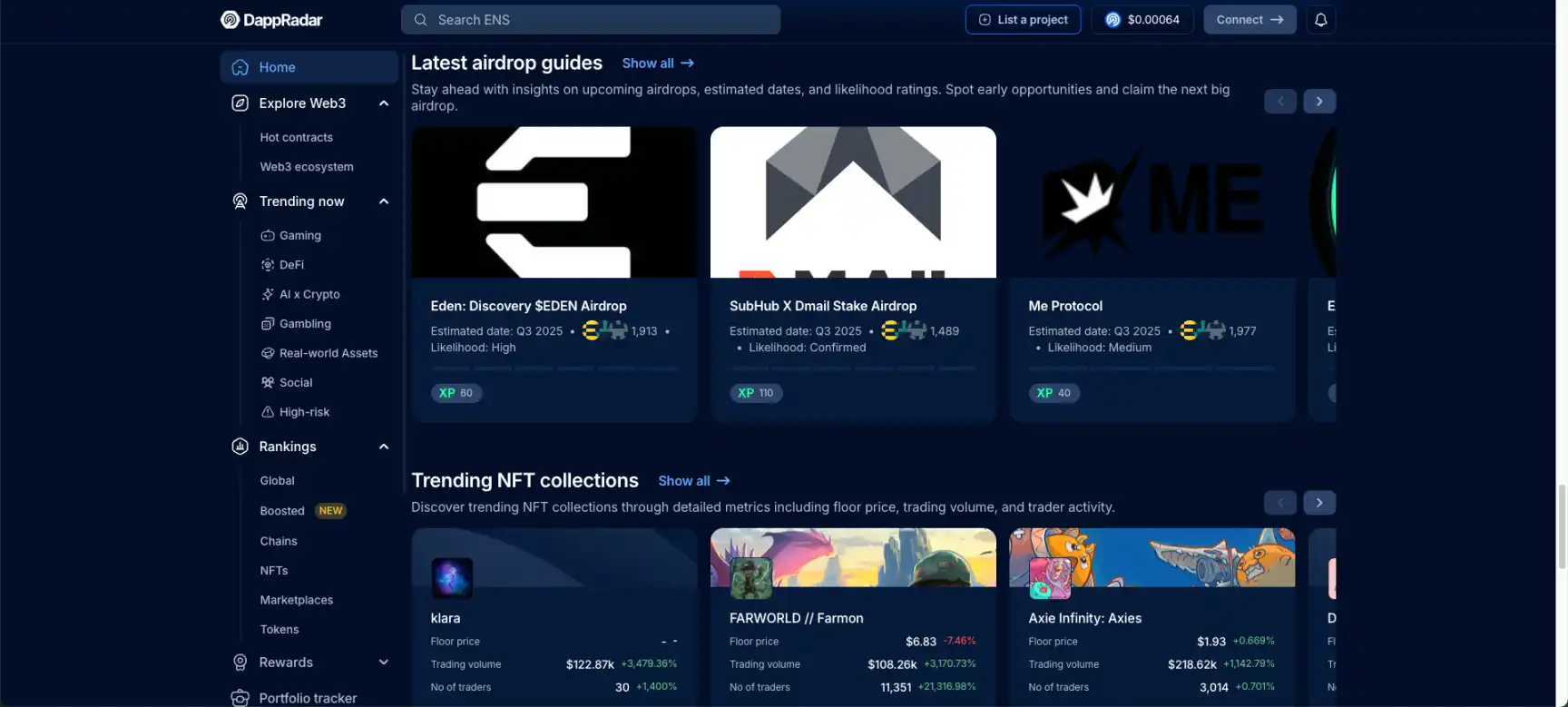
This kind of nitpicking expertise can indeed provide high-quality material for Bloomberg and Forbes, but it lacks any commercial value. The RADAR token launched after the 2021 funding round seems to have not seen a better use case other than subscribing to Pro services, staking, and voting, and it has also blocked the most premium subscription revenue source.
What was initially built on a comprehensive image has gradually turned into a shackle. Its DeFi professionalism is no match for DefiLlama, its token information seems inferior to CMC, its research depth does not reach the level of Bankless, and the only thing it excels at, the NFT sector, has become stagnant. However, I believe that DappRadar itself has long been aware of these issues, so it has also accelerated its commercialization, including providing high-quality data through an API and offering advertising space.
After the 2021 funding round, DappRadar has also been supported for 4 years. Apart from the funding itself, it has certainly generated some revenue through traffic monetization, but obviously, this revenue falls short compared to the cost needed to provide massive data for exponential growth. Moreover, since 2023, although the market has been bullish, there are not many projects with truly sufficient budgets. The limited budget has been mostly spent on KOLs, exchanges, and some emerging platforms, leaving DappRadar, which has been left high and dry, increasingly strapped for cash.
As mentioned earlier, its coverage is too long-tail, and tail-end projects may have no way of knowing what kind of user profile would refer to DappRadar's information under what circumstances. In the wilderness era, DappRadar provided a channel to understand new projects, but after the dust settled, the channel to understand the few "premium projects" has become more widespread, and the relics of the past are no longer the only best choice.
Compared to the concise website of two to three years ago, today's DappRadar is all-encompassing but seems cluttered, which is the result of excessive effort in commercialization, and it is the epitome of the "exhaust all possibilities" in the farewell letter. For DappRadar, without ongoing funding or excessive funding to spend, it needs to show on its website the balance between content curation and ad display. DappRadar's excessive insistence on professionalism or "orthodoxy," and its later realization of the mistake of content and ad stacking, have laid bare its operational shortcomings.
In addition to its own shortcomings, the Web3 data and information platform itself is a challenging business. Today, multi-chain data explosion, rising costs of indexing and servers, and a market demand for high-quality data coupled with a lack of matching payment capability make it difficult. Without other sources of revenue, relying solely on advertising and API sales will inevitably face competition. Platforms with low monetization capabilities, in order to survive, increase ad density and compromise user experience, leading to a seemingly inevitable decline.
The seven-year trajectory of DappRadar encapsulates the common commercialization challenges of such projects: high value, low payment, cost rigidity, and rapid narrative iteration. Its shutdown leaves a clear lesson for newcomers: if a business model cannot be closed-loop from day one, even the most authoritative data cannot prevent "death by hemorrhage."
You may also like

Former Star Public Blockchain Berachain in Crisis: Price Collapse, Layoffs, Developer Exodus

Coinbase CEO Raises Red Flags Regarding US Crypto Bill
Key Takeaways Coinbase CEO Brian Armstrong voices opposition to the proposed Senate crypto bill, citing significant concerns. The…

Transforming the Cryptocurrency Landscape: A 2026 Outlook
Key Takeaways Cryptocurrency systems have seen expansive growth and technological innovation. The introduction of new regulations has reshaped…
New ChatGPT Forecasts for XRP, Ethereum, and Solana by 2026
Key Takeaways ChatGPT predicts a potential bull market for XRP, Ethereum, and Solana by 2026, supported by the…

An Insight into the Dynamics of Crypto Market Trends
Key Takeaways The article provides a comprehensive look at the latest developments in the cryptocurrency market. Insight is…

Senate Crypto Bill Markup Rescheduled to January 27 Amid Legislative Momentum
Key Takeaways The Senate Agriculture Committee has rescheduled the release of the legislative text for crypto market structure…

CLARITY Act Hearing Suddenly Postponed – Where Does the Disagreement Lie?
YO Protocol’s Automated Conversion Error Resolves $3.7 Million Shortfall
Key Takeaways YO Protocol, a decentralized finance platform, recently experienced an automated conversion operation error, resulting in a…

Sonic Labs Recovers and Redistributes Millions in Stolen Assets
Key Takeaways Sonic Labs has successfully recovered 5,829,196 stolen S tokens after a November 2025 exploit. These recovered…

Dolomite Surges with Prominent Integrations Boosting Market Value
Key Takeaways Dolomite (DOLO) has seen a significant 24.60% price increase in the last 24 hours, currently trading…

YO Protocol Suffers $3.7 Million Loss in Unfortunate Swap Incident
Key Takeaways YO Protocol experienced a $3.7 million loss due to a mistaken swap involving YoUSD. The incident…

Base releases new roadmap, Solana integrates private swap feature, what are the updates in the mainstream ecosystem?

Which Protocols Drained the Crypto Market in 2025?

Alibaba Backed Latin America Stablecoin Company, Why VelaFi?

AI Crypto Trading in 2026: How AI Agents Use Stablecoins for Capital Management and Settlement
Learn how AI agents use stablecoins for crypto trading in 2026 — managing capital, settling transactions, and operating across exchanges and DeFi protocols.

US Senate Agriculture Committee Schedules January 27 for Crypto Market Structure Hearing
Key Takeaways The Senate Agriculture Committee will release its crypto market structure bill on January 21, followed by…
XRP Price Analysis and Outlook: Unpacking the Gravestone Doji
Key Takeaways The gravestone doji, a rare chart pattern, has recently appeared on XRP’s weekly chart, indicating potential…

Life Candlestick Drama Escalates: Fund Established, ‘Cyber Altruism Box’ Feature Launched; Founder Denies Meme Coin Issuance
Key Takeaways The “Life K-Line” phenomenon combines traditional Chinese astrology with modern stock chart analysis, rapidly gaining popularity…
Former Star Public Blockchain Berachain in Crisis: Price Collapse, Layoffs, Developer Exodus
Coinbase CEO Raises Red Flags Regarding US Crypto Bill
Key Takeaways Coinbase CEO Brian Armstrong voices opposition to the proposed Senate crypto bill, citing significant concerns. The…
Transforming the Cryptocurrency Landscape: A 2026 Outlook
Key Takeaways Cryptocurrency systems have seen expansive growth and technological innovation. The introduction of new regulations has reshaped…
New ChatGPT Forecasts for XRP, Ethereum, and Solana by 2026
Key Takeaways ChatGPT predicts a potential bull market for XRP, Ethereum, and Solana by 2026, supported by the…
An Insight into the Dynamics of Crypto Market Trends
Key Takeaways The article provides a comprehensive look at the latest developments in the cryptocurrency market. Insight is…
Senate Crypto Bill Markup Rescheduled to January 27 Amid Legislative Momentum
Key Takeaways The Senate Agriculture Committee has rescheduled the release of the legislative text for crypto market structure…


 App
App