
- Buy Crypto
- Markets
- Futures
- Spot
- Copy Trade
 Earn
Earn- More
Navigating the AI Landscape: NVIDIA’s Journey

Key Takeaways
- NVIDIA reported outstanding financial results, with significant growth in revenue and profit, defying market concerns about an AI bubble.
- The company’s data center business continues to drive revenue, with impressive sales of the new GB300 series chips.
- Divergent market opinions about NVIDIA’s future highlight a debate about the existence of an AI bubble.
- CEO Jensen Huang dismisses concerns over an AI bubble, emphasizing the robust demand for AI technology and NVIDIA’s role in its ecosystem.
NVIDIA’s Stellar Performance Amidst Market Divides
NVIDIA recently announced its financial results for the fiscal third quarter ending October 26, 2026. Despite market criticisms and fears surrounding a potential AI bubble, the company continues to exceed expectations, showcasing its prowess as a leader in AI and graphics technology. The results indeed stood out, with notable increases not only in revenue and profit but also in the performance of its core data center business.
Understanding NVIDIA’s Impressive Financials
The fiscal third-quarter results reflect NVIDIA’s exceptional performance, with a reported revenue of $570.1 billion, outpacing analysts’ projections of $549.2 billion. Additionally, net income reached $319.1 billion, marking a significant 65% year-on-year increase. Adjusted earnings per share were $1.3, surpassing the anticipated $1.25. These figures underscore NVIDIA’s growing dominance in the tech industry.
The driving force behind these impressive numbers is NVIDIA’s data center division, which secured revenues of $512 billion—constituting approximately 90% of total revenues and showcasing a striking 66% year-over-year growth. The GB300 chip series, a leading product in NVIDIA’s AI computing platform, is the main driver behind this growth. Released to the market in May of the previous year, the GB300 integrates advanced technology including 72 Blackwell Ultra AI GPUs and 36 Grace CPUs based on Arm Neoverse architecture.
The Dual Forces Influencing Market Perceptions
NVIDIA’s financial success comes amid contrasting market perspectives regarding its future. On one side, several investment entities are optimistic about NVIDIA’s trajectory. Notably, DA Davidson shifted its rating for NVIDIA from “neutral” to “buy,” with an increased target price, reflecting a newfound confidence in the AI computing demands that NVIDIA is positioned to meet.
Conversely, skepticism remains, especially from influential figures like Michael Burry, known for his foresight during the subprime mortgage crisis. Burry’s recent actions suggest he perceives a speculative bubble in the AI sector, of which NVIDIA is a central part. His reservations are intensified by recent debates over whether AI has entered a speculative overvalued phase similar to past tech bubbles.
CEO Jensen Huang’s Reassurance Against AI Bubble Fears
Addressing these uncertainties during the earnings call, CEO Jensen Huang firmly refuted the notion of an AI bubble. Huang argues that AI is revolutionizing workloads and industrial processes, marking a clear departure from historical internet bubbles. He emphasized the exponential growth in demand for AI capabilities, supported by the strong demand for NVIDIA’s GPUs, all sold out for cloud deployment.
NVIDIA’s confidence is reflected in its backlog of $500 billion worth of chip orders, slated for delivery into 2026, including the future Rubin processors expected to hit the market next year. Huang’s outlook underscores a broader industry transformation and the expansion of AI into new sectors and geographies, diminishing concerns about unsustainable growth.
Future Projections and Market Dynamics
Looking ahead, NVIDIA anticipates fourth-quarter revenues to reach approximately $650 billion, well above analysts’ estimates. This projection comes as the company continues to navigate the challenges and opportunities within the AI sector, balancing robust demand against broader economic and logistical considerations.
Despite these positive outlooks, some analysts remain cautious, noting concerns over potential artificial inflation of profits through extended depreciation of AI computing equipment. However, NVIDIA’s strategic investments and continued focus on innovation position it favorably for capturing ongoing advancements in AI technology.
FAQs
What are the main factors contributing to NVIDIA’s recent financial success?
NVIDIA’s recent success is primarily driven by its data center business, particularly the high demand for its cutting-edge GB300 series chips, which are central to its AI computing platform.
How does NVIDIA address concerns about a potential AI bubble?
CEO Jensen Huang countered AI bubble concerns by highlighting the genuine demand and transformative impact of AI technologies across industries, signaling robust, sustainable growth.
Why are market opinions about NVIDIA’s future so divided?
The divergence stems from varying assessments of AI market sustainability, with some predicting continued growth due to real technological demand, while others fear speculative investment might lead to an eventual downturn.
What role does NVIDIA play in the current AI ecosystem?
NVIDIA is pivotal due to its advancements in AI technology and hardware, particularly GPUs, which are a critical component of AI computing, thereby driving significant industry shifts and expansions.
How is NVIDIA preparing for future growth and demand in the AI sector?
NVIDIA is focusing on innovation with upcoming products like the Rubin processors, expanding its customer base, and maintaining strong sales pipelines to ensure readiness for sustained demand increases.
You may also like

Crypto and AI: the hidden digital gray market of Xianyu
Crypto and AI: You Can Buy Anything on Xianyu.

What’s Driving Crypto Markets in Early 2026: Market Swings, AI Trading, and ETF Flows?
Imagine checking Bitcoin and Ethereum prices in a day — one minute up 5%, the next down 4%. Sharp moves, quick reversals, and sensitivity to macro signals marked the first week of 2026. After an early-year rally, both assets pulled back as markets recalibrated expectations around U.S. monetary policy and institutional flows. For traders — including those relying on AI or automated systems — this period offered a vivid reminder: abundant signals do not guarantee clarity. Staying disciplined in execution is often the real challenge.
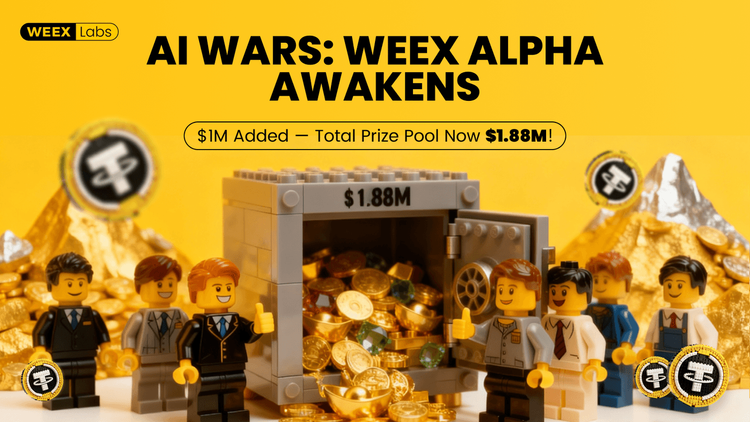
WEEX Global AI Trading Hackathon Kicks Off: $1.88M Prize Pool Powers the Next Generation of AI Trading Champions
WEEX Labs, the innovation arm of WEEX, a leading global crypto exchange serving over 6.2 million users across 150+ countries, is set to kick off the preliminary round of its flagship global AI trading hackathon, AI Wars: WEEX Alpha Awakens, on January 12, 2026. Backed by the strong support of world-class sponsors including Amazon Web Services (AWS), the total prize pool has surged from $880,000 to an unprecedented $1,880,000, positioning AI Wars among the largest AI trading hackathons in the crypto industry. At the top of the leaderboard awaits an extraordinary champion prize — a Bentley Bentayga S, already on standby in Dubai, ready to be claimed by the ultimate AI trading victor.

2025 Market Prediction Retrospective: Total Transaction Volume Exceeds $50 Billion, Duopoly Market Share Exceeds 97.5%

Pentagon Pizza Index Soars 1250%: Who Will Be the Next Venezuela?

From Theory to Live Markets: AOT Matrix’s Dual-Brain System in WEEX AI Trading Hackathon
In crypto markets — one of the most unforgiving non-stationary systems — strategy failure is rarely caused by models being too simple. It happens because most strategies are never truly exposed to live-market pressure. This is exactly the problem WEEX AI Trading Hackathon is designed to surface — shifting the focus from theoretical innovation to real deployability, real execution, and real performance. Among the participating teams, AOT Matrix stood out with advanced AI-driven quantitative capabilities. Through its V4.4 dual-brain architecture, the system achieved end-to-end optimization — from core logic to execution — reflecting the platform’s dual emphasis on innovation and real-world performance.

Predicting Contrarian Buy Pressure in the Market: Who is Taking the Other Side of Your Trade?

$250 Billion, 6723 Rounds of Funding: Where Did Crypto VCs Invest in 2025?

Visa Crypto Lead: Eight Key Evolutions of Crypto and AI by 2026

Karatage Welcomes Shane O’Callaghan as Senior Partner in Strategic Move
Key Takeaways Karatage, a London-based hedge fund, appoints Shane O’Callaghan as a senior partner to enhance its institutional…

Stores of Value: Gold and Silver Once Again Lead Global Asset Charts
Key Takeaways: Gold and silver have retaken their positions as the top assets by market capitalization, highlighting their…
Preliminary Round Participant Insights — AOT Matrix: Left-Brain Analysis, Right-Brain Decisions in AI Trading
In the WEEX AI Trading Hackathon, AOT Matrix chose a more cautious path in system design — one that’s actually harder to pull off in a live trading environment. From the very start, they made clear choices about what role AI should and shouldn’t play in the trading system. We interviewed AOT Matrix about their decision-making logic, the multiple iterations of their system architecture, and what it’s like to implement it under WEEX’s real trading environment and engineering constraints.

Why AI Tokens Are Rising Faster Than the Broader Crypto Market
AI tokens are outperforming — and not quietly. Bitcoin is moving. Ethereum is holding ground. Yet some of the strongest relative gains are coming from AI-labeled tokens, not majors, not memes. At first glance, this feels intuitive. AI is real technology. It’s shaping industries far beyond crypto. But markets rarely move on intuition alone — especially not this fast. When prices accelerate ahead of adoption, the more useful question isn’t “Is AI important?” It’s which version of the AI story the market is buying — right now.

Doubling in a single day won't make up for a 98% crash - Did Parcl's 'Polymarket Story' Hold Up?

Dalio's Year-End Review: Currency, US Stocks, and Global Wealth Redistribution

Key Market Intelligence on January 6th, how much did you miss out on?

How to Flip Real Estate in the Prediction Market

Tether, which has "enriched" itself through stablecoins, is now heavily investing in AI
Crypto and AI: the hidden digital gray market of Xianyu
Crypto and AI: You Can Buy Anything on Xianyu.
What’s Driving Crypto Markets in Early 2026: Market Swings, AI Trading, and ETF Flows?
Imagine checking Bitcoin and Ethereum prices in a day — one minute up 5%, the next down 4%. Sharp moves, quick reversals, and sensitivity to macro signals marked the first week of 2026. After an early-year rally, both assets pulled back as markets recalibrated expectations around U.S. monetary policy and institutional flows. For traders — including those relying on AI or automated systems — this period offered a vivid reminder: abundant signals do not guarantee clarity. Staying disciplined in execution is often the real challenge.
WEEX Global AI Trading Hackathon Kicks Off: $1.88M Prize Pool Powers the Next Generation of AI Trading Champions
WEEX Labs, the innovation arm of WEEX, a leading global crypto exchange serving over 6.2 million users across 150+ countries, is set to kick off the preliminary round of its flagship global AI trading hackathon, AI Wars: WEEX Alpha Awakens, on January 12, 2026. Backed by the strong support of world-class sponsors including Amazon Web Services (AWS), the total prize pool has surged from $880,000 to an unprecedented $1,880,000, positioning AI Wars among the largest AI trading hackathons in the crypto industry. At the top of the leaderboard awaits an extraordinary champion prize — a Bentley Bentayga S, already on standby in Dubai, ready to be claimed by the ultimate AI trading victor.
2025 Market Prediction Retrospective: Total Transaction Volume Exceeds $50 Billion, Duopoly Market Share Exceeds 97.5%
Pentagon Pizza Index Soars 1250%: Who Will Be the Next Venezuela?
From Theory to Live Markets: AOT Matrix’s Dual-Brain System in WEEX AI Trading Hackathon
In crypto markets — one of the most unforgiving non-stationary systems — strategy failure is rarely caused by models being too simple. It happens because most strategies are never truly exposed to live-market pressure. This is exactly the problem WEEX AI Trading Hackathon is designed to surface — shifting the focus from theoretical innovation to real deployability, real execution, and real performance. Among the participating teams, AOT Matrix stood out with advanced AI-driven quantitative capabilities. Through its V4.4 dual-brain architecture, the system achieved end-to-end optimization — from core logic to execution — reflecting the platform’s dual emphasis on innovation and real-world performance.


 App
App