
- Buy Crypto
- Markets
- Futures
- Spot
- Copy Trade
 Earn
Earn- More
a16z Raises $15 Billion in New Fund: Long Criticized, Why Has It Become the "Best Storytelling" Venture Capitalist?

Original Title: a16z: The Power Brokers
Original Source: Not Boring
Original Translation: Saoirse, Foresight News
Editor's Note: This article focuses on the venture capital giant a16z, taking advantage of its new $15 billion fund to dig deep into its "unconventional venture capital" core—positioning for the future with an engineer's mindset and placing firm bets on potential companies (such as Databricks). The article intersperses performance data with classic cases, dissecting its advanced logic from startup to managing over $90 billion in assets. To understand how this "technology faithful" is reshaping industry rules, delve into the article.
When a16z announced the $15 billion new fundraise, the entire venture capital community was once again stirred up—some brought up years of questioning its model, while others wondered where this money would flow.
To uncover the mysteries of this perennially controversial institution, I spoke with its GPs (General Partners) and LPs (Limited Partners), had in-depth conversations with founders of post-investment companies valued at over $200 billion, and combed through its fund performance data since its inception.
However, rather than dwell on "where a16z went wrong," I am more interested in asking: What are those clever individuals who have always been able to make the right judgments in the past really targeting now? Of course, I must confess, I was a crypto advisor to a16z, listed as a shareholder alongside key figures, so I cannot claim to be a completely objective observer.
But I don't want to judge whether this $15 billion investment is worthwhile—the LPs of the institution have already cast their votes with real money, and the answer will not be revealed until ten years later. I am more interested in showing you: why a16z has become the "best storyteller" in the venture capital community? What kind of unconventional ambition is hidden behind its vision of the future?
"I live in the future, the present is my past; my existence itself is a gift, if you don't agree, then leave."
—Kanye West, "Monster"
"Too ostentatious," "Should speak less and do more in politics," "Do not agree with one or two of its recent investment projects," "Using the Pope's words to launch a social media platform is too inappropriate," "With a fund size this large, it is impossible to bring reasonable returns to LPs"...
a16z has been listening to these voices for nearly 20 years.
For example, in 2015, New Yorker journalist Tad Friend, in writing The Future Shaper, had breakfast with Marc Andreessen (co-founder and general partner at a16z). Prior to this, Friend had just heard skepticism from a peer VC that the a16z fund was too large in size but too low in ownership [1], needing the total returns of the first four funds to be 5-10x, with the total portfolio valuation reaching $240-480 billion.
In the article, Friend wrote: "As I tried to fact-check this data with Andreessen, he made a dismissive gesture, saying, 'Nonsense. We have a full stack model—we are here to hunt elephants, go after big fish!'"
Remember this scene because you may have similar questions next, with Andreessen likely having the same reaction.
Today, a16z has announced that all its investment strategies have raised $15 billion, with Regulatory Assets Under Management (RAUM) surpassing $90 billion.
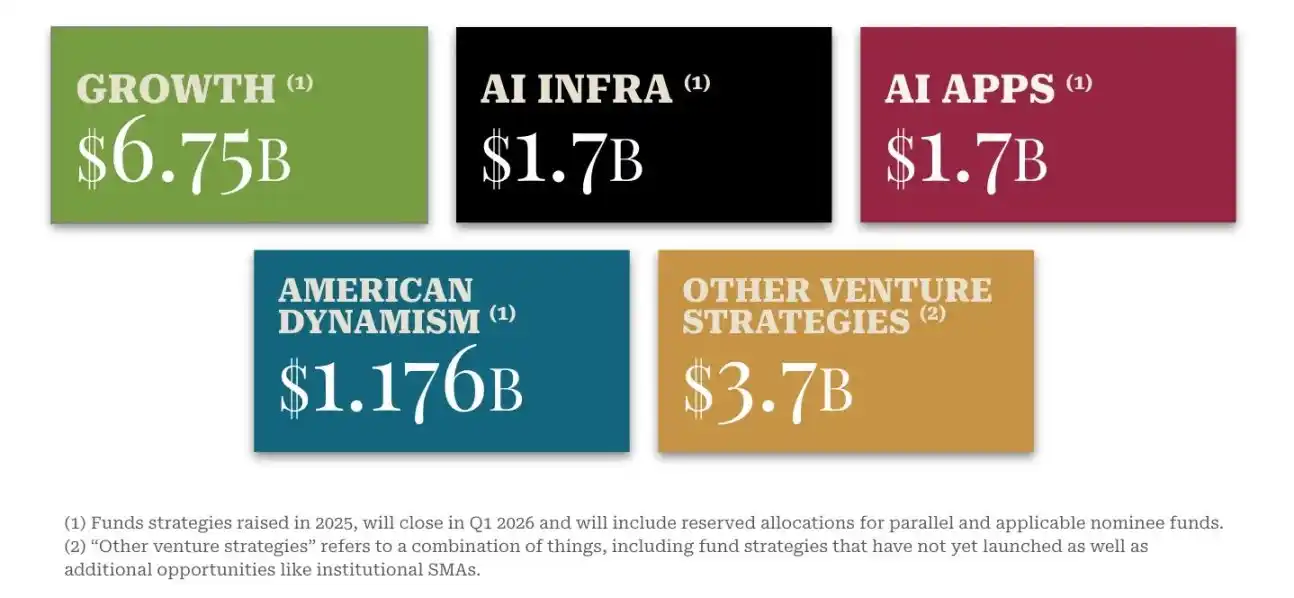
a16z's various fund strategies and corresponding fund sizes raised in 2025
In 2025, the venture capital fundraising market is dominated by a few top institutions, and a16z's fundraising amount exceeds the total raised by the second and third-ranked Lightspeed ($9 billion) and Founders Fund ($5.6 billion) [2].
In the worst venture capital fundraising environment in nearly five years, a16z's 2025 fundraising amount accounts for over 18% of the total U.S. venture capital fundraising [3]. Typically, a venture capital fund takes an average of 16 months to complete fundraising, but a16z took just over three months from start to finish.
Breaking it down, a16z has four funds that made it to the "2025 Top10 Industry-Wide Fundraising": the Late-Stage Venture Fund LSV V ranks second, the AI Infrastructure Fund X and the AI Application Fund X tied for seventh, and the "U.S. Growth Fund" AD II ranks tenth.
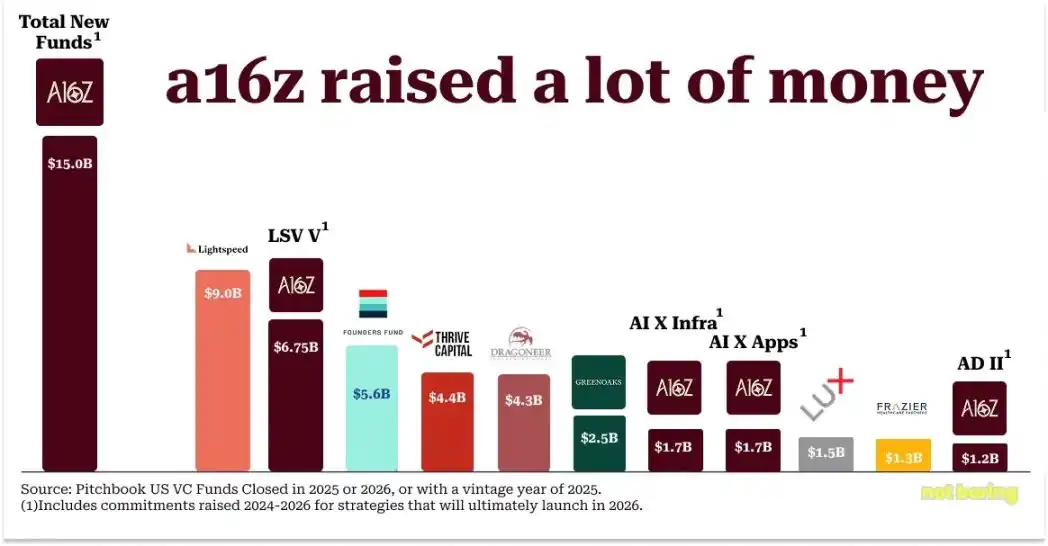
Comparison of fundraising sizes of U.S. venture institutions in 2025-2026
Some might say, with so much money, VC firms can't possibly allocate it sensibly to achieve outsized returns. But I guess a16z's response would probably be: "Blah, blah, blah." After all, they've always been about "hunting elephants, chasing whales"!
Today, across all a16z funds, their portfolio includes 10 of the "Top 15 Private Companies by valuation": OpenAI, SpaceX, xAI, Databricks, Stripe, Revolut, Waymo, Wiz, SSI, and Anduril [4].
Over the past decade, a16z has invested in 56 unicorn companies through its funds [5], more than any other institution in the industry.
The total valuation of their AI portfolio's unicorn companies accounts for 44% of the entire industry [6], also ranking first.
From 2009 to 2025, a16z led early-stage investments in 31 "Eventual $5B+ Enterprise" companies, 50% more than the sum of the second and third-ranked institutions.
They not only have a full-fledged model but now also have solid performance to back it up.
Previously mentioned, peers once questioned whether the combined valuation of a16z's first four funds need to reach $240-480 billion for validation. In fact, the combined valuation of a16z's Funds I-IV (based on exit or latest post-money valuations) has already reached $853 billion [7].
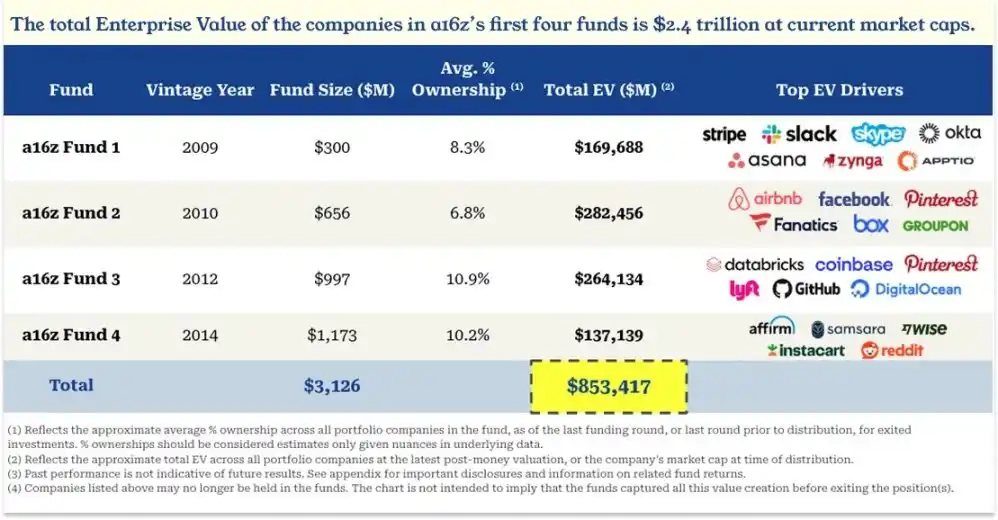
Total Investment Portfolio Value of a16z's First Four Funds
And that's just the exit valuation — the market cap of Facebook alone has since increased by $15 trillion!
This kind of storyline repeats itself: a16z makes a seemingly crazy bet on the future, industry insiders call it "stupid," but a few years later, it turns out it's not so stupid after all!
After the global financial crisis in 2009, a16z raised a $300 million Fund I and introduced the concept of "providing operational support platforms to founders." Ben Horowitz (a16z's Co-Founder and General Partner) recalled: "We talked to many VC peers, most of whom said it was a dumb idea, advised us not to do it, and even said this model had been tried before and just didn't work." And now, almost all top VCs have similar platform teams.
In 2009, a16z drew $65 million from this fund to join Silver Lake and other institutions in a $2.7 billion acquisition of Skype from eBay. At the time, "everyone said this deal wouldn't go through because the intellectual property risks were too high" — after all, during the transaction, eBay was in a legal battle with Skype's founders over technology ownership. Less than two years later, Microsoft acquired Skype for $8.5 billion, and Ben reminisced about the skepticism in a blog post [8].
In September 2010, Marc and Ben raised a $650 million Fund II, then made large late-stage investments in companies like Facebook ($50 million, post-money valuation of $34 billion), Groupon ($40 million, post-money valuation of $5 billion), Twitter ($48 million, post-money valuation of $4 billion), betting that the IPO window was about to open. The Wall Street Journal wrote in an article titled "Venture Capital Newcomers Shake Up Silicon Valley" that peers were quite unhappy about this, believing that "trading equity in private deals is not what venture capital is supposed to do" (at the time, this now common practice was still very new, and not even labeled as "secondary transactions"). Benchmark Partner Matt Cohler once said, "You can make money trading pork bellies and oil futures, but that's not what we should be doing." The result? In November 2011, Groupon IPO'd at a $17.8 billion valuation; in May 2012, Facebook IPO'd at a $104 billion valuation; and in November 2013, Twitter closed its first day at a $31 billion valuation.
In January 2012, Marc and Ben raised a $1 billion Fund III and a $540 million parallel opportunity fund. The skepticism at this time had turned into the now common "the funds are too large": a16z's fundraising amount that year accounted for 7.5% of total U.S. venture capital fundraising, while the overall venture capital industry was underperforming. A 2014 Harvard Business School case study on a16z referenced a report from the Kauffman Foundation in 2012: "For over ten years, the venture industry has performed poorly." Data from the Cambridge Association showed that in 2012, the average venture capital return was only 8.9%, far below the S&P 500 Index's 20.6%. Legendary venture capitalist Bill Draper once said, "The consensus in Silicon Valley's venture capital industry is that too many funds are chasing too few truly great companies." This statement still holds true today.
In 2016, The Wall Street Journal published an article in which David Rosenthal of the Acquired podcast referred to it as "an obviously peer-venture-capitalist-sanctioned hit piece," titled "Andreessen Horowitz (a16z) Fund Lags Elite Venture Capitalists in Returns." At that time, a16z's three funds had been established for 7 years, 6 years, and 4 years, respectively. The article stated that Fund I was able to reach the top 5% of the industry, Fund II was only in the top 25%, and Fund III didn't even make it to the top 25%.
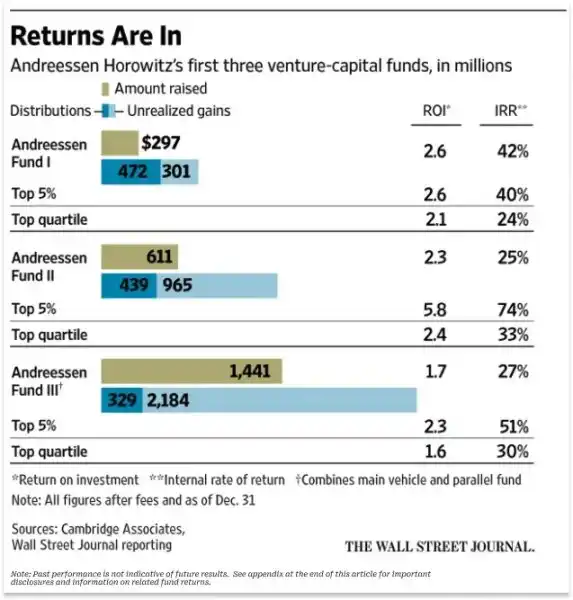
Performance of a16z's First 3 Funds and Comparison with Industry Leaders
However, in hindsight, Fund III stands out as a "legend": as of September 30, 2025, its net TVPI (Total Value to Paid-In capital) after fees reached 11.3x; including parallel funds, the net TVPI was 9.1x.
Fund III's portfolio includes: Coinbase (bringing in a total allocation of $7 billion to a16z LP), Databricks, Pinterest, GitHub, and Lyft (missing out on Uber, but the one omission could not overshadow the "achievements" of multiple precise investments). I believe this fund can be considered "one of the most successful large-scale venture capital funds in history." By the end of the third quarter of 2025, Databricks (currently a16z's largest position) had a valuation of $134 billion, indicating that Fund III's performance is still on the rise (assuming other positions have not depreciated). Through Fund III and parallel funds alone, a16z has already distributed $7 billion in net proceeds to LPs, with nearly an equivalent amount of unrealized gains yet to be realized.
A significant portion of these unrealized gains comes from Databricks. When the Wall Street Journal criticized a16z in 2016, this big data company was still small, just a few months away from a $5 billion valuation. Today, Databricks accounts for 23% of a16z's total Net Asset Value (NAV).
Anyone who has interacted with a16z will often hear the name "Databricks". Not only is it a16z's largest position (perhaps also one of the top three in terms of investment amount in the entire VC industry), but its development trajectory is also a vivid example of a16z's "best operating model".
The Operating Formula of Databricks and a16z
Before discussing Databricks, there are several key points about a16z that need to be understood first.
Firstly, a16z was founded and is operated by engineers—not only founders, but also "founders with an engineering background". This has influenced the institutional design logic (pursuing economies of scale and network effects) and determined their standards for markets and companies.
Secondly, at a16z, being the "investment industry second" is perhaps the greatest "original sin of investing." If you miss out on the early winner, you can still make a follow-up investment later; but if you invest in the second-place company, you completely lose the opportunity to invest in the winner—even if the winner has not yet emerged at that time.
Thirdly, once a16z identifies a company as a "winner in the race," the classic operation is to "invest far beyond what the other party expects." This approach is often ridiculed in the industry, but they always stick to it.
These three points have never changed since the early days of a16z.
In the early 2010s, a few years after a16z was founded, "big data" was the trend at the time, and the mainstream big data framework in the industry was Hadoop. Hadoop adopted Google's MapReduce programming model, distributing computing tasks to a cluster of inexpensive commodity servers rather than expensive dedicated hardware, which can be described as the driving force behind the "democratization of big data." Subsequently, a group of companies around Hadoop emerged, and in 2014, the industry's investment frenzy reached its peak: Cloudera, founded in 2008, raised $900 million, and the total funding for Hadoop-related companies that year increased fivefold to $1.28 billion compared to before; Yahoo's spin-off Hortonworks also went public the same year.
While the big data trend was flourishing, and funds were pouring in, a16z remained inactive.
The "z" in a16z—Ben Horowitz, fundamentally did not believe in Hadoop. Before serving as the CEO of LoudCloud/OpsWare, with a background in computer science, he believed that Hadoop could not become a mainstream architecture: "Complex programming, difficult to manage, and not suitable for future needs—every step of MapReduce computation must write intermediate results to disk, which drives people crazy with slowness for iterative computing tasks like machine learning."
So Ben chose to stay away from the Hadoop craze. Jen Kha told me that Marc even "complained" to Ben about this at the time:
"'We definitely missed it! We messed up completely, made a big mistake!' Marc was very anxious at the time.
But Ben said: 'I don't think this is the direction of the next architectural revolution.'
Later, when Databricks appeared, Ben said, 'This might be the right one.' And then, of course, he went all-in."
The birth of Databricks was timely and right near the University of California, Berkeley.
During the 1984 Iran revolution, Ali Ghodsi's family fled Iran and settled in Sweden. His parents bought Ali a Commodore 64 computer, through which he taught himself programming. His skills were so impressive that he even received a visiting scholar invitation from the University of California, Berkeley.
At Berkeley, Ali joined the AMPLab research lab, where he, along with 8 researchers including mentors Scott Shenker and Ion Stoica, collaborated to bring to life the ideas in Ph.D. student Matei Zaharia's paper, developing Spark—an open-source big data processing engine.
Spark was designed with the idea of "being able to replicate the functionality of tech giants' neural networks without complex interfaces." It once set a world record in data sorting speed, and Zaharia's paper even won "Best Computer Science Paper of the Year." However, following the academic tradition, after they open-sourced the code, hardly anyone used it.
Starting in 2012, these 8 individuals met for dinner multiple times, eventually deciding to form a company around Spark, named Databricks. 7 of them became co-founders, with Shenker serving as an advisor.
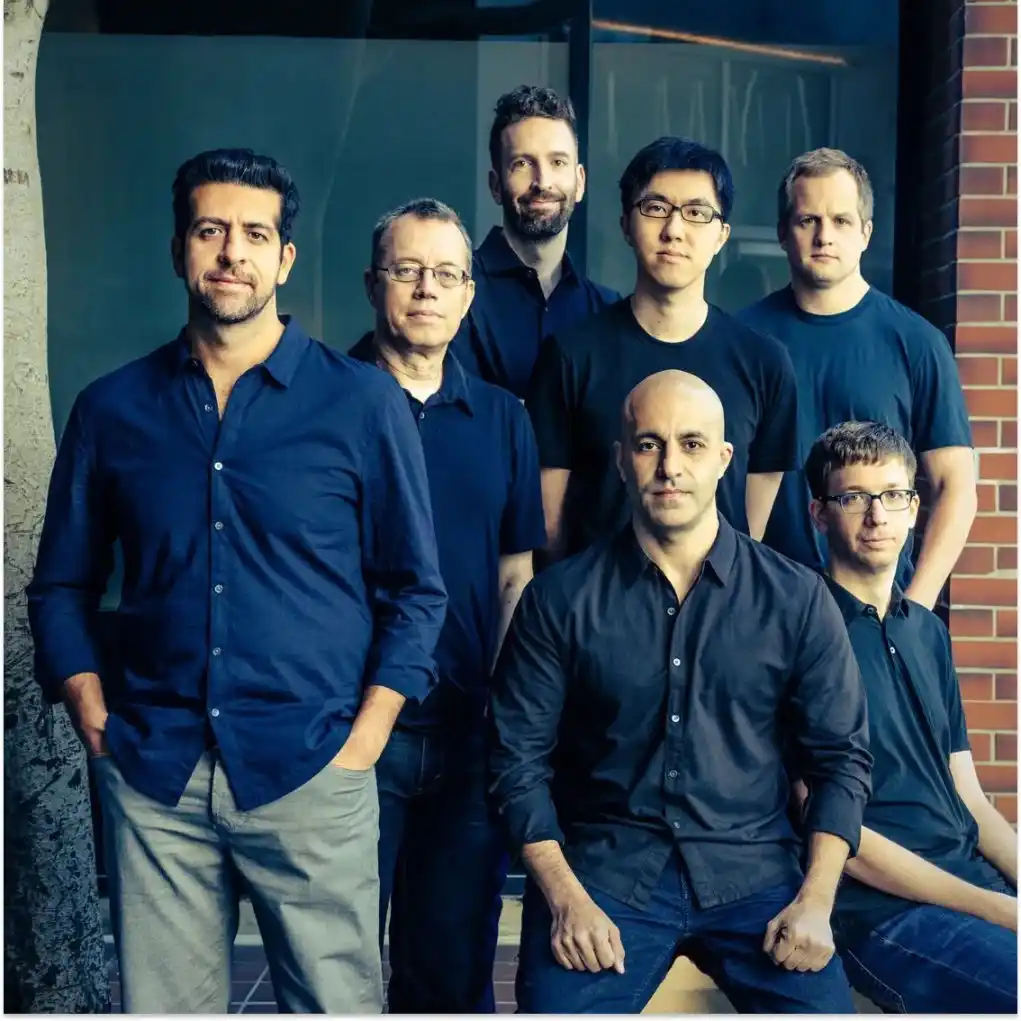
Databricks Co-Founder Ali Ghodsi sitting in the front and center, Forbes
The team initially felt they "needed a little money but not too much." Ben recalled in an interview with Lenny Rachitsky:
"When I met with them, they said, 'We need to raise $200,000.' At that moment, I knew they had Spark, and their competition was Hadoop companies with significant funding already. Plus, Spark was open-source, and time was of the essence."
Ben also realized that as academics, this team was "easily satisfied with small goals." He told Lenny, "Usually, for a professor to achieve a $50 million valuation in a campus startup, they would already be a 'hero'."
So, Ben delivered some "bad news" to the team: "I can't write a $200,000 check."
Next came the "good news": "I can write a $10 million check."
His reasoning was: "If you want to start a business, you have to take it seriously and go all in. Otherwise, you might as well stay in school."
The team decided to drop out of school. This further increased the investment, with a16z leading Databricks' Series A funding round, post-money valuation of $44 million, with a16z holding a 24.9% stake.
This initial encounter—Databricks asking for $200k, a16z investing $10 million—set the tone for the collaboration: once a16z invests in you, they will "wholeheartedly believe in you" and propel you to "aim for bigger goals."
When I asked Ali about the impact of a16z, his attitude was very clear: "I think, without a16z—especially without Ben—Databricks simply wouldn't exist today. I don't think we would have made it this far. They genuinely believed in us."
In the company's third year, revenue was only $1.5 million. "At that time, we couldn't be sure if we would succeed at all," Ali recalled, "The only person who truly believed that this company would be incredibly valuable in the future was Ben Horowitz. His confidence was stronger than all of us, truly, even stronger than my own confidence. He deserves high praise for this."
Having conviction is a great thing, but its value increases when you have the ability to make that conviction self-realize.
For example, in 2016, when Ali was trying to strike a deal with Microsoft. In his view, the market's demand to "integrate Databricks into the Azure cloud platform" was extremely urgent, and this collaboration should have been a natural fit. He had asked several VC partners to help connect him, hoping to get in touch with Microsoft CEO Satya Nadella—they did help, but these connections ultimately "got lost in the president's assistant's process and went nowhere."
Then, Ben personally intervened to establish a formal communication channel for Ali with Satya. "I received an email from Satya, in which he said, 'We are very interested in building a deep partnership,'" Ali recalled, "He also copied his deputy, as well as the deputy's subordinates. Within a few hours, my inbox was flooded with 20 emails, all from Microsoft employees I had tried to contact unsuccessfully before, all asking in their emails: 'When can we meet for detailed discussions?' That's when I realized: 'This is different, this collaboration will definitely happen.'"
For example, in 2017, Ali was trying to recruit a senior sales executive to drive the company's business acceleration. This executive proposed to include a "change of control clause" in the contract — essentially, if the company was acquired, his held shares would vest more quickly.
This became a sticking point in the negotiations, so Ali asked Ben to help persuade this executive, convincing him that Databricks' valuation "could reach at least $10 billion." After Ben communicated with this executive, he sent Ali the following email:
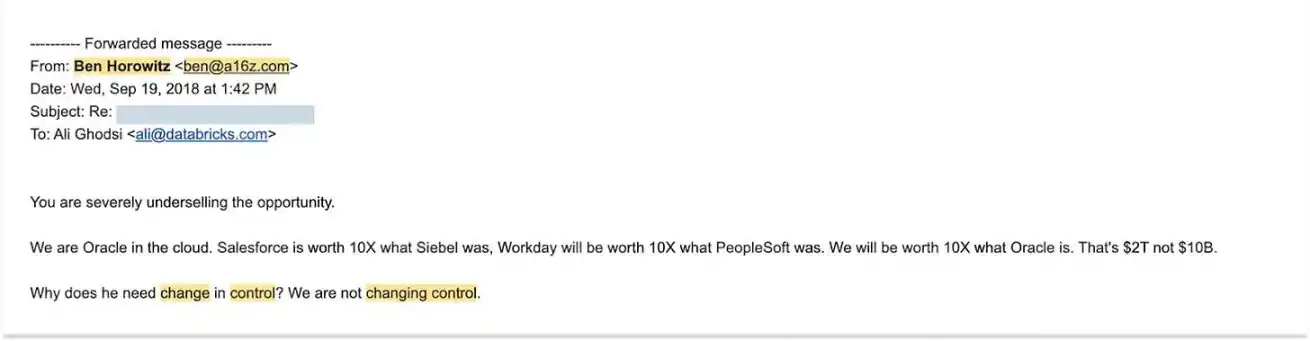
Email from Ben Horowitz to Ali Ghodsi, September 19, 2018, provided by Ali Ghodsi
"You have severely underestimated the value of this opportunity.
We will become the Oracle of cloud computing. Salesforce's valuation was 10 times that of Siebel, Workday's valuation will be 10 times that of PeopleSoft, and our valuation will be 10 times that of Oracle — which means our target is $2 trillion, not $10 billion.
Why does he need a 'change of control clause'? We will not experience a change of control."
This is perhaps one of the most emphatic corporate emails in history, especially considering that at the time Databricks' revenue run rate (annualized revenue) was $100 million, with a valuation of only $10 billion; whereas today, the company's revenue run rate has exceeded $480 million, and the valuation has reached $134 billion.
"They could see the full potential of something," Ali told me, "When you're in it, dealing with day-to-day operations every day, facing various challenges — deals not closing, getting suppressed by competitors, running out of funds, being unknown to everyone, employees constantly leaving — it's hard to take such a long-term view of the issue. But they'll show up at board meetings and tell you, 'You will eventually conquer the world.'"
Their judgment was correct, and this belief brought them generous rewards. In summary, a16z participated in all 12 rounds of Databricks funding, with 4 rounds led by a16z. It was because of investment targets like Databricks that a16z's initial investment in the AH 3 fund performed so well; at the same time, Databricks was also a key driver of return growth for the larger-scale "Late Stage Venture Funds 1, 2, 4."
「First and foremost, they really care deeply about the company's mission,」 Ali remarked. 「I don't think Ben and Marc see this primarily as a return-chasing investment; the investment return is secondary. They are believers in technology, hoping to use tech to change the world.」
If you can't grasp Ali's assessment of Marc and Ben, you'll never truly understand a16z.
What Exactly Is a16z?
a16z is not a traditional venture capital fund. At first glance, this is obvious: the scale of the recent fundraising by the company is the largest within the entire strategic coverage since SoftBank's $98 billion Vision Fund in 2017 and Vision Fund II in 2019 [8]. This is completely contrary to the characteristics of traditional VC. However, even so, the SoftBank Vision Fund is fundamentally still just a "fund," whereas a16z is not.
Of course, a16z raised funds and needs to create returns for investors. It has to excel in this regard, and so far, its performance has been outstanding. Not Boring has obtained the return data for a16z's funds to date, which we will share in the following text.
But first, we need to be clear: What is a16z, exactly?
a16z is a "technology faith community." Everything it does is to drive the birth of more advanced technology to create a better future. The company firmly believes [9]: 「Technology is the glory of human ambition and achievement, the vanguard of progress, and the realization of human potential.」 All actions stem from this core belief. It has a strong faith in the future and puts the entire company's resources at stake to live up to this belief.
a16z is an "institution." It is a business, a company built to achieve scalable growth and continually improve itself in the process of scaling. I believe that the many qualities an "institution" possesses are lacking in traditional "funds," which will be elaborated on in the following text. I believe this positioning of "institution> fund" precisely unravels the most contradictory aspect of the venture capital industry's self-awareness: the industry provides the most scalable product (funding) to the most scalable potential companies (tech startups), yet the industry itself is considered "not meant to scale."
This positioning of "institution> fund" stems from a16z's General Partner (GP) David Haber. He is the most "East Coast finance circle" person on the team and also calls himself a "student of investment institution business models." He explains: 「The fund's objective function (core goal) is to earn the most side income with the least hands in the shortest amount of time; whereas the institution's goal is to create outstanding returns and to build a competitive advantage that generates compounding effects. What we need to think about is: How do we make the company stronger, not weaker, in the scaling process?」
a16z is operated by engineers and entrepreneurs. The typical approach of a traditional asset management firm is to compete for a larger share of a fixed "cake"; engineers and entrepreneurs, on the other hand, aim to make the "cake" itself larger by building a more robust system and driving system scalability.
a16z is a "sovereign of the time domain" and an "institution built for the future." In moments of embracing grander ambitions, this institution sees itself on par with the world's top financial institutions and national governments. It has stated its goal is to become the "(original) J.P. Morgan of the information age," but in my view, this statement still underestimates its true ambition. If governments serve a "specific spatial domain," then a16z serves the "vast time dimension of the future." Venture capital is just one way it has found—through this approach, it can have the greatest impact on the future, and this business model best aligns with the logic of "profiting from advancing the future."
a16z creates and "sells" influence. It builds its influence through scalable development, cultural construction, networking, organizational structuring, and past successful experiences; subsequently, it bestows this influence upon the tech startups in its portfolio—mainly through sales support, marketing, talent recruitment, and government relations maintenance. However, in the words of its founder, a16z will "help in every way possible," and it seems capable of much more.
If you were to design such an institution—one that believes "technology is penetrating markets far beyond traditional tech industry boundaries" and "all domains will eventually become technologized"—what you would ultimately create is a company that will be at the core of thousands of "possible future economies," selling "capability to win." And I believe the institution you would eventually build would be very similar to a16z.
Because those companies that may form the core of future economies are often small in scale and weak in foundation in the initial stages. They are initially dispersed across various fields, each with different goals and competitors, often even competing against each other; at the same time, they have to face the incumbents dominating the current market and unwilling to yield to newcomers. A startup, no matter how promising, may struggle to recruit top recruiters (thus failing to attract the best engineers and executives); it may not be able to advocate for policies to create a fair competitive environment; it may lack a sufficient audience to have its ideas heard by the outside world; it may lack enough credibility to sell its products to government departments and large enterprises inundated with sales pitches promising the next big thing.
For any startup, investing billions to build the above capabilities solely for itself is illogical; but if these capabilities can be distributed among "all these startups," covering a "future market value of tens of trillions of dollars," these small companies can suddenly have the resources of large companies. Their success will depend solely on the quality of the product, and they can rightly usher in the future.
What would be the result of combining the agility and innovation of a startup with the influence and power of a "Time Domain Leader"?
This is exactly what a16z has been working to do — since its days as a startup itself.
Why Did Marc and Ben Start a16z?
In June 2007, Marc wrote a blog post titled "The Only Thing that Matters," [11] which was part of the "Pmarca Guide to Startups" [12]. At first glance, this post offered advice to tech startups, but looking back, it reads more like a "how-to guide for starting a16z." The core of the article addressed a question: among the three key elements of a startup — team, product, market — which is most important?
Entrepreneurs and venture capitalists often say "team is most important"; engineers usually say "product is most important."
"I come down on the side of a third view," Marc wrote, "I believe that the market is the most important factor in a startup's success."
Why? He explained in the article:
"In a great market — a market with lots of real potential customers — the market will 'pull' a product out of a startup...
Conversely, in a lousy market, even with the world's best product, team, and execution, you will fail...
So, in homage to former Benchmark Capital partner Andy Rachleff, I present 'The Rachleff Rule for Startups' here:
The #1 company-killer is lack of market.
As Andy puts it:
Great team + lousy market = market wins;
Lousy team + great market = market wins;
Great team + great market = the chance of real magic."
I believe Marc and Ben saw in the venture capital world a 'great market' (though no one realized how great it was at the time), filled with 'lousy teams' (equally underestimated at the time).
Between 2007 and 2009, Ben and Marc had been contemplating their next move. They were already very successful tech entrepreneurs — despite their success, the two still felt restless; and precisely because of this success, they had the capital to take a leap without holding back.
But what to do specifically?
Whether as entrepreneurs or later as angel investors, Marc and Ben had dealt with many unprofessional venture capitalists, and they thought, "Competing with these people might be fun."
"In my opinion, Marc doing this was never about money," David Haber told me, "He was already very wealthy from around the age of 20. Initially, he probably did this more to 'show Benchmark or Sequoia Capital a bit of color.'"
There was another characteristic of the venture capital industry, at the peak of the economic recession triggered by the Global Financial Crisis (GFC), that almost no one noticed: it might be the highest quality market in the world. And this was crucial for Marc.
Of course, not all venture capital firms were bad. The two companies Marc wanted to "show some color" — Sequoia Capital and Benchmark — were actually very excellent (Marc even quoted Andy Rachleff's views!), but they had a tendency to "oust founders." And for founders who wanted to retain control, Peter Thiel had founded Founders Fund as early as 2005, which was in the investment period of "2007 Vintage Fund II" — as Mario wrote, this fund eventually achieved a performance of "for every dollar invested, they have so far gotten $18.60 in cash back (DPI, Distributed to Paid-In capital ratio)."
But compared to today, the venture capital industry at that time was still a "lazy, closed, and manually operated industry."
Marc often tells a story: In 2009, when he and Ben were considering founding a16z, they met with a GP from a top venture capital firm, who likened investing in startups to "picking sushi off a conveyor belt." According to Marc's recollection, this GP said to him:
"Venture capital is like going to a sushi-go-round restaurant. You just sit on Sand Hill Road, and startups will come to you naturally. Even if you miss one, it's okay because the next sushi will come around soon. You just sit there, watch the 'sushi' go by, and occasionally grab one with your hand."
In the Uncapped podcast, Marc explained to Jack Altman, "If the goal is just to 'maintain the status quo,' as long as industry ambition is limited, this approach can work."
But Marc and Ben's ambitions extend far beyond that. In the company they are about to found, "missing out on a high-quality project"—meaning not being able to invest in an excellent company—would be the biggest mistake. This is no small matter because they clearly see: as the market grows, the scale of those large tech companies will become unimaginably large.
"Ten years ago, there were about 50 million internet users, even fewer with broadband connections," Ben and Marc wrote in the April 2009 "a16z Fund I" fundraising memo, "Today, there are about 1.5 billion internet users, many of whom have broadband connections. Therefore, whether on the consumer or infrastructure side, the most successful companies in the industry may have far more potential than the most successful tech companies of the previous generation."
Meanwhile, the cost of starting a company has significantly decreased, and processes have become simpler—meaning there will be more startups in the future.
In a letter to potential limited partners (LPs), they wrote, "Over the past decade, the cost of developing a new technology product and bringing it to market in at least beta form has dramatically decreased; today, this cost is typically only $0.5 million to $1.5 million, compared to $5 million to $15 million required a decade ago."
Finally, as startups transition from being "tool providers" to "players directly competing with industry giants," their ambitions are also expanding—meaning that all industries will eventually become tech industries, and the scale of all industries will consequently grow.
This is why at that time, the "market" was so premium. Marc continued:
"From the 1960s to around 2010, the venture capital industry had a fixed 'script'... The companies at that time were essentially 'tool providers,' companies that 'sold picks and shovels'—mainframes, desktop computers, smartphones, laptops, internet access software, SaaS, databases, routers, switches, disk drives, word processing software, all of these are tools.
Around 2010, the industry underwent a permanent transformation... the most successful companies in tech were increasingly those that directly entered traditional industries and competed with existing giants."
In the early days, was a16z guilty of "overpricing" companies? Or was the pricing actually reasonable relative to the future potential those companies would eventually realize?
In hindsight, it's easy to argue for the latter; but what's impressive about a16z is that they held this view even before things played out.
As they wrote in their post: roughly 15 tech companies hit $1 billion in annual revenue every year, and these companies account for 97% of the total market cap of all newly public companies that year—this is the well-known "Power Law." Given this, they had to go all-in, investing as much as possible in companies that had the potential to be one of those 15; and then, within those companies, doubling down and tripling down on the winners.
But to do this, having just two investing partners wasn't enough—a16z had to build the firm in a way that was "fundamentally different from everyone else."
So, after laying out the basic terms of "Fund I" (a target of $250 million, with LPs committing $15 million), Ben and Marc summarized the core strategy of the firm in a single sentence.
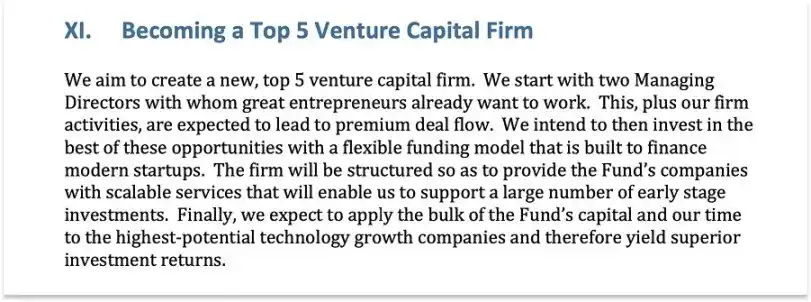
Fund I Memo
Despite the firm's growth far beyond "two partners" and ambitions no longer limited to "entering the top five in the industry," they continue to execute this strategy to this day.
a16z's Three Growth Phases
Looking back at the entire company's journey since its inception, I believe a16z's extraordinary conviction about the future and its asymmetric, unwavering attitude have always been its core competitive advantage. It's this differentiation that has led to all other advantages.
As the firm's ambitions, resources, fund sizes, and influence have expanded, the way they leverage this advantage and achieve differentiation has also evolved.
Phase One (2009 - approx. 2017)
In a16z's first phase (2009 - approx. 2017), the core insight was this: if "software is eating the world," then the value of top software companies would far exceed everyone's valuation expectations at the time.
With this belief, a16z took three actions, successfully transitioning from a newcomer to one of the top 5 investment firms in the industry:
To Place High Price Trades: As mentioned earlier, some of the early deals made by a16z's fund were perceived at the time by many peers as overpriced or off the conventional track. In the "Acquired" podcast, Ben Gilbert stated, "The outside world generally criticized them for 'spending money to buy reputation,' squeezing into high-quality projects through high-priced investments." However, he also pointed out that this approach was rational at the time and questioned, "Would anyone today think that the actual valuations of any projects a16z invested in between 2009 and 2015 were really too high? The answer is definitely no." As explained by Ben Horowitz in a 2014 Harvard Business School (HBS) case study, "Even with valuations in the billions, investors may still underestimate the potential of these companies." And this "underestimation" is where a16z found its opportunity.
Building Operational Infrastructure Considered "Excessive" by Others: Establishing a full-service team, hiring recruiting partners, setting up an executive briefing center... To fund managers at that time, these actions seemed like additional expenses that would drag down costs. But if one believes that the companies in the portfolio could grow to become the industry benchmarks of a "category-defining" company and that they need enterprise-level strength to achieve this goal, then these investments are justified. a16z's move is a future layout—startups in the future must have the image of a "mature enterprise" to win cooperation deals from Fortune 500 companies.
Viewing Technical Founders as a Scarce Resource: This was also a gamble—due to the lower cost of starting a company and reduced barriers, even without traditional management experience, technical geniuses have the ability to and will undoubtedly found more influential enterprises. Therefore, a16z did everything possible to attract and support these founders, bringing the model of the innovation talent agency CAA into the venture capital industry. Today, being "founder-friendly" has become a popular concept in the industry, but at that time, this was undoubtedly a highly innovative move.
It is worth noting that in the first stage, a16z's core goal was to invest in the "right companies" and to profit when these companies grew to their expected success scale. Of course, they also focused on supporting the founders, but fundamentally, the core of this stage was to seize the opportunity of "valuation arbitrage."
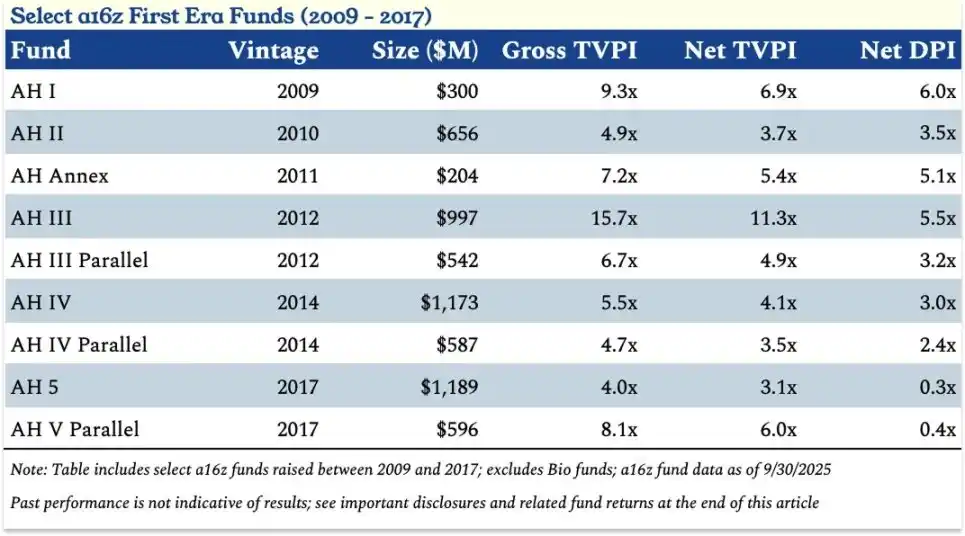
a16z Core Data for Funds in 2009-2017 (Phase One)
a16z's Third Fund (AH III) stood out due to its simultaneous investments in Coinbase and Databricks, but what's more noteworthy is the "consistency" of its performance.
As a Limited Partner (LP), "we are happy to see funds sustainably achieve a 3x (net) Total Value to Paid-in Capital ratio (TVPI), occasionally with over 5x (net) TVPI performance, and a16z has done just that," said David Clark, Chief Investment Officer at VenCap (who has been an LP since a16z's Third Fund), "a16z is one of the few companies that can consistently deliver such performance over the long term and at scale." This can also be seen from the performance data above.
If in this phase, a16z was willing to "pay a high price" and "cross over into investing like pork belly futures" to build brand reputation and wait for long-term returns, then in the short term, the cost of this "effort" seems relatively low.
Phase Two (2018-2024)
In a16z's Phase Two (2018-2024), its core belief shifted to: the scale of top companies will far exceed everyone's expectations, they will remain private for longer, and the industry's "scope of disruption" by technology is broader than most realize.
Based on this belief, a16z took three steps to move from the "Top 5" to industry leaders:
Raising Larger Funds: In Phase One, a16z raised $6.2 billion through 9 funds; whereas in the five years of Phase Two, it raised $32.9 billion through 19 funds. The traditional VC industry consensus is "the larger the fund size, the lower the return," but a16z proposed the opposite view: if the final value of the top companies will be higher, then more capital is needed to maintain a meaningful stake through multiple rounds of financing. For VCs, the worst-case scenario is "missing out on a top company" or "having insufficient ownership in a top company already invested in." Marc often says, "At most, you will lose the capital you invest (i.e., a 1x loss), but the potential upside is almost limitless."
Breaking the "single fund" model to achieve diversified deployment: In Phase One, a16z mainly raised core funds, along with subsequent late-stage funds. While each General Partner (GP) had their own focus area, all GPs invested from the same pool of funds. Additionally, a16z also raised a biotech fund—due to the stark differences between the biotech field and other fields. This article will focus on a16z's VC funds in non-biotech and healthcare.
Entering the second phase, a16z began to implement a "decentralized" layout. In 2018, under the leadership of Chris Dixon, a16z launched its first cryptocurrency-focused fund, CNK I. In 2019, the company hired David George to establish a dedicated Late Stage Ventures (LSV) team and raised the largest fund at the time - LSV I, with a size of $2.26 billion, roughly twice the size of any previous a16z fund. During this period, a16z raised multiple new funds focusing on core tracks, cryptocurrency, biotech, LSV, among other areas. In 2021, they also launched a dedicated seed fund (AH Seed I, $478 million), a gaming fund in 2022 (Games I, $612 million), and the first cross-strategy fund in 2022 (2022 Fund, $1.4 billion) - allowing LPs to invest proportionally across all funds raised in the same year.
Importantly, while each fund could leverage the company's centralized resources (such as the investor relations team), each fund built its own dedicated platform team covering marketing, operations, finance, event planning, policy research, and other areas to meet the needs of founders in specific verticals.
Extended Holding Period: In the second phase of a16z's development, leading companies began to stay private for longer and raised more funds in the private markets - including both "first-market financing" for company operations and "second-market transactions" to provide liquidity to employees and early investors. When a16z purchased late-stage Facebook shares in a secondary market transaction, Matt Cohler likened this practice to "investing in pork belly futures." Today, this model has become an industry norm - companies like Stripe, SpaceX, WeWork, Uber, among others, can now access liquidity in the private markets that was previously only available in the public markets.
This trend has brought challenges to the industry: LPs find it difficult to easily access liquidity, causing a disruption in capital allocation cycles. But for institutions that believe "technology company scale will expand significantly" (such as a16z), this is seen as a golden opportunity - not only does it provide a chance to invest more money into high-quality private companies, but it also shifts the returns that originally belonged to public market investors to the private markets. I believe this shift is one of the key reasons why a16z and other venture capital firms can significantly scale without suppressing returns.
To address this trend, a16z took two key initiatives: becoming a Registered Investment Advisor (RIA), allowing them to freely invest in cryptocurrency, public equities, and secondary market transactions; and under the leadership of David George, they launched the aforementioned LSV I fund. In the second phase, of the $32.9 billion raised by a16z, the LSV series of funds contributed $14.3 billion. Furthermore, the cryptocurrency fund was also split - the fourth cryptocurrency fund (CNK IV) was divided into a seed fund ($1.5 billion) and a late-stage fund ($3 billion).
The following are the top 10 investment projects of each LSV fund sorted by either "Latest Round Financing Valuation" or "Current Market Value":
LSV I: Coinbase, Roblox, Robinhood, Anduril, Databricks, Navan, Plaid, Stripe, Waymo, Samsara
LSV II: Databricks, Flock Safety, Robinhood (exited in the public market and funds reinvested in Databricks), Stripe, Deel, Figma, WhatNot, Anduril, Devoted Health, SpaceX
LSV III: SpaceX, Anduril, Flock Safety, Navan, OpenAI, Stripe, xAI, Safe Superintelligence, Wiz, DoorDash
LSV IV: SpaceX, Databricks, OpenAI, Stripe, Revolut, Cursor, Anduril, Waymo, Thinking Machine Labs, Wiz
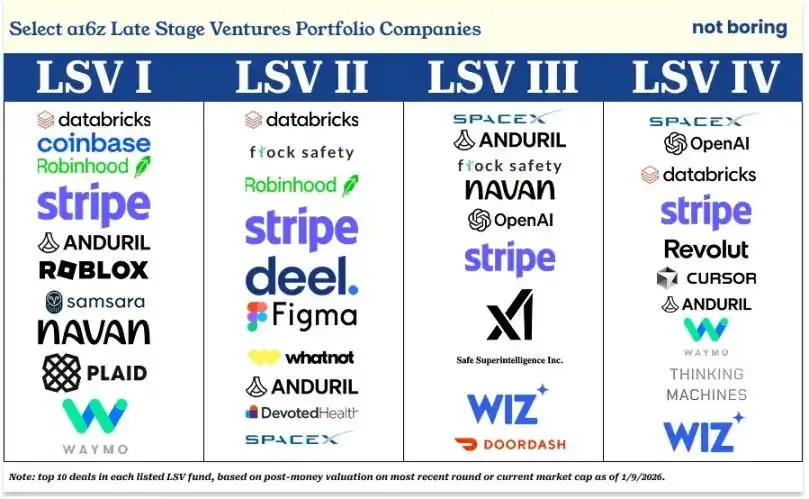
If, as previously accused by the outside world, a16z's investment was for "riding on the coattails of famous companies' popularity," then the above investment portfolio is undoubtedly a "high-quality popularity list." More importantly, according to the Cambridge Association's data for the second quarter of 2025, LSV I ranks in the top 5% among funds of the same vintage, while both LSV II and LSV III are in the top 25% (i.e., the first quartile) of funds of the same vintage.
As of September 30, 2025, LSV I has a Net TVPI of 3.3x; LSV II has a Net TVPI of 1.2x (however, following recent financing rounds for Databricks and SpaceX, this number may have increased); LSV III has a Net TVPI of 1.4x (furthermore, there are reports that SpaceX is about to complete a large-scale secondary market transaction, with a valuation potentially reaching 800 billion dollars, more than double the previous value, so LSV III's Net TVPI is highly likely to increase further).
Due to a firm belief that the ultimate value of these leading companies will far exceed that of most people (although not everyone - for example, Founders Fund's assessment of SpaceX and Thrive's assessment of Stripe align with a16z), a16z has been able to invest more in these high-quality private tech companies while they are still in the private stage.
The key is that a16z has proven: under the right conditions, growth funds can also achieve venture capital-level returns. Specifically, based on analysis data obtained from an a16z LP, if a venture capital firm has strong early investment capabilities and continues to add investments in the growth stage, it can not only achieve venture capital-level returns (multiple), but also obtain a higher Internal Rate of Return (IRR). Of course, establishing a deeper relationship with these companies can further enhance a16z's industry influence.
In the second phase, a16z believes the most important goal is to "hold as much ownership in top-tier companies as possible" — if it can gain a deep understanding of the company through early-stage investments, and continue to add investments through a dedicated late-stage fund (or compensate for early-stage investment mistakes), this goal is easier to achieve (although its ownership stake has not yet reached the common "controlling" level seen in other asset classes).
The core of this phase is still "arbitrage," but unlike the first phase, a16z expends more effort in this phase to help individual portfolio companies succeed.
Although the return cycle of the second-phase funds has not yet fully ended, the performance of the second-phase funds is currently leading compared to the performance of the first-phase funds at the same time (when its performance was reported as poor by The Wall Street Journal).
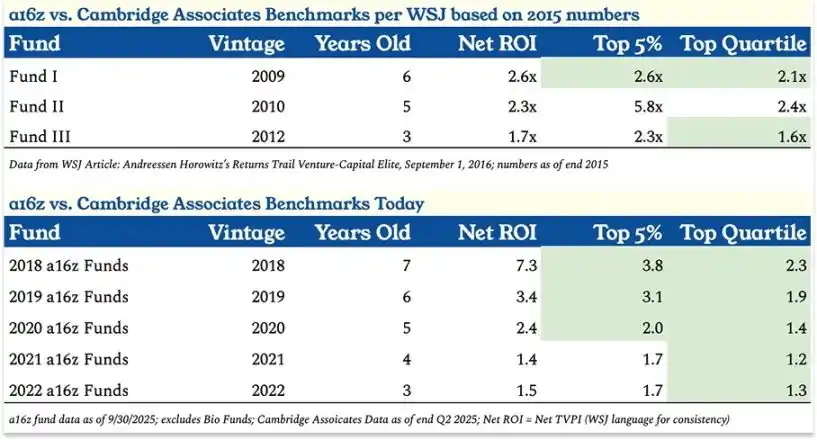
a16z Fund Investment Return Performance vs. Cambridge Associates Industry Benchmark
Specifically: the 2018 vintage fund's net TVPI is 7.3x; the 2019 vintage fund is 3.4x; the 2020 vintage fund is 2.4x; the 2021 vintage fund is 1.4x; the 2022 vintage fund is 1.5x.
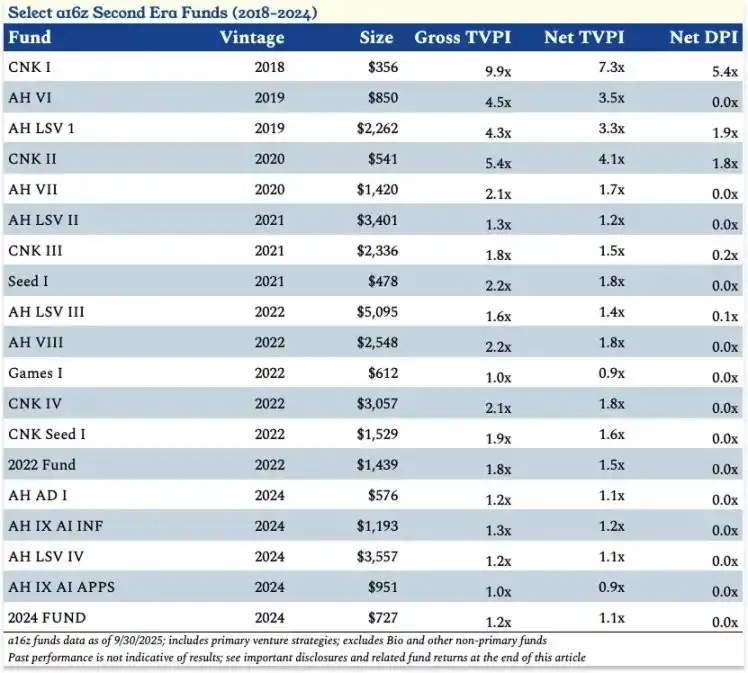
Core Performance Data of a16z Part of Funds from 2018 to 2024 (Second Phase)
The most noteworthy highlight of this phase is the outstanding performance of the cryptocurrency funds (CNK 1-4 and CNK Seed 1) — among them, CNK I has delivered LPs a 5.4x Net Distributed to Paid-In (DPI) capital ratio return.
What's even more surprising is that despite some questioning whether a16z "mistimed the market and overcapitalized a crypto fund" in 2022, as of now, its $3 billion raise for the Crypto Network Fund IV (CNK IV) has achieved a net TVPI of 1.8x.
The two core narratives of the second phase—LSV fund series and the cryptocurrency fund—perfectly embody a16z's two beliefs about the future: LSV responds to the trend of "enterprise private cycle extension and increasing demand for private market financing," while cryptocurrency represents an idea—that innovation (and returns) may come from an entirely new area outside the traditional investment track.
These two narratives also highlight a16z's need to further expand its service scope—providing support to portfolio companies while empowering the entire industry. For example, to help late-stage portfolio companies grow, a16z needs to replicate some advantages of the public market in the private market; and to ensure the survival space of the cryptocurrency industry in the US, ensuring that various new technology companies can compete fairly with existing giants, a16z must enter Washington (engage in policy lobbying).
This leads to a16z's third phase (2024 - onward). In this phase, its core belief is: with a level playing field, new technology companies can not only reshape various industries but also excel in all industries; and a16z must lead the industry and even the entire country in the right direction.
This belief once again changes a16z's positioning. When the company reaches a specific threshold (this $15 billion raise is a clear milestone), "picking winners" is no longer enough—
To create winners, you must shape an environment conducive to their competition.
As Ben puts it: "It's time to lead the industry."
a16z's Third Phase: It's Time to Lead the Industry
At this moment, you might envision a scenario: an analyst from a rival venture capital firm messages journalist Tad Friend, saying, "To achieve 5-10x returns for these two $15 billion funds, 'you have to expand the size of the entire US tech industry several times over.'"
And you can probably guess Marc and Ben's response: Yes, that's exactly what we intend to do.
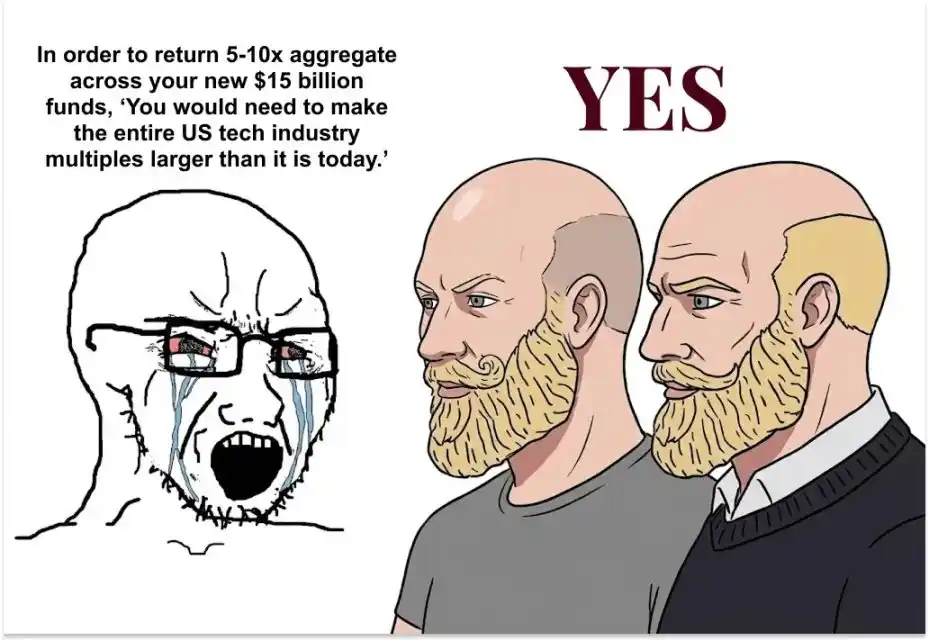
This is exactly the plan that a16z has explicitly laid out, the logic of which is as follows:
Since 2015, a16z has invested in more early-stage unicorn companies than any other investor, and the gap between it and the second-ranked investor (Sequoia Capital) is akin to the gap between the second and twelfth.
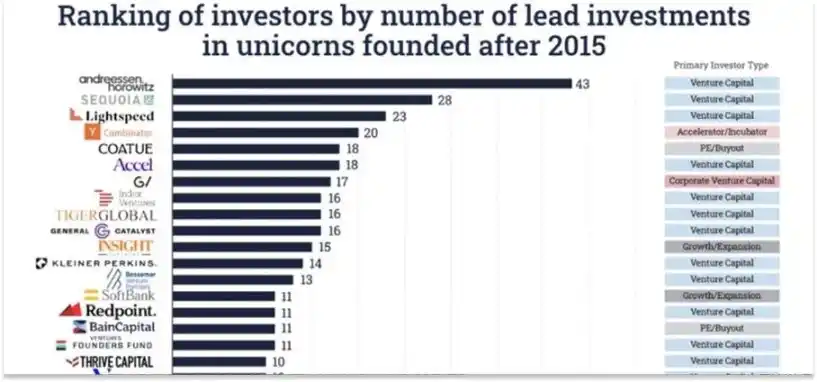
Data Source: Stanford University Professor Ilya Strebulaev
Clearly, the "number of unicorns grown from early-stage investments" is a very specific and convenient metric for measuring the "top investor." A more common way to evaluate is through returns — whether it's multiple returns, internal rate of return (IRR), or simply the total cash distributed to limited partners (LPs). Some people also focus on investment hit rate or performance stability. There are various ways to assess the ranking of the venture capital industry, each with its own perspective.
But this assessment criterion centered on "unicorn quantity" seems to be highly consistent with a16z's view of the industry. In the process of communicating with the a16z cryptocurrency team, I repeatedly heard this viewpoint: if many excellent entrepreneurs are laying out in a particular area, it is acceptable to bet on that area, even if the ultimate judgment is wrong; but if the wrong investment is made in a field, or if the eventual leader is missed for any reason, that is unacceptable. As Ben puts it:
"We are well aware of the extremely high risk of founding a company, so as long as we follow the correct process during investment and make a reasonable risk assessment, we will not be overly concerned even if some investments do not succeed. On the contrary, if we fail to accurately assess whether an entrepreneur is the best candidate in their field, we will take it very seriously.
Picking the wrong emerging field is not a big deal; picking the wrong entrepreneur is a serious problem; missing out on an excellent entrepreneur is equally a big problem. Whether due to conflicts of interest or active opt-outs, as long as we miss out on a company with epochal significance, the consequences are far more severe than investing in the best entrepreneur in a misjudged field."
From a16z's self-defined "core metric," it has already become a leader in the venture capital industry.
"So, what's next?" Ben poses the question, "What does leading an industry actually mean?"
In the X platform's lengthy announcement of raising $15 billion, they provided the answer: "As a leader in the U.S. venture capital industry, the future of U.S. new technology is to some extent in our hands. Our mission is to ensure that the U.S. wins the tech dominance of the next 100 years."
For a venture capital firm to say such a thing is indeed rare.
But if you agree with the following premise — that technology is the engine of progress, the U.S. must maintain its leading position by having technological superiority, a16z is the largest and most influential investor in U.S. emerging technology companies, and has the ability and resources to provide these companies with a level playing field against industry giants — then this statement is not entirely unreasonable.
Furthermore, he pointed out that to win the tech dominance of the next 100 years (which a16z equates to winning the overall leading position of the next 100 years), one must grasp key new technological architectures — AI and cryptocurrency — and apply these technologies to the most critical areas such as biotech, defense, healthcare, public safety, education, and even integrate them into the government's operations.
These technologies will significantly expand the market size. As I discussed in my articles "The Tech Market Will Expand Dramatically" and "Everything Can Be Technologized," industries and unresolved tasks that were not originally covered by the tech sector are now included. This means that the Value-Creating Actionable Vision (VCAV) for venture capital will also see a substantial increase.
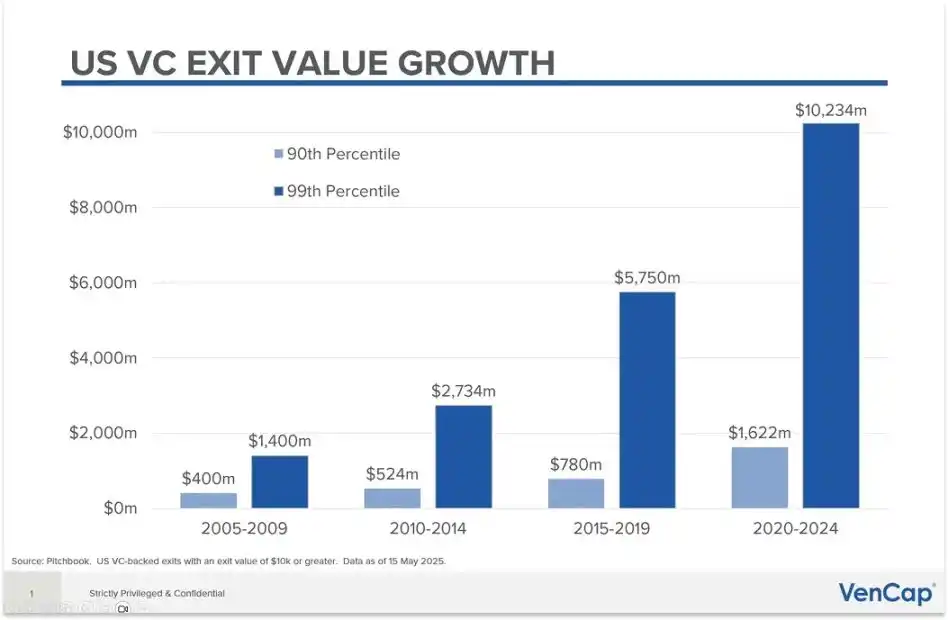
The U.S. venture capital exit scale is growing significantly, chart source: VenCap Chief Investment Officer David Clark
This is a continuation of a16z's long-standing investment strategy, but with a key conceptual shift: as long as a16z fulfills its leadership role, these values can be unlocked, securing the future of the U.S. (and even the world).
Specifically, this means doing five things:
1. Reshaping U.S. tech policy to return to its peak;
2. Bridging the gap between private companies and public companies;
3. Driving marketing models to evolve towards the future;
4. Embracing new models of corporate founding;
5. While enhancing its own capabilities, continuously shaping corporate culture.
a16z's seemingly puzzling moves are almost all in service of these five core goals.
Most notably, over the past two years, a16z has been increasingly vocal in the political arena, with Marc and Ben openly supporting President Trump in the last election. This move has sparked discontent among many, with some believing that a venture capital fund should not interfere in national politics.
However, a16z staunchly opposes this view. It aims to "reset U.S. tech policy to its former glory."
Marc and Ben outlined their position in the "Small Technology Business Development Agenda," with the core idea being:
Small emerging tech businesses are crucial to national development.
To win the future, there needs to be innovation-friendly laws, policies, and regulatory systems, while also preventing well-resourced industry incumbents from impeding competition through "regulatory capture."
However, the current reality is quite the opposite: "We believe that bad government policy has become the number one threat facing small tech businesses."
Currently, there is no one advocating for emerging tech businesses at the government level or in the fight against industry giants: the incumbents won't do it, and startups shouldn't devote their limited resources to such matters.
The financial success of venture capital firms is closely tied to the success of emerging tech companies, so the VC industry should carry this banner; and as a leader in the VC industry, a16z has an even greater responsibility.
a16z's political stance is "single-issue oriented," focusing only on the development of small tech businesses, and is guided by a bipartisan approach.
Its public positions include: "We will not engage in political disputes unrelated to small technology businesses" and "We support or oppose a politician solely based on their stance toward small technology businesses, irrespective of their party affiliation and positions on other issues" - from what I have seen and heard at a16z, these are not empty slogans but their true action principles.
a16z's foray into politics is not because they find it amusing (although at least Marc seems to enjoy this "lively scene"; he seems passionate about many things and can find humor in the absurd - this ability is an underestimated competitive advantage, but we don't have time to discuss it today). In the short term, a16z is willing to endure the criticism of appearing "foolish" and criticism from all sides just to ensure the long-term flourishing of emerging technology.
As former Benchmark partner Bill Gurley pointed out in his article "2581 Miles," for a long time, the tech industry could largely ignore Washington, and Washington could largely ignore the tech industry. However, a few years ago, things changed, partially for the reasons I mentioned earlier - the tech industry's position has shifted from "building tools" to "competing with industry giants." And the cryptocurrency industry is the first to face "life or death" level regulatory pressure.
When a16z first entered the Washington political scene, "small tech companies" were not yet a influential group in Washington. Large tech companies had dedicated lobbying teams and government relations networks; industry giants—whether in banking, defense, or other sectors—also had their own lobbying resources and connections. But small tech companies, including cryptocurrency firms, did not have such support. At that time, apart from Coinbase possibly having the capability, no small tech company could afford the cost and upfront investment required to establish a representation mechanism in Washington (and even state legislatures across the US).
Therefore, in October 2022, the a16z cryptocurrency team hired Collin McCune as the head of government affairs to lead efforts to educate US political figures about cryptocurrency. Collin, Chris Dixon, a16z's Chief Legal Officer for Crypto Miles Jennings, other team members, and entrepreneurs from a16z's portfolio and the entire cryptocurrency industry, made multiple trips to Washington to explain to policymakers the workings of cryptocurrency, its development potential, and, most importantly, the risk that overregulation could stifle innovation in emerging technologies.
These efforts paid off. Largely due to their advocacy and the bipartisan political action committee "Fairshake SuperPAC," the cryptocurrency industry is no longer at risk of being "snuffed out" by legislation. Last year, President Trump signed the "GENIUS Act," which for the first time brought stablecoins under regulation; simultaneously, a comprehensive cryptocurrency market structure bill passed the House with overwhelming bipartisan support and is currently awaiting Senate review, poised to pass later this year and be signed into law.
This experience played a crucial role as artificial intelligence became a focus in Washington. Today, McCune oversees all of a16z's government affairs business, establishing a permanent presence in Washington covering multiple areas such as AI, cryptocurrency, and "American Dynamism." Currently, a16z is advocating for the establishment of unified federal artificial intelligence regulatory standards to avoid inconsistent state regulatory policies and promote other innovation-friendly policies.
While the term "lobbying" may carry negative connotations, the current reality is this: small tech companies' competitors have mature government affairs and policy teams, and they are seeking to make it challenging for newcomers to enter the market through "regulatory capture."
In order for the tech industry to win the future, and for a16z's funds to deliver returns, staying away from politics is no longer a viable option. The good news is that a16z's survival depends on the creation, growth, and success of startups, making it more motivated than any institution to uphold a fair competitive environment conducive to innovation.
Because even a16z itself admits that, standing here today, no one can predict what companies will emerge in the future, or how they will come about.
The idea of "embracing a new model of company creation" means accepting the possibility that, with the help of artificial intelligence technology, the number of employees needed for a founder to start a company in the future might be only 1/10 or even 1/100 of what it was in the past, and the elements required to build a great company may also be drastically different from before. This also means that a16z itself needs to adjust.
For example, a16z has launched an internal accelerator program called "Speedrun": providing up to $1 million in funding to startups and conducting a 12-week incubation program. Through this initiative, a16z can get an early look at the founding models of these new types of companies, thoroughly evaluate each participating company, and therefore make more informed decisions to further invest in promising companies.
However, this move also comes with risks: increasing the number of companies that can claim to have received investment from a16z, lowering the investment threshold, may dilute a16z's brand credibility. For instance, a16z faced controversy on Platform X for investing in a company called Doublespeed through the Speedrun program— the company claimed to provide "synthetic creator infrastructure," but others accused it of being a "phone farm" and "garbage information as a service."
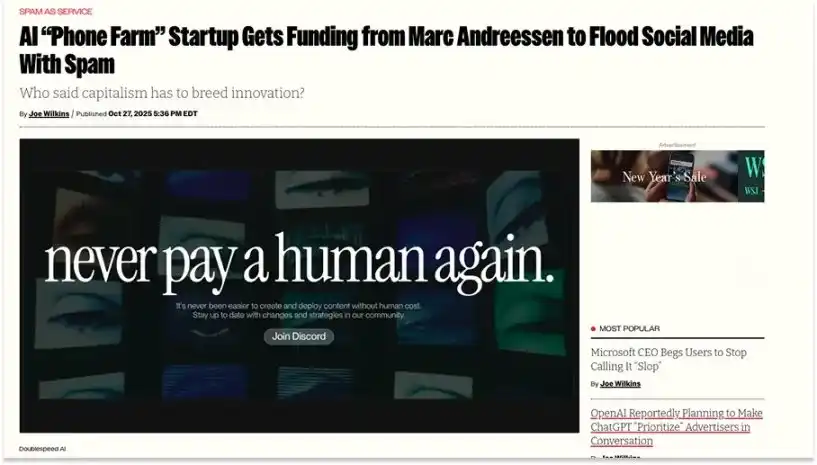
Source: Futurism
There is a viewpoint that "the company received investment from Marc Andreessen," which is quite ironic— because Marc does not participate in individual investments below $1 million in the Speedrun program, considering each Speedrun investment accounts for only about 0.001% of a16z's assets under management (AUM). But this precisely highlights the core issue: I have seen many references on Platform X to this "company receiving investment from a16z," until eventually realizing it might be a project incubated through Speedrun, and then verifying it. Yet, most people won't take the time to fact-check this.
Another more controversial similar case is the startup Cluely, which claims to "help users cheat in various transactions," and a16z led a $15 million investment in the company through its AI application fund.
People have reason to question: as an institution dedicated to shaping the future of America, why would a16z invest in a company that prioritizes "viral spread" over "ethical guidelines"? In the eyes of those active on the internet, does having a company like Cluely in the portfolio undermine the credibility of all other invested companies?
The answer is likely yes. Personally, I do not agree with this investment decision—it gives off a sense of being "lowbrow" and undignified.
However! From a16z's own logic, this decision is consistent.
Because setting aside the product itself, the core message conveyed by Cluely is: in the age of artificial intelligence, the business founding model is undergoing a fundamental transformation—its premise being that the capability of the underlying model is trending towards integration and commodification, thus "spreadability" will become the sole key factor; and to achieve spread, even if it sparks some controversy, is irrelevant.
If a16z is truly committed to "embracing a new model of business founding," then exchanging $15 million and a minor X Platform controversy for a "front-row seat" to observe an extremely innovative business founding model is actually not a high price to pay.
More broadly, in the industry where a16z operates, occasionally "seeming foolish" is a necessary cost to avoid repeating Kodak's fate. Companies must be willing to take risks, and these risks go far beyond the financial level. Given a16z's scale, investing a small amount of money is actually the lowest-risk way to take a gamble.
However, there is also a viewpoint that, from a holistic perspective, these minor controversies on the X Platform (which is also an a16z portfolio company) are inconsequential. In fact, when I asked a16z General Partner Katherine Boyle (who is also a co-founder of the company's "American Renaissance" business) about this issue, she expressed the following view:
"You might say, yes, we do face some criticism on the X Platform because of certain companies—like people in a certain circle in San Francisco or New York do not like a particular company, they would say 'We don't like them doing 'American Renaissance' business! We don't like them doing cryptocurrency!'
But in the grand scheme of our system, these momentary minor controversies are completely insignificant.
The top institutions all have a scalable system, just like the United States as a country. When the U.S. makes some embarrassing moves on the global stage, do we care? No, because it does not have a substantial impact on the U.S., just like similar events do not affect the Roman Catholic Church."
Our unit of thought is the 'century,' not 'the tweet.'
You might not agree with all of a16z's practices, but you have to admire the audacity of this firm.
Notably, when I ask some of a16z's LPs about these controversial companies that have stirred up conflict on X platform, they often respond with a puzzled look and ask, "Who?" — clearly, they have never heard of these companies.
For a16z, what has always mattered most is the 'leading companies': spotting them early, successfully participating in their funding rounds, and holding as much equity for as long as possible. If you ask any a16z LP about Databricks, they will surely be familiar with it.
Now, in the 'leading the industry' third stage, there is something equally important: even as these leading companies have greatly expanded, helping them continue to grow.
I believe this is at the core of what Ben refers to as 'filling the gap between the development of private companies and public companies' — it is also the most crucial perspective reshaping the current understanding of a16z's positioning and how it is expected to achieve a 5-10x return on its $15 billion fund.
Ben stated: "In the past, venture capitalists would help companies achieve $100 million in revenue and then hand them over to investment banks for the subsequent IPO process." But that era is gone. Today's companies not only stay private longer but are also larger — meaning that the venture capital industry, represented by a16z, needs to enhance its capabilities to meet the development needs of large companies.
To this end, a16z recently hired former VMware CEO Raghu Raghuram to serve in a 'triple role': as a General Partner on Martin Casado's AI Infrastructure team, a General Partner on David George's Growth Fund team, and as a Managing Partner, acting as Ben's 'advisor to help run the firm.' Raghu will co-lead a series of new initiatives with Jen Kha to 'meet the needs of large companies in their growth.'
Specifically, these initiatives include: partnering with governments worldwide to help portfolio companies achieve scale and market expansion locally; establishing strategic partnerships with companies like Eli Lilly (both have jointly launched a $500 million biotech ecosystem fund); expanding the number and depth of limited partner (LP) relationships globally; and expanding the services of the a16z Executive Briefing Center — which provides tailored services to large companies, enabling them to directly engage with businesses in a16z's investment portfolio in relevant sectors globally.
Even for large enterprises, some resources, if each company were to build them from scratch individually, would be neither practical nor cost-effective. However, having them built centrally by a16z and then distributed to the entire portfolio is a reasonable choice. These resources happen to involve government-level matters, trillion-dollar-scale companies, and trillions of dollars in capital.
All of these initiatives could allow companies to stay private without sacrificing the credibility, partnerships, or funding channels that public companies have.
This means that companies can grow to a larger scale in the private market—a market that is a core focus area for a16z.
It also means that a16z has the opportunity to invest more capital with a reasonable chance of a substantial return; and more returns can be translated into more resources to enhance its capabilities, strengthen industry influence—these capabilities and influence can then further empower its portfolio companies, and gradually empower the entire emerging technology industry, thus driving more and higher-quality new technologies to be applied in more areas of the economy, ultimately enabling everyone to have a better future.
Of course, there are inevitably many risks in the process. "More money, more problems," leaders always have to endure more criticism, and so on.
In my view, a16z is engaging in industry competition with an unprecedented breadth and scale, which presents both opportunities and risks.
For example, the broader the business coverage, the more potential risk points there naturally are. In theory, the longer a company stays private, the more challenging it is to create liquidity for limited partners (LPs); the difficulty for LPs to invest in new funds will also increase, and these new funds are the financial foundation for a16z to invest in potential future giants.
But ultimately, there are two core groups that determine everything: founders and LPs—they are both the company's clients and investors.
The Two Key Groups: LPs and Founders
Whether founders choose which institution's investment to accept or LPs choose which institution to fund, their attitudes toward a16z precisely encapsulate all the core logic I discussed earlier.
My analytical logic is as follows:
If the most elite founders believe that the system a16z has built can help them build a bigger company than through other means, they will prioritize a16z's investment (or at least ensure that a16z is one of their funding sources).
If LPs believe that a16z will continue to invest in the best founders, then even in the face of a liquidity crisis, they will prioritize funding a16z and hold its fund shares for the long term.
During my conversation with Jen Kha, she shared a story that vividly illustrates: in the venture capital industry, "investing in the very best companies" (assuming the right market) is the only key thing.
A few years ago, during a brief VC market downturn, the market faced liquidity concerns and uncertainty due to the Trump administration's unclear stance on the tax status of donation funds. At that time, a16z took the initiative to offer liquidity support to LPs. Looking back at the news at that time—including rumors about top-tier donation funds selling off their VC portfolios—it's easy to see that a16z's move was like offering a cup of water in the desert.
Specifically, a16z's first fund (Fund 1) held Stripe's seed round shares, while the third fund (Fund III) acquired a significant stake in Databricks during its Series A funding. a16z told LPs: "We understand everyone is facing a liquidity crisis. If you're willing, we can buy back your shares in these companies to create some liquidity for you."
"Packy, here's the situation," Jen recalled, "All 30 LPs responded with 'absolutely not considering.' They said, 'Thank you for the offer, but we don't want to cash out from these companies' shares; we want liquidity from other companies' shares.'
As an LP in a16z, VenCap's Chief Investment Officer David Clark explained: "The essence of venture capital is not short-term liquidity but long-term compounding growth. We don't want the fund manager to sell off the highest-quality company shares too early."
Anne Martin of Wesleyan University was one of those 30 early LPs, and her investment experience also confirmed the power of compounding. Since the establishment of a16z's first fund in 2009, she has been supporting the organization—back when she was at Yale Endowment Fund; now as the CIO of Wesleyan University, she has participated in 29 of a16z's funds. The latest fund raised by a16z will push this number past 30.
"In the portfolios I lead investments in, a16z not only has a significant position but also is the longest-held asset," Anne said last month during our conversation, "At the first investment committee meeting I chaired after joining, I recommended two new fund managers to the committee members, and a16z was one of them."
Initially, Anne invested in a $300 million fund—Jen said, "She directly negotiated the Limited Partner Agreement (LPA) terms with Ben." Anne agrees with a16z's view that "the market opportunity can already support a larger fund."
「What sets a16z apart is... take their $1.6B AI infrastructure fund, for example, you can simply draw a matrix calculation: 'Assuming they hold 8% of the company at exit... what exit valuation is needed to return the fund?' With an 8% ownership stake, the company would need to exit at a $20B valuation. While such a scenario is not common, a16z seems to hit many. More importantly, is the 8% ownership stake reasonable for them? Because often their ownership stake is much higher.」
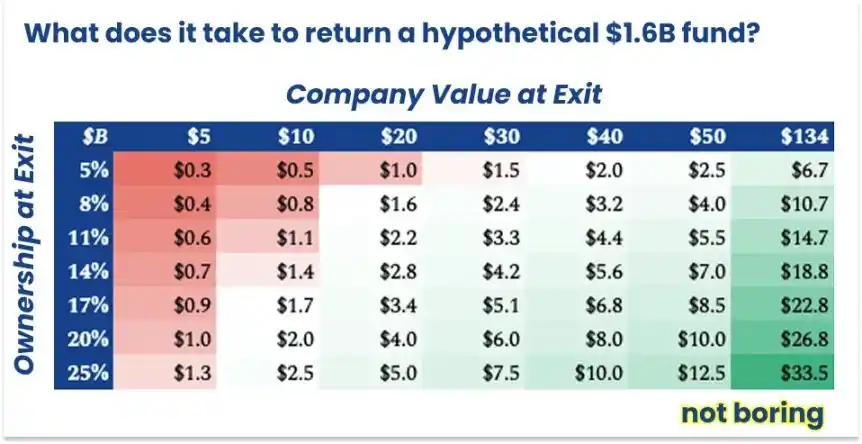
For illustrative purposes only... yet entirely feasible
「I think, for them, the key is the ownership stake and the ability to help these companies achieve massive outcomes,」 Anne told me, 「It is these two points that make LPs confident in large-scale funds.」
It is this ability to 'help companies achieve massive outcomes' that even the most sought-after founders are willing to offer a16z more favorable investment terms than other competitors. In just 2025, in several transactions, a16z invested at a valuation lower than other top-tier firms in the same round. While I cannot disclose specific company names, I understand that just last year, four well-known technology companies adopted this model in their financing rounds.
In fact, founders highly appreciate the resources that a16z can provide, so they are sometimes willing to accept valuations below market levels. This is in stark contrast to a16z's early days—when competitors, dissatisfied with a16z's frequent high-price snatching of projects, even gave it the nickname 'A-Ho.' The change today is enough to prove that working with a16z can bring real and tangible value, and companies are willing to accept a 'higher dilution ratio' as an exchange.
This means that while I mentioned two key groups earlier, ultimately, there is only one core group: if the very best founders are willing to work with a16z, the highest quality LPs will naturally follow suit.
Can a16z enhance the development outcomes of its portfolio companies?
This is the core question, isn't it? We can express it with a hypothetical formula:
a16z's contributed market value percentage × Total affected market value
The key challenge of this formula is: in order to significantly increase the left-hand side's "Contribution Share," you must provide assistance at the smallest "Affected Total Market Value" on the right-hand side (i.e., the early stages of a company).
However, when you truly help a small-scale enterprise grow into an industry giant, the loyalty you receive is priceless — founders will actively recommend you to other founders considering funding and advocate for you in media coverage.
Previously, I asked Erik Torenberg to help me connect with some founders invested in by a16z, and within a few hours, he facilitated introductions for me to founders of companies with a combined market value of over $200 billion, including Ali Ghodsi of Databricks and Garrett Langley of Flock Safety.
I specifically mention these two founders because within 48 hours of establishing contact with them, two significant events occurred: Databricks announced a $40 billion funding round, valuing the company at $134 billion, and Flock Safety assisted in apprehending the suspect in the murder of individuals associated with Brown University and the Massachusetts Institute of Technology (MIT). These two events vividly demonstrate the influence of a16z's portfolio companies.
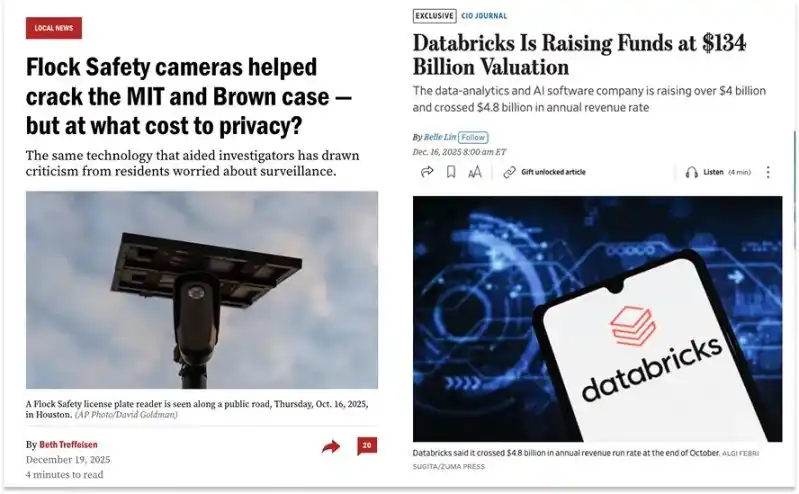
Source: Boston.com and The Wall Street Journal
But what I truly want to understand is: how does a16z leverage its influence to support these companies? Has this support truly altered the trajectory of these companies? Has the resource ecosystem that a16z has invested hundreds of millions, even billions, to build really brought about significant change for these companies?
To believe in a16z's bet in the third phase — that is, to create substantial returns for the $15 billion new fund by expanding the market for tech startups and increasing the value of portfolio companies — you might first need to believe that the answer to the above questions is yes.
And indeed, the answer is yes.
Recall, Ali from Databricks once said: "Without a16z, there would be no Databricks today." For just this one company, it has added $134 billion (and counting) in value to the VC-investable market and brought a net return of around $20 billion to a16z. Even if his statement is somewhat exaggerated, it is not difficult to argue that a16z's support for Databricks — from early sales assistance, facilitating collaborations with Microsoft, to helping establish specific departments — has already surpassed the value of all its investments in platform development since a16z's inception.
In fact, we can make an assumption: if a16z currently still holds about 15% of Databricks, a rough calculation shows that as long as a16z's contribution to Databricks' valuation reaches around 25%, it can cover the regular venture capital management fees it has charged since its inception.
All the founders I have interviewed have mentioned a consistent working model at a16z—no matter which General Partner (GP) they interact with, this model clearly carries the shadow of the innovative talent agency CAA: when you don't need them, they never intervene, allowing you to independently operate your business; once you make a request, they will "all hands on deck" to provide support.
This is also a key way a16z wins investment deals: each fund's GP is responsible for deciding on investment targets, and when needed, they will mobilize all company resources—including Marc and Ben themselves—to fully pursue the deal.
“The most ideal state for a company is 'delegated authority, shared beliefs, collaborative breakthrough',” David Haber told me, “Marc will basically say: 'As long as you tell me this is the next Coinbase, I'm willing to fly anywhere in the world. I can invite this entrepreneur to my house for dinner tonight. Act immediately, at any cost.'”
After the deal is completed, the GP's collaboration model with the founders remains the same.
“Regardless of the situation, their support is unwavering. a16z will even over-support me and the founding team, even if we have differing views, they will never interfere too much,” Ali said, “but as soon as you need help, they will all get involved to ensure the problem is resolved.”
Of course, a16z's support for Databricks is so, and I have heard the exact same sentiment from several other early-stage a16z-backed companies.
Shane Mac, CEO and co-founder of XMTP, a real-time communication protocol company in the a16z cryptocurrency investment field, told me through a message:
“a16z has done a lot of things, like most venture capitalists. But I think more important is what they 'don’t do':
They never micromanage; they don't engage in short-term speculation; they never let me waste time. Every resource they introduce has altered the trajectory of our company’s growth. They made me believe in myself more, made me realize that I too could build such an ambitious business, and that together we can change the world.”
I think this is what they excel at: believe in me and push me beyond my self-awareness limits.
The founders of the "Stealth Company" (I reported on this company back in late 2024 when a16z invested) Dancho Lilienthal and Jose Chayet had a very similar experience—even though they were working with a different GP (Anish Acharya) under a different team (AI Apps).
A few weeks ago, they had a Zoom call with Anish. They were anxious because their company's growth was "compounding steadily" instead of "breaking out like other AI companies."
"We were worried that investors would think 'this company is growing too slowly, I don't want to spend more time on them,'" Dancho recalled, "and Anish looked at us through the screen and said, 'Guys, unless I die or get fired, I'm here to support you all the way. Whatever happens, I'm here.'"
They described this "hands-off, but there when needed" model as:
"It's like the ideal perfect parent—there when you need them, taking responsibility for you, making sure everything is going smoothly; when you don't need them, they don't interfere, they don't cause chaos."
This model is both excellent and intentionally designed.
Joe Connor, founder of Odyssey (a company focused on the "school selection platform," also backed by a16z and Not Boring Capital), said he doesn't go to a16z for day-to-day operational advice, but "whenever I need to connect with anyone anywhere in the world, I just send a message to Katherine, and I get connected."
Although a16z can help companies connect with experts in any field globally, it explicitly states that it does not interfere with company operations. In a 2014 Harvard Business School (HBS) case study, Marc once said, "We are not the 'training wheels' for startups. Companies must do what they can do by themselves, and we will not do it for them."
a16z's goal is to give companies "credibility" and "influence."
Over the years, a16z has offered various services. Alex Danco, who has delved into these issues, told me, "What is the most important service we offer now? It is recruitment support and sales and marketing support. Why these two? Because these two areas need the most 'credibility reserves,' and a16z's core role is the 'credibility bank.'"
Alternatively, as Marc put it: "What you want from a VC is the amplification."
Joe gave me two examples.
Back when Odyssey was still in its early stages, they encountered a Stripe-related issue that couldn't be resolved through regular channels. "a16z helped me get in touch with Patrick Collison, and the issue was immediately resolved," he said. "Every time I sought help, I was never turned down. Stripe is valued at around $95 billion, while our valuation was almost negligible at that time. But we are all part of the a16z ecosystem, and everyone supports each other."
Even outside the a16z ecosystem, the name itself carries a lot of weight. Odyssey's clients are state governments, whose employees may not even be able to name three VC firms and may not care about VC at all. But Joe said, "They know a16z, they know Marc and Ben. When we didn't have a track record and states couldn't choose us based on past experiences, a16z's endorsement gave states confidence — it made them believe we could deliver on our promises, believe we had excellent technology as advertised, because an institution that invested in Stripe and Instacart endorsed us."
In October 2024, Odyssey won the $1 billion Texas Education Savings Account (ESA) program operations contract — the largest of its kind in the U.S. Today, Odyssey has earned credibility through its own efforts.
This is a concrete manifestation of "building credibility" and also demonstrates the scalability of credibility. For the vast majority of market participants who don't closely follow Silicon Valley trends, building credibility requires "scale support." The more successful a16z's self-promotion is, the stronger the credibility of its portfolio companies in the eyes of potential customers, partners, and employees.
"If our company does all sorts of amazing things but no one knows about it," Ben asked in the article "It's Time to Lead the Industry," "did we really achieve it?" Clearly, a16z's marketing targets include founders — they need to understand what help a16z can provide. But at the same time, a16z's marketing targets also include all the entities that founders may collaborate with in the future.
Marketing
For this reason, investing in building a top-notch in-house media team is inherently rational.
Some attention is cheap and lacks novelty, while the goal of the media team is to make attention generate real value. The team operates a complete internal media system: building and operating high-quality owned channels (covering X platform, YouTube, Instagram, and Substack), planning product launch events and timeline takeover events (refers to concentrated platform content dissemination during specific time periods), and directly deploying staff at critical stages of portfolio company development.
「We've recently been facing some PR challenges.」 Garrett Langley of Flock Safety mentioned to me a few weeks ago - back when his company had not yet assisted in solving the murder cases at MIT and Brown University, nor had quickly turned around the PR situation. 「While most institutions on the investor list just offered ideas, a16z took real action. Erik and his team got directly involved, with no beating around the bush. They have now joined our Slack workspace, contributing to our positioning and brand document drafting. Just this week, we also recorded a podcast with Ben. A brand as credible and reputable as a16z speaking out for our business is crucial for market awareness and employee confidence.」
During times of smooth company development, such as the vibrant early startup days, they also provide support. Fei-Fei Li, legendary computer scientist and founder of World Labs, stated: 「Four weeks before the launch of our 'Marble' product, their new media team proposed a creative idea I had never seen before—a 3D LED virtual stage shoot for the launch video, while simultaneously generating the scene environment in real-time through our own product. From film-quality video production, behind-the-scenes documentary filming, launch event planning, to engaging with thought leaders in the visual effects (VFX) field, they collaborated with us extensively. The final product launch garnered widespread attention. At that time, we had not yet established our own marketing capabilities, and they helped us lay the foundation for our marketing system. This kind of comprehensive support that extends from creative conception to enterprise building is simply unmatched elsewhere.」
I'll admit I may be a bit biased, given that these people are my friends and long-term partners, but they truly are top-notch professionals in the industry.
For a long time, Erik has been dedicated to building a new media institution, which is why I initially invited him to participate in the production of "Miracle Age." He has also always believed that venture capital firms can have structural advantages.
I remember one time when Erik and I discussed his team-building approach, and I never would have imagined that he could recruit talent like Alex Freaking Danco.
If "writing is a technology of transferring influence" - a belief I strongly hold, then having Alex Danco and the newly joined Elena Burger write for you and collaborate with you is undoubtedly a superpower that money can't buy. Nowadays, every company is scrambling to hire a "Chief Storytelling Officer," yet a16z keeps absorbing such talent and radiating their abilities throughout the entire invested-in enterprise ecosystem.
Furthermore, I first met Erik and David Booth during my participation in the On Deck program in 2019. In the tech community, no one understands the value of "community building" as deeply as David. Now, with more abundant resources and the opportunity to connect with top talent globally, he is putting his experience into practice—working to transform a16z into a more efficient "priority access" machine (note: referring to a positive feedback loop that attracts high-quality resources through resource tilt) and to give the venture capital business network effects.
I realize my tone may be a bit too enthusiastic at the moment, and a16z has also tried in the past to lead industry narratives through projects like "Future," which unfortunately never materialized. But two points need to be clarified: 1) from the above economic logic, a16z should indeed make 100 attempts like "Future"; 2) this platform team is the team I am most familiar with—after all, I am also engaged in related work, and I never even thought I could discover such talents. If other teams could reach this level, I would be even more convinced that a16z is indeed building a machine with compounding advantages, an advantage that a single company would find hard to independently construct.
Every dollar spent on telling the story of the company itself and its portfolio companies radiates value across multiple dimensions, and the cost spread across each dimension is almost negligible. Moreover, regardless of how much a16z invests, as long as these investments help them capture one more high-quality company like Databricks, Coinbase, Applied Intuition, Deel, Cursor (or any other a16z-backed company you recognize), all investments are worthwhile.
This is the economic logic a16z follows in all its operations. This logic is consistent with the logic of the company's investment in startups—"you will at most lose the amount you invest, but the potential returns are almost infinite"—and is now applied to every decision the company makes.
For a16z, building a system that most portfolio companies need (but is not their core business) makes much more sense than having a single company build it independently—at least until the company reaches a scale large enough.
Talent Recruitment
From practical feedback, every founder I interviewed mentioned that a16z's support in two areas is particularly crucial: talent recruitment and sales.
Since its inception, talent recruitment has been a core part of a16z's services. Back then, Marc and Ben poached Shannon Callahan from Opsware; subsequently, Shannon persuaded Ben to hire Jeff Stump as Head of Talent, and together they built an early-stage venture capital field's "invaluable" talent team.
“Both in terms of scale and quality, they are not even in the same league.” Ali, when comparing a16z to other VCs' talent teams, said, “Other organizations might just be ‘casually helpful’ — like hiring a few people to assist with recruiting for you; whereas a16z has a professional recruiting department whose primary responsibility is to achieve recruiting goals, with metrics focused on successfully closing candidates and curating a top talent pool for you.”
Founders at different stages of development have told me that this talent team can support a company from its inception all the way to maturity.
Cursor Co-Founder and President Oskar Shulz mentioned in an email, “a16z’s scale allows them to provide assistance across multiple functional areas,” with the most critical ones being “engineering/research hiring, executive hiring. Other smaller-scale organizations simply do not have the resources to provide us with a comprehensive view of the talent landscape.”
This “resource” also includes General Partners (GPs). In a recent conversation between a16z AI Infrastructure team GP Martin Casado and Cursor CEO Michael Truell, the two mentioned that Martin spends his nights and weekends recruiting talent for Cursor. “Get your board members to engage more until they ‘wave the white flag,’” Truell joked, “Make full use of their time.”
Qasar Younis, Founder and CEO of Applied Intuition, valued at $15 billion, said, “Many of our early employees, including our COO, came through a16z recommendations. Our number two person in the finance department also came from a16z. Several a16z employees have even joined Applied Intuition, like Matthew Colford — who was an early member of a16z’s government affairs team.”
Alex Bouaziz, Co-Founder and CEO of Deel, mentioned that as the company has grown and its presence in the a16z portfolio has increased, they have received more and more support:
“Since we started working with a16z, Shannon Barbour (Executive Talent Partner) has been like an extension of our recruiting team. We closely collaborated with her and Jeff Stump on executive hiring — for example, when hiring a CFO, Ben personally interviewed all candidates, which was incredibly surprising. The CFO we were impressed with (Joe Kauffman) had exceptional abilities and high demands, and Ben and Anish helped me successfully convince him. Anish would send him messages, and Ben would also send him messages.”
Today, Deel's Annual Recurring Revenue (ARR) has surpassed $1 billion, and the board is preparing for an IPO. "a16z helped us recruit two out of three independent directors—Francis deSouza (former COO of Google Cloud, Disney board member) and Todd Ford (former CFO of Coupa, HashiCorp board member). They are responsible for talent scouting, deep due diligence, background checks, and referrals, investing a significant amount of time to become our true strategic partners."
Sales Support
Whether in the early or later stages of company development, a16z's sales support is equally important, including both direct support and indirect empowerment.
Astro Mechanica is an invested company in a16z's "American Dynamism" theme and Not Boring Capital. Its founder and CEO, Ian Brooke, stated that both direct and indirect support are crucial for expanding the company's presence in the defense sector.
"When introducing to government partners, no other fund carries the credibility and brand recognition like a16z, especially within the Department of Defense (DoD)," he evaluated the value of indirect support. As for direct support, "a16z will ensure they establish influence within government agencies to facilitate key introductions for us, such as connecting us with entities like the U.S. Air Force Rapid Sustainment Office."
"The essence of collaborating with the government lies in building relationships with the right people and departments," he further explained. "a16z deliberately nurtures such relationships and proactively shares them with us. A senior executive from the Defense Innovation Unit (DIU) once explicitly told me, 'We highly value a16z's recommendations and actively ask them, "Which companies should we engage with?"'"
Qasar's company primarily sells products to car manufacturers but has gradually expanded into the defense and other "American Dynamism" related industries. He believes a16z has helped the company successfully enter the defense sector: "Our first defense customer was connected through their Executive Business Center (EBC) events." Applied Intuition can receive precise referrals in any industry. "Whoever I want to reach out to, Marc can connect me," Qasar said. "Whether in defense, automotive, construction, or mining sectors, he can establish the connection channels."
Of course, a16z can also provide support in software sales — this is precisely the company's core area of strength, where network effects and economies of scale are fully realized.
Cursor's COO Jordan Topoleski stated that a16z invested in Cursor during Series A funding, and their sales support was specifically demonstrated as: "In the first year of our partnership, the platform team introduced us to nearly 200 key target customers' Chief Technology Officers (CTOs). They would have daily stand-ups with us, work late nights in our office, and even specially arranged team-led strategic meetings for us. When we were expanding into the financial services sector, they set up 34 executive meetings in their office for us within a week. They were like an extension of our Go-To-Market (GTM) team."
Taking Databricks as another example, 50% of the company's early sales can be attributed to EBC support; and their transformative partnership with Microsoft was especially reliant on Ben's drive.
Alex from Deel also mentioned that it was challenging for the company to penetrate the enterprise market early on, but now they are acquiring large customers and driving partnerships through a16z's enterprise market platform and GTM team. Today, revenue from enterprise customers accounts for 10%-15% of the company's total revenue.
Alex and Garrett from Flock Safety both indicated that in the early stages of enterprise development, a16z did indeed follow a "hands-off, but there if needed" approach; but as the company scales, a16z's platform team embeds into the corresponding departments of the enterprise — this approach both allows founders to maintain operational autonomy and provides tangible support for business growth.
"For me, many times it's hard to clearly tell investors what help I need." Alex said, "But when dedicated platform members are embedded with the team — like when the recruiting and GTM teams align goals with our internal teams, the effect is much better than me proactively stating specific needs."
Garrett used the "VC Barbell Model" to describe a16z's support system:
"With some VC firms, you choose a specific GP (General Partner), and the firm itself is secondary. But I think a16z is exactly the opposite — you choose the firm, not an individual GP. Although technically, DU (a certain GP) is on our board, I interact with Ben, David George (responsible for growth investments), Alex Immerman (also part of the growth team), Erik Torenberg (responsible for communications/brand), Stump (responsible for executive recruiting), and others — I could go on, but I think you get my point."
And that's just my personal point of contact. Every member of our management team has a dedicated contact at a16z with a corresponding role. This level of support is crucial."
Deep involvement in the operational details of top-funded companies means that a16z can help companies grow in various tangible and quantifiable ways.
More importantly, it also means that a16z knows these companies well enough to provide both "belief support" and "financial support" at crucial moments.
Belief Support
Qasar Younis had a great experience collaborating with a16z. Marc, as a board member, is directly involved in company affairs — a situation that is not common. And whenever support is needed, Marc and the entire a16z team are willing to lend a hand and provide access to their network.
But, he admits while knocking on wood for luck, "We haven't faced a real crisis yet. I believe that an investor's response during a crisis is the true litmus test of their value."
From this perspective, the testimonials of Garrett from Flock Safety and Alex from Deel about a16z are highly convincing. As mentioned earlier, the New Media team embedded support when Flock Safety faced a PR crisis, and Alex also admitted that Deel faced a similar PR challenge last year.
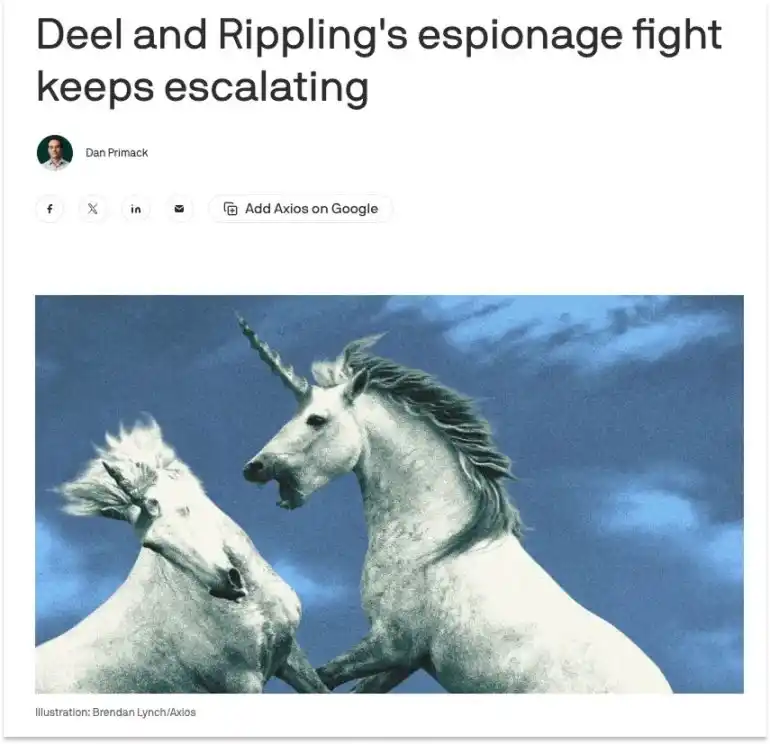
Source: Axios
"As an organization," Alex told me, "whenever there is negative media coverage, they firmly stand with us."
I vividly remember this. When Rippling accused Deel of engaging in espionage, almost immediately after the news broke, I saw Ben and Anish openly supporting Deel on Twitter — I thought at the time that this was a very 'bold' move.
Alex said: "They mentioned, 'We understand your character, your way of working, your background, and your ethical standards, and we will support you.' They not only made a public statement but also reacted swiftly. In private communications, they would also remind others, 'Guys, you know Alex.' When someone like Ben has all the details and has been specifically following your situation for the past two or three years, the weight of that support is unparalleled."
「Other investors also provided support,」 he added, 「but a16z's support was notably superior. They would take initiative to help me refine my approach, bring in the most professional individuals to assist, and even personally intervene to solve problems. During that chaotic period, I couldn't find a more reliable partner than them.」
If you can't 'show up' for your invested companies, then what's the point of 'hardcore cred'?
Later, Deel's Annual Recurring Revenue (ARR) surpassed $1 billion; subsequently, they raised $300 million from new investor Ribbit Capital—Ribbit Capital must have conducted thorough due diligence and ultimately reached the same conclusion as a16z. Following this funding round, Deel's post-investment valuation reached $17.3 billion, $5 billion higher than their Series D round valuation in February 2025 (pre-crisis). Of course, a16z participated in this funding round, as they have in every funding round, including secondary transactions.
「They are extremely loyal investors,」 Alex stated, 「whenever there's a secondary stock sale or other investors are reducing their holdings, a16z will buy up as many shares as possible. They acquired all the publicly traded Deel shares on the market because they are deeply involved in the company's operations and understand us well enough. Other market investors are not familiar with us—after all, Deel had never been publicly funded before.」
Furthermore, Deel once needed funds to acquire another company. 「Our Series C funding was not a conventional funding round,」 Alex recalled, 「I wanted to acquire a company and urgently needed funds, so I reached out to several investors. But no institution could act like a16z—just tell them 'this acquisition will change the industry landscape,' and they will swiftly inject $100 million for the acquisition.」
Alex revealed that thanks to this continued support, a16z now holds "over 20%" of Deel through its various funds. This level of shareholding is the result of a16z's firm belief and specific strategic support.
This precisely confirms the effectiveness of their model: deeply understanding the invested companies, working closely with them, and thus knowing these companies better than any other institution; being decisive and fully committed when others hesitate, while helping companies achieve a scale far beyond independent development.
It is not difficult to see, after speaking with the founders, that working with a16z has had a direct and substantial impact on their business. However, similar to a16z's policy in the field, its influence encompasses not only direct action but also indirect empowerment—even founders outside a16z's investment portfolio can benefit from the industry changes it brings.
This means that a16z's support for its portfolio companies and the broader tech startup ecosystem is another way to push other funds to allocate management fees to "helping startups succeed" initiatives.
"Many of the principles advocated by a16z in the early years have now become mainstream views in the venture capital industry," said Qasar from Applied Intuition to me, "such as 'founder-centricity,' 'having GPs with technical backgrounds,' and 'building a platform team.' Looking back, Benchmark, Founders Fund, KP, Sequoia, Khosla, and other institutions prided themselves on 'post-investment invisibility' - they would even explicitly say 'you may never hear from us again' and see this model as an advantage rather than a flaw. But now the situation has completely reversed: founders will actively ask, 'What more can you provide for me? After all, I can get money anywhere.'"
"That's the industry imprint that a16z has left behind."
As I wrote in the early 2024 article "Venture Capital and Free Lunch," I believe that management fees are "one of the most fascinating categories of capital globally," and a16z holds a huge amount of management fees. This has also become one of the main criticisms from external parties - some people believe that a16z always wants to raise more funds because every penny brings them management fee income every year, regardless of investment performance.
But perhaps a more worthwhile perspective is this: a16z is eager to raise large amounts of money precisely to invest significant resources in building a system to "help companies succeed" - an investment that few other funds are motivated to make but that can effectively help its portfolio companies and emerging tech compete.
Initially, my collaboration with a16z's cryptocurrency team made me realize this; and in the process of writing this article, I became even more convinced: no other institution can use management fees as effectively and continuously as a16z to benefit its endeavors.
"In my view," David Haber said, "one of a16z's early structural advantages is that Marc and Ben had already achieved financial freedom and did not need to rely on salaries to live. Therefore, they could focus on the long term, allocate management fees to platform building, and create a competitive advantage that benefits from compounding growth. To this day, we continue to adhere to this trade-off: instead of paying employees high salaries and bonuses like many funds, we choose to invest in the company itself, allowing the advantage to compound over time [12]."
You can invest $1 billion in LP (Limited Partner) funds to build a system that helps all tech startups succeed; relying solely on Databricks, this investment can generate returns several times over; and the subsequent successes of every company like Coinbase, Applied Intuition, Deel, Cursor (or any other a16z-backed company you can think of) will continue to yield returns for this system.
As a result, today all major venture capital firms are trying to build a similar system. This means that founders can receive funding in the tens of billions of dollars, as well as the support of hundreds of shrewd and well-connected professionals to help them replace entrenched industry incumbents, reduce resource waste, address existential threats, shrink global distances, ensure security, and achieve all the goals that technology should strive for in the future.
And this is precisely the core significance of the a16z model.
The Future of Future Enterprises
Today, a16z has over 600 employees, with a high rate of new member onboarding. When anyone joins, they must sign the company's “Culture Doc.”
Although everyone in the company will read this document, Katherine Boyle believes that “we have not given it the attention it deserves.”
“There is a sentence in the document,” she said, “the third point: we believe in the future, and are willing to bet the company on it.” Katherine particularly agrees with this statement. In her view:
“Everyone in Silicon Valley misunderstands the meaning of this sentence. It means we will never do anything that bets against the future. That is why sometimes, compared to other bearish institutions, we look like ‘fools.’ But our culture document explicitly states that no one can bet on the future to fail.
I actually think this sentence should be the first point. No other institution can make this commitment. Other institutions will issue memos saying ‘a macro crisis is imminent,’ but ‘believing in the future and betting the company on it’ is exactly what Marc and Ben founded this company for.
Marc and Ben are not afraid to look ‘foolish,’ but if anyone bets on the future to fail in any area, they will definitely be fired.”
Wholeheartedly and unreservedly believing in the future can be seen as either charmingly naive or vacuous, depending on how you look at it.
A few years before I delved into understanding a16z, I also thought that this statement was at least partially vacuous. Weren't they just “elephant hunters” (referring to investors focused on potential unicorn startups)? Just wanting to win. Wrapping themselves in the “future,” isn't that no different from wrapping themselves in the “American flag.”
From an external perspective, a16z seems to be trying to build one of the world's largest financial institutions. This impression partly stems from the fact that the assets under its management have exceeded $90 billion, which is undoubtedly a huge amount to me.
When comparing the fund size of a16z to major financial institutions like Apollo and Blackstone, David Haber pointed out that a16z's scale is still relatively small—Blackstone manages $1 trillion in assets, and Apollo is also about to reach this scale.
In terms of compounding advantages, scale effects, incentive mechanisms, internal operations, and how to operate a global financial institution, there is much that a16z can learn from these giants. At first glance, these institutions today share similarities with what a16z hopes to become.
However, I believe there is a fundamental difference between the two.
Apollo and Blackstone don't actually "believe" in anything—they are financial institutions with the goal of creating financial returns. This is not a problem in itself: the economy needs the services they provide, and they excel in this regard.
But a16z is "believing." It is building a company that envisions a better future through technology, with finance being just a means to that end. Like any proper tech company, it continues to compound and optimize as it grows. It has the ability to mobilize more and more resources and influence, striving for the future it believes in—even though the specific shape of the future is not yet clear.
Painting the details of the future is the entrepreneur's responsibility. They provide the specific direction, while a16z provides the belief support.
As the call was about to end, I asked Ali: after over a decade of working with a16z, what does he think is the biggest misunderstanding about this company from the outside world? He almost didn't hesitate.
"Ben and Marc are true believers," he said, "If you can't see it even after reading their blogs, I can say that their belief in technology has reached a level of 'obsession.' They genuinely believe that technology can fundamentally change the world, and in every startup they engage with, they view the future from this perspective—seeing the maximum potential these companies can achieve."
Looking back at the development of a16z, it is essentially a "history of skepticism by the masses": everyone thought Marc and Ben were doing venture capital in a "foolish way"; after waiting for about ten years, they realized they were right only when they saw the results; then everyone followed suit, missing out on all the compounding advantages a16z had accumulated during the "decade of skepticism" from its competitors.
And this cycle continues to repeat.
Initially, when the fund size was only $300 million or even $1 billion, this model's success was not surprising, but with such a large scale, it certainly won't work.
It's not surprising to see success in the early days of a social network, but definitely not in the cryptocurrency, American Dynamism, or artificial intelligence field.
However, at least so far, in the vast majority of cases, the a16z model has succeeded.
When a16z chooses to believe in something, its belief is stronger and more enduring than anyone else's. It has the resources to be patient and is clear that this unwavering commitment will eventually pay off — something it also has enough resources to validate.
Regardless of whether you think their judgment this time is correct, whether you agree with their ideas, whether you like their approach, Marc, Ben, and the team they have built at a16z genuinely believe that they are working for the future and, in the process, for all of us.
Although it may sound somewhat unusual, of all the venture capital models I have seen, their approach can be considered a paragon of "humility": if a group of extremely intelligent people are passionate about something, that something is likely worth being passionate about. Follow their lead, even before others realize "there is an opportunity here," and raise an entire fund to follow them.
You may not agree with this approach, and indeed, you should question it! There is no one right path in venture capital, but you must have something you believe in strongly.
However, you might not want to pass judgment on it without understanding the "rules of the game" a16z is involved in and the "bets" it has made.
One of a16z's core bets is that technology will account for an increasingly large share of the economy, and when this trend happens, the scale of emerging companies will be 10 times, even 100 times, that of the traditional companies they replace. This is a foundational judgment that any daring venture capital fund can make such a prediction.
But another unique bet of a16z's is that it believes it can accelerate this future through policy advocacy, platform building, and resource integration, making the future arrive sooner and in a grander, more complete form; while helping its portfolio companies win in the process. Based on my conversations with a16z founders, this bet seems to be paying off now — and it is an extremely asymmetric bet in terms of risk and reward: each success can build more capabilities for the firm; the entire system grows exponentially like a snowball, achieving compounding growth.
In my opinion, combining the first two bets, a16z's most interesting bet is actually the most "obvious" — understood from a different perspective:
Venture capital firms can, like almost all other types of companies in the world, become better as they scale.
If this bet is right (and I think it is), then a16z's best days are ahead of it.
That is undeniably a good thing, and I admire this group of people.
But where a16z's “product” truly shines is this: as it scales, it actually improves—accumulating more resources, skills, connections, and influence, every emerging tech company that partners with it, and even many that don’t, can leverage its scale to grow.
If a16z succeeds, the world will see this: emerging tech companies able to compete on a more level playing field with industry incumbents, ultimately letting “the best product win.”
If a16z succeeds, the world will see this: from energy to AI, from cryptocurrency to autonomous vehicles—every layer of the tech stack, emerging technologies can integrate faster and more deeply into the economy, making a bigger impact.
If you, like me, believe that “emerging technology can offer humanity the tools to make the world better,” then a successful a16z world will be a world that arrives sooner and is more abundant.
a16z is working toward that future. If their bet is entirely right, then all of our best days are also ahead of us.
Appendix: Important Performance Disclosure
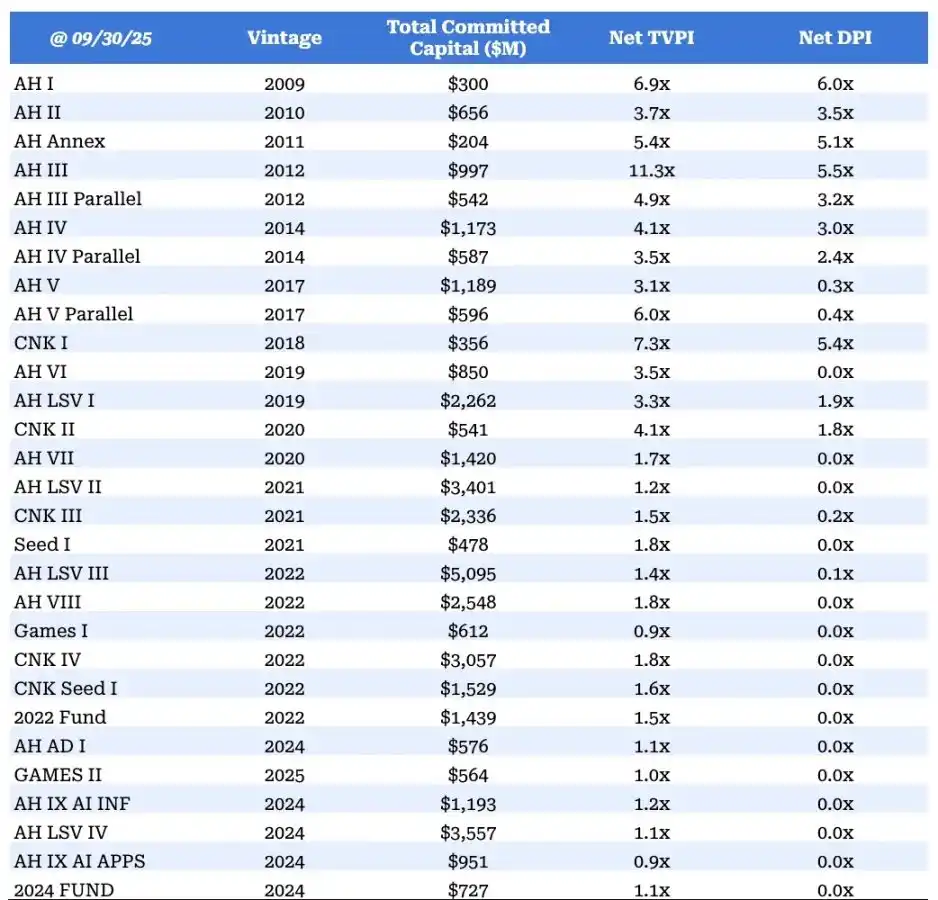
This appendix is for informational purposes only and does not constitute an offer to sell any interests in funds managed by a16z Capital Management LLC (hereinafter referred to as “ACM”). The information in this document should not be construed as legal, tax, investment, or accounting advice, and should not be relied upon in any form. Investing in any funds managed by ACM involves high risks, including the risk of losing the entire investment amount.
Unless otherwise specified, all data is as of September 30, 2025. All performance data, valuations, and fund summaries contained in this document have not been audited and may change. Past performance is not indicative of future results, and there is no guarantee that any fund or investment managed by ACM in the future will achieve similar performance. Furthermore, due to significant differences in market environments, investment strategies, and other factors, the performance of future ACM funds is not comparable to the performance of existing funds. No individual investor or fund has achieved the investment performance shown in this document.
The gross performance and net performance data provided in this article do not represent, nor should they be a substitute for, the actual performance of the funds managed by ACM. Performance data for certain funds reflects the use of leverage, capital calls, or similar credit facilities; if calculated from the time of credit facility usage rather than initial capitalization, the performance data would be different and may be lower. The performance data includes the performance of the "main fund" as described in this article and all "feeder funds" (entities that pool capital from multiple individual investors primarily to invest in the main fund, often charging no management fee or carried interest); excluding these feeder funds would result in lower performance. Fund performance does not include the performance of ACM's Bio & Health Strategy Fund, Cultural Leadership Fund, single-investor vehicles, or Special Purpose / single-investor vehicles (SPVs) unless otherwise noted.
The performance data includes reinvested funds; excluding the reinvestment portion would result in different performance data. The performance data reflects fee waivers voluntarily provided by the General Partner (GP); excluding such fee waivers would result in lower performance. The investments and invested companies mentioned in this article do not represent all of ACM's fund portfolios, and there is no guarantee that the investments mentioned will be profitable or that future investments will have similar characteristics or achieve similar results. The performance data does not include all investment funds managed by ACM. For a list of all investment projects managed by ACM, please visit a16z.com/portfolio.
Total Value to Paid-In (TVPI) at the fund level: the multiple of (1) the aggregate amount distributed to all limited partners (LPs) of the fund and the aggregate fair value of all LPs' capital accounts at the end of the period, relative to the aggregate capital contributions of all LPs to the fund. Net TVPI has been adjusted for the impact of management fees, fund expenses, and carried interest.
Distribution to Paid-In (DPI) at the fund level: the multiple of the aggregate amount distributed by ACM's fund to limited partners relative to the aggregate capital contributions of all LPs to the fund.
Fund-Level Gross Performance Metrics: include cash, other assets, and liabilities held by the fund. Gross return includes the re-addition of management fees, carried interest, and fund expenses.
[1] An analyst from a certain competitor estimated this ratio to be 7.5%, which closely aligns with actual data. a16z's average ownership stake in its invested companies is 8%.
[2] Pitchbook data shows that Founders Fund raised funds for Growth III ($4.6 billion) and IX ($9.72 billion) in 2025.
[3] According to Pitchbook data, the total venture capital fundraising in the U.S. in 2025 was $82 billion, with a16z contributing $15 billion.
[4] Source: Valuation data from Pitchbook as of September 14, 2025.
[5] Source: Ilya Strebulaev, Stanford Graduate School of Business Venture Capital Program, April 2025.
[6] Source: Based on Pitchbook data available as of July 31, 2025, excluding AI unicorns from mainland China and Hong Kong.
[7] Past performance is not indicative of future results. For important disclosures and information on fund returns, please refer to the appendix.
[8] Supporters of Insight Partners note: The firm's XII fund ($20 billion) raised in 2022 includes an acquisition fund.
[9] For more information on "Late Stage Venture (LSV)," refer to a recent insightful conversation between David George, Patrick O'Shaughnessy, and Harry Stebbings.
[10] The a16z 10th AI Fund raised $1.7 billion, but for the purpose of this article, we use $1.6 billion for ease of calculation.
[11] "The core logic is simple: if large funds believe they can benefit from the growth of the early tech ecosystem, then they have a reason to invest in all kinds of 'ecosystem development' initiatives. If you believe in the benefits of tech (as I do), then fees used to strengthen the tech ecosystem are like a 'charitable investment that keeps on giving.'"
a16z recently announced that it will "support candidates who align with our tech vision and values." Additionally, it has built a world-class cryptocurrency research team, with a core belief in "the opportunity to build an industry research lab that helps connect academic theory with industry practice." Subsequently, the team has developed and open-sourced several practical products based on research findings, including Lasso and Jolt.
For institutions with a long-term outlook, they have the economic incentive to support transactions with long return cycles and high uncertainty—a support incentive that has gradually disappeared in today's increasingly rigid and slow-moving government and academic sectors. For example, I would not be surprised if more venture-backed basic research and applied research labs emerge in the future."
[12] It is essential to note that the a16z team is compensated quite generously, and there is no need to feel sorry for them. The key point is: a16z has not chosen to concentrate a large amount of funds in the hands of a few (enabling them to earn an 'income enough to buy galaxies'), but rather has opted to provide generous compensation to more employees, building a compounding competitive advantage.
You may also like

Space Featured in Binance Research Ecosystem Report: Key Signals of the Predictive Market Leverage Layer are Emerging

The A-share market frenzy crashed servers, and cryptocurrencies are waiting for Twitter to come to the rescue
The market is never short of entry points, but it lacks the profit-making effect—people will naturally flock to it if there is profit, and even the best platform and functions cannot save it if there is no profit.

UK Lawmakers Urge Ban on Political Donations in Crypto
Key Takeaways: A group of senior UK lawmakers is pushing for a legislative ban on political donations in…

X to Introduce ‘Smart Cashtags’ for Tracking Real-Time Crypto and Stock Prices
Key Takeaways Smart Cashtags Integration: X is set to launch a new feature, Smart Cashtags, allowing users to…

Why is the Hong Kong RWA Market Attracting Global Capital in Droves?

Trump Gets Serious: Powell Faces Criminal Investigation, Rate Battle Intensifies
Key Market Intel on January 12th - A Must Read! | Alpha Morning Report

Twitter Hashtag Price Check, Will Trading Go Further?

Crypto and AI: the hidden digital gray market of Xianyu
Crypto and AI: You Can Buy Anything on Xianyu.

Base contributes 70% of revenue but pays only 2.5% in rent; Superchain may be entering its "forking" countdown

Left Hand BTC, Right Hand AI Computing Power: The Gold and Oil of the Data Intelligence Era

$250 Billion, 6723 Rounds of Funding: Where Did Crypto VCs Invest in 2025?

Ranger Fund Takes a New Approach to Public Offering: Can a Grassroots Team Earn Market Trust?

Visa Crypto Lead: Eight Key Evolutions of Crypto and AI by 2026

Ripple reaffirms its decision to remain private, supported by a robust balance sheet
Key Takeaways Ripple has decided against pursuing an IPO, thanks to ample internal resources and a strong balance…

Nike Sells its NFT and Virtual Sneakers Amid Waning Interest in Digital Art
Key Takeaways Nike has discreetly sold its NFT and virtual sneakers subsidiary, RTFKT, as interest in digital collectibles…

Six-Figure Target: The Top Airdrops to Watch in 2026

2025 Crypto Card Annual Report: 40,000 Monthly Active Users, Average Spending of Less Than $100
Space Featured in Binance Research Ecosystem Report: Key Signals of the Predictive Market Leverage Layer are Emerging
The A-share market frenzy crashed servers, and cryptocurrencies are waiting for Twitter to come to the rescue
The market is never short of entry points, but it lacks the profit-making effect—people will naturally flock to it if there is profit, and even the best platform and functions cannot save it if there is no profit.
UK Lawmakers Urge Ban on Political Donations in Crypto
Key Takeaways: A group of senior UK lawmakers is pushing for a legislative ban on political donations in…
X to Introduce ‘Smart Cashtags’ for Tracking Real-Time Crypto and Stock Prices
Key Takeaways Smart Cashtags Integration: X is set to launch a new feature, Smart Cashtags, allowing users to…


 App
App