
- Buy Crypto
- Markets
- Futures
- Spot
- Copy Trade
 WE-Launch
Binance Alpha Points Gameplay Overtakes on the Inside Track, Sweeping 90% of the Web3 Wallet Market

Original Article Title: "Binance Alpha Points 'Arena': A Web3 Wallet War where a Whale Devours 90% of Market Share"
Original Article Author: Frank, PANews
Recently, Binance's Web3 wallet, with its innovative 'Alpha' gameplay, has caused a huge wave in the Web3 wallet market, rapidly gaining market share, occupying 90% of the territory, and attracting attention. Behind this phenomenon is its clever points airdrop mechanism, strategic adjustments by competitors, and the chain reaction and significant recovery of the BNB Chain ecosystem triggered by it.
How did Binance Alpha cleverly utilize market gaps and user psychology to achieve an 'eating up the market' expansion? Beneath the surface of the 'gold rush,' what pressures of 'burnout' do users face, and what are the real benefits? Is this merely a short-lived traffic frenzy, or a model innovation sufficient to lead an industry revolution?
Exploiting Gaps and Points Gameplay: Whale Devouring the Wallet Market
Since its launch, Binance's Web3 wallet market share has shown explosive growth. According to Dune data, as of May 12, 2025, Binance's Web3 wallet accounted for as high as 95.7% of the total transaction volume of all tracked Web3 wallets, ranking first. This marks a significant leap from 54.1% in March 2025. On May 10, 2025, Binance's wallet reached a peak daily trading volume of over $9.3 billion. On April 22, this figure was only $76 million.
BNB Chain's ecosystem has also been boosted by Alpha. The TVL of the BNB Chain has also seen a significant increase, growing by over $6 billion from early 2024 to May 2025. This growth is inseparable from Binance Alpha. According to official data, among the top 20 tokens by trading volume, half are BSC native projects. Among the top 10 tokens with new active users, 90% are BSC tokens, with 6 projects having over 20% share of new users. On-chain BSC data has also seen significant growth: approximately 4.3 million new users in the past week, over 1 million new addresses for two consecutive days, and over 2 million active addresses. The total number of unique BSC addresses has reached 552 million. From these data points, Binance Alpha is becoming a key engine for the activity and capital inflow of the BNB Chain.
It is worth noting that the sharp increase in Binance Web3 Wallet's market share coincided closely with the time when competitor OKX paused its DEX aggregator service. On March 17th this year, OKX announced the suspension of its DEX product aggregator trading service, after which OKX's wallet market share plummeted from about 50% to 3.6%. Almost simultaneously, on March 18th, Binance announced the launch of Binance Alpha2.0 test version, integrating Alpha trading directly into the Binance trading platform.
A clear shift is also reflected in the data. From March 10th to March 17th, in one week, Binance Wallet's transaction volume market share was only 8.3%, growing to 50.2% by March 24th. It became the wallet application with the highest market share.
On April 17th, BinanceAlpha announced the upcoming launch of the GM token and initiated an airdrop plan. BinanceAlpha's search index began to rise rapidly, and its trading volume also showed a noticeable change. The trading volume from April 17th to April 24th reached $184 million, more than tripling from the previous week's $57.94 million. As the points-based gameplay gained popularity on social media, the trading volume for the week ending May 5th reached $1.574 billion, a 27-fold increase from the week before the airdrop gameplay was launched. This surge also propelled the entire on-chain wallet transaction volume to break through the historical record, reaching $1.876 billion.
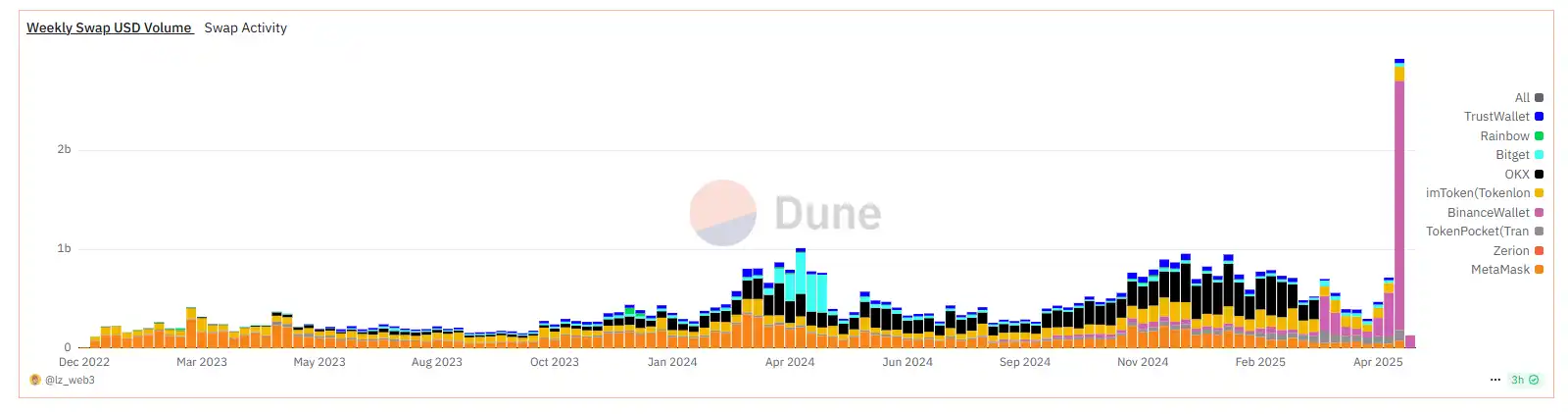
Alpha Users' "Sweet" and "Burden"
This explosive growth can be traced back to the points-based airdrop gameplay of Binance Alpha. The Binance Alpha points system is a complex mechanism designed by Binance to incentivize user participation, screen active users, and distribute airdrops or TGE qualifications. It mainly allocates points based on users' transaction volume and balance on Binance Alpha, and then determines which users can participate in each airdrop event by setting a points threshold.
However, with the surge in user numbers, this points-based gameplay is becoming a new battleground for competition. The key evaluation metrics of this points mechanism are asset balance and daily transaction volume.
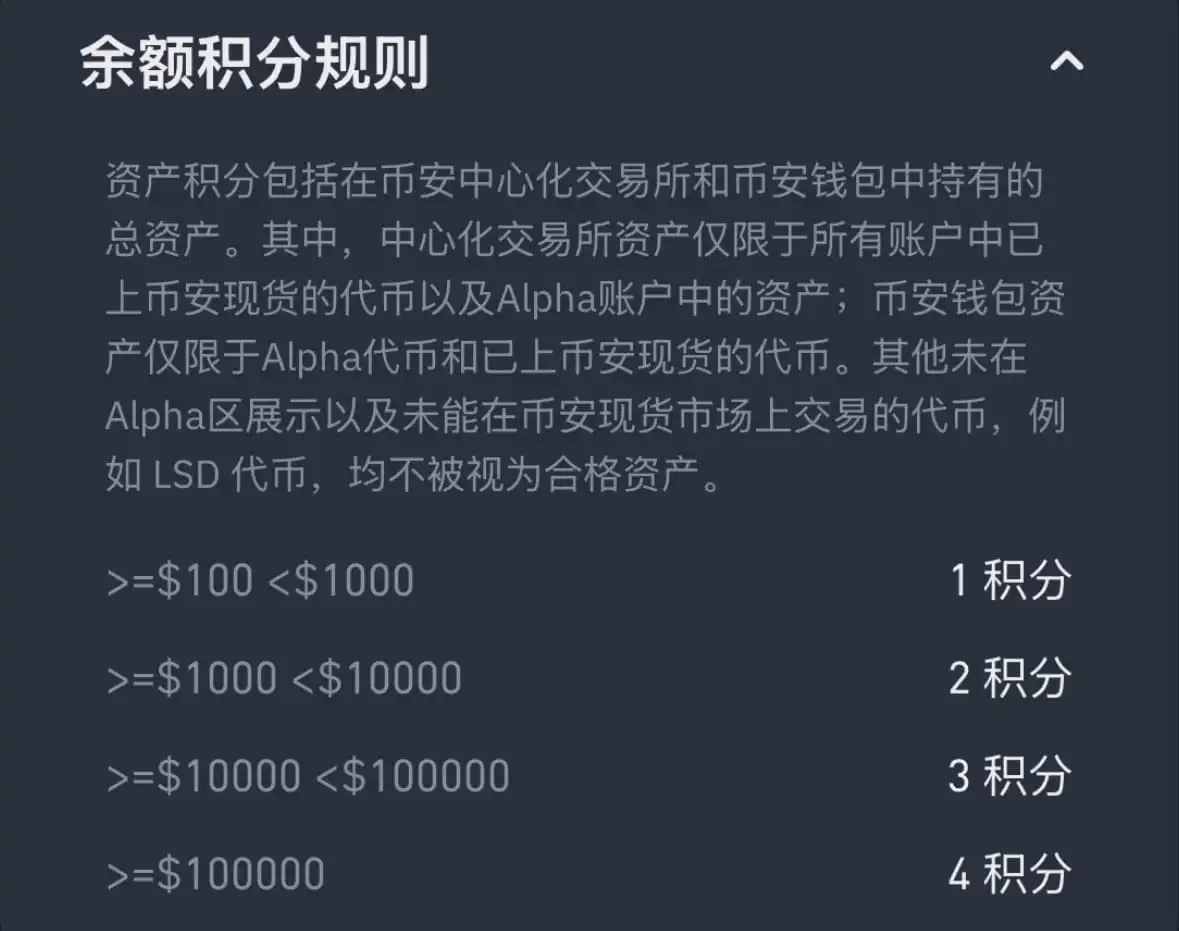
Asset balances are divided into four levels. Total asset value $100 to <$1,000: 1 point per day; total asset value $1,000 to <$10,000: 2 points per day; total asset value $10,000 to <$100,000: 3 points per day; total asset value $100,000 and above: 4 points per day.
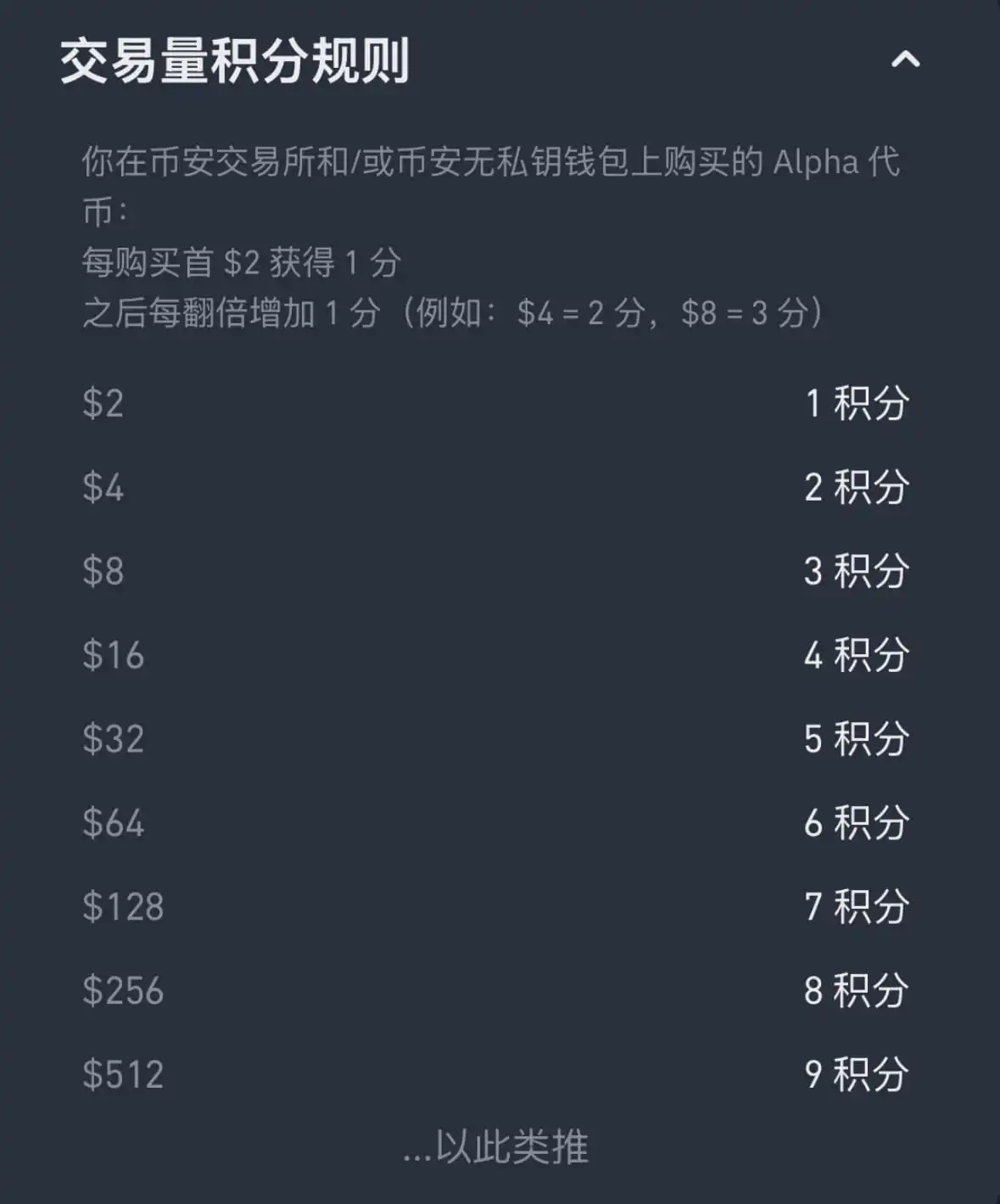
Regarding transaction volume, purchasing $2 worth of tokens: earns 1 point; purchasing $4 worth of tokens: earns 2 points; purchasing $8 worth of tokens: earns 3 points; purchasing $16 worth of tokens: earns 4 points; purchasing $32 worth of tokens: earns 5 points. Subsequently, for every doubling of the purchase transaction volume, an additional 1 point is awarded (for example, purchasing $64 earns 6 points, purchasing $128 earns 7 points, and so on). Typically, it is considered a relatively cost-effective choice to transact $32 in a single day to obtain 5 points.
Furthermore, this type of point system is calculated on a 15-day rolling basis, meaning that users cannot achieve these points in a single effort; they must consistently engage in transactions to maintain their point levels.
There are several relatively apparent attractions of this point system for users. Firstly, the rules are clear, allowing users to predict the number of points they can earn based on their own strategies to reach the airdrop threshold. Secondly, there is virtually no first-mover advantage under this point system, as later users can equally participate and achieve similar point levels to those who joined earlier.
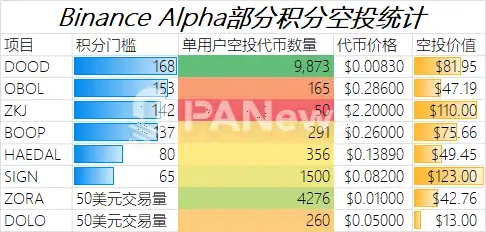
However, as competition intensifies, the point threshold for participation is constantly increasing. From the initial criteria of a $50 transaction volume or $100 asset balance standard to the latest project DOOD raising the requirement to 168 points. Based on this calculation, a new user needs to maintain a daily point amount of over 11.2 points to participate in this airdrop. According to estimates, users who meet the criteria need to hold over $1000, conduct transactions of over $1024 daily to accumulate enough for the airdrop. Factoring in on-chain fees, transaction slippage costs, the total cost could exceed $60. Relative to the final airdrop value of $81, approximately a 35% return can be achieved. However, one must also consider the opportunity cost of the $1000 principal, with the return over 15 days being roughly 2% compared to the total capital investment. This return rate may not be as high as a token's price surge at once, but it is relatively stable. Therefore, many rug pull studios choose to batch create accounts and participate in mass operations due to this stability.
Is it a Traffic Party or a Paradigm Revolution?
Is Binance Alpha really a new type of airdrop exploitation?
In DOOD's airdrop event announcement, the user threshold was disclosed. A total of 30,271 accounts met the requirements. Calculating based on approximately $81 of airdrop per account, the total airdrop scale of this event is around $2.48 million. The address data for other token airdrop events were not disclosed, so specific amounts cannot be determined, but the estimated scale should be similar. For a project's airdrop, a multimillion-dollar scale does not seem high, especially when compared to the several billion-dollar airdrop scales of projects like Hyperliqued, Movement, and even not as high as a single whale's airdrop amount.
However, from the perspective of publicity and the transaction data brought to the ecosystem, the input-output ratio of Binance Alpha is undoubtedly impressive. Essentially, this is similar to the trading mining craze that was popular a few years ago. With Binance's significant impact, many other trading platforms are also launching similar gameplay.
On May 7, Bybit announced the launch of the WEB3 Points Program, where users can earn WEB3 points by completing tasks such as holding cryptocurrency assets, conducting exchange transactions, and inviting friends.
On May 5, the OKX trading platform announced a major functional upgrade to its self-hosted wallet OKX Wallet's built-in DEX Aggregator. Several new features were added, including on-chain market analysis, smart fund tracking, and Meme mode. As of May 11, OKX Wallet's market share has rebounded to 8.5%.
As trading platforms compete to capture the wallet market share, some traditional wallet applications have become unwitting targets. In June 2023, MetaMask's transaction volume market share could reach over 60%. By May 2025, it has dropped to only 2.9%, and Binance's Trust Wallet is facing a similar predicament.
Overall, Binance Alpha has ignited a new wave of frenzy through its points system, similar to early liquidity mining on trading platforms, stimulating trading activity through potential incentives. On one hand, it serves as an effective tool for Binance Wallet, BSC, and other ecosystem products to gain market share and increase user activity. Through carefully designed point and airdrop mechanisms, it has successfully attracted a large number of users and funds, even to some extent eroding the market share of competitors. There is a clear positive correlation between the recovery of the BNB Chain and the promotion of Alpha, forming an "Alpha-BNB Chain flywheel effect."
On the other hand, for users, the 15-day rolling points, point burning mechanism, and continuously rising airdrop thresholds force users into a continuous high-intensity trading "Alpha treadmill." The true net income is often difficult to accurately measure, and users face many hidden costs such as slippage, gas fees, etc. For many ordinary users, the "gold rush" may gradually evolve into a "sweatshop" as a result of this model's internal looping effect, which is spreading from users to potentially between trading platforms. If the input-output ratio of such airdrops falls below the profit line, today's lively scene may quickly cool off in a short time.
However, for the industry, there are indeed many aspects of Binance Alpha's mechanism design that are worth learning from, especially for projects with expected airdrops. Binance Alpha can be considered a classic case of achieving a lot with little money.
You may also like

Key Market Insights for May 16th, how much did you miss out on?
Deconstructing Binance Alpha2.0's New "Asia-Led Liquidity Mining" Model
Gate.io MemeBox has officially integrated with the Solana ecosystem, providing lightning-fast on-chain asset trading.
Taking Stock of the Top 10 Emerging Launchpad Platforms: Who Will Succeed in Disrupting Pump.fun?
Stablecoin Showdown: Six Rising Stars Enter the Fray, Will the Market Structure Shift?
This Week in Review | Trump to Host Dinner for TRUMP Holders; Musk and US Treasury Secretary Engage in Heated Argument at the White House
Cryptocurrency Market Sentiment Warms Up, MCP Emerges as New AI Frontier
How did Gate.io manage to break through besides Binance and OKX?
BYDFi has officially launched the on-chain trading tool MoonX, ushering in the era of CEX+DEX dual-engine.
Binance Wallet IDO Survival Report: 10 Projects' Real Data Proves Narrative is More Important Than Traffic?
Crypto Market Update: Potential Trend Reversal Ahead, Capitalizing on Short-Term Funding for Investment Opportunities
Four.meme: How to Turn the BSC Chain into a DeFi Meme Wonderland Using AI Concept
Weekly Recap | MANTRA (OM) Plunges Sparking Controversy; Powell Emphasizes No Immediate Market Intervention
Key Market Intelligence on April 18th, how much did you miss out on?
On-chain Liquidity Migration: A Rollercoaster Ride of 15 Months, Who Will Stand Tall Post-Hype?
Federal Reserve Chair Powell recently commented on cryptocurrency, what bullish signals did he give to the industry?
During the liquidity crisis of Q1 25YO, where did on-chain transaction volume flow to?
Original Article Author: @stacy_muur, CuratedCrypt0 Member
Original Article Translation: Motion小Deep
Editor's Note: From January 2024 to March 2025, DeFi on-chain transaction volume experienced a surge and downturn. DEX trading volume reached a peak of $380 billion in January 2025, followed by a 35% decline. Solana's native DEX emerged, holding 5 out of the top 10 seats, with Hyperliquid occupying over 60% of the perpetual contract market share. Leading DEXs such as Uniswap and PancakeSwap dominated around 40% of the trading volume. Chain-level market share saw fluctuations, with Solana, Ethereum, and Base showing varying degrees of persistence, while CEX still accounted for nearly 80% of spot trading. The future of DeFi depends on the chain that can solidify user habits, rather than mere speculation.
The following is the original content (restructured for easier reading comprehension):
Over the past 15 months, the DeFi liquidity landscape has been redrawn among different chains, moving away from hype-driven outliers and quietly concentrating on fundamentals rather than noise.
· DEX trading volume hit a historic high of $380 billion in January 2025, followed by a 35% drop in the next two months, signaling a possible short-term top.
· The top 10 DEXs now account for nearly 80% of the activity volume; Uniswap and PancakeSwap alone represent around 40%.
· Solana's native DEX quietly took the top spot, with 5 out of the top 10, and its share expanded due to meme-driven trading volume growth.
· Hyperliquid disrupted the perpetual contract landscape, rising from a newcomer to dominating over 60% of the market share by March 2025.
All insights are based on public data. Special thanks to DefiLlama for consistently providing high-quality statistical data.
In early 2024, DEX trading volume showed strength in March and May, followed by a slowdown in the middle of the year.
The situation took a sharp turn in the fourth quarter, with transaction volumes surging in November and December, continuing into January 2025 to reach an explosive peak of $380 billion.
However, this wave of growth was short-lived. By February, the transaction volume had dropped to $245 billion, a steep 35% decrease, bringing an end to the three-month vertical climb. This decline set the tone for a more cautious second quarter.
The DEX landscape remains highly concentrated. The top 10 protocols now account for 79.5% of daily trading volume, with just the top 5 controlling 59.1%.
Uniswap and PancakeSwap represent around 40% of all DEX trading volume, being the only two protocols with total trading volume exceeding a trillion dollars. Their dominance is built on first-mover advantage, cross-chain coverage, and deep liquidity.
Uniswap Labs has also launched Unichain, a dedicated Ethereum L2 based on the Optimism Superchain, aiming to provide fast, low-cost transactions with native cross-chain interoperability.
Solana's rise has been noteworthy. Five out of the top 10 DEXs are Solana-native: @orca_so, @MeteoraAG, @RaydiumProtocol, @Lifinity_IO, @pumpdotfun.
Orca (8.02%) and Meteora (6.70%) alone contribute about 15% of global DEX activity.
This rise is driven by low fees, fast block times, and the sticky flow of Solana's meme coin culture. Pump.fun entering the top 10 clearly reflects this energy.
@0xfluid (7.09%) is the most capital-efficient DEX in the top 5. Active on Ethereum, with monthly trading volumes surpassing $100 billion. Its launch on Arbitrum saw volumes grow from $426 million in February to $1.6 billion in March, demonstrating rapid adoption.
@AerodromeFi, based on Base, reflects the growth of liquidity on the Base L2.
While Hyperliquid doesn't rank high in spot trading, it dominates the perpetual contract market with over 60% market share.
The past 15 months have shown that while most chains can attract attention, few can retain users. From January 2024 to March 2025, chain-level DEX market share has shifted rapidly, with only a few maintaining significant traction.
Solana has seen the most prominent performance. It steadily climbed in 2024, reaching a peak of 45.8% in January 2025 during the $TRUMP and $MELANIA meme coin craze. By March, its share halved to 21.5%. Nonetheless, its average share of 25.1% remains the highest across all chains.
Ethereum, on the other hand, exhibited the opposite trend. Starting at about 32% share in 2024, it dropped to 15.3% in January 2025 but rebounded to 26.4% by March, demonstrating its resilience even after losing momentum.
Base has been the most stable climber. Rising from 3% in March 2024 to 12.4% in December and remaining steady at 7.4% in March 2025, averaging 6.6% during this period. No hype, just gradual, sticky growth.
The BNB chain maintained an average share of 14.7%, remaining stable throughout, without any sudden spikes or crashes, sustained only by retail traffic, lacking any breakthrough moments.
Arbitrum started strong at 16% but failed to take off. By January 2025, it slipped to 4.8%, surpassed by Base and Solana.
Blast peaked at 42.3% in June 2024, only to vanish the following month—a typical case of incentive-driven transaction volume with no retention.
Conclusion: Chain-level DEX dominance is highly volatile. Solana surged, Ethereum recovered, Base slowly gained ground, and hype cycles quickly burned out. The enduring chains are not the loudest but the most utilized.
Despite the DEX explosion at the beginning of 2025, centralized exchanges (CEX) continue to dominate the spot market. Even at the peak of DEX in January, CEX still held nearly 80% of the total trading volume.
While the CEX dominance dropped from 90% at the beginning of 2024 to a low of 79%, the overall pattern is clear: DEX is growing, but CEX remains the default venue for most traders.
In 2024, the on-chain perpetual contract landscape saw a reversal.
After dYdX's two-plus-year reign at the top, Hyperliquid rose to redefine the dominant position. It first took the lead in February, briefly lost to @SynFuturesDefi mid-year, regained the top spot in August, and has held it since. By March 2025, Hyperliquid held nearly 59% of the perpetual contract trading volume, establishing itself as the preferred venue for professional traders.
This rise to prominence was fueled by a product offering close to a CEX experience, gaining attention. In contrast, dYdX quickly declined. Its market share dropped from 13.2% at the beginning of 2024 to 2.7% in March 2025 as users gravitated towards faster, sleeker, and more modern alternatives.
@JupiterExchange took a different path in perpetual contracts, climbing to second place with an 8.8% share by leveraging Solana-native liquidity and a spot DEX funnel. It expanded rapidly but stabilized behind Hyperliquid. Others such as SynFutures, @Vertex_Protocol, and @ParadexApp briefly showed traction.
The most significant shift in perpetual contract infrastructure over the past year has not been in user preferences for a particular protocol but in their trust in which chain executes transactions.
In January 2024, Ethereum and Arbitrum controlled over 65% of the perpetual contract trading volume. However, by March 2025, this had plummeted to just 11.8%, overtaken by updated, faster execution layers.
Leading this transition is Hyperliquid's custom chain, which saw its share increase from 13.6% to 58.9% during the same period. In less than a year, it has become the default perpetual contract execution environment, supplanting the L1 and L2 layers that once defined the category. Not only is it faster, but it also provides the high reliability and low latency that professional traders require.
Solana also showed strength, rising to nearly 16% by the end of 2024 with Jupiter and Phoenix, but eventually stabilizing at 10-11%, failing to sustain its breakout momentum. Base and ZKsync showed vitality, peaking at around 6-7%, but have not yet reached the top tier.
Meanwhile, Blast became a cautionary tale: achieving a 18.8% single-month miracle in June 2024, only to quickly vanish. In the realm driven by product quality and user retention, hype failed to endure. The new execution stack is clear—performance-first chains have reset the standard, and traditional infrastructure is no longer the default choice.
The future of DeFi lies not in the number of chains, but in solidifying the narrative into user habits.
「Original Article Link」
Cryptocurrency Asset Valuation Model Exploration
Key Market Insights for May 16th, how much did you miss out on?
Deconstructing Binance Alpha2.0's New "Asia-Led Liquidity Mining" Model
Gate.io MemeBox has officially integrated with the Solana ecosystem, providing lightning-fast on-chain asset trading.
Taking Stock of the Top 10 Emerging Launchpad Platforms: Who Will Succeed in Disrupting Pump.fun?
Stablecoin Showdown: Six Rising Stars Enter the Fray, Will the Market Structure Shift?
This Week in Review | Trump to Host Dinner for TRUMP Holders; Musk and US Treasury Secretary Engage in Heated Argument at the White House
Popular coins
Latest Crypto News


Customer Support:@weikecs
Business Cooperation:@weikecs
Quant Trading & MM:bd@weex.com
VIP Services:support@weex.com
 App
App