
- Buy Crypto
- Markets
- Futures
- Spot
- Copy Trade
 WE-Launch
Bring the Ethos to Corporate Etherians

Original Article Title: "Ethereum Developers Bringing Their Talents to the Private Sector"
Original Article Author: Eric, Foresight News
On the evening of the 19th (Beijing time), Bankless co-founder David Hoffman posted on X to "commemorate" Ethereum Foundation's longest-serving researcher, Dankrad Feist, who chose to leave Ethereum and join the stablecoin L1 Tempo.
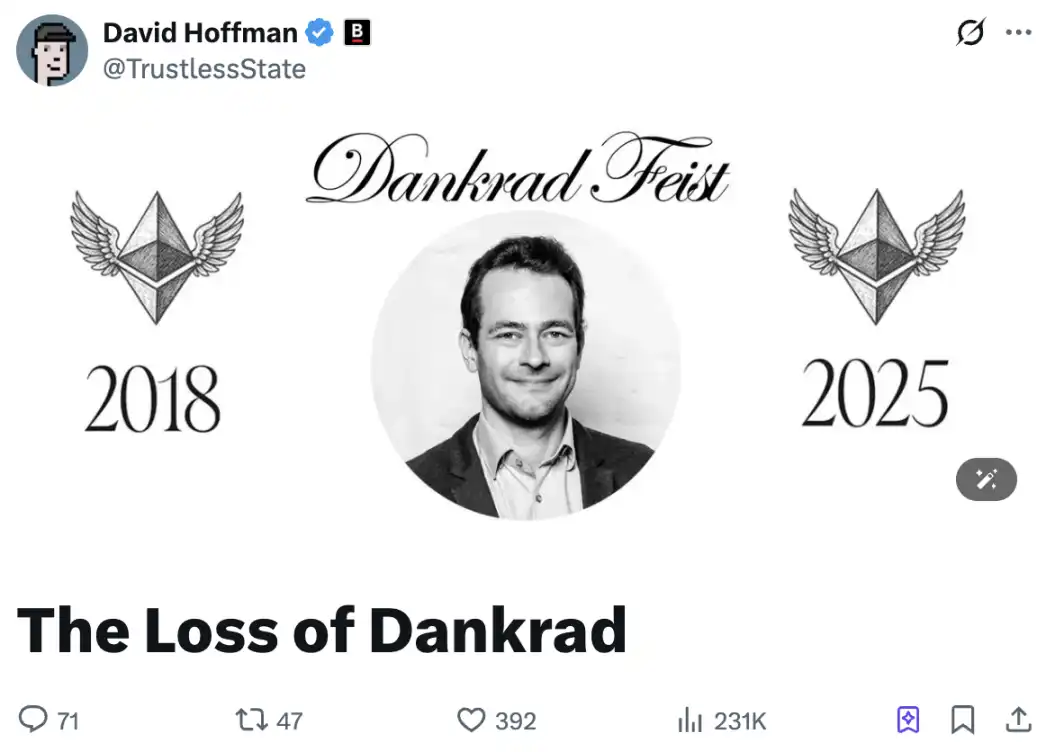
David Hoffman believes that the issue of for-profit companies absorbing talent nurtured by the Ethereum open-source community is significant and states that these companies will not necessarily bring greater benefits to Ethereum as they claim. David Hoffman bluntly expressed, "In my view, the significance of Tempo is to intercept the tens of trillions of dollars expected to flow into it over the next decade and put it on their private blockchain. Of course, this will grow the pie, but Tempo still intends to take as big a slice of that pie as possible." He believes that Tempo will be restricted by compliance issues regardless and that even issuing tokens cannot solve this. Although Tempo and Ethereum will both bring changes to the world, only Ethereum is best suited to be a trusted, neutral global settlement layer, with no shareholders and not bound by laws.
The "grass is greener on the other side" sentiment towards Ethereum has been evident since this cycle, as Ethereum's price performance lagged behind Bitcoin. Over time, it has become apparent that the departure of talented individuals from the Ethereum community seems to be an irreversible trend. When dreams clash with interests, many people ultimately choose the latter, which has long been a concern in the industry...
Dankrad Feist is Not the First, Nor Will He Be the Last
On the 17th of this month, Dankrad Feist announced on X that he would join Tempo and continue to serve as a research advisor for Ethereum Foundation's protocol cluster's three strategic initiatives (L1 scaling, Blob extension, and user experience improvement). Dankrad Feist stated, "Ethereum has a unique set of strong values and technical choices that underpin it. Tempo will be a great complement, built on similar technology and values while able to break boundaries in scale and speed. I believe this will greatly benefit Ethereum. Tempo's open-source tech can easily reintegrate back into Ethereum, benefiting the entire ecosystem."
According to LinkedIn, Dankrad Feist officially became an Ethereum researcher in 2019, focusing on researching Ethereum mainnet's sharding technology for scalability. The current core part of Ethereum's scalability roadmap, Danksharding, is named after him. Danksharding is seen as a key technological path for Ethereum to achieve high throughput and low-cost transactions, widely regarded by the community as a crucial upgrade direction post "Ethereum 2.0."
Dankrad Feist drove the precursor version of Danksharding, Proto-Danksharding (EIP-4844), which introduced the blob transaction type. This EIP provided Rollup with a cheaper and more efficient data availability layer, significantly reducing the data publishing costs of Rollup.
Furthermore, he engaged in a public dispute with Geth lead developer Péter Szilágyi on the MEV issue, eventually prompting Vitalik to intervene and push the community to prioritize MEV mitigation mechanisms like PBS (Proposer-Builder Separation).
Tempo researcher Mallesh Pai introduced new members joining Tempo in September, including Liam Horne, former CEO of OP Labs and co-founder of ETHGlobal.
Prior to Dankrad Feist, another figure that surprised the industry was Danny Ryan, co-founder of Etherealize, which secured a $40 million funding. As a former core member of the Ethereum Foundation known as the "Ethereum 2.0 Lead," he announced an indefinite departure in September 2024 and joined Etherealize just six months later. However, given Etherealize's similarity to ConsenSys founded by Ethereum co-founder Joseph Lubin, who left 11 years ago due to commercialization disputes, Danny Ryan received wide understanding.
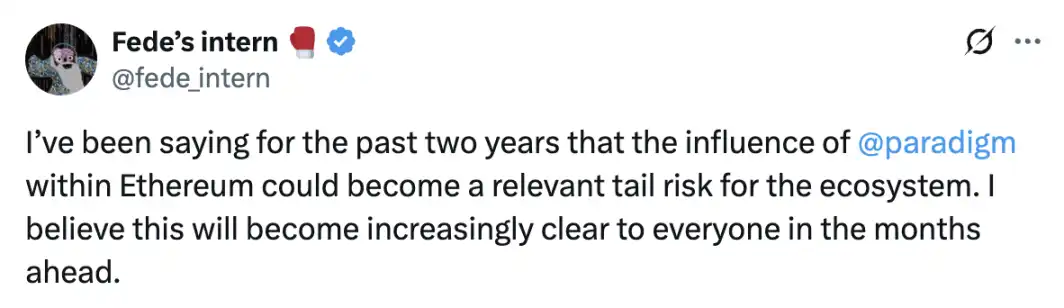
What really concerns David Hoffman are companies like Tempo and Paradigm. Renowned Ethereum developer Federico Carrone expressed a similar view, retweeting David Hoffman's tweet about Dankrad Feist joining Tempo and stating that he has been warning for the past two years that Paradigm's influence within Ethereum could pose a tail risk to the entire ecosystem.
Federico Carrone wrote that the sole objective of a venture capital fund is to maximize returns for LPs, and Ethereum should not form a deep technical dependency on a venture capitalist playing with very high strategic skill. After the FTX scandal, Paradigm almost entirely removed all cryptocurrency-related brand exposure, making a high-profile shift to AI. Carrone believes this is enough to prove his point.
Following Trump's return to the White House, Paradigm re-entered the Web3 space, heavily recruiting top community researchers and funding key Ethereum open-source libraries, as well as supporting Stripe's launch of Tempo. Carrone believes that while Paradigm claims everything they do is beneficial for Ethereum - more funding, more tools, more testnets, new ideas that can all feed back into Ethereum - these are indeed potential benefits. However, when a company has too much visibility and influence over an open-source project, priorities shift from the community's long-term vision to corporate interests.
The Accumulation of Ethereum's Technical Debt
The mere loss of talent in the Ethereum open-source community may not be a cause for widespread concern, but if talent loss is accompanied by the accumulation of technical debt, then there is cause for high alert.
A week ago, a community user posted a screenshot on X and stated that the top contributors to the Solidity language have almost ceased their development efforts. Only Cameel continues to raise new issues and drive technical progress, but it appears to be in a maintenance mode. They believe the community needs to allocate more resources to support this programming language.
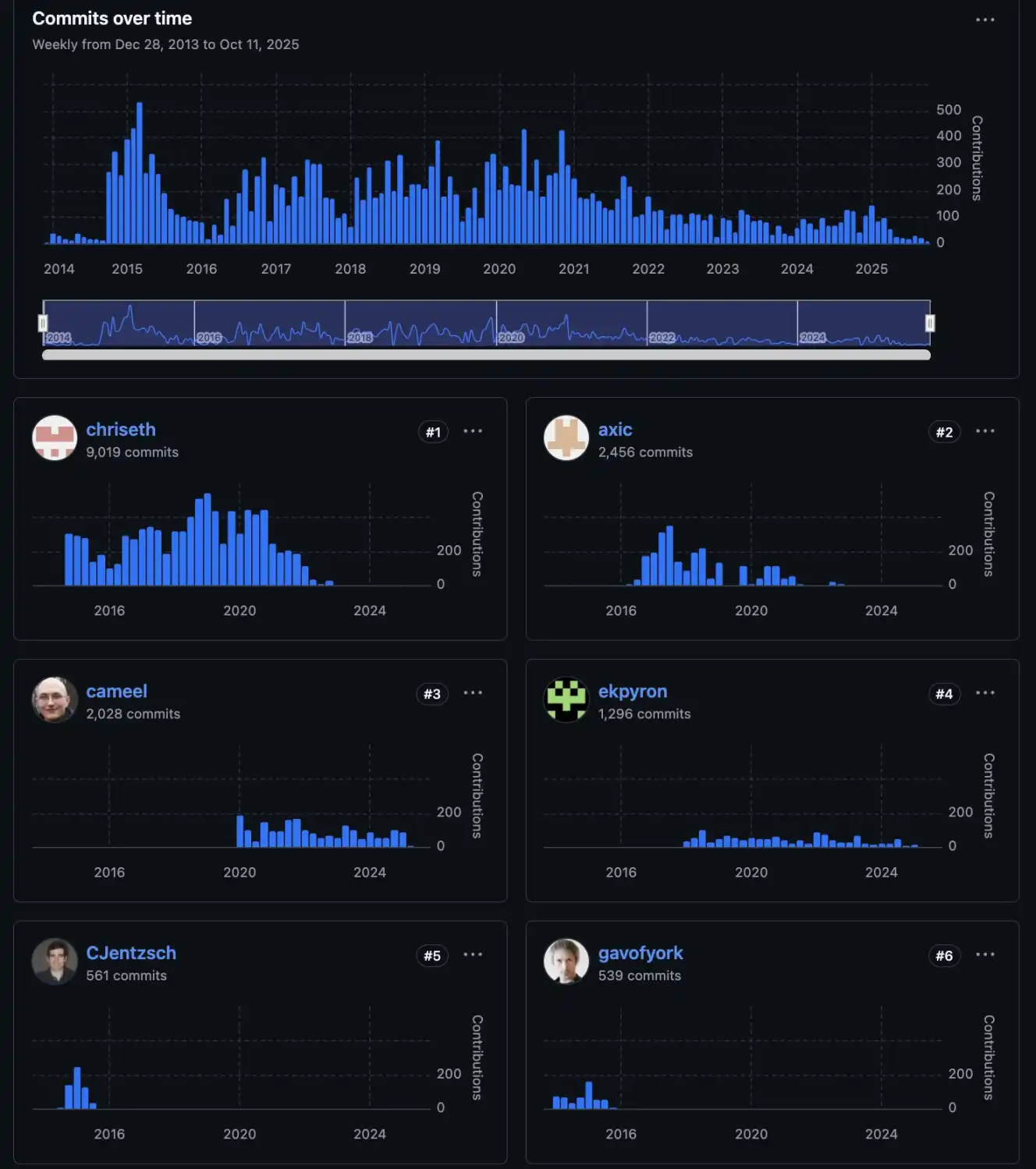
Some users in the comments questioned why effort should be spent on continuing to improve upgrade Solidity rather than just maintaining it to ensure stability and security. The user who posted explained that even changing the Solidity compiler would not affect any already deployed contracts but could enhance security, improve development experience, or support the use of new contracts. As shown in the image above, the level of development activity has sharply declined since the beginning of the last hype-driven bull market.
Federico Carrone also expressed his concerns, stating that what worries him the most is that many core tools and libraries built around Solidity may not receive long-term maintenance at all. Even the latest Solidity compiler is currently supported by very few developers. Additionally, companies related to L2 and ZK technologies are downsizing, making it possible that the iteration of cutting-edge technology may rely on just a few companies. As the Gas Limit increases, many execution clients have not made substantial performance improvements, and judging from the libraries, the development teams of these clients seem to have fallen behind.
Federico Carrone stated, "Ethereum's technical debt continues to accumulate, not only because the protocol itself must keep evolving, but also because many dependent libraries and peripheral repositories are now stagnant. The entire ecosystem continues to expand, guarding assets worth billions of dollars, while part of its foundation is quietly eroding."
The Open Source Community Cannot Solely Rely on "Love-Powered" Contributions
For an open-source community like Ethereum that carries a significant amount of tangible value in the form of programmable money, balancing "love-powered" contributions with economic incentives is a problem with no prior cases to reference. This should have been a highly concerning issue for the Ethereum Foundation, but it seems to have been overlooked.
Péter Szilágyi, who joined the Ethereum Foundation in 2015 and was responsible for Geth development and maintenance, explicitly outlined three of the most disappointing issues in a letter to the Ethereum Foundation leadership a year and a half ago: being portrayed externally as a leader but marginalized internally, severe income misalignment with Ethereum's market cap growth, and an excessive influence of Vitalik and a small group around him on the Ethereum ecosystem.
By the end of 2024, Péter Szilágyi discovered the Ethereum Foundation secretly incubating an independent Geth fork team, was subsequently fired due to disputes with the Ethereum Foundation, and was repeatedly denied rehiring. Subsequently, the Ethereum Foundation even proposed to pay Péter Szilágyi $5 million for Geth to become independent of the foundation, a proposal that was rejected. Currently, Péter Szilágyi still maintains the Geth codebase as an independent contributor.
Rumors of internal corruption within the Ethereum Foundation have been widespread, but this is actually a problem that should have been anticipated from the moment the Ethereum Foundation was established. The saying goes, "Where there are people, there is a rivers-and-lakes community," indicating that we cannot eliminate human greed. However, we cannot allow Ethereum to gradually lose its most core value due to commercialization.
Ethereum has a market cap of tens of billions of dollars, has facilitated the transfer of trillions of dollars' worth of value on-chain over the years, and is built on the foundation of a professional technical team, with a core ethos of permissionless open source, and through the commercialization brought by a large number of enterprises. However, such a vast system requires a significant amount of personnel to maintain, and as we have seen, these individuals are leaving due to disappointment or choosing to join other projects for economic gain.
The Ethereum Foundation underwent substantial reforms this year, but it does not seem to have produced remarkable results yet. Ethereum still can be described as the world's computer, with the potential in commercial applications still being continuously explored by brilliant teams. However, as the foundation of all this, Ethereum cannot continue to disappoint those who still persist for their ideals.
You may also like

Lighter Founder's Latest Response on Token Launch Progress, What Was Said

Whale Withdraws 2,218 ETH from Kraken Sparking Market Interest
Key Takeaways A massive withdrawal of 2,218 ETH, 37.1 million SKY, and 4,772 AAVE occurred from Kraken. The…

Whale Trader Reaps Significant Profits from Ethereum Sales
Key Takeaways A whale, identified as address “0xa339”, has executed a large sale of 50,623 ETH. The total…

Whale Withdraws Millions in Ethereum and Other Tokens from Kraken
Key Takeaways A whale has withdrawn 2,218 ETH, valued at approximately $6.52 million, from Kraken. The whale also…

ZKC Price Surge Shakes Crypto Market
Key Takeaways ZKC (Boundless) experienced a significant 20.72% increase over the past 24 hours, reaching $0.14. The transition…

Smart Trader Closes Ethereum Positions, Faces $3.4 Million Loss
Key Takeaways Smart trader pension-usdt.eth closed a 30,000 ETH short position, incurring a $3.4 million loss. Despite this…

Japanese Central Bank Signals Potential Interest Rate Hikes Impacting Crypto Market
Key Takeaways The Japanese Central Bank has indicated potential interest rate hikes as the yen weakens, affecting the…

Bitcoin Reaches $90,000 Amid Geopolitical Tensions and Oil Price Surge
Key Takeaways Bitcoin recently surged past $90,000, driven by heightened geopolitical tensions and rising oil prices. The cryptocurrency…

Crypto Whale Strategically Bets on Bitcoin, Ethereum, Solana Shorts
Key Takeaways A prominent crypto whale has launched a substantial $243 million short position across Bitcoin, Ethereum, and…

Hong Kong Implements Basel Crypto Standards for Banking
Key Takeaways Hong Kong Monetary Authority will enforce the Basel crypto asset regulatory standards starting January 1, 2026.…

Plasma Token Surges 14.3% as Stablecoin Blockchain Gains Traction
Key Takeaways Plasma Token’s Price Surge: The price of Plasma (XPL) surged by 14.3% over the last 24…

ZEC Price Soars Amidst Market Frenzy as Major Positions Shift
Key Takeaways ZEC witnessed a price surge of 14.36% within 24 hours, reaching $512.25 on December 27. The…

Crypto Treasury Companies Face Uncertain Future by 2026, Ethereum and Solana May Be Affected
Key Takeaways Altan Tutar, CEO of MoreMarkets, predicts a grim outlook for most cryptocurrency treasury companies by 2026.…

Trend Research Significantly Boosts Ethereum Holdings
Key Takeaways Trend Research has increased its Ethereum holdings by purchasing 46,379 ETH. The firm now owns approximately…

Whale Deposits 1.81 Million USDC in HyperLiquid for Leveraged LIT Position
Key Takeaways A significant investor has deposited 1.81 million USDC into HyperLiquid. The investor utilized a 3x leverage…

Ethereum’s ‘Hegota’ Upgrade Expected by Late 2026 as Developers Accelerate Roadmap
Key Takeaways Ethereum’s next major upgrade, named “Hegota,” is planned for release in the latter part of 2026,…
2026: Ethereum’s Exponential Scaling with ZK Technology
Key Takeaways Ethereum’s transition to zero-knowledge (ZK) proofs is set to dramatically improve transaction speed and scalability, aiming…

Bitcoin Price Dips as Precious Metals Hit Record Highs Amid Rising Geopolitical Tensions
Key Takeaways Major Slide in Crypto Sector: Cryptocurrencies and crypto-related stocks experienced a notable decline with Bitcoin falling…
Lighter Founder's Latest Response on Token Launch Progress, What Was Said
Whale Withdraws 2,218 ETH from Kraken Sparking Market Interest
Key Takeaways A massive withdrawal of 2,218 ETH, 37.1 million SKY, and 4,772 AAVE occurred from Kraken. The…
Whale Trader Reaps Significant Profits from Ethereum Sales
Key Takeaways A whale, identified as address “0xa339”, has executed a large sale of 50,623 ETH. The total…
Whale Withdraws Millions in Ethereum and Other Tokens from Kraken
Key Takeaways A whale has withdrawn 2,218 ETH, valued at approximately $6.52 million, from Kraken. The whale also…
ZKC Price Surge Shakes Crypto Market
Key Takeaways ZKC (Boundless) experienced a significant 20.72% increase over the past 24 hours, reaching $0.14. The transition…
Smart Trader Closes Ethereum Positions, Faces $3.4 Million Loss
Key Takeaways Smart trader pension-usdt.eth closed a 30,000 ETH short position, incurring a $3.4 million loss. Despite this…
Popular coins
Latest Crypto News


Customer Support:@weikecs
Business Cooperation:@weikecs
Quant Trading & MM:bd@weex.com
VIP Services:support@weex.com
 App
App