
- Buy Crypto
- Markets
- Futures
- Spot
- Copy Trade
 WE-Launch
Cryptocurrency people who use candlestick charts for fortune telling

AI fortune-telling is nothing new; it can predict everything from facial analysis to choosing seats in mahjong.
But the crypto world is doing it differently, directly incorporating fate into candlestick charts.
On December 13th,@0xSakura樱花, a blogger specializing in crypto metaphysics, released a new app called "Life Candlestick Chart."
By inputting your birth information, AI generates a candlestick chart from age 1 to 100 based on your birth chart, with red and green candles depicting your life's fortune.
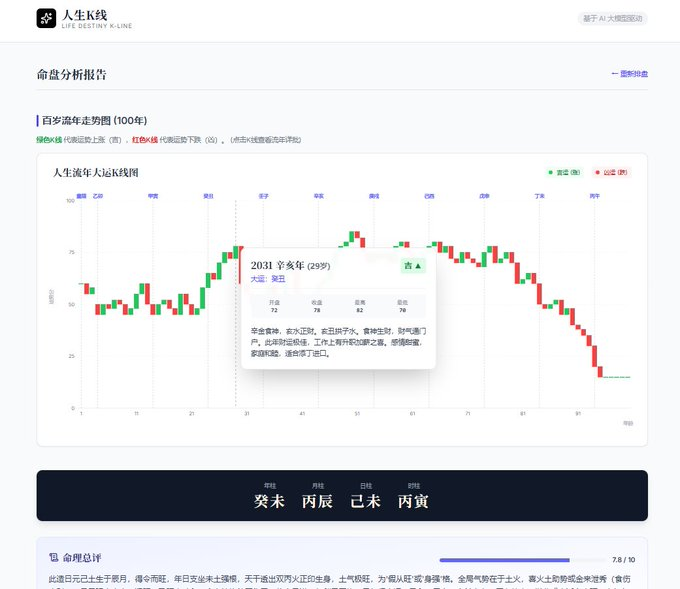
This thing went viral on Twitter. The initial tweet garnered over 3.3 million views, and within three days, the website and API calls exceeded 300,000. People started sharing screenshots like crazy, with many saying the generated candlestick charts closely matched their past life trajectories.
Even more bizarrely, this tool, explicitly labeled "for entertainment purposes only," saw a clone token appear within 24 hours of its launch.
Why would an entertainment-oriented fortune-telling tool resonate so strongly within the cryptocurrency community?
Behind this lies a long-standing undercurrent of trading mysticism, and also a concentrated release of collective anxiety within the cryptocurrency world.
The Mystic School in the Trading Industry
It's not surprising that cryptocurrency traders believe in mysticism. Wall Street is no exception.
W.D. Gann was one of the most famous market analysts of the 20th century, and also the person on Wall Street who most deeply combined mysticism and technical analysis, using astrology to predict market trends for trading.
George Soros admitted in *The Alchemy of Finance* that he would judge market risk based on the severity of his back pain. When the market is about to reverse, his back will ache intensely.
But these stories have long remained at the level of "legend," with few openly admitting to using metaphysics to guide their trading.
Privately, one might set up feng shui arrangements, wear lucky beads, or consult a master, but this must not be known to peers, otherwise it would be considered unprofessional.
The cryptocurrency world has broken this taboo.
In this industry, which inherently possesses an air of mystery, metaphysics seems a natural fit. Some predict BTC's fortune for the coming year based on astrological charts, while others use today's fortune to decide whether to open a trade.
Furthermore, discussions about metaphysics within the crypto industry seem to have increased significantly in recent years. More and more people, either trusting or out of curiosity, are joining the ranks of those engaging in metaphysical trading. A large number of cryptocurrency bloggers on Twitter have emerged, specializing in metaphysical analysis.
The explosive popularity of "life charts" is a prime example.
Many users in the community exchange and discuss their "life trajectory" with attitudes ranging from serious to joking. They don't see themselves as "superstitious"; they are simply using a more interesting way to share their feelings about uncertainty with peers.
The role of metaphysics among traders has shifted, transforming from a Wall Street secret into a public topic on cryptocurrency social media.
Why is metaphysics more popular in the crypto industry?
Why do crypto traders need metaphysics?
The answer to this question can be broadly categorized into three reasons:
Psychological compensation for anxiety about uncertainty
The crypto market is a perfect environment for creating anxiety.
Trading 24/7, 365 days a year, with no circuit breakers, means that wild swings can happen instantly.
Here, a single tweet from a prominent figure can wipe out hundreds of millions or even billions of dollars in market capitalization for a coin in an instant, and the founders of well-packaged projects can disappear overnight.
Traders constantly face "unknown risks," and the most terrifying aspect is not the "risk" itself, but the "unknown."
Economist Frank Knight pointed out in 1921 that risk is a quantifiable probability (like rolling dice), while uncertainty is an unquantifiable unknown (like whether war will break out tomorrow).
Humans are inherently afraid of uncertainty. When humans cannot quantify risk, they instinctively create "false certainty" to alleviate anxiety.
Metaphysics is precisely the perfect vehicle for this false certainty.
When you can't find your direction, checking today's trading almanac can at least give you a clear indication.
Within the cryptocurrency world, crypto astrologer @AstroCryptoGuru, with 51,000 followers, uses Bitcoin's "birth chart" (genesis block time January 3, 2009) combined with planetary cycles to make predictions:

Saturn signals correspond to bear markets, and Jupiter signals correspond to bull market peaks. He claims to have successfully predicted the December 2017 bull market peak, the 2022 bear market, and the 2024 BTC high.
This method of prediction, which links specific dates to celestial events, provides traders with a clear "wait signal" when market conditions are uncertain, even if that signal comes from outer space.
"Don't trade during Mercury retrograde," "A full moon will cause a crash," "Astrological charts indicate a BTC bull market next year"—these directional predictions don't require complex technical analysis or reading obscure white papers; you only need to believe in "predestination."
A 2006 study by the University of Michigan found that stock markets in 48 countries returned 6.6% less during a full moon than during a new moon.
This isn't because the moon actually influences the market, but because collective superstition influences trader behavior. When enough people believe "a full moon will cause a crash," they sell in advance, and the crash actually happens.
In the cryptocurrency world, this collective anxiety is even more intense, especially during a bear market. All "fundamental analysis" and "value investing" become a joke, while mystical analysis seems more reliable.
Therefore, traders need mystical methods, not because they are accurate, but because they offer an explanation, even if that explanation is false, it's still easier to accept than unpredictable uncertainty.
Cognitive bias leads to self-reinforcement
Why does mysticism always "seem effective"?
The reason mysticism continues to be popular in the cryptocurrency world is not only because it alleviates anxiety, but also because it "seems to actually work."
This isn't because mysticism itself is accurate, but because cognitive biases in the brain are self-reinforcing.
The most typical example is confirmation bias: when you believe "a full moon will cause a crash," you'll remember all the cases where a crash occurred after a full moon, while ignoring those days of surges or sideways movement. When your "life chart" shows this year is a bull market, you'll attribute every small rise to "the chart coming true," while interpreting crashes as "short-term corrections that don't affect the overall trend."
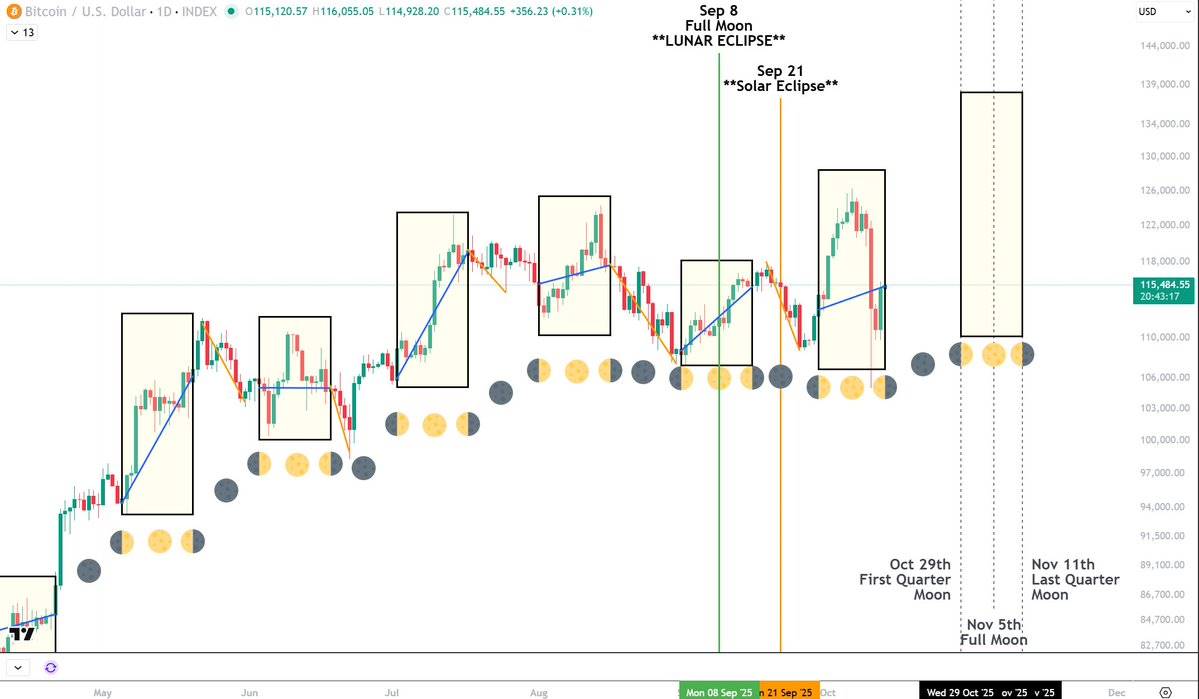
The social media environment within the cryptocurrency world amplifies this bias many times over.
Tweets like, "I followed the tarot card advice to go long on ETH contracts and made 20% in three days!" are highly likely to be widely shared, liked, and screenshotted.
However, traders who lost money following tarot card advice won't post about it, and their posts won't be seen.
As a result, the community's information flow is filled with cases of seemingly miraculous outcomes, while failures are filtered out.
Similar cases are ubiquitous on Twitter. For example, when @ChartingGuy predicted the Blood Moon in March of this year, regardless of market movements, there was always room for explanation: "early peak," "delayed fulfillment," "requires conjunction with other planetary angles."
And if BTC did indeed pull back during that period, this tweet would be repeatedly cited as a "prophetic prediction."
When BTC crashes, traders desperately need a reason. We look at social media: technical analysis says "it broke through support levels," macro analysis says "Japan raised interest rates," but these explanations are too complex and uncertain.
Metaphysics offers a simple and straightforward answer: "Saturn retrograde means the cryptocurrency market is entering a bear market cycle."
This explanation requires no understanding of market trends, policies, or data; it only requires the belief that celestial movements influence the market. Thus, it spread rapidly and became a consensus.
More importantly, the ambiguity of metaphysics means it can never be disproven.
A guru says not to trade during Mercury retrograde. If you lose money, it's because you didn't heed the guru's advice; if you profit, it's because your birth chart is special and suited for counter-trend trading. Tarot cards indicate significant recent volatility, and whether the price goes up or down, it's considered accurate.
This characteristic of being able to be interpreted correctly in any way makes metaphysics invincible in the cryptocurrency market.
Therefore, traders are not superstitious; rather, their brains are processing information in the most energy-efficient way: remembering what's useful, ignoring what's useless, and replacing complex analysis with simple explanations.
Metaphysics is not popular because it's accurate, but because it always seems accurate.
The Social Attributes of Metaphysics
Another reason for the popularity of metaphysics in the cryptocurrency market is that it has become a kind of social currency.
Discussions about technical analysis may lead to disagreements, but discussions about metaphysics have no right or wrong, only resonance. The question, "Is your life's K-line accurate?" is widely discussed not because people genuinely believe it, but because it's a topic anyone can participate in, requiring no professional expertise.
An example perfectly illustrates the existence of this demand for metaphysics.
Previously, our readers kept asking if we could add a horoscope function. Because of the numerous inquiries, we actually created a "Today's Horoscope" section on our website.
People don't necessarily rely on it for decision-making, but they want a common topic, a daily ritual for mental well-being.

When you say in a group chat, "Mercury retrograde today, I'm not trading," no one will question you, "That's not scientific." Instead, someone will reply, "Me too, let's get through this together."
The essence of this interaction is actually confirming that each other's anxieties are reasonable.
A 2025 Pew Research survey showed that 28% of American adults consult astrology, tarot cards, or fortune telling at least once a year.
Mysticism is no longer a fringe culture, but a universal psychological need. The crypto world has simply transformed this need from "private use" to "public display."
In this market without authoritative answers, mysticism doesn't offer answers, but rather companionship.
So, how accurate is your "life chart"?
The explosive popularity of "life charts" lies in using the crypto world to express what every trader feels but dares not admit: our sense of control over the market may be as fragile as our sense of control over fate.
When you see your "life chart" showing a bear market this year, you won't actually liquidate your entire position and leave the market. But you'll feel less self-blame when you lose, and more comfort when you miss out:
"This isn't my problem; my astrological cycle is wrong."
In this 24/7, year-round, and uncertain market, what we really want to predict isn't our life's trajectory, but rather a psychological support that keeps us at the poker table.
You may also like
Holiday Season Markets: Understanding Low Liquidity and Trading Conditions
At WEEX, we recognize that the holiday season often brings a different trading experience for many users. As market participation slows, price behavior can feel less predictable and familiar trading rhythms may shift. For traders following AI news today or using AI trading tools, this period often highlights how market structure can influence model performance and short-term signals. Approaching these periods with clear expectations and a disciplined mindset can help traders better navigate seasonal market conditions.

Social Engineering in the Crypto Universe: Safeguarding Your Assets in 2025
Key Takeaways Social engineering, a psychological manipulation tactic, has been the leading cause of crypto asset theft in…

Vitalik Buterin Discusses Grok’s Impact on X’s Truthfulness
Key Takeaways Grok, an AI chatbot, is praised by Vitalik Buterin for enhancing the truthfulness of the social…

Vitalik Buterin Says Grok Keeps Musk’s X More Honest
Key Takeaways Vitalik Buterin believes Grok is a valuable addition to X by challenging users’ preconceptions. Grok’s unpredictability…

Canton Token Climbs Amid DTCC’s Tokenized Treasury Plans
Key Takeaways: The Canton Coin experienced a 27% increase following DTCC’s announcement of tokenizing US Treasury securities. The…

Vitalik Buterin Believes Grok Enhances X’s Truth-Friendliness Despite Shortcomings
Key Takeaways Grok, an AI chatbot, is being praised by Vitalik Buterin for making the X platform more…
Palmer Luckey’s Erebor Reaches $4.3B Valuation as Bank Charter Progresses
Key Takeaways: Erebor, a digital bank co-founded by Palmer Luckey, has raised $350 million, bringing its valuation to…
Kalshi First Research Report: When Predicting CPI, Crowd Wisdom Beats Wall Street Analysts

Polymarket Announces In-House L2, Is Polygon's Ace Up?
AI Trading Risks in Crypto Markets: Who Takes Responsibility When It Fails?
AI trading is already core market infrastructure, but regulators still treat it as a tool — responsibility always stays with the humans and platforms behind it. The biggest risk in 2025 is not rogue algorithms, but mass-adopted AI strategies that move markets in sync and blur the line between tools and unlicensed advice. The next phase of AI trading is defined by accountability and transparency, not performance — compliance is now a survival requirement, not a constraint.

Beacon Guiding Directions, Torches Contending Sovereignty: A Covert AI Allocation War
Key Takeaways The AI that rules today’s landscape exists in two forms—a centralized “lighthouse” model by major tech…

Decoding the Next Generation AI Agent Economy: Identity, Recourse, and Attribution
Key Takeaways AI agents require the development of robust identity, recourse, and attribution systems to operate autonomously and…

Nofx’s Two-Month Journey from Stardom to Scandal: The Open Source Dilemma
Key Takeaways Nofx’s rise and fall in two months highlights inherent challenges in open source projects. A transition…

MiniMax Knocks on the Door of Hong Kong Stock Exchange with Billion-Dollar Valuation
Key Takeaways MiniMax, a prominent AI startup, is rapidly progressing towards an IPO on the Hong Kong Stock…

When AI Starts Spending Money: Who Will Underwrite Agent Transactions?
When the Prediction Market Shifts from 'Predicting' to 'Revealing the Truth': Delphi Officially Launches Prediction Market Coverage

Key Market Insights from December 19th, How Much Did You Miss Out?
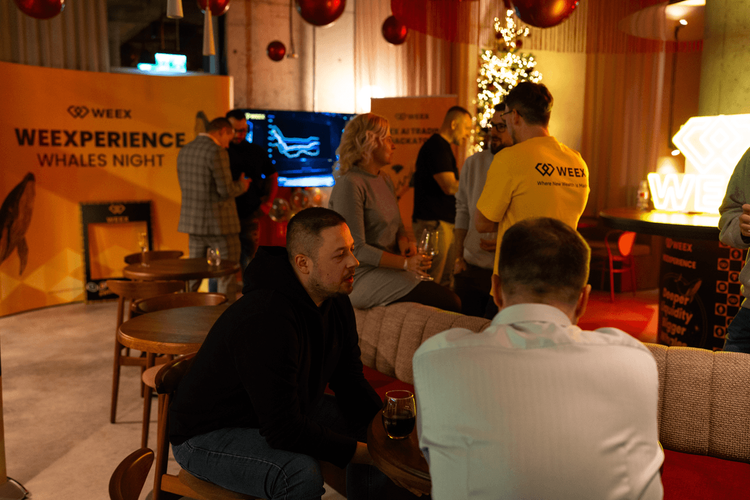
WEEXPERIENCE Whales Night: AI Trading, Crypto Community & Crypto Market Insights
On December 12, 2025, WEEX hosted WEEXPERIENCE Whales Night, an offline community gathering designed to bring together local cryptocurrency community members. The event combined content sharing, interactive games, and project presentations to create a relaxed yet engaging offline experience.
Holiday Season Markets: Understanding Low Liquidity and Trading Conditions
At WEEX, we recognize that the holiday season often brings a different trading experience for many users. As market participation slows, price behavior can feel less predictable and familiar trading rhythms may shift. For traders following AI news today or using AI trading tools, this period often highlights how market structure can influence model performance and short-term signals. Approaching these periods with clear expectations and a disciplined mindset can help traders better navigate seasonal market conditions.
Social Engineering in the Crypto Universe: Safeguarding Your Assets in 2025
Key Takeaways Social engineering, a psychological manipulation tactic, has been the leading cause of crypto asset theft in…
Vitalik Buterin Discusses Grok’s Impact on X’s Truthfulness
Key Takeaways Grok, an AI chatbot, is praised by Vitalik Buterin for enhancing the truthfulness of the social…
Vitalik Buterin Says Grok Keeps Musk’s X More Honest
Key Takeaways Vitalik Buterin believes Grok is a valuable addition to X by challenging users’ preconceptions. Grok’s unpredictability…
Canton Token Climbs Amid DTCC’s Tokenized Treasury Plans
Key Takeaways: The Canton Coin experienced a 27% increase following DTCC’s announcement of tokenizing US Treasury securities. The…
Vitalik Buterin Believes Grok Enhances X’s Truth-Friendliness Despite Shortcomings
Key Takeaways Grok, an AI chatbot, is being praised by Vitalik Buterin for making the X platform more…
Popular coins
Latest Crypto News


Customer Support:@weikecs
Business Cooperation:@weikecs
Quant Trading & MM:bd@weex.com
VIP Services:support@weex.com
 App
App