
- Buy Crypto
- Markets
- Futures
- Spot
- Copy Trade
 WE-Launch
Etherscan's Surcharge Scandal Exposes Ethereum Ecosystem's Data Dependency Dilemma

Original Article Title: "Etherscan Cancels Several Free APIs, Revealing Unforeseen Issues"
Original Article Author: Eric, Foresight News
On November 23, Lefteris Karapetsas, the founder of the open-source portfolio tracker Rotki, took to Twitter to complain about Etherscan. He mentioned that during Devcon, Etherscan suddenly announced that they would no longer provide free APIs for the Avalanche C-Chain, Base, BNB Chain, and OP Mainnet block explorers.
While he understood the pressure of providing free services, he questioned why there was no advance notice or why such a decision was made during a major event when everyone was away, leading to a "sudden attack" without any time to react.
According to Etherscan's announcement, as the chain's performance gradually improved, the data volume also increased significantly, leading to a substantial rise in costs. In this situation, they could no longer afford to provide all APIs for free and had to reluctantly convert some previously free APIs into paid versions.
It is evident that the decision to no longer offer free APIs for specific chains was likely due to insufficient funding or resource support.
Finally, the founder expressed some confusion, questioning why, apart from Avalanche, Base, OP Mainnet, and BNB Chain did not have enough money to support such critical services.
However, opposing voices quickly emerged, with the founder of Routescan and operator of the Avalanche block explorer Snowtrace, Jack, at the forefront. Jack provided some industry-insider data:
· Etherscan charges supported chains approximately between $1.5 million to $2 million annually, with some as low as around $300,000, but providing only basic data;
· For chains that are already paying, Etherscan only provides a free API with 5 RPS (Requests Per Second), and for additional requests, the monthly subscription fee can go up to $899.
· Last month, the independent visitor numbers of various chain explorers on Etherscan were as follows: OP Mainnet, 102k; BNB Chain, 2.5M; Base, 1M; HyperEVM, 30k; Avalanche, 16k. Etherscan itself had 4M visitors.
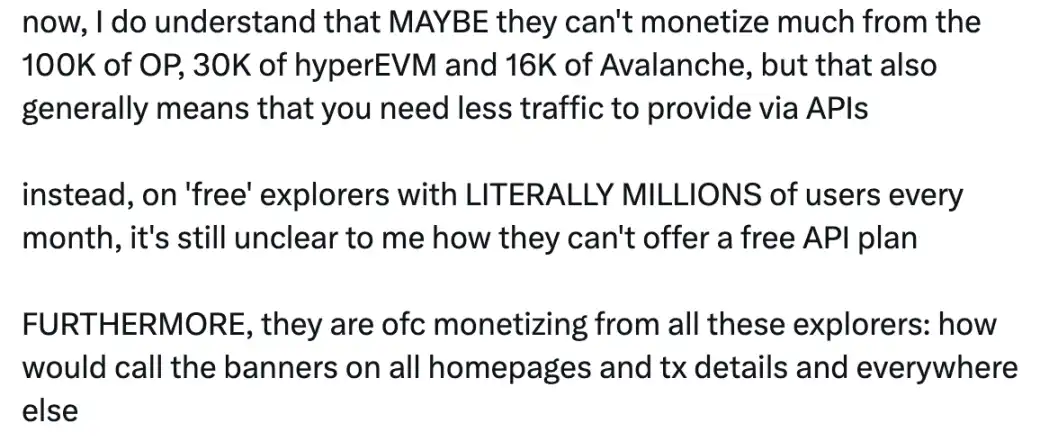
The CEO's implicit meaning is: Charging for a small number of APIs is indeed due to financial constraints, not because we find the income insignificant. For some chains that don't pay us, we have offered free service for a while and have done our utmost. Let's stop arguing about this and move on.
There isn't much to say about the discussion on this issue; it's simply a matter of some people thinking Etherscan is too greedy, while others view it as justifiable business behavior. However, some discussions arising from this event are quite interesting.
First of all, it was through this incident that the author learned about an ecosystem alliance called VERA, which promotes convenient, standardized, and open access to EVM smart contract source code, as well as the Open Labels Initiative, which drives the standardization framework and data model for EVM address labels. The fundamental goal of both organizations is to support the accessibility of blockchain data, especially validation.
The Open Labels Initiative retweeted Lefteris Karapetsas's complaint tweet, stating that over the past year, they have been working to prevent incidents like this caused by overreliance on centralized on-chain data providers. They believe that such critical infrastructure should not be monopolized but rather co-developed.
Entities such as sourcefify.eth for verifying Ethereum contract code, the Ethereum data visualization platform growthepie, the open-source block explorer Blockscout, and the previously mentioned Routescan are all contributing to the readability and accessibility of Ethereum data.
According to Akshat Mittal, a DeFi engineer at Reserve Protocol, Etherscan has not been involved in these initiatives. Is it for commercial gain? No one knows, but even if it is, it's understandable. The Ethereum ecosystem will always have individuals who adhere to open-source culture and reject excessive commercialization, which is not a matter of right or wrong but rather showcases the diversity of the ecosystem. Profit-driven institutions can ensure service quality, while open-source products will still have their place.
Furthermore, there has been recent effusive praise by IC's zCloak Network founder 0xFrancis, once again comparing IC to Ethereum.
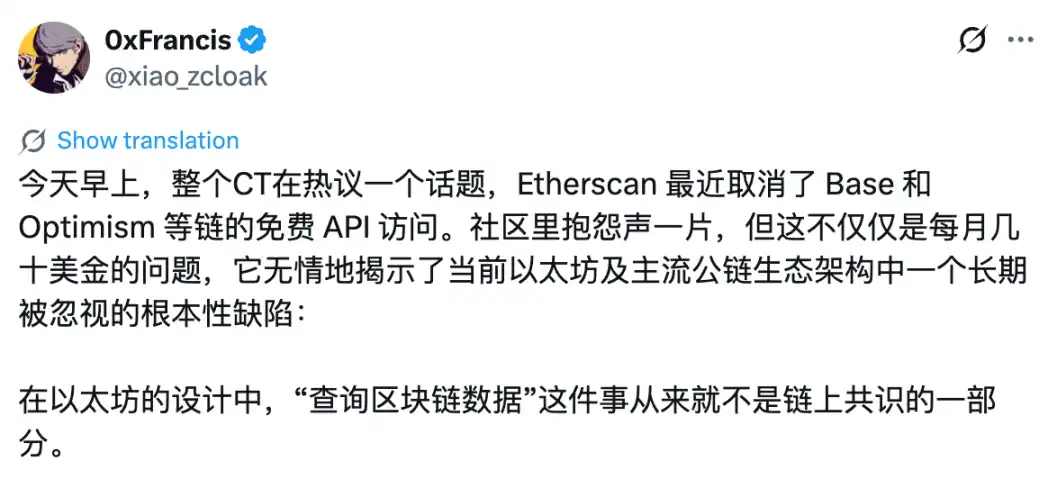
0xFrancis argues that Ethereum does not include "querying block data" as part of its consensus, so DApp development must rely on third-party RPC services. If RPC nodes collectively go offline, the chain will still run but become "unreadable."
Going deeper, if centralized RPC nodes or websites like Etherscan provide false data, they can easily deceive users. The Internet Computer (IC) incorporates querying as part of its protocol. When someone initiates a query, the request is executed through the ICP node network and returns cryptographically authenticated data to ensure its accuracy.
0xFrancis's point is not unfounded. This can be seen as a case of IC being too forward-thinking, with the Etherscan fee controversy being a typical debate about centralization versus decentralization. However, could it be that Ethereum's imperfections and the need for commercialized components have actually contributed to the ecosystem's prosperity?
You may also like

Blockchains Quietly Prepare for Quantum Threat as Bitcoin Debates Timeline
Key Takeaways: Several blockchains, including Ethereum, Solana, and Aptos, are actively preparing for the potential threat posed by…

Former SEC Counsel Explains What It Takes to Make RWAs Compliant
Key Takeaways The SEC’s shifting approach is aiding the growth of Real-World Assets (RWAs), but jurisdictional and yield…

Trend Research Quietly Becomes One of Ethereum’s Largest Whales with Major ETH Acquisition
Key Takeaways Trend Research has acquired 46,379 ETH, boosting their total holdings to about 580,000 ETH. The company,…

Web3 and DApps in 2026: A Utility-Driven Year for Crypto
Key Takeaways The transition to utility in the crypto sector has set a new path for 2026, emphasizing…

Base's 2025 Report Card: Revenue Grows 30X, Solidifies L2 Leadership

The Trillion-Dollar Stablecoin Battle: Binance Decides to Step in Again

Are Those High-Raised 2021 Projects Still Alive?

Aave Community Governance Drama Escalates, What's the Overseas Crypto Community Talking About Today?

Polymarket Announces In-House L2, Is Polygon's Ace Up?

Ether pumps to outsiders, dumps in-house. Can Tom Lee's team still be trusted?
Coinbase Joins Prediction Market, AAVE Governance Dispute - What's the Overseas Crypto Community Talking About Today?
Over the past 24 hours, the crypto market has shown strong momentum across multiple dimensions. The mainstream discussion has focused on Coinbase's official entry into the prediction market through the acquisition of The Clearing Company, as well as the intense controversy within the AAVE community regarding token incentives and governance rights.
In terms of ecosystem development, Solana has introduced the innovative Kora fee layer aimed at reducing user transaction costs; meanwhile, the Perp DEX competition has intensified, with the showdown between Hyperliquid and Lighter sparking widespread community discussion on the future of decentralized derivatives.
This week, Coinbase announced the acquisition of The Clearing Company, marking another significant move to deepen its presence in this field after last week's announcement of launching a prediction market on its platform.
The Clearing Company's founder, Toni Gemayel, and the team will join Coinbase to jointly drive the development of the prediction market business.
Coinbase's Product Lead, Shan Aggarwal, stated that the growth of the prediction market is still in its early stages and predicts that 2026 will be the breakout year for this field.
The community has reacted positively to this, generally believing that Coinbase's entry will bring significant traffic and compliance advantages to the prediction market. However, this has also sparked discussions about the industry's competitive landscape.
Jai Bhavnani, Founder of Rivalry, commented that for startups, if their product model proves to be successful, industry giants like Coinbase have ample reason to replicate it.
This serves as a reminder to all entrepreneurs in the crypto space that they must build significant moats to withstand competition pressure from these giants.
Regulated prediction market platform Kalshi launched its research arm, Kalshi Research, this week, aimed at opening its internal data to the academic community and researchers to facilitate exploration of prediction market-related topics.
Its inaugural research report highlights Kalshi's outperformance in predicting inflation compared to Wall Street's traditional models. Kalshi co-founder Luana Lopes Lara commented that the power of prediction markets lies in the valuable data they generate, and it is now time to better utilize this data.
Meanwhile, Kalshi announced its support for the BNB Chain (BSC), allowing users to deposit and withdraw BNB and USDT via the BSC network.
This move is seen as a significant step for Kalshi to open its platform to a broader crypto user base, aiming to unlock access to the world's largest prediction market. Furthermore, Kalshi also revealed plans to host the first Prediction Market Summit in 2026 to further drive industry engagement and development.
The AAVE community recently engaged in heated debates around an Aave Improvement Proposal (AIP) titled "AAVE Tokenomics Alignment Phase One - Ownership Governance," aiming to transfer ownership and control of the Aave brand from Aave Labs to Aave DAO.
Aave founder Stani Kulechov publicly stated his intention to vote against the proposal, believing it oversimplifies the complex legal and operational structure, potentially slowing down the development process of core products like Aave V4.
The community's reaction was polarized. Some criticized Stani for adopting a "double standard" in governance and questioned whether his team had siphoned off protocol revenue, while others supported his cautious stance, arguing that significant governance changes require more thorough discussion.
This controversy highlights the tension between the ideal of DAO governance in DeFi projects and the actual power held by core development teams.
Despite governance disputes putting pressure on the AAVE token price, on-chain data shows that Stani Kulechov himself has purchased millions of dollars' worth of AAVE in the past few hours.
Simultaneously, a whale address, 0xDDC4, which had been quiet for 6 months, once again spent 500 ETH (approximately $1.53 million) to purchase 9,629 AAVE tokens. Data indicates that this whale has accumulated nearly 40,000 AAVE over the past year but is currently in an unrealized loss position.
The founder and whale's increased holdings during market volatility were interpreted by some investors as a confidence signal in AAVE's long-term value.
In this week's top article, Morpho Labs' "Curator Explained" detailed the role of "curators" in DeFi.
The article likened curators to asset managers in traditional finance, who design, deploy, and manage on-chain vaults, providing users with a one-click diversified investment portfolio.
Unlike traditional fund managers, DeFi curators execute strategies automatically through non-custodial smart contracts, allowing users to maintain full control of their assets. The article offered a new perspective on the specialization and risk management in the DeFi space.
Another widely circulated article, "Ethereum 2025: From Experiment to Global Infrastructure," provided a comprehensive summary of Ethereum's development over the past year. The article noted that 2025 is a crucial year for Ethereum's transition from an experimental project to global financial infrastructure. Through the Pectra and Fusaka hard forks, Ethereum achieved significant reductions in account abstraction and transaction costs.
Furthermore, the SEC's clarification of Ethereum's "non-securities" nature and the launch of tokenized funds on the Ethereum mainnet by traditional financial giants like JPMorgan marked Ethereum's gaining recognition from mainstream institutions. The article suggested that whether it is the continued growth of DeFi, the thriving L2 ecosystem, or the integration with the AI field, Ethereum's vision as the "world computer" is gradually becoming a reality.
The Solana Foundation engineering team released a fee layer solution called Kora this week.
Kora is a fee relayer and signatory node designed to provide the Solana ecosystem with a more flexible transaction fee payment method. Through Kora, users will be able to achieve gas-free transactions or choose to pay network fees using any stablecoin or SPL token. This innovation is seen as an important step in lowering the barrier of entry for new users and improving Solana network's availability.
Additionally, a deep research report on propAMM (proactive market maker) sparked community interest. The report's data analysis of propAMMs on Solana like HumidiFi indicated that Solana has achieved, or even surpassed, the level of transaction execution quality in traditional finance (TradFi) markets.
For example, on the SOL-USDC trading pair, HumidiFi is able to provide a highly competitive spread for large trades (0.4-1.6 bps), which is already better than the trading slippage of some mid-cap stocks in traditional markets.
Research suggests that propAMM is making the vision of the "Internet Capital Market" a reality, with Solana emerging as the prime venue for all of this to happen.
The competition in the perpetual contract DEX (Perp DEX) space is becoming increasingly heated.
In its latest official article, Hyperliquid has positioned its emerging competitor, Lighter, alongside centralized exchanges like Binance, referring to it as a platform utilizing a centralized sequencer. Hyperliquid emphasizes its transparency advantage of being "fully on-chain, operated by a validator network, and with no hidden state."
The community widely interprets this as Hyperliquid declaring "war" on Lighter. The technical differences between the two platforms have also become a focal point of discussion: Hyperliquid focuses on ultimate on-chain transparency, while Lighter emphasizes achieving "verifiable execution" through zero-knowledge proofs to provide users with a Central Limit Order Book (CLOB)-like trading experience.
This battle over the future direction of decentralized derivatives exchanges is expected to peak in 2026.
Meanwhile, discussions about Lighter's trading fees have surfaced. Some users have pointed out that Lighter charged as much as 81 basis points (0.81%) for a $2 million USD/JPY forex trade, far exceeding the near-zero spreads of traditional forex brokers.
Some argue that Lighter does not follow a B-book model that bets against market makers, instead anchoring its prices to the TradFi market, and the high fees may be related to the current liquidity or market maker balance incentives. Providing a more competitive spread for real-world assets (RWA) in the highly volatile crypto market is a key issue Lighter will need to address in the future.

The Secret Centralization Landscape of Stablecoin Payments: 85% of Transaction Volume Controlled by Top 1000 Wallets

Audiera Sees Massive Price Surge – Key Cryptocurrency Updates
Key Takeaways Audiera (BEAT) has witnessed significant growth, experiencing a 70.10% increase in the past week. Despite the…

Market Outlook: The Future of Cryptocurrency by 2026
Key Takeaways The report focuses on the impact of critical factors like Bitcoin, Ethereum, and Solana, alongside regulatory…

Stability in the Crypto World: Understanding Stablecoin Usage and Its Implications
Key Takeaways Stablecoin use in payments has rapidly increased alongside blockchain technology advancements. Stablecoins USDT and USDC dominate…
Trump’s World Liberty Financial Token Ends 2025 Down Over 40%
Key Takeaways World Liberty Financial, a Trump family crypto project, faces substantial losses in 2025. The project initially…
Blockchains Quietly Prepare for Quantum Threat Amid Bitcoin’s Debate Over Timeline
Key Takeaways Many blockchains are preparing for potential threats from quantum computing by integrating post-quantum technologies. Ethereum views…
Ronin and ZKsync’s Onchain Metrics Experienced Notable Declines in 2025
Key Takeaways Some of the major blockchain networks, including Ronin and ZKsync, saw a significant reduction in onchain…
Blockchains Quietly Prepare for Quantum Threat as Bitcoin Debates Timeline
Key Takeaways: Several blockchains, including Ethereum, Solana, and Aptos, are actively preparing for the potential threat posed by…
Former SEC Counsel Explains What It Takes to Make RWAs Compliant
Key Takeaways The SEC’s shifting approach is aiding the growth of Real-World Assets (RWAs), but jurisdictional and yield…
Trend Research Quietly Becomes One of Ethereum’s Largest Whales with Major ETH Acquisition
Key Takeaways Trend Research has acquired 46,379 ETH, boosting their total holdings to about 580,000 ETH. The company,…
Web3 and DApps in 2026: A Utility-Driven Year for Crypto
Key Takeaways The transition to utility in the crypto sector has set a new path for 2026, emphasizing…
Base's 2025 Report Card: Revenue Grows 30X, Solidifies L2 Leadership
The Trillion-Dollar Stablecoin Battle: Binance Decides to Step in Again
Popular coins
Latest Crypto News


Customer Support:@weikecs
Business Cooperation:@weikecs
Quant Trading & MM:bd@weex.com
VIP Services:support@weex.com
 App
App