
- Buy Crypto
- Markets
- Futures
- Spot
- Copy Trade
 WE-Launch
From Cantor to Securitize, Crypto Industry Buys Up Washington

Last week, the Financial Times reported a major piece of news that Wall Street veteran Cantor Fitzgerald is joining forces with SoftBank, Tether, and Bitfinex to plan the formation of a Bitcoin investment alliance exceeding $3 billion in scale. Notably, the helm of this financial giant, Brandon Lutnick, is the son of U.S. Secretary of Commerce Howard Lutnick. Against the backdrop of the Trump administration's push for cryptocurrency-friendly policies, this newly formed investment alliance has sparked considerable speculation in the market about the nexus between government and business.
Tether's Behind-the-Scenes Player, Cantor: Straddling Both Politics and Business
Cantor Fitzgerald, a Wall Street stalwart established in 1945, is renowned for government securities trading, investment banking services, and bond brokerage. As one of the Treasury Department's 24 primary dealers, Cantor directly participates in the issuance and trading of government bonds, maintaining close business ties with the Federal Reserve and the Treasury Department. With operations spanning over 20 countries worldwide, the company boasts a workforce of over 12,500 employees.

What truly brought Cantor into the spotlight is its relationship with Tether. For Cantor, a midsize investment bank located in Midtown Manhattan, Tether has become its most lucrative client. Cantor serves as the primary custodian of Tether's U.S. dollar reserves, managing 99% of its U.S. Treasury bond reserves, amounting to billions of dollars.
The relationship between Cantor and Tether is mutually beneficial. Tether struggled to be profitable in the past, but now earns billions of dollars in interest annually from its government debt holdings at Cantor. According to Forbes, Cantor not only provides highly secure custody but also leverages its expertise in the bond market to assist Tether in converting high-risk commercial paper into low-risk U.S. Treasury bonds, significantly reducing systemic risk. An insider revealed that Cantor purchased short-term Treasury bonds with a maturity of 3-6 months for Tether, ensuring high liquidity. By adjusting the bond-to-cash ratio through a dynamic asset management system, Cantor generated approximately $2 billion in interest income for Tether in 2023, nearly one-third of its $5.6 billion profit that year.
One of the key figures who facilitated the collaboration between these two companies was Howard Lutnick. This 63-year-old billionaire, former CEO of Cantor, made his bank the backbone of the Tether system. Following a 2020 federal regulatory decision that made it easier for banks to hold digital assets, he sought a way to enter the cryptocurrency industry and learned about Tether. Cantor manages Tether's up to $390 billion U.S. Treasury portfolio, making it the U.S. dollar asset custodian for the Tether stablecoin USDT. Currently, the market capitalization of Tether tokens exceeds $1.3 trillion, with Cantor holding most of the U.S. Treasuries backing these tokens.
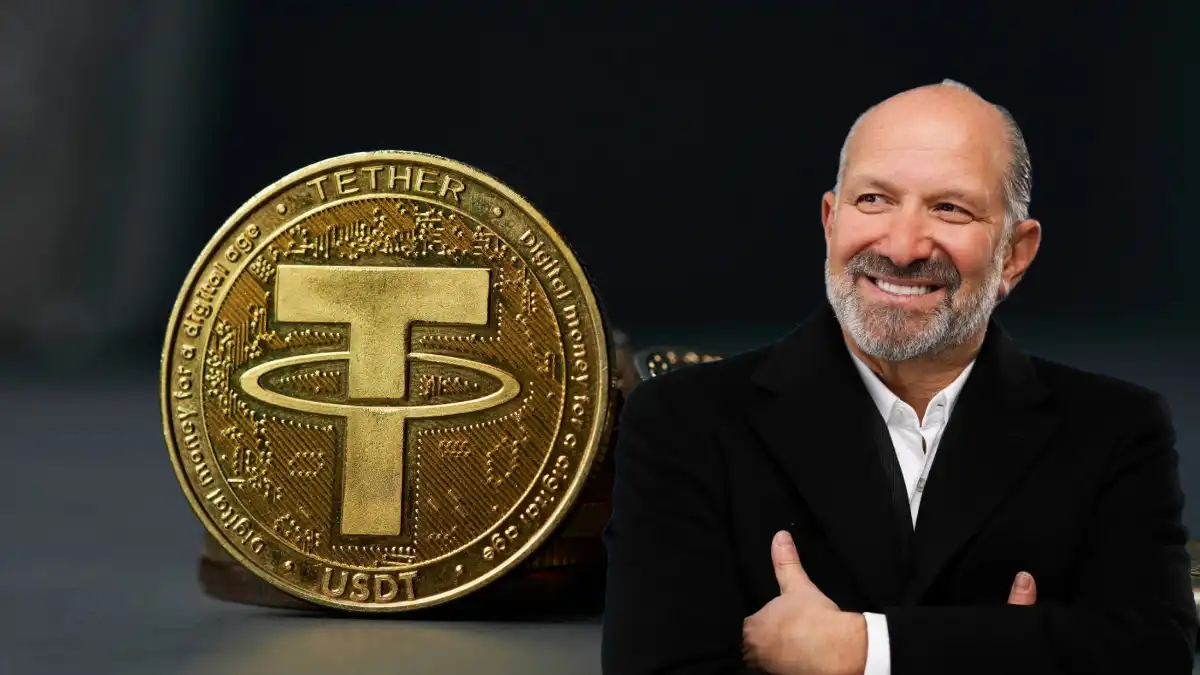
Cantor Former CEO Howard Lutnick
The connection between these two companies dates back to 2021. At that time, Tether had already issued over 500 billion tokens, but there were always doubts from the outside world about whether it really had an equivalent $500 billion reserve. In February of the same year, the company's owners agreed to pay a $18.5 million fine to the New York Attorney General to settle charges of making false statements about its reserves. Due to multiple U.S. banks refusing to process the company's transactions, coupled with concerns from major U.S. regulators that Tether could collapse in a bank run, the company was in crisis. At a critical moment, Howard stepped in to provide support for Tether. According to sources familiar with the matter, in return, Tether paid Cantor tens of millions of dollars, and Cantor thereby acquired a minority stake in Tether.
Previously, Tether had most of its funds deposited in an account at a Bahamian bank and invested part of its reserve in risky assets such as Chinese commercial paper to generate returns. This operating model made it heavily dependent on the ability of the Bahamian bank to connect with U.S. banks on its behalf. However, when in October 2021 Tether paid a $41 million fine to the U.S. Commodity Futures Trading Commission for false reserve statements, this channel came under serious threat.
After obtaining sufficient evidence to confirm that Tether did indeed hold all reserves, Howard proposed a solution. As a major dealer of U.S. Treasury bonds, Cantor could easily acquire a large amount of secure U.S. Treasury bond assets. He pledged that as long as Tether converted its held assets into U.S. Treasury securities, Cantor was willing to become its client.
On Tether's side, the Chief Financial Officer and largest shareholder, Devasini, was in contact with Howard. According to The Wall Street Journal, their interaction was highly secretive, with Howard "only letting very few employees know that Cantor was in contact with Tether, limited to a few top executives." He often personally handled this relationship with Devasini and would take private planes to meet him.
This Italian entrepreneur, who had previously been involved in plastic trading, was considered the "shadow helmsman" of Tether. Devasini stated that Cantor's custody services allowed the company to "more efficiently meet regulatory demands for liquidity and stability," believing that "Howard would use his political influence to try and eliminate the threat to Tether." Howard also placed great importance on the collaboration with Tether. In a investment agreement reached last year, Howard unusually took the lead in negotiations, enabling Cantor to obtain up to a 5% stake in Tether valued at as high as $6 billion.
As a patriarch, Howard was also paving the way for the next generation's network. The Bitcoin investment alliance this time was led by Howard's son, Brandon, planning to consolidate Tether's $1.5 billion in Bitcoin, SoftBank's $9 billion, and Bitfinex's $6 billion in funds. This model easily brings to mind MicroStrategy (now renamed Strategy), a company that achieved a market cap of $910 billion through large-scale Bitcoin hoarding.
Interestingly, Brandon had previously interned at Tether and was the one who introduced Tether to the right-wing video platform Rumble Inc. According to Bloomberg, Cantor facilitated Tether's $775 million investment in the right-wing video site Rumble Inc. When this transaction was announced, Rumble's stock price surged by 81%, and Cantor's stake in Rumble increased in value by $54 million.
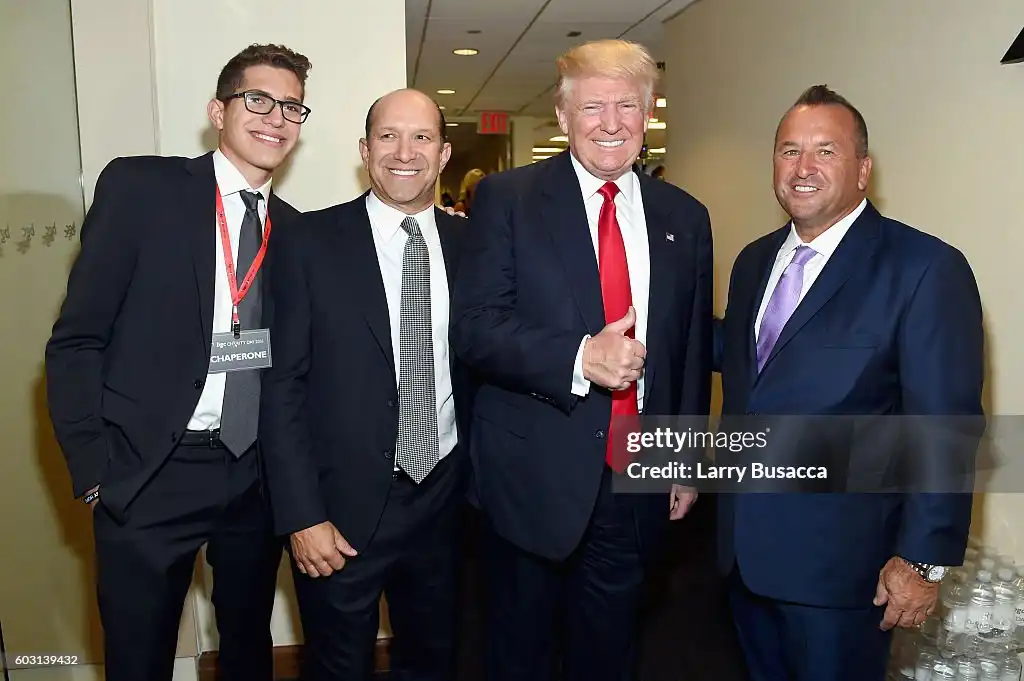
Brandon Luettelnick (Left One); Howard Luettelnick (Left Two)
In February of this year, Howard narrowly won the vote 51 to 45 and was appointed as Secretary of Commerce. The former Cantor CEO has publicly voiced support for Tether on multiple occasions: "I hold their commercial paper, they have a lot of commercial paper. I'm a big fan of Tether," and he emphasized the contribution of stablecoins to the U.S. economy.
Although when Howard was appointed as a Department of Commerce official, he stated that he would resign from his position at a financial firm and "intend to divest any holdings I have in these companies to comply with government ethics guidelines." However, opposition voices have always existed. Senator Elizabeth Warren expressed her opposition: "I am concerned about Howard Luettelnick's past work with a sanctioned entity (namely Tether), the Secretary of Commerce should fight for the interests of the United States—not for his personal interests or those of former clients whose actions harmed our national security."
Looking back now, Howard did indeed fulfill his promise by resigning from his position at Cantor to avoid a direct affiliation with Tether. However, the baton was passed early and handed over to Brandon.
From the Department of Commerce to the SEC, the "sibling relationship" between the crypto industry and the Trump administration
Cantor and Tether are not the only combination of their kind. The world's largest asset management company, BlackRock, established the BUIDL Fund in 2024, which has become a leader on the RWA track with a management scale exceeding 25 billion this year. The designated custodian for BUIDL is a company named Securitize. Unlike Cantor's traditional financial background, Securitize is a crypto company founded in 2017, focusing on blockchain technology and digital asset securitization.
Why would BlackRock suddenly invest in a crypto company? This may be closely related to Securitize's network of relationships. Looking at the management team of Securitize alone, one might not think of it as a crypto company, but rather as a traditional finance newcomer with a gathering of top Wall Street executives. But don't just focus on Wall Street; take a look at Washington, and you will find that Securitize hired Brett Redfearn, former Director of the SEC's Trading and Markets Division in 2021, who now serves as Senior Strategic Advisor and Chairman of the Advisory Council.
The relationship with the SEC is not the only one of its kind; Securitize also has a very close relationship with newly appointed SEC Chairman Paul Atkins. Paul Atkins joined Securitize as early as 2019, serving as a member of the Advisory Committee and the Board of Directors, holding up to $500,000 in stock options, and only recently stepping down in February of this year. Coincidentally, also in 2019, Securitize became an SEC-registered broker-dealer and SEC-regulated Alternative Trading System (ATS) operator.
Related Reading: "New Chairman Takes Office within 48 Hours, SEC Becomes 'Crypto Daddy'"
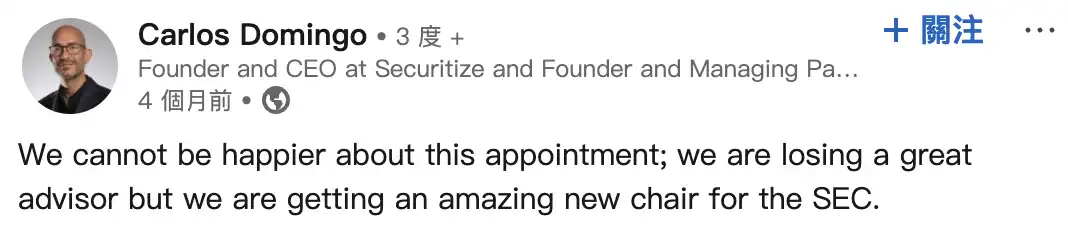
Just as Trump announced the nomination of Atkins as the next SEC Chairman, Securitize's CEO Carlos Domingo specifically congratulated on LinkedIn: "We are extremely pleased with this appointment; although we have lost an outstanding advisor, we have also welcomed an excellent new SEC Chairman." At the same time, Securitize's official LinkedIn account created a special congratulatory image.

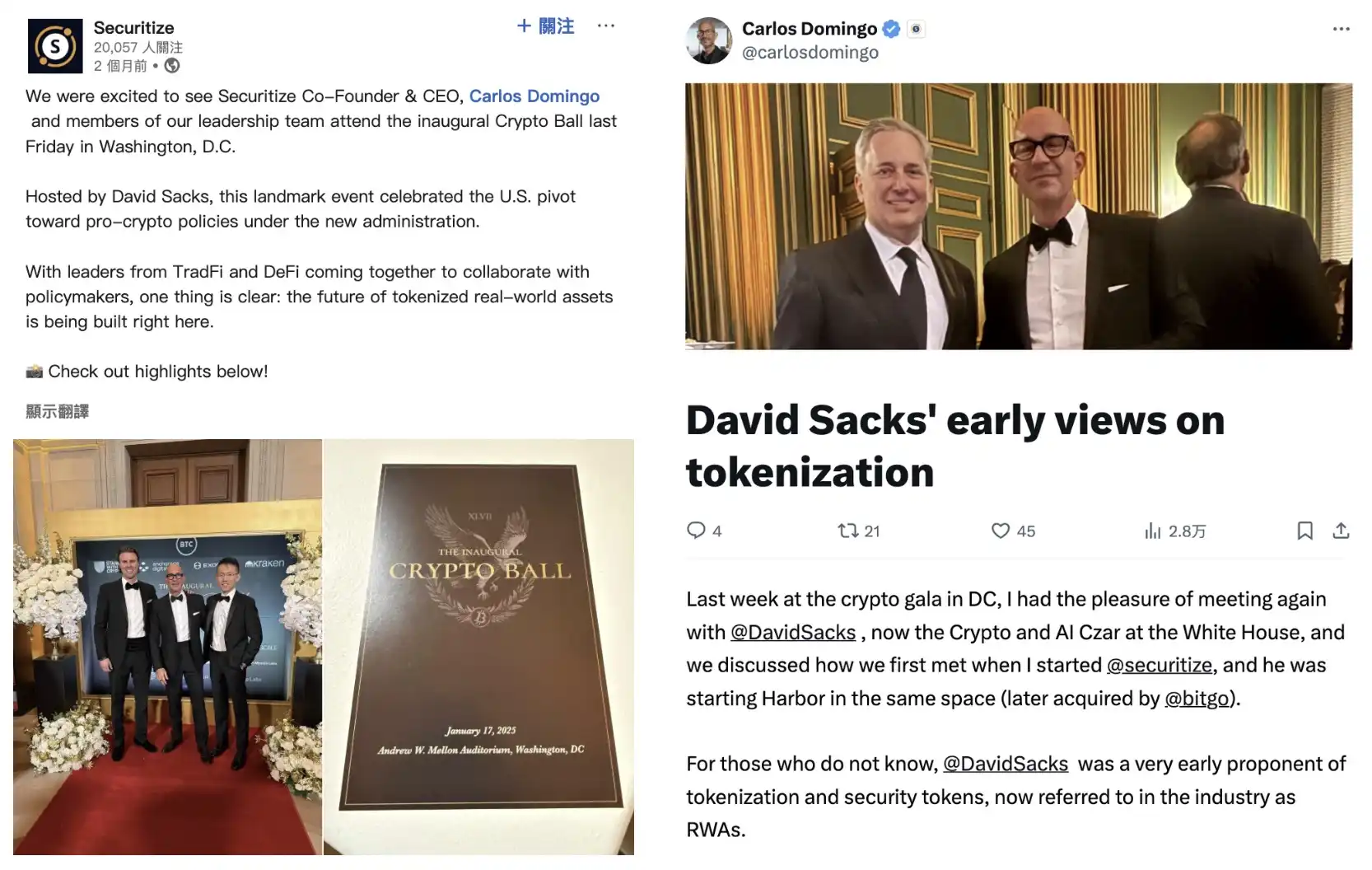
Not only with the SEC, Carlos Domingo seems to have a good relationship with White House "Crypto Tsar" David Sacks. Although David Sacks did not have direct business dealings with Securitize, Domingo not only was invited to attend the "Crypto Ball" held in Washington in February of this year and "meet again" with Sacks but also wrote a long post-event review of Sacks' early views on tokenization and RWAs.
The Best Channel for "Political Cashout"?
When it comes to tying political influence to personal branding and marketing in the crypto sphere, who is the first person you think of? Although in 2021, Trump was still calling Bitcoin a "scam" on Fox Business, three years later, the DeFi project WLFI supported by the Trump family made a high-profile appearance in October 2024 with a valuation of $15 billion. Trump himself served as the "Chief Crypto Advocate," his son Barron Trump as a "DeFi Visionary," and Eric Trump and Donald Trump Jr. actively promoted the project. In March 2025, WLFI launched its stablecoin USD1, operating on the Ethereum and Binance blockchains, competing with Tether's USDT and Circle's USDC.
The funding source and investment portfolio of WLFI have been a focus of external attention. WLFI raised $550 million through two token sales, with Justin Sun investing $30 million, becoming a key supporter. Previously, Justin Sun faced an SEC lawsuit for alleged securities fraud, but in February 2025, the SEC suspended its investigation into him. According to Forbes, Sun's investment brought the Trump family approximately $400 million in potential revenue, as the family holds 75% of the WLFI token revenue.
The Trump family's presence in the cryptocurrency field continues to expand, with their investment portfolio far exceeding the WLFI project. Based on Bloomberg's calculations using publicly available data, the family's diversified investments in NFTs, meme coins, Bitcoin ETFs, and mining have now approached nearly $1 billion in unrealized gains.
Trump's earliest involvement in crypto was likely in December 2022 when he launched a series of NFT trading cards with a distinct personal style. These digital collectibles featuring superhero-like characters were proposed and launched by Trump's old friend, Bill Zanker, the founder of The Learning Annex, and immediately sparked a frenzy in the collecting world. In hindsight, this successful venture may have led Trump to sniff out the business opportunity in crypto.

As we enter 2025, the Trump family's crypto activities have noticeably accelerated. In January, the Trump couple successively launched personal meme coins, with the initial price surge bringing in a hefty profit of $11.4 million. Through their entities CIC Digital and Fight Fight Fight LLC, the Trump family controls 80% of the token supply and has established a three-year gradual unlock mechanism. Just last week, Trump announced that the top 220 holders of $TRUMP will have the opportunity to have dinner with him.
In February of this year, the Trump Media & Technology Group teamed up with Crypto.com to apply for the registration of the "Truth.Fi Bitcoin Plus ETF," coincidentally occurring as the SEC concluded its investigation into Crypto.com. By the end of March, the Trump family went even further, announcing a partnership with leading North American mining firm Hut 8 to enter the Bitcoin mining field and even launched the USD-pegged stablecoin USD1, competing for market share with Tether and Circle.
From the President to the Secretary of Commerce, and all the way to the SEC Chairman and the "Crypto Czar," these key figures' involvement in the crypto industry seems to form a tightly intertwined web of interests. As the Trump administration's push for crypto-friendly policies gradually materializes, Cantor, Securitize, and WLFI may just be a microcosm of the entire industry. Perhaps, this "feedback loop" has only just begun. Whether this web of interests and the high-level government officials' foray into the crypto sphere will lead to increased public oversight and regulatory scrutiny, or has already become an accepted de facto reality or even a new "unwritten rule," remains to be seen.
You may also like
a16z Leads $18M Seed Round for Catena Labs, Crypto Industry Bets on Stablecoin AI Payment
Never Underestimate the Significance of the US Stablecoin 'Infrastructure Bill'
If the US stablecoin bill, the "GENIUS Act," passes smoothly this time, its significance will be tremendous. I even think it's significant enough to enter the top five in Crypto history.
Although abbreviated as the GENIUS Act, which translates directly to the Genius Act, it is actually the Guiding and Establishing National Innovation for U.S. Stablecoins, which translates to "Guiding and Establishing National Innovation for US Dollar Stablecoins."
The proposal is lengthy, with several key points summarized for everyone:
· Mandatory 1:1 Full Asset Backing: Assets include cash, demand deposits, and short-term US Treasuries. At the same time, misappropriation and rehypothecation are strictly prohibited.
· High-Frequency Disclosure: Reserve reports must be published at least monthly, introducing external audits.
· Licensing Requirement: Once the circulating market cap of the issuer's stablecoin exceeds $100 billion, it must transition into the federal regulatory system within a specified timeframe, adopting banking-grade regulation.
· Introduction of Custody: The custodian of the stablecoin and its reserve assets must be a regulated qualified financial institution.
· Clear Definition as a Payment Medium: The bill explicitly defines stablecoin as a new type of payment medium, primarily regulated by the banking regulatory system, rather than restricted by the securities or commodities regulatory system.
· Embracing Existing Stablecoins: A maximum 18-month grace period after the bill's enactment, aimed at encouraging existing stablecoin issuers (such as USDT, USDC, etc.) to promptly obtain licenses or become compliant.
After finishing the main content, let's talk about the significance of this matter with an excited heart.
Over the years, when others asked, "After working in the Crypto industry for 16 years, what application have you created?"
In the future, you can confidently tell others—Stablecoins.
Some people have held opposing views. In the past, people's impression of stablecoins was that they were an opaque black box. Every few months, there would be FUD — whether Tether's assets were frozen or Circle had a significant black hole deficit.
In fact, if you think about it, Tether easily rakes in billions of dollars a year just from the interest on those underlying government bonds. Circle, slightly less, also made a $1.7 billion profit last year.
They basically made money while standing there. From a motivational standpoint, they have no malicious intentions. In fact, they are the most eager for compliance.
Now, this opaque black box will become a transparent white box.
In the past, the only complaint was that Tether's funds might have been frozen by the United States. Now, they will be directly placed into U.S. compliant custodial institutions, with high-frequency disclosures, so you can rest assured.
【No need to worry about a rug pull】 is such a huge advantage—I think especially all Crypto people understand this.
Stablecoins were once almost on the verge of being overtaken by CBDCs. In any country, if a central bank digital currency really exists, it is highly likely not built on a blockchain, at most it is built on some internal central bank consortium chain, which to be honest, is meaningless.
When CBDCs were at their peak, that was the most dangerous time for stablecoins.
If CBDCs had become a reality back then, stablecoins today would have been relentlessly suppressed into a dark corner, and blockchain would only be able to play a minimal role.
The remaining half-dead stablecoins would even have to learn the standards of central bank digital currencies, completely relinquishing their standard-setting power.
And now, stablecoins have won (or are about to).
Instead, everyone should learn the 【Blockchain + Token】 standard.
Nowadays, many blockchains actually have no meaningful applications on top, only stablecoin transfers. For example, with Aptos, the only scenario I use Aptos for is transfers between Binance and OKX.
And now, stablecoins will be legislated, what does that mean?
That's right, blockchain will become the only standard.
In the future, every stablecoin user will be the first to learn how to use a wallet.
As an aside, I actually think Ethereum's concerted push for EIP-7702 is quite forward-thinking. While other chains are all about memes, thank you Ethereum for sticking to account abstraction.
EIP-7702 is about Account Abstraction, which can support, for example:
· Social Account Registration Wallet
· Paying GAS with Native Coin
· And more
This paves the way for future new users to heavily use stablecoins, solving the last-mile problem.
Furthermore, once stablecoins receive legislative support, deposits and withdrawals will become even easier.
Let's imagine a scenario: previously, hindered by the gray nature of stablecoins, but after the bill passes, many traditional brokerages can support stablecoins themselves. The money from a US stock investor can be converted into stablecoins in minutes and instantly deposited into Coinbase. Believe it or not.
Let's imagine another scenario: if the brilliant bill smoothly passes through the House of Representatives, next, you will see:
Due to the extremely lucrative nature of this trading, existing stablecoin leaders and newly entering traditional giants will crazily start promoting their stablecoin products.
And an outsider, due to these promotions, will start using stablecoins. And then one day, after finding out that the wallet account has been created, will explore Bitcoin inside. Is mining Bitcoin difficult?
Stablecoins are a huge Trojan horse. The moment you start using stablecoins, you unwittingly step half a foot into the Crypto world.
As a large reservoir for digesting US debt, although stablecoins cannot directly absorb debt, they at least provide ammunition for the US debt secondary market. These functions are quite important, and slowly, stablecoins are becoming a part of the US debt market's body. Therefore, once the US legislation is passed and experiences the benefits, there is no turning back.
And, we are also confident that stablecoins are indeed one of the great innovations in our industry. People who have used stablecoins will find it hard to return to the traditional cash-banking system.
Once the bill is passed, users can't go back. In the future, concerns are about to be resolved, standards will be mastered, and the era of large deposits seems to be on the horizon.
Original Article Link
After CEX and Wallet, OKX enters the payment game
Why Are Crypto Projects Rushing to Issue Credit Cards? A Battle Between Web3 and the Real World
President's 'Official' Coin Issuance, Market Performance 'Desensitized'; Trump's Crypto Empire Lacks Novelty
Launch on Binance Alpha, how much is your HAEDAL airdrop worth?
Taking Stock of the Top 10 Emerging Launchpad Platforms: Who Will Succeed in Disrupting Pump.fun?
GoRich Officially Launched: On-Chain Transactions with Zero Barrier to Entry, Even Beginners Can Catch 100x Meme Coins
Exclusive Interview with AllianceDAO Partner qw: Crypto Entrepreneurs Are Fleeing to AI, 90% of Crypto+AI Projects Are Misleading
Parse Haedal Protocol: Sui Liquidity Staking Gem Project, TVL Ratio Exceeds Sum of Competitors
Stablecoin Showdown: Six Rising Stars Enter the Fray, Will the Market Structure Shift?
Deep Dive into Dubai's Crypto Dream: Illusion, Capital, and Decentralized Empire
HTX Research Latest Research Report丨Sonic: A Case Study of the New DeFi Paradigm
While the industry was still embroiled in the Layer 2 scaling debate, Sonic offered a new answer through a "foundational revolution." Recently, HTX Research released its latest research report "Sonic: A Blueprint for the DeFi New Paradigm," detailing the new public chain Sonic. While fully compatible with the EVM, Sonic has achieved a throughput of over 2000 TPS, 0.7-second transaction finality, and a transaction cost of 0.0001 USD, outperforming mainstream Layer 1 solutions and even surpassing most Layer 2 solutions. The performance-boosting Sonic is reshaping public chain infrastructure, officially ushering in the "sub-second era" of public chains.
As a high-performance public chain based on a Directed Acyclic Graph (aDAG), Fantom Opera initially stood out for its high throughput and fast confirmation capabilities. However, as the on-chain ecosystem expanded, the limitations of its traditional EVM architecture became increasingly apparent: state storage expansion, slow node synchronization, and constrained execution efficiency. To address this, Fantom introduced the new upgrade solution Sonic, aimed at achieving performance leaps through fundamental reconstruction without relying on sharding or Layer 2.
Led by the restructured Sonic Labs, Sonic's core development team brought together top industry talents, including CEO Michael Kong, CTO Andre Cronje (founder of Yearn Finance), and Chief Research Officer Bernhard Scholz. Over a period of two and a half years, the team comprehensively optimized from the virtual machine, storage engine to the consensus mechanism, ultimately creating the standalone new chain Sonic. While being EVM-compatible, Sonic has achieved over 2000 TPS, 0.7-second finality, $0.0001 transaction cost, a 90% improvement in storage efficiency, and reduced node synchronization time from weeks to within two days.
· SonicVM: The new virtual machine dynamically compiles EVM bytecode, caches high-frequency operations (such as SHA3 hashing), and pre-analyzes jump instructions, improving execution efficiency several times over to support high-throughput demands.
· SonicDB: Using a layered storage design, it separates real-time state (LiveDB) from historical data (ArchiveDB), compressing storage space by 90%, reducing node maintenance thresholds, and enhancing decentralization.
· Sonic Gateway: A Layer 2-like cross-chain bridge to Ethereum, balancing security and efficiency through a batch processing mechanism, supporting bi-directional asset migration, and seamless integration with the Ethereum ecosystem.
Sonic introduces its native token S, exchanged 1:1 with the old token FTM, undertaking functions such as gas payment and governance staking. Its innovative mechanisms include:
· Gas Fee Monetization (FeeM): Developers can receive up to 90% of transaction fee sharing, incentivizing ecosystem app innovation; non-FeeM apps have 50% of fees burned to deter inflation.
· Point Airdrop System: Users earn points (Passive/Activity Points and Gems) through holding tokens, participating in DeFi, or ecosystem interactions, redeemable for a total of 200 million S tokens, creating a "usage is mining" positive feedback loop.
During the market downturn in 2025, Sonic's on-chain TVL grew over 500% against the trend, with stablecoin volume surpassing $260 million, driven by high-leverage yield strategies:
· Silo v2 Recurring Borrowing: Pledge S tokens to borrow stablecoins, leverage up to 20x, capturing multiple points and spread yields.
· Euler+Rings Combination: Deposit USDC to mint overcollateralized stablecoin scUSD, leverage up to 10x, while receiving Sonic points and protocol airdrops.
· Shadow DEX Liquidity Mining: Provide liquidity for mainstream trading pairs, earning up to 169% APY and receiving a share of trading fees.
The ecosystem's future plans involve introducing Real World Asset (RWA) yields and off-chain payment scenarios, expanding through compliant asset backing and consumer app integration, establishing a sustainable stablecoin utility loop.
Sonic's core DEX, FlyingTulip, designed by Andre Cronje, integrates trading, lending, and leverage functions, with key technological breakthroughs including:
· Adaptive AMM Curve: Combining Curve V2's liquidity aggregation advantage, introducing external oracle monitoring of volatility, dynamically adjusting the curve shape—close to a constant-product curve during low volatility (low slippage), and approaching a constant-product curve during high volatility (preventing liquidity depletion), reducing impermanent loss by 42%, and improving capital efficiency by 85%.
· Dynamic LTV Lending Model: Drawing inspiration from Curve's LLAMA liquidation mechanism but dynamically adjusting the loan-to-value (LTV) ratio based on market volatility. For example, the ETH collateral loan-to-value ratio can plummet from 80% during calm periods to 50% during volatile periods, reducing systemic risk.
With its triple advantage of "high performance + nested yield + low threshold," Sonic is expected to exceed $2 billion in TVL within 12 months, and its token S may impact billions of dollars in market capitalization. Its model has established a new paradigm for the industry: replacing liquidity speculation with on-chain efficiency and real returns, potentially triggering a fundamental shift in the logic of public chain competition.
Potential risks are concentrated at the technical level, including the Adaptive AMM relying on an external oracle, which could result in liquidity pool anomalies if the price feed is attacked. High-leverage strategies face liquidation risks during extreme market conditions and require hedging tools (such as perpetual contract shorts) to manage volatility.
From a macro perspective, Sonic is poised to be the dark horse in the 2025 DeFi revival wave, with the success of its stablecoin ecosystem creating broad upside potential for the ecosystem token S and overall network value. Sonic's rise validates a key proposition: even in a bear market, through mechanism innovation and performance breakthroughs, DeFi can still build a "yield fortress" to attract rational capital for long-term retention. Its nested yield model, developer incentive system, and efficient infrastructure provide the industry with a reusable template. If successfully integrated with RWAs and payment scenarios, Sonic may become a bridge connecting on-chain yield with real economic demand, propelling DeFi into a new stage of mass adoption.
To read the full report, please visit: https://square.htx.com/wp-content/uploads/2025/04/HTX-Research-Latest-Report.pdf
HTX Research is the dedicated research arm of HTX Group, responsible for in-depth analysis of a wide range of areas including cryptocurrency, blockchain technology, and emerging market trends. HTX Research produces comprehensive reports, offers professional evaluations, and is committed to providing data-driven insights and strategic foresight. It plays a key role in shaping industry perspectives and supporting informed decision-making in the digital asset space. With rigorous research methods and cutting-edge data analysis, HTX Research always remains at the forefront of innovation, driving industry thought leadership and facilitating a deep understanding of the evolving market dynamics.
Key Market Insights from April 27th, How Much Did You Miss?
WLFI Holdings Token Analysis: Did the Trump Family's Crypto Investment Pay Off?
This Week in Review | Trump to Host Dinner for TRUMP Holders; Musk and US Treasury Secretary Engage in Heated Argument at the White House
Key Market Information Discrepancy on April 27th - A Must-Read! | Alpha Morning Report
Cryptocurrency Market Sentiment Warms Up, MCP Emerges as New AI Frontier
a16z Leads $18M Seed Round for Catena Labs, Crypto Industry Bets on Stablecoin AI Payment
Never Underestimate the Significance of the US Stablecoin 'Infrastructure Bill'
If the US stablecoin bill, the "GENIUS Act," passes smoothly this time, its significance will be tremendous. I even think it's significant enough to enter the top five in Crypto history.
Although abbreviated as the GENIUS Act, which translates directly to the Genius Act, it is actually the Guiding and Establishing National Innovation for U.S. Stablecoins, which translates to "Guiding and Establishing National Innovation for US Dollar Stablecoins."
The proposal is lengthy, with several key points summarized for everyone:
· Mandatory 1:1 Full Asset Backing: Assets include cash, demand deposits, and short-term US Treasuries. At the same time, misappropriation and rehypothecation are strictly prohibited.
· High-Frequency Disclosure: Reserve reports must be published at least monthly, introducing external audits.
· Licensing Requirement: Once the circulating market cap of the issuer's stablecoin exceeds $100 billion, it must transition into the federal regulatory system within a specified timeframe, adopting banking-grade regulation.
· Introduction of Custody: The custodian of the stablecoin and its reserve assets must be a regulated qualified financial institution.
· Clear Definition as a Payment Medium: The bill explicitly defines stablecoin as a new type of payment medium, primarily regulated by the banking regulatory system, rather than restricted by the securities or commodities regulatory system.
· Embracing Existing Stablecoins: A maximum 18-month grace period after the bill's enactment, aimed at encouraging existing stablecoin issuers (such as USDT, USDC, etc.) to promptly obtain licenses or become compliant.
After finishing the main content, let's talk about the significance of this matter with an excited heart.
Over the years, when others asked, "After working in the Crypto industry for 16 years, what application have you created?"
In the future, you can confidently tell others—Stablecoins.
Some people have held opposing views. In the past, people's impression of stablecoins was that they were an opaque black box. Every few months, there would be FUD — whether Tether's assets were frozen or Circle had a significant black hole deficit.
In fact, if you think about it, Tether easily rakes in billions of dollars a year just from the interest on those underlying government bonds. Circle, slightly less, also made a $1.7 billion profit last year.
They basically made money while standing there. From a motivational standpoint, they have no malicious intentions. In fact, they are the most eager for compliance.
Now, this opaque black box will become a transparent white box.
In the past, the only complaint was that Tether's funds might have been frozen by the United States. Now, they will be directly placed into U.S. compliant custodial institutions, with high-frequency disclosures, so you can rest assured.
【No need to worry about a rug pull】 is such a huge advantage—I think especially all Crypto people understand this.
Stablecoins were once almost on the verge of being overtaken by CBDCs. In any country, if a central bank digital currency really exists, it is highly likely not built on a blockchain, at most it is built on some internal central bank consortium chain, which to be honest, is meaningless.
When CBDCs were at their peak, that was the most dangerous time for stablecoins.
If CBDCs had become a reality back then, stablecoins today would have been relentlessly suppressed into a dark corner, and blockchain would only be able to play a minimal role.
The remaining half-dead stablecoins would even have to learn the standards of central bank digital currencies, completely relinquishing their standard-setting power.
And now, stablecoins have won (or are about to).
Instead, everyone should learn the 【Blockchain + Token】 standard.
Nowadays, many blockchains actually have no meaningful applications on top, only stablecoin transfers. For example, with Aptos, the only scenario I use Aptos for is transfers between Binance and OKX.
And now, stablecoins will be legislated, what does that mean?
That's right, blockchain will become the only standard.
In the future, every stablecoin user will be the first to learn how to use a wallet.
As an aside, I actually think Ethereum's concerted push for EIP-7702 is quite forward-thinking. While other chains are all about memes, thank you Ethereum for sticking to account abstraction.
EIP-7702 is about Account Abstraction, which can support, for example:
· Social Account Registration Wallet
· Paying GAS with Native Coin
· And more
This paves the way for future new users to heavily use stablecoins, solving the last-mile problem.
Furthermore, once stablecoins receive legislative support, deposits and withdrawals will become even easier.
Let's imagine a scenario: previously, hindered by the gray nature of stablecoins, but after the bill passes, many traditional brokerages can support stablecoins themselves. The money from a US stock investor can be converted into stablecoins in minutes and instantly deposited into Coinbase. Believe it or not.
Let's imagine another scenario: if the brilliant bill smoothly passes through the House of Representatives, next, you will see:
Due to the extremely lucrative nature of this trading, existing stablecoin leaders and newly entering traditional giants will crazily start promoting their stablecoin products.
And an outsider, due to these promotions, will start using stablecoins. And then one day, after finding out that the wallet account has been created, will explore Bitcoin inside. Is mining Bitcoin difficult?
Stablecoins are a huge Trojan horse. The moment you start using stablecoins, you unwittingly step half a foot into the Crypto world.
As a large reservoir for digesting US debt, although stablecoins cannot directly absorb debt, they at least provide ammunition for the US debt secondary market. These functions are quite important, and slowly, stablecoins are becoming a part of the US debt market's body. Therefore, once the US legislation is passed and experiences the benefits, there is no turning back.
And, we are also confident that stablecoins are indeed one of the great innovations in our industry. People who have used stablecoins will find it hard to return to the traditional cash-banking system.
Once the bill is passed, users can't go back. In the future, concerns are about to be resolved, standards will be mastered, and the era of large deposits seems to be on the horizon.
Original Article Link
After CEX and Wallet, OKX enters the payment game
Why Are Crypto Projects Rushing to Issue Credit Cards? A Battle Between Web3 and the Real World
President's 'Official' Coin Issuance, Market Performance 'Desensitized'; Trump's Crypto Empire Lacks Novelty
Launch on Binance Alpha, how much is your HAEDAL airdrop worth?
Popular coins
Latest Crypto News


Customer Support:@weikecs
Business Cooperation:@weikecs
Quant Trading & MM:bd@weex.com
VIP Services:support@weex.com
 App
App