
- Buy Crypto
- Markets
- Futures
- Spot
- Copy Trade
 WE-Launch
Is the Shift Away from "Buying the Dip" Strategy the Reason Behind Bitcoin's Recent Drop?

Original Article Title: Why did Bitcoin's largest buyers suddenly stop accumulating?
Original Article Author: Oluwapelumi Adejumo, Crypto Slate
Original Article Translation: Luffy, Foresight News
Throughout most of 2025, Bitcoin's support level seemed unshakable due to the unexpected alliance between Corporate Digital Asset Treasuries (DAT) and Exchange-Traded Funds (ETF), collectively forming the support foundation.
Enterprises acquired Bitcoin through issuing stocks and convertible bonds, while ETF inflows quietly absorbed new supply. Together, they built a robust demand foundation that helped Bitcoin withstand the pressure of a tightening financial environment.
Now, this foundation is beginning to weaken.
On November 3, Charles Edwards, the founder of Capriole Investments, posted on X platform that as institutional accumulation slowed down, his bullish outlook has diminished.
He pointed out: "For the first time in 7 months, institutional net inflows fell below daily mining supply, a concerning development."
Bitcoin Institutional Buying Volume, Source: Capriole Investments
Bitcoin Institutional Buying Volume, Source: Capriole Investments
Edwards stated that even though other assets outperform Bitcoin, this indicator remains a key reason for his optimism.
However, currently, around 188 corporate treasuries hold significant Bitcoin positions, with many companies having a relatively single-focused business model besides Bitcoin exposure.
Bitcoin Treasury Accumulation Slows Down
No company represents corporate Bitcoin trading better than the recently renamed "Strategy," formerly known as MicroStrategy.
Led by Michael Saylor, this software manufacturer has transformed into a Bitcoin treasury company, currently holding over 674,000 bitcoins, securing its position as the world's largest single corporate holder.
However, its buying pace has significantly slowed down in recent months.
In the third quarter, Strategy only increased its Bitcoin holdings by about 43,000 coins, the lowest quarterly purchase amount this year. Considering that the company's Bitcoin purchases during this period plummeted to only a few hundred coins, this number is not surprising.
CryptoQuant analyst J.A. Maarturn explained that the slowdown in accumulation may be related to Strategy's Net Asset Value (NAV) decline.
He stated that investors had previously paid a high "NAV premium" for each $1 of Bitcoin on Strategy's balance sheet, essentially allowing shareholders to benefit from Bitcoin's price appreciation through leverage. However, this premium has significantly narrowed since mid-year.
With the dwindling valuation premium, issuing new shares to purchase Bitcoin no longer brings significant appreciation, and the incentive for corporate financing to increase holdings has decreased accordingly.
Maarturn pointed out: "The funding difficulty has increased, and the stock issuance premium has dropped from 208% to 4%."
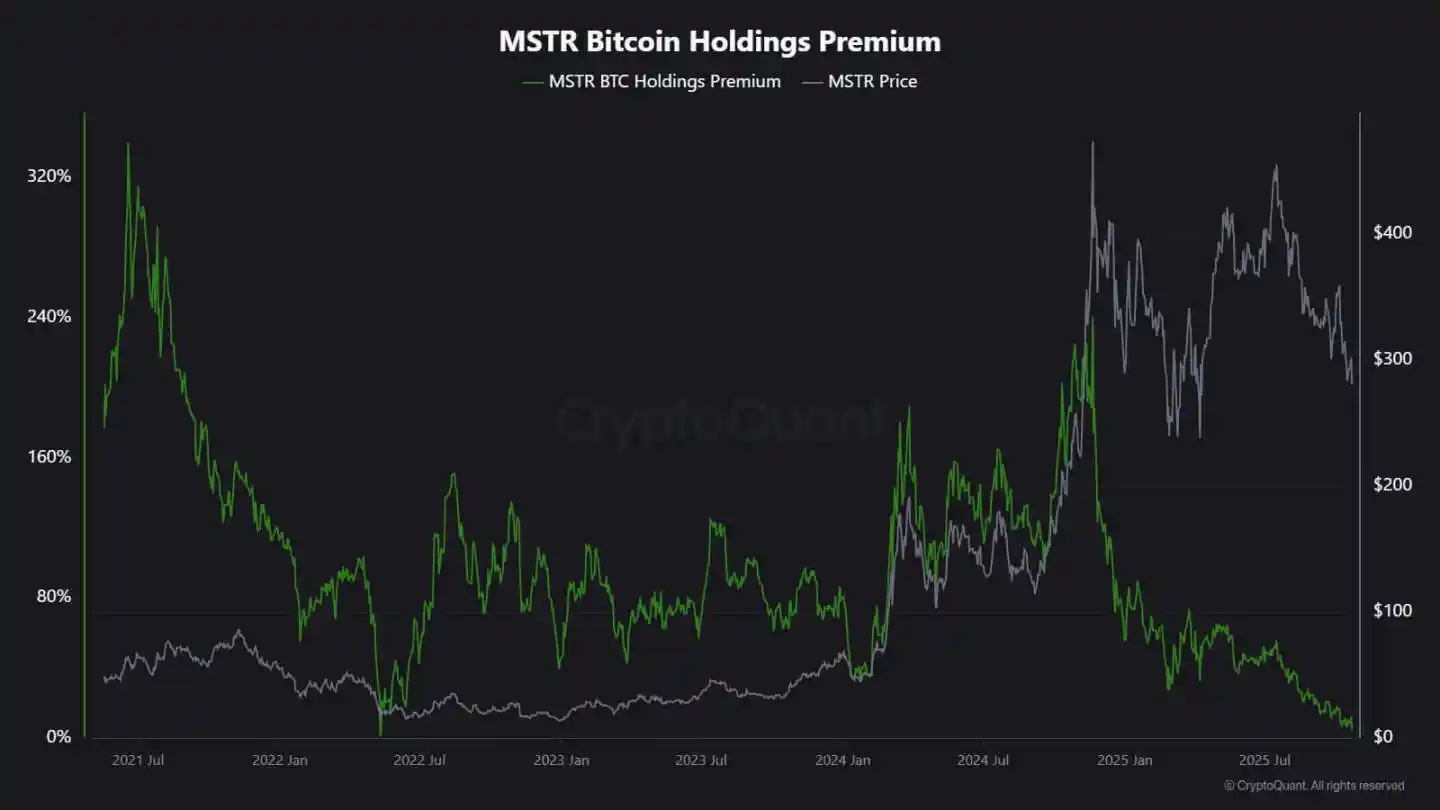
Strategy Stock Premium, Source: CryptoQuant
Meanwhile, the cooling trend in accumulation is not limited to Strategy.
Tokyo-listed company Metaplanet previously followed the model of this U.S. pioneer, but after a significant drop in the stock price, the recent trading price is below its Bitcoin holdings' market value.
In response, the company approved a stock repurchase plan and introduced new funding guidance to expand its Bitcoin treasury. This move demonstrates the company's confidence in its balance sheet, but also highlights that investors' enthusiasm for the "crypto treasury" business model is waning.
In fact, the slowdown in Bitcoin treasury accumulation has led to some corporate mergers.
Last month, asset management firm Strive announced the acquisition of smaller-scale Bitcoin treasury company Semler Scientific. After the merger, these companies will hold nearly 11,000 Bitcoins.
These cases reflect structural constraints rather than wavering beliefs. When stock or convertible bond issuance no longer commands a market premium, capital inflows dry up, and corporate accumulation naturally slows down.
How Are ETF Flows Doing?
Long seen as the "New Supply Absorber," the spot Bitcoin ETF has also shown similar signs of weakness.
Throughout much of 2025, these financial investment tools dominated net demand, with subscription volume consistently outpacing redemption volume, especially during Bitcoin's surge to an all-time high.
However, by late October, their fund flows became unstable. Influenced by interest rate expectations, portfolio managers adjusted positions, risk departments reduced exposure, and some weekly fund flows turned negative. This volatility marked a new phase of behavior for Bitcoin ETFs.
The macro environment has tightened, hopes for rapid rate cuts have gradually faded, and liquidity conditions have cooled. Nevertheless, the market demand for Bitcoin exposure remains strong but has shifted from "steady inflows" to "pulsed inflows."
SoSoValue's data clearly reflects this shift. In the first two weeks of October, cryptocurrency asset investment products attracted nearly $6 billion in inflows; however, by the end of the month, with redemptions exceeding $20 billion, some of the inflows were wiped out.

Bitcoin ETF Weekly Fund Flows, Source: SoSoValue
This pattern indicates that Bitcoin ETFs have matured into a true two-way market. They can still provide deep liquidity and institutional access channels but are no longer just one-way accumulation tools.
When macro signals fluctuate, ETF investors' exit speed may be just as rapid as their entry speed.
Market Impact on Bitcoin
This shift does not necessarily mean that Bitcoin will experience a decline, but it does indicate increased volatility. As the absorption capacity of corporations and ETFs weakens, Bitcoin's price trajectory will be increasingly influenced by short-term traders and macro sentiment.
Edwards believes that, in this scenario, new catalysts—such as monetary easing, regulatory clarity, or a return of stock market risk appetite—could reignite institutional buying.
However, at present, marginal buyers are more cautious, making price discovery more sensitive to the global liquidity cycle.
The impact is primarily manifested in two aspects:
First, the structural buy orders that once served as support are diminishing. During periods of insufficient absorption, intraday volatility may intensify as there is a lack of stable buyers to curb volatility. The halving in April 2024 technically reduced new supply, but without sustained demand, scarcity alone cannot guarantee price increases.
Second, Bitcoin's correlated features are shifting. As the balance sheet accumulation cools off, the asset may once again follow overall liquidity cycle dynamics. Periods of rising real rates and a strong dollar could create price pressure, while loose conditions could see it reestablishing leadership in risk-on rallies.
Essentially, Bitcoin is re-entering a macro reflexivity phase, behaving more like a high-beta risk asset rather than digital gold.
At the same time, all this does not negate Bitcoin's long-term narrative as a scarce, programmable asset. Instead, it reflects the increasing influence of institutional dynamics—entities that shielded Bitcoin from retail-driven volatility are now tightening its correlation with broader capital markets, cementing its mainstream portfolio allo-cation.
The coming months will test whether Bitcoin can hold its store of value characteristics in the absence of corporate and ETF auto-matic inflows.
By historical analogy, Bitcoin has often exhibited adaptability. As one demand channel wanes, another emerges—whether from sovereign reserves, fintech integration, or retail re-engagement in a macro easing cycle.
You may also like

Hyperliquid Whales Shift Strategies: BTC Longs Decline, ETH Shorts Dominate
Key Takeaways A significant reduction in Bitcoin long positions has been observed on Hyperliquid, with large holders decreasing…

Crypto Christmas Heist: Over $6 Million Lost, Trust Wallet Chrome Extension Wallet Hacked Analysis
Bitcoin Surges Toward $90,000 as $27 Billion Crypto Options Expire
Key Takeaways Bitcoin’s price is nearing the $90,000 mark amid increased market activity following the holiday lull. The…

Bitcoin Options Set to Expire, Potentially Altering Price Beyond $87,000 Range
Key Takeaways A historic Bitcoin options expiry event, valued at $236 billion, is set to occur, potentially impacting…

Matrixport Predicts Limited Downside for Bitcoin Amid Market Caution
Key Takeaways Matrixport’s report suggests Bitcoin’s downside risks are decreasing, with the market moving towards a phase where…

Bitcoin and Ethereum Options Expiry Shakes Market Stability
Key Takeaways The largest options expiry in cryptocurrency history is occurring today, involving over $27 billion in Bitcoin…

Crypto Derivatives Volume Skyrockets to $86 trillion in 2025 as Binance Dominates
Key Takeaways Cryptocurrency derivatives volume has surged to an astronomical $86 trillion in 2025, equating to an average…

Kraken IPO to Rekindle Crypto’s ‘Mid-Stage’ Cycle: A Comprehensive Analysis
Key Takeaways: Kraken’s anticipated IPO in 2026 could significantly attract fresh capital from traditional financial investors, marking a…
Fed Q1 2026 Outlook: Potential Impact on Bitcoin and Crypto Markets
Key Takeaways: Federal Reserve’s policies could exert significant pressure on cryptocurrencies if rate cuts halt in early 2026.…

Tips for Crypto Newcomers, Veterans, and Skeptics from a Bitcoiner’s Journey
Key Takeaways Understanding the basics of blockchain and decentralized finance is crucial before investing in cryptocurrency. Newcomers should…

Quantum Computing in 2026: No Crypto Doomsday, Time to Prepare
Key Takeaways: Quantum computing still poses a theoretical risk to cryptocurrency security, but immediate threats are minimal due…
El Salvador’s Bitcoin Aspirations Brought Closer to Earth in 2025
Key Takeaways: Early Ambitions vs. Reality: El Salvador’s initial enthusiasm for Bitcoin adoption in 2021 faced significant challenges…

Ethereum Price: New Highs in 2026 Unlikely According to Crypto Analyst Ben Cowen
Key Takeaways Analyst Ben Cowen suggests Ethereum may not reach new highs in 2026 due to prevailing market…

Blockchains Quietly Brace for Quantum Threat Amid Bitcoin Debate
Key Takeaways Cryptocurrency networks, especially altcoins, are enhancing security to prepare for potential quantum computing threats. Bitcoin faces…

Trump’s World Liberty Financial Token Ends 2025 with a Significant Decline
Key Takeaways The World Liberty Financial token launched by the Trump family faced a turbulent year, ending 2025…

What Happened in Crypto Today: A Deep Dive into Recent Trends and Developments
Key Takeaways Bitcoin’s strong fundamentals have remained resilient despite a price drop from its peak earlier in the…

Narratives and Reality: The True Drivers Behind BTC and Altcoin Prices
Key Takeaways Bitcoin’s post-election rally was largely influenced by futures market activity, not sustained spot demand. Spot Bitcoin…
Canton Token Surges Amid DTCC’s Tokenized Treasury Plans
Key Takeaways Canton Coin has surged by approximately 27% due to growing institutional interest and DTCC’s announcement to…
Hyperliquid Whales Shift Strategies: BTC Longs Decline, ETH Shorts Dominate
Key Takeaways A significant reduction in Bitcoin long positions has been observed on Hyperliquid, with large holders decreasing…
Crypto Christmas Heist: Over $6 Million Lost, Trust Wallet Chrome Extension Wallet Hacked Analysis
Bitcoin Surges Toward $90,000 as $27 Billion Crypto Options Expire
Key Takeaways Bitcoin’s price is nearing the $90,000 mark amid increased market activity following the holiday lull. The…
Bitcoin Options Set to Expire, Potentially Altering Price Beyond $87,000 Range
Key Takeaways A historic Bitcoin options expiry event, valued at $236 billion, is set to occur, potentially impacting…
Matrixport Predicts Limited Downside for Bitcoin Amid Market Caution
Key Takeaways Matrixport’s report suggests Bitcoin’s downside risks are decreasing, with the market moving towards a phase where…
Bitcoin and Ethereum Options Expiry Shakes Market Stability
Key Takeaways The largest options expiry in cryptocurrency history is occurring today, involving over $27 billion in Bitcoin…
Popular coins
Latest Crypto News


Customer Support:@weikecs
Business Cooperation:@weikecs
Quant Trading & MM:bd@weex.com
VIP Services:support@weex.com
 App
App