
- Buy Crypto
- Markets
- Futures
- Spot
- Copy Trade
 Earn
Earn- More
Michael Saylor Microsoft Board Presentation: Bitcoin is the Corporate World's Best Treasury Reserve Asset

Original Author: Michael Saylor, Founder of MicroStrategy
Original Translation: Felix, PANews
Microsoft plans to vote on the proposal to "Evaluate Bitcoin Investment" at its annual meeting on December 10. If the proposal is approved, Microsoft will become the largest publicly traded crypto investment company, surpassing MicroStrategy and Tesla. Ahead of the voting, Michael Saylor gave a 3-minute speech to the Microsoft board, explaining why Bitcoin should be adopted. In his speech, Michael Saylor proposed that Bitcoin represents "digital capital," is the core opportunity of the next wave of technological innovation, embodies the greatest digital transformation of the 21st century, and suggested that Microsoft adopt Bitcoin as a core corporate strategy. Below are some highlights of the presentation slides used:
Microsoft cannot afford to miss the next wave of technological trends, which include 7:
· Personal Computing
· Graphical User Interface
· Internet
· Mobile Computing
· Cloud Computing
· Artificial Intelligence
· Digital Capital

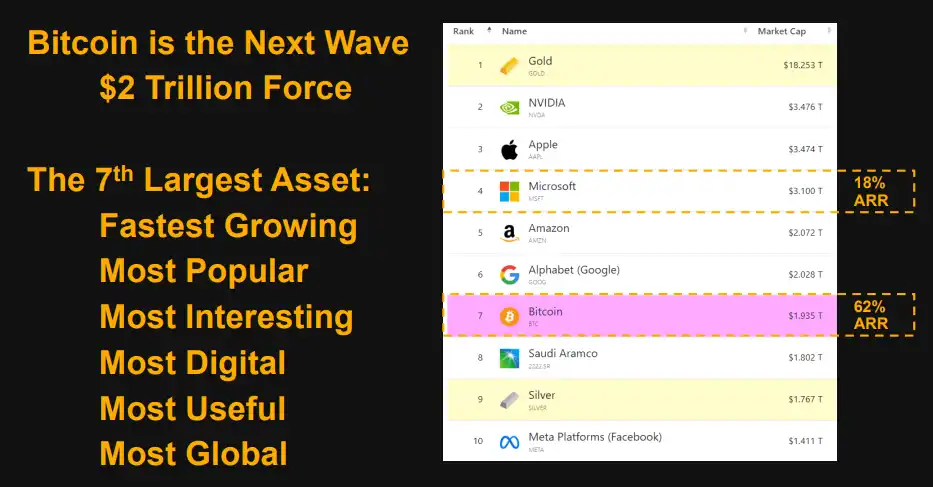
The greatest digital transformation of the 21st century is the transformation of capital, and Bitcoin is digital capital. Bitcoin is currently the world's seventh largest asset, with the fastest growth, most popularity, most intriguing, most digital nature, most utility, and most global. In addition, Microsoft's current Annual Recurring Revenue (ARR) is 18%, while Bitcoin's ARR is 62%.
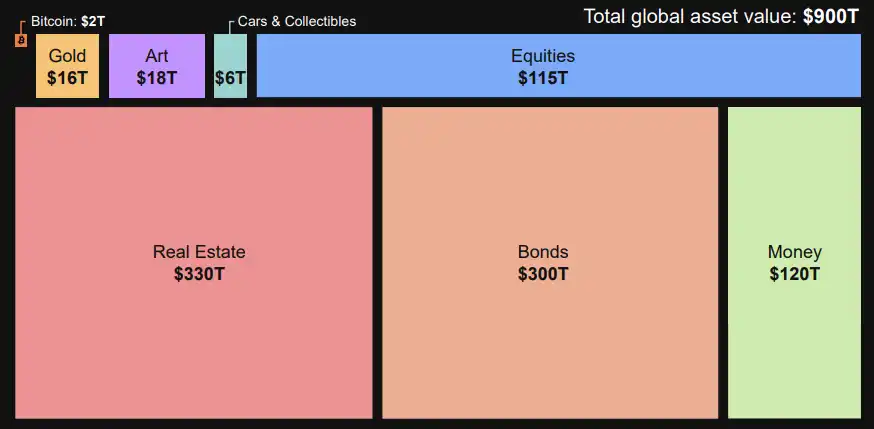
Currently, global wealth is distributed among various assets. In the current global asset market of around $90 trillion, Bitcoin's market cap is around $2 trillion.
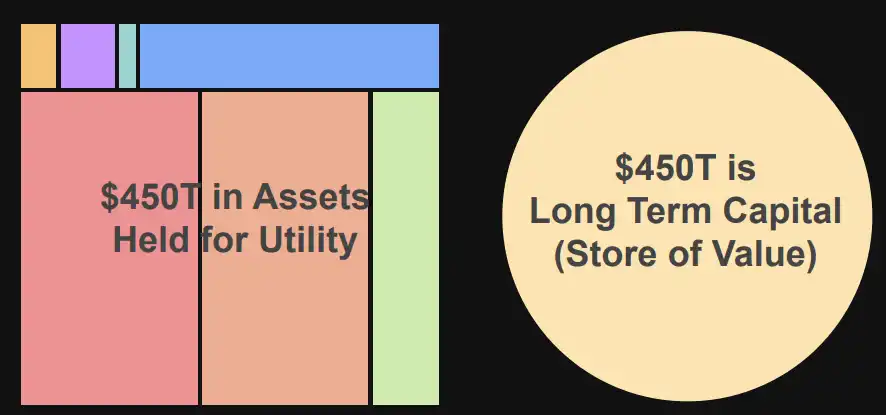
Global wealth is distributed between assets that provide utility and assets that serve as store of value. Of the $450 trillion belonging to long-term capital (value storage), more than $10 trillion of assets are lost each year due to risks such as regulation, taxation, competition, obsolescence, economic and political turmoil, and crime.
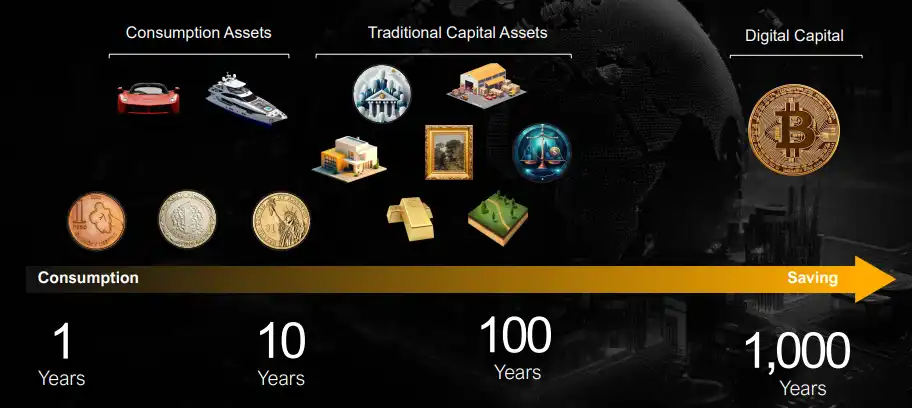
Digital capital is economically and technologically superior to physical capital, and long-term capital is transitioning to digital capital (Bitcoin). Bitcoin offers advantages similar to owning a building but without obvious, fixed asset liabilities. For example: no taxation, no need to consider traffic, tenants, encroachments, weather factors, building decay, and regulatory bodies. Instead, Bitcoin has properties such as intangibility, indestructibility, permanent existence, remote transferability, programmability, divisibility, convertibility, and configurability.
One could argue that Bitcoin is a revolutionary advancement in capital preservation.
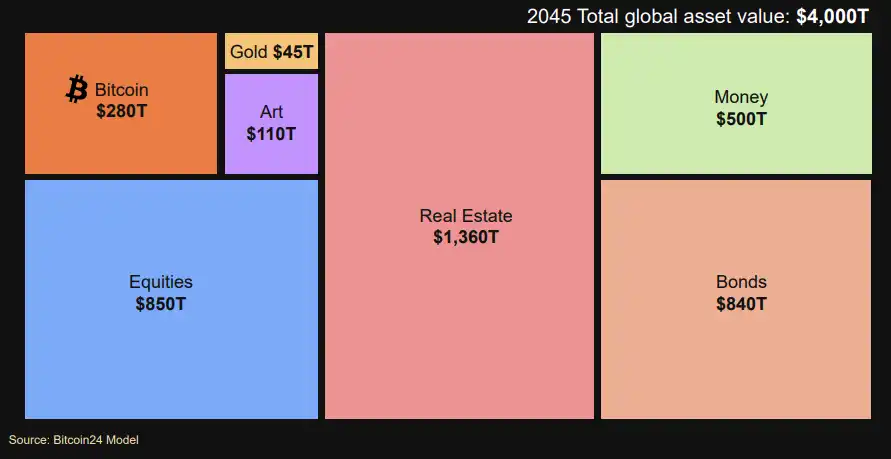
Furthermore, Bitcoin's market capitalization is expected to grow from the current $2 trillion to $280 trillion by 2045, surpassing traditional assets such as bonds and gold.
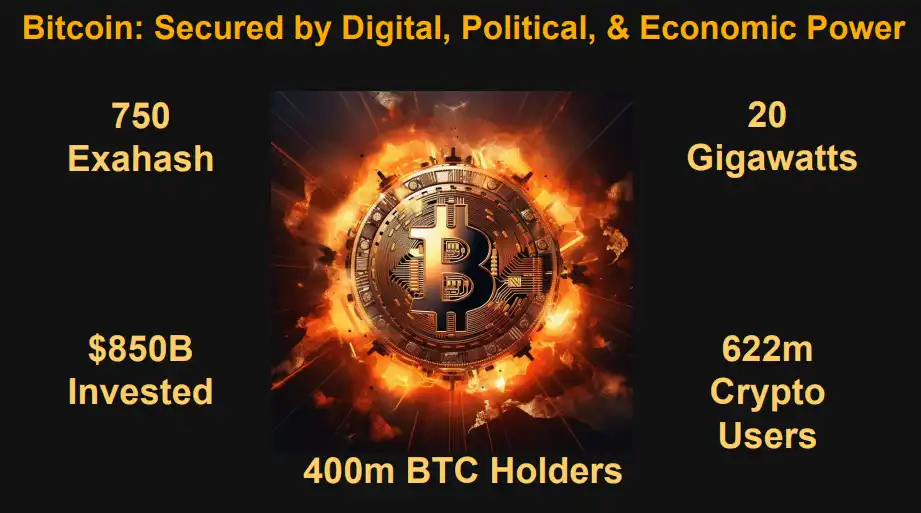
Additionally, Bitcoin is protected by digital, political, and economic forces. The current Bitcoin network has over 750 Exahashes of computing power, with 622 million crypto users and 400 million Bitcoin holders.
Based on a four-year annual asset performance chart, Bitcoin is the best-performing non-correlated asset on a corporate balance sheet.
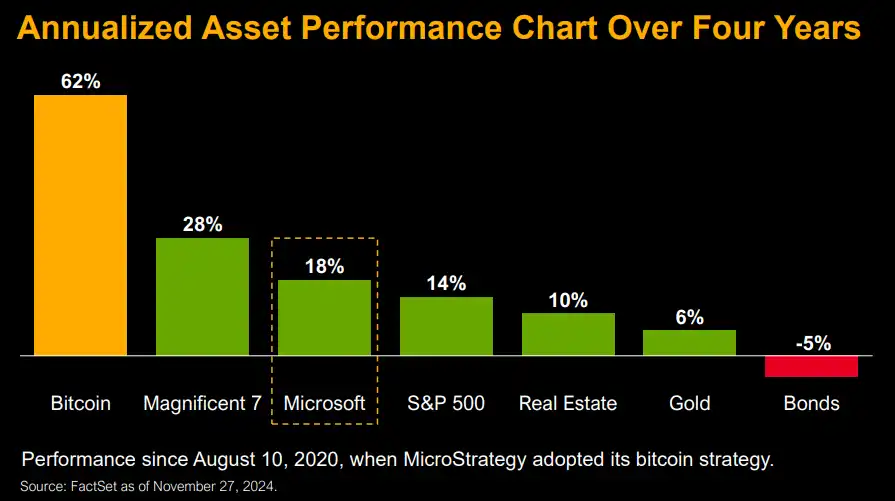
Performance since MicroStrategy adopted a Bitcoin strategy on August 10, 2020
Bitcoin's annual performance is ten times higher than Microsoft's, while bonds have performed less impressively.
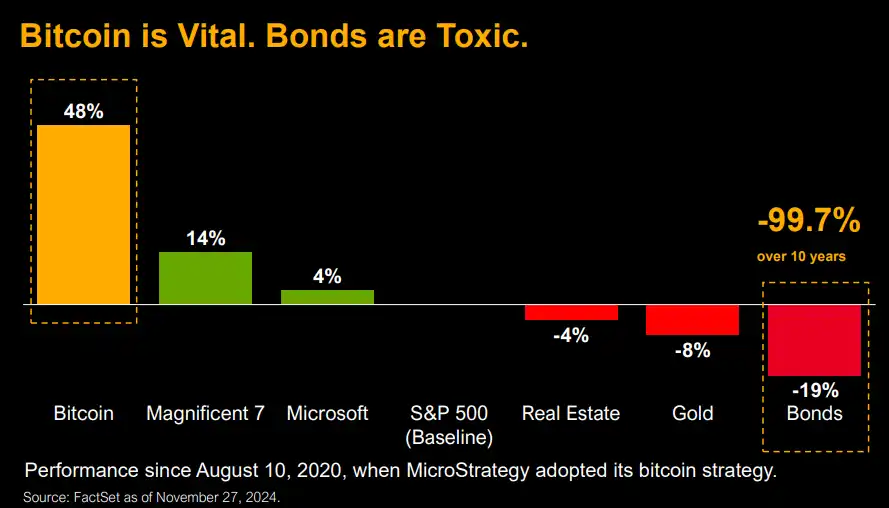
Performance since MicroStrategy adopted a Bitcoin strategy on August 10, 2020
The outstanding performance of corporate stocks is inseparable from Bitcoin (digital capital). Since MicroStrategy adopted a Bitcoin strategy on August 10, 2020, MicroStrategy's stock price has increased by 3045%, while Microsoft (MSFT) has only seen a 103% increase.
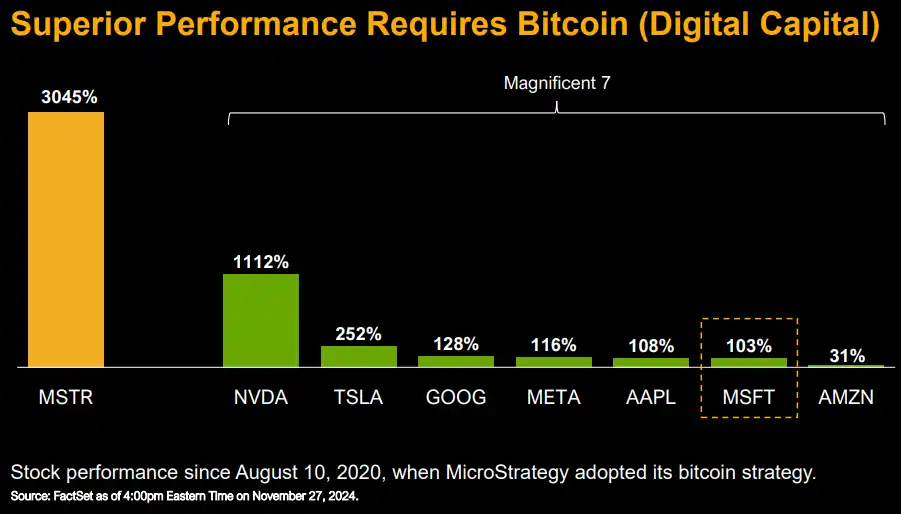
Performance since MicroStrategy adopted a Bitcoin strategy on August 10, 2020
Furthermore, MSFT (Microsoft) stocks and options are weak and deteriorating (Microsoft is actively reducing the options market and stocks as a store of value through its financial strategy).
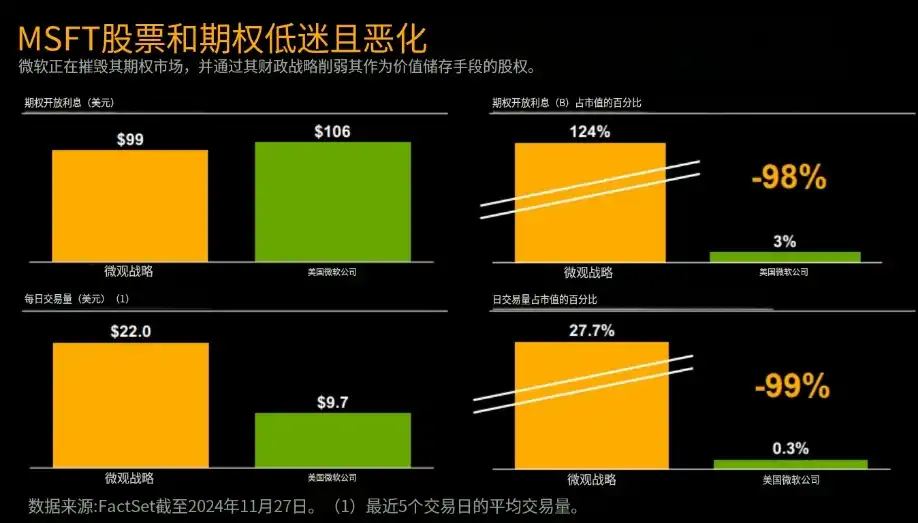
Today, Bitcoin has become an institutional asset, now seen as a viable alternative to corporate bonds. The number of public entities holding Bitcoin has surged:
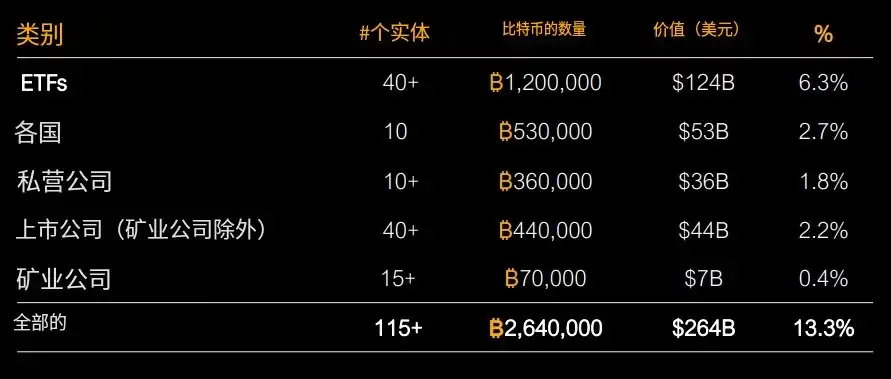
In addition, a wave of political support for Bitcoin is surging, with endorsements from government, Wall Street, and several well-known political figures. Endorsements have come from the White House, Senate, House of Representatives, and Wall Street, with notable figures such as Donald Trump, JD Vance, Robert Kennedy, Howard Lutnick, and Musk. Meanwhile, support for the United States' strategic Bitcoin reserve is also growing rapidly, with Trump once saying, "Never sell your Bitcoin."
2025 will be the first year of a comprehensive cryptocurrency renaissance. Expect:
· Wall Street adopting ETFs
· FASB fair value accounting
· Over 250 cryptocurrency supporters in Congress
· Bitcoin Strategic Reserve Act
· Repeal of SAB 121
· End to legal battles over cryptocurrency
· Digital asset framework
In this scenario, Microsoft must make a choice:
· Stick to the past: A traditional financial strategy based on government bonds, buybacks, and dividends
· Embrace the future: An innovative financial strategy based on Bitcoin as a digital capital asset
· Step back: Buy back $100 billion annually, increase investor risk, and slow growth
· Move forward: Invest $100 billion annually, reduce investor risk, and accelerate growth
Microsoft has already bought back $200 billion in capital over five years.
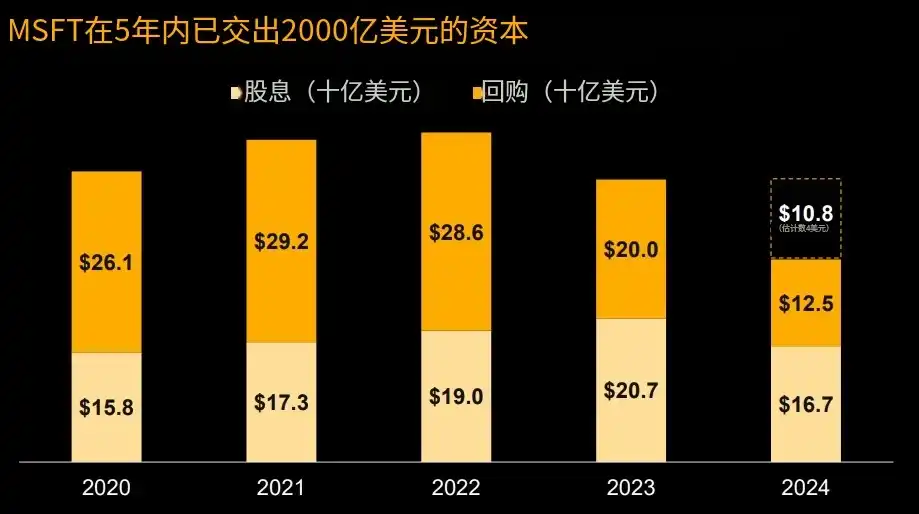
Buybacks and dividends amplify Microsoft's risk factors. Bitcoin is the best way to break free from this vicious cycle. As an asset, Bitcoin has no counterparty risk from competitors, nations, corporations, creditors, cultures, or currencies. It is recommended that Microsoft seize this era-defining opportunity and take a leading position in global digital financial innovation.
You may also like

Telegram 2025 Financial Report Puzzle: Revenue Soars by 65%, Yet Plagued by $200 Million Loss Due to TON?

North Korean Hackers Enjoy 'Fat Years': Stole Record Amount in 2025, With Money Laundering Cycle of About 45 Days

Crypto and AI: the hidden digital gray market of Xianyu
Crypto and AI: You Can Buy Anything on Xianyu.

Why Is On-Chain Fixed-Rate Lending Hard to Come By? "Basis Swap" Trading Is the Way Out

What’s Driving Crypto Markets in Early 2026: Market Swings, AI Trading, and ETF Flows?
Imagine checking Bitcoin and Ethereum prices in a day — one minute up 5%, the next down 4%. Sharp moves, quick reversals, and sensitivity to macro signals marked the first week of 2026. After an early-year rally, both assets pulled back as markets recalibrated expectations around U.S. monetary policy and institutional flows. For traders — including those relying on AI or automated systems — this period offered a vivid reminder: abundant signals do not guarantee clarity. Staying disciplined in execution is often the real challenge.

America's First State-Backed Stablecoin FRNT: Can It Save Wyoming Amid Energy Slump?

Zcash Core Team Exodus Story, Crypto's Own OpenAI Drama

Kinetiq Exclusive Interview: From Hyperliquid's Largest LST Protocol to the "Exchange Factory"

Glassnode New Year Report: $95K Call Option Premium, Bulls Shift to Aggressive Offense

Base contributes 70% of revenue but pays only 2.5% in rent; Superchain may be entering its "forking" countdown

ZCash Team Split, Bank of America Upgrades Coinbase Rating, What's the Overseas Crypto Community Talking About Today?
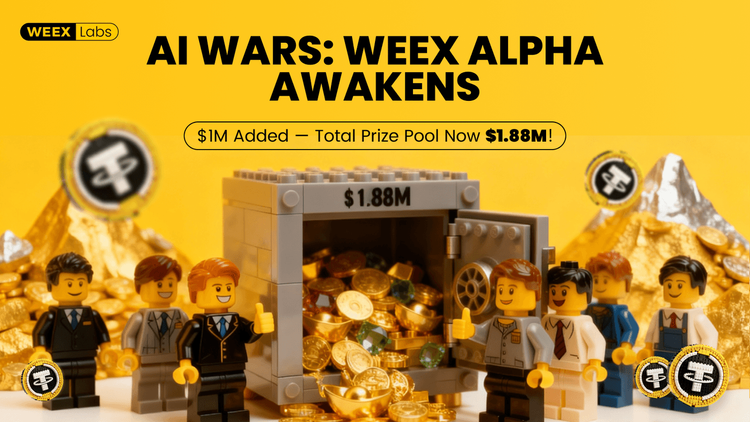
WEEX Global AI Trading Hackathon Kicks Off: $1.88M Prize Pool Powers the Next Generation of AI Trading Champions
WEEX Labs, the innovation arm of WEEX, a leading global crypto exchange serving over 6.2 million users across 150+ countries, is set to kick off the preliminary round of its flagship global AI trading hackathon, AI Wars: WEEX Alpha Awakens, on January 12, 2026. Backed by the strong support of world-class sponsors including Amazon Web Services (AWS), the total prize pool has surged from $880,000 to an unprecedented $1,880,000, positioning AI Wars among the largest AI trading hackathons in the crypto industry. At the top of the leaderboard awaits an extraordinary champion prize — a Bentley Bentayga S, already on standby in Dubai, ready to be claimed by the ultimate AI trading victor.
December Exchange Rankings: CEX and DEX Simultaneously Weaken, On-Chain Perpetual Contract Trading Volume Declines by 30%

2025 Market Prediction Retrospective: Total Transaction Volume Exceeds $50 Billion, Duopoly Market Share Exceeds 97.5%

Key Market Info Discrepancy on January 9th - A Must-Read! | Alpha Morning Report

Aster Coin: A Deep Dive into Its Price, Potential, and Why It’s Catching Eyes in 2026
Have you ever stumbled upon a crypto project that seems poised for growth amid market volatility, only to…
Left Hand BTC, Right Hand AI Computing Power: The Gold and Oil of the Data Intelligence Era

Wyoming’s FRNT Stablecoin Launches — First State-Backed Stablecoin Hits Market
Key Takeaways Wyoming leads innovation in the U.S. by launching the first state-backed stablecoin, FRNT, representing a pivotal…
Telegram 2025 Financial Report Puzzle: Revenue Soars by 65%, Yet Plagued by $200 Million Loss Due to TON?
North Korean Hackers Enjoy 'Fat Years': Stole Record Amount in 2025, With Money Laundering Cycle of About 45 Days
Crypto and AI: the hidden digital gray market of Xianyu
Crypto and AI: You Can Buy Anything on Xianyu.
Why Is On-Chain Fixed-Rate Lending Hard to Come By? "Basis Swap" Trading Is the Way Out
What’s Driving Crypto Markets in Early 2026: Market Swings, AI Trading, and ETF Flows?
Imagine checking Bitcoin and Ethereum prices in a day — one minute up 5%, the next down 4%. Sharp moves, quick reversals, and sensitivity to macro signals marked the first week of 2026. After an early-year rally, both assets pulled back as markets recalibrated expectations around U.S. monetary policy and institutional flows. For traders — including those relying on AI or automated systems — this period offered a vivid reminder: abundant signals do not guarantee clarity. Staying disciplined in execution is often the real challenge.


 App
App