
- Buy Crypto
- Markets
- Futures
- Spot
- Copy Trade
 Earn
Earn- More
**Military Lockdown Shakes Up South Korean Crypto Market: $33 Billion Sell-Off Wave and Native Project Exoduses**

Original Article Title: Martial law in South Korea and the crypto market outlook
Original Source: Tiger Research Reports
Original Translation: Deep Tide TechFlow
Key Points Summary:
· Market Volatility: The announcement of martial law triggered a massive sell-off on South Korean cryptocurrency exchanges, with a total sell-off amounting to around 33.3 billion USD. The price of Bitcoin dropped to 62,300 USD, with the local market recording the highest trading volume globally at one point.
· Investor Exodus: Due to price fluctuations and system failures in local exchanges, South Korean investors are expected to pivot to overseas exchanges and DeFi platforms.
· Industry Contraction: Political instability is prompting South Korean blockchain projects to move overseas. Key legislation, such as the Virtual Asset User Protection Law, may be delayed as a result.
1. Introduction

Source: Yonhap News
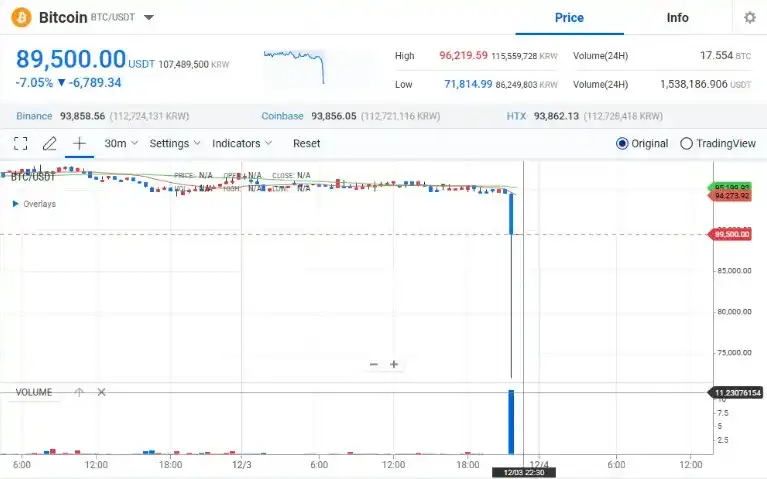
Last night, President Yoon Suk-yet suddenly announced and lifted martial law, causing a shock to South Korea's cryptocurrency market. Bitcoin's price on South Korea's largest exchange Upbit dropped to 62.3K USD. Upbit and Bithumb, the two major South Korean exchanges, saw 24-hour trading volumes of 26.9 billion USD and 6.4 billion USD, respectively, reaching their highest levels this year. This reflects the large-scale sell-off by South Korean investors following the declaration of martial law. During this period, South Korean exchanges briefly became the highest-volume market globally, highlighting the extreme volatility of its market.
2. Decline in Trust in the Won Assets and Rise in Cryptocurrency Demand

The martial law event severely eroded trust in won-denominated assets. With foreign capital exiting, the stock and bond markets may become even more volatile. As a result, investors are gradually shifting their focus to decentralized assets such as cryptocurrency.
Against the backdrop of rising geopolitical risks, investors are turning to cryptocurrency to protect their assets. Major cryptocurrencies like Bitcoin are garnering attention for being beyond government control. In past crises such as the Hong Kong protests and the Russia-Ukraine conflict, cryptocurrency has been seen as a safe-haven asset.
3. The Double-Edged Sword of Stringent Regulation and the Acceleration of Exchange Exodus
South Korean cryptocurrency exchanges maintain high security through strict travel rules and KYC regulations. The enactment of designated financial transaction information reporting and usage laws has strengthened anti-money laundering (AML) measures and enhanced investor protection. These efforts have positioned South Korea as a leader in regulatory compliance.
Source: Upbit
However, the market crash revealed the double-edged sword effect of stringent regulation. The strict rules have sustained a Kimchi Premium, widened the price gap with global markets, and made it difficult for investors to make rational decisions.
The significant price fluctuations and system instability of local exchanges have eroded investor trust. With overnight trading volumes reaching $33.3 billion, servers of Upbit and Bithumb experienced crashes. Unlike overseas exchanges, this instability has made local exchanges appear unreliable.
These issues are expected to accelerate South Korean investors' shift to overseas exchanges and DeFi platforms. Binance and Coinbase provide a stable trading environment and diverse financial products, making them the preferred choice for South Korean investors.
4. Acceleration of South Korean Blockchain Project Exodus
Due to political instability, the investment environment for South Korean blockchain projects has been affected. Many large projects have already moved overseas, and this trend is expected to continue. Nexon's blockchain division Nexpace has relocated to Abu Dhabi, Klaytn and LINE Finschia's Kaia Foundation have moved to Singapore, and Wemade's Wemix has shifted to Dubai. These companies have chosen blockchain-friendly countries to avoid South Korea's regulatory uncertainty and political risk. More projects are expected to move to Singapore and the UAE, where regulations remain clear and stable.
The overseas migration of blockchain startups has raised concerns about talent drain. This trend could weaken South Korea's competitiveness in the blockchain field. Against the backdrop of rapid development in Web3 and blockchain technology, talent outflow may have a long-term negative impact on South Korea's technological advantage. This brain drain has intensified the industry's sense of crisis.
Furthermore, the impeachment issue may delay the progress of key legislation. Laws such as the Virtual Asset User Protection Act currently being discussed in the National Assembly may face delays. These delays could further hinder the institutionalization process of South Korea's cryptocurrency market.
5. Conclusion
The martial law incident exposed structural weaknesses in the South Korean cryptocurrency market. Overnight, $333 billion in value vanished from sight, with major exchanges’ servers crippled. The market experienced extreme price volatility, with significant price discrepancies compared to global exchanges. These events underscored political risks in the market and the fragility of the current trading system under pressure.
In the short term, market instability is expected to persist. However, with appropriate institutional improvements and system enhancements, this crisis could also serve as a turning point. These efforts will help strengthen the stability of the South Korean cryptocurrency ecosystem and drive its globalization. The future trajectory is worth close monitoring.
You may also like

After Forty Years of Sanctions, How Iran Is Rebooting Financial Channels Through Crypto

Telegram 2025 Financial Report Puzzle: Revenue Soars by 65%, Yet Plagued by $200 Million Loss Due to TON?

North Korean Hackers Enjoy 'Fat Years': Stole Record Amount in 2025, With Money Laundering Cycle of About 45 Days

Crypto and AI: the hidden digital gray market of Xianyu
Crypto and AI: You Can Buy Anything on Xianyu.

Why Is On-Chain Fixed-Rate Lending Hard to Come By? "Basis Swap" Trading Is the Way Out

What’s Driving Crypto Markets in Early 2026: Market Swings, AI Trading, and ETF Flows?
Imagine checking Bitcoin and Ethereum prices in a day — one minute up 5%, the next down 4%. Sharp moves, quick reversals, and sensitivity to macro signals marked the first week of 2026. After an early-year rally, both assets pulled back as markets recalibrated expectations around U.S. monetary policy and institutional flows. For traders — including those relying on AI or automated systems — this period offered a vivid reminder: abundant signals do not guarantee clarity. Staying disciplined in execution is often the real challenge.

America's First State-Backed Stablecoin FRNT: Can It Save Wyoming Amid Energy Slump?

Zcash Core Team Exodus Story, Crypto's Own OpenAI Drama

Kinetiq Exclusive Interview: From Hyperliquid's Largest LST Protocol to the "Exchange Factory"

Glassnode New Year Report: $95K Call Option Premium, Bulls Shift to Aggressive Offense

Base contributes 70% of revenue but pays only 2.5% in rent; Superchain may be entering its "forking" countdown

ZCash Team Split, Bank of America Upgrades Coinbase Rating, What's the Overseas Crypto Community Talking About Today?
WEEX Global AI Trading Hackathon Kicks Off: $1.88M Prize Pool Powers the Next Generation of AI Trading Champions
WEEX Labs, the innovation arm of WEEX, a leading global crypto exchange serving over 6.2 million users across 150+ countries, is set to kick off the preliminary round of its flagship global AI trading hackathon, AI Wars: WEEX Alpha Awakens, on January 12, 2026. Backed by the strong support of world-class sponsors including Amazon Web Services (AWS), the total prize pool has surged from $880,000 to an unprecedented $1,880,000, positioning AI Wars among the largest AI trading hackathons in the crypto industry. At the top of the leaderboard awaits an extraordinary champion prize — a Bentley Bentayga S, already on standby in Dubai, ready to be claimed by the ultimate AI trading victor.
December Exchange Rankings: CEX and DEX Simultaneously Weaken, On-Chain Perpetual Contract Trading Volume Declines by 30%

2025 Market Prediction Retrospective: Total Transaction Volume Exceeds $50 Billion, Duopoly Market Share Exceeds 97.5%

Key Market Info Discrepancy on January 9th - A Must-Read! | Alpha Morning Report

Aster Coin: A Deep Dive into Its Price, Potential, and Why It’s Catching Eyes in 2026
Have you ever stumbled upon a crypto project that seems poised for growth amid market volatility, only to…
Left Hand BTC, Right Hand AI Computing Power: The Gold and Oil of the Data Intelligence Era
After Forty Years of Sanctions, How Iran Is Rebooting Financial Channels Through Crypto
Telegram 2025 Financial Report Puzzle: Revenue Soars by 65%, Yet Plagued by $200 Million Loss Due to TON?
North Korean Hackers Enjoy 'Fat Years': Stole Record Amount in 2025, With Money Laundering Cycle of About 45 Days
Crypto and AI: the hidden digital gray market of Xianyu
Crypto and AI: You Can Buy Anything on Xianyu.
Why Is On-Chain Fixed-Rate Lending Hard to Come By? "Basis Swap" Trading Is the Way Out
What’s Driving Crypto Markets in Early 2026: Market Swings, AI Trading, and ETF Flows?
Imagine checking Bitcoin and Ethereum prices in a day — one minute up 5%, the next down 4%. Sharp moves, quick reversals, and sensitivity to macro signals marked the first week of 2026. After an early-year rally, both assets pulled back as markets recalibrated expectations around U.S. monetary policy and institutional flows. For traders — including those relying on AI or automated systems — this period offered a vivid reminder: abundant signals do not guarantee clarity. Staying disciplined in execution is often the real challenge.


 App
App