
- Buy Crypto
- Markets
- Futures
- Spot
- Copy Trade
 Earn
Earn- More
Musk's Million-Dollar Artistic Creation Reward, Long-Form Content Revival, and Everything App's Ambition

Entering 2026, X (Twitter) has been quite active. While we can't see if anxiety is written on Musk's face, we can see Musk's anxiety written in his tweets.
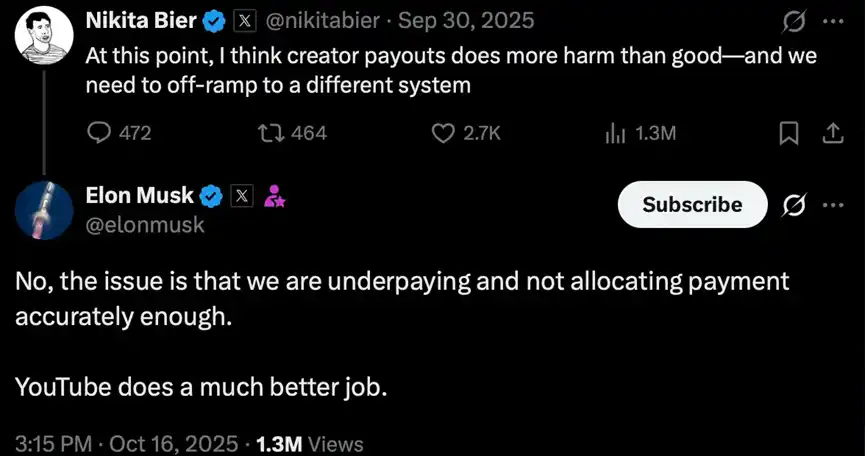
Musk said, "We still pay creators too little money, and the distribution is not done well enough, YouTube does much better in this regard."
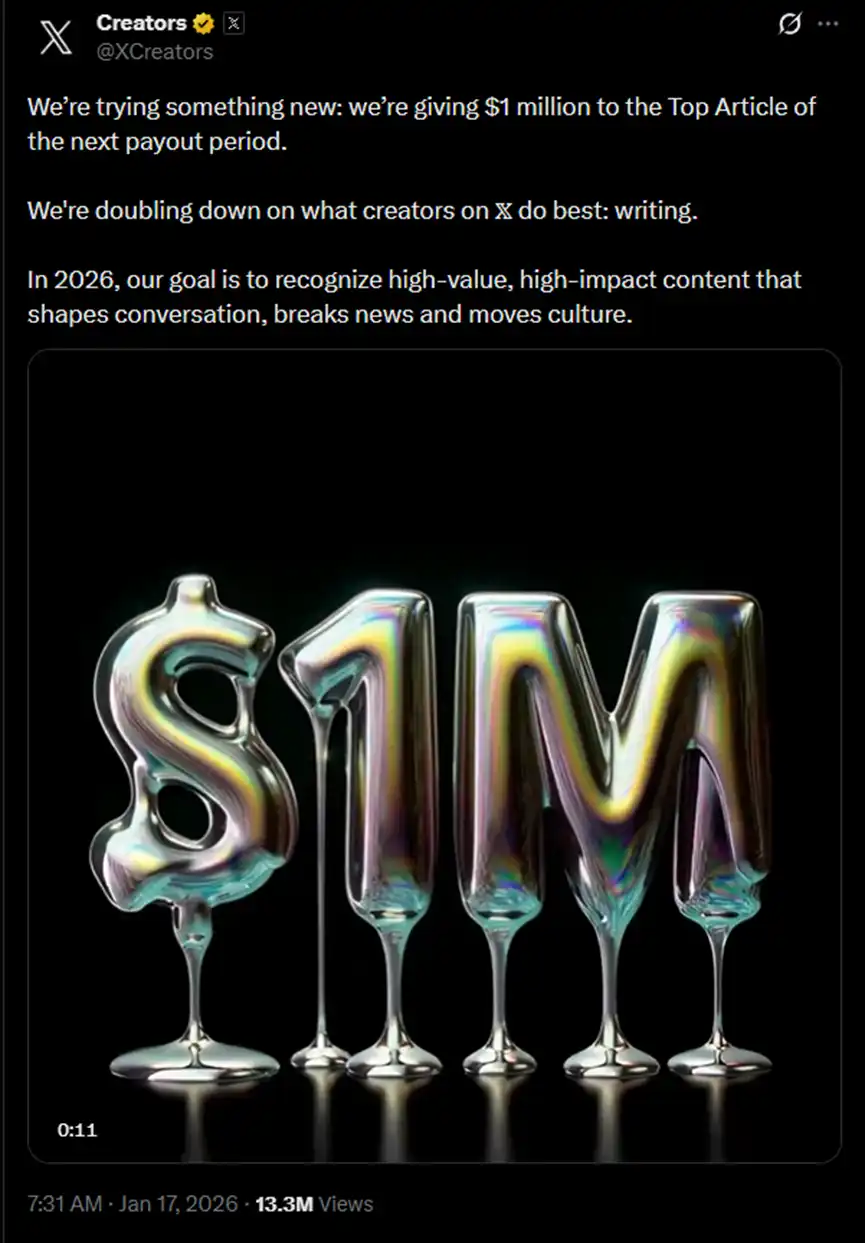
Moreover, last weekend, X officially launched a "Million Dollar Article Reward Event," sparking a wave of "long article fever" on the platform.
Currently, the most impactful article is "How to Fix Your Life in 1 Day" by DAN KOE. This article has received over 1.5 billion reads and has been retweeted by Musk.

Since Musk's acquisition of X several years ago, why has he started vigorously promoting X's creator ecosystem this year? In today's fragmented global user reading habits, why choose long articles as the key content type to promote? Can the revival of long-form content really support Musk's Everything App ambitions?
Musk's Anxiety
Every family has its own challenges, and even geniuses face anxiety. The relentless pressure from competitors and X's financial performance have also made Musk restless.
X is facing fierce competition in user growth and engagement, especially since Meta's Threads were launched in 2023, showing rapid growth and surpassing or closely approaching X in several metrics.
According to data analytics firm Similarweb's latest data released in early January 2026, Threads' global mobile Daily Active Users (DAU) have exceeded X, averaging 143.2 million, while X stands at 126.2 million. Looking at the growth trends, X's global DAU has seen an 11.9% year-on-year decrease, while Threads achieved an astonishing 37.8% growth. Even in X's home market, the United States, although X still leads Threads with 21.2 million DAU compared to Threads' 19.5 million, the gap is rapidly narrowing, with the latter seeing a 41.8% annual growth rate, while X has declined by 18.4%.
In terms of Monthly Active Users (MAU), Threads has also performed well. As of January 2026, its MAU has reached 320 million, and it grew from 350 million to 400 million in 2025. In comparison, X's MAU, although still at around 611 million, has lost approximately 32 million users since Musk's acquisition. This ebb and flow trend undoubtedly has put tremendous pressure on Musk.
The decline in user data has directly impacted X's core revenue source — advertising. According to public data, X's global ad revenue dropped to $25 billion in 2024, almost halving from $44 billion in 2022. Although a slight rebound to $22.6 billion is projected for 2025, the overall decline is still significant, with some institutions predicting that it will only recover to $2.7 billion by 2027.
Meanwhile, competitor Threads is highly anticipated by the capital market. Analysts forecast that Threads' advertising revenue in 2026 could reach $11.3 billion, several times higher than X's estimated revenue. Although X achieved quarterly revenue growth at the end of 2025, the company remains in a loss-making position overall due to high restructuring costs.
Although Premium subscribers (X Premium) saw significant growth in 2025, their revenue contribution is far below Musk's initial target of "50% of total revenue." Therefore, X will link the growth of Premium subscriptions to creator earnings directly, not only providing higher creator revenue but also clearly calculating revenue based on the Verified Home Timeline impressions of paid users to incentivize creators to produce high-quality content that attracts paid users and thus drive more users to subscribe to the Premium service.
So much so that we eventually saw the "Million-Dollar Article Reward" event initiated by the Old Horse. Chinese users joked that in 2026, the Old Horse started the "New Concept Essay Contest" in the United States.
The Renaissance of Long-Form Content
Musk chose to use long-form articles as the breakthrough point for the X platform's creator ecosystem, not on a whim but based on deep strategic considerations of the platform's positioning.
Today, X's recommendation algorithm has a core metric — "Regret-Free User Time," which is the total time users effectively spend on a piece of content. Musk explicitly stated that this mechanism inherently favors long-form content because they can "accumulate more user seconds," thereby enhancing the content algorithm's weight and the platform's overall user engagement.
Due to its depth, context, and complete narrative, long-form content inherently extends user dwell time, contrasting sharply with the fast consumption model of short posts or videos. Recent algorithm updates have introduced "content format weighting," explicitly favoring longer-form content that requires more creative effort and has a greater impact. This is not only an incentive for creators but also a data-driven decision: high-quality long articles can effectively reduce user clicks to external links, keep users on the platform longer, and provide more high-quality training data for Elon Musk's AI project Grok AI.
Musk has repeatedly emphasized his desire to make X the "primary news source on Earth," replacing traditional media with real-time aggregation of "collective wisdom." The long-form content feature allows users to publish "complete articles or even books," enabling domain experts, eyewitnesses, and in-depth creators to directly share their full insights on the platform, rather than fragmented information. Furthermore, compared to other platforms' significant subsidies for short videos, the incentive model for long-form content is more conducive to achieving a commercial closed loop through subscriptions, thereby attracting more professional journalists and writers back to the X platform.
However, a question arises. You may ask, in today's world where global user reading habits have become fragmented, what is Elon doing with this "Renaissance"?
Undeniably, global users' digital reading habits are showing a clear trend of fragmentation, especially under the impact of short-video platforms, where younger groups like Gen Z prefer "fragmented" reading several times a day, 5-10 minutes each time. Nevertheless, data also shows that overall reading volume is actually increasing. As a countermovement, "slow, immersive reading" is on the rise, as people in digital fatigue seek depth, emotional connection, and meaningful content consumption.
What X aims for is not to become another entertainment platform like TikTok but to become more like WeChat, a "life hub" deeply integrated into every American's daily life, which Musk has always referred to as the "Everything App." To achieve this, the platform's content and service ecosystem must be significantly enriched, enhancing users' "time well spent," giving them more reasons to stay on the platform, and accomplish more tasks here.
Ambitions of the Everything App
All of Musk's efforts ultimately point to a grand goal: turning X into an "Everything App" like WeChat. However, to achieve this ambition, X still has a long way to go.
Compared to WeChat, X lags significantly in several key metrics. In terms of Monthly Active Users (MAU), WeChat has over 1.4 billion users, while X has only 557 million, less than a third of the former. Such a huge gap in user numbers makes it difficult for X to establish the robust "network effect" of WeChat—where users cannot leave because all their friends, family, and life services are on the platform. WeChat has become essential in many people's daily lives, while X is still seen by most users as a social media platform for news consumption and opinion sharing, still reminiscent of the old Twitter or the "American Weibo."
When it comes to user engagement, the gap is equally evident. The average daily usage time of WeChat users is as high as 82 minutes, while X users are only at 30-35 minutes. The reason behind this is that users can complete a large number of "productive" tasks within WeChat, such as chatting, payment, shopping, and accessing municipal services, whereas X's content consumption still relies mainly on passive browsing, which easily leads to "browse and leave" behavior.
Old Ma doesn't want X to become TikTok, so he first needs to let X break away from the entertainment-focused user experience of "browse and leave." He needs high-quality, in-depth content to enhance user engagement, attract and retain high-value users, then gradually integrate more services such as payment and e-commerce based on content, ultimately paving the way to the "Everything App."
And the grander this dream is, the deeper Musk's anxiety will be.
You may also like

Market Correction Drives Major Drop in Meme Coins, WhiteWhale Suffers Significant Losses
Key Takeaways WhiteWhale’s price has plunged by 32.3% over the last 24 hours and is currently 75% below…

Meme Coins Tumble: WhiteWhale and Others Face Severe Losses
Key Takeaways WhiteWhale has experienced a significant decline, dropping by 75% from its peak. The market correction has…

Trump’s Tariff Policies Impact Cryptocurrency Market Dynamics
Key Takeaways Trump’s tariff policies lead to significant volatility in cryptocurrency markets, notably affecting Bitcoin prices. Bitcoin experienced…

Market Decline Impacts Meme Coins with WhiteWhale Dropping 75%
Key Takeaways The meme coin market has experienced a severe correction, notably impacting $WhiteWhale, which has decreased by…

Market Correction Reveals Dramatic Price Shifts in Meme Coins
Key Takeaways WhiteWhale has experienced a steep decline, dropping 75% from its peak. In contrast, $BLACKWHALE surged by…

Federal Judge Blocks SBF’s Second Request for Pretrial Release
Key Takeaways A federal judge has denied the second request from Sam Bankman-Fried (SBF) for pretrial release. The…

Brian Shroder Resigns as Binance.US CEO, Firm Undergoes Strategic Changes
Key Takeaways Brian Shroder steps down as CEO of Binance.US, replaced temporarily by Chief Legal Officer Norman Reed.…

Market Correction Causes Significant Drop in Meme Coin Values
Key Takeaways WhiteWhale’s value has decreased by 32.3% in the past 24 hours. The coin is currently trading…

Market Correction Halts Meme Coin Rally: WhiteWhale Suffers Massive Losses
Key Takeaways WhiteWhale experiences a significant price drop, declining 75% from its peak. BlackWhale showing better performance, increasing…

Market Correction Sparks Unsettling Decline in Meme Coins
Key Takeaways The cryptocurrency market correction has significantly impacted meme coins, notably leading to a 75% drop in…

Meme Coin Market Faces Sharp Decline as WhiteWhale Falls 75%
Key Takeaways WhiteWhale has plummeted 75% from its peak amid the current market correction. Several meme coins, including…

Electric Capital Targets $300 Million for Third Venture Fund
Key Takeaways Electric Capital, a venture capital firm with a focus on Web3 technologies, is aiming to raise…

Memecoins Fall While BlackWhale Rises in Cryptocurrency Market Shakeup
Key Takeaways The cryptocurrency market is experiencing a correction that has severely impacted memecoins. WhiteWhale’s value has declined…
Hyperliquid Introduces Direct ETH Deposits and Withdrawals for Enhanced Spot Trading
Key Takeaways Hyperliquid has officially rolled out direct Ethereum deposits and withdrawals, streamlining its spot trading capabilities. The…

Meme Coins Experience Sudden Market Shifts
Key Takeaways WhiteWhale’s value has dropped by 75% from its peak, illustrating the volatility of meme coins amidst…

Market Turmoil: Meme Coins Plummet as WhiteWhale Faces a Massive Drop
Key Takeaways WhiteWhale has experienced a drastic 75% drop from its peak on January 10, following recent market…
Solana Whale Sells $1M WhiteWhale, Leading to Steep Price Drop
Key Takeaways The White Whale cryptocurrency has recently experienced a significant decline with a drop of -11.1% within…
Market Correction Drives Meme Coins’ Value Decline
Key Takeaways The meme coin “WhiteWhale” has experienced a significant 75% drop from its previous high, signaling a…
Market Correction Drives Major Drop in Meme Coins, WhiteWhale Suffers Significant Losses
Key Takeaways WhiteWhale’s price has plunged by 32.3% over the last 24 hours and is currently 75% below…
Meme Coins Tumble: WhiteWhale and Others Face Severe Losses
Key Takeaways WhiteWhale has experienced a significant decline, dropping by 75% from its peak. The market correction has…
Trump’s Tariff Policies Impact Cryptocurrency Market Dynamics
Key Takeaways Trump’s tariff policies lead to significant volatility in cryptocurrency markets, notably affecting Bitcoin prices. Bitcoin experienced…
Market Decline Impacts Meme Coins with WhiteWhale Dropping 75%
Key Takeaways The meme coin market has experienced a severe correction, notably impacting $WhiteWhale, which has decreased by…
Market Correction Reveals Dramatic Price Shifts in Meme Coins
Key Takeaways WhiteWhale has experienced a steep decline, dropping 75% from its peak. In contrast, $BLACKWHALE surged by…
Federal Judge Blocks SBF’s Second Request for Pretrial Release
Key Takeaways A federal judge has denied the second request from Sam Bankman-Fried (SBF) for pretrial release. The…


 App
App