
- Buy Crypto
- Markets
- Futures
- Spot
- Copy Trade
 WE-Launch
Trading Strategy: Deep Dive into the xUSD Flash Crash Cause

Original Title: Oct 10th Red Friday: the root cause of Stream xUSD blowing up, the longer version
Original Author: Trading Strategy
Original Translation: Kaori, BlockBeats
Editor's Note: The collapse of xUSD has sounded a loud alarm for the entire DeFi world. This article delves into how Stream Finance, through black-box operations, extreme leverage, and liquidation priority design, violated the core spirit of DeFi. It also explores how the industry can ensure that capital flows into truly responsible, transparent, and robust projects by introducing measures such as a more rigorous treasury technical risk assessment.
False Neutrality Strategy
Stream xUSD is a "tokenized hedge fund" disguised as a DeFi stablecoin, claiming its strategy is "delta-neutral." However, Stream recently found itself in a situation of insolvency after a series of suspicious operations.
Over the past five years, several projects have attempted a similar pattern — generating income through the so-called "neutral yield strategy" to create initial liquidity for their native tokens. Successful examples include MakerDAO, Frax, Ohm, Aave, Ethena, and others.
Unlike these relatively "more genuine" DeFi projects, Stream severely lacks transparency in its strategy and position disclosure. Of the claimed $500 million TVL, only about $150 million can be seen on-chain through platforms like DeBank. It was later discovered that Stream actually allocated some funds to an off-chain proprietary trading strategy, with some of the traders being liquidated, resulting in a loss of about $100 million.
According to @CCNDotComNews, the $120 million hack on Balancer DEX this Monday is not related to the Stream collapse.
According to rumors (yet to be confirmed as Stream has not disclosed specific information), some of the losses are related to the off-chain "selling volatility" strategy.
In quantitative finance, "selling volatility" (also known as short volatility or short vol) refers to a profit-making trading strategy in which one profits when market volatility decreases or remains stable. The logic is that when the price of the underlying asset does not fluctuate much, the option value will shrink or even drop to zero, allowing the seller to retain the option premium as profit.
However, such a strategy carries extremely high risk — once the market experiences intense volatility (i.e., a surge in volatility), the seller may face enormous losses. This risk is often vividly referred to as "picking up pennies in front of a steamroller."
Systemic Collapse
On October 10th (October 11th in UTC+8 time), also known as "Red Friday," I experienced a severe surge in volatility.
This systemic leverage risk had long been accumulating in the crypto market and was ignited by the market frenzy surrounding Trump in 2025. When Trump announced new tariff policies on Friday afternoon, October 10th, all markets plunged into panic, and the panic swiftly spread to the cryptocurrency market.
In the panic, the early panickers profited — everyone began selling off liquid assets, triggering a chain liquidation.
Due to the previously accumulated leverage risk pushing systemic leverage to a peak, the depth of the perpetual futures market was insufficient to support the smooth liquidation of all leverage positions. In this scenario, the Auto Deleveraging (ADL) mechanism was triggered, starting to "socialize" some of the losses and distribute them among traders who were still profitable.
This further distorted the already frenzied market structure.
The volatility caused by this event can be described as a once-in-a-decade upheaval in the crypto market. Similar crashes occurred in the early days of crypto in 2016, but at that time, market data was scarce. Therefore, today's algorithmic traders mostly design their strategies based on data from the past few years of "smooth volatility."
Due to the lack of historical samples of such intense volatility, even leverage positions of just around 2x were liquidated across the board in this volatility.
After "Red Friday," the first "corpse" to surface was Stream.
The definition of a so-called "Delta Neutral Fund" is: theoretically cannot lose money.
If it does lose money, by definition, it is not Delta Neutral.
Stream has always claimed to be a Delta Neutral Fund, but in reality, it secretly allocated funds to opaque, off-chain proprietary strategies.
Of course, the concept of "Delta Neutral" is not an absolute black-and-white divide, but in hindsight, many experts believe that Stream's strategy carried excessive risk and could not truly be considered neutral — because once this strategy backfired, the consequences were extremely severe. And indeed, it turned out to be the case.
When Stream lost its principal in these high-risk transactions, it immediately became insolvent.
In DeFi, risk is inherent — losing money is not the end of the world.
If you can recover 100% of your principal, even after experiencing a 10% drawdown, it's not catastrophic, especially when your annualized return can reach 15%.
However, in Stream's case, the issue was this: it not only employed a risky strategy but also engaged in "recursive borrowing" leverage with another stablecoin, Elixir, amplifying the risk to the extreme.
Chaotic Risk Exposure
Recursive borrowing is a leverage yield farming strategy in the DeFi lending market. It involves repeatedly borrowing against already deposited collateral — usually using the borrowed asset as additional collateral — to amplify exposure to interest rates, liquidity mining rewards, or other lending protocol (such as Aave, Compound, or Euler) yields. This creates a "loop," allowing users to effectively double the capital invested without additional external funds, essentially letting users borrow from themselves and then borrow back to the protocol.
Stream's xUSD wallet holds 60% of the circulating xUSD, all of which is leveraged.
Due to the commingling of funds across their products, we cannot determine how much of it is achieved through recursive borrowing to support their own endorsement. But it is certain that this includes a $95 million position on Plasma Euler.
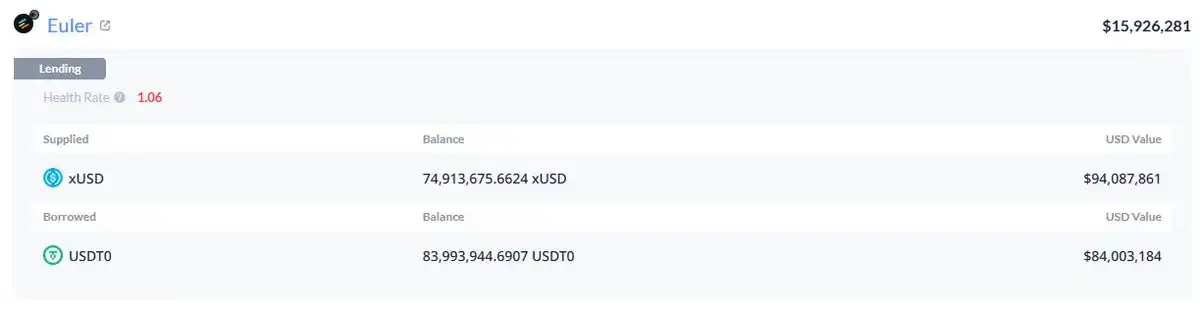
Stream's xUSD Primary Risk Exposures
The major risk exposures of xUSD include:
mHYPE (whose liquidity buffer appears to be empty).
RLP (with discrepancies between the numbers on its transparency page and the wallet data, and displaying a negative $25 million balance on Binance).
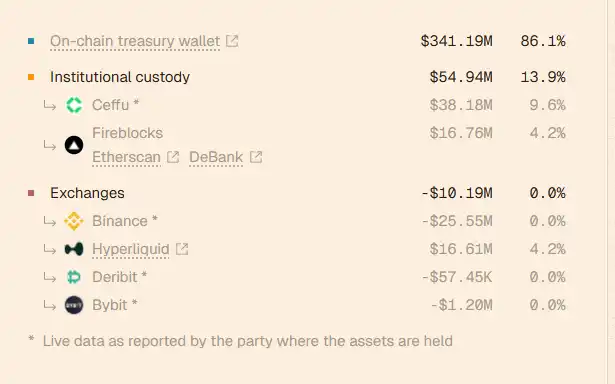
Another notable risk exposure is the allocation to other yield coins, such as rUSD. Approximately 30% of rUSD's support is rUSD itself.
Additionally, there's deUSD, of which 30% is backed by mF-ONE.
mF-ONE has most of its assets off-chain, claiming to have a $16 million "liquidity buffer," but this fund is actually 100% deposited into mTBILL.
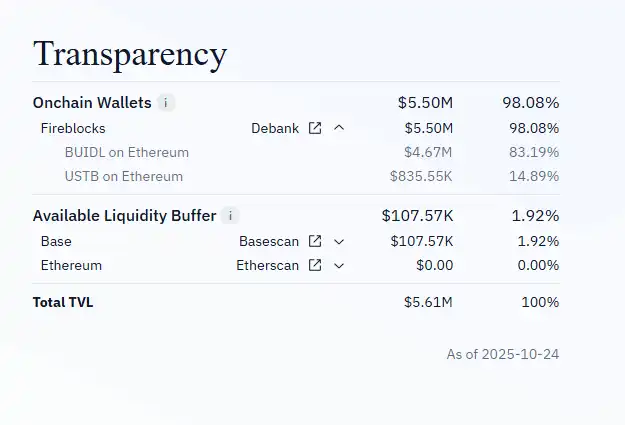
mTBILL is missing approximately $15 million, but it only has a $100,000 "liquidity buffer," with an additional $5 million in BUIDL.
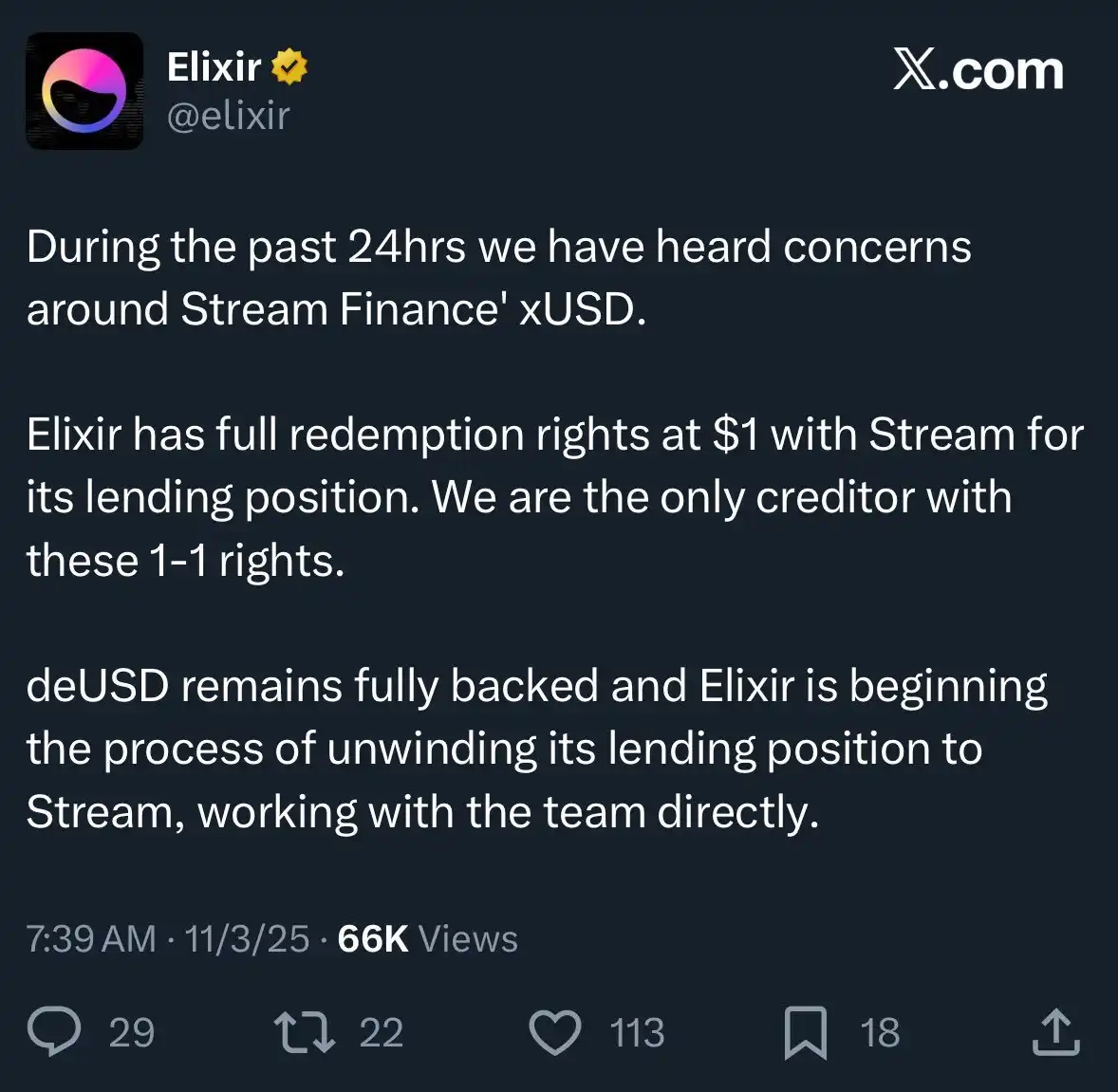
To make matters worse, Elixir also claims to have "settlement seniority" in an off-chain agreement—meaning that if Stream were to go bankrupt, Elixir could reclaim its principal first, while other DeFi users who invested in Stream would only be able to reclaim a smaller amount of money, or even nothing at all.
Due to Stream's highly opaque operation, coupled with the presence of recursive leverage and proprietary trading strategies, we actually do not know the exact losses of ordinary users. Currently, the price of the Stream xUSD stablecoin has plummeted to only $0.6 per $1.
Even more infuriating is that none of this was communicated to investors beforehand. Many users are now furious with Stream and Elixir—not only did they lose money, but they found out that their losses were "socialized," allowing those from Wall Street who cashed out early to walk away with profits.
This event has also affected other lending protocols and their asset managers:
"Everyone who thought they were participating in collateralized borrowing on Euler was actually extending uncollateralized loans through an agent."—Rob from InfiniFi
Furthermore, due to Stream's lack of publicly transparent on-chain data and the non-disclosure of its positions and P&L, users are now suspicious that it may have misappropriated user profits for team management or internal use after this event.
Stakers of Stream xUSD rely on the project's self-reported "oracle" data to calculate earnings, and this data cannot be verified by third parties nor is there any way to verify if the calculations are accurate or fair.
How can this issue be addressed?
Events like this involving Stream are entirely preventable—especially in an industry like DeFi that is still in its early stages.
The rule of "high risk, high reward" always holds true, but to apply it, you must truly understand the risks.
Not all risks are created equal, and some risks are entirely unnecessary.
In fact, there are also some reputable yield aggregation, lending, or "hedge fund in the form of a stablecoin" protocols in the market that are relatively transparent in terms of risk, strategy, and position disclosure.
Aave founder @StaniKulechov has discussed the DeFi protocol's "curator" mechanism and when the risk of excessive risk-taking behavior might arise:
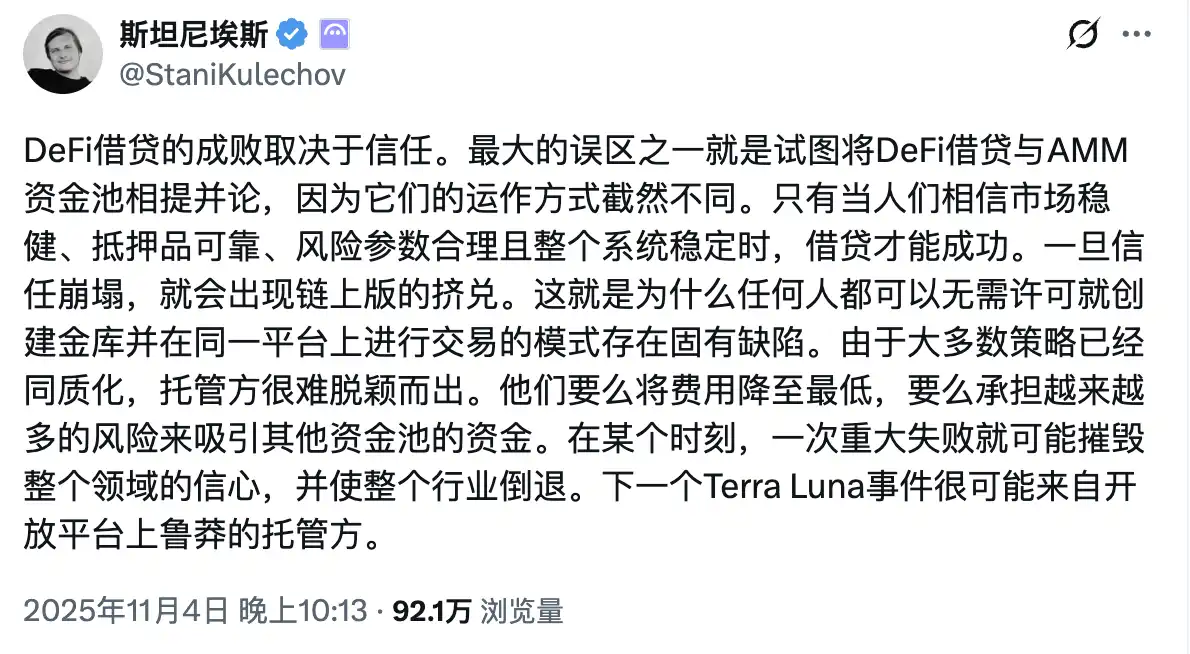
Vault Risk Framework
To help the market better distinguish between "good vaults" and "bad vaults," the Trading Strategy team has introduced a new metric in their latest DeFi Vault report: Vault Technical Risk Score.
The so-called "technical risk" refers to the likelihood of funds in a DeFi vault being lost due to improper technical execution.
The Vault Technical Risk Framework provides an intuitive tool for categorizing DeFi vaults into high-risk and low-risk categories.
This scoring system cannot eliminate market risks (such as trading errors, contagion risk, etc.),
but it can ensure that third parties are able to independently assess and quantify these risks, enabling users to have a clearer understanding of their risk exposure.
When DeFi users can access more comprehensive, transparent information, capital naturally flows to projects that are responsible, compliant, and operate soundly.
As a result, events like the one with Stream will become less frequent in the future.
You may also like

Aave’s $10M Token Purchase Raises Concerns Over Governance Power
Key Takeaways: Aave founder Stani Kulechov’s $10 million AAVE token purchase sparks debates over governance power concentration. Concerns…

Web3 and DApps in 2026: A Utility-Driven Year for Crypto
Key Takeaways The transition to utility in the crypto sector has set a new path for 2026, emphasizing…
How to Evaluate a Curator?

December 24th Market Key Intelligence, How Much Did You Miss?

Base's 2025 Report Card: Revenue Grows 30X, Solidifies L2 Leadership

From Aave to Ether.fi: Who Captured the Most Value in the On-Chain Credit System?

Venture Capital Post-Mortem 2025: Hashrate is King, Narrative is Dead

DeFi Hasn't Collapsed, So Why Has It Lost Its Allure?

NIGHT, with a daily trading volume of nearly $10 billion, is actually coming from the "has-been" Cardano?
Aave Community Governance Drama Escalates, What's the Overseas Crypto Community Talking About Today?

2025 Token Postmortem: 84% Peak at Launch, High-Cap Project Turns into a "Rug Pull" Epicenter?
Polymarket Announces In-House L2, Is Polygon's Ace Up?

Coinbase Joins Prediction Market, AAVE Governance Dispute - What's the Overseas Crypto Community Talking About Today?
Over the past 24 hours, the crypto market has shown strong momentum across multiple dimensions. The mainstream discussion has focused on Coinbase's official entry into the prediction market through the acquisition of The Clearing Company, as well as the intense controversy within the AAVE community regarding token incentives and governance rights.
In terms of ecosystem development, Solana has introduced the innovative Kora fee layer aimed at reducing user transaction costs; meanwhile, the Perp DEX competition has intensified, with the showdown between Hyperliquid and Lighter sparking widespread community discussion on the future of decentralized derivatives.
This week, Coinbase announced the acquisition of The Clearing Company, marking another significant move to deepen its presence in this field after last week's announcement of launching a prediction market on its platform.
The Clearing Company's founder, Toni Gemayel, and the team will join Coinbase to jointly drive the development of the prediction market business.
Coinbase's Product Lead, Shan Aggarwal, stated that the growth of the prediction market is still in its early stages and predicts that 2026 will be the breakout year for this field.
The community has reacted positively to this, generally believing that Coinbase's entry will bring significant traffic and compliance advantages to the prediction market. However, this has also sparked discussions about the industry's competitive landscape.
Jai Bhavnani, Founder of Rivalry, commented that for startups, if their product model proves to be successful, industry giants like Coinbase have ample reason to replicate it.
This serves as a reminder to all entrepreneurs in the crypto space that they must build significant moats to withstand competition pressure from these giants.
Regulated prediction market platform Kalshi launched its research arm, Kalshi Research, this week, aimed at opening its internal data to the academic community and researchers to facilitate exploration of prediction market-related topics.
Its inaugural research report highlights Kalshi's outperformance in predicting inflation compared to Wall Street's traditional models. Kalshi co-founder Luana Lopes Lara commented that the power of prediction markets lies in the valuable data they generate, and it is now time to better utilize this data.
Meanwhile, Kalshi announced its support for the BNB Chain (BSC), allowing users to deposit and withdraw BNB and USDT via the BSC network.
This move is seen as a significant step for Kalshi to open its platform to a broader crypto user base, aiming to unlock access to the world's largest prediction market. Furthermore, Kalshi also revealed plans to host the first Prediction Market Summit in 2026 to further drive industry engagement and development.
The AAVE community recently engaged in heated debates around an Aave Improvement Proposal (AIP) titled "AAVE Tokenomics Alignment Phase One - Ownership Governance," aiming to transfer ownership and control of the Aave brand from Aave Labs to Aave DAO.
Aave founder Stani Kulechov publicly stated his intention to vote against the proposal, believing it oversimplifies the complex legal and operational structure, potentially slowing down the development process of core products like Aave V4.
The community's reaction was polarized. Some criticized Stani for adopting a "double standard" in governance and questioned whether his team had siphoned off protocol revenue, while others supported his cautious stance, arguing that significant governance changes require more thorough discussion.
This controversy highlights the tension between the ideal of DAO governance in DeFi projects and the actual power held by core development teams.
Despite governance disputes putting pressure on the AAVE token price, on-chain data shows that Stani Kulechov himself has purchased millions of dollars' worth of AAVE in the past few hours.
Simultaneously, a whale address, 0xDDC4, which had been quiet for 6 months, once again spent 500 ETH (approximately $1.53 million) to purchase 9,629 AAVE tokens. Data indicates that this whale has accumulated nearly 40,000 AAVE over the past year but is currently in an unrealized loss position.
The founder and whale's increased holdings during market volatility were interpreted by some investors as a confidence signal in AAVE's long-term value.
In this week's top article, Morpho Labs' "Curator Explained" detailed the role of "curators" in DeFi.
The article likened curators to asset managers in traditional finance, who design, deploy, and manage on-chain vaults, providing users with a one-click diversified investment portfolio.
Unlike traditional fund managers, DeFi curators execute strategies automatically through non-custodial smart contracts, allowing users to maintain full control of their assets. The article offered a new perspective on the specialization and risk management in the DeFi space.
Another widely circulated article, "Ethereum 2025: From Experiment to Global Infrastructure," provided a comprehensive summary of Ethereum's development over the past year. The article noted that 2025 is a crucial year for Ethereum's transition from an experimental project to global financial infrastructure. Through the Pectra and Fusaka hard forks, Ethereum achieved significant reductions in account abstraction and transaction costs.
Furthermore, the SEC's clarification of Ethereum's "non-securities" nature and the launch of tokenized funds on the Ethereum mainnet by traditional financial giants like JPMorgan marked Ethereum's gaining recognition from mainstream institutions. The article suggested that whether it is the continued growth of DeFi, the thriving L2 ecosystem, or the integration with the AI field, Ethereum's vision as the "world computer" is gradually becoming a reality.
The Solana Foundation engineering team released a fee layer solution called Kora this week.
Kora is a fee relayer and signatory node designed to provide the Solana ecosystem with a more flexible transaction fee payment method. Through Kora, users will be able to achieve gas-free transactions or choose to pay network fees using any stablecoin or SPL token. This innovation is seen as an important step in lowering the barrier of entry for new users and improving Solana network's availability.
Additionally, a deep research report on propAMM (proactive market maker) sparked community interest. The report's data analysis of propAMMs on Solana like HumidiFi indicated that Solana has achieved, or even surpassed, the level of transaction execution quality in traditional finance (TradFi) markets.
For example, on the SOL-USDC trading pair, HumidiFi is able to provide a highly competitive spread for large trades (0.4-1.6 bps), which is already better than the trading slippage of some mid-cap stocks in traditional markets.
Research suggests that propAMM is making the vision of the "Internet Capital Market" a reality, with Solana emerging as the prime venue for all of this to happen.
The competition in the perpetual contract DEX (Perp DEX) space is becoming increasingly heated.
In its latest official article, Hyperliquid has positioned its emerging competitor, Lighter, alongside centralized exchanges like Binance, referring to it as a platform utilizing a centralized sequencer. Hyperliquid emphasizes its transparency advantage of being "fully on-chain, operated by a validator network, and with no hidden state."
The community widely interprets this as Hyperliquid declaring "war" on Lighter. The technical differences between the two platforms have also become a focal point of discussion: Hyperliquid focuses on ultimate on-chain transparency, while Lighter emphasizes achieving "verifiable execution" through zero-knowledge proofs to provide users with a Central Limit Order Book (CLOB)-like trading experience.
This battle over the future direction of decentralized derivatives exchanges is expected to peak in 2026.
Meanwhile, discussions about Lighter's trading fees have surfaced. Some users have pointed out that Lighter charged as much as 81 basis points (0.81%) for a $2 million USD/JPY forex trade, far exceeding the near-zero spreads of traditional forex brokers.
Some argue that Lighter does not follow a B-book model that bets against market makers, instead anchoring its prices to the TradFi market, and the high fees may be related to the current liquidity or market maker balance incentives. Providing a more competitive spread for real-world assets (RWA) in the highly volatile crypto market is a key issue Lighter will need to address in the future.

The Secret Centralization Landscape of Stablecoin Payments: 85% of Transaction Volume Controlled by Top 1000 Wallets

Audiera Sees Massive Price Surge – Key Cryptocurrency Updates
Key Takeaways Audiera (BEAT) has witnessed significant growth, experiencing a 70.10% increase in the past week. Despite the…

Stability in the Crypto World: Understanding Stablecoin Usage and Its Implications
Key Takeaways Stablecoin use in payments has rapidly increased alongside blockchain technology advancements. Stablecoins USDT and USDC dominate…
Major Cryptocurrency Exchange Updates and Insights
Key Takeaways Cryptocurrency exchanges are continually evolving, adapting to new technologies, and regulatory environments. Decentralized Finance (DeFi) is…

Understand Tokenization, Differentiating Between the DTCC Model and the Direct Ownership Model
Aave’s $10M Token Purchase Raises Concerns Over Governance Power
Key Takeaways: Aave founder Stani Kulechov’s $10 million AAVE token purchase sparks debates over governance power concentration. Concerns…
Web3 and DApps in 2026: A Utility-Driven Year for Crypto
Key Takeaways The transition to utility in the crypto sector has set a new path for 2026, emphasizing…
How to Evaluate a Curator?
December 24th Market Key Intelligence, How Much Did You Miss?
Base's 2025 Report Card: Revenue Grows 30X, Solidifies L2 Leadership
From Aave to Ether.fi: Who Captured the Most Value in the On-Chain Credit System?
Popular coins
Latest Crypto News


Customer Support:@weikecs
Business Cooperation:@weikecs
Quant Trading & MM:bd@weex.com
VIP Services:support@weex.com
 App
App