
- Buy Crypto
- Markets
- Futures
- Spot
- Copy Trade
 WE-Launch
Unveiling the Movement Liquidity Provider Sell-Off Scandal: Secret Contracts, Shadow Advisors, and Hidden Intermediaries

Original Article Title: Inside Movement's Token-Dump Scandal: Secret Contracts, Shadow Advisers and Hidden Middlemen
Original Article Author: Sam Kessler, CoinDesk
Original Article Translation: Aki Chen, Wu Shuo Blockchain
Layer 2 blockchain project Movement Labs is reportedly investigating a fraudulent liquidity protocol incident. What was originally intended to facilitate the smooth listing of the MOVE cryptocurrency token has turned into a market-shaking dumping scandal. The protocol allegedly, without full knowledge of the project team, handed over control of 66 million MOVE tokens to a shadowy intermediary entity called Rentech. Rentech, in the protocol, purportedly acted as both the "Web3Port subsidiary" and the "Foundation agent," engaging in self-trades. This arrangement directly triggered a $38 million token dump the day after MOVE's listing, causing a significant price drop and leading to a Binance ban.
Despite internal objections to the protocol, senior management still pushed for its signing, raising serious concerns about governance failures, lack of due diligence, and conflicts of interest. Currently, multiple executives and legal advisors are under scrutiny, and the project's governance structure and partnership mechanisms are being thoroughly questioned. This crisis has revealed deep-seated flaws in Movement's institutional design, risk control, and compliance capabilities, potentially causing long-term damage to its future reputation and ecosystem development.
MOVE Token Plummets on Listing, Movement Labs Suspected of Misguided High-Risk Protocol Signing
According to internal documents reviewed by CoinDesk, Movement Labs, the blockchain project behind the MOVE cryptocurrency token, is conducting an internal investigation into a contentious financial protocol. This protocol may have granted significant control over the token market to a single entity without full knowledge of the project team, causing structural imbalance.
The protocol directly resulted in the concentrated dumping of 66 million MOVE tokens on December 9, 2025, the day after the token's exchange listing, triggering a cliff-like price drop and raising widespread questions about "internal trading" and rent-seeking. Of note, the MOVE project received a public endorsement from the Trump-backed crypto venture fund World Liberty Financial, adding political and industry influence to the event.
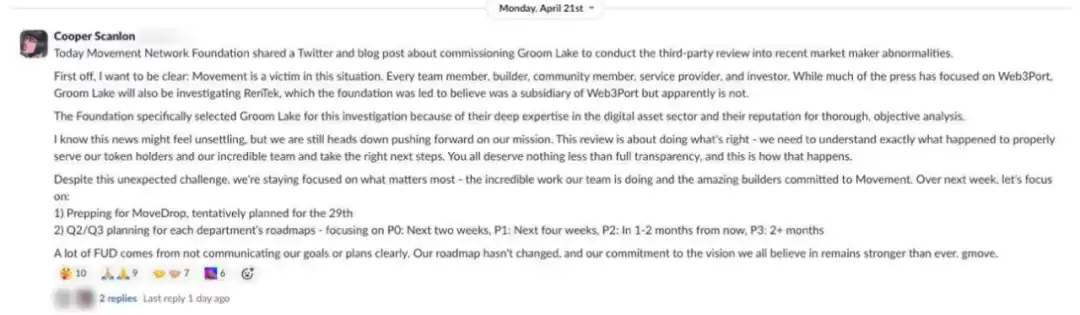
Movement Labs Co-Founder Cooper Scanlon announced in an internal Slack message on April 21 that the team is investigating a critical issue: how over 5% of the MOVE token originally allocated for liquidity provider Web3Port was transferred to an intermediary entity named Rentech.
Reportedly, the Movement Foundation was initially informed that Rentech was a subsidiary of Web3Port, but the investigation revealed otherwise. Rentech, on the other hand, denies any misleading behavior.
Rentech Holds Unilateral Control Over Nearly Half of the Circulating Supply, Resulting in Imbalance in MOVE Token Circulation
According to an internal memo from the Movement Foundation, the agreement between Movement and Rentech lent a portion equivalent to half of the MOVE token's circulating supply to this single counterparty. This arrangement granted Rentech an unusually significant market influence at the early stages of the token listing.
Several interviewed industry experts have pointed out that this centralized structure deviates significantly from the decentralized distribution principle typically pursued by crypto projects, making it vulnerable to price manipulation or one-sided arbitrage.
Upon reviewing a version of the contract obtained by CoinDesk, veteran crypto industry founder Zaki Manian noted that certain terms in the agreement effectively set an incentive for "pumping up the MOVE token's fully diluted valuation to over $5 billion before dumping on retail." He bluntly stated, "Even the discussion of such tactics in a written document is alarming." This comment further deepened external skepticism regarding Rentech's intentions and ethical boundaries in the agreement.
In theory, a liquidity provider is engaged by the project to provide liquidity services for a newly listed token, with the responsibility to facilitate buying and selling within an exchange using funds provided by the project to maintain price stability and market depth. However, in practice, this role also carries abuse risks.
In the absence of regulation or transparency in the agreement, a liquidity provider may become a tool for insiders to manipulate the market and surreptitiously shift significant token holdings, evading detection from external parties and severely compromising the interests of retail investors and market fairness.
Contract Exposure Reveals Crypto Gray Areas: How Public Projects Turn into Few People's Arbitrage Tools in a Regulatory Vacuum
A series of contract documents obtained by CoinDesk has revealed a little-known gray area in the crypto industry: in an environment lacking effective regulation and legal transparency, blockchain projects originally aimed at the public are very easily used as a vehicle for a small group of individuals behind the scenes to profit.
The contents of these agreements show that once a project team is negligent in structural design and compliance oversight, so-called "decentralized" projects may also be completely privatized by a few operators through unequal terms, deviating from the original intent of fairness and openness.
In the crypto market, rumors of manipulation and abuse surrounding market-making mechanisms have long been heard, but the specific details of such operations, contract structures, and benefit arrangements are rarely brought to light. As a result, the internal contract and agreement details disclosed by Movement Labs in this incident have become a rare window to observe the black box operation and gray market-making space of Web3 projects, once again bringing the industry's focus back to the most basic yet often overlooked principle of "transparency."
The market-making contract reviewed by CoinDesk shows that Rentech appeared in the transaction with Movement Foundation in two capacities at the same time: on the one hand, as an agent of Movement Foundation, and on the other hand, it signed the agreement as a subsidiary of Web3Port. This structure provided Rentech with the possibility to take on the "intermediary dominance" in the transaction, theoretically allowing it to set transaction terms on its own and profit from it under information asymmetry.
The market-making agreement reached between Movement and Rentech eventually opened a sell-off channel for a group of wallets associated with Web3Port. This Chinese financial institution claimed to have served MyShell, GoPlus Security, and the crypto fund World Liberty Financial associated with Donald Trump. These wallets quickly liquidated approximately $38 million worth of tokens on the day after the MOVE token was first issued on the exchange, causing a sharp market fluctuation and raising concentrated doubts about the motives and legitimacy of the agreement arrangement itself.
Binance Bans Market-Making Account for "Irregular Behavior," Movement Initiates Emergency Token Buyback
In the wake of the incident, the major exchange Binance has banned the involved market-making account for "improper behavior." Meanwhile, the Movement project team urgently announced the initiation of a token buyback plan in an attempt to stabilize market sentiment and regain community trust.
Similar to startup employee stock options, most cryptocurrency projects set a lock-up period during token distribution to restrict the core team, investors, and early contributors from selling off a large portion of their holdings in the initial stages of the project.
This mechanism is intended to protect market stability and prevent insiders from taking advantage of information asymmetry to profit early. However, in the Movement event, the bypassing of lock-up restrictions in token flows was precisely the core issue that sparked external scrutiny.
Binance's action to freeze the involved accounts quickly prompted speculations in the community, with many observers suggesting that this might indicate a prior agreement between Movement project insiders and Web3Port to circumvent the standard lock-up mechanism for early token sales.
In response to this scrutiny, the Movement team denied any wrongdoing, asserting that they had not engaged in any illicit transfer arrangements with third parties. However, the information confusion and contract structure flaws exposed by this event still make it challenging to completely dispel the impression of "insider trading."
Star Layer 2 Project Embroiled in Controversy, Rentech Protocol Faces Mutual Accusations
Movement is an Ethereum scaling Layer 2 network built on the Facebook open-source Move language. Due to its technical innovation and capital backing, it has rapidly become one of the most discussed emerging projects in the cryptocurrency industry in recent years.
The project was founded by two only 22-year-old dropouts from Vanderbilt University, Rushi Manche and Cooper Scanlon, who raised $38 million in funding and was selected for the World Liberty Financial crypto investment portfolio backed by Trump. In January 2025, Reuters reported that Movement Labs was about to complete a new round of funding of up to $1 billion, with a valuation potentially reaching $30 billion.
However, significant internal disagreements emerged within the project surrounding the controversial market-making agreement with Rentech. CoinDesk interviewed over a dozen sources familiar with the internal dynamics of the project (most requested anonymity), and they provided various contradictory accounts.
Rentech's owner, Galen Law-Kun, denied any misleading behavior and stated that the transaction structure was designed in coordination with YK Pek, the general counsel of the Movement Foundation. However, internal memos and communication records reviewed by CoinDesk indicate that Pek initially strongly opposed the agreement and denied involvement in Rentech's establishment process.
Movement Labs Co-Founder Scanlon stated in an internal Slack message, "Movement is a victim in this event." This statement also signifies that the project team is attempting to shift responsibility towards an external operator.
According to four anonymous sources familiar with the progress of the internal investigation, Movement is actively reviewing the role of its co-founder Rushi Manche in the Rentech agreement. It is alleged that Manche initially forwarded the agreement to the team and advocated for the collaboration within the organization.
Also under investigation is Sam Thapaliya — the founder of the crypto payment protocol Zebec and a business partner of Rentech owner Galen Law-Kun. While Thapaliya did not hold a formal position at Movement, he had long been involved in core affairs in an "informal advisory" capacity, making his specific influence in this event a key focus of the project's internal audit.
Reject-Then-Accept Approach, Movement Bypasses Due Diligence Mechanisms, Governance Structure Questioned
Despite initially vetoing a significant risk associated with the market-making agreement with Rentech, Movement eventually signed a structurally similar revised version of the agreement. The core reliance of the agreement was based on an oral assurance from an intermediary with almost no public track record.
Behind this decision lies a spotlight on the governance shortcomings in the current crypto industry. As per common practices, to mitigate securities regulatory risks, crypto projects usually split operations into two entities: one managed by a non-profit foundation responsible for token management and community resource allocation, and another being the for-profit development company in charge of core technical development. Movement Labs serves as the project's development entity, while Movement Foundation is responsible for token affairs.
However, internal communication materials reviewed by CoinDesk show that the initially intended independently operating structure failed in the Movement case. Co-Founder Rushi Manche, while nominally an employee of Movement Labs, played a leading role in critical matters of the non-profit foundation. This overlap in roles undermined the dual-entity mechanism that was supposed to mitigate compliance risks.
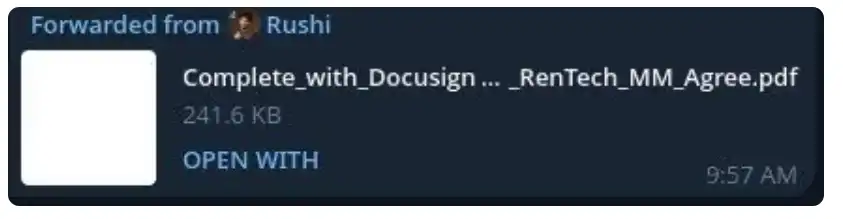
On March 28, 2025, Co-Founder Rushi Manche sent a draft market-making agreement to Movement Foundation via Telegram, stating that the contract "needs to be signed as soon as possible."
On November 27, 2024, Rentech submitted a market-making agreement draft to Movement, which included lending up to 5% of the total MOVE token supply to Rentech. According to the contract, Rentech was the borrower, and Movement was the lender. However, this agreement was ultimately not signed.
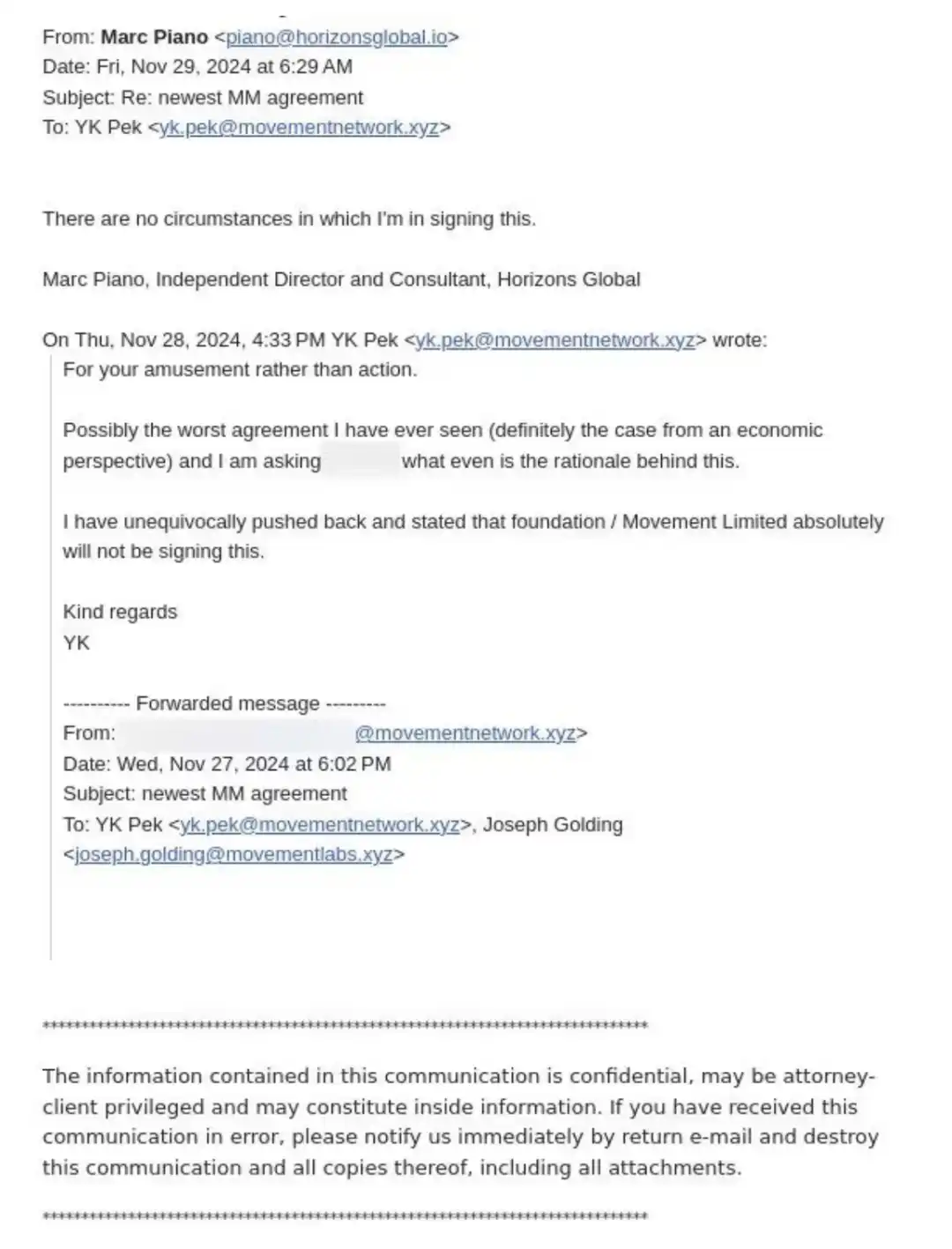
Rentech, being a company with almost no public background or on-chain records, immediately triggered internal alert within the Foundation with its significant token borrowing request. Movement Foundation's legal counsel, YK Pek, bluntly stated in an email that the document was "possibly the worst agreement I've ever seen." In another memorandum, he further pointed out that if executed, the agreement would amount to handing over substantial control of the MOVE market to a vaguely identified external entity.
Additionally, Marc Piano, a director of the Foundation registered in the British Virgin Islands, also refused to sign the agreement. The various objections mentioned above show that internal awareness of the risks of this agreement within Movement was actually very clear; however, it failed to prevent the agreement from proceeding in a modified form in subsequent processes, further exposing governance failures.
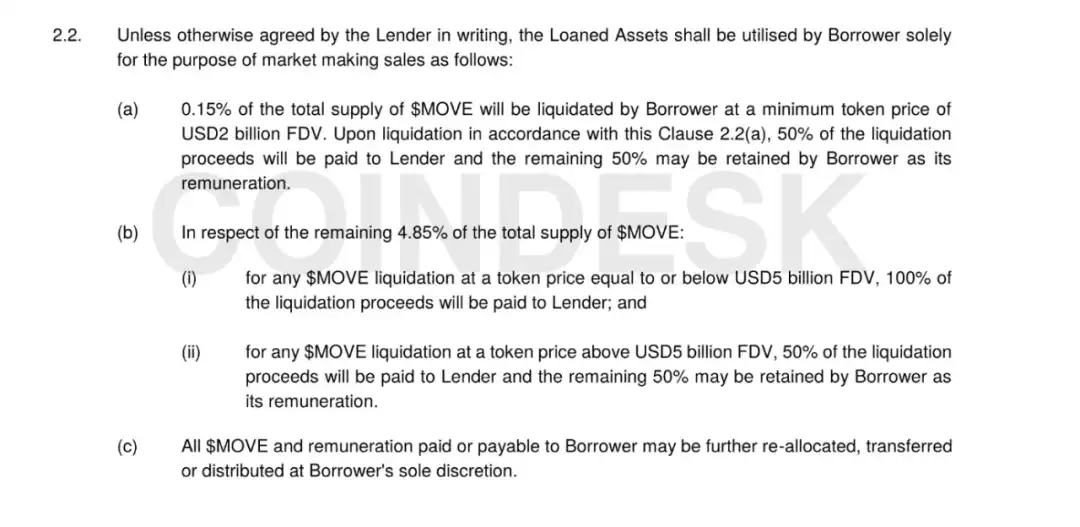
One particularly notable clause in the contract stated that once the Fully Diluted Valuation (FDV) of the MOVE token exceeded $5 billion, Rentech could begin liquidating its held tokens and share the resulting profits with Movement Foundation on a 50:50 basis.
Cryptocurrency industry veteran Zaki Manian pointed out that this structure essentially created a "perverse incentive mechanism," encouraging the market maker to artificially pump the MOVE price to concentrate its large holdings for profit-taking when the valuation is inflated. This design not only deviates from the original purpose of market-making to serve price stability but also could directly harm retail investors' interests.
Although Movement Foundation initially refused to sign the high-risk market-making agreement, its negotiations with Rentech did not cease. According to three sources interviewed by CoinDesk and legal documents reviewed, Rentech later claimed to the Foundation that it was a subsidiary of the Chinese market-making institution Web3Port and voluntarily offered to provide $60 million in collateral, thereby increasing the agreement's attractiveness.
Under the above conditions, Movement Foundation accepted a revised agreement on December 8, 2025. This version made modifications to some key terms, removing one of the original most contentious clauses — the right for Web3Port to sue Movement Foundation for compensation if the MOVE token failed to list on a specific exchange.
Despite some formal adjustments to the protocol, this compromise decision indicates that the foundation has relaxed its risk mitigation stance in the face of multiple pressures and incentives, ultimately laying the groundwork for subsequent events.
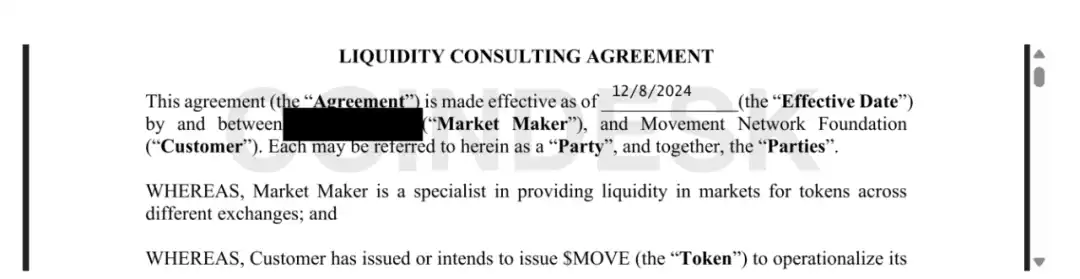
On December 8, 2025, the Movement Foundation and Rentech officially signed the revised liquidity provision agreement. Although Rentech is explicitly labeled as "Web3Port" in the agreement (the name has been redacted in some documents), in essence, its role as the borrower remains unchanged, with the foundation still being the lender.
Of note is that the main drafter of this agreement is none other than the foundation's legal counsel, YK Pek, who had previously expressed clear opposition to the initial version of the agreement. Despite the removal of some of the most contentious clauses in the revised version, the core structure remains unchanged: Web3Port can still borrow up to 5% of the MOVE token's total supply and can sell in a certain manner to realize profits.
Further technical details reveal the deliberate nature of the operations behind the agreement—the domain name "web3portrentech.io" registered under Rentech's director's email was only registered on the day the agreement was signed.
Was the agreement already a done deal? Web3Port and "Movement" secretly signed a contract, with the foundation only finding out later
According to three sources close to the event, when the Movement Foundation formally signed the agreement on December 8, 2025, they were unaware that Web3Port had already, weeks prior, signed a similar cooperation agreement with the nominal "Movement."
This "preliminary agreement" not only bypassed the foundation's formal processes but also circumvented the required compliance review and governance mechanisms.
Based on a contract dated November 25, 2025, obtained by CoinDesk, Web3Port had already signed a highly similar liquidity provision agreement with Rentech before the official signing with the Movement Foundation. In this agreement, Rentech was identified as the lender, Web3Port as the borrower, and Rentech was directly referred to as the representative of "Movement" in the document.
This "shadow agreement" nearly replicated the original proposal that the foundation later rejected, indicating that some key arrangements had already been established through informal channels without going through the foundation's approval process. This discovery confirms the existence of multiple "power channels" within the project.
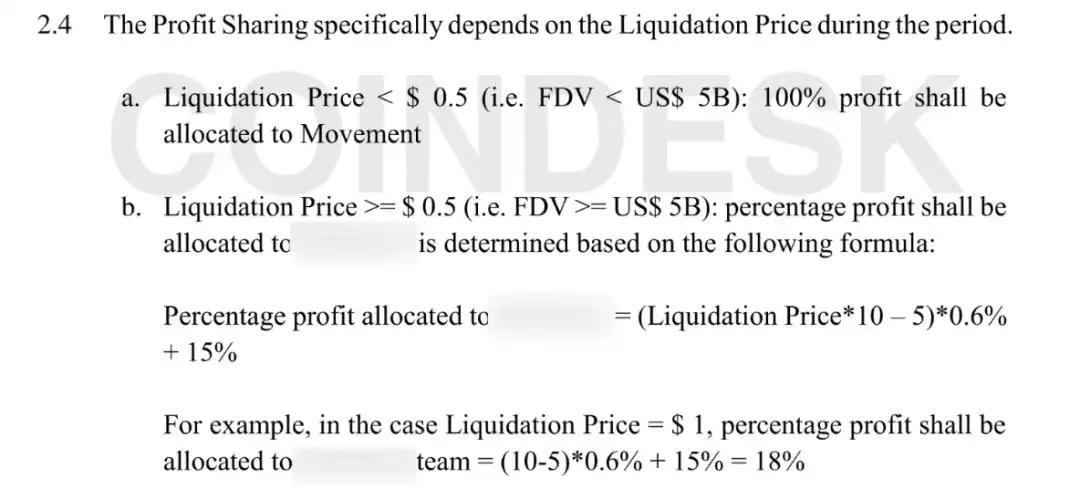
The early agreement signed on November 25, structurally similar to the contract rejected on November 27, still explicitly allows market makers to carry out liquidation operations when the MOVE token price reaches a specific threshold.
This setting, considered by industry figures like Zaki Manian to be a "highly manipulative risk," is a core mechanism where manipulation could occur through orchestrated price movements followed by concentrated selling to profit from it. This indicates that even in subsequent versions apparently modified on the surface, some key stakeholders behind the project continue to drive a path of operation with inherent arbitrage incentives without substantively addressing the fundamental risk.
"Shadow Co-Founder"? Behind-the-Scenes Operator Emerges, Zebec Founder Allegedly Deeply Involved in Protocol Design
Multiple sources close to the Movement project revealed to CoinDesk that there are still many speculations about the true mastermind of the Rentech protocol. The agreement, which was directly linked to the massive December sell-off of the MOVE token and a public relations storm, had its initial version circulated internally by co-founder Rushi Manche and was actively promoted by him in the decision-making process.
According to Blockworks, Manche was briefly suspended last week due to his involvement in the protocol. Manche himself responded, stating that MVMT Labs has always relied on the Foundation team and multiple advisors for advice and assistance in selecting market makers, but "it now appears that at least one Foundation member represented the interests of both sides of the agreement, which has become a focal point of our current investigation."
Simultaneously, another key figure, Sam Thapaliya, has also attracted significant attention. Thapaliya is the founder of the crypto payment protocol Zebec and has long been an advisor to Manche and co-founder Scanlon. He was cc'd on multiple emails exchanged between Web3Port and Movement, appearing alongside Rentech, Manche, in crucial communications.
This clue reinforces external suspicions that Thapaliya may have played a "behind-the-scenes orchestrator" role in Rentech's design - not merely an advisor but rather the driving force behind the protocol's structure and deeply involved in decision-making as a "shadow co-founder."
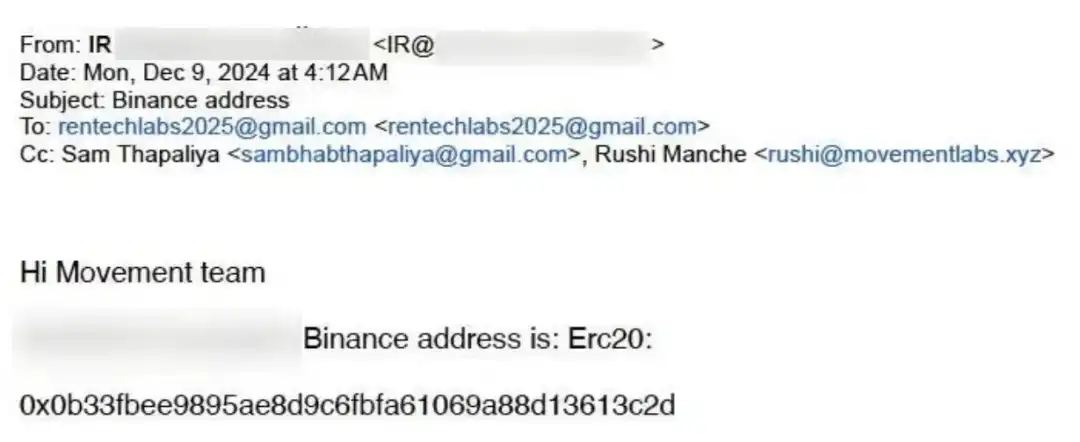
According to several Movement employees, Zebec founder Sam Thapaliya may be playing a role within the project far beyond his advisory capacity. Some have referred to him as "Rushi's (Manche) close advisor, a sort of shadow third co-founder," and pointed out: "Rushi has always been secretive about this relationship, and we usually only hear about him occasionally."
Another employee, on the other hand, stated, "Many times we have reached consensus on a certain matter, but at the last moment there is always a change, and at such times we usually know that it might be Sam's opinion."
According to three eyewitnesses, Thapaliya appeared at Movement's San Francisco office on the day the MOVE token was launched to the public. CoinDesk also reviewed multiple Telegram screenshots showing co-founder Scanlon had entrusted Thapaliya to assist in screening the MOVE airdrop list—a highly sensitive part of the project's community token distribution mechanism.
Such arrangements further deepened the impression of some team members: Thapaliya's actual influence in the project is far deeper and more covert than his public persona suggests. In response to this, Thapaliya told CoinDesk that he had met Manche and Scanlon during his university years and had since been involved in the project as an external advisor, but he "does not hold any shares in Movement Labs, has not received tokens from the Movement Foundation, and does not have any decision-making power."
Who Is Rentech? Behind the Veil of Mystery, Founder and Project Legal Advisor Point Fingers at Each Other
At the heart of the MOVE token controversy is Rentech, founded by Galen Law-Kun—a business partner of Zebec founder Sam Thapaliya. Law-Kun told CoinDesk that Rentech is a subsidiary of his Singapore-registered financial services company Autonomy, aimed at bridging financing for crypto projects and Asian family offices.
Law-Kun claimed that YK Pek, the Movement Foundation's general legal counsel, not only assisted in setting up Autonomy SG but was also the legal counsel for the company (or its affiliates) Rentech. He also stated that despite Pek's strong internal opposition to the Rentech agreement, he himself had actually helped design Rentech's structure and participated in drafting the initial version of the liquidity agreement, "the contents of which were almost identical to the formal contract version he later drafted for the foundation."
However, CoinDesk's investigation did not find direct evidence of Pek working at Autonomy or in that capacity drafting any contracts related to Rentech.
In response to this, Pek stated, "I have never been, nor have I ever been the legal counsel for Galen or any of its entities." He explained that a corporate secretarial services company he co-founded did provide secretarial services to two companies under Galen, but these two companies were not Rentech, and they both declared "no assets" in their 2025 annual audit.
Pek further stated that he had spent two hours reviewing an advisory agreement between Galen and a certain project in 2024, and only provided free advice on the FTX case deadline and NDA documents. "I have no idea why Galen would claim that I am his general counsel, which leaves me confused and unsettled."
Pek also pointed out that the legal teams of Movement Foundation and Movement Labs were introduced to the lawyer hired by Rentech, GS Legal, through co-founder Rushi Manche.
On the other hand, according to Galen, Pek had been introduced to 10 different projects as the "Autonomy legal advisor" and did not deny this title. Regarding GS Legal's involvement, it was "a formal process completed only at Movement's request."
Following the incident, Movement Labs co-founder Cooper Scanlon emphasized in an internal Slack announcement that the company had engaged an external audit firm, Groom Lake, to conduct a third-party independent investigation into the recent anomalies in the liquidity arrangements. He reiterated, "Movement is a victim in this incident."
This series of mutual denials and accusations has exposed the intricate interpersonal and legal relationships behind Rentech and has further propelled the MOVE saga from a market event into the core maelstrom of trust crisis and governance rift.
You may also like
Key Market Insight Discrepancy on May 2nd - A Must-Read! | Alpha Morning Report
Arthur Hayes Interview: Bitcoin Has Bottomed, Which Tokens Can Outperform Bitcoin?
WLFI Holdings Token Analysis: Did the Trump Family's Crypto Investment Pay Off?
Key Market Information Gap on April 24th, A Must-See! | Alpha Morning Report
Arthur Hayes New Article: Bitcoin to Return to “Gold Tier” Safe Haven, Altseason to Potentially Follow
SEC Watershed Moment? 2025 Could Be the 'Altcoin ETF' Year, Which Tokens Are Most Likely to Be Approved
Rate Cut Countdown: $9 Trillion National Debt "Maturity Wall" Could Be the Cryptocurrency Market's Most Powerful Catalyst
Global Stock Markets Face Worst 3-Day Performance in 50 Years, Can the Crypto Market Hold Up?
Just one week after U.S. President Trump signed the executive order on "reciprocal tariffs," the U.S. stock market experienced a two-day crash, with a market value loss of about $6.6 trillion. Despite Trump's "tariff" turmoil washing over the global markets, he seems unconcerned and instead went to his private club in Florida to vacation and play golf.
On his way back from Florida to Washington on April 6, aboard Air Force One, Trump gave a media interview about the global market turmoil caused by last week's stock market crash. His view on the current market plunge was, "Sometimes you have to take medicine to solve a problem." After Trump made the "take medicine" remark, Nasdaq 100 futures continued to decline, dropping over 6%. Can taking medicine really solve the problem?
Following Trump's "take medicine" remark, global stock markets and the cryptocurrency market entered a waterfall crash mode. The cryptocurrency market took a heavy blow this morning, with Bitcoin falling below $78,000, a 6.89% drop in 24 hours. Ethereum fell below $1,600, a 13.19% drop in 24 hours. SOL dropped below $110, a 11.94% drop in 24 hours. According to Alternative data, today's crypto fear and greed index dropped to 23, compared to the weekly average and yesterday's both at 34, indicating the market sentiment is in a state of "extreme fear."
In the past 24 hours, a total of 290,000 users globally have been liquidated, with a total liquidation amount of $893 million, of which long positions account for $762 million.
The Nikkei Futures Index opened for trading for 10 minutes, and the Nikkei average index plummeted by over 8%, dropping more than 2,500 points, breaking through the key level of 32,000 points. An announcement on the Japan Exchange Group website stated that the TOPIX futures circuit breaker was triggered at 08:45:31 Japan time and was restored at 08:55:41. This is the first time since August 5 last year that the index has fallen by more than 2,500 points, when concerns about the U.S. economy led to a single-day stock market plunge of more than 4,000 points, dubbed the "Reiwa Black Monday."
The Korea Composite Stock Price Index (KOSPI) reported 2,357.28 points at 9:02 am local time, a sharp drop of 108.14 points, representing a 4.39% decline from the previous trading day. KOSPI also activated the sidecar mechanism, suspending trading for 10 minutes. European stock index futures continued last week's declines, with EURO STOXX 50 index futures dropping by 4.3%, Germany's DAX index futures falling by 5.0%, and the UK's FTSE 100 index futures declining by 4.1%. After the Taiwan Stock Exchange opened, a circuit breaker was triggered, with TSMC and Foxconn both dropping by nearly 10%, and the Taiwan Weighted Index falling by close to 10%.
According to The Kobeissi Letter, the U.S. stock market lost $11.1 trillion in value over 44 trading days, roughly equivalent to 38% of the U.S. GDP. The S&P 500 futures extended their losses to -4.5%, with a cumulative drop of -15% over the past three days.
Due to the U.S. stock market futures declining by over -15% for three consecutive days, brokerages issued a circuit breaker warning yesterday. The Chicago Mercantile Exchange has circuit breakers set at 7%, 13%, and 20%. A 7% or 13% circuit breaker would trigger a 15-minute trading halt; if the level reaches 20%, the market would close for the day. According to the Daily Mail, hedge funds are facing Lehman-style margin calls due to the market collapse triggered by President Trump's tariff measures.
Note: Lehman-style margin calls refer to an extreme scenario where a market experiences a sharp decline, investors or institutions face significant losses due to high leverage, and brokerages or clearinghouses demand additional margin. However, because of illiquidity or panic, investors are unable to raise funds, ultimately leading to forced liquidation or bankruptcy. This situation could potentially trigger broader systemic risks, similar to the "domino effect" seen during the Lehman Brothers bankruptcy.
Some professionals have pointed out that Nasdaq 100 index futures are down 6.07%, and S&P 500 index futures are down 5.97%. If this situation is accurate, it will be the worst three days for the market performance since "Black Monday" in 1987, even worse than during the COVID-19 pandemic.
Just as the week has begun, the market has delivered a shock to the world, and several key meetings this week will serve as a turning point for the market. Among them, the "reciprocal tariffs" measures may start on April 10, the Federal Reserve's March monetary policy meeting minutes will be released on April 10, March PPI inflation data and University of Michigan consumer sentiment data on April 11.
Treasury Secretary Benson stated, "My current advice to every country is not to retaliate, not to take action, observe the situation, and see how things develop. Because if you retaliate, the situation will escalate. If you don't retaliate, then the current situation is capped."
The countries depicted on the "reciprocal tariffs" sign have split into two camps over the past week: those bowing to the U.S. and adopting a wait-and-see approach, and those strongly retaliating. Currently, Vietnam, Argentina, and Israel have eliminated all tariffs on the U.S., India intends to impose nearly zero tariffs on the U.S., while Mexico, Japan, and the UK do not plan to impose U.S. tariffs.
Singapore Prime Minister Lee Hsien Loong delivered a speech on April 4, stating, "This marks a significant shift in the global order. The rules-based globalisation and free trade era has ended, and we are now entering a new age, a more dangerous phase of rising protectionism. The calm and stability of the global economy that we are familiar with will not return quickly."
On the other hand, China has become the world's first country to retaliate with "tit-for-tat tariffs," announcing a 34% retaliatory tariff against the United States. President Trump, on his social media platform "Trust Social," stated that China made the wrong decision in this matter. The European Union is also preparing to vote on April 9 on how to impose retaliatory tariffs on certain U.S. products. European Trade Commissioner Phil Hogan, after meeting with U.S. officials, stated that the EU is willing to negotiate but is also prepared to defend its own interests.
However, BitMEX's co-founder Arthur Hayes is quite optimistic about this. He believes that volatility is back and says it will be an interesting week. He also mentioned that the Bond Volatility Index, "MOVE Index," is deeply related to when the Federal Reserve will back off and start up the printing press. "The higher this index rises, the more likely institutions trading leveraged government or corporate bonds are to be forced to sell due to increased margin requirements, and these are precisely the two markets where the Fed will fight tooth and nail to support. When MOVE breaks above 140 (currently at 127), it will be an opportunity for the market to get rich after the market crash and the Fed's liquidity injection."
On April 7, Donald Trump Jr., serving as a strategic advisor, made a prediction through the prediction market Kalshi that the likelihood of a U.S. economic recession by 2025 has surged to 68%, reaching the highest level in months. J.P. Morgan Chase also seems to share the same concerns, according to Watcherguru's report, J.P. Morgan is calling on the Federal Reserve to cut interest rates before the next meeting.
Meanwhile, some traders believe that this crisis may also be an opportunity. Top trader Eugene Ng Ah Sio expressed in his personal channel, "This downturn is not only in the cryptocurrency market but also an unprecedented turbulence in the entire stock market. I vaguely feel that, as long as the response is appropriate, when this storm passes, perhaps it can create enough wealth to change destinies. But for now, survival is key."
Founder of Formula News, Vida, believes that "the current U.S. stock market is similar to 2022, where it overprices an expectation that is not actually as serious. This round of U.S. stock market correction is similar to 2018, 2022, occurring periodically (every 2-3 years), rather than a financial crisis like 2008, 2020 (every 10 years)." He predicts that the market's turning point will occur in Q1 2026, and during this period, he will gradually begin buying shares of his favorite U.S. tech companies. If there is another major market plunge during this period, he will accelerate his buying pace.
However, the true market trend still needs to be validated over time. Nevertheless, we have entered a phase where conservative investment is necessary. Sometimes we may have to swallow "this pill," but what every investor must learn is how to navigate the risk after swallowing the pill.
Market's Darkest Hour: Global Assets Plunge in Sync, Crypto Market Cap Down 10%, When Will the Dawn Break?
The global financial market is currently experiencing a dark hour as a storm triggered by U.S. President Donald Trump's new tariff policy sweeps through major asset classes. At the Monday opening, the U.S. stock futures market was bleak, with S&P 500 futures down 3.2%, Nasdaq 100 futures plummeting 5.7%, the VIX fear index futures skyrocketing by 34.4% to 45.8, reaching the highest level since 2022. Safe-haven sentiment drove up the price of the 10-year U.S. Treasury bond, the Japanese yen appreciated by 1.3% against the U.S. dollar, and spot gold fell to $2988.61 per ounce.
Last Thursday, the S&P 500 Index plunged 4.8% to close at 4850 points, marking the largest single-day drop since 2024. On Friday, the selling frenzy further engulfed the market, with the Dow Jones Industrial Average plummeting 2231 points, a 5.5% decline, closing at 38900 points, wiping out nearly two months of gains. The tech-heavy Nasdaq Composite Index fell by 11.8% over two days, officially entering bear market territory. Big Tech performed poorly: Apple fell to $205, a 5.5% drop; Tesla plunged by 10.3% intraday, closing at $310; NVIDIA saw its market value evaporate by over $300 billion in a single day, a 9.1% drop. Global stock markets came under pressure simultaneously, with the Japanese Nikkei 225 Index falling by 5.6% at Monday's opening, triggering a 7% circuit breaker during the session, halting trading for 15 minutes; the South Korean KOSPI Index fell by 4.9%, hitting a six-month low; and the European STOXX 600 Index opened down by 3.8%.
The commodities market also did not escape unscathed. Gold broke below the $3000 per ounce psychological barrier, hitting a low of $2988.61, a 1.9% drop, while silver fell by 2.3% to $34.50 per ounce. The energy market suffered heavy losses, with WTI crude oil futures dropping to $59.80 per barrel, a 12% decline from the previous week's high, hitting a new low since April 2021; Brent crude fell to $63.20 per barrel. Industrial metal prices slid, with COMEX copper falling by 8.2% to $3.85 per pound, reflecting the market's pessimistic outlook on global manufacturing. The foreign exchange market saw heightened volatility, with the Australian dollar falling by 1.1% against the U.S. dollar to 0.6350, the euro weakening by 0.9% against the U.S. dollar to 1.0450, and the U.S. dollar index rising to 104.50, reaching a three-month high.
The cryptocurrency market has failed to escape its fate as a risk asset. CoinMarketCap data shows that the global crypto market cap has shrunk from $2.4 trillion to $2.16 trillion, a 10% decrease. Bitcoin fell by 6%, hitting a low of $77,100; Ethereum dropped by 12.4% to $1,540; the crypto market's performance is highly synchronized with the Nasdaq, highlighting its nature as a "high-beta asset." The total liquidation amount across the market in the past 24 hours was $886 million.
Concerns in the bond market are also escalating. The MOVE Index (Merrill Lynch Option Volatility Estimate Index), a gauge of the implied volatility of U.S. bonds, has surged from 108.50 at the end of March to 125.71, a 15.8% increase. BitMEX co-founder Arthur Hayes pointed out, "To predict when the Fed will capitulate and ease significantly, the MOVE Index is a key indicator. The higher the index, the higher the margin requirements for bond and credit financing trades, and selling pressure will sweep through the market. This is an area the Fed will fight to the death to defend. If it breaks above 140, easing is inevitable." The current level is just a step away from the critical point, indicating that greater turmoil is on the horizon.
Facing a market meltdown, the Trump administration has shown an unusually calm demeanor. Treasury Secretary Steven Mnuchin stated on Sunday, "Market volatility is temporary, and the economic fundamentals have not collapsed." Commerce Secretary Robert Lighthizer took a tough stance, saying, "Tariffs are a necessary safeguard for the U.S. economy and will not retreat." Trump posted on the social platform "True Social," saying, "Don't be afraid, this is just a little episode on the way to prosperity." Hayes analyzed, "Many of Trump's core voters do not hold stocks or financial assets. For them, a market downturn even brings a psychological satisfaction towards the 'Wall Street elite.' This gives Trump the confidence to push tariffs because he knows the votes will not be lost."
However, the market remains unmoved. U.S. federal funds futures show that investors are betting on a 120-basis-point interest rate cut by the Fed this year, implying an expectation of five 25-basis-point rate cuts. JPMorgan predicts that the Fed may start cutting rates from May onwards and lower the federal funds rate to 2.75%-3.0% by January 2026. Goldman Sachs warns that if tariffs are fully implemented, the U.S.' GDP growth rate for 2025 may be revised down to 1.2%, while the inflation rate could rise to 3.8%, putting the Fed in a dilemma. An anonymous Wall Street hedge fund manager stated, "Investors no longer believe in the government's optimistic promises, they only look at the data and the Fed's next move."
Trump's remarks have further exacerbated uncertainty. He shared a video on "Truth Social," implying his intention to cause a 20% stock market drop to boost Treasury demand, weaken the dollar, and lower mortgage rates. White House economic advisor Kevin Hassett urgently clarified: "This is just the President's personal idea, not a policy objective." However, market trust has been severely damaged, with the VIX index rising further to 47.2 in pre-market trading on Monday.
The current situation evokes historical crisis moments. In 1987, on "Black Monday," the Dow Jones Industrial Average plummeted by 22.6% after a weekend panic, setting a record for the largest single-day drop. The meltdown crisis triggered by the COVID-19 pandemic in March 2020 was more recent, with the S&P 500 index hitting the circuit breaker four times in 10 days:
In this crisis, the S&P 500 index dropped from 3393 points at the end of February to 2237 points on March 23, a drop of over 34%. Bitcoin's performance was particularly brutal, plummeting by 39.5% on March 12, marking a rare single-day drop in the crypto market. Notably, Bitcoin failed to break away with an independent trend but instead became highly correlated with the Nasdaq, amplifying the tech stock performance. CNBC commentator Jim Cramer pointed out: "The lesson of 2020 is that Bitcoin is no longer a safe haven asset but rather a 'large-cap Nasdaq,' with a risk exposure far exceeding the traditional stock market." Today, the same pattern is repeating: Bitcoin's correlation with the Nasdaq 100 has recently risen to 0.85, much higher than gold's 0.12, indicating its vulnerability in a panic environment.
History also reveals a turning point. After each circuit breaker in 2020, the market's short-term panic intensified, but the Federal Reserve promptly cut interest rates to zero and launched unlimited QE, ultimately stabilizing the situation. While the turmoil caused by Trump's tariffs was policy-driven, the panic eruption on Monday followed a similar pattern. Cramer added: "The commonality between 1987 and 2020 is that fear brewing over the weekend spiraled out of control on Monday. Today, the opacity of the trade war leaves investors nowhere to hide."
The ripple effects of this storm have swept across the globe. China's Ministry of Commerce stated on Sunday: "Resolute measures will be taken to counteract." The EU's trade commissioner warned of possible tariffs on U.S. cars and agricultural products. India and Brazil are also evaluating retaliatory measures. A 7.2 magnitude earthquake in Myanmar last week further disrupted the rare earth and semiconductor supply chain, driving up tech manufacturing costs. Morgan Stanley estimates that if the supply chain crisis persists, global economic growth could be revised down by 0.5 percentage points by 2025.
Hedge assets have become a rare bright spot. The 10-year U.S. Treasury yield fell by 10 basis points to 3.89%, while the 2-year yield fell by 19 basis points to 3.46%. Bloomberg data shows that the global negative-yield bond market has grown to $16.5 trillion, reaching a high not seen since 2023. The Japanese yen rose to 148.50 against the U.S. dollar, and the Swiss franc increased by 0.8%. Although gold has experienced a short-term pullback, it remains attractive in the long run, with UBS predicting it may return to $3100 per ounce by year-end.
The Federal Reserve is facing unprecedented pressure. Tariffs may raise import costs, and inflation concerns have emerged—Goldman Sachs estimates that if a 34% tariff is implemented, the U.S. CPI could rise by 1.2 percentage points in 12 months. However, a market crash and bond volatility are forcing accommodation. Hayes's MOVE Index theory has become a focal point: "As the MOVE Index rises, the financing cost of bond trading surges, and selling pressure will transmit to the financial system. The Fed has no choice but to act. 140 is the critical point." The current index has reached 125.71, and if panic intensifies on Monday, it may quickly surpass this level.
There is disagreement within the Fed. Hawkish officials advocate waiting for inflation data, while doves warn that delays could trigger systemic risks. Chicago Fed President Evans stated, "When markets are in disarray, monetary policy must be decisive." The market expects the May FOMC meeting to potentially initiate a rate cut, with a magnitude of up to 50 basis points.
Hedge fund manager Bill Ackman has proposed another possibility: "If Trump announces a tariff delay on Monday to seek negotiation space, the market may catch its breath." However, he also warns that if the policy remains tough, the S&P 500 could fall another 10%, and the risk of an economic recession could increase from the current 35% to 60%. Ackman concludes, "In any case, this Monday will determine the direction of the next few months."
Although this earthquake is chilling, it may herald a turning point. After the 2020 circuit breaker, the Fed's decisive intervention reversed the decline. Now, with the MOVE Index sounding the alarm, the pressure for rate cuts is mounting. If the Fed gives in, accommodative policies could inject vitality into the market and reignite investor confidence. History tells us that the deepest darkness often comes before the dawn. The tug-of-war between Trump's tough stance and the market's fragility makes the Fed's decision a decisive variable.
The calls for rate cuts are growing louder—perhaps this is the first ray of sunshine after the storm. For investors, the gold pullback may be a buying opportunity, and the tech stock slump is a litmus test of patience. As Ackman said, this Monday will go down in history, and the Fed's actions may unexpectedly bring this crisis to a close.
Original Article Link
VC Short-Sightedness and Long-Term Pain: Why Over-Betting on Public Blockchains Has Plunged the Crypto World into an "Empty Block" Crisis?
This Week in Review | Binance Reports Employee "Front-Running"; Hyperliquid Faces Another Attack, Performs "Pulling the Plug" Self-Rescue
From Traditional to Innovative: Can Backpack Seize the Future Opportunity in Crypto Derivatives?
Key Market Intelligence on March 26th, how much did you miss?
Fake Volume, Pump and Dump: Exposing High FDV Token Manipulation
Key Market Information Discrepancy on March 26th - A Must-Read! | Alpha Morning Report
OKX Friends Session 9 | In Conversation with a Visionary, Reflections on the Past, Present, and Future
The Altcoin ETF Battle Has Begun: Who Will Be Approved First?
Week 9 On-Chain Data: Extreme Fear Sentiment, When Will the Sell-Off End?
Key Market Insight Discrepancy on May 2nd - A Must-Read! | Alpha Morning Report
Arthur Hayes Interview: Bitcoin Has Bottomed, Which Tokens Can Outperform Bitcoin?
WLFI Holdings Token Analysis: Did the Trump Family's Crypto Investment Pay Off?
Key Market Information Gap on April 24th, A Must-See! | Alpha Morning Report
Arthur Hayes New Article: Bitcoin to Return to “Gold Tier” Safe Haven, Altseason to Potentially Follow
SEC Watershed Moment? 2025 Could Be the 'Altcoin ETF' Year, Which Tokens Are Most Likely to Be Approved
Popular coins
Latest Crypto News


Customer Support:@weikecs
Business Cooperation:@weikecs
Quant Trading & MM:bd@weex.com
VIP Services:support@weex.com
 App
App