
- Buy Crypto
- Markets
- Futures
- Spot
- Copy Trade
 WE-Launch
What are Tokenized US Stocks: How They Work, Models, and Future Development

Tokenized US stocks are experiencing an unprecedented, concentrated boom. June 30th marked a landmark moment in fintech history: US online brokerage Robinhood, along with crypto giants Bybit and Kraken, simultaneously announced the launch of tokenized US stock services, offering users a 24/7, uninterrupted stock trading experience. Spurred by this news, Robinhood's stock price surged by nearly 10%, hitting a new all-time high. The tokenized stocks "xStocks," a collaboration between Bybit and Kraken, attracted over 100,000 users on their first day of trading. Suddenly, tokenized US stocks became a major hot topic in the crypto world, drawing market attention and raising a key question: Is this the next big narrative?
In fact, tokenized US stocks are not a new concept; they have existed since 2020. This article will provide a deep and comprehensive understanding of tokenized stocks, covering their concept, history, platform models, and future development.
What are Tokenized US Stocks?
Simply put, creating tokenized US stocks involves using blockchain technology to represent traditional US stocks (like Tesla or Apple) as tokens. This allows users to trade "on-chain equivalents" of these stocks 24/7 on crypto exchanges. The real stocks are held by a compliant custodian (such as Backed Finance), ensuring the token's value is pegged 1:1 to the underlying asset.
The History of Tokenized US Stocks
The journey of tokenized US stocks began around 2020, marked by a cycle of innovation, regulatory crackdowns, and recent revival.
The Wild West Era (2020-2022)
Early attempts by platforms like FTX and Binance saw massive trading volumes but were quickly shut down by regulators for operating without proper licenses. Other projects, like Mirror, tried to create synthetic stock tokens but failed when their underlying technology collapsed.
The Frozen Period (2023-2024)
Regulators, particularly the U.S. SEC, took a hard stance against unregistered tokens. This forced many projects to move offshore and led to the abandonment of models that weren't backed by real stocks.
The Breakout Year (2025)
A shift in policy has sparked a resurgence. With a more favorable regulatory outlook, major players like Robinhood, Bybit, and Kraken have launched new, more compliant tokenized stock services. Coinbase has also applied to enter the U.S. market, signaling a potential new chapter for tokenized stocks.
The Core Mechanism of Tokenized US Stocks
The operation of tokenized US stocks relies on blockchain technology to create a closed-loop process for issuance, trading, and management. This involves five key stages:
Issuance Mechanism: From Asset Mapping to Compliant Registration
- Asset On-Chaining: The issuer encodes stock rights into tokens via smart contracts. For example, when Backed Finance issues bSTOCK tokens, it must first purchase the corresponding stocks in the traditional market and place them in custody, then mint tokens at a 1:1 ratio.
- Compliance Review: The process must be reviewed by regulatory bodies. For instance, Exodus submitted its application twice to tokenize its common stock before finally receiving SEC approval in December 2024. Hong Kong requires tokenized securities to comply with the Securities and Futures Ordinance and pass KYC /AML reviews.
- Investor Access: Access is typically limited to accredited investors. For example, the tZERO platform is only open to certified investors. Although Robinhood's tokenized stocks in the EU have a low entry point of €1, they still require identity verification.
Trading Mechanism: 24/7 Fractional Trading
- Enhanced Liquidity: It breaks the time constraints of traditional stock markets, supporting 24/7 trading (like Robinhood's Layer-2 solution on Arbitrum). It also eliminates the need for a central clearing house, reducing transaction confirmation times to minutes.
- Fractional Ownership :Tokens s can be divided into extremely small units (e.g., 0.01 of a share), lowering the investment barrier. For example, tokenized shares of the unlisted company OpenAI are priced as low as $0.50, allowing retail investors to participate in early-stage projects.
- Cross-Chain Interoperability: Some projects are exploring cross-chain trading, such as using Hash Time Locked Contracts (HTLCs) to achieve atomic swaps of stock tokens between different blockchains, solving the problem of asset silos.
Rights Management: Automated Processing via Smart Contracts
- Dividends and Voting: Smart contracts automatically execute rights distribution. For example, holders of Robinhood's tokenized stocks automatically receive dividends corresponding to the underlying shares and can participate in corporate governance through on-chain voting.
- Dynamic Rights Adjustment: When the underlying stock undergoes events like splits or rights issues, the smart contract automatically adjusts the number of tokens and the associated rights. For example, if a stock undergoes a 1:2 split, the token holder's position will automatically double.
Custody and Settlement: On-Chain and Off-Chain Synergy
- Custody Models:
- Centralized Custody: As with Backed Finance, which holds stocks in a Swiss custodian bank, token holders have indirect ownership through smart contracts.
- Decentralized Custody: Some projects are experimenting with managing assets through DAOs (Decentralized Autonomous Organizations), but they face legal and compliance challenges.
- Settlement Efficiency: It uses a "payment versus payment" model where assets and funds are settled simultaneously upon transaction completion, significantly improving efficiency compared to the traditional T+2 settlement cycle.
Regulatory Compliance: Penetrative Risk Control
- Technology Risk Disclosure: Issuers must disclose information such as blockchain security vulnerabilities and smart contract audit reports. For example, the Hong Kong SFC requires tokenized products to disclose technological risks like "51% attacks."
- Cross-Border Regulatory Collaboration: Regulatory standards vary significantly across jurisdictions:
- United States: The SEC treats stock tokens as securities, requiring registration and compliance with regulations like the JOBS Act.
- European Union: The Markets in Crypto-Assets (MiCA) regulation applies, emphasizing investor protection and anti-money laundering.
- Hong Kong SAR: Adopts the principle of "same business, same risks, same rules," requiring intermediaries to have technological compliance capabilities.
Three Models of Tokenized US Stocks
The market has formed three main approaches to offering tokenized stocks:
Third-Party Issuance Model (e.g., Bybit, Kraken)
A regulated third party (like Backed Finance) issues tokens that are 1:1 pegged to real stocks. These tokens are then traded on various crypto exchanges. The issuer handles compliance, while the exchanges provide the trading platform, typically for non-US users.
Licensed Broker Model (e.g., Robinhood)
A licensed brokerage firm issues and manages its own stock tokens on its own blockchain infrastructure. This all-in-one model is highly compliant but also technically complex and expensive, making it less common.
Contracts for Difference (CFD) Model (e.g., Bybit)
This model doesn't involve real stocks. Instead, users trade contracts based on a stock's price movements, often with leverage. It's popular for speculation but offers no actual ownership rights (like dividends). This is a strictly regulated financial derivative.
Additionally, Coinbase is pursuing a different path by seeking SEC approval to offer fully compliant tokenized stocks directly to the US market, which could make it a pioneer if successful.
The Future and Challenges of Tokenized US Stocks
Future Trends: A Dual Race of Regulation and Technology
The recent surge in tokenized stocks is driven by both friendlier regulations and new technology. In the U.S., a more open regulatory stance and proposals for "sandboxes" are creating opportunities. Europe's MiCA regulation is also providing a clear path forward. This has revived a sector that was dormant for years.
However, major hurdles remain. The U.S. domestic market is still closed, making Coinbase's pending application a critical test for the industry. Platforms also face a dilemma: strict KYC rules can deter crypto users, while less regulated platforms lack trust. Furthermore, the stable nature of US stocks may not appeal to crypto traders seeking high volatility.
On the tech side, innovations are paving the way for growth. Cross-chain technology is making it easier to move assets between blockchains, and integration with DeFi platforms allows investors to earn higher yields than in traditional finance. There's even potential to tokenize equity in private companies like SpaceX, which could disrupt the IPO market.
Real-World Dilemmas: Liquidity and Trust
Despite the excitement, tokenized stocks face significant real-world problems. Liquidity is a major issue, with most tokens seeing very low trading volumes. This is partly because market makers face a key challenge: they can't easily hedge their risk between on-chain tokens and traditional stock exchanges, especially when markets are closed. High fees on these platforms also cut into potential profits.
Trust is another major concern. Users of tokenized stocks typically get economic rights (like dividends) but not true legal ownership or voting rights. This "suspended ownership" creates risk, as highlighted when OpenAI stated it had not approved Robinhood's tokenized offering of its equity. The questionable history of some issuers further erodes confidence. Compounding this are regulatory gray areas, with most platforms avoiding U.S. users and carrying high-risk ratings.
The Path Forward
The future of tokenized stocks depends on solving three core issues:
- Liquidity: Creating mechanisms that link on-chain and off-chain markets so market makers can hedge risk.
- Rights: Using smart contracts to ensure users receive full rights, including voting.
- Regulation: Establishing clear, collaborative rules across different countries.
This new wave of tokenization is far more robust and compliance-aware than failed past attempts. Its ultimate success will depend on finding the right balance between strong regulation and a seamless user experience. If achieved, it could truly democratize finance, allowing anyone in the world to invest in top companies and startups. This convergence of Wall Street and blockchain is already reshaping the future of finance.
You may also like
U.S. Stablecoin Regulation Explained: How the U.S. GENIUS Act Reshapes Crypto Markets
The U.S. GENIUS Act marks the end of blockchain market’s “Wild West” era, transforming dollar-backed digital assets from speculative experiments into regulated pillars of the financial system. By replacing ambiguity with a bank-grade framework, Washington isn’t just setting rules — it is laying the foundation for the next wave of institutional adoption.

Introducing zkPass: Complete Guide to $ZKP and Airdrop Opportunities
zkPass (ZKP) is a Protocol for Private Data based on MPC, ZKP, 3P-TLS designed to enable the seamless transfer of private data from the web2 realm to web2 or web3. Learn its tokenomics, ecosystem impact, and how to claim free tokens in the WEEX $50,000 LISA airdrop until Dec.26, 2025!

VOOI (VOOI) Coin Price Prediction & Forecasts for December 2025: Could This DeFi Newcomer Surge 50% Post-Launch?
As a seasoned crypto investor who’s navigated multiple market cycles, I’ve seen plenty of DeFi projects launch with…

What is VOOI (VOOI) Coin?
Cryptocurrency enthusiasts recently witnessed the listing of the VOOI token on WEEX. This new development underscores WEEX’s commitment…

VOOI USDT Spot Trading Now Open on WEEX Exchange
VOOI (VOOI) Coin is now listed on WEEX Exchange. Access VOOI USDT spot trading for the DeFi super-app. Check the listing timeline and project details here.

Introducing Aave: Complete Guide to $AAVE and Airdrop Opportunities
Aave (AAVE) is a leading decentralized non-custodial lending protocol that allows users to supply assets to earn interest and borrow against collateral on blockchain networks. Learn its tokenomics, ecosystem impact, and how to claim free tokens in the WEEX $50,000 AAVE airdrop until Dec.22, 2025!
Introducing Talus Network: Complete Guide to $US and Airdrop Opportunities
Talus Network(US) is is a blockchain platform with a focus on decentralizing artificial intelligence. Learn its tokenomics, ecosystem impact, and how to claim free tokens in the WEEX $50,000 US airdrop until Dec.18, 2025!
What is Tea(Tea)? TEA is now available on WEEX Pre-Market
Tea(TEA) is developing a decentralized, open-source software platform to fairly remunerate open-source developers based on their contributions to the entire ecosystem.

What is Stable(STABLE)? The Stablecoin Public Chain
Stable(STABLE) is a Layer 1 blockchain launched by Tether that supports free peer-to-peer USDT transfers using USDT as the native gas.

Tea Protocol (TEA) Coin Price Prediction & Forecasts for December 2025: Could This Layer 2 Newcomer Surge 50% Post-Launch?
As of December 4, 2025, the crypto world is buzzing with the launch of Tea Protocol (TEA) Coin,…

Introducing Rayls: Complete Guide to $RLS and Airdrop Opportunities
Discover Rayls (RLS) — an uniFi'd blockchain Ecosystem — aims to bring $100T of TradFi liquidity and the 6 Billion banked population into DeFi. Learn its tokenomics, ecosystem impact, and how to claim free tokens in the WEEX $50,000 RLS airdrop before Dec.09, 2025!

Introducing Irys: Complete Guide to $IRYS and Airdrop Opportunities
Irys ($IRYS) is the Layer-1 datachain, advancing beyond the existing Layer-1 model with a design purpose-built for AI. Learn its tokenomics, ecosystem impact, and how to claim free tokens in the WEEX $50,000 IRYS airdrop before Dec.02, 2025!

How Investors Are Positioning in Late 2025
Against a backdrop of healthy consolidation and still-intact long-term bull trends, WEEX Auto Earn offers flexible, no-lock USDT yield so investors can keep earning steady daily returns while they calmly wait for the next major move in crypto.
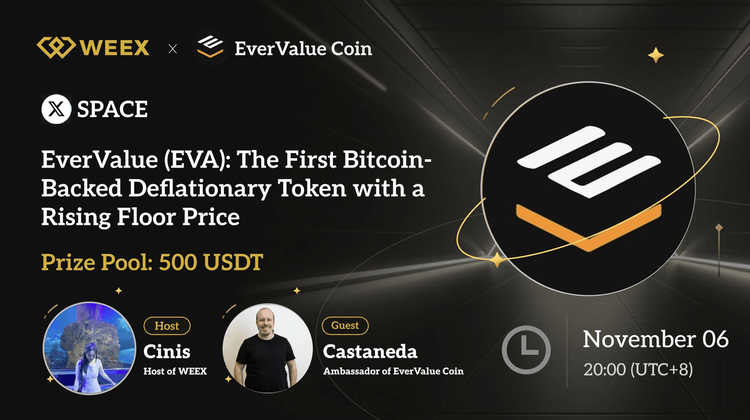
WEEX x EverValue X Space Recap: The First Bitcoin-Backed Deflationary Token with a Rising Floor Price
The WEEX x EverValue AMA unpacked how $EVA, the world’s first Bitcoin-backed deflationary token, turns real mining revenue into a transparent, burn-to-redeem asset with a continuously rising BTC floor.

What is X Bangers (BANGERS) Coin? Everything You Need to Know
X Bangers (BANGERS) is the latest meme-driven cryptocurrency built around viral trends and community engagement on X (formerly…
Introducing Allora Network: Complete Guide to ALLO and Airdrop Opportunities
Discover Allora Network ($ALLO)— the Self-Improving Decentralized Intelligence Layer Powering the Future of AI.Learn its tokenomics, ecosystem impact, and how to claim free tokens in the WEEX $50,000 ALLO airdrop before Nov.18, 2025!
What is Allora(ALLO)?The Self-Improving DeAI Layer Powering the Future of AI
Allora Network represents a paradigm shift — from centralized AI silos to an open, decentralized intelligence network that self-improves over time.

What is Audiera (BEAT) Coin? Everything You Need to Know About the New Listing on WEEX
Audiera (BEAT) is a newly launched Web3 entertainment token that reimagines a global dance game IP by merging…
U.S. Stablecoin Regulation Explained: How the U.S. GENIUS Act Reshapes Crypto Markets
The U.S. GENIUS Act marks the end of blockchain market’s “Wild West” era, transforming dollar-backed digital assets from speculative experiments into regulated pillars of the financial system. By replacing ambiguity with a bank-grade framework, Washington isn’t just setting rules — it is laying the foundation for the next wave of institutional adoption.
Introducing zkPass: Complete Guide to $ZKP and Airdrop Opportunities
zkPass (ZKP) is a Protocol for Private Data based on MPC, ZKP, 3P-TLS designed to enable the seamless transfer of private data from the web2 realm to web2 or web3. Learn its tokenomics, ecosystem impact, and how to claim free tokens in the WEEX $50,000 LISA airdrop until Dec.26, 2025!
VOOI (VOOI) Coin Price Prediction & Forecasts for December 2025: Could This DeFi Newcomer Surge 50% Post-Launch?
As a seasoned crypto investor who’s navigated multiple market cycles, I’ve seen plenty of DeFi projects launch with…
What is VOOI (VOOI) Coin?
Cryptocurrency enthusiasts recently witnessed the listing of the VOOI token on WEEX. This new development underscores WEEX’s commitment…
VOOI USDT Spot Trading Now Open on WEEX Exchange
VOOI (VOOI) Coin is now listed on WEEX Exchange. Access VOOI USDT spot trading for the DeFi super-app. Check the listing timeline and project details here.
Introducing Aave: Complete Guide to $AAVE and Airdrop Opportunities
Aave (AAVE) is a leading decentralized non-custodial lending protocol that allows users to supply assets to earn interest and borrow against collateral on blockchain networks. Learn its tokenomics, ecosystem impact, and how to claim free tokens in the WEEX $50,000 AAVE airdrop until Dec.22, 2025!
Popular coins


Customer Support:@weikecs
Business Cooperation:@weikecs
Quant Trading & MM:bd@weex.com
VIP Services:support@weex.com
 App
App