
- Buy Crypto
- Markets
- Futures
- Spot
- Copy Trade
 Earn
Earn- More
Next Generation of ICO Launchpads: From First Come, First Serve to Tailored Investor Engagement

Key Takeaways:
- The emergence of next-generation ICO launchpads signifies a shift towards selective investor engagement to build sustainable communities around projects.
- Platforms like Legion, Buidlpad, MetaDAO, and Kaito are pioneering new approaches to investor selection and token distribution models.
- These launchpads offer varying strategies, including community-based evaluations and performance-driven allocations, to enhance project credibility and success.
- A renewed interest in ICOs heralds increased funding potential, yet emphasizes the importance of differentiating quality projects amidst market saturation.
WEEX Crypto News, 2025-11-28 09:47:07
The Evolution of ICOs: A New Landscape
In recent years, the world of ICOs has witnessed remarkable transformations, propelled by the return of interest and trust among investors. Unlike the previous era dominated by a first-come-first-served (FCFS) model where investors scrambled to get in at the lowest valuation, the current wave focuses on creating well-aligned investor communities. This evolution has ushered in a new era of launchpads, where the emphasis lies on building trust and offering deeper insights into project mechanics.
Coinbase’s acquisition of Echo and its subsequent launch of a token sales platform exemplifies this trend. Partnerships like those between Kraken and Legion, and Binance’s close ties with Buidlpad, reflect a consolidated effort to leverage these platforms for more structured ICOs. They’ve been buoyed by successful fundraising endeavors; for example, MetaDAO’s Umbra Privacy raised an astonishing $156 million, far exceeding its target of $750,000.
This narrative unfolds as a response to the lessons learned between 2017 and 2019 when many ICOs, plagued by scams and inadequate vetting processes, left investors cautious. Today, platforms are honing their strategies to ensure only genuine investors engage with projects.
From FCFS to Selective Community Engagement
Historically, ICOs drew investors driven by the allure of quick profits, often leading to “lemon markets” where high-quality projects were indistinguishable from those of low caliber. This trend shifted when research revealed that nearly 30% of investors exited within the first month post-launch, leaving project teams with the conundrum of ensuring long-term investor engagement.
Enter the rise of platforms like Echo, which has already amassed $200 million across 300 projects, signaling a maturation in approach. The transition from FCFS to more community-centric models highlights a pivot towards sustainable growth. Echo, for instance, channels efforts into achieving transparency and community alignment, ensuring projects can differentiate between fleeting interest and committed support.
One illustrative story is that of Pump.fun, which garnered $500 million in merely 12 minutes, and Plasma, whose ambitious fundraising goal was overshot by over $323 million within moments. These occurrences not only underscore the regained trust in ICOs but also epitomize efficiency and interest that is becoming the hallmark of next-generation launchpads.
A Close-Up on New Generation Platforms
The latest wave of launchpads—Legion, Buidlpad, MetaDAO, and Kaito—represent a significant deviation in strategy. Their overarching mission revolves around fostering quality engagements rather than merely inviting investments. Each platform offers a unique method to integrate investor interests with project objectives, using diverse selection mechanisms:
Legion: The Performance-Driven Approach
Legion has crafted an intricate performance-driven system for allocation, implementing a ‘Legion Score’. This score meticulously evaluates factors such as cross-protocol activity, developer credentials, and social influence, prioritizing participants not only based on financial metrics but community involvement. By aligning interests through metrics like developer participation and key opinion leader influence, Legion reshapes how projects gauge their investor landscape.
Kaito: The Targeted Engagement Model
Kaito employs a distinct approach that intertwines social influence with stake-based allocations. By encouraging discussions on social platforms like Twitter and assessing users on factors such as NFT rarity and voting reputation, Kaito enables projects to fortify their early adopter community with genuine advocates. The platform prioritizes voices that resonate with project ethos, fostering an engaged initial investor group eager to foster visibility.
Buidlpad: Capital and Community Symbiosis
While Buidlpad channels on capital sufficiency as a determinant for participation scaling, it balances this by integrating a ‘team system’. This allows participants to gain additional rewards through content creation, educational activities, and community promotion. With this model, Buidlpad acknowledges the importance of involvement beyond financial contributions, promoting balanced participation.
MetaDAO: Governance-Focused Distribution
MetaDAO stands out with its Futarchy model where governance decisions endorse transactions. Funds raised are centrally placed in on-chain treasuries linked to market decisions rather than simply price movements. Here, investors participate without permissions, leveraging the power of collective decision-making post-ICO to drive project value through democratic choices. This democratic ethos undergirds its community-centric approach, nurturing a co-dependent relationship between the project and its community.
Re-aligning with Long-term Visions
In this evolving landscape, projects are increasingly aware of the merits of long-term alliances over fleeting investor interest. The strategies adopted by Legion, Kaito, Buidlpad, and MetaDAO reflect a deeper understanding and appreciation for investor alignment, community building, and development support post-ICO.
These launchpads not only promise clearer operational frameworks and accountability but also provide the tools necessary for projects to attract enduring support from their communities.
Building With Credibility: The Role of Next-Gen Launchpads
Successful ICOs in this era are contingent upon a concrete foundation of trust and community alignment. The seamless integration of participant vetting mechanisms across emerging launchpads is crucial for distinguishing authentic projects from ephemeral endeavors.
Through verifiable credential systems and incentivized engagement, next-gen launchpads have the potential to effectively mobilize communities around blockchain-based initiatives, culminating in a sustained ecosystem where both investor expectations and project developments harmoniously align.
FAQs
How have next-generation ICO launchpads changed the fundraising landscape?
Next-gen ICO launchpads have shifted from a first-come-first-served model to curated investor selection, focusing on building sustainable communities, transparency, and reducing market noise.
What are the benefits of selective investor engagement for ICO projects?
Selective engagement fosters committed, long-term participants who align with project goals, enhancing trust, and helping avoid the pitfalls associated with “pump and dump” scenarios prevalent in earlier ICO phases.
What mechanisms do platforms like MetaDAO use to distribute tokens?
MetaDAO employs a Futarchy model, where governance decisions, instead of financial speculation, dictate transactions, ensuring a democratic and value-driven community allocation process.
How do Legion and Kaito differ in their approach to community selection?
Legion uses a performance-driven method, evaluating a range of metrics like developer participation, while Kaito leverages social influence, rewarding active participants on platforms like Twitter along with their investment.
Can next-gen launchpads provide a solution to historical ICO challenges?
Yes, by incorporating comprehensive vetting mechanisms and prioritizing community-centric models, these launchpads aim to create a sustainable ecosystem, effectively addressing previous transparency and trust issues within ICO frameworks.
You may also like

After Forty Years of Sanctions, How Iran Is Rebooting Financial Channels Through Crypto

Telegram 2025 Financial Report Puzzle: Revenue Soars by 65%, Yet Plagued by $200 Million Loss Due to TON?

North Korean Hackers Enjoy 'Fat Years': Stole Record Amount in 2025, With Money Laundering Cycle of About 45 Days

Crypto and AI: the hidden digital gray market of Xianyu
Crypto and AI: You Can Buy Anything on Xianyu.

Why Is On-Chain Fixed-Rate Lending Hard to Come By? "Basis Swap" Trading Is the Way Out

What’s Driving Crypto Markets in Early 2026: Market Swings, AI Trading, and ETF Flows?
Imagine checking Bitcoin and Ethereum prices in a day — one minute up 5%, the next down 4%. Sharp moves, quick reversals, and sensitivity to macro signals marked the first week of 2026. After an early-year rally, both assets pulled back as markets recalibrated expectations around U.S. monetary policy and institutional flows. For traders — including those relying on AI or automated systems — this period offered a vivid reminder: abundant signals do not guarantee clarity. Staying disciplined in execution is often the real challenge.

America's First State-Backed Stablecoin FRNT: Can It Save Wyoming Amid Energy Slump?

Zcash Core Team Exodus Story, Crypto's Own OpenAI Drama

Kinetiq Exclusive Interview: From Hyperliquid's Largest LST Protocol to the "Exchange Factory"

Glassnode New Year Report: $95K Call Option Premium, Bulls Shift to Aggressive Offense

Base contributes 70% of revenue but pays only 2.5% in rent; Superchain may be entering its "forking" countdown

ZCash Team Split, Bank of America Upgrades Coinbase Rating, What's the Overseas Crypto Community Talking About Today?
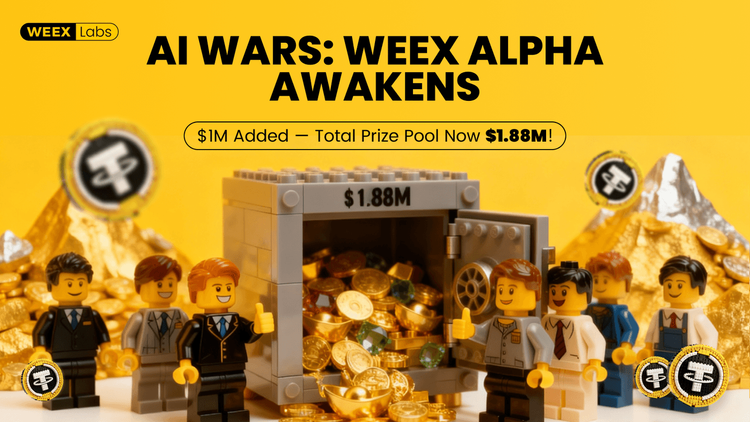
WEEX Global AI Trading Hackathon Kicks Off: $1.88M Prize Pool Powers the Next Generation of AI Trading Champions
WEEX Labs, the innovation arm of WEEX, a leading global crypto exchange serving over 6.2 million users across 150+ countries, is set to kick off the preliminary round of its flagship global AI trading hackathon, AI Wars: WEEX Alpha Awakens, on January 12, 2026. Backed by the strong support of world-class sponsors including Amazon Web Services (AWS), the total prize pool has surged from $880,000 to an unprecedented $1,880,000, positioning AI Wars among the largest AI trading hackathons in the crypto industry. At the top of the leaderboard awaits an extraordinary champion prize — a Bentley Bentayga S, already on standby in Dubai, ready to be claimed by the ultimate AI trading victor.
December Exchange Rankings: CEX and DEX Simultaneously Weaken, On-Chain Perpetual Contract Trading Volume Declines by 30%

2025 Market Prediction Retrospective: Total Transaction Volume Exceeds $50 Billion, Duopoly Market Share Exceeds 97.5%

Key Market Info Discrepancy on January 9th - A Must-Read! | Alpha Morning Report

Aster Coin: A Deep Dive into Its Price, Potential, and Why It’s Catching Eyes in 2026
Have you ever stumbled upon a crypto project that seems poised for growth amid market volatility, only to…
Left Hand BTC, Right Hand AI Computing Power: The Gold and Oil of the Data Intelligence Era
After Forty Years of Sanctions, How Iran Is Rebooting Financial Channels Through Crypto
Telegram 2025 Financial Report Puzzle: Revenue Soars by 65%, Yet Plagued by $200 Million Loss Due to TON?
North Korean Hackers Enjoy 'Fat Years': Stole Record Amount in 2025, With Money Laundering Cycle of About 45 Days
Crypto and AI: the hidden digital gray market of Xianyu
Crypto and AI: You Can Buy Anything on Xianyu.
Why Is On-Chain Fixed-Rate Lending Hard to Come By? "Basis Swap" Trading Is the Way Out
What’s Driving Crypto Markets in Early 2026: Market Swings, AI Trading, and ETF Flows?
Imagine checking Bitcoin and Ethereum prices in a day — one minute up 5%, the next down 4%. Sharp moves, quick reversals, and sensitivity to macro signals marked the first week of 2026. After an early-year rally, both assets pulled back as markets recalibrated expectations around U.S. monetary policy and institutional flows. For traders — including those relying on AI or automated systems — this period offered a vivid reminder: abundant signals do not guarantee clarity. Staying disciplined in execution is often the real challenge.


 App
App