
- Buy Crypto
- Markets
- Futures
- Spot
- Copy Trade
 Earn
Earn- More
After Lighter, the next batch of Perp DEXs Worth Keeping an Eye On

2026 is destined to be the year of the Perp DEX airdrop.
From Hyperliquid, Aster, to the recent TGE of Lighter, every coin-launching Perp DEX in this cycle has been as lively and festive during airdrops. After Lighter, second-tier Perp DEXs have also seen a significant increase in activity. According to perpetualpulse data, the top trading volume among the unreleased Perp DEXs includes edgeX, Variational, Extended, GRVT, and Paradex.
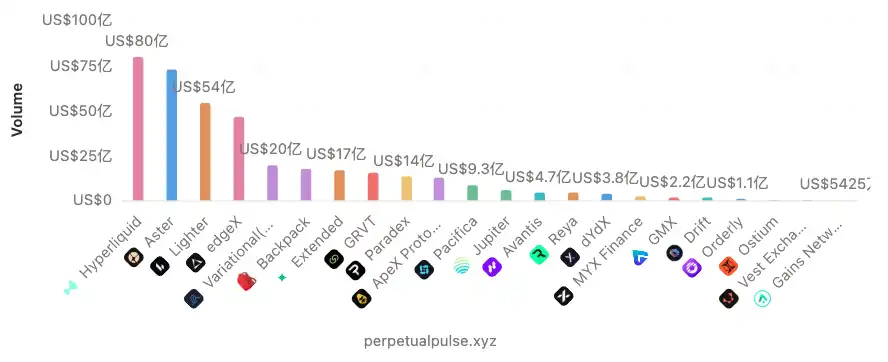
In the new year, the competition among Perp DEXs has entered a more intense stage, from trading volume to various activities and subsidies, and even the projects have started to take jabs at each other. Faced with various Perp DEX point mechanisms and strategies, how can ordinary users choose? How can they maximize point weight with limited funds? How can they avoid being rug pulled?
In this article, BlockBeats will start from four dimensions: team background, core mechanism, data performance, and interaction strategy, select four popular second-tier Perp DEXs in the market: Variational, Extended, Paradex, StandX, comprehensively analyze their differences and characteristics, and provide some concluding content based on community KOLs' practical experience.
Variational
Variational Omni is one of the products that the editor has been paying close attention to.
Since the introduction of open liquidation refunds, Kaito Yaps rewards, and the point system, Variational's data has been soaring: as of December 26, 2025, the cumulative spread income reached $7.6 million; as of January 3, 2026, the cumulative trading volume exceeded $1 trillion. There have also been many discussions on trading and point strategies on CT, such as posts by dTfN (@deTEfabulaNar_) and Tony (@T0nyCrypt0).
The Variational team has a strong background. The two core founders are alumni of Columbia University and previously co-founded a quantitative trading firm that was acquired by Genesis Trading. After leaving Genesis in 2021, the two started Variational, where they continue to iterate on machine learning, quantitative market making, and decentralized derivatives design. In 2024, Variational completed a $10.3 million seed round led by Bain Capital Crypto and Peak XV Partners, with participation from Coinbase Ventures and Dragonfly Capital.
For Lucas and Edward, who experienced the FTX incident firsthand, amplifying into a systematic impact during extreme market conditions is a problem that needs to be addressed. It is also the design philosophy behind Variational. In July 2025, Edward appeared on the 'Flirting with Models' podcast, where he elaborated on the concept of 'How OTC Derivatives Go On-Chain.' This was a deep dive where he integrated Bayesian framework, market-making games, and on-chain mechanisms. His personal website quant.am and Lucas's website lucasschuermann.com are constantly updated with relevant research. For more information on the team background, you can refer to the author's previous article "How Does Variational, Produced by Columbia University, Generate Revenue with Zero Fees?," so it won't be further discussed here.
What I would like to elaborate on here is how to understand Variational's spread mechanism and arbitrage logic from the perspective of its product features to enhance and optimize trading strategies.
Although both Variational and Lighter have zero fees, their profit mechanisms are entirely different: Lighter charges market makers a fee, while Variational profits through the Omni Liquidity Provider's spread arbitrage mechanism. (The spread is the difference between the buying and selling prices, serving as the trading cost for users. The smaller the spread, the lower the trading cost).
Simply put, on Variational there is only one market maker, which is Variational itself. When a user places an order, Variational internally acts as the sole market maker and counterparty, charging a spread of 4-6 basis points, while simultaneously hedging by opening a reverse position on an external trading platform to capture the price difference as profit. Many traders have also validated this core logic through various control group tests: the larger the spread, the higher the Variational profit, and the higher the user's point weight. So how to maximize the point weight? A straightforward strategy to boost points is that the larger the spread, the better. So how to increase the spread?
Based on the principles discussed earlier, we know that ways to reduce the spread include: trading mainstream coins, such as BTC or ETH; choosing time periods with good liquidity.
Conversely, ways to increase the spread are: trading small coins, where the spread of low-liquidity altcoins is larger than that of mainstream coins; additionally, opting for periods of low liquidity, such as weekends or Asian nighttime. This way, the weight will be higher, and based on this, you can further increase trading volume data by increasing trade count, holding period, single trade amount, and so on.
Through these methods, you can achieve a higher point weight with the same trading volume, thereby gaining a more favorable position in the airdrop distribution.
Extended
Extended, often mentioned alongside Variational, along with Perp DEX, is frequently used for cross-matching strategies.
Extended is a Perp DEX with a strong traditional finance background, with team members mostly from Revolut, a European fintech unicorn valued at $33 billion. Extended's CEO, Ruslan Fakhrutdinov, previously oversaw Revolut's crypto business operations and also served as a McKinsey consultant; the CTO held architect positions at four crypto exchanges, including Revolut; and the CBO is a former Revolut crypto chief engineer and Corda blockchain contributor.
This Perp DEX built by the former Revolut team has secured a $6.5 million funding round led by StarkWare, with angel investors including Revolut executives and Lido co-founder Konstantin Lomashuk, among others. In August 2025, Extended officially launched on the Starknet mainnet. As of January 6, 2026, the cumulative trading volume reached $108.6 billion, TVL is $142 million, and open interest is $206 million.
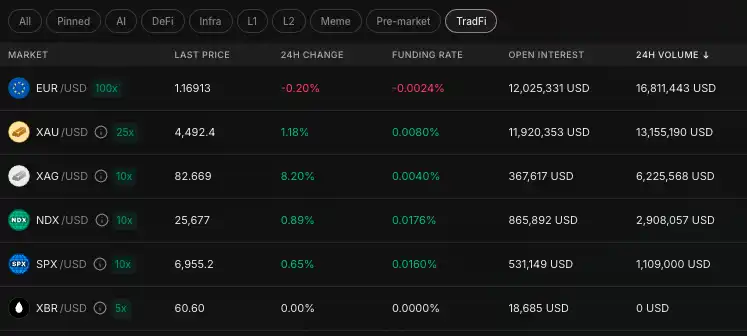
The product design of Extended currently looks quite solid, covering six TradFi assets in addition to mainstream cryptocurrencies: the S&P 500, Nasdaq stock indices, EUR/USD forex pair, precious metals gold and silver, and commodity oil. From the OI distribution, gold trading has always been in the top 5 of Extended, indicating that there is indeed significant real demand for TradFi assets.
In addition, Extended also has a highlight in the design of its XVS (Extended Vault Shares) vault, where up to 50% of the XVS balance can be directly counted as collateral for leveraged trading. This means that the trading collateral itself also earns interest, while also significantly increasing liquidity. Extended's roadmap plans to increase this to 90%. At the time of writing, Extended's XVS vault has had an APR of 16% over the past 30 days, with a TVL of 77 million USD, accounting for nearly 50% of the total TVL on Starknet.
Regarding the fee structure, Extended's Taker fee is 0.025%, Maker fee is 0%, and a rebate of up to 2 bps is provided. The liquidation fee is 0.5%. As it is deployed on the Starknet network, it also involves a Gas fee, but this part has been subsidized by Starknet to be 0.
As mentioned earlier, Extended is often mentioned together with Variational. Due to Extended's fee structure being more Maker-friendly, the interaction Tip from the DappRadar team is: place a Maker order on Extended, post the order near the market price to enjoy the rebate; then simultaneously place an order in the opposite direction at the same price on Variational. When closing positions, try to have a profitable account on Extended and a losing account on Variational, as Variational has a lottery mechanism for loss refunds.
Paradex
Paradex is also a Perp DEX briefly introduced by the DappRadar team before. Previously, the team viewed its potential as the largest options DEX, and its advantages in perpetual contracts were not outstanding, but the team has now changed this view.
Starting in the second half of 2025, Paradex experienced significant growth in the perpetual contract market, and as of January 6, 2026, Paradex has surpassed a $200 billion trading volume.
As mentioned earlier, Paradex's team's greatest strength is its extensive experience in the institutional-grade options and derivatives market, which is an advantage that several other project teams do not have. Paradex was incubated by the crypto institutional liquidity platform Paradigm (unrelated to the venture capital firm of the same name), and although the incubator is not the well-known crypto top-tier VC Paradigm, but rather the crypto institutional liquidity platform Paradigm with the same name, it is still worth discussing.
Founded in 2019, Paradigm serves hedge funds, market makers, and family offices, providing services to institutional clients with a lengthy background in crypto options and other derivative trading markets. Initially, its work involved handling over-the-counter matching, with on-exchange execution, clearing, and settlement delegated to exchanges like FTX. At its peak, it held 30% of the global cryptocurrency options market share, raised $35 million in funding at a $400 million valuation with lead investments from Jump Crypto and Alameda Research. However, following FTX's collapse, Paradigm, as a partner, also suffered a significant blow, leading to a rapid decline in trading volume and the launch of Paradex to rebuild the ecosystem.
Thanks to its years of research in the derivatives market, Paradex's key features include support for perpetual contracts, perpetual futures, perpetual options, and spot trading. It implemented a similar unified margin system to Hyperliquid earlier, where all trades are settled in one account, any asset can be collateral, and it supports isolated, cross, and portfolio margin modes, significantly increasing capital efficiency. Additionally, it is worth mentioning that Paradex currently has a 0 fee structure.
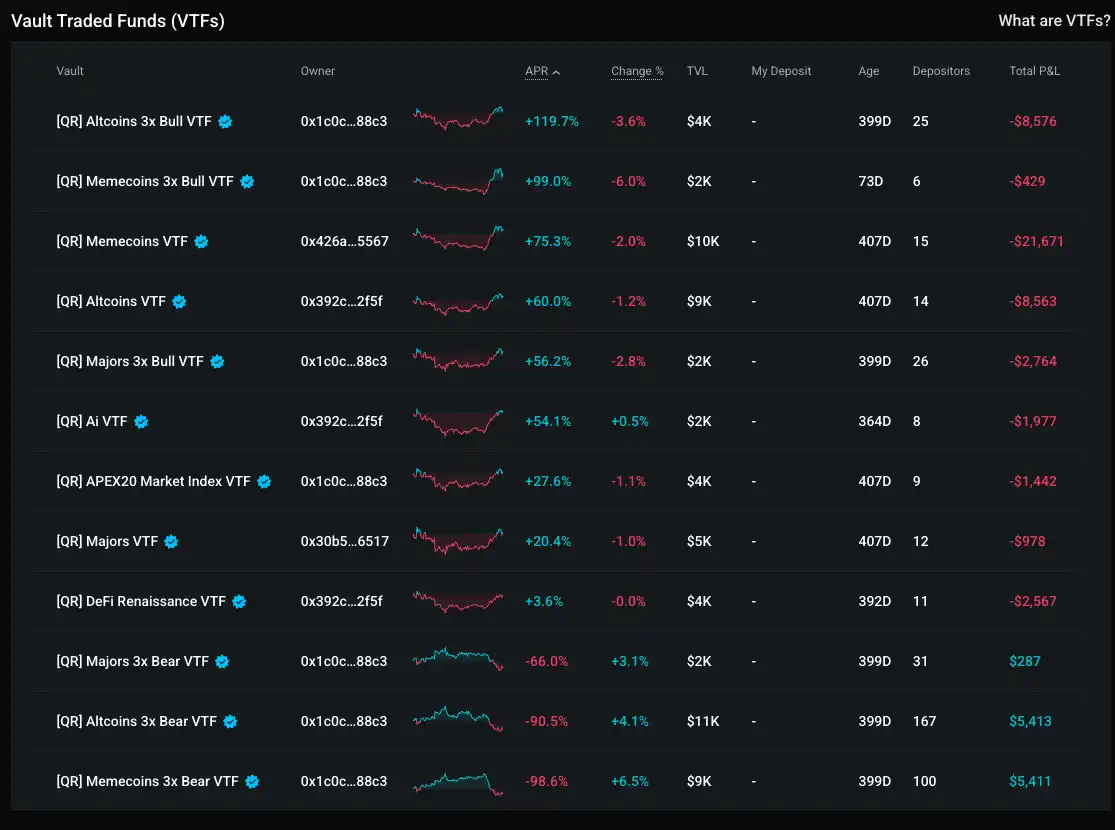
Paradex also has some innovations in its treasury management. The official treasury currently has an APR of 13.5% and a TVL of $105.4 million. The treasury allows users to receive LP tokens pro-rata and can combine mainstream DeFi projects such as Pendle, Morpho, Aave, and others. In addition to the official treasury, Paradex also offers the widest selection of trader-managed treasuries in the Perp DEX market, where traders can choose the treasury they trust based on trading style, P&L, management fees and performance fees charged, APY, TVL, and other metrics.
Paradex has currently released the tokenomics, with 20% allocated to the point airdrop, including a 57.6% token reward to the community, with the community showing strong interest in its coin issuance. Therefore, Paradex often forms a 2026 Perp DEX farming portfolio together with Extended, Variational, etc.
StandX
Initially, StandX was also sought after by the community due to its Binance genes. CEO Aaron Gong and co-founder Justin Cheng were core members of Binance's Futures contract business team, with ample CEX derivative experience.
StandX launched the stablecoin DUSD in April last year, went live at the end of November, has fully self-financed to date, and has not accepted any external investment. As one of its core products, DUSD offers a 5.2% APY, with a TVL of $157 million. StandX's treasury SLP currently has a TVL of $22 million, with no displayed APY data yet.
Another notable feature is the recently launched Maker Points, also the first to introduce the "order mining" model in the Perp DEX track, which many KOLs call the "Blur" of the Perp DEX track; as long as the order is not executed, there is no cost. Limit orders must remain on the order book for more than 3 seconds to earn points. The core mechanism is the closer the order price is to the market price, the larger the size, and the longer the order time, the more points earned. It is best to control it within 10 basis points, so that the points obtained are 100%. 10 basis points is 0.1%, for example, for Bitcoin at $100,000, the order price should be between $99,900 and $100,100. Additionally, 10-30 basis points receive 50% of the points, and 30-100 basis points receive 10% of the points.
This model will significantly increase StandX's depth. It is expected that many studios will access StandX's API to start running scripts. Friends with coding abilities can also try using AI combined with running scripts. The gameplay will be much more fun than other Perp DEX platforms where you are actually trading fees, and the costs are much lower.
StandX's mainnet has only been live for less than two months, but the daily trading volume has reached a historical high of $372 million, and market discussions are also very active. Overall, compared to several other Perp DEX platforms, it is an earlier Alpha opportunity.
You may also like

Ranger Fund Takes a New Approach to Public Offering: Can a Grassroots Team Earn Market Trust?

Key Market Information Discrepancy on January 8th - A Must-See! | Alpha Morning Report

Key Market Insights for January 7th, how much did you miss?

Six-Figure Target: The Top Airdrops to Watch in 2026

2026 Crypto New Year's Rally: Cautiously Bullish Market Sets Sail

IOSG: The Game of No Winner, How Can the Shitcoin Market Break the Deadlock?
Starknet Mainnet Halted Again: Fresh Outage Freezes Ethereum L2 Operations for Over 2 Hours
Key Takeaways Starknet, an Ethereum Layer-2 solution, faced another major outage lasting over two hours. The incident raised…

Lurking in 600 Scam Groups, He Wants to Intercept Illicit Funds

If you are long on oil, Maduro's arrest is not good news

Decode Bitget TradFi: How to Bridge the Final Gap Between Crypto and Traditional Assets?

I made $200,000 in two weeks, how do I bootstrap on Hyperliquid?

Meme Army Front’s Rising Short Position on Surging PEPE
Key Takeaways The Meme Army Front has been building substantial short positions in trending meme coins, particularly PEPE…

The Rise of the HyperEVM Ecosystem: Much More Than Hyperliquid
Key Takeaways Hyperliquid is a decentralized exchange running on its own L1 blockchain, supporting efficient and cost-effective trading.…
Solana 2025 Report Card: $15 Billion Annual Revenue, Surpassing Hyperliquid+ Ethereum Total

Header Fund 2025 Postmortem: What were the successful and unsuccessful trades made?

Compared to the Gas futures market, ETHGas is more interested in being a real-time execution layer

Arkstream Capital: When Cryptocurrency Returns to 'Financial Logic' by 2025


 App
App