
- Buy Crypto
- Markets
- Futures
- Spot
- Copy Trade
 Earn
Earn- More
If I were the founder of Kaito, how would InfoFi 2.0 survive?

Original Title: What If: I Were the Founder of Kaito?
Original Author: RYAN YOON, TIGER RESEARCH
Translation: Peggy, BlockBeats
Editor's Note: A one-time API policy adjustment caused InfoFi to "freeze collectively" within three days. This collapse not only exposed Web3's deep reliance on centralized platforms but also revealed another side of incentive mechanisms: the more rewards, the faster the brushing, making quality control more difficult.
This article takes Kaito as a starting point, outlines five possible ways out for the InfoFi project, and points out that InfoFi 2.0 is likely to move towards a smaller scale, stronger screening, and more quality-controlled mode. In addition, a more critical question is, after the airdrops and narrative frenzy fade, what will support the token value of InfoFi?
The following is the original text:
Key Takeaways
X's policy change caused the InfoFi ecosystem to collapse within three days, exposing the structural limits of over-reliance on centralized platforms.
The InfoFi project currently faces five choices: shut down; transition to a task platform based on a reward mechanism; adopt a Korean-style brand sponsorship writing model; expand to multi-platform operations; or transform into an MCN-style KOL management model.
InfoFi 2.0 is likely to evolve into a smaller scale, more controllable model, shifting from "permissionless large-scale expansion" to "collaboration between curated KOLs and project teams."
Two fundamental challenges remain unresolved: how to establish a fair reward system and how to provide reasonable support for the token value.
InfoFi Collapsed Within Three Days
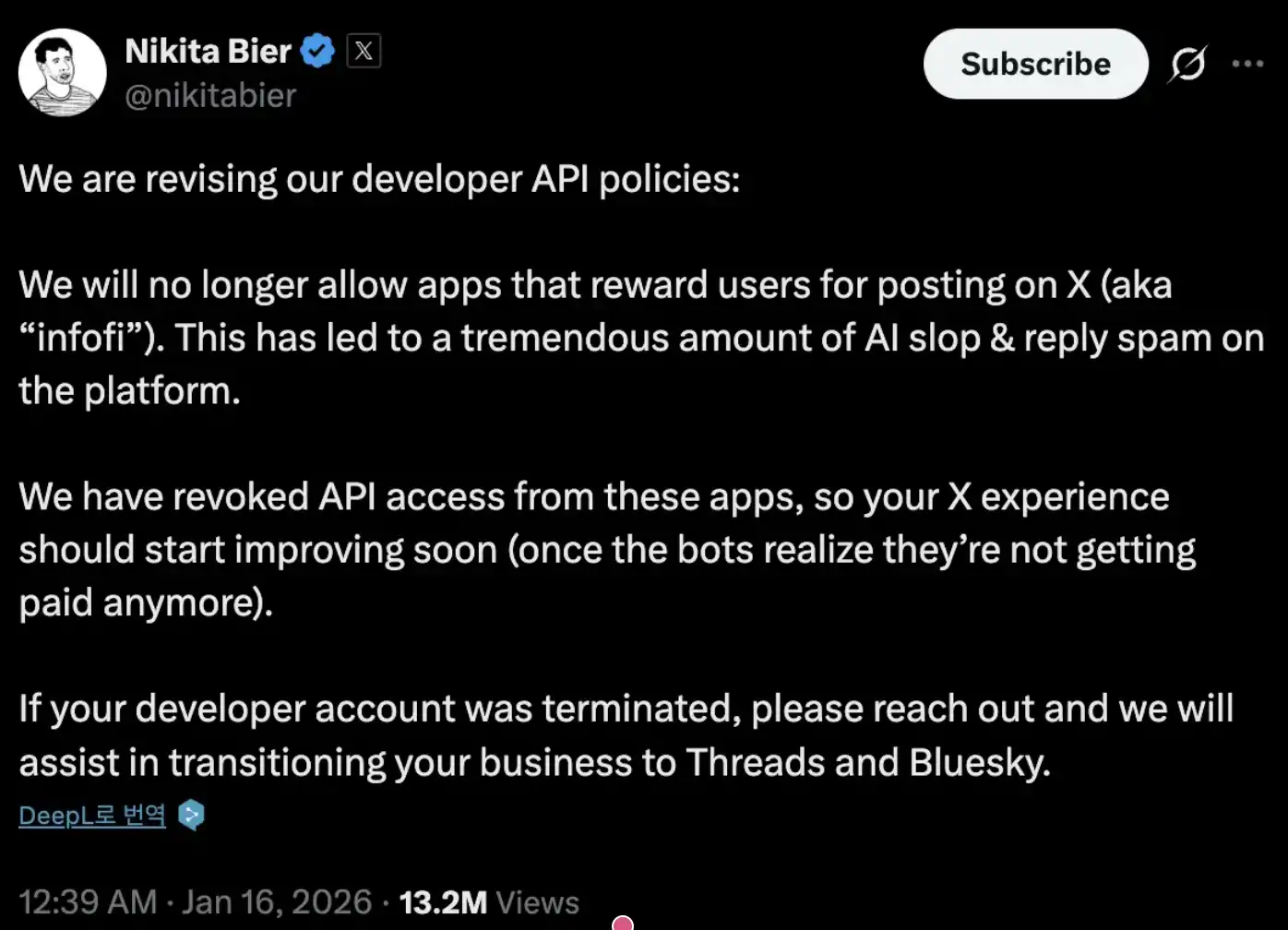
Source: X (@nikitabier)
On January 15, X's product lead Nikita Bier posted a short update, clearly stating that the platform would no longer allow apps that "exchange rewards for posts" to continue operating. For the InfoFi project, this was almost equivalent to a doomsday verdict.
According to Kaito founder Yu Hu's review, the progression of the event was roughly as follows:
January 13: Kaito received an email from X stating that they may enter the audit process. The team immediately sent a reply requesting further clarification.
January 14: X issued a formal legal notice, and Kaito submitted a legal response on the same day.
January 15: Nikita Bier's public post was published. Kaito, like everyone else, almost simultaneously learned of the final decision.
The market's reaction was unforgiving.
$KAITO swiftly dropped, and the community also began to criticize the team for "claiming to have had a contingency plan in place but failing to warn of the risk in advance." That evening, Kaito issued an emergency statement explaining that they had received legal notices from X in the past, all of which were ultimately resolved by signing new agreements. Therefore, this time the team chose to wait for further communication and negotiation first.
However, regardless of the explanation, reality had become clear enough: one decision by X directly ended the entire InfoFi ecosystem. In just three days, a whole track collapsed entirely because the platform deemed it detrimental to user experience and content quality.
If I Were an InfoFi Project Founder Today
Does this mean InfoFi is already over? Projects like Kaito have actually been preparing for the next steps. But what is truly needed now is not to continue the old model but to find a different form of InfoFi 2.0.
If I were a founder of an InfoFi project like Kaito, what viable options are left in reality today? By examining these "feasible" paths, we may be able to outline what the next stage of InfoFi might look like.
Shutdown
This is the most direct and simplest option: shrink and cease operations as soon as funds run out. In reality, many small and medium-sized projects are likely to enter a "zombie state," no longer actively updating the product, occasionally posting on social media, and then slowly fading away.
Since the product's PMF (Product-Market Fit) was built on top of X, and this foundation has now been taken away, it is more in line with business rationality to cut losses in a timely manner, proactively exit, rather than continue to burn money searching for a new direction.
If the project still holds reusable data assets, it may also consider selling them to other companies to recover some value. It is for this reason that most small to medium-sized InfoFi projects are likely to choose this path.
Reward-Based Task Platform
When unable to continue using X's API, a feasible alternative is to return to a more "traditional" incentive model: have KOLs directly sign up to participate in activities, have their content submitted for manual review, approve it, and then reward them.
This mechanism is essentially more like early "task platforms" or "bounty programs": KOLs apply proactively; the project team manually screens and assigns tasks; creators submit content; the platform settles rewards after approval,
It sacrifices the original automation and scalability, but in exchange for a more controllable execution process. In cases where platform rules are tightening, this "inefficient but compliant" approach is easier to survive.

Source: Scribble
Scribble is a typical case. The project team releases a grant in the form of a "reward task," and KOLs create content and submit it for review. They can only receive the reward after approval. This mechanism is not about real-time tracking and instant settlement but leans more towards a "submit-review" process model.
This structure has the potential to become an open platform: the platform provides matchmaking and infrastructure support, while individual projects are responsible for specific event operations and content management. As more projects join, the KOL pool expands; and as the creator base grows, project teams also have more potential collaborators to choose from.
However, its drawbacks are also evident: high uncertainty for KOLs. If their content is rejected, the time cost invested is lost entirely. After experiencing multiple failures, KOLs are likely to leave the platform.
Korean-Style "Brand Blog" Model
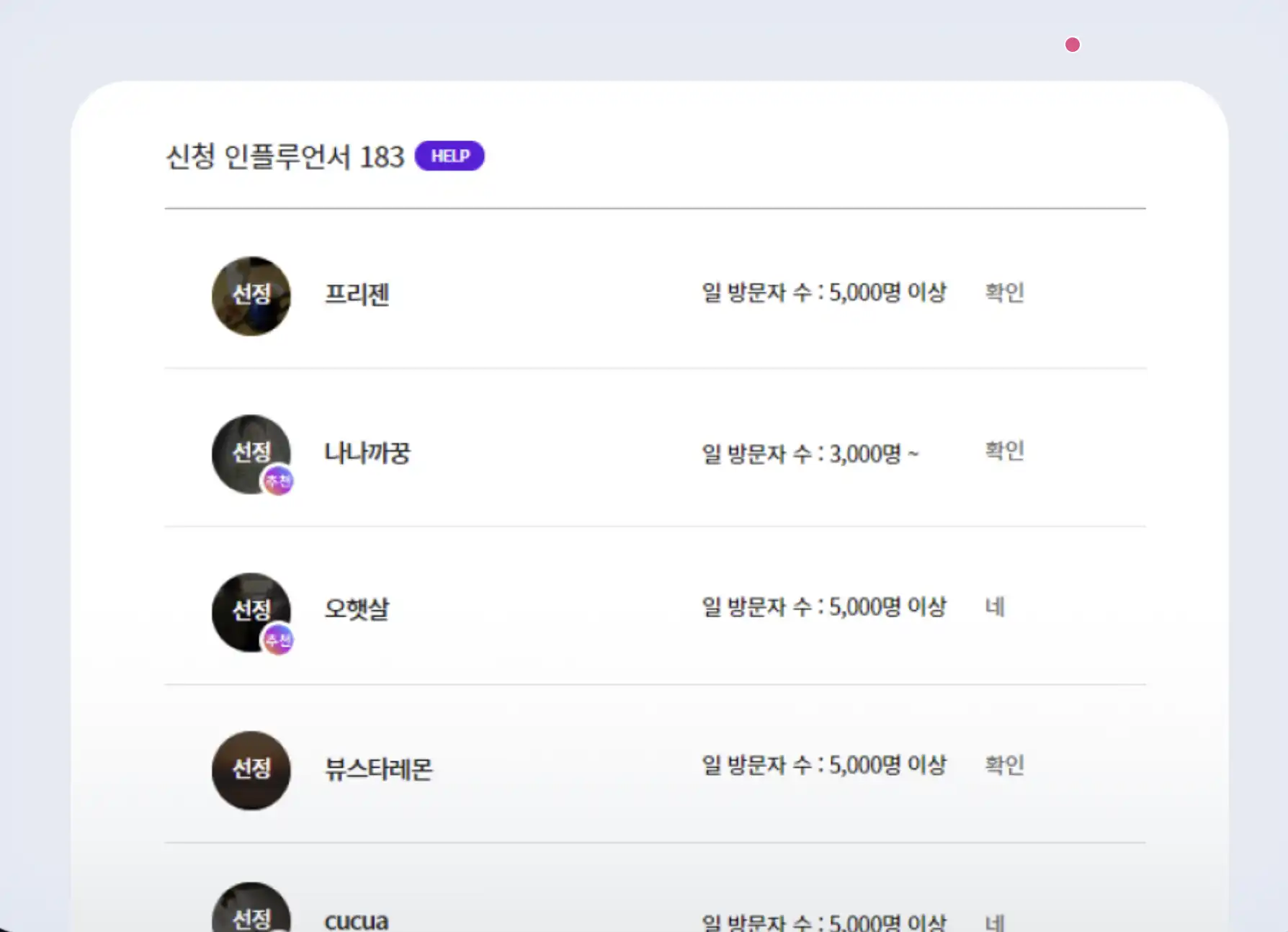
Source: Revu
The Korean "brand blog" model follows a "screen first, then manage" path, rather than the "create content first, then review" approach seen in reward platforms. Institutions like Revu have been operating under this model for over a decade.
The process is also very clear: the project team first sets the target number of participants and launches an activity. After creators submit their applications, the project team selects collaborating KOLs based on metrics such as fan base size and past performance. The selected KOLs receive clear content guidelines and writing requirements. After content publication, it is inspected by operations personnel; if it does not meet the standards, revisions are requested. Failure to submit on time may result in penalties or deductions.
The biggest advantage of this model is that creators are almost never left empty-handed. As long as the selection process is followed and standards are met, the reward can be considered essentially locked in, avoiding the risk of "completion rejection leading to zero labor cost" present in bounty mechanisms. For the project team, since collaborators are pre-screened, quality management is easier, making overall execution more controllable.
Multi-platform Expansion
If X is no longer available, the next viable option is to pivot to platforms like YouTube, TikTok, Instagram, and others. In fact, within the Web3 community, "moving beyond X" has long been a consensus: to achieve meaningful growth, it is necessary to transition from a community primarily composed of crypto-native users to channels where a broader user base is present.
The main advantage of this approach is the significantly larger potential user base compared to X. Especially in emerging markets like Southeast Asia and Latin America, the influence of TikTok and Instagram may be even stronger. Additionally, each platform has its own content distribution logic, so even if one platform is restricted, exposure and operations can be maintained on other channels.
However, the trade-off is a steep increase in operational complexity. On X, only text and interactions need to be reviewed; on YouTube, watch time and production quality directly affect performance; on TikTok, the first three seconds almost determine success or failure; on Instagram, evaluation of Stories, layout, and visual completion is necessary. This requires the team to have platform operation capabilities or establish new tools and processes. Furthermore, platform API policies and data retrieval methods vary, akin to "rebuilding the system."
Policy risks still exist, as any platform could suddenly change its rules like X did. However, a multi-platform presence can at least mitigate single-point risks. For larger projects, this is also the only direction that still offers "scalability space."
MCN-style KOL Management Model
In the Web2 MCN model, the brand value of KOLs inherently determines their commercial value; in Web3, this effect is even more pronounced. Narrative drives fund flows, and the influence of opinion leaders is amplified to the extent that they can directly impact token prices, with a single comment causing fluctuations.
Some successful InfoFi projects have already built a highly active and cohesive group of KOLs. These KOLs are not brought in temporarily from outside but have grown gradually on the platform over months. In contrast to Web2 MCNs relying on continuous "talent discovery," InfoFi is more likely to retain these existing KOLs and shift the platform's advantage towards data-driven management and distribution.
The so-called MCN-ization means that the partnership will transition from a loose "voluntary participation" to a more formal contract and commitment. Leveraging long-accumulated data and relationship networks, the platform's bargaining power in the Web3 ecosystem will also be stronger, making it easier to obtain better partnership terms and resource allocation.
However, this path poses higher demands on the InfoFi project: there must be a sufficiently strong management system, and "data" will become a core asset. If the platform can use data to guide KOLs' output pace, content direction, and conversion effectiveness, and provide the project with a more professional, data-driven Go-To-Market (GTM) strategy, this model may establish a longer-term competitive barrier.
InfoFi 2.0
The collapse of InfoFi left two important lessons for the entire Web3 ecosystem.
First is the irony of decentralization: many Web3 projects actually rely heavily on centralized platform X, and a single decision by X is enough to cause the entire system to collapse.
Second is the boundary of incentive design: the reward mechanism indeed successfully attracted a large number of participants, but the platform lacked effective quality control measures, leading to a rapid proliferation of spam content and gaming behavior, providing X with more than enough reasons to intervene and shut down.
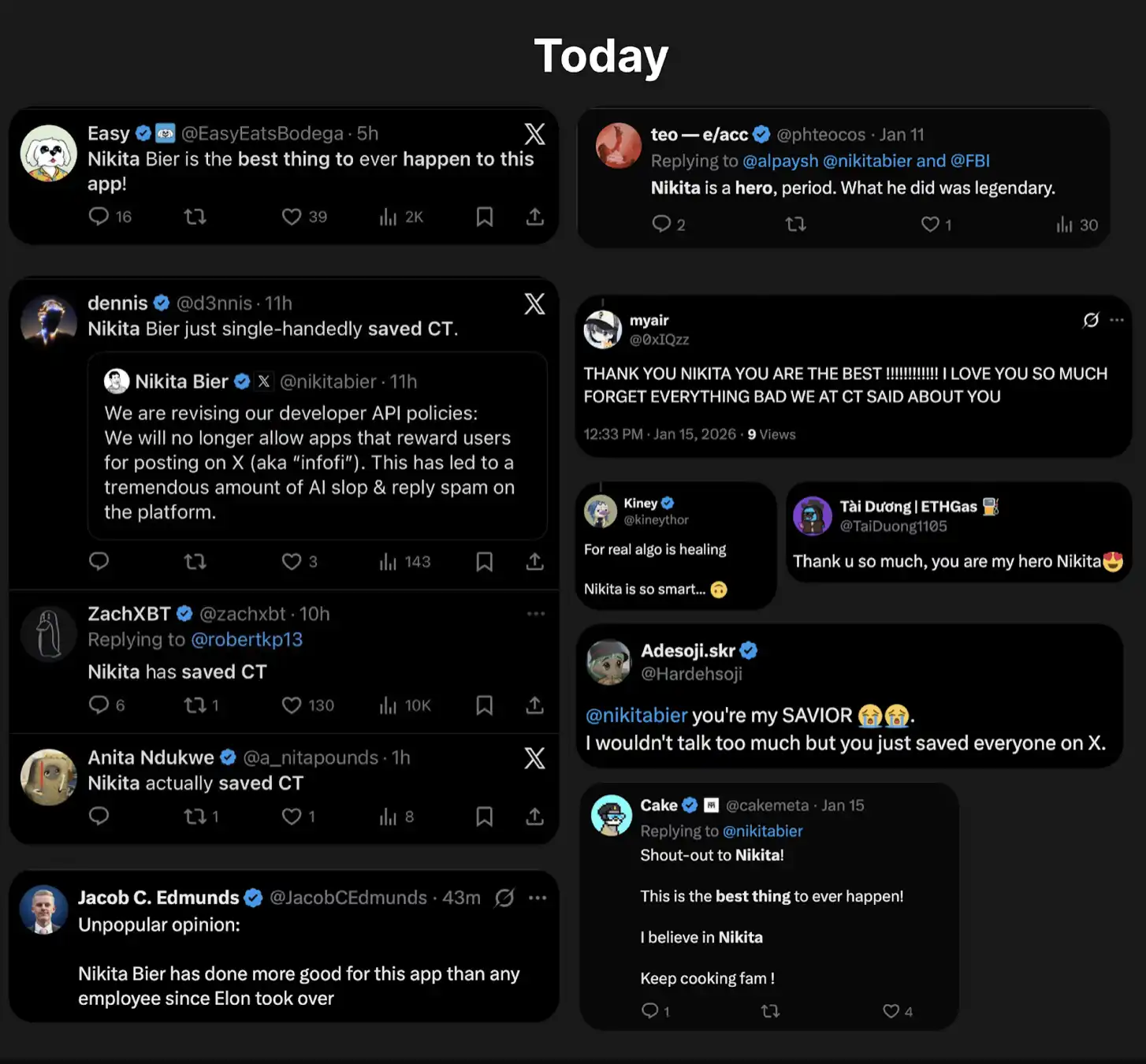
Source: X (@nikitabier)
Does this mean that InfoFi has ended?
Not entirely. A few projects that have truly achieved Product-Market Fit (PMF) may still survive by reshaping themselves, such as transitioning to multi-platform expansion, conducting more curated ad placements, or upgrading to an MCN-style KOL management model.
However, InfoFi 2.0 is likely to become smaller, more controllable, and place greater emphasis on content quality. It will shift from the past open, permissionless, scale-seeking "platform form" to a curated partnership network, more akin to an integrated marketing platform that advances localized GTM and combines components like offline advertising to form a more complete execution loop.
Nevertheless, fundamental issues still persist.
Joel Mun of Tiger Research House points out that once a reward mechanism is introduced, participants will inevitably seek ways to "game" the system, making it nearly impossible to design a fair incentive structure. Such behavior will continue to lower content quality and create a negative feedback loop, ultimately harming the platform itself—the key challenge that the InfoFi project must squarely face.
David raised a more fundamental question. He believed that the value proposition of the InfoFi token, rather than stemming from the platform's actual performance, was more based on "staking airdrops" and "narrative faith." However, both of these have lost their practical significance, so the question was directly raised: Why would investors still buy the InfoFi token?
If InfoFi 2.0 wants to survive, it must provide clear answers to these questions. A project detached from token holders ultimately struggles to achieve true sustainability.
You may also like

IOSG Investment Insider: In 2026, How Should We Bet on Mainstream Assets?

「Money Printer」 PUMP.FUN Establishes Investment Arm, Can $3 Million Keep a Good Project?

After reviewing the recommendation algorithm of Platform X, this is the type of content you need to post to generate high traffic.

Trump's First Year in Office: Big Wins and Major Setbacks

If I were the founder of Kaito, how would InfoFi 2.0 survive?

Wintermute: The four-year cycle is dead, Crypto Breakthrough 2026, where to next?

CLARITY Act Stalls: Why Has the Interest-Bearing Stablecoin Become a Bank's "Thorn in the Side"?

WEEX Football Trading Season: When the LALIGA Season Tightens, Every Decision Matters
The excitement of LALIGA never stops. From intense matchups on the pitch to shifting league standings, competition unfolds week after week. As an official regional partner of LALIGA, WEEX brings that same competitive rhythm into trading — where consistency, strategy, and timing matter just as much.

How AI Trading Systems Perform in Live Markets: Inside the WEEX AI Hackathon Beta Test
WEEX launched a Beta Test to provide participants with a proving ground that closely mirrors real trading conditions, allowing strategy stability, execution capability, and risk control to be tested by the market in advance, while refining an AI trading infrastructure that can truly be deployed in live markets.

Key Market Information Discrepancy on January 20th - A Must-See! | Alpha Morning Report

Paradex Rollback Roasted, HIP-3 Competition Heats Up, What's New in the Mainstream Ecosystem?

NYSE Plans to Launch 24/7 Stock Tokenization Trading, Is the Moat of the Crypto Market Disappearing?
Why Can Coinbase Halt a CLARITY Act Vote with Just One Sentence?

31 Investments, 4 IPOs: Veteran VC Pantera's 2025 Report Card and 2026 Outlook

Here’s What Happened in Crypto Today
Key Takeaways Bitcoin experienced a significant price dip as Europe considered retaliatory trade measures against the U.S. The…

Key Market Intelligence on January 16th, how much did you miss?

Market Correction Drives Major Drop in Meme Coins, WhiteWhale Suffers Significant Losses
Key Takeaways WhiteWhale’s price has plunged by 32.3% over the last 24 hours and is currently 75% below…

Meme Coins Tumble: WhiteWhale and Others Face Severe Losses
Key Takeaways WhiteWhale has experienced a significant decline, dropping by 75% from its peak. The market correction has…


 App
App